
The nap was supposed to start at 9:30. It was 9:42, the coffee beside me had already gone cold, and the baby in this familiar scene was standing at the crib rail looking delighted with the direction his morning had taken. Twelve minutes should not feel like a referendum on an entire schedule. At 10 months old, somehow it can.
Try this first: for the next three days, anchor the morning wake time, offer two naps, and move only the next nap by 10 to 15 minutes if the same problem repeats.
Most 10-month-olds still do best with two naps: one in the morning and one in the afternoon, with about 12 to 16 total hours of sleep across 24 hours, naps included. A useful starting rhythm is roughly three hours awake before nap one, three to three-and-a-half hours before nap two, and three-and-a-half to four hours before bed. Those are starting points, not medical rules. Your baby’s full-day sleep total, mood, feeding, settling, and repeated pattern matter more than whether the clock says 9:30 exactly.
A workable two-nap starting day
- 6:30–7:00 a.m.: wake for the day
- 9:30–10:00 a.m.: nap one begins
- 2:00–2:30 p.m.: nap two begins
- 7:00–7:45 p.m.: bedtime, depending on when nap two ended
Start with the morning wake time, then move only one nap by 10 to 15 minutes when the same problem repeats for several days. Do not rebuild the whole day because Tuesday was weird.

A sample 10-month-old nap schedule that can bend
I like a schedule with anchors because anchors are useful; handcuffs are not. The morning wake time gives you a place to begin. Nap one shapes nap two. Nap two shapes bedtime. When one piece moves, you adjust the next piece instead of declaring the day ruined before lunch.
The anchor-and-adjust day
This example assumes a 6:45 a.m. start. Shift the whole pattern later or earlier to fit your baby’s real morning.
Another perfectly reasonable baby might wake at 7:15, nap from 10:15 to 11:30, take a second nap from 2:45 to 3:45, and go to bed near 7:45. The shape is the useful part: two real nap opportunities, enough awake time to build sleep pressure, and a bedtime that does not drift toward midnight because the afternoon got away from everyone.
The American Academy of Sleep Medicine recommends 12 to 16 hours of sleep in each 24-hour period for infants 4 through 12 months, including naps. That range is intentionally broad. A baby who sleeps 11 hours at night and takes two one-hour naps lands at 13 hours. A baby who sleeps 10.5 hours overnight and naps for 2.5 hours also lands at 13. The clock faces look different; the total is the same.

How much daytime sleep does a 10-month-old need?
Many 10-month-olds collect roughly two to three hours of sleep across two naps, but that is a practical pattern, not a quota. Some take a long morning nap and a shorter afternoon nap. Some split the time more evenly. Some nap less and sleep longer overnight. I would look at the whole 24 hours before calling any single nap “too short.”
Do the nap math before changing the schedule
Night sleep
Count from actual sleep onset to morning wake, subtracting long awake stretches when you can.
Nap one + nap two
Use actual sleep, not the full time your baby spent protesting the crib decor.
The 24-hour total
Compare the repeated total with the 12–16-hour guideline and with how your baby functions.
Example: 10 hours 45 minutes overnight + 1 hour 10 minutes in nap one + 1 hour 5 minutes in nap two = 13 hours total. That is more informative than declaring the second nap a failure because it did not reach 90 minutes.
If your baby regularly lands far below or above the recommended range, seems persistently exhausted, or has feeding, growth, breathing, or developmental concerns, the next step is not a more elaborate spreadsheet. Bring the pattern to your pediatric clinician. I love a useful pattern; I do not want nap math pretending to be medical assessment.

What wake windows work at 10 months?
A common starting range is about three to four hours awake between sleeps, often with the shortest stretch before nap one and the longest before bedtime. You may see shorthand such as 3/3.25/4, meaning three hours before nap one, three hours fifteen minutes before nap two, and four hours before bed.
Wake-window charts are planning tools, not official prescriptions from the AASM or AAP. They help you choose a reasonable first attempt. Your baby’s repeated response tells you whether that attempt fits. I would rather see a parent make one small, observable change than spend the day chasing every yawn as if it were a breaking-news alert.
Sleep cues still matter, but I would read them beside the clock rather than letting either one run the house alone. At 10 months, rubbing eyes, becoming quieter, losing interest in play, leaning into you, or getting clumsy can mean sleep is approaching. They can also mean boredom, overstimulation, hunger, or frustration. A yawn at 8:40 after a 6:45 wake does not automatically require an immediate nap; a baby who repeatedly becomes glassy-eyed and miserable at the same point in the morning deserves more attention than a single yawn.
Try a simple two-part check: Has a reasonable amount of awake time passed, and is my baby showing a cluster of settling-down cues? When both answers are yes, begin the short nap routine. When the clock says it is time but your baby is bright, social, and taking 25 minutes to fall asleep every day, move the offer slightly later. When the cues arrive early after a poor night or a short previous nap, let the day flex. This keeps you responsive without asking a sleepy eyebrow rub to carry the full weight of the schedule.
Read the pattern, then change one thing
- Nap takes more than about 20–30 minutes to begin, and your baby is cheerful: the nap may be offered too early. Try 10–15 minutes later for several days.
- Your baby falls asleep instantly but wakes after a short nap upset: overtiredness is one possibility, but hunger, discomfort, noise, light, illness, and ordinary variation also matter. Try the nap slightly earlier only if the pattern repeats.
- Nap one is long and nap two disappears: the first nap may be using most of the day’s nap sleep. Test a later start or a gentle cap before abandoning nap two.
- Both naps work, but bedtime becomes a long party: nap two may end too late, or bedtime may be offered before enough awake time has built.
Hold the rest of the day reasonably steady while you test. If you move nap one, nap two, bedtime, the room, the routine, and the feeding pattern together, you will have no idea which change mattered. This is where I get blunt: babies are complicated enough without conducting six experiments in the same Tuesday.
When a timing change is clearly needed, our guide to adjusting a baby sleep schedule without changing everything shows how to move the day in small steps instead of forcing a sudden reset.
Troubleshoot the exact part of the two-nap day that is failing
“The schedule does not work” is too large a problem to solve. I want to know which handoff fails: morning into nap one, nap one into nap two, nap two into bedtime, or bedtime into morning. Each points us toward a different first adjustment.
One symptom, one first move
| What you see | Look at first | Small test | Do not assume |
|---|---|---|---|
| Nap one is refused | Morning wake time and how long settling takes | Move nap one 10–15 minutes later | That your baby is ready for one nap |
| Nap two is refused | Length and end time of nap one | Offer nap two later or shorten an unusually long first nap | That nap two has permanently vanished |
| Both naps are short | Total night sleep, illness, room, hunger, and timing | Choose the most obvious repeated variable and test only that | That every short nap has the same cause |
| Bedtime is difficult | When nap two ended | Use a slightly later bedtime or an earlier nap-two end | That more daytime exhaustion will fix the night |
| Morning starts very early | Bedtime, room light, and the previous day’s nap total | Protect a consistent morning anchor while correcting the clearest cause | That the first nap must move earlier and earlier |
If your baby wakes after 35 minutes but is calm, pause long enough to see whether the nap is actually over before rushing in. If your baby is distressed, respond. This article does not require leaving a baby to cry, and a schedule is not a reason to ignore what you see and hear. The useful question is not “Can I make this nap match the chart?” It is “What does this repeated pattern tell me?”
Is 10 months too early for one nap?
Most 10-month-olds still need two nap opportunities, although the edges of the transition can begin to show for some babies. Mayo Clinic notes that some babies 10 to 12 months old begin dropping the morning nap, while also describing two naps as common during the first year. That is exactly why I would not diagnose a transition from one week of nonsense.
Before you drop a nap, walk this path
- Has the refusal repeated? A few disrupted days can come from development, illness, travel, teething discomfort, or a long first nap.
- Did you test timing? Move the resisted nap later in small steps before removing it.
- Can your baby comfortably reach midday? A baby melting down long before lunch may not be ready for one consolidated nap.
- What happens to total sleep? If one nap creates chronic overtiredness, repeated early wakes, or a collapsing evening, the transition is not helping yet.
- Is something else going on? Sudden sleep change with illness, pain, feeding trouble, breathing concerns, or unusual lethargy belongs with your pediatric clinician.
A temporary bridge can be useful: keep two nap opportunities on ordinary days, but use an earlier bedtime when the second nap truly does not happen. I would not make a late car snooze do all the work if it pushes bedtime much later; nor would I force a wired baby through a heroic wake window just to protect a pretty schedule.
Why a 10-month-old may suddenly fight naps
At this age, the crib is competing with a very interesting world. Babies may be crawling, pulling to stand, practicing sounds, noticing exactly when you leave, and objecting to that departure with impressive clarity. The CDC lists reacting when a caregiver leaves, including looking, reaching, or crying, as a social-emotional milestone most babies show by nine months. That does not prove why your baby fought today’s nap, but it gives the protest developmental context.
This is where I’d keep two ideas in the room at once. Your baby can need sleep and dislike the separation that begins it. A longer wake window does not solve every emotional objection. Sometimes the better experiment is a calmer, more predictable handoff.
A five-minute pre-nap handoff
- Finish the active play and say the same plain cue: “It is nap time now.”
- Change the diaper and put on the usual sleep clothing.
- Dim the room, turn on the usual safe sound if you use one, and hold or cuddle briefly.
- Place your baby on their back in the empty crib and use the same short goodbye.
- Respond in the way that fits your family if your baby becomes distressed; keep the cue steady rather than adding a brand-new performance each day.
The routine is not magic, and it does not need a bath, seven books, or a tiny spa appointment. Its job is to make the handoff recognizable. If naps and nights have both changed suddenly, the more focused guide to the 10-month sleep regression pattern can help you separate schedule timing from a broader developmental disruption.
The nap schedule never outranks safe sleep
Every nap counts as sleep, even the accidental one. Through the first birthday, place your baby on their back for each nap and night on a firm, flat, noninclined, safety-approved sleep surface with only a fitted sheet. Keep blankets, pillows, bumper pads, stuffed toys, positioners, and other soft items out of the sleep space. If your baby falls asleep in a car seat, stroller, swing, carrier, or sling, move them to a firm, flat sleep surface as soon as practical.
If a 10-month-old can roll both ways independently, continue placing them down on their back; you do not need to keep turning them back after they roll themselves. Keep the crib mattress at the appropriate lower setting when your baby can sit, pull up, or stand, following the crib manufacturer’s instructions. Do not add an object to keep a standing baby down. The original version of this article suggested a favorite blanket or soft toy for self-soothing. I am removing that advice because it does not belong in an infant sleep space.
Watch the safe nap setup
CDC experts show what belongs in an infant sleep space
A schedule can tell you when to offer the nap. This demonstration shows the safety boundary that still applies once the room goes quiet.
Takeaway: back placement, a firm flat surface, and an empty sleep space apply to daytime naps too.
Make the nap environment repeatable, not elaborate
A darker room can reduce a very obvious daytime cue to stay awake. A steady, low background sound may soften household noise if you use it safely. Comfortable room temperature, ordinary sleep clothing, and a short repeated routine can make the setting recognizable. None of those guarantees sleep, and none needs to become an expensive nursery renovation.
I would start with the variable that is visibly inconsistent. If bright sun lands across the crib during nap two, work on light. If a dog barks beside the room at exactly 2:05 every day, work on sound. If the pre-nap routine has quietly grown to 40 minutes because everyone is bargaining with a person who cannot yet say “counteroffer,” shorten the routine.
A practical nap-environment pick
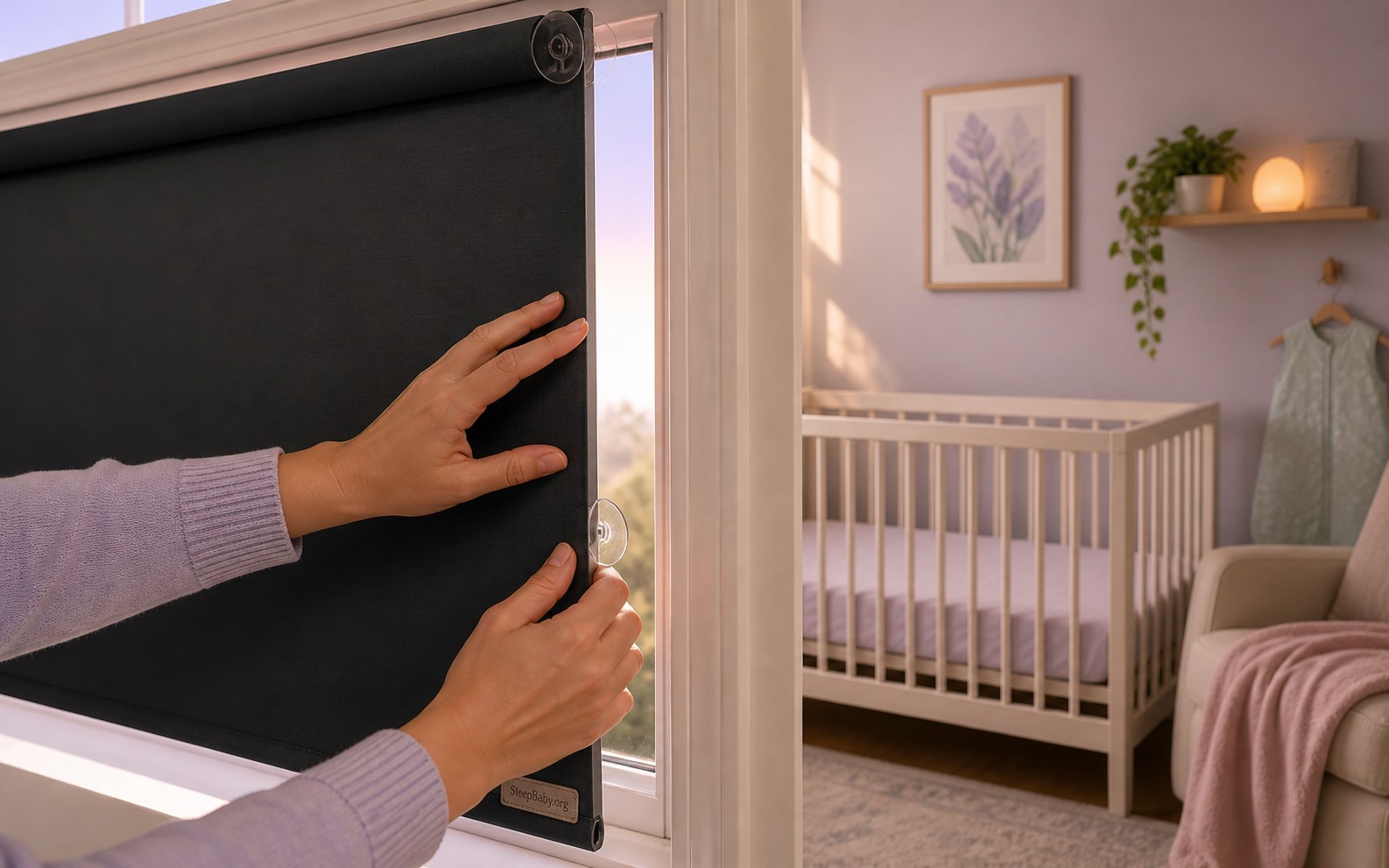
Amazon Basics portable blackout curtain
If daytime light is the variable you keep fighting, the suction-cup Amazon Basics Portable Window Blackout Curtain Shade gives you one repeatable cue without permanent hardware. It is a better fit for this exact nap-schedule problem than another tracker or generic routine bundle because you can use it in the nursery, move it to another room, or pack it for a visit while keeping the same darker nap environment.
Buy it for the boring, useful reason: it lets you test timing without the sun changing the experiment. It cannot make a baby sleep, and it should be installed exactly as directed with every part well out of your baby’s reach.
See the portable blackout curtain on Amazon
As an Amazon Associate, SleepBaby may earn from qualifying purchases.
Daycare, travel, and the day that refuses to cooperate
A useful schedule should survive contact with real life. Daycare may offer naps at fixed times. A sibling pickup may land directly in nap two. A family visit may produce a 17-minute car nap that your baby treats as sufficient restoration for the remainder of civilization.
When you cannot control the whole day, protect two or three anchors:
- Keep morning wake reasonably consistent rather than letting one rough night shift the entire day by hours.
- Tell daycare the pattern, not only the clock: when your baby actually woke, how long nap one lasted, and the earliest reasonable nap-two window.
- Use an earlier bedtime after a genuinely short nap day instead of forcing a late rescue nap that erases bedtime.
- Resume the ordinary rhythm the next day. Recovery usually needs a calm return, not compensation in every direction.
For travel, bring the smallest cues that already mean nap: the usual sleep clothing, a short book, safe sound if you use it, and a way to control light. Keep the sleep surface itself safe and separate. A hotel blackout solution is useful; a tent or cover placed over a crib is not something I would improvise without clear manufacturer approval for that exact product and setup.
When the schedule is probably not the whole problem
Sleep varies, and a messy week is often just a messy week. But timing advice should not absorb symptoms that deserve medical attention. Contact your baby’s clinician if the sleep change is persistent and comes with pain, fever, ear pulling plus illness symptoms, unusual lethargy, feeding difficulty, fewer wet diapers, vomiting, poor growth, or a developmental concern. Bring a simple description of what changed, when it changed, and what else you noticed.
Seek urgent help for breathing difficulty, repeated pauses in breathing, blue or gray color, severe unresponsiveness, or another emergency sign. Loud frequent snoring, gasping, choking sounds, or labored breathing during sleep also deserve clinical discussion. Do not treat those as wake-window problems.
If your baby was born prematurely or has a medical condition, feeding plan, or growth concern, use their clinician’s guidance rather than a general internet schedule. Ten months by the calendar does not tell me everything I need to know about an individual baby.


Your three-day schedule check
Before changing anything, write down only five facts for three ordinary days: morning wake, actual nap-one sleep, actual nap-two sleep, bedtime sleep onset, and the rough 24-hour total. This is not a lifestyle. It is a short investigation.
- Circle the repeated problem. Is nap one consistently resisted? Is nap two disappearing after a long first nap? Is bedtime the only difficult handoff?
- Choose one 10–15-minute shift. Keep everything else as steady as real family life permits.
- Watch the next several days. Look for easier settling, a more workable second nap, a stable bedtime, and a reasonable full-day sleep total.
- Keep, reverse, or adjust again. The result is information, not a grade on your parenting.
I want to return to 9:42. The baby is still standing. The coffee is still cold. But the clock is no longer announcing that you failed; it is giving you one small clue. If the same thing happens tomorrow, and the day after that, move the nap a little. If tomorrow looks completely different, Tuesday was simply Tuesday.
The schedule is a handrail, not a set of handcuffs. Use it to steady the day, then keep your eyes on the baby holding your hand.
Sources
- American Academy of Sleep Medicine: Recommended Amount of Sleep for Pediatric Populations
- CDC: Positive Parenting Tips for Infants (0–1 years)
- Mayo Clinic: Baby Naps and Daytime Sleep Tips
- CDC: Milestones by 9 Months
- CDC: Helping Babies Sleep Safely
- American Academy of Pediatrics/HealthyChildren.org: Safe Sleep
- NHS: Your baby’s sleep patterns
When the clock stops helping
Build a calmer plan for the sleep around those two naps
A skipped afternoon nap can turn dinner, bedtime, and your own last nerve into one long handoff. Once you know which part of the day keeps slipping, SleepBaby can help you think through the wider sleep rhythm without pretending every baby belongs on the same minute-by-minute chart.