
A useful 6-month-old sleep schedule is a repeatable pattern, not a stopwatch. Start with a fairly steady morning, offer two or three naps based on the pattern your baby is actually showing, and choose bedtime from the way the final nap ended. Across the full day and night, the American Academy of Sleep Medicine recommends 12 to 16 hours of sleep for infants 4 to 12 months, including naps.
For the next three ordinary days, write down morning wake time, each nap, feeds, and bedtime. Then adjust one anchor instead of rebuilding the whole day. If your baby is hungry, sick, unusually hard to wake, or struggling to breathe, the schedule waits. Your baby does not.
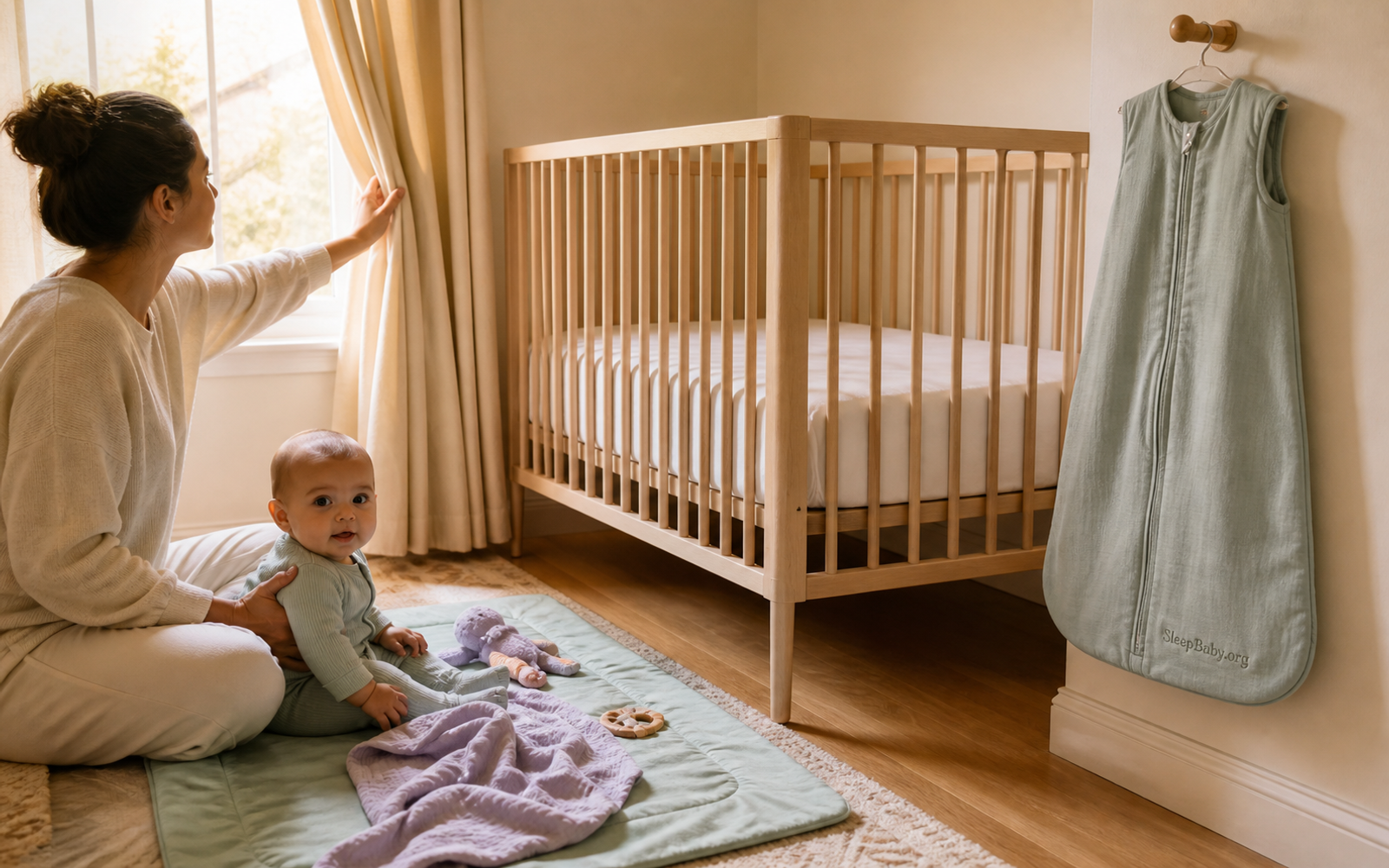
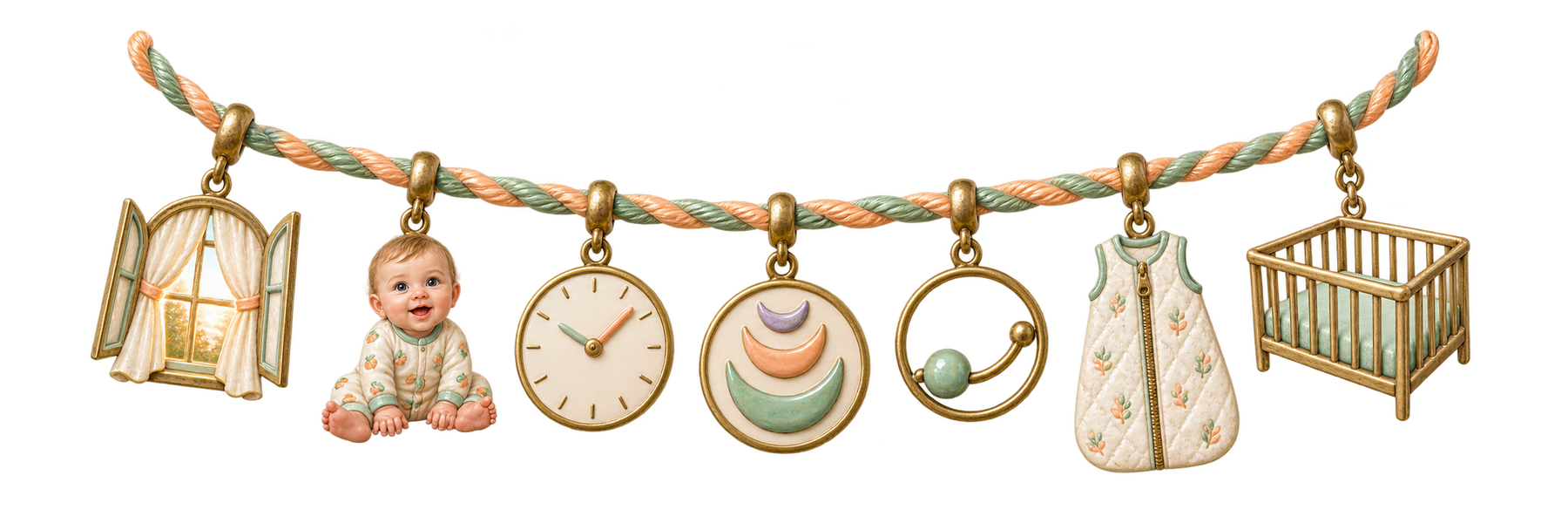
Your schedule compass
Anchor the day, then let the naps tell you where bedtime belongs
1. Morning light
Choose a realistic start to the household day. Open the curtains, feed, and begin normal activity. A repeatable morning gives the rest of the clock somewhere to begin.
2. Sleep opportunities
Use two or three nap opportunities according to what repeats across several days. A nap is offered, not extracted by force like the last pea from a baby-food pouch.
3. Familiar wind-down
Keep the final few steps short and recognizable. The routine can stay steady even when the clock moves after a short or refused nap.
SleepBaby.org schedule aid · Consistency lives in the sequence, not in pretending every nap lasts exactly 90 minutes.
I would begin here because a clock-only plan asks the wrong question. It asks, “Did the baby obey 9:00?” A useful plan asks, “Did this day contain enough sleep opportunity, feeding, light, movement, and a calm path into the next sleep?” The first question produces panic at 9:07. The second gives you something you can actually adjust.
How much should a 6-month-old sleep?
The American Academy of Sleep Medicine recommends 12 to 16 hours of sleep in each 24-hour period for infants 4 to 12 months, including naps. That is a broad range on purpose. It does not mean every baby should land in the middle, and it does not tell you how much must happen at night versus during the day.
Think in 24-hour totals before deciding that one nap is “too short” or one night is “bad.” A baby who sleeps 10.5 hours overnight and takes three hours of naps has 13.5 hours. A baby who sleeps 12 hours overnight and takes two hours of naps has 14. Both totals sit inside the age-range recommendation even though the days look different.
Two or three naps are common at six months. That is a planning benchmark, not a birthday requirement. Some babies are clearly comfortable on three naps. Some are moving toward two. Many produce the least aesthetically pleasing answer of all: a week containing both. Mixed days are not evidence that you have failed to choose a schedule. They are often the transition.
A flexible 3-nap schedule for a 6-month-old
This first clock is an example, not a medical prescription. It works for a baby whose day begins around 6:30 a.m., who still benefits from a small late-afternoon bridge nap, and whose naps are long enough to place bedtime around 7:30 p.m. Move the whole example earlier or later to match your household’s real morning.
Example day A
Three naps, with the third acting as a bridge
- 6:30Start the day, feed, open curtains, and begin normal awake time.
- 8:45Offer nap 1 after a short familiar wind-down.
- 12:30Offer nap 2. The exact clock moves with the morning nap and the baby’s state.
- 4:30Offer a brief bridge nap if the first two naps cannot comfortably carry the baby to bedtime.
- 7:30Bedtime after feeding and the usual wind-down, adjusted to the way nap 3 actually ended.
How to use it: preserve the order and purpose, not every minute. If nap 1 ends early, nap 2 may need to move earlier. If nap 2 runs long, the bridge nap may become shorter, later, or unnecessary.
There is no prize for stretching a tired baby to the printed clock. Watch what happens around sleep: slowing down, losing interest, staring away, becoming harder to engage, or escalating from mild fussing into the sort of outrage usually reserved for a missing spoon. Cues are imperfect, especially once a baby is already overtired, so pair them with the recent sleep pattern rather than using either cues or clocks alone.
A flexible 2-nap schedule, and why you may not need it yet
A two-nap example makes sense when two substantial naps repeatedly cover the day, the third nap is refused often enough to push bedtime into a daily puzzle, and the baby can reach bedtime without a long miserable stretch. One refused third nap does not prove a transition. Neither does a single excellent two-nap day followed by a day that appears to have been scheduled by a raccoon.
Example day B
Two naps on a day when both naps hold
7:00 · Morning
Wake, feed, daylight, and ordinary play.
9:30 · Nap 1
Offer the first nap. In this example it lasts to about 11:00.
2:15 · Nap 2
Offer the second nap. In this example it lasts to about 3:45.
7:15 · Bedtime
Begin the final sleep after the usual routine, moved as needed for the actual nap end.
Mixed-day option: keep the third nap available on short-nap days and skip it on long-nap days. You do not need to declare a permanent schedule before the pattern is ready.
If nap length and nap-to-nap timing are the hard part, use the nap-length and nap-to-nap timing guide for 6-month-olds for that narrower job. When two naps begin carrying the day more often, the 7-month-old sleep schedule shows what the next stretch can look like without turning the calendar into a deadline.
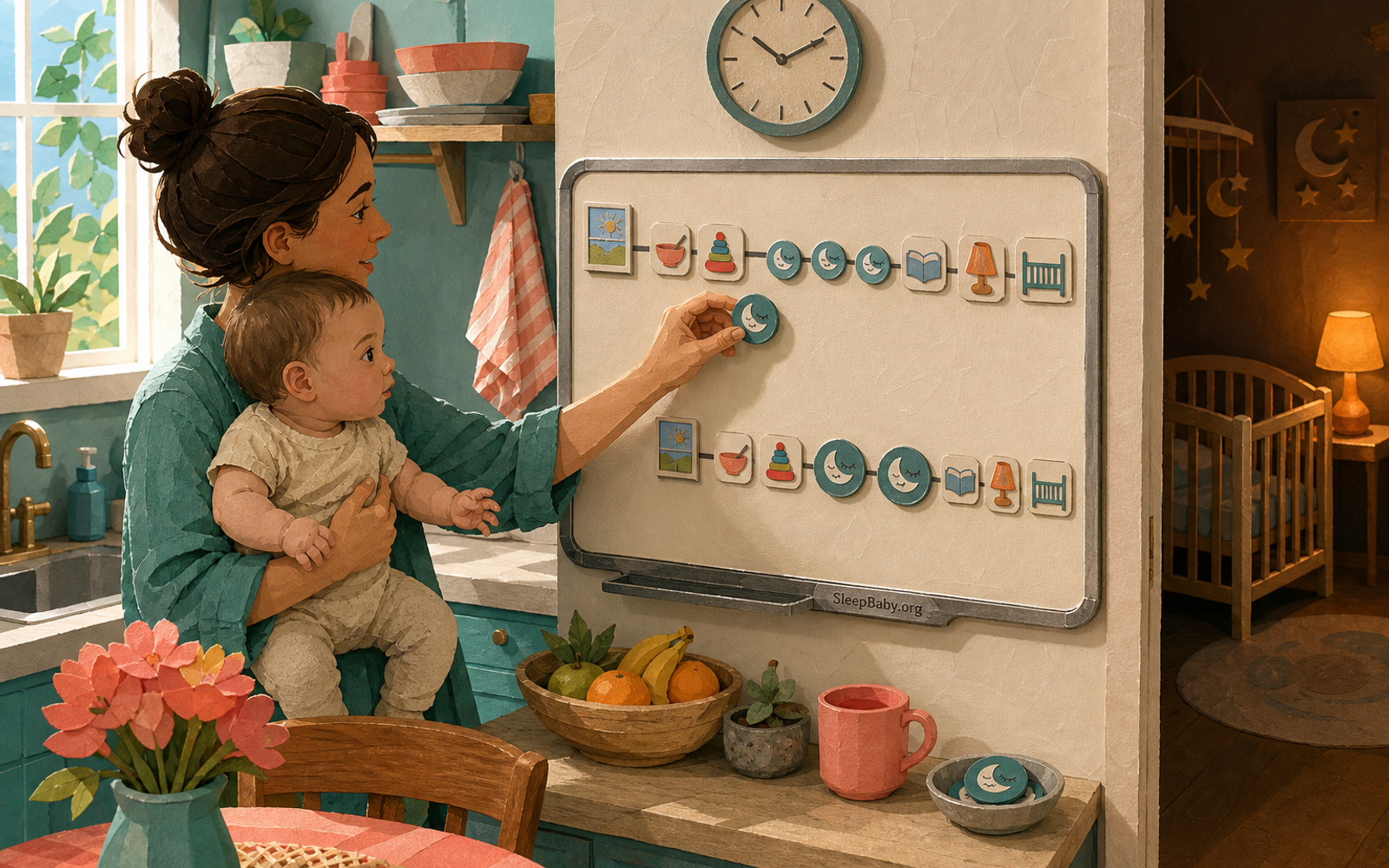

How to adjust after a short, long, or refused nap
This is the part most sample schedules leave out, even though it is the part parents have to use. A schedule that works only when every nap matches the example is not a plan. It is fan fiction.
| What happened | What to do next | What not to conclude |
|---|---|---|
| Nap ended quickly | Feed or comfort as needed, use calm awake time, and offer the next sleep sooner if tired behavior appears earlier. | One short nap does not prove the schedule, room, or baby is broken. |
| Nap ran long | Let the next opportunity and bedtime move later if the baby is rested and the 24-hour pattern still works. | You do not have to squeeze in every printed nap. |
| Third nap was refused | End the attempt, reset with ordinary quiet activity, and use an earlier bedtime if the day cannot comfortably stretch. | One refusal does not force a permanent two-nap schedule. |
| Baby slept late in the morning | Shift the example day or gently return to the normal morning anchor over several days. | A late start is not a reason to skip needed feeding or force exhaustion. |
Change one thing, then watch two or three days unless safety, illness, or feeding requires action sooner. Moving morning wake time, every nap, and bedtime at once creates a fog of cause and effect. If the new plan helps, you will not know which piece mattered. If it does not, you will not know what to undo.
For a slower reset, the flexible seven-day sleep-schedule plan shows how to move one anchor at a time. If you want to see how this month fits the wider arc, use the first-year sleep schedule rather than borrowing a toddler pattern for a six-month-old.
What about wake windows at 6 months?
You will see numerical wake windows everywhere. They can be useful as rough planning shorthand, but the AAP parent guidance and the AASM sleep-duration recommendation used for this guide do not prescribe one universal wake-window range for six-month-olds. That matters. A number repeated by many sleep sites is still not a medical threshold.
Use elapsed awake time as one piece of evidence. Pair it with the length and quality of the previous sleep, the baby’s behavior, feeds, stimulation, illness, and the pattern across several days. If a baby becomes calmly focused and then drifts off after a familiar routine, the timing may be workable. If every attempt becomes a long battle, the baby is alert and playful throughout, or the day ends in repeated exhaustion, adjust the next opportunity and observe again.
I would not stretch a clearly tired baby merely to reach a chart’s final number. I also would not assume every yawn means “crib immediately.” Six-month-olds yawn when bored, rub faces while teething, and become fussy for reasons that are not sleep. The schedule becomes clearer when you read the whole cluster rather than one cue.
Feeding belongs in the schedule, but hunger outranks it
Breast milk or infant formula remains central at six months. Complementary foods can begin around this age when a baby is developmentally ready and the pediatric clinician agrees, but solids are not a sleep tool. The CDC specifically says adding cereal or other food to a bottle does not make a baby sleep longer and can increase choking risk.
Build the day around responsive feeding cues rather than making a hungry baby wait for a nap clock. A sample schedule can show “feed after waking” because it is easy to remember, but real babies sometimes need to feed before sleep, after a short nap, during the night, or at an inconvenient moment involving the one clean shirt you had left.
Age alone does not tell you to remove night feeds. Growth, daytime intake, breast or formula feeding, prematurity, illness, and a clinician-directed plan all matter. If you are considering changing overnight feeding, ask the baby’s clinician what is appropriate for this baby. Do not dilute formula, add cereal to a bottle, or delay a needed feed to protect a schedule.
Three questions before you blame the clock
- Is a basic need asking first? Hunger, a dirty diaper, pain, temperature, illness, or a caregiver’s need to check the baby comes before schedule analysis.
- Is this one night or a repeating pattern? One unusual night is information. A week of the same difficulty is a pattern worth troubleshooting.
- What is the smallest safe change? Move one sleep opportunity, protect feeding, or shorten the routine. Do not change five variables and call the result science.

Night waking does not automatically mean the schedule is wrong
Night waking at six months is common. In one longitudinal study, 57% of six-month-olds did not sleep eight uninterrupted hours. Some babies return to sleep after a few minutes. Others need feeding, comfort, a diaper change, or help because they are sick. “Sleeping through the night” also has inconsistent definitions, so it is a poor pass-fail grade for your parenting or your schedule.
When the baby stirs, pause long enough to understand what is happening if it is safe to do so. A brief grumble with eyes closed is different from escalating crying, a hunger pattern, coughing, vomiting, breathing difficulty, or a baby who seems unwell. Respond to the baby you have in front of you. The goal is not to win a contest for the longest parental delay.
If waking happens every hour or close to it for several nights, look wider than bedtime arithmetic. Review feeding, temperature, illness, pain, rolling practice, the sleep environment, and whether the baby is getting enough total sleep opportunity. The guide to a baby waking every hour walks through that wider check without assuming one cause.
The nighttime ladder
Observe, meet the need, then troubleshoot the pattern
1. Observe briefly when safe
Listen for whether the baby is settling, escalating, coughing, struggling, or clearly asking for you.
2. Meet the actual need
Feed, change, comfort, or assess illness as appropriate. Keep the room calm and return to the safe sleep surface.
3. Study repeating nights in daylight
Use the next day to review the 24-hour pattern and make one change. Exhausted 2 a.m. is a terrible committee chair.
Safe sleep stays fixed while the schedule flexes
Every nap and night starts on the back in a safety-approved crib, bassinet, portable crib, or play yard with a firm, flat, level, noninclined surface and only a fitted sheet. Use a separate infant sleep space and keep soft objects, loose bedding, pillows, bumpers, positioners, and weighted products out. Room sharing without bed sharing is recommended ideally for at least the first six months.
If your baby falls asleep in a car seat, swing, stroller, carrier, or sling, move the baby to the regular safe sleep surface as soon as possible. Convenience does not turn a sitting or carrying device into a routine sleep surface.
Always place the baby on the back. If the baby can comfortably roll both ways, you do not need to repeatedly turn the baby back, but the sleep space still stays bare. Stop swaddling when the baby shows signs of trying to roll. Six months does not make a loose blanket, positioner, or weighted sleep product safe.
If you are deciding when to move the baby out of your room, read the guide to room sharing and moving rooms. A room change is a separate decision from whether today’s third nap happened.
Keep the safety floor visible
How can a baby sleep well and safely?
Boston Children’s Hospital gives a short visual overview of healthy and safe infant sleep. Use it as a safety reset, not as a promise that one routine will make every baby sleep through.
Takeaway: a flexible schedule can support a familiar rhythm, but the safe sleep surface and responsive care do the nonnegotiable work.
Open the Boston Children’s video on YouTube if the embedded player is unavailable.
When the schedule needs a clinician, not another tweak
A sudden sleep change can come from a schedule mismatch, but it can also come from hunger, pain, illness, breathing trouble, feeding difficulty, or a medication change. Contact the baby’s clinician when a change is persistent, you are worried about intake or growth, feeding becomes difficult, the baby seems to be in pain, or the baby is much sleepier or harder to wake than usual.
Get emergency help now for severe trouble breathing, blue or gray lips, tongue, face, or skin, unresponsiveness, or another life-threatening sign. If your baby was born early, use corrected age for developmental expectations, and follow the baby’s medical or feeding plan rather than a generic internet schedule.
I want the schedule to reduce uncertainty, not teach you to argue with your own concern. A clear log can help you tell the clinician what changed and when. It cannot diagnose the reason.

A three-day schedule check that tells you something useful
For three ordinary days, note the time the day clearly began, each sleep start and end, feeds, bedtime, and any long night waking. Add one plain-language observation: cheerful, fading, frantic, hungry, sick, or difficult to rouse. Do not score the baby. You are looking for what repeats.
At the end, total sleep in each 24-hour period. Then ask:
- Does the morning begin in roughly the same neighborhood?
- Are two naps carrying the day, or is a third bridge still regularly useful?
- Does bedtime difficulty follow a particular nap pattern?
- Are wakes connected to feeding or another clear need?
- Is the baby generally alert and engaged while awake, or consistently exhausted?
Choose one change for the next three days. You might make the morning more consistent, move the first nap slightly, keep the third nap as a smaller bridge, or move bedtime earlier after short-nap days. If the pattern is chaotic because of travel, illness, vaccination discomfort, a growth concern, or family disruption, stabilize care first. You can study the schedule when the day becomes ordinary again.
The one-change rule
If sleep is mostly working: keep the pattern. A schedule does not need improvement just because another baby’s day looks tidier online.
If one seam is failing: change the nearest anchor. Do not rebuild breakfast because the third nap was refused.
If the baby seems unwell or feeding is off: stop treating it as a schedule experiment and get appropriate clinical guidance.
SleepBaby.org principle · The best schedule is not the prettiest one. It is the one you can understand, adjust, and use safely.
Common 6-month schedule questions
Is a fourth nap still okay after short naps?
It can be. If the first naps were brief and a small bridge nap helps your baby reach bedtime without a long exhausted stretch, the fourth opportunity may be the most practical answer that day. Keep watching the full 24-hour total, feeding, mood, and bedtime rather than treating the nap count as a grade. If every nap suddenly shortens or your baby seems unwell, look beyond the schedule.
What if daycare uses a different schedule?
Ask for the actual sleep and feeding times instead of trying to make two clocks match perfectly. At home, keep the morning and wind-down recognizable, then move bedtime according to the naps your baby really had. A consistent sequence can travel between settings even when the exact nap minutes cannot.
Is 9 p.m. too late for a 6-month-old?
A 9 p.m. bedtime is not automatically wrong for every six-month-old. Look at morning wake time, total sleep, nap timing, feeding, how bedtime goes, and whether the schedule works for the family. If a late bedtime repeatedly leaves the baby short on sleep or makes mornings difficult, move it earlier gradually.
How long should the last wake window be?
The AAP guidance and AASM sleep-duration recommendation do not set one last wake-window number for every six-month-old. Use the end of the last nap, the baby’s recent pattern, and behavior during the wind-down. On a short-nap day, bedtime may need to arrive earlier. On a day with a late bridge nap, it may move later. Treat online wake-window charts as starting ideas, not medical limits.
Should I wake my baby from a nap?
Sometimes families consider waking from a late nap because it consistently displaces needed feeding or pushes bedtime far beyond the household’s workable night. That is an individual tradeoff, not a universal six-month rule. If the baby has growth, feeding, prematurity, illness, or excessive-sleepiness concerns, ask the clinician before deliberately restricting sleep.
Why does my baby wake 30 minutes after bedtime?
A “false start” can follow a schedule mismatch, but it can also follow hunger, discomfort, illness, noise, temperature, or the normal complexity of infant sleep. Check the immediate need first. If the pattern repeats, compare it with the final nap and bedtime across several nights before changing one anchor.
Do we need sleep training to have a schedule?
No. A schedule organizes sleep opportunities and routines. Sleep training is a separate set of behavioral decisions. You can build a predictable morning, nap rhythm, and bedtime routine while responding to your baby in the way your family and clinician consider appropriate. The guide to sleeping without formal sleep training explains that choice in more detail.
Sources
- American Academy of Sleep Medicine: Recommended Amount of Sleep for Pediatric Populations
- HealthyChildren: Getting Your Baby to Sleep
- Boston Children’s Hospital: Healthy Sleep Tips
- American Academy of Pediatrics: 2022 Safe Sleep Recommendations
- NICHD Safe to Sleep: Safe Sleep Environment
- NICHD Safe to Sleep: Back Sleeping and Rolling
- HealthyChildren: A Parent’s Guide to Safe Sleep
- CDC: Infant and Toddler Nutrition FAQs
- CDC: When, What, and How to Introduce Solid Foods
- CDC: Signs Your Child Is Hungry or Full
- CDC: Infant Formula Preparation and Storage
- Pediatrics: Uninterrupted Infant Sleep, Development, and Maternal Mood
- American Academy of Pediatrics: When to Call Emergency Medical Services
- HealthyChildren: Corrected Age for Preemies
When the clock is loud and the baby is louder
Build a night that can bend without coming apart
A six-month schedule does not need perfect naps. It needs a clear morning, enough sleep opportunity, responsive feeding, a safe sleep space, and one familiar way to wind down when the day changes shape.
Sleep guidance does not replace medical care, feeding support, or urgent evaluation when a baby seems unwell.






What viewers said10 comments · 4 replies+
Archived comments from the original Baby Sleep Miracle presentation. Not independently verified by SleepBaby.org; individual experiences vary.
Thank you so much for this video! I had no idea about the dangers of baby swings :O
Hi Mary-Ann. I have a question: Is method in any way similar to the ones recommended by Dr Bucknam, Dr. Weissbluth or Dr. Karp? We tried those but none of them help.
Hi Regina, thank you for your question. The short answer is no. The techniques I share in my guide are based on newest scientific research and this is why I have never seen any approach similar to the one I recommend.
This method really works! I tried it on my son Jesus and after just one week he went from waking up more than 5 times a night to waking up just once or twice. You are a lifesaver, Mary-Ann!
I'm truly impressed with how much information you share in your video. And all for free! I can feel that you truly care about mothers like myself, and that's hard to find these days. I have recommended your site to several of my friends already.
Mary-Ann, our child suffers from autism. Is your approach still suited?
Chloe, I made sure my method can be used with any child, even babies who are special like yours. Please note that I'm not a doctor and that I always advice to consult with your physician because nothing is more important than the safety and well-being of your love.
Hallo Mary-Ann, I'm from Germany. Do you have your guide in German?
Hello Heide, we do! Normally you should already see our video in German. If not, please contact our support so they can guide you
Thenk you for your answer, Mary-Ann!
I just completed your approach and I have to say, it worked almost too well. Yes, it took a bit of getting used to with your bedtime routine but the difference is huge. My son George used to take 1 hours to go down and now he's firmly asleep in no more than 10 minutes! You're the best!
It seems I'm the only man watching this video, lol! What you shared about the 'emotional backpack' made immediate sense to me and I can't wait to help my little girl Mila to unpack it!
Hey there, just discovered your site and this really sounds different. Just wanted to say thanks for sharing :)
For everyone who's still thinking about getting Mary-Ann's guide I want to advise you to go ahead. I wasn't sure myself but now I'm so thankful I invested in this program. It made a huge difference in our life as a family and yes, my baby girl does sleep through the night now.