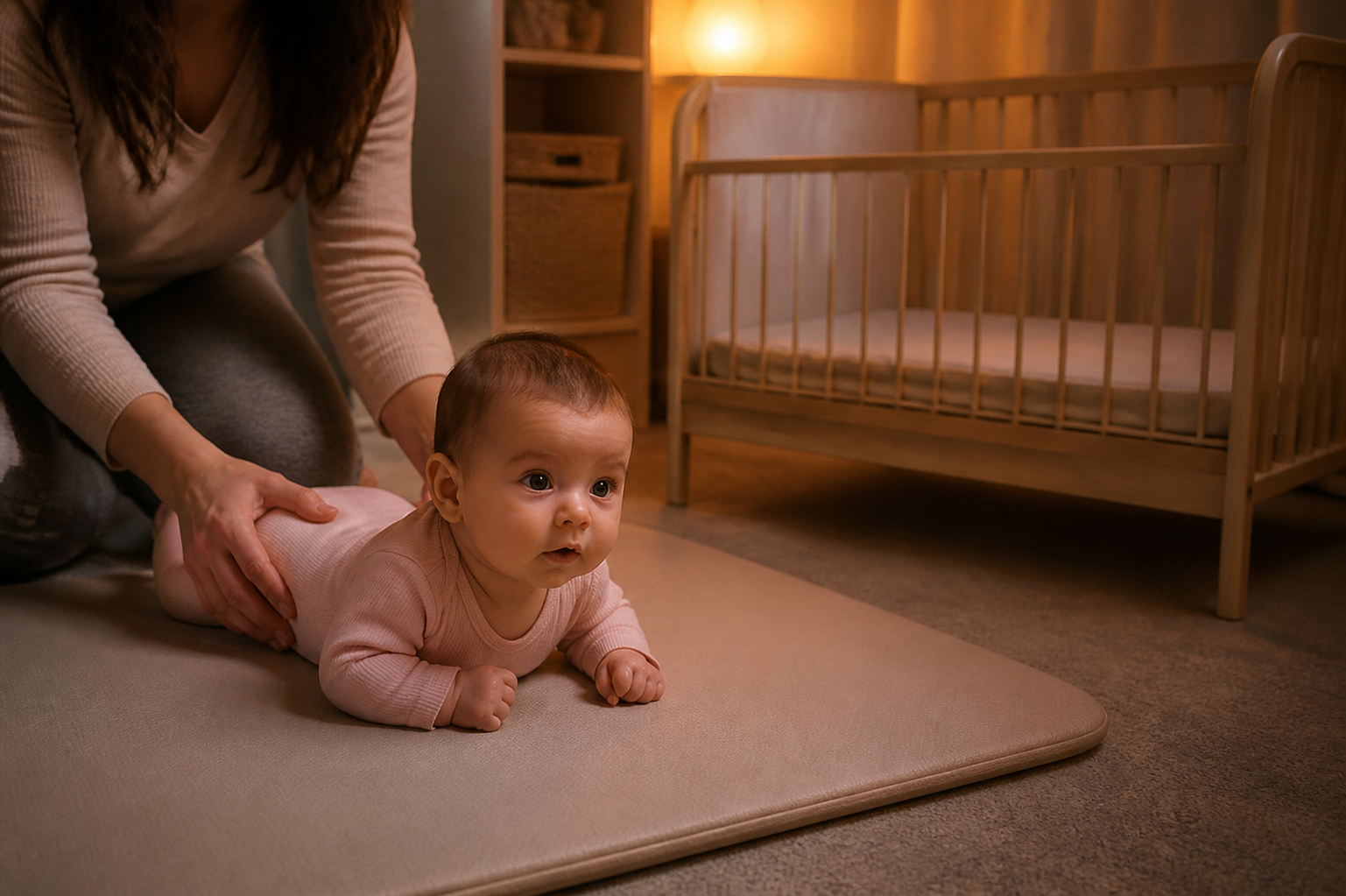
You were making faces at floor level, your baby’s head gave one last determined bob, and then the tiny protest noises stopped. Their cheek settled against the mat. The tummy-time session had quietly become a nap, and now the question feels much larger than the two feet between you and the crib.
If your baby falls asleep during tummy time, end the session and move them promptly to a separate safe sleep space. Support their head, neck, and body as you lift them. Place them on their back in a safety-approved crib, bassinet, portable crib, or play yard with a firm, flat, noninclined mattress and only a fitted sheet. Do not let the nap continue face-down on a play mat, nursing pillow, sofa, adult chest, or lap—even while you watch. Tummy time is awake, continuously supervised play. When sleep begins, tummy time is over.
The private question underneath “my baby fell asleep during tummy time” is usually: Did I miss something dangerous while I was sitting right here? What matters now is not turning the last thirty seconds into a courtroom exhibit. You noticed. The useful response is a calm transfer, followed by a better plan for the next awake session.
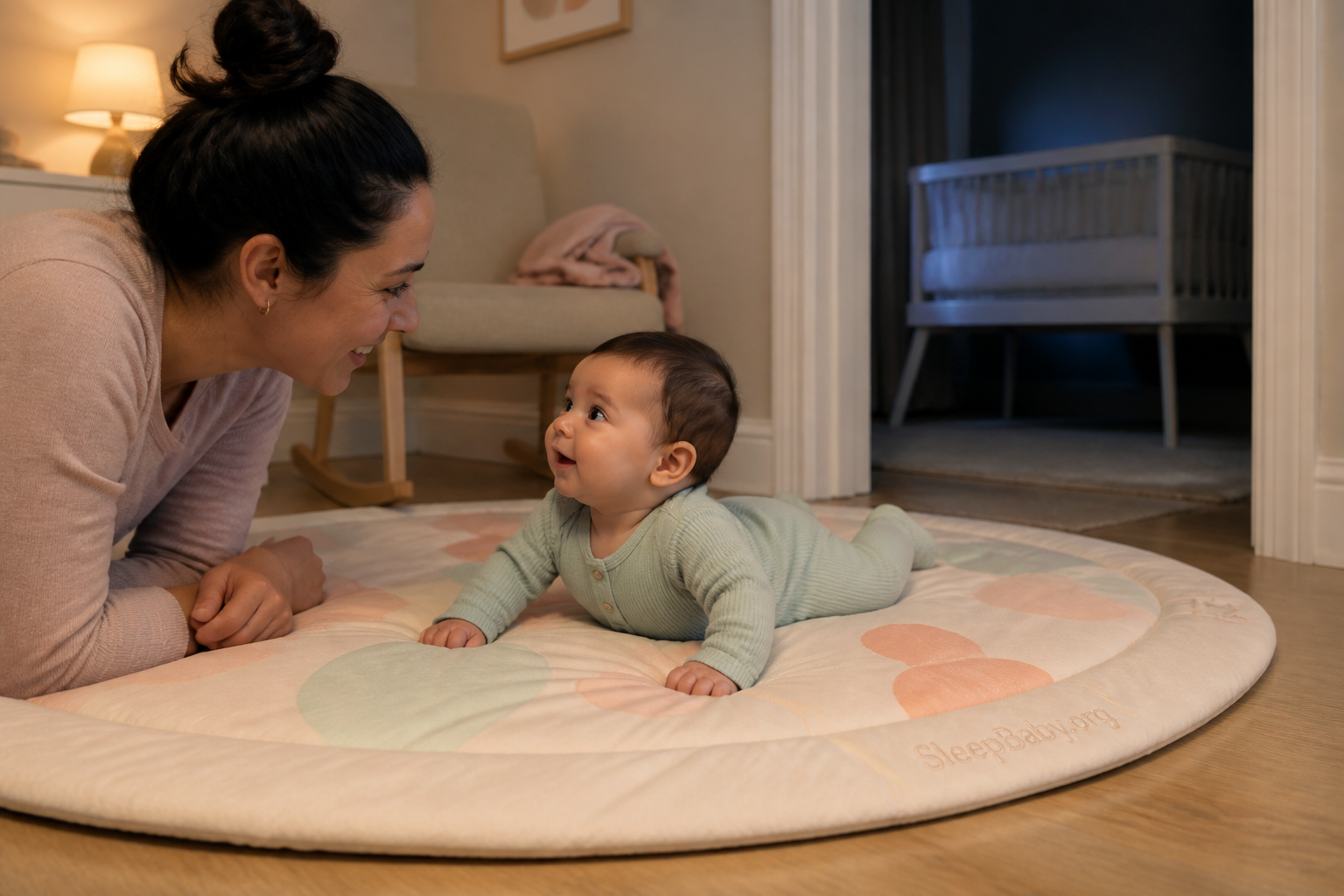
What to do right now, in three calm moves
I would keep this sequence deliberately boring. A safety step does not become more effective because we perform it with the emotional energy of an airport evacuation.
- Stop the session.
Move toys and supports aside. If your baby is on your chest or lap, make sure you are fully awake and steady before standing. - Lift with full support.
Slide one hand beneath the chest and shoulders and the other beneath the hips, keeping the head and neck supported for a young baby. - Land on the back.
Use the baby’s separate safety-approved sleep space: firm, flat, noninclined, and clear except for a fitted sheet.
You do not need to make the baby fully cheerful before the transfer. They may stir, squint at you as if you have violated a very small labor agreement, or wake completely. That is inconvenient, but the target is a safe sleeping position and surface—not preserving the nap at any cost.

Why supervision does not make a tummy nap safe
Supervision is what makes tummy time appropriate. It lets you see your baby’s face, effort, color, breathing, and response. It does not turn a play mat, pillow, adult mattress, sofa, lap, or caregiver chest into an infant sleep surface. Watching can help you catch sleep. It cannot change the physics of the place where sleep happened.
The American Academy of Pediatrics recommends placing babies on their backs for every nap and nighttime sleep through the first year. The sleep surface should be firm, flat, level, and noninclined, with soft objects and loose bedding kept out. NIH Safe to Sleep uses a wonderfully clear division: tummy time means the baby is on the stomach while awake and someone is watching. The word awake is doing important work there.
If a product or position is promoted for awake play, use it only for awake play and follow its instructions. The moment your baby becomes drowsy, the session has reached its natural ending. This is also why I would skip social-media setups that turn transport equipment into a prone-play station; our guide to why the viral stroller tummy-time hack is unsafe walks through that separate equipment problem without blurring it into this sleep-transfer question.
Do I need to wake my baby completely?
No rule says you must conduct a tiny wakefulness interview before moving them. Transfer promptly and place them on their back. Some babies sleep through the move; some wake as soon as the air changes temperature; some open one eye with the weary suspicion of a building inspector. All three outcomes are acceptable.
What I would not do is leave a baby face-down because waking them feels cruel, or roll them onto their back on the same soft mat and call the problem solved. The destination matters as much as the position. A clear cot mattress made for infant sleep is different from foam flooring, a folded blanket, a cushion, or a pillow.
Clearly labeled composite Kacey-and-Benjamin scene
The nap I did not want to ruin
Imagine Benjamin finally quiet after a noisy three-minute floor session, one fist tucked near his cheek and his whole body suddenly heavy. In this composite scene, I am close enough to count his eyelashes and still briefly tempted to preserve the miracle. The useful distinction is that my closeness makes the awake practice supervised; it does not make the sleeping position safe. I lift him, accept the offended squeak, and move him to the bassinet on his back.
That scene is illustrative, not evidence. The evidence comes from AAP, NIH, and CDC safe-sleep guidance. The scene simply names the decision parents actually face: protect the nap, or protect the sleep setup. The setup wins.

Why did my baby fall asleep during tummy time?
Often the explanation is ordinary timing. You started close to the next nap. A feed made the baby drowsy. The room was warm. The effort of lifting and turning the head used up the small amount of alert energy available. Young babies move between waking and sleep with very little ceremony; sometimes the warning system is one yawn you notice only in retrospect.
One episode cannot tell you whether your baby was overtired, perfectly tired, under-stimulated, unusually sleepy, or simply comfortable. I would look at the larger pattern instead:
- Timing: How long had your baby been awake, and were you already seeing yawning, staring away, slower movement, or fussiness?
- Feeding: Was a feed due, just completed, unusually short, or difficult?
- Baseline: Is your baby otherwise waking, feeding, moving, and responding in their usual way?
- Repetition: Did this happen once near nap time, or does the baby repeatedly fall asleep almost as soon as awake play begins?
Move tummy time earlier in the awake period rather than trying to entertain an exhausted baby into staying up. After a diaper change or shortly after waking often works better than the final minutes before a nap. Avoid starting immediately after a large feed if your baby tends to spit up or seems uncomfortable; give them an appropriate upright pause and follow any individualized feeding guidance.

What changes when the baby is a newborn?
Newborns sleep often and may tolerate only very short awake sessions. Tummy time does not need to become a daily endurance test. The AAP and NIH describe starting with short supervised sessions soon after birth and gradually building as the baby becomes stronger and more alert. A few engaged minutes can be more useful than a longer session that drifts into distress or sleep.
Feeding is the boundary I would watch most closely in a very young baby. If your newborn keeps dozing before feeds are complete, is hard to wake for feeding, sucks weakly, feeds much less than usual, has fewer wet diapers, looks unusually yellow, or seems markedly less responsive, contact the baby’s clinician promptly. Sleepiness that is different from your baby’s normal rhythm should not be explained away as “tummy time tiredness.”
Emergency signs come before finishing the tummy-time session, reading another paragraph, or trying a new product. If your baby cannot be awakened or is struggling to breathe, call emergency services now.
What if my baby can already roll?
Rolling changes what happens after a baby is safely placed in the cot; it does not turn sleeping during tummy-time practice into an approved nap. Keep beginning every sleep by placing your baby on the back. If your baby can roll from back to tummy and tummy to back independently, AAP guidance says you do not need to keep turning them back after they choose another position in a clear, safety-approved sleep space.
The conditions matter: the baby got there independently, the mattress is firm and flat, and the space is empty. A baby who fell asleep prone on a mat did not independently reposition after being placed on the back in a crib. Those are different events.
Stop swaddling as soon as your baby shows signs of trying to roll. A swaddled baby who reaches a prone position may not be able to use their arms effectively. Weighted swaddles, weighted sleep clothing, positioners, and products designed to hold a baby in one sleep position are not safe substitutes for the basic setup.


How much tummy time should happen before sleepiness wins?
There is no prize for completing one long prone session. AAP guidance commonly starts with two or three short rounds of roughly three to five minutes and builds gradually, with a goal of reaching about 15 to 30 minutes across the day by around seven weeks. Those numbers are orientation, not a demand that a fussy newborn remain face-down until a timer feels satisfied.
Total time can be collected in pieces. Two calm minutes while you lie face-to-face after a diaper change counts. A short chest-to-chest round while you are fully awake and supporting the baby counts. Another floor round after the next nap counts. What does not count as useful developmental practice is a baby sleeping prone while the adult keeps the clock running.
I would end the round when your baby’s effort changes: the head stays down, the face presses into the surface, movement becomes slower rather than purposeful, the baby stops responding to your face or voice, or the early sleepy stare appears. Crying is not the only stop signal. A baby can be quietly finished.
What if my baby has reflux, was premature, or has special positioning advice?
Ask the baby’s own clinician how to adapt awake practice. Prematurity, low muscle tone, torticollis, recovery from a procedure, breathing or feeding needs, and individualized physical-therapy plans can change how tummy time begins and how much support is appropriate. They do not create a general permission for prone sleep on a pillow or mat.
Healthy babies with reflux are ordinarily still placed flat on their backs for sleep. Elevating the mattress, adding a wedge, using an inclined sleeper, or placing the baby prone is not a home reflux treatment. If discomfort, coughing, choking, poor weight gain, or feeding difficulty repeatedly interrupts play and sleep, take that pattern to the clinician rather than experimenting with a sleep position.
A physical therapist may show you a supported awake position that looks very different from standard floor practice. Follow the individualized instructions while the baby is awake and watched, then remove the supports and return to the ordinary safe-sleep setup when the session ends. Therapy equipment does not remain in the crib unless the baby’s medical team has provided a specific, documented plan for a rare circumstance.
Will stopping early cause a flat head or delay development?
No single short session decides head shape or motor development. Tummy time helps reduce sustained pressure on the back of the head and supports neck, shoulder, arm, and trunk strength, but the benefit grows through repeated awake practice over days and weeks. You do not protect development by allowing a tired baby to sleep prone.
Vary awake positions across the day. Hold your baby, switch the direction they face in the crib while continuing to place them on the back, alternate feeding sides when appropriate, use supervised floor play on the back and tummy, and limit unnecessary time in seats that keep pressure on the same part of the head. These ordinary changes can add variety without making one tummy-time round carry the entire developmental workload.
Talk with the pediatrician if you notice a flat area that is becoming more pronounced, a head tilt, a strong preference for looking one direction, difficulty turning the neck, marked stiffness or floppiness, movement that remains different on one side, or loss of a skill. Those observations are more useful than reporting that Tuesday’s session lasted four minutes and Wednesday’s lasted six.
A better note than “baby hates tummy time”
Watch three short sessions, not one dramatic minute
Time since waking, last feed, alertness, and position used.
Head turns, arm support, side preference, breathing, and when effort fades.
Whether baby feeds, wakes, moves, and settles in their usual way.
Bring the pattern—not a diagnosis—to the pediatrician or physical therapist if something concerns you.
How to make tummy time less likely to become nap time
The simplest adjustment is not louder toys. It is better timing. Try soon after your baby wakes and has been fed and changed, while they are calm but visibly alert. Keep the first round short. End while the baby still has enough energy to leave the session without collapsing into sleep.
I like to think in small rounds rather than one heroic daily total. Lie at eye level. Move your face slowly from side to side. Talk, sing, or place one visually interesting object ahead of the baby. For a young baby, chest-to-chest or across-the-lap practice may feel more manageable than the floor, but it remains an awake activity with your hands supporting and your attention present.
Build a session the baby can finish awake
Choose an alert window
Set
Clear stable surface
Connect
Face, voice, one focal object
Finish
Stop before drowsiness
Discomfort is information. If your baby cries immediately, try a shorter angle on your chest, a rolled towel beneath the upper chest only while awake and watched, or side-lying play. Keep the face clear and remove every support when the session ends. If your baby consistently turns only one way, has a persistent head tilt, seems unusually stiff or floppy, uses one side differently, loses a skill, or has breathing or feeding difficulty during activity, ask the pediatric clinician to assess the pattern.
A useful awake-time focal point
A floor mirror that does one simple job
For short floor sessions, the Bright Starts Sit and See Safari Floor Mirror gives an alert baby a face-level reflection and colorful detail to look toward. It fits this exact situation better than a nursing pillow, lounger, or plush activity gym because it stands apart from the baby rather than becoming a support surface that could be mistaken for somewhere to sleep. Its fold-flat design also makes it easy to put away when play ends.
Buy it if your practical problem is keeping a calm, awake baby interested for another short round—not as a way to keep a sleepy baby awake and never as a sleep aid. Use it only on a stable floor during direct supervision, follow the manufacturer’s instructions, and remove it from the sleep area before every nap.
See the Bright Starts floor mirror on Amazon
As an Amazon Associate, SleepBaby may earn from qualifying purchases.
The questions that arrive after the transfer
What if the nap was only going to last ten minutes?
The length does not change the surface rule. Brief sleep is still sleep. Move the baby to the proper sleep space and let the nap length become tomorrow’s less important problem.
Can I keep a hand on my baby while they sleep on their tummy?
No. A hand and close observation do not make prone sleep on a mat, pillow, sofa, bed, lap, or chest equivalent to back sleep in a safety-approved cot. Transfer the baby.
What if my baby falls asleep on my chest during chest-to-chest tummy time?
If sleep begins, move the baby to their separate firm, flat sleep space and place them on the back. This matters especially if you feel sleepy too. Sofas and armchairs are particularly hazardous places for an adult to doze while holding an infant.
Does falling asleep mean tummy time was too hard?
Not necessarily. It may simply have landed too close to nap time. Look at how the baby behaves across the whole day. If the baby repeatedly cannot stay awake for feeds or ordinary interaction, seems weak, or is difficult to rouse, contact the clinician rather than trying to solve the pattern with stimulation.

Watch the awake-play and safe-sleep boundary
NIH Safe to Sleep video
See what “back to sleep” looks like after tummy play ends
This official NICHD video shows the broader safe-sleep setup. I include it because the tummy-time transfer makes more sense when the destination is visible: a separate clear sleep space, not a modified corner of the play setup. The written guidance in this article remains complete without playback.
Written takeaway: tummy time builds strength while the baby is awake; every nap begins on the back in a firm, flat, clear infant sleep space. Watch on YouTube.
What I would change before the next session
- Choose an earlier, clearly alert part of the wake period.
- Use a stable clear floor, chest, or lap position with the face visible.
- Keep one engaging face, mirror, or toy ahead of the baby instead of surrounding them with stimulation.
- Stop at the first sustained signs of drowsiness, distress, feeding need, or fading effort.
- Have the clear crib or bassinet ready before you begin so the handoff is easy.
That cheek against the mat does not need a dramatic explanation. It needs a change of location. Once your baby is on their back in a clear, firm sleep space, the moment becomes much smaller: tummy play ran into nap time, you noticed, and you moved the boundary where it belonged.
When awake play keeps colliding with sleep
Build a day where the handoffs feel less improvised
If tummy time, feeding, and naps keep arriving on top of one another, SleepBaby can help you look at the day’s rhythm and create a calmer next-step plan—without turning the clock into another safety rule or promising a perfect nap.
Sources
- American Academy of Pediatrics: Back to Sleep, Tummy to Play
- American Academy of Pediatrics: 3 Tummy Time Activities to Try With Your Baby
- American Academy of Pediatrics: Safe Sleep—9 Ways to Reduce SIDS and Suffocation Risk
- NIH Safe to Sleep: Tummy Time for a Healthy Baby
- NIH Safe to Sleep: Frequently Asked Questions
- CDC: Milestones by 2 Months
- CDC: Providing Care for Babies to Sleep Safely
- American Academy of Pediatrics: Your Newborn’s First Week
- American Academy of Pediatrics: Newborn Reflexes and Behavior Symptom Checker






What viewers said10 comments · 4 replies+
Archived comments from the original Baby Sleep Miracle presentation. Not independently verified by SleepBaby.org; individual experiences vary.
Thank you so much for this video! I had no idea about the dangers of baby swings :O
Hi Mary-Ann. I have a question: Is method in any way similar to the ones recommended by Dr Bucknam, Dr. Weissbluth or Dr. Karp? We tried those but none of them help.
Hi Regina, thank you for your question. The short answer is no. The techniques I share in my guide are based on newest scientific research and this is why I have never seen any approach similar to the one I recommend.
This method really works! I tried it on my son Jesus and after just one week he went from waking up more than 5 times a night to waking up just once or twice. You are a lifesaver, Mary-Ann!
I'm truly impressed with how much information you share in your video. And all for free! I can feel that you truly care about mothers like myself, and that's hard to find these days. I have recommended your site to several of my friends already.
Mary-Ann, our child suffers from autism. Is your approach still suited?
Chloe, I made sure my method can be used with any child, even babies who are special like yours. Please note that I'm not a doctor and that I always advice to consult with your physician because nothing is more important than the safety and well-being of your love.
Hallo Mary-Ann, I'm from Germany. Do you have your guide in German?
Hello Heide, we do! Normally you should already see our video in German. If not, please contact our support so they can guide you
Thenk you for your answer, Mary-Ann!
I just completed your approach and I have to say, it worked almost too well. Yes, it took a bit of getting used to with your bedtime routine but the difference is huge. My son George used to take 1 hours to go down and now he's firmly asleep in no more than 10 minutes! You're the best!
It seems I'm the only man watching this video, lol! What you shared about the 'emotional backpack' made immediate sense to me and I can't wait to help my little girl Mila to unpack it!
Hey there, just discovered your site and this really sounds different. Just wanted to say thanks for sharing :)
For everyone who's still thinking about getting Mary-Ann's guide I want to advise you to go ahead. I wasn't sure myself but now I'm so thankful I invested in this program. It made a huge difference in our life as a family and yes, my baby girl does sleep through the night now.