The grandparent sleepover plan
Why Your Toddler Won’t Sleep at Their Grandparents—and What to Do
A different room, a different grown-up, and the terrible discovery that Grandma’s hallway makes its own noises can turn an ordinary bedtime into a very long family meeting.
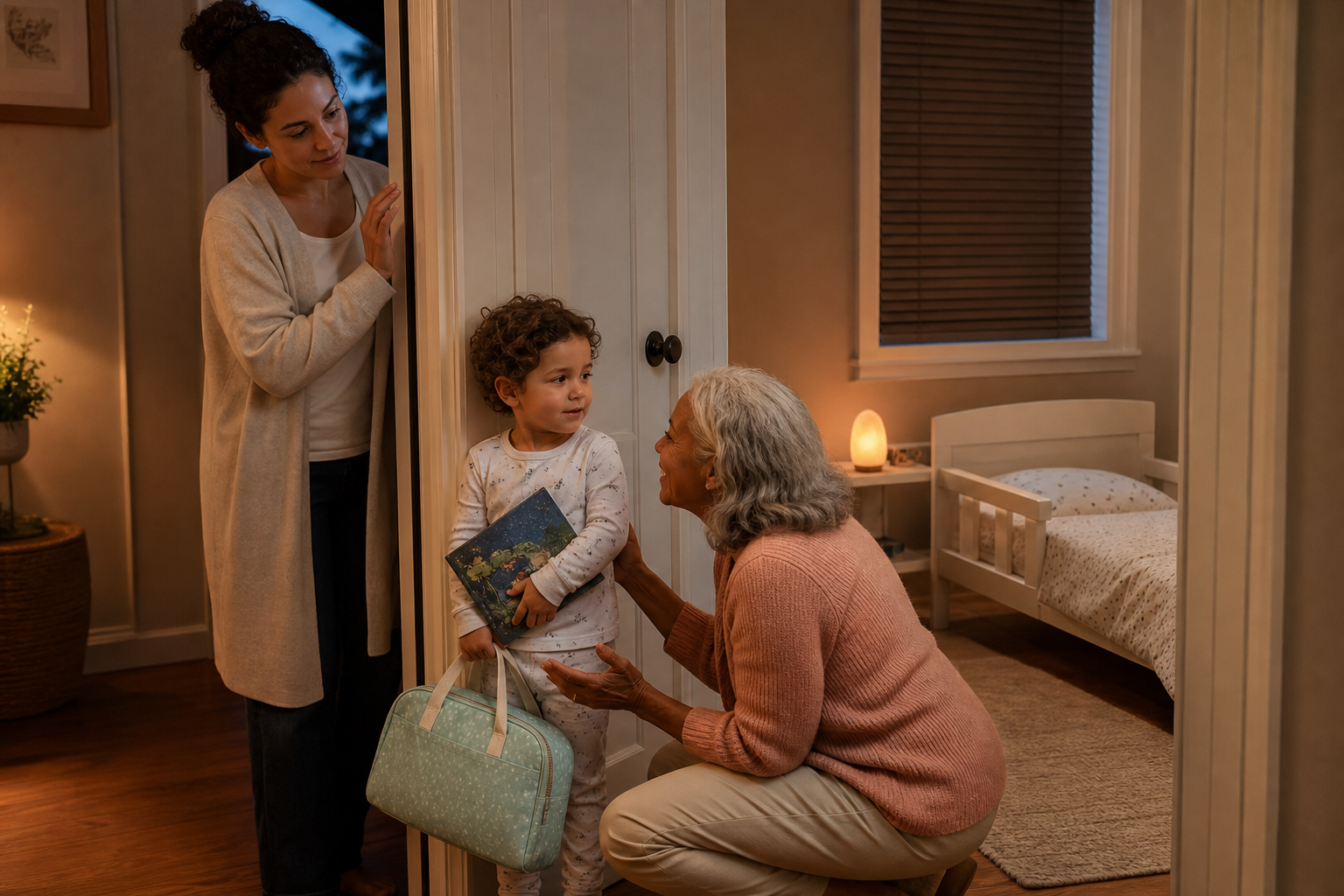
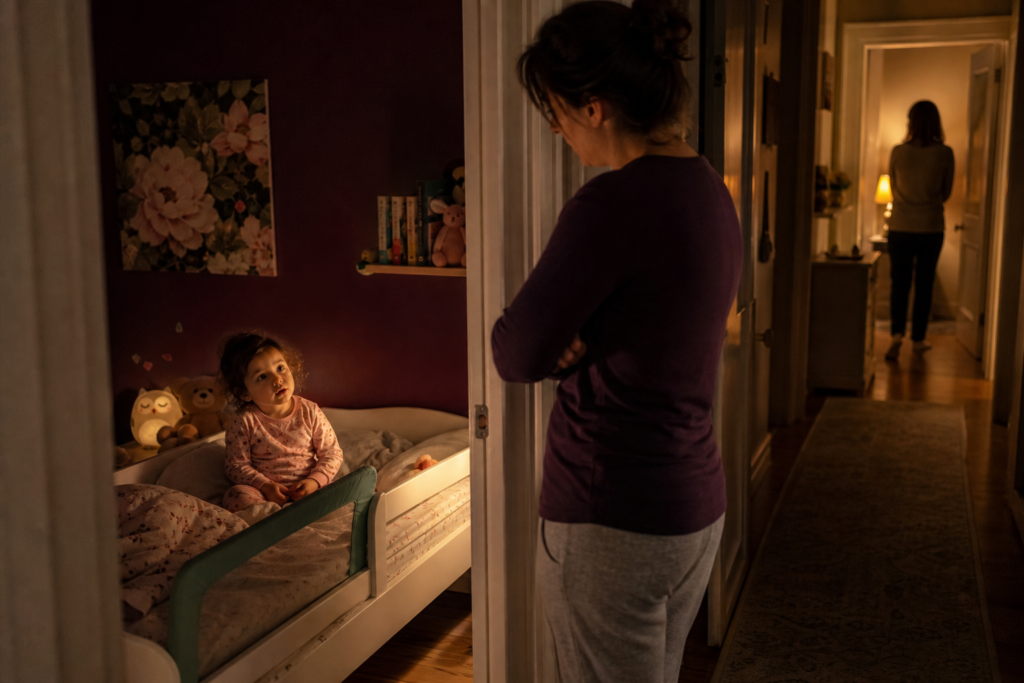
The overnight bag is open on the guest-room floor. The pajamas are right, the favorite book is right, and Grandma has performed the bedtime song with admirable commitment. Your toddler is still standing in the doorway announcing, with the certainty of a tiny attorney, that sleep cannot happen here.
Most toddlers who will not sleep at their grandparents are reacting to a pileup of ordinary changes: a new room, separation from their usual parent, altered timing, exciting attention, and bedtime cues that do not quite match home. It does not automatically mean the grandparents did anything wrong, the bond is weak, or your child is permanently “not ready.” Start by making the night more predictable, carrying a few strong sleep cues from home, and deciding in advance how the grandparent will respond to protests and wake-ups. If distress is intense, the child is ill, or the setup cannot be made safe, postpone the overnight without turning that decision into a verdict on anyone.
I think the private question beneath this search is often less about sleep than belonging: Will my child feel safe without me, and will the grandparents think I have created a terrible sleeper? A difficult night cannot answer either question. When I look at this problem, I see a vulnerable transition moved into a room with no sleep history. Your toddler is being asked to trust the people, the room, the sequence, and the fact that morning will still bring the expected reunion.

Why bedtime can fall apart at Grandma and Grandpa’s house
A toddler can genuinely love a grandparent and still protest sleeping there. Daytime affection and nighttime separation are different jobs. During a visit, your child can check where you are, run back for reassurance, and stay busy. At bedtime, the house gets quiet, the exciting adults leave the room, and every unfamiliar detail gets promoted to breaking news.
To learn which part is hardest, change only one layer at a time. Have the grandparent handle bedtime in your child’s own room while you leave the house. On another evening, stay at the grandparent’s home while the grandparent leads the routine. If bedtime is manageable at home without you but difficult in the guest room, the environment probably needs more familiarity. If distress spikes whenever you leave, even at home, practice the caregiver handoff first. If both versions go reasonably well but the full overnight collapses after midnight, focus on the waking plan and morning reunion rather than redesigning bedtime. This small comparison prevents adults from solving the wrong problem with more toys, later bedtimes, or increasingly elaborate promises.
The room has no sleep history yet
At home, hundreds of tiny cues work together: the angle of the hallway light, the sound machine, the order of the books, the squeak of the door, the way a parent says the last sentence. At a grandparent’s house, the mattress may feel different, the curtains may admit a streetlight, the clock may tick, and the heating system may suddenly sound like a submarine surfacing. Adults call these small differences. A toddler’s nervous system may call them the entire plot.
The reunion question is unresolved
Young children do not experience time as adults do. “I’ll see you tomorrow after breakfast” is warm and accurate, but tomorrow is not a useful unit when a child wants you now. Some toddlers repeatedly ask where the parent is, resist the final goodnight, or wake and restart the question. That can be separation distress without being evidence of a damaged attachment.
Grandparents are exciting
Extra play, dessert, visitors, a later meal, and three additional stories can leave a child both thrilled and depleted. Overtiredness does not always look sleepy. It can look loud, silly, weepy, fast, or fiercely opposed to the next transition. A grandparent may reasonably think, “She is not tired at all,” while the child is operating on the emotional equivalent of sparks.
The schedule moved
A late car nap, a longer afternoon nap, or bedtime shifted well past the usual window can reduce or scramble sleep pressure. The CDC notes that children around age two generally need 11 to 14 hours of sleep in 24 hours, including naps. That range is not a command to make one night add up perfectly. It is a useful reminder to look at the whole day before treating bedtime resistance as purely behavioral.
The adults are using different rules
Grandparents do not have to imitate the parent perfectly, but a child struggles when the answer changes every two minutes. One more snack becomes another snack; one more cuddle becomes a tour of the house; returning to bed becomes negotiating on the sofa. The problem is not kindness. It is that the child cannot tell which response is the real ending.
A clearly labeled Kacey-and-Benjamin composite scene: I picture Benjamin at a grandparent’s guest-room door at 8:42 p.m., clutching one pajama sleeve and explaining that the ceiling fan is “looking.” Grandma offers a third book. I offer a video call. Grandpa considers removing the fan from the ceiling through force of will. Everybody is helping, which is how four new bedtime steps can appear before anyone notices.
The useful distinction in that composite is not whether the fan is objectively frightening. It is whether the adults can acknowledge the feeling without rebuilding bedtime around it. “That fan looks different. It stays off tonight. Grandma will sit by the bed while we sing the same song, then it is time to rest.” The child gets truth, comfort, and a boundary in one answer.
When you’re staying away
A different place.
The next bedtime.
A new room means finding your way through bedtime in a different place. Watch our video below for baby-sleep ideas to bring to your night away.
Prefer to read?Press play for a little help with your baby’s next bedtime.
Kind words about the original video
“Thank you so much for this video!”
“I'm truly impressed with how much information you share in your video.”
The SleepBaby Workshop
Get the Workshop.
Get the Workshop, including the Travel & Grandparent Sleep Pack. 15 guides and five audio tracks in a simple browser hub. Read, listen, and return to the part you need.
A conversation, if you want one.Night Owls is the SleepBaby chat room. Read what is there or join in.
First decide what kind of visit you are planning
“Sleep at the grandparents” can mean three very different things. A nap while the parent runs an errand is not the same challenge as a first overnight. An overnight with the parent sleeping in the next room is not the same as being dropped off before dinner and reunited the next day. Name the actual step. Smaller, successful practice is often more useful than declaring the child ready for the hardest version.
Practice visit
The grandparent handles pajamas, books, and the beginning of settling while the parent remains in the house but out of the room.
Nap or late evening
The child practices one sleep period or completes bedtime there, then the parent collects them before morning.
Full overnight
The grandparent handles bedtime, any night waking, and morning with a clear reunion plan.
Readiness is not a personality badge. Look for practical signs: your child can be comforted by the grandparent, has spent enjoyable time there without you, understands a simple reunion plan, and has a sleep setup the adults can manage safely. A child who cries at pickup can still have had a good visit; a child who cheerfully waves goodbye can still unravel at 2 a.m. These are clues, not guarantees.
Build a bedtime routine that can travel
The goal is not to reproduce the home bedroom down to its final molecule. I would carry the cues with the strongest meaning and leave the fragile extras behind. The CDC’s toddler guidance emphasizes routines that are consistent, predictable, and simple. The NHS similarly recommends a calming wind-down of roughly 30 minutes and a clear limit around the bedtime routine.
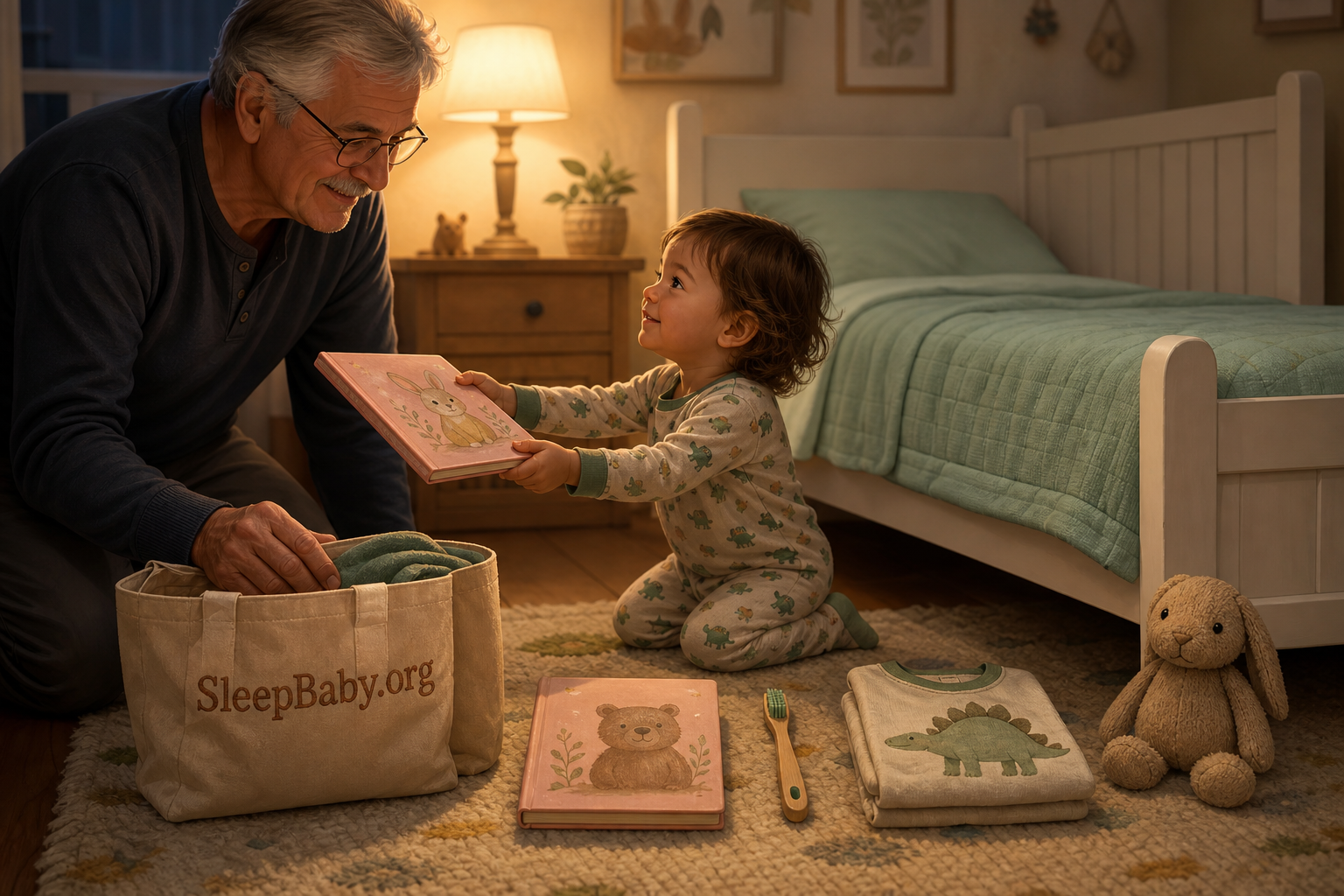
- Keep the order. Use the familiar sequence—perhaps snack, teeth, pajamas, two books, song, bed—even if the bathroom and bedroom look different.
- Keep the final phrase. A short sentence such as “You are safe, it is time to rest, and Dad comes after breakfast” can become a portable ending. The grandparent should use language that feels natural rather than performing an impression of the parent.
- Bring two or three meaningful cues. Familiar pajamas, one known book, a permitted comfort object, or the usual sound can help. Do not transport a van full of bedtime debris because you fear choosing the wrong sock.
- Match the broad timing. Preserve the child’s approximate nap and bedtime rhythm. If the day has run late, use a shorter routine rather than adding a stimulating second evening.
- Make the room boring enough to sleep. Dim the light, remove tempting toys from sight, check temperature, and stop screens before the wind-down.
If your child depends on every step being identical, practice small changes at home before the overnight. Our guide to a toddler who is very attached to routines explains how to keep useful anchors while gently building flexibility. For timing questions, compare the day with a flexible two-year-old sleep schedule or an age-appropriate three-year-old bedtime routine.

Use a grandparent handoff script instead of a secret escape
Leaving without saying goodbye can avoid one hard minute and create a much larger question later: if the parent vanished once, will it happen again? A better handoff is brief, truthful, and specific. Do not stretch it into a twenty-minute emotional press conference.
“You are sleeping at Grandma’s tonight. She will do pajamas, two books, and the song. I am leaving after dinner. I will come back after you wake up and eat breakfast. You may feel sad, and Grandma will help you.”
Then follow the plan. A photo schedule can help a child who needs to see the sequence: dinner, bath, books, bed, breakfast, parent returns. Use pictures rather than clock times unless your child genuinely understands the clock. The CDC notes that predictable routines help toddlers know what to expect; the value of the schedule is not decoration but reducing surprise.
Decide the video-call policy before you leave. For some children, a short goodnight call settles the reunion question. For others, seeing the parent restarts the entire goodbye and makes the room feel less tolerable. Test it during an easier evening. If calls usually escalate distress, send a recorded goodnight or skip the call and keep the return promise concrete.
What grandparents should do when the toddler protests
Grandparents need a plan simple enough to follow while tired. I want the plan to survive 1:17 a.m., not merely sound wise at dinner. Agree on the response before bedtime, preferably without holding the planning meeting over the child’s head.
Validate once, then guide
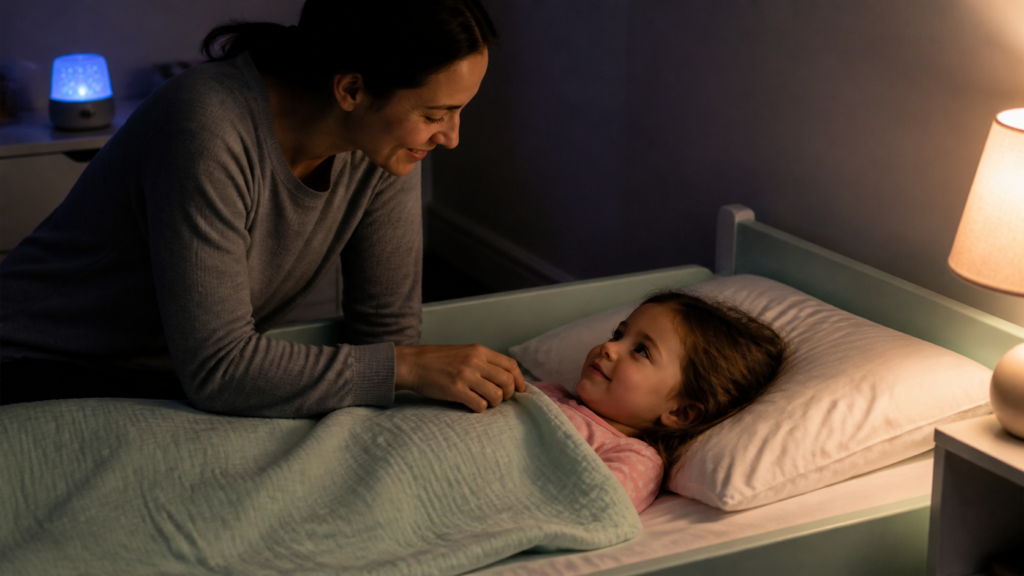
“You want Mom. She comes after breakfast. I am here with you. It is time for bed.” The grandparent can cuddle, sit nearby, or use another support the family has agreed upon. Repeating a calm answer is different from arguing the child out of missing someone.
Use a temporary support deliberately
A first overnight may need more presence than bedtime at home. Grandma might sit beside the bed, check at short predictable intervals, or stay until the child is calmer. That does not automatically destroy independent sleep. Name the support as part of this visit and step it down on later visits if it becomes unnecessary.
Keep limits warm and finite
Choose the number of books, whether another drink is available, and what happens after lights out. Meet real needs, but avoid converting every protest into a new activity. The NHS advises returning a child to bed with as little fuss as possible and limiting conversation at night so the response does not become stimulating.
Do not compete with home
A grandparent does not need a magical technique that proves they can make the child sleep better. The parent does not need to send a fourteen-page manual that implies no other adult can be trusted. Agree on safety, the core routine, comfort boundaries, and when to call. Leave room for the grandparent to sound like themselves.

If your toddler wakes in the night
Night waking in a new place is not surprising. The child surfaces between sleep cycles, checks the room, and discovers the grandparent instead of the expected parent. The first task is orientation: “You are at Grandma’s. It is nighttime. Dad comes after breakfast. I am here.” Use low light and few words.
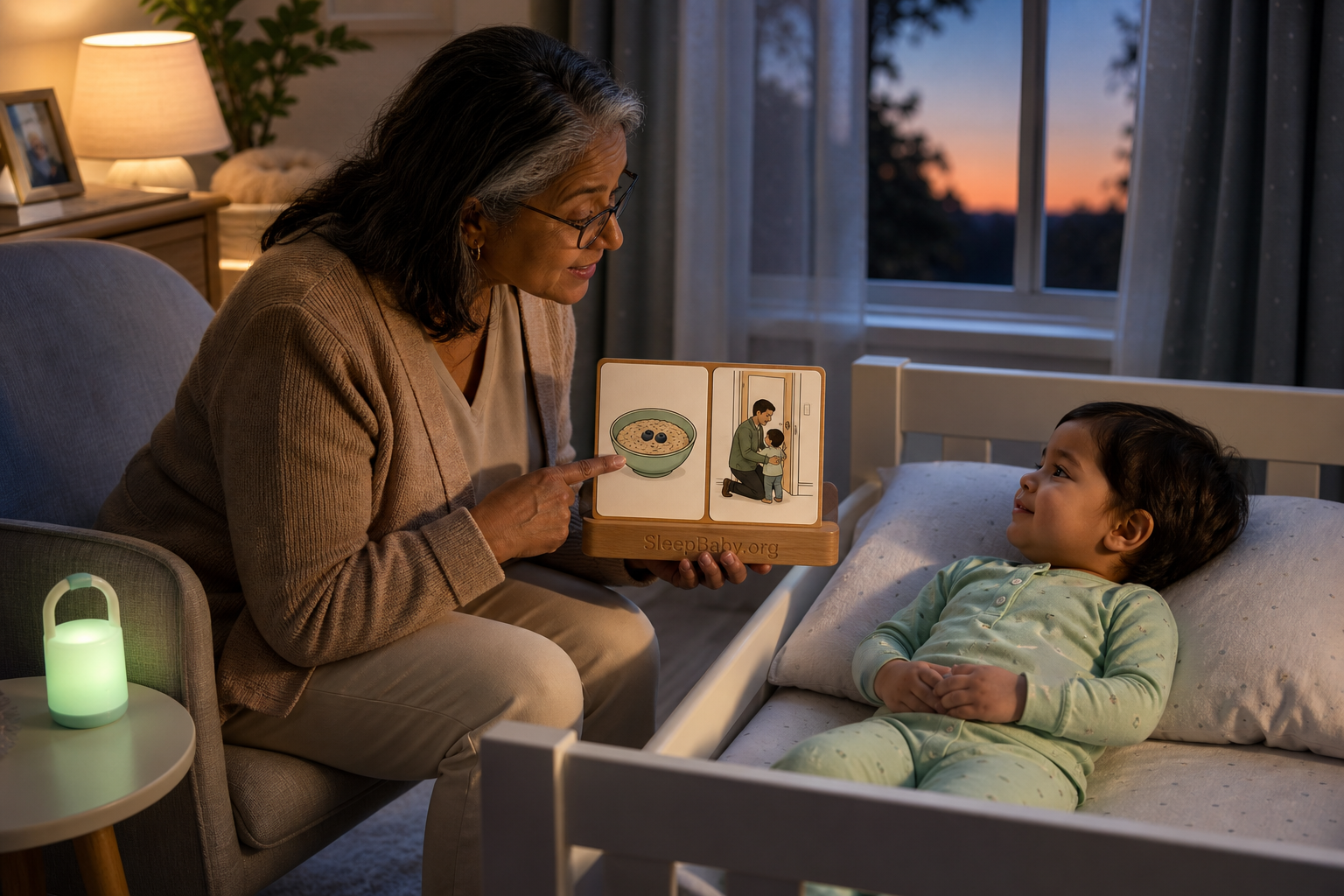
Respond to practical needs—pain, fever, thirst, toileting, a wet diaper, temperature, or fear—without assuming every wake is behavioral. Once those are addressed, return to the same agreed response. Repeating the exact calm pattern matters more than finding increasingly creative solutions at 1:17 a.m.
If the child becomes inconsolable, the grandparent can call the parent. Decide beforehand what “call me” means. Useful triggers might include signs of illness, breathing trouble, injury, repeated vomiting, a safety concern, distress that remains extreme despite the agreed comfort plan, or a grandparent who feels unable to continue safely. A pickup is not a failed experiment. It is an adult responding to the night that actually occurred.
Check the sleep space before the overnight
Grandparents may have lovingly saved equipment that is now old, damaged, recalled, or no longer appropriate for the child’s age. Inspect the actual setup rather than relying on memory. Use a sleep surface that matches the child’s developmental stage and the manufacturer’s limits. Check for gaps, entrapment hazards, unstable furniture, reachable cords, blind loops, medications, button batteries, magnets, firearms, pools, pets, and stairs.
If the child is still using a crib, confirm that it is correctly assembled, has the proper mattress, and has not been recalled. Do not add pillows, bumpers, or improvised padding to make a younger child’s unfamiliar crib “cozier.” For a child in a bed, secure the room as a sleep space: anchor furniture, block unsafe exits or stairs as appropriate, and keep medications and small hazards inaccessible. The overnight plan should include who is listening for the child and how the grandparent will reach the room safely.
Do not use melatonin, antihistamines, or another sleep product for a grandparent sleepover unless the child’s clinician has given individualized guidance and the caregivers can follow it exactly. A hard bedtime is not a reason to improvise medication.
When to postpone the sleepover
- Your toddler is ill, in pain, or recovering from a major disruption.
- The grandparent is unwell, exhausted, or not confident they can manage the overnight safely.
- The room or sleep equipment cannot be made safe in time.
- Your child has never spent meaningful awake time with the grandparent without you.
- Recent practice visits have produced escalating, prolonged distress rather than gradual familiarity.
- The adults disagree about essential safety or caregiving boundaries.
Postponing is especially reasonable when the overnight exists mainly to prove that the child “should be able to do it.” Try a shorter visit, bedtime practice with the parent nearby, or a grandparent caring for the child in the child’s own home. Readiness can grow without a ceremonial leap.
A seven-day practice plan before the next overnight
- Day 1: choose the portable anchors. Pick the final phrase, two routine steps, and one or two safe comfort cues that can travel.
- Day 2: let the grandparent lead one step at home. They read the books or do pajamas while the parent stays nearby but quiet.
- Day 3: visit the sleep room in daylight. Let the child see the bed, hear the house sounds, and place the book where it will be used.
- Day 4: practice a short separation. The parent leaves for an ordinary errand and returns at the promised event, such as after snack.
- Day 5: let the grandparent complete bedtime while the parent is elsewhere in the house. Keep the exit low-key and do not appear midway unless that was the plan.
- Day 6: review timing and safety. Confirm nap timing, dinner, medications if any, contacts, the sleep space, and the call-or-pickup plan.
- Day 7: keep the day ordinary. Avoid packing the hours with special excitement. Use the practiced goodbye and let the grandparent take over.
This is not a required seven-day certification. Some families need less practice and some need more. The point is to separate the skills: trusting the caregiver, recognizing the room, tolerating the goodbye, and following the portable routine.
A useful sleepover-room upgrade
A portable blackout blind can make the room less surprising
If the guest room gets bright summer-evening light or a streetlamp shines across the bed, the Tommee Tippee Sleeptime Portable Blackout Blind is a focused fix for this exact situation. It changes the light cue without asking your toddler to accept a new mattress, new bedding, or another stimulating bedtime object. That makes it a stronger fit than buying a pile of “sleepover” accessories when the clearest mismatch is simply a room that never gets dark enough. Measure the window, follow the manufacturer’s installation instructions, keep every part out of the child’s reach, and remove it if it cannot be secured as directed.
Check the Tommee Tippee portable blackout blind on Amazon
As an Amazon Associate, SleepBaby may earn from qualifying purchases.
What to do the morning after a bad night
Do not conduct an interrogation at pickup. “Did you cry? Were you scared? Why didn’t you sleep?” can make the night feel like a test the child failed. Start with reunion and basic facts. Ask the grandparent privately what time the child settled, what helped, when waking happened, and whether there were signs of illness or discomfort.
Keep the next day gentle, but do not automatically repair one poor night with a very long late nap that pushes bedtime far away again. Use your child’s usual rhythm as the reference and adjust modestly. If the visit was basically safe and warm but sleep was rough, identify one change for next time: earlier arrival, less evening excitement, a clearer goodbye, a darker room, or a shorter grandparent response. Do not change five variables and then claim the experiment taught you something.
If the overnight ended with a pickup, describe it neutrally: “Sleeping there was hard, so I came back. We can practice again another time.” The child does not need to hear adult disappointment or jokes about being a “failed sleepover kid.” Grandparents deserve the same kindness. A hard night is tiring; it is not a referendum on their relationship.

When persistent sleep trouble deserves professional help
Bring sleep concerns to your child’s pediatric clinician when difficulty settling or frequent waking also happens at home, persists for weeks, causes significant daytime sleepiness or behavior change, or comes with loud snoring, pauses or gasps in breathing, unusual movements, pain, reflux symptoms, persistent itching, or another health concern. Seek urgent care for breathing difficulty, serious injury, poisoning, severe illness, or another immediate medical emergency.
The grandparent’s house may reveal a broader issue because the usual supports are missing, but it does not diagnose the cause. Write down what happened at home and away: nap timing, bedtime, how long settling took, night waking, breathing or movement observations, and daytime effects. Specific observations help a clinician much more than “he is a terrible sleeper everywhere.”
The simplest plan for tonight
If the overnight is tonight and you have no week to practice, I would narrow the plan to four things. Keep the child’s approximate schedule. Pack the two strongest familiar cues. Give one short truthful goodbye with a concrete reunion point. Leave the grandparent a written response for protests, night waking, and when to call. Then stop improving the plan.
The overnight bag on the guest-room floor does not need to contain a replica of home. It needs enough familiarity for the child to recognize the path toward sleep, enough clarity for the grandparent to hold that path calmly, and a reunion promise the adults will keep. The unfamiliar hallway may still make noises. By morning, it can also become part of a house where your toddler learned: I missed my parent, another trusted person helped me, and the promised return happened.
Watch the sequence, not a sleep trick
Preview a toddler bedtime routine before you hand it over
This child-facing routine video can help adults notice how few cues a portable wind-down actually needs. Preview it yourself; the useful lesson is the predictable order, not adding screen time at bedtime.
Grandparent takeaway: choose a short sequence you can repeat calmly—wash, pajamas, books, goodnight—and keep the phone or tablet out of the child’s actual wind-down.
Sources
One calm plan for the next night
Make the unfamiliar room feel predictable
Carry the bedtime sequence, agree on the grandparent’s response, and keep the reunion promise concrete. SleepBaby can help you choose the next age-appropriate step without turning one difficult overnight into a family verdict.
Explore more SleepBaby sleep guidance
SleepBaby offers general education, not individualized medical advice or a replacement for your child’s clinician.
The SleepBaby.org Workshop
Make a plan for
the next bedtime.
Practical help for wake-ups, short naps, and sharing the night shift. Watch the original video, then get 15 guides and five audio tracks for $9.
$9 USD, paid once. No subscription. Digital access.
Watch the original Baby Sleep Miracle presentation
Press play for a little help with your baby’s next bedtime.
Original presentation. Watch before you decide.
15practical guides
5audio tracks
1one-time payment
Kind words about the original video
“Thank you so much for this video!”
“I'm truly impressed with how much information you share in your video.”
Inside the Workshop
Start with the night
you're having.
You don't need to read all 15 guides before bedtime. Choose the one that answers the question in front of you, then come back for the next part.
Before you buy
A few things
made clear.
A straightforward purchase, with space to decide what fits your family.
What am I buying?
The SleepBaby.org Workshop includes 15 digital guides, five audio tracks, and the original Baby Sleep Workshop PDF as an additional download. It costs $9 USD, paid once, with no subscription. Nothing is shipped.
Where should I start?
Try Tonight Rescue when you need a starting point. If your question is more specific, go straight to the guide on naps, a caregiver handoff, the sleep space, or another topic. You can read at your own pace.
Is this personal sleep coaching?
No. This is an educational collection for parents of babies and young children. Use the age-specific guidance, and bring feeding, breathing, growth, illness, or other health concerns to your child's clinician. It does not diagnose a problem or promise a sleep result.
Is the video the paid Workshop?
You can watch the original Baby Sleep Miracle presentation on this page. Your purchase is the SleepBaby.org Workshop collection of guides, audio tracks, and the original PDF described here.
How do I find it after checkout?
On your thank-you or order-status page, look for Open Workshop access, then Open your SleepBaby Workshop. Keep your order confirmation so you can return. If you need help finding your access, use our Workshop download help.
The SleepBaby.org Workshop
Have somewhere to start
at the next bedtime.
15 practical guides. Five audio tracks. One $9 purchase.
A quiet parent-to-parent note
What would you add about Toddler Sleep?
Share one useful detail, question, or experience. No account is needed. Please leave out names, medical records, and other private details.
There is room for the first useful note.
If you have a thoughtful question or detail about Toddler Sleep, you can begin the conversation below.