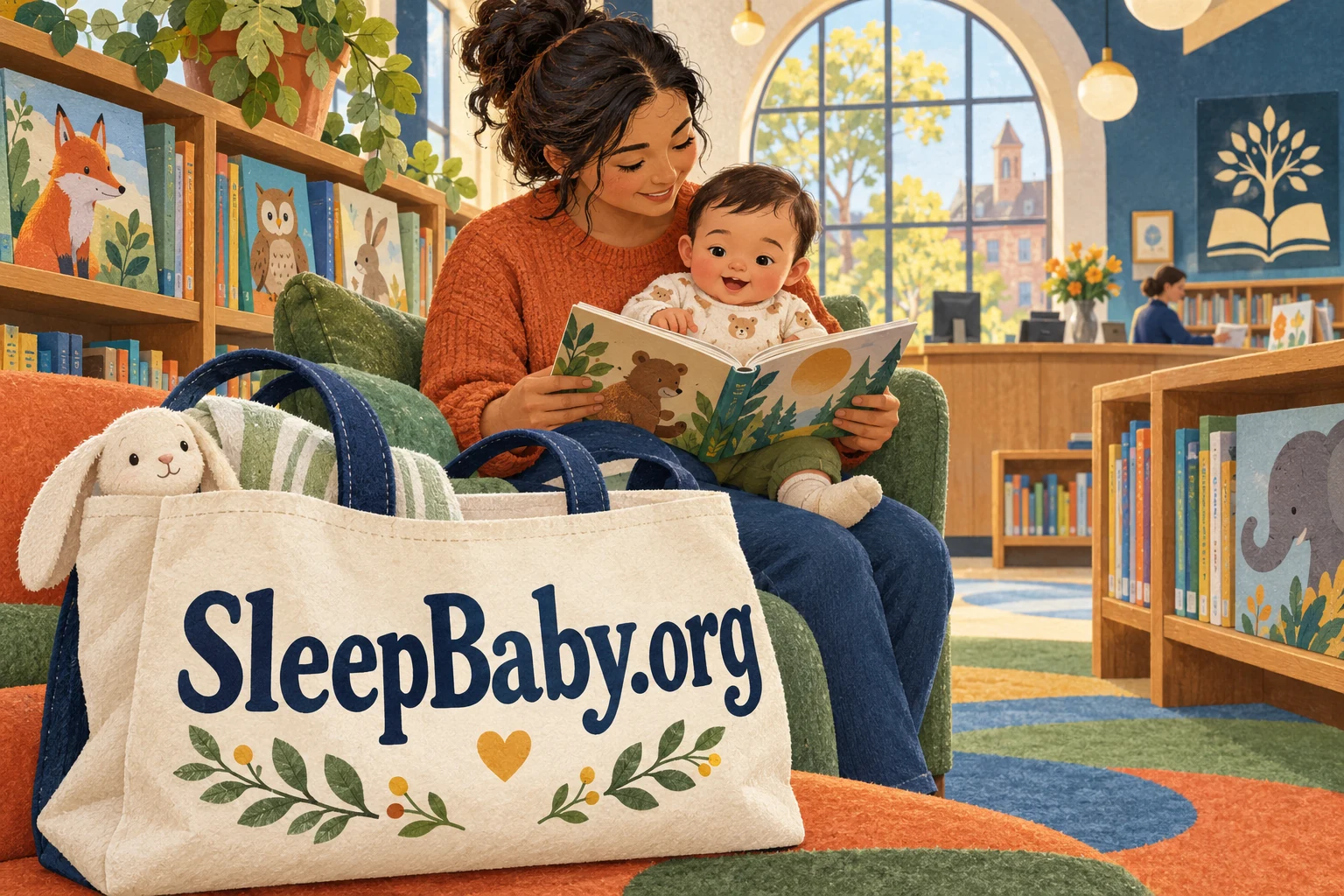
Yes, you can plan a library visit with a baby. Start with the children’s area or a program specifically for babies, check your branch’s current rules, and keep the first visit easy to leave. Your baby does not need to sit still, understand a story, or finish a book for sharing it with you to be worthwhile.
I would make the first goal very small: find the baby books, look at one together, and learn where you can take a break. Borrowing a book is a useful bonus. Staying until the last song is optional.
If your baby is unwell, choose care and a book at home instead of a group event. For a newborn or a baby with medical vulnerabilities, ask their clinician about crowded indoor outings. Being ready to share books and being ready for a busy room are separate questions.
SleepBaby.org · The original video
A little help
for the night ahead.
Take a moment to watch the original Baby Sleep Miracle presentation. Your article will be right here when you’re ready to keep reading.
Ready to get started?Take the next step with SleepBaby.
Help my baby sleepChoose the visit you actually want
A quiet browse, a baby storytime, and an hour when you hope to do your own work are three different outings. Plan for the first two with your baby. For uninterrupted study or work, arrange another adult to care for them. A librarian leading an activity is not taking over supervision.
A browse lets you arrive when it suits your day, provided the branch is open. A scheduled group can introduce you to songs, books and other caregivers, but it brings a fixed start time and possibly a crowded room. Neither choice is a better-parent test.
Three good versions of a first visit
Browse: find the children’s desk, choose one book and sit together for a moment. Best when you want to learn the building without a program deadline.
Join: attend a baby-appropriate session with a clear route out for a feed, change or break. Best when its timing and format fit today’s needs.
Collect: pick up a reserved book and head home. Best when the outing needs to be brief. Check whether your branch offers holds or another collection option before relying on it.
You can change versions after you arrive. Collecting one book after deciding against a noisy room still gives you something to share later.
Check the branch, not just the event’s name
Look up the specific location and date. Confirm whether the session is for pre-walkers, babies and caregivers, toddlers, or mixed ages. “Family storytime” can cover a very different group from a gentle lapsit program.
For example, the New York Public Library’s event listings distinguish baby/lapsit sessions from programs for new walkers, with different registration and capacity arrangements. That illustrates why the individual listing matters; it is not a schedule or admission rule for your own library.
Check these practical details before the day becomes a trip to the wrong entrance:
- Whether booking, a ticket or first-come admission is required, and whether each child needs a place.
- Whether siblings can join the same session.
- The accessible entrance, elevator availability and route to the children’s room.
- Where strollers go and whether yours can remain with you.
- Where the toilets, changing facilities and a suitable place for feeding are.
- Any current illness, food, drink or shared-toy guidance.
If floor sitting is difficult, ask about a chair before the program. If you need a quieter arrangement, a sign-language program, materials in another language, or accessible books, name that need directly. Availability varies. Staff can give you a more useful answer to a specific request than to “Is it baby friendly?”
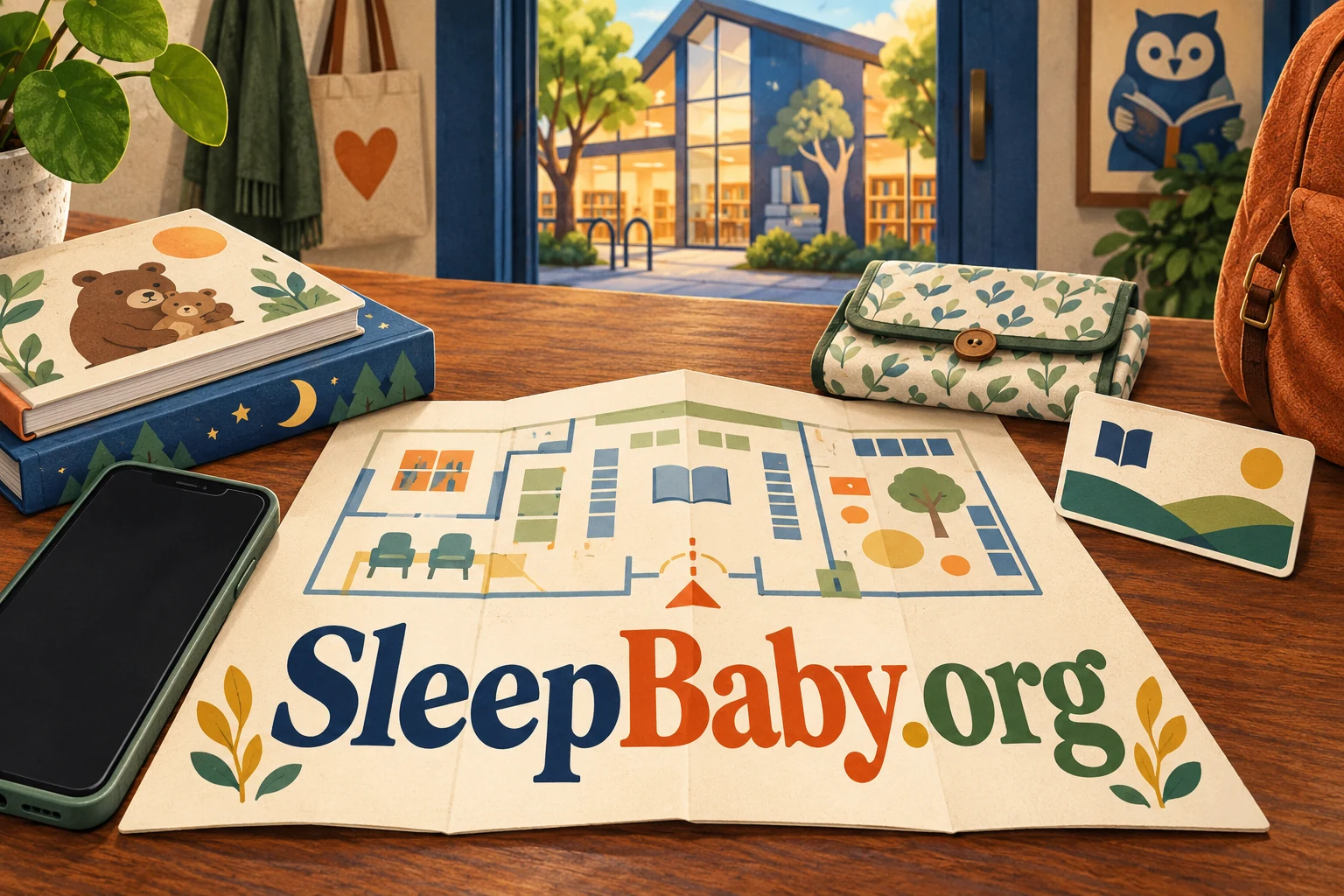
A short question for the children’s desk
Here is a suggested script you can adapt: “I’m bringing a baby who isn’t walking yet. Is this session suitable, do we need to book, and where can we step out for a feed or a break? I also need to know about the stroller entrance and changing facilities.”
Add the detail that could change your decision, such as an older sibling, difficulty using stairs, or a baby who finds loud singing upsetting.
Pick a manageable window, not a perfect nap
Choose a time when getting there is reasonably comfortable for both of you. Count the journey, parking or transit, reaching the room, and the journey home. A short event can still mean a long stretch away from your usual supplies.
A feed or diaper change before leaving may simplify the start, but keep responding to your baby’s needs once you are there. Do not postpone a feed, keep a tired baby awake, or rush your own recovery to make the opening song. A different session or a simple browse may suit the day better.
For the first visit, I would leave the calendar afterward fairly open. That gives you room for a change or feed without making the library the first stop in a chain of deadlines. There is no required number of minutes to earn the benefit of a book.
Pack so that you can find the useful things
Bring your usual feeding supplies, diapers, wipes, a changing mat if you use one, a spare outfit and a bag for wet clothing. Keep feeding items protected and separate from borrowed books. Bring what you normally need for the outing plus a realistic delay; you do not need special library equipment.
A small pouch that you can reach with one hand is often more useful than several loose bags. Put your card or collection details in an accessible pocket. If you borrow books, keep them away from leaking bottles and wet wipes on the trip home.
If you bring milk or formula, follow the storage and preparation guidance for that exact feed. The CDC’s breast milk guidance and formula guidance distinguish preparation, storage and feeding limits. A book bag is not cold storage, and a program running late does not extend those limits.
For snacks once your baby is eating solids, choose a permitted eating spot and their usual safe, supervised feeding setup. Do not turn walking between shelves into snack time. There is no need to bring food merely because a generic packing list mentions it.

Let the first few minutes be about getting settled
Find the children’s desk, the place for a break, and the exit before opening the first book. Ask where to put books you have handled but are not borrowing; some branches prefer a return trolley rather than your attempt to find the exact shelf.
In storytime, choose a place where you can see the reader and leave without climbing over other families. Keep a door or accessible route clear. Set bags and stroller wheels out of the walking path, and keep your baby with you.
If the room is already full, ask about another session or browse instead. Do not squeeze into a space that prevents safe movement. If you arrive late, follow staff’s guidance about joining rather than assuming that every group accepts late entry.
Watch what the room is asking of your baby. A group with loud instruments, energetic toddlers and floor movement may feel quite different from one adult sharing a board book with a small circle. Choosing a quieter option is a practical adjustment, not a judgment about your child’s ability.

What if your baby cries?
Attend to your baby first. Try a position change, feed or diaper check as appropriate, and move to your planned break spot if the room is not helping. You do not need to wait until the crying becomes dramatic before stepping out.
Brief baby sounds and sustained distress call for different responses. Follow the setting’s expectations, while remembering that an infant cannot be instructed to whisper. In a shared quiet space, taking a break protects your baby’s comfort and lets other people continue their activity.
One simple sentence is enough: “We’re going to take a break.” You do not owe the room a running apology. Rejoin if your baby settles, you want to return, and the session allows it. Otherwise, leave.
If you are worried about this before your first outing, try the short browse version. Knowing the route from the children’s area to the door can make a later group visit feel much less complicated.
AFTER THE LIBRARY
A small story can come home with you
For information about everyday bedtime routines and baby sleep schedules, the SleepBaby.org Method is described on our homepage.
A borrowed book or a familiar rhyme can give you something simple to return to after the trip. Follow your baby’s feeding and sleep needs; the story does not need an ending before you put it down.
If you want to explore ordinary sleep planning separately, read the current Method information and decide whether it fits that question. It does not make storytime attendance necessary, promise a quiet outing, or replace individual medical advice.
Share the book your baby is interested in
The American Academy of Pediatrics recommends sharing books from birth. You do not need to wait until two months or until your baby can point, answer a question or turn a page.
Try a clear picture, a familiar object or a simple rhyme. Let your baby’s interest guide what happens next. Looking away, fussing or arching away can mean it is time to pause. The AAP specifically notes that you do not need to finish the story.
A book with a ball on the page does not require a lesson about colors, counting and circles. You can name the ball, make a rolling gesture, and see whether your baby wants another moment. If they reach for a different page, go there. Keep it a shared exchange rather than a demonstration of what they know.
The one-page pause
- Notice: open to a picture your baby is looking at.
- Offer: name one thing, make a small sound, or describe what you see.
- Pause: give your baby room to look, move, vocalize or simply stay close.
- Follow: continue, change the page, or stop according to their interest.
This is an easy way to make a book into a shared moment. It is not a developmental test, and your baby does not need to give a particular response.
Match the book to what your baby can do today
For a very young baby, you can hold the book while supporting them comfortably. For a baby who reaches and grabs, thick pages may be easier to handle. Avoid treating an age label as an instruction to perform a skill.
Ask staff to show you a few sturdy choices rather than bringing a towering stack to your chair. If a flap, loose piece or damaged edge looks unsuitable for your baby, choose another book and tell staff. Do not use small story cubes, beads or detachable craft pieces as infant reading props. The CPSC advises keeping small balls and toys with small parts away from children under three.
An older, mobile baby may prefer a few moments of looking and then a change of activity. Keep supervising them around shelves, chairs and older children’s materials. If they want to explore, use a suitable permitted space together; do not let a children’s room sign stand in for supervision.
Keep your own language in the conversation
You can describe pictures in the language you use comfortably, even if the printed words are in a different language. Ask about books or sessions that fit your family’s languages. The AAP and American Speech-Language-Hearing Association advise caregivers to communicate in the languages they are most comfortable using.
If reading printed text aloud is difficult, start with pictures and your own description. You can borrow a book for the pictures without turning the outing into a test of your reading, pronunciation or storytelling voice.
Ask for adaptations that fit your child
Children with hearing, vision, motor or developmental needs can share books, too. The AAP’s reading adaptations include thick pages, describing pictures, and positioning the book and your face where the child can access them. Ask your child’s care team about individual communication or positioning needs.
A librarian may be able to help locate tactile books, appropriate formats or a quieter program. Describe what would help. A child who does not participate like the rest of a group has not failed storytime.
Borrowed books, baby mouths and shared materials
Mouthing books is a familiar part of infancy, but a shared library book still needs care. Stay close, redirect to an appropriate item of your own when needed, and hand a mouthed or soiled book to staff so they can follow their procedure. Do not quietly put it back for the next family.
Ask how the branch handles cleaning and damaged items. Do not soak, spray or wipe a borrowed book with a product without checking; its pages and binding may not tolerate it. If a page is damaged, tell staff rather than making a repair they may need to undo.
Wash hands at useful points such as after a diaper change and before preparing a feed. Avoid sharing items that are going into babies’ mouths. No shared room or object is guaranteed germ-free, so keep your plans flexible when someone is ill.
For respiratory symptoms, follow the CDC’s guidance about staying home when sick and your clinician’s advice, as well as the library’s current expectations. Do not assume a quiet baby with a fever just needs a calmer storytime. A baby three months old or younger with a rectal temperature of 100.4°F (38°C) or higher needs an immediate call to their clinician, according to the AAP’s infant fever guidance.
An optional book of your own
If you want to compare a personal copy for repeated handling, one named option is Indestructibles: Baby Faces: A Book of Happy, Silly, Funny Faces, illustrated by Kate Merritt and created by Amy Pixton. Check the publisher’s current description and care instructions for the exact edition. I haven’t tested it, and the books illustrated here are imaginary rather than pictures of that product.
Free or already-owned alternative: borrow a suitable book with the library’s guidance, or share a sturdy book you already have. Keep supervising handling and stop using an item that is damaged or unsuitable. You do not need a new purchase to begin reading together.
This section has no affiliate purchase link. As an Amazon Associate, SleepBaby.org earns from qualifying purchases through affiliate links elsewhere on the site.
Feeding, changing and breaks without a scramble
Keep feeding responsive to your baby. If you prefer privacy or need a particular seat, ask about options; a separate room may not exist. For bottle preparation, use your usual safe method and the feed’s storage limits rather than improvising because a tap or microwave is nearby.
Use the designated changing facility where available. Keep a hand on your baby on a raised changing surface; Miller Children’s Hospital’s changing guidance emphasizes close supervision and keeping needed supplies within reach. If the facilities do not work for you, ask staff for an appropriate alternative. A reading table or public seating area is not your default changing station.
When using a stroller, secure the harness and brakes according to its instructions. Keep bags from making it unstable, as the AAP’s stroller guidance explains. A carrier may be convenient, but keep your baby’s face visible, their airway clear and their chin away from their chest, following CPSC’s babywearing guidance.
If your baby falls asleep in a sitting device such as a stroller or car seat, the NIH advises moving them to a suitable infant sleep space as soon as possible. Use their back, a firm flat level mattress and a clear separate crib or other appropriate infant sleep space. Library cushions, a changing mat and a couch are not substitutes. Plan the trip home around care needs rather than keeping a nap going while you browse.

Make borrowing manageable at home
Before checking out, ask about the card you need, borrowing limits, return dates, renewals and what happens if an item is lost or damaged. Rules and charges vary, so do not assume that a policy from another library applies.
Start with a number of books you can keep track of. One or two is a perfectly usable choice. Put the due date somewhere you will see it and choose a dry place for library books, away from leaking supplies. Keep bags and their straps out of your baby’s reach.
If you want recommendations, tell the librarian what you noticed: “My baby kept looking at the animal pictures,” or “We need sturdy pages, and I would like books in Spanish.” That gives them a starting point for the next choice without turning your observation into a developmental label.
You can also ask about reserving a book, borrowing across branches, accessible formats or outreach if getting into the building is difficult. These are options to investigate, not services every library necessarily provides.

Bring home one thing you want to repeat
It might be a rhyme you enjoyed, a picture your baby watched, or the knowledge that a shorter session fits better. Repeat the part that worked without trying to recreate the whole program.
The American Library Association’s Babies Need Words Every Day resources include simple ideas for talking, reading, singing and playing, along with a book list you can ask about at your library. You do not need to turn the kitchen into a classroom to keep sharing language after the outing.
If a book fits comfortably into your evening, share it while you are both awake and put it away before your baby sleeps. A familiar story can be part of your routine; finishing it is not a condition for going to bed.
Your note for next time
Keep: one thing that made the visit easier, such as the accessible entrance or a seat near the exit.
Change: one friction point, such as the time, the size of the group or the number of books you carried.
Ask: one useful question for staff, such as a different program or a book in your home language.
The next visit can be smaller. The useful part is finding a way to share books that you can actually return to.
Watch: sharing stories with your baby
UNICEF’s Why it’s important to read to your baby discusses picture books, everyday conversation and stories as shared experiences. It offers a reading perspective, not a requirement to attend a library program or a prediction of your child’s development.
Written takeaway: notice what interests your baby, talk about pictures and ordinary experiences, and use short stories while you spend time together. You can make the exchange meaningful without reading every printed word.
If playback is unavailable, read the complete official transcript or open UNICEF’s video.
Sources
- NYPL: Storytime and Read-Aloud Event Listings
- CDC: Breast Milk Storage and Preparation
- CDC: Formula Preparation and Storage
- AAP: How to Share Books With Your Baby
- CPSC: Toy Safety
- AAP and ASHA: Young Children Learning Multiple Languages
- AAP: Reading With Special Health and Development Needs
- CDC: Preventing Respiratory Spread When Sick
- AAP: Fever and Your Baby
- Miller Children’s Hospital: Changing Table Safety
- AAP: Stroller Safety
- CPSC: Safe Babywearing
- NIH: Safe Sleep Environment
- ALA: Babies Need Words Every Day
- UNICEF: Why It Is Important to Read to Your Baby, Video and Transcript
- Hachette/Workman: Indestructibles Baby Faces, Publisher Listing
ONE BOOK IS A START
Keep the part that worked
Borrow a manageable number of books, note one helpful detail for next time, and let your baby set the pace of the reading. Your next library visit can be a short one.
For separate information about everyday bedtime routines and baby sleep schedules, visit SleepBaby.org to read about the current Method.
SleepBaby.org · The original video
A next step for
the next bedtime.
Still thinking about sleep? Watch the presentation here, then explore the SleepBaby program whenever you’re ready.
Ready to get started?Take the next step with SleepBaby.
Help my baby sleep