
If your baby may have swallowed gravel, check their breathing first. Call 911 if they cannot breathe or cry, have a weak or absent cough, turn blue, collapse, or cannot be awakened. If they are breathing comfortably, move them away from the gravel and call their pediatrician or urgent-care service now for advice. Babies are in the higher-risk age group for swallowed objects. Do not make them vomit or try to push a stone down with food.
I would make that call before trying to work out whether the missing pebble was “small enough.” The useful distinction is whether a stone was swallowed, inhaled, or only held in the mouth. A comfortable-looking baby does not answer all three questions. Seattle Children’s advises prompt care for swallowed objects in children younger than 2.
Start with the baby, then the stone
Breathing emergency: Call your local emergency number immediately. In the U.S., that is 911. Follow the dispatcher’s instructions and give age-appropriate choking first aid.
Breathing comfortably, but a stone may be missing: Contact your child’s clinician promptly. Describe what happened, including any coughing or choking that has already stopped.
Possible chemical or soil exposure: In the U.S., call Poison Control at 1-800-222-1222. Outside the U.S., use your local poison service. Trouble breathing takes priority over a poison consultation.
These are different routes to help. A poison assessment of the material does not, by itself, establish where a solid stone went.

What I would do in the first few minutes
Pick your baby up or move together to a clear area. Keep watching their breathing and responsiveness while you arrange help. If another adult is there, one person can stay with the baby while the other makes the call and gathers information.
Do not reach blindly into the mouth. An object you cannot see is not something to hunt for with your finger. Remove an object only if it is clearly visible and can be taken out easily without pushing it farther back. The American Red Cross warns against blind finger sweeps.
If your baby is coughing strongly and can breathe or cry, stay with them and allow the cough to work. Be ready to act if that changes. For a responsive infant under 1 with severe choking, Red Cross guidance uses cycles of five back blows and five chest thrusts. If the infant becomes unresponsive, start CPR according to your training and the emergency dispatcher’s directions. Infant and older-child techniques differ; do not use abdominal thrusts on a baby under 1.
Do not delay emergency action to read the rest of this page or play a video. The written Red Cross instructions below are a learning resource for another moment, not a reason to postpone calling.
For gravel ingestion, I would skip improvised “fixes”: extra food, a large drink, oil, laxatives, or trying to trigger vomiting. Ask the clinician what your baby may have by mouth while you arrange assessment. If your baby is drooling, distressed, or having difficulty swallowing, do not give food or drink. Poison Control advises against inducing vomiting; the Royal Children’s Hospital explains when swallowing symptoms need hospital care.
Symptoms that change the plan
Call emergency services for breathing difficulty, severe choking, collapse, a seizure, or a baby who cannot be awakened. New wheezing or a harsh sound when breathing after this event also needs emergency attention. You do not need to finish counting stones first.
Seek urgent medical assessment for drooling that is unusual for your baby, trouble swallowing, ongoing vomiting, pain in the neck, chest or belly, blood in vomit or stool, or a child who looks very unwell. Tell the clinician about fever after a suspected swallowed object. These are reasons to get help, not a checklist that must all be present.
One detail deserves its own sentence: tell the clinician about a choking or coughing episode even if your baby now seems settled. An inhaled object can produce a quieter interval. The Royal Children’s Hospital’s inhaled-object guidance notes that symptoms can be delayed and that a normal examination or chest X-ray does not exclude an airway foreign body. A later persistent cough or wheeze needs assessment with this history included.
I would say “this started when gravel was in their mouth,” rather than reporting the cough as an unrelated new symptom. That connection gives the medical team information they cannot get from how your baby looks during the call.
The STONE note: five things to bring to the call
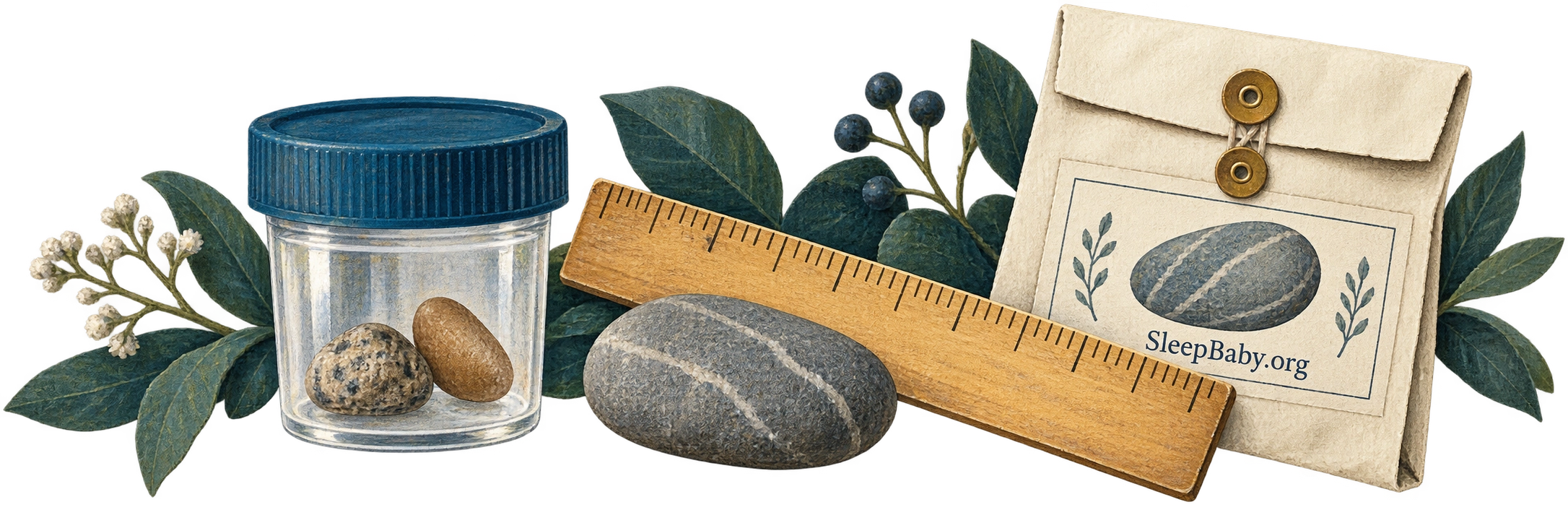
You can use a scrap of paper or the notes app already on your phone. This is a memory aid, not a home risk score. Leave an unknown blank rather than inventing a likely answer, and never delay care to fill it in.
S · T · O · N · E
- S: Symptoms
- What is happening now? What happened at the start, including a cough or choke that stopped?
- T: Time
- When did you see it, or when was the last moment you know the gravel was out of reach?
- O: Object
- Was it definitely stone? Smooth or jagged? One piece or an unknown number? Photograph a similar piece beside a ruler if another adult can do that without delaying help.
- N: Nearby material
- Garden soil, a treated driveway, plant fertilizer, paint chips, aquarium products, or another substance? Keep the actual label if there is one.
- E: Essential child details
- Age, known weight, relevant health conditions, medicines, and previous swallowing or digestive problems.
Useful opening: “My baby may have swallowed gravel at about [time]. They are [describe breathing and symptoms]. I saw [what you actually saw]. I don’t know [what is uncertain].”
The details about time, amount, symptoms and your child come from Poison Control’s guidance on what specialists ask. A similar object can also help the hospital assess its size and material. Keep any sample closed and out of reach; do not hand it back to your baby to compare.
AFTER THE CARE PLAN IS CLEAR
Leave the medical decisions with your clinician. Make the ordinary evening simpler.
When the medical questions have been addressed, you can explore your free starting step at SleepBaby.org. Three choices suggest one ordinary sleep-planning step, without a sign-up or card.
A gravel scare can interrupt the day’s rhythm. I would keep the clinician’s observation instructions in their own note, then decide whether a familiar bedtime step needs any attention at all.
If you want more guidance later, the optional paid SleepBaby.org Workshop offers short lessons you can revisit and a seven-night tracker. It cannot assess a swallowed stone, authorize sleep, replace monitoring instructions or promise a result.
Will a swallowed pebble pass on its own?
Many small, smooth objects pass through the digestive tract without a procedure. That is reassuring background information, but it is not a way to clear an individual baby at home. Age, symptoms, the object’s shape and size, and whether it was actually swallowed all matter.
The clinician may recommend an examination, imaging, or a specific observation plan. I would let that decision follow the actual history instead of asking your baby to demonstrate that they can swallow a cracker. A feeding experiment cannot tell you everything you need to know about a missing stone.
Ask what should happen next if the stone is not seen in a diaper. Published advice differs about checking stools and when follow-up is needed. Your child’s plan should say whether to look, for how long, and when to call back. You do not need to turn a general “a few days” estimate into a deadline or a promise.
If home observation is recommended, write down the instructions while you are still on the call. I would ask: “What can they eat or drink? What symptoms mean we leave for care? Do you want a follow-up call? Do we need to look for the object?” Those answers are more useful than repeatedly searching for a universal passing time.
What about dirt, garden chemicals, or aquarium gravel?
The stone and anything coating it are separate questions. Tell Poison Control where it came from and whether a product was used nearby. “Driveway gravel” and “decorative stones from a recently treated planter” are useful descriptions. Neither tells you the exact exposure on its own.
Poison Control’s dirt guidance describes stomach upset after eating dirt and additional concerns with repeated ingestion. It does not make a swallowed pebble harmless. For a baby with visible dirt around the lips and no choking, gently wiping the accessible residue with a damp cloth is different from reaching into the throat. Ask for age-appropriate feeding advice rather than offering a large amount of water to a young infant.
For a planted pot, keep the soil or fertilizer packaging available. For an aquarium, report the gravel and any water-treatment products that may be involved. If you cannot identify the product, say so. Do not guess that a colorful grain was a stone if a bead, magnet, battery, or another small object could have been nearby.
A possible button battery or magnet needs immediate emergency assessment. Do not follow an ordinary-pebble observation plan when the object is uncertain. Describe that uncertainty clearly when you call.
Make the next play spot easier to supervise
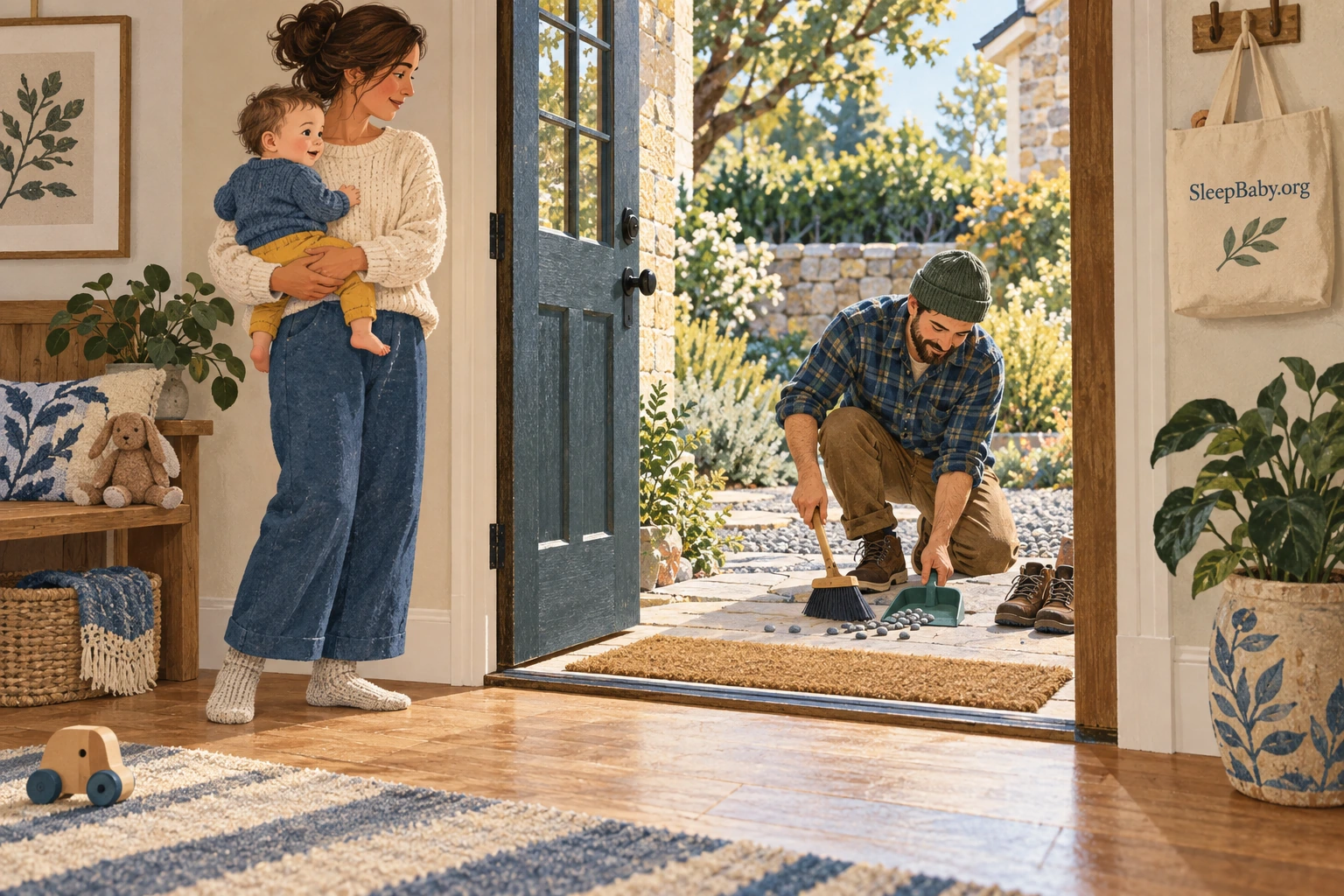
Once your baby’s care has been arranged, I would change where play happens before trying to teach a crawling baby to leave every pebble alone. A garden can stay a garden; your baby does not need access to every part of it.
- Choose a clear surface away from loose landscaping. Look at it from your baby’s level. A blanket with a gravel border within reach does not create much separation.
- Check the route back indoors. Loose stones can arrive in shoe tread, a stroller basket, pockets, or the fold of an outdoor mat. Empty and clean those things where your child cannot reach the contents.
- Move decorative stones out of reach. Low plant pots, craft trays and bowls of polished pebbles deserve the same attention as the driveway.
- Keep suitable toys simple. Use age-appropriate toys in good condition. The CPSC advises keeping small balls and toys with small parts away from children under 3.
- Agree who is watching. A direct handoff such as “I’m going inside; you’re watching now” is clearer than two adults each assuming the other has the job.
A useful prevention change is one you can point to: the planter is higher, the threshold is clear, or today’s floor play has moved indoors. “We’ll be more careful” is much harder to repeat when everyone is carrying bags and opening doors.
Optional: a defined space for supervised play
As an Amazon Associate, SleepBaby may earn from qualifying purchases.
If you want a physical boundary on a clear, level surface, one option to compare is the Toddleroo by North States Superyard Classic, six-panel gray enclosure, model 8666/8669. The manufacturer lists a 26-inch height and an enclosed area of up to 18.5 square feet. Its practical role here is separating an awake play area from loose garden material; it is not a treatment or a guarantee against swallowing objects.
The current instructions specify ages 6–24 months, adult supervision and stopping use when a child can climb over or dislodge/open it. Use the prescribed configuration and all required parts, follow the surface and temperature restrictions, and never use it on uneven ground or as a pool or stair barrier. A panel enclosure is not a crib or a sleep space.
Free alternative: Use a cleared indoor floor area and sit beside your baby with suitable toys. You do not need to buy anything to move play away from gravel.
Compare the six-panel Superyard Classic on Amazon
Check the exact model, current instructions and recall information before use, especially for a secondhand enclosure. Manufacturer details and instructions.
Does eating stones mean pica?
One mouthing incident is not enough to diagnose pica or a nutrient deficiency. Young babies explore with their mouths. Repeatedly seeking out and eating nonfood material deserves a separate conversation with your child’s clinician, especially as the pattern continues beyond ordinary infant mouthing.
The American Academy of Pediatrics’ parent guidance discusses pica and its possible connection with low iron. That connection is a reason for assessment, not a reason to start an iron supplement on your own.
I would note what your child tries to eat, where it happens, and how often. “Three attempts to eat plant-pot soil this week” gives the clinician a more concrete starting point than “puts everything in their mouth.” Keep preventing access while you arrange that conversation; a possible explanation does not make gravel suitable for play.
Can my baby sleep after swallowing gravel?
Ask the clinician handling this event about sleep and observation before putting your baby down. An article cannot give clearance for a nap, and looking sleepy does not establish that an object has passed. If your baby cannot be awakened, call emergency services.
Once you have a home-care plan that allows sleep, keep the medical instructions separate from ordinary bedtime habits. Record what you were told about checks or follow-up and pass that information to the next caregiver. Do not replace those instructions with a sleep-training plan.
For babies under 1, continue the usual NICHD safe-sleep guidance: start sleep on the back, on a firm, flat, level approved sleep surface with a fitted sheet and no loose bedding or soft objects. Do not incline the mattress, add a positioner, or choose stomach sleeping to try to help a pebble move.
If everyone has had an unsettled afternoon, I would keep the ordinary evening simple once the care plan permits it. A familiar quiet routine is enough. There is no need to “make up” a nap by overlooking new symptoms or changing the medical plan.
Learn infant choking first aid from the Red Cross
The American Red Cross demonstration, What to Do When Infant is Choking (Responsive), shows infant first-aid technique. It is for learning and review after the immediate situation has been handled. It does not decide whether a swallowed or inhaled stone needs medical assessment.
Written fallback: A baby who cannot cough or cry needs immediate help. Infant choking care uses back blows and chest thrusts; an unresponsive baby needs CPR according to your training and emergency instructions. Read the official Red Cross steps and take a practical course when you can. If choking is happening now, call emergency services rather than watching.
Before another caregiver takes over
Give them the actual plan: what may have been swallowed, the time, who you spoke with, what that professional advised, and what would mean getting help again. A photo of the written instructions is easier to share than a hurried “they said it’s probably okay.”
My next step would stay small and concrete: get the right advice for this baby, keep that advice where both caregivers can find it, and move the next play session away from loose stones. You do not have to settle every future garden decision while you are dealing with today’s call.
Sources
- Seattle Children’s: Swallowed Foreign Object
- American Red Cross: Infant Choking
- Poison Control: First Aid for Poisonings
- Poison Control: How to Get Help
- Poison Control: Dirt and Soil
- Royal Children’s Hospital: Swallowed Objects
- Royal Children’s Hospital: Inhaled Foreign Bodies
- CPSC: Toy Safety
- HealthyChildren.org: Nonfood Substances and Pica
- NICHD Safe to Sleep: Ways to Reduce Risk
- North States: Superyard Classic Details
- North States: Superyard Instructions, September 2025
CARE FIRST. ORDINARY ROUTINES WHEN APPROPRIATE.
One clear next step is enough for tonight.
Use your child’s care instructions for this incident. For separate, everyday questions about bedtime, the free SleepBaby.org library and starting-step preview are there when you are ready.






What viewers said10 comments · 4 replies+
Archived comments from the original Baby Sleep Miracle presentation. Not independently verified by SleepBaby.org; individual experiences vary.
Thank you so much for this video! I had no idea about the dangers of baby swings :O
Hi Mary-Ann. I have a question: Is method in any way similar to the ones recommended by Dr Bucknam, Dr. Weissbluth or Dr. Karp? We tried those but none of them help.
Hi Regina, thank you for your question. The short answer is no. The techniques I share in my guide are based on newest scientific research and this is why I have never seen any approach similar to the one I recommend.
This method really works! I tried it on my son Jesus and after just one week he went from waking up more than 5 times a night to waking up just once or twice. You are a lifesaver, Mary-Ann!
I'm truly impressed with how much information you share in your video. And all for free! I can feel that you truly care about mothers like myself, and that's hard to find these days. I have recommended your site to several of my friends already.
Mary-Ann, our child suffers from autism. Is your approach still suited?
Chloe, I made sure my method can be used with any child, even babies who are special like yours. Please note that I'm not a doctor and that I always advice to consult with your physician because nothing is more important than the safety and well-being of your love.
Hallo Mary-Ann, I'm from Germany. Do you have your guide in German?
Hello Heide, we do! Normally you should already see our video in German. If not, please contact our support so they can guide you
Thenk you for your answer, Mary-Ann!
I just completed your approach and I have to say, it worked almost too well. Yes, it took a bit of getting used to with your bedtime routine but the difference is huge. My son George used to take 1 hours to go down and now he's firmly asleep in no more than 10 minutes! You're the best!
It seems I'm the only man watching this video, lol! What you shared about the 'emotional backpack' made immediate sense to me and I can't wait to help my little girl Mila to unpack it!
Hey there, just discovered your site and this really sounds different. Just wanted to say thanks for sharing :)
For everyone who's still thinking about getting Mary-Ann's guide I want to advise you to go ahead. I wasn't sure myself but now I'm so thankful I invested in this program. It made a huge difference in our life as a family and yes, my baby girl does sleep through the night now.