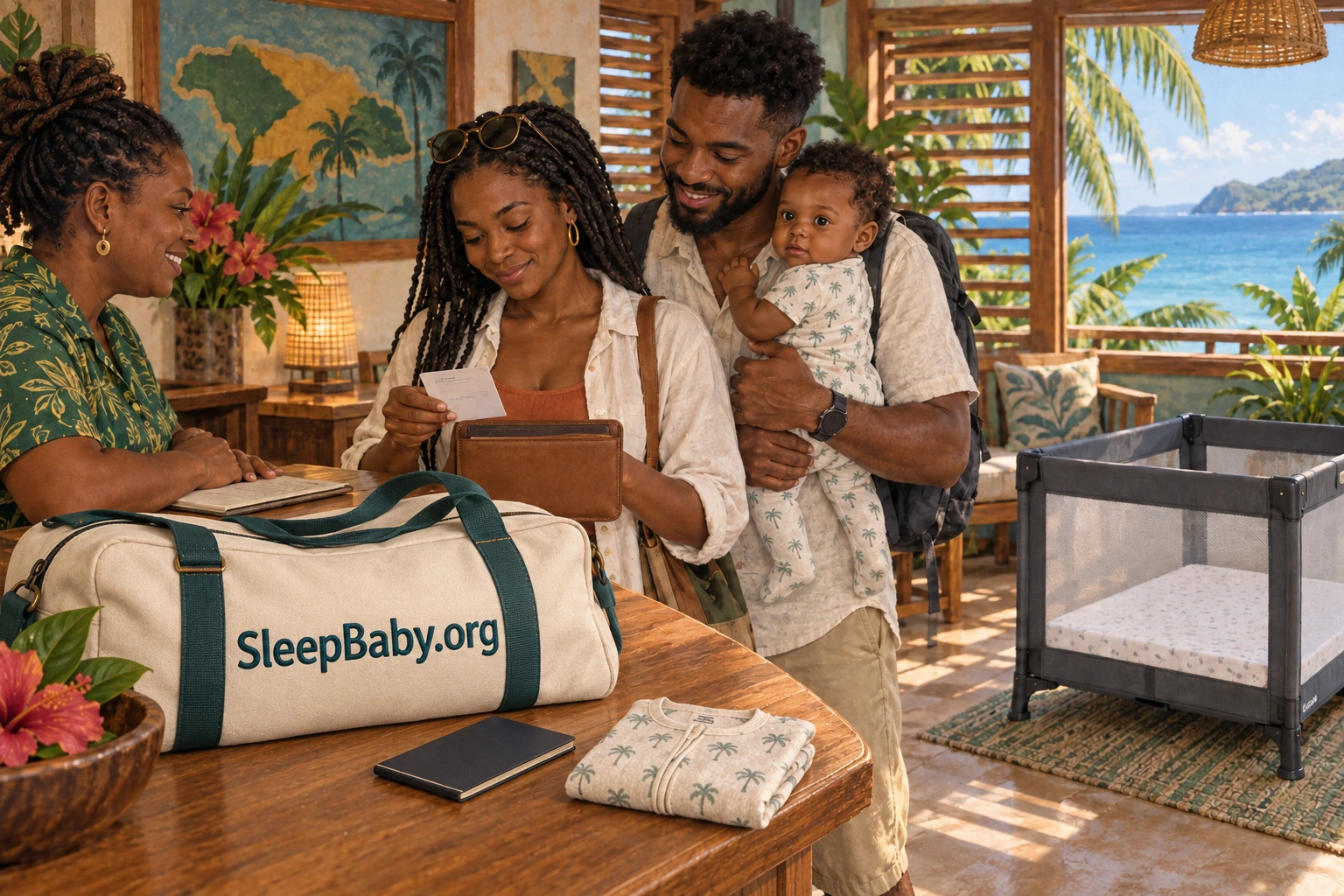
You can take a baby to Jamaica, but I would confirm the travel documents, a suitable car seat, a safe sleep space, feeding arrangements, and a route to medical care before booking. Your baby’s age and health matter more than a resort’s “family friendly” label. Start with your baby’s clinician and the current entry and travel-health guidance, then ask the property what it can actually provide.
You do not need a packed sightseeing schedule to make the trip worthwhile. A place where you can manage feeds, naps, and a short outing comfortably may suit you better than a beautiful room that requires a long drive whenever you need something.
The planning below covers the questions I would settle first, what belongs in your hand luggage, and how to keep the first evening manageable. Document rules depend on citizenship and family circumstances; the U.S. examples are labeled so you can check the rules that apply to you.
Before you pay for the trip
Five confirmations I would want in writing
- Documents: Your baby’s passport, applicable visa or entry permission, and any required parental consent.
- Transfer: The actual vehicle and an appropriate car seat you can install and use correctly.
- Sleep: The exact crib or play yard, its availability, and a usable backup.
- Feeding: Safe preparation water, cleaning facilities, and suitable cold storage if needed.
- Help: Where you would take an unwell baby and how you would get there.
A reply that says only “no problem” leaves you with another question. Ask for the missing detail while you still have room to change the booking.
Start with your baby’s health and the current Jamaica guidance
Before choosing dates, tell your baby’s clinician where you plan to stay, how old your baby will be, and whether they were premature or have feeding, breathing, immune, or other medical needs. Ask what would make this particular trip unsuitable or worth postponing. There is no single age at which every baby is ready for an international holiday.
The CDC’s Jamaica travel-health page recommends reviewing routine and destination vaccines before departure. Infants aged 6–11 months may need early measles and hepatitis A vaccination for international travel; those early doses do not replace the usual later series. A clinician should work out the timing for your child. Ideally, have that conversation at least a month ahead, and still ask if departure is sooner.
As checked September 26, 2026, the U.S. State Department’s Jamaica advisory is Level 2, “Exercise Increased Caution,” with stronger warnings for specific areas. Read the actual destination details before booking and again before leaving. The advisory also describes limits in medical care and ambulance availability. A resort reservation does not remove those concerns.
I would price insurance that covers your baby, the care you might need, and medical evacuation, then read the exclusions and payment arrangements. Save the insurer’s assistance number where both adults can find it. Ask the property which medical facility it would contact for an infant, whether transport can be arranged overnight, and who answers the phone after reception gets quiet.
This is also the point to look at your cancellation terms. If the trip depends on your baby being well, a passport arriving, or an important appointment happening first, know which payments become nonrefundable and when. Keeping that information together helps you make an ordinary decision instead of trying to remember five booking emails under pressure.
Ask how the property and transfer company communicate weather disruptions or changes to arrival arrangements. Keep their direct contact details alongside your airline booking. If a flight moves to the following day, you will need to update more than the room reservation: the driver, crib request, food supplies, and any childcare booking may also need attention. I would keep that short contact list available offline.
Sort out passports, consent, and the arrival form
For a U.S. citizen arriving by air, your baby needs their own valid passport; a birth certificate does not replace it. Current U.S. guidance says the passport must be valid on entry and exit, and a tourist visa is not required for stays of 90 days or less. Other citizenships and circumstances need their own check with Jamaica’s Passport, Immigration and Citizenship Agency, rather than a rule borrowed from another family.
For a child traveling with only one parent, current U.S. guidance for Jamaica says a notarized consent letter from the absent parent is required, or proof of sole custody. It also advises carrying proof of the parent-child relationship. If names differ, custody arrangements are complex, or another adult is taking the baby, resolve the exact paperwork with the relevant authorities before departure.
Jamaica uses an online immigration and customs declaration, the official C5 form. Follow its current instructions for your party, including your baby’s details, and keep the confirmation accessible. Use the official government site instead of assuming that the first paid service in a search result is necessary. Also keep your accommodation details and return or onward travel information handy.
I would make one travel folder with the documents you must carry, the booking references, and copies stored separately. Check that your baby’s name matches across the passport and airline booking. Then give the other traveling adult access to the confirmations. If you are traveling alone, make the folder simple enough to open while holding your baby and a bag.
Do this before filling a suitcase with small conveniences. A missing sunhat is usually a shopping problem. A missing travel document can stop the trip at the airport.
Choose the location around the transfer you can manage
You may be comparing Montego Bay, Negril, Ocho Rios, or a stay with family elsewhere on the island. I would begin with the airport you will actually use and the journey to the exact address. A hotel’s destination label tells you less than the door-to-door route, the likely arrival time, and whether a stop is possible when you need one.
Ask the transfer provider for a realistic estimate for your flight’s arrival window, not a best-case drive with no waiting. Add the time needed to collect luggage, fit the seat, feed or change your baby, and find the driver. If an attractive property comes with a transfer you already dread, compare a closer option before assuming you should push through it.
For the drive, arrange a rear-facing seat suitable for your baby and follow the seat and vehicle instructions. NHTSA’s child-passenger guidance recommends keeping children rear-facing until they reach their seat’s rear-facing height or weight limit. This is a safety recommendation, not a claim about what every Jamaican driver is legally required to supply.
“Baby seat available” is not enough detail. Ask for the make and model, the appropriate size range, the vehicle’s seating and belt arrangement, and who will install it. Bringing your own familiar seat may simplify the uncertainty, but you still need to check that it works with the booked vehicle. Do not accept a plan that depends on holding your baby in the moving car.
If the promised seat is missing or unsuitable, keep your baby out of that transfer while you arrange a suitable vehicle or seat. Save the provider’s contact number and an alternative contact before flying. That way the decision at the curb has already been made, even if the replacement takes time.
Send this before booking
Ask about your actual room and baby
“We’re traveling with a baby who will be [age]. Can you confirm the exact infant sleep equipment, whether it is guaranteed, and the backup if it cannot be used? We also need details of [feeding preparation or refrigeration], the route to the room with luggage, and medical help available overnight.”
If you want childcare, add the minimum age, hours, fees, caregiver arrangements, and whether you must stay nearby. A kids’ club description does not establish that it accepts infants.
Check the room details that will shape every day
A small kitchen may be more useful to you than a bigger pool. A room close to the places you will use may matter more than a dramatic view at the top of several flights of stairs. Tell the property what you need to carry and whether you are bringing a stroller. Ask about the actual path to your room, including steps and lifts, instead of relying on “accessible” as a general description.
Check sleeping arrangements with equal care. Ask for a current photo and the identity of the crib or play yard, the original mattress or pad, and the sheet supplied with it. Find out whether it is reserved for you or merely requested. I would also ask what happens after a late arrival if the equipment is missing or damaged.
Air conditioning, window screens, and shade can affect how comfortable the room feels, but photographs rarely show whether they are in working order. Ask how the room is cooled, whether windows have screens, and whether you can report a problem overnight. If there is a balcony, ask about the door lock and keep furniture from becoming a climbing route for a mobile child.
For childcare, make a separate inquiry even when the property advertises activities for children. Ask about infant ages, advance reservations, staffing, feeding instructions, collection procedures, and how staff contact you. Decide what would let you feel comfortable using the service. It is equally reasonable to choose a trip where the adults trade short breaks and do all the care themselves.
I would avoid building the whole holiday around an unconfirmed service. If childcare or a particular feeding facility is essential, a clear answer belongs in the booking decision. If it is simply a welcome extra, you have more flexibility.
Make the flight plan before packing for it
Check your airline’s infant booking rules, baggage allowance, stroller and car-seat handling, and any international charges. Do not assume “under two” means a free international ticket. If your baby will turn two during the trip, explain the full itinerary when arranging the booking.
The FAA recommends an approved child restraint in the child’s own seat as the safest place for a child under two on a U.S. airplane. Buying a seat guarantees that space for an appropriate restraint. Check the required aircraft-approval label, your baby’s size limits, airline seating restrictions, and installation instructions before departure. A carrier or your arms does not provide the same protection.
I would practice carrying the seat and the bags together before travel day. You do not need an elaborate rehearsal, just enough to notice that both hands are already occupied before you reach the check-in desk. Decide which bag holds the next feed, spare clothing, nappies or diapers, and the documents, and keep that bag with you through any gate-checking.
At a U.S. checkpoint, TSA allows formula, breast milk, and related baby liquids above the ordinary 3.4-ounce limit, subject to screening. Tell the officer and separate those items as directed. Check the airport and airline guidance for the return journey too; U.S. screening instructions do not automatically describe the Jamaican checkpoint.
Pack for an inconvenient delay, including clean feeding equipment and a change for the adult as well as the baby. Keep prescribed medicines and essential supplies in hand luggage. If something must stay cold, resolve the storage and journey plan in advance rather than expecting a member of cabin crew to find refrigerator space.
Divide the luggage by when you need it. Keep the next change and feed in the bag you can reach during the journey; put the first evening’s clothing and toiletries together so you can unpack just that part at the hotel. Leave bulky replacements in the main case. Before handing a bag over at the gate, check it once for the documents, medicine, and feeding items you meant to keep.
Before you choose the airline seats
Why a child restraint matters in flight
This NTSB video explains why an approved child restraint offers protection that an adult’s arms cannot. It is an older safety explainer; use the current FAA guidance and your seat’s instructions for the actual booking and installation.
Watch the NTSB child-passenger safety video on YouTube, then confirm your restraint and seating arrangement with the airline.
Plan feeds around the facilities you will actually have
If you breastfeed directly, think about comfortable places to pause and the help you want with luggage, meals, and the next outing. If you express milk or use formula, write down the whole process from preparing a feed to cleaning up. That often reveals a missing facility before a packing list does.
For powdered formula, safe drinking water is only part of the question. Powder is not sterile, and bottled water does not make it sterile. The CDC’s preparation guidance includes extra precautions for babies younger than two months, those born prematurely, and those with weakened immune systems. Ask your clinician which approach is appropriate, including whether ready-to-feed formula would simplify your trip. Never dilute formula to make supplies last.
Follow the product and public-health instructions for preparation and storage. CDC says to use prepared formula within two hours of preparation and within one hour after feeding starts; discard what remains after the feed. If you will refrigerate an unused prepared feed, follow the current guidance and confirm that your storage actually meets it. A minibar described as “cool” is not a verified milk-storage plan.
For washing, arrange a clean basin reserved for feeding items, the appropriate soap and brush, safe water, and a protected drying area. CDC advises against washing bottle parts directly in the sink and recommends thorough air-drying. Ask about sanitizing requirements for your baby and follow the equipment instructions. You should not have to improvise this beside a bathroom tap after the first feed.
I would bring enough of your baby’s usual supplies for the journey and a realistic delay, then check where replacements are available. If you use a particular formula or specialized equipment, do not assume a nearby shop stocks the same version. Bring written product details, and discuss an appropriate alternative with your clinician if supply is a concern.
For a baby already eating solids, choose age-appropriate textures and follow the CDC’s food and water precautions: freshly cooked food served hot and fruit you can wash with safe water and peel yourself are useful options. Ask how food is prepared rather than assuming everything on a buffet is equally suitable. Keep ordinary choking precautions and close supervision at meals.
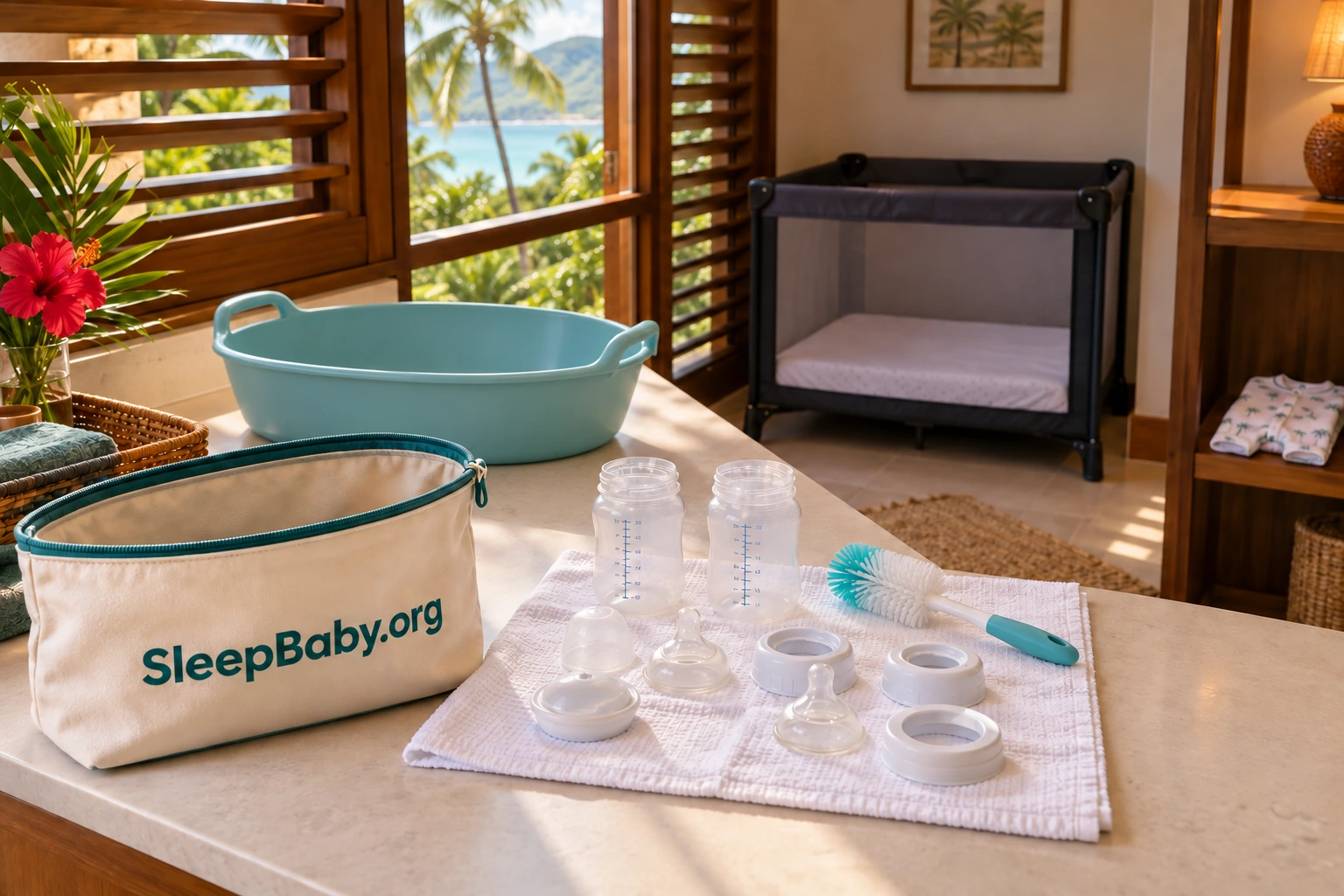
An optional tool for a small feeding station
OXO Tot On-the-Go Drying Rack with Bottle Brush, Gray
If you will wash bottles in your room and want a compact brush-and-rack set, this is an option to compare. OXO lists the closed footprint as 8.5 by 5.5 inches; check the space you will actually have. This is a convenience for organizing feeding items, not a sterilizer or a solution to unsafe water.
Check before buying: Look for the complete gray On-the-Go rack and brush set, model 62146300, rather than a replacement part or a larger countertop rack. Confirm that the brush suits your bottles and that you can clean and dry the set properly.
When I would skip it: If your own dedicated brush and clean drying area already work, use them. CDC notes that air-drying on a clean, unused towel or paper towel is probably more hygienic than a rack. If you choose a rack, reserve it for feeding items and follow CDC’s cleaning and sanitizing guidance, with extra care for higher-risk infants.
As an Amazon Associate I earn from qualifying purchases.
Give the first evening fewer jobs
I would leave arrival day free of a prepaid excursion or a dinner you cannot change. You already have enough to do: reach the room, feed your baby, inspect the sleep equipment, and find the supplies you need next. The beach will still be there after you have put the luggage down.
Inspect the supplied crib or play yard before using it, even if you received a reassuring photograph. The AAP’s hotel-safety guidance calls for an appropriate infant sleep space and attention to hazards such as cords, windows, and unstable furniture. Check the equipment’s identity, condition, limits, complete assembly, and original sleep surface. Do not pad a doubtful setup with towels or an extra mattress.
For a baby under one, follow NIH safe-sleep guidance: back for every sleep, a firm, flat, level separate infant sleep surface, and only a fitted sheet. Share your room, not your bed. Keep blankets, pillows, toys, and improvised covers out of the sleep space. Our hotel safe-sleep guide walks you through the equipment check and what to do when it fails.
If a usable sleep space is not available, ask for a suitable replacement or arrange your known portable unit or other verified option. If that cannot be done, change the accommodation or plan. An awake adult can care for the baby while you sort it out; an adult bed, sofa, or car seat left in the room is not the substitute.
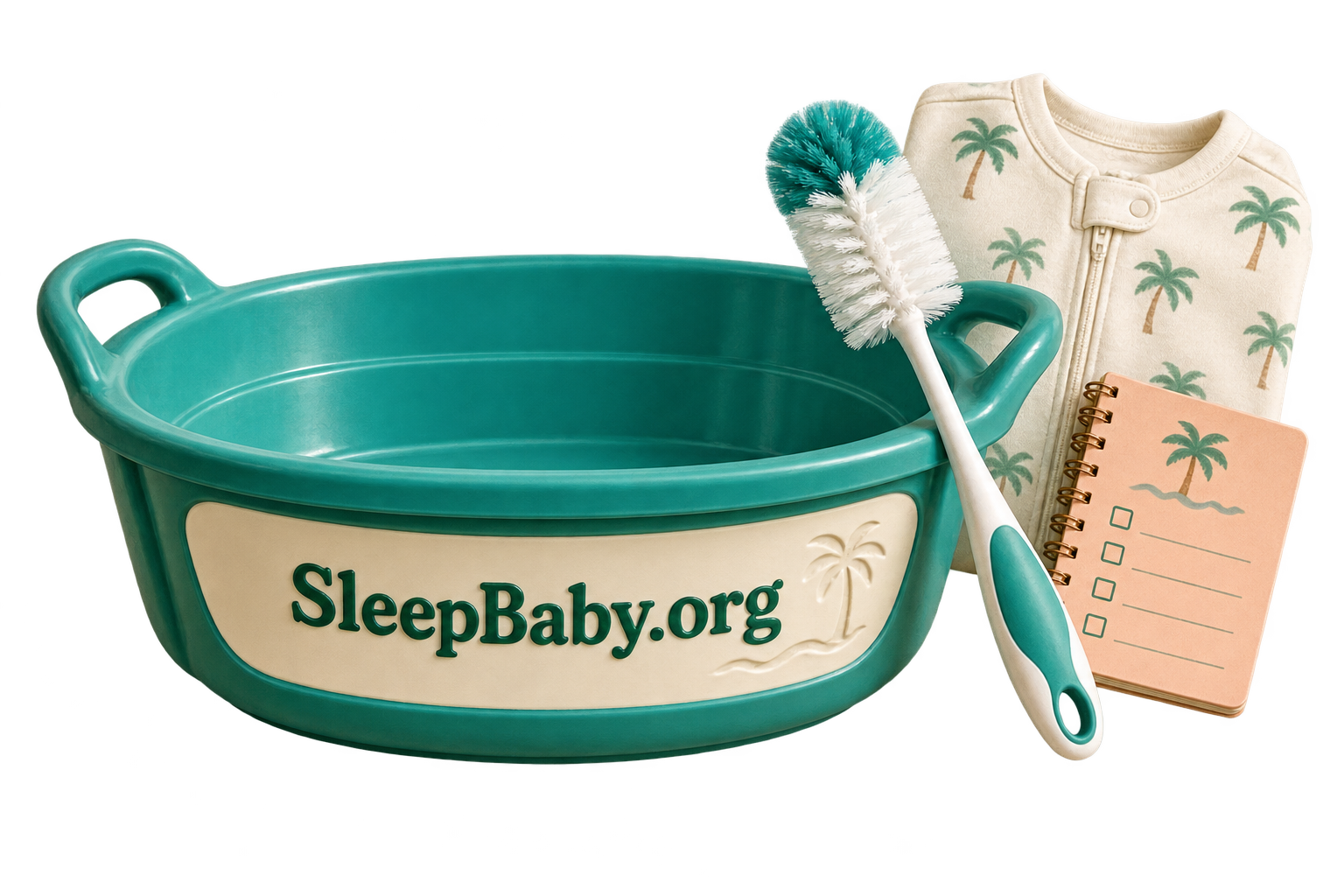
When you reach the room
Keep the first evening to four jobs
1. Meet the immediate need
Feed, change, or comfort your baby before tackling the whole suitcase.
2. Inspect the sleep space
Check the actual unit and its surroundings while the baby is elsewhere.
3. Prepare the next feed
Know where the clean equipment, safe water, and required storage are.
4. Use a familiar goodnight
Keep the usual short sequence, with enough flexibility for a tired travel day.
Make outings small enough to change your mind
A good first outing might be a short walk or time together in a shaded area near your room. Before committing to a beach, garden, boat ride, or other attraction, check its actual infant age restrictions, transport, shade, changing facilities, and exit options. A description saying an activity is relaxing does not establish that it is suitable for a baby.
I would choose one main outing in a day and see how that feels. Leave space for the feed that takes longer or the nap that happens earlier. If you need two adults, a transfer, and a prepaid ticket just to get back to the room, that outing deserves more thought than one you can end whenever you choose.
Use shade and light clothing for sun protection. The AAP advises keeping babies under six months out of direct sunlight; if shade and clothing cannot adequately protect small exposed areas, its guidance allows a small amount of sunscreen there. Ask your clinician about your baby’s needs, and keep a stroller ventilated rather than covering it with a blanket to make shade.
For mosquitoes, start with screened or air-conditioned spaces and clothing that covers exposed skin without overheating your baby. Ask which EPA-registered repellent is appropriate for your baby and follow the label. CDC’s child-travel guidance says not to use oil of lemon eucalyptus or PMD products on children under three. Avoid improvising loose netting over an infant sleep space. If a bite occurs, our baby mosquito-bite guide covers simple care and symptoms that need medical advice.
At a pool or the sea, keep an adult actively supervising at close range; agree who that is whenever you swap. A quick trip back to the room is a handoff, not something to assume the other adult noticed. Use the same clarity with childcare, restaurant breaks, and anyone offering to hold the baby.
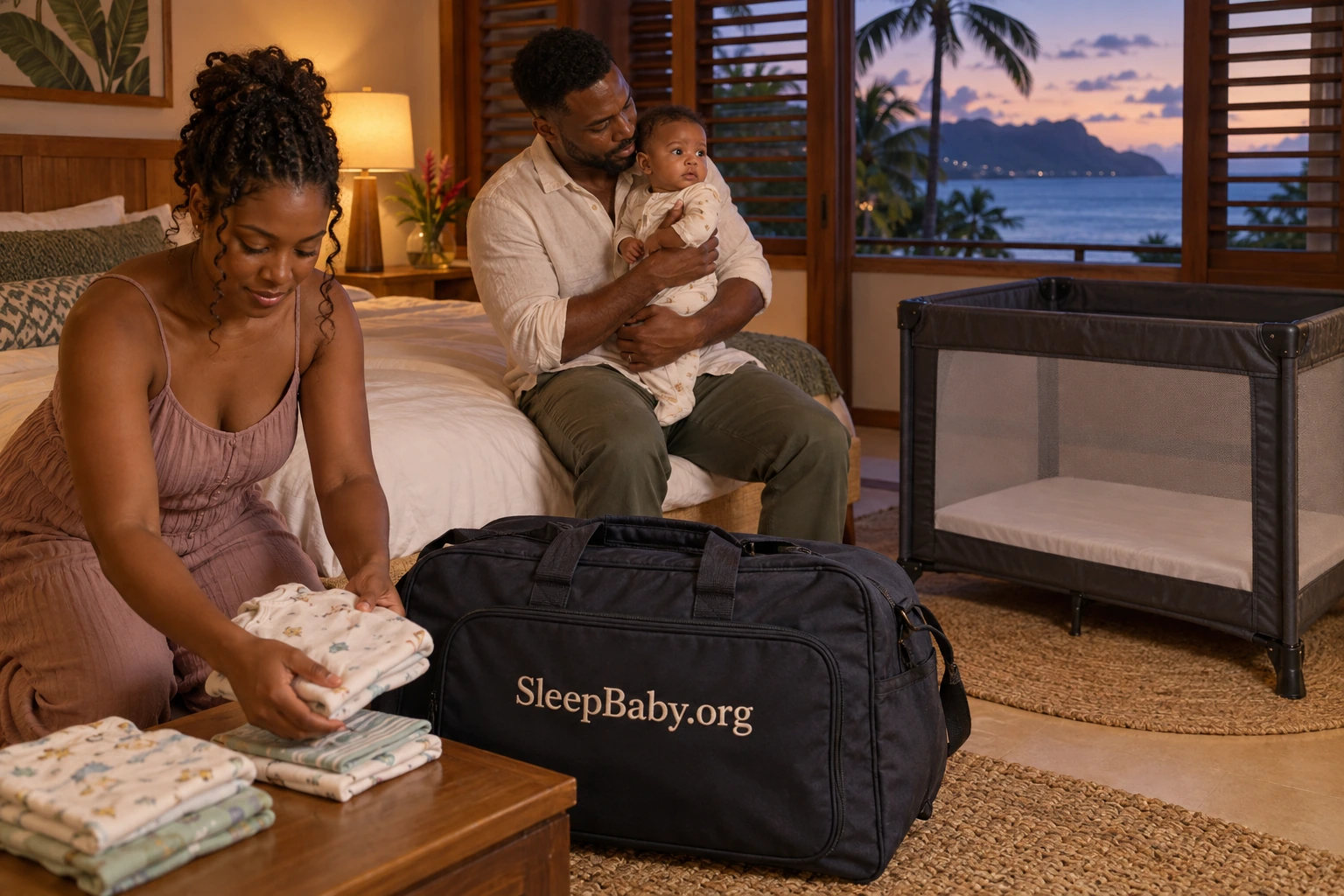
Let the routine be familiar without demanding a perfect night
Your baby may notice the different light, sounds, and sequence of the day. I would keep the parts you can repeat easily: the order of feeding and changing, the same quiet song, ordinary sleep clothing, and a calm return to the separate sleep space. You do not need to recreate every object from home.
Look at the local clock and your baby together. Offer needed feeds and naps rather than keeping a tired baby awake to prove you have adjusted. If you have crossed time zones, give yourself room for a gradual change. If you have not, the travel day itself may still have interrupted the usual pattern.
Stay with your baby in the room when they sleep; a monitor does not make leaving them there alone safe. If one adult wants to go out, agree who remains. That may mean taking turns at a meal or enjoying a quiet evening instead of both attending an event. It helps to discuss that expectation before one person is dressed and waiting at the door.
If your baby seems unwell, unusually sleepy, has trouble feeding, or develops other concerning symptoms, use the medical plan rather than treating everything as a travel sleep problem. Seek urgent help for breathing difficulty, unresponsiveness, or other emergency symptoms. Tell the clinician your travel dates and where you have been.
When you return, our guide to baby sleep problems after travel can help you rebuild the familiar daily cues. For the trip itself, I would judge the day by whether your baby was cared for and you found something to enjoy, not by how much of the itinerary survived.
Sources and planning references
Entry, health, and travel advice checked September 26, 2026. Recheck official guidance close to departure.
- U.S. State Department: Jamaica advisory and country information
- PICA: entry visa requirements and official C5 declaration
- CDC: Jamaica travel health and traveling safely with infants and children
- FAA: child restraints on aircraft; NHTSA: car seats; TSA: traveling with children
- CDC: formula preparation and storage; cleaning feeding items; food and water safety
- AAP: hotel safety; sun safety; NIH: a safe infant sleep environment
- OXO: On-the-Go Drying Rack with Bottle Brush specifications





What viewers said10 comments · 4 replies+
Archived comments from the original Baby Sleep Miracle presentation. Not independently verified by SleepBaby.org; individual experiences vary.
Thank you so much for this video! I had no idea about the dangers of baby swings :O
Hi Mary-Ann. I have a question: Is method in any way similar to the ones recommended by Dr Bucknam, Dr. Weissbluth or Dr. Karp? We tried those but none of them help.
Hi Regina, thank you for your question. The short answer is no. The techniques I share in my guide are based on newest scientific research and this is why I have never seen any approach similar to the one I recommend.
This method really works! I tried it on my son Jesus and after just one week he went from waking up more than 5 times a night to waking up just once or twice. You are a lifesaver, Mary-Ann!
I'm truly impressed with how much information you share in your video. And all for free! I can feel that you truly care about mothers like myself, and that's hard to find these days. I have recommended your site to several of my friends already.
Mary-Ann, our child suffers from autism. Is your approach still suited?
Chloe, I made sure my method can be used with any child, even babies who are special like yours. Please note that I'm not a doctor and that I always advice to consult with your physician because nothing is more important than the safety and well-being of your love.
Hallo Mary-Ann, I'm from Germany. Do you have your guide in German?
Hello Heide, we do! Normally you should already see our video in German. If not, please contact our support so they can guide you
Thenk you for your answer, Mary-Ann!
I just completed your approach and I have to say, it worked almost too well. Yes, it took a bit of getting used to with your bedtime routine but the difference is huge. My son George used to take 1 hours to go down and now he's firmly asleep in no more than 10 minutes! You're the best!
It seems I'm the only man watching this video, lol! What you shared about the 'emotional backpack' made immediate sense to me and I can't wait to help my little girl Mila to unpack it!
Hey there, just discovered your site and this really sounds different. Just wanted to say thanks for sharing :)
For everyone who's still thinking about getting Mary-Ann's guide I want to advise you to go ahead. I wasn't sure myself but now I'm so thankful I invested in this program. It made a huge difference in our life as a family and yes, my baby girl does sleep through the night now.