
You can sometimes take a baby to visit someone in a hospital or nursing home, but there is no universal safe age and no blanket permission that travels from one building to another. For an optional visit, the answer depends on the exact unit’s rules today, whether there is an outbreak or isolation precaution, whether anyone is sick or recently exposed, and how vulnerable your baby is.
When I look at this decision, I do not start with a number on the baby’s birth certificate. I start with why you are going. A baby who needs care, a parent who has no childcare for a necessary appointment, and a newborn being brought to an optional social visit are not the same problem. The purpose changes how much risk is reasonable, how much flexibility you have, and who needs to help you decide.
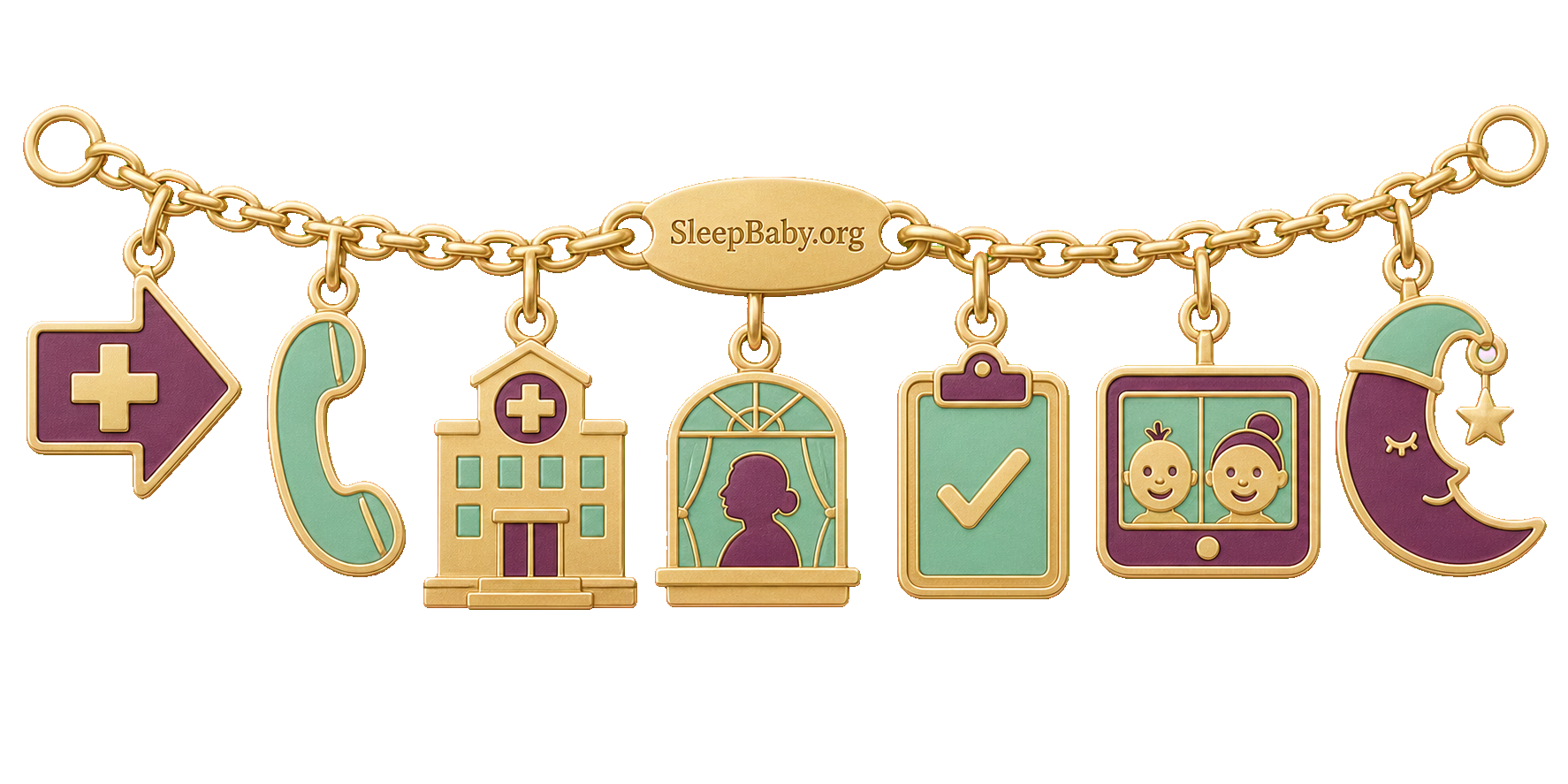
Choose the right doorway
The reason for the trip decides the first move
Baby needs urgent care
Go now or call emergency services. Ask the clinical team how to enter safely, but do not turn infection concern into a delay.
The trip is necessary
Call the office or unit for arrival instructions and ask whether another healthy adult can wait with the baby outside the clinical area.
The baby is an optional visitor
Pause for the facility call, the patient’s or resident’s consent, the baby’s vulnerability, and a same-day illness check before packing the car.
Sleep connection: choosing the right branch before departure prevents the kind of rushed, hungry, overtired visit that follows the family home into bedtime.
SleepBaby.org original decision component
There is no magic age when a healthcare visit becomes risk-free
A healthy 10-month-old and a 10-month-old with a weakened immune system do not carry the same risk. Neither do a full-term 3-month-old and a baby of the same chronological age who was born very early and has chronic lung disease. Younger infants are more vulnerable to severe RSV, and prematurity, chronic lung disease, congenital heart disease, and weakened immunity raise concern further.[7]
That does not mean every young or medically vulnerable baby must remain home from every meaningful family moment. It means a general internet answer has reached its limit. For an optional visit, call the pediatrician when your baby was born prematurely, is very young, has heart or lung disease, has immune problems, is recovering from illness, or has any other condition that changes infection risk. Ask one useful question: Given my baby’s history and the facility’s current situation, would you postpone this visit?
You can also ask whether the baby’s current RSV protection is up to date. Depending on eligibility and timing, protection may come through maternal vaccination during pregnancy or a long-acting antibody for the infant.[8] Vaccination and antibody protection can reduce severe disease risk; they do not turn an outbreak room into an ordinary living room.
Close caregivers and household members should stay current on recommended vaccines, including seasonal flu and pertussis protection. Babies younger than 6 months cannot receive a flu vaccine themselves, which is one reason the health of the people around them matters.[9] Still, I would never use vaccination as a substitute for the simpler question: Is anyone sick today?
Call the exact unit before you load the diaper bag
A hospital website may say “visitors welcome” while a particular ICU, oncology floor, maternity unit, behavioral-health area, or treatment space has different rules. A nursing home’s front door may be open while one wing is managing a respiratory or stomach-virus outbreak. Current healthcare guidance expects facilities to communicate infection-prevention measures, and it advises symptomatic people to defer non-urgent visits.[3][4]
A visitor badge is not a health clearance. The detail that changes my answer is the same-day status of the exact room you plan to enter.
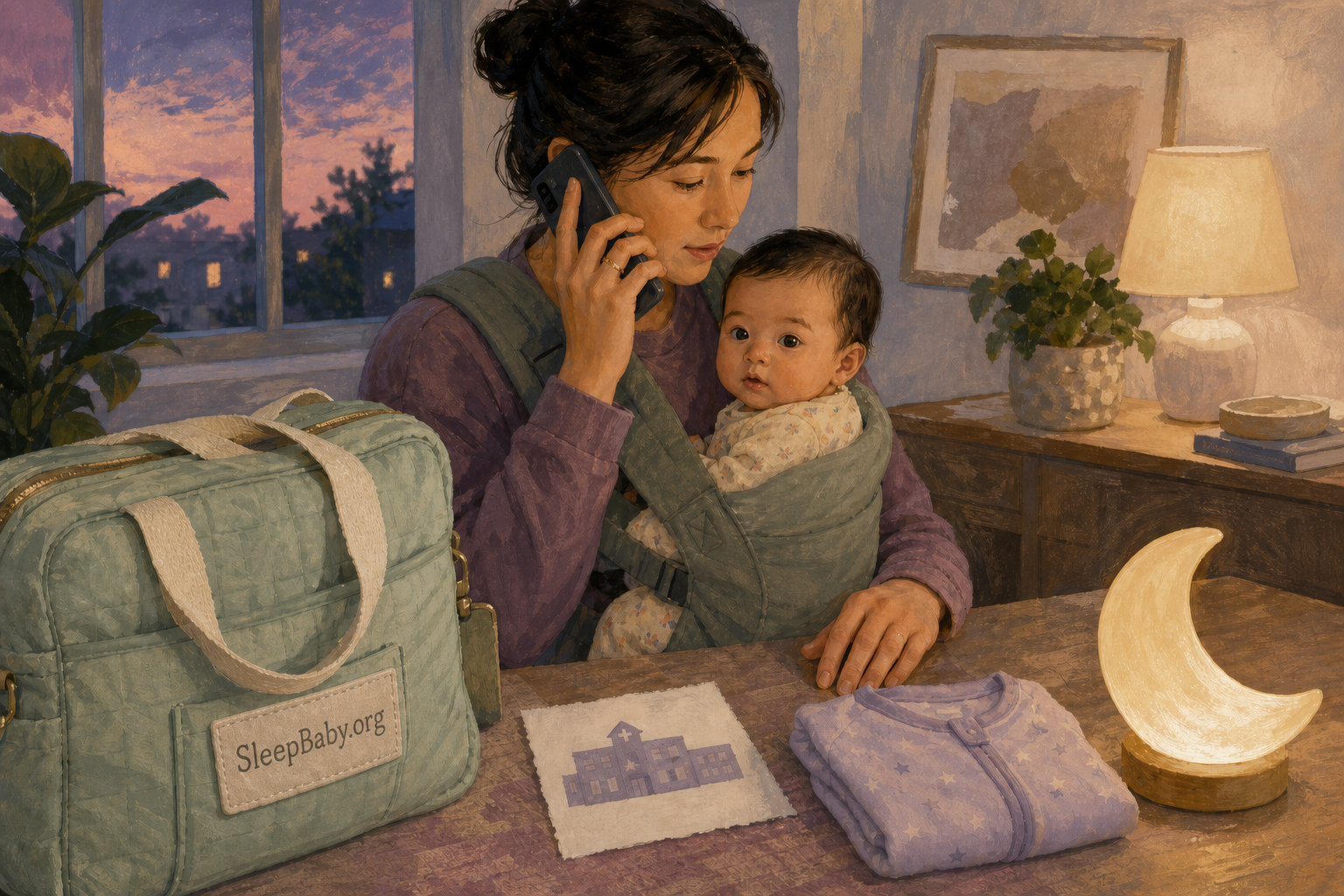
Hospital and nursing-home visits are related, not identical
Both settings care for vulnerable people, but the visit itself may have a different purpose. In a hospital, the room can be part of active treatment. In a nursing home, it is also the resident’s home. That difference matters for consent, timing, and how you enter the space.
| Question | Hospital | Nursing home |
|---|---|---|
| Who decides? | The patient when able, plus the clinical unit’s current visitor and isolation rules. | The resident’s consent matters, alongside the facility’s reasonable clinical and safety restrictions.[5] |
| What may change fast? | Procedures, tests, patient condition, room changes, unit census, and isolation status. | Respiratory or GI outbreaks, wing-specific precautions, resident condition, and group-activity rules. |
| Best backup | One adult visits while another waits with the baby, or the patient joins a video call when able. | A quieter common room, courtyard, window visit, short video call, or another day if the resident agrees. |
| What not to assume | Lobby access does not mean the baby may enter every clinical area. | Resident visitation rights do not erase outbreak controls, and a facility cannot treat every visit as identical. |
CMS guidance protects nursing-home residents’ ability to receive visitors with their consent while allowing reasonable clinical and safety restrictions.[5] So do not assume “babies are banned,” but do not arrive insisting that a general visitation right settles a specific infection-control question. Ask, listen, and preserve the resident’s dignity.
In either setting, the patient or resident gets to say no. They may be exhausted, in pain, confused by noise, worried about exposing the baby, or simply not ready to be seen. Do not take photos, post updates, or put the baby on the bed without explicit permission. Love does not need to prove itself by crossing somebody else’s boundary.

If there is isolation, an outbreak, or recent illness, let the visit wait
For an optional visit, postpone when the baby, a caregiver, the patient, the resident, or someone in the visiting household has fever, cough, sore throat, vomiting, diarrhea, or another potentially contagious illness. Current CDC healthcare guidance advises symptomatic visitors to defer non-urgent visits and use alternatives such as video calls until they have recovered.[3]
Recent exposure can be less obvious. Tell the facility if a household member was just diagnosed with flu, RSV, COVID-19, norovirus, or another contagious infection, even if the planned visitor feels well. The facility may ask the adult to mask, delay, test, or stay out of a particular area. During a norovirus outbreak, nonessential visitors may be restricted from affected areas, and symptomatic visitors may be excluded.[13]
Do not invent your own universal waiting period from a social-media graphic. Different illnesses, exposures, facilities, and patient populations require different instructions. Use the facility’s current rule and your clinician’s guidance.
If the patient is on isolation precautions, ask the nurse before bringing the baby anywhere near the room. Adults may sometimes use gowns, gloves, masks, or eye protection after instruction. A baby cannot participate in that plan like an adult can. Children younger than 2 should not wear masks because of suffocation risk.[10] Never improvise a face covering for the baby.
Build the visit around clean hands, clean gear, and an easy exit
The goal is not to disinfect the world. It is to interrupt the most avoidable routes between a high-touch care environment, adult hands, feeding equipment, and the baby’s face.
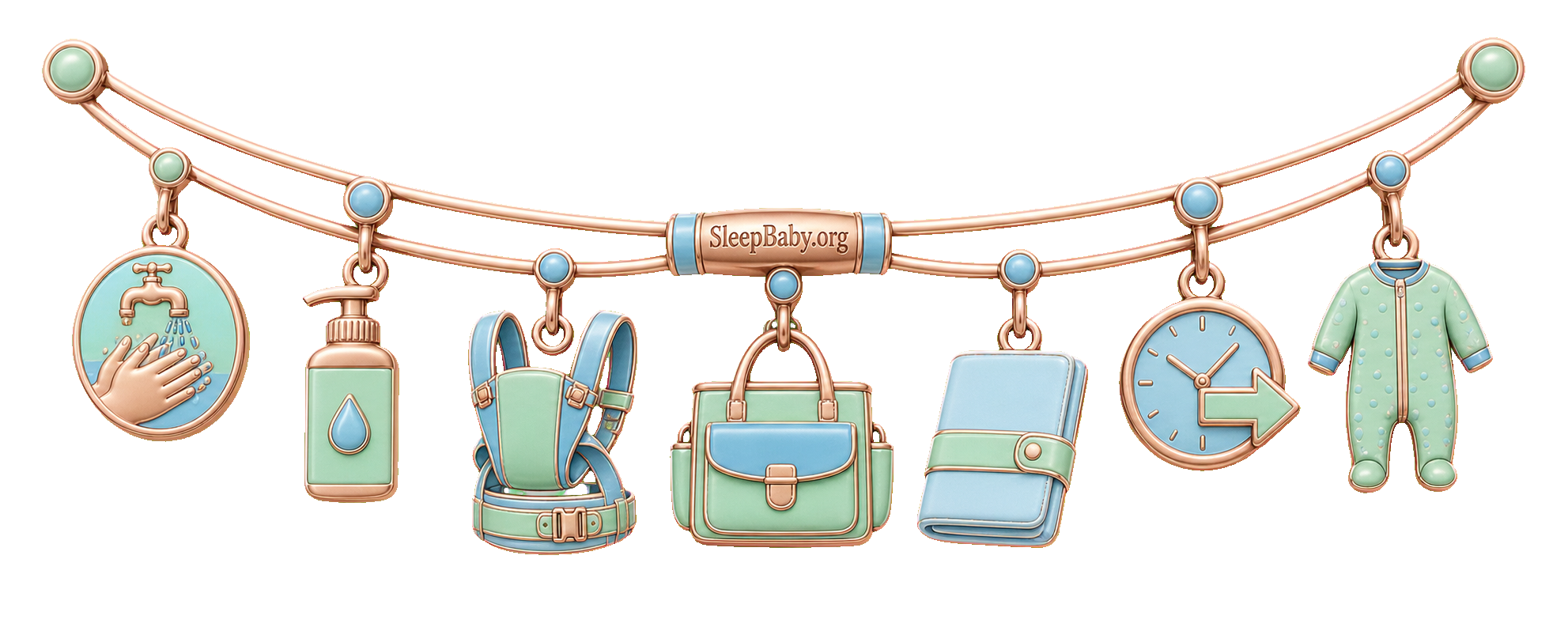
From entrance to exit
Three routes to keep separate
Adult hands
Clean them on entry, before touching the baby’s hands or face, before feeding, after high-touch surfaces, after diapering, and when leaving.
Baby gear
Keep bottles, pump parts, pacifiers, toys, and changing supplies off the patient bed, bedside table, floor, and shared clinical equipment.
The exit
Know who will carry the bag, who will carry the baby, and what phrase ends the visit before anyone is overtired or pressured to stay.
Sleep connection: a clean exit also creates a clean handoff to the next feed or nap instead of making the car the place where every delayed need finally arrives.
CDC hand-hygiene guidance tells healthcare visitors to clean their hands, including after touching hospital surfaces. Alcohol-based sanitizer is useful when hands are not visibly dirty; soap and water are important after restroom use and when hands are visibly soiled. Gloves do not replace hand hygiene.[6]
Let healthy adults follow the facility’s current masking and PPE instructions. Keep hand sanitizer out of the baby’s reach and allow it to dry before handling a pacifier or touching the baby’s face. There is no need to scrub the baby’s skin with sanitizer or harsh disinfectant. Clean the adults’ hands and protect the baby’s things.
Limit how many people hold the baby. Ask visitors not to kiss the baby’s face or hands, and do not pass the baby around because several relatives are waiting. Keep the stroller or carrier out of care pathways, and never let a handle, wheel, or strap snag tubing, cords, bed controls, or other equipment. If a nurse needs access to the patient, move promptly.
Give the baby one home base inside the room
Choose one healthy adult as the baby’s base for the visit. That person carries or holds the baby, watches feeding and sleep cues, and can step into the hall without a family debate. A second adult can focus on the patient or resident. This is quieter than having one person attempt to comfort the baby, listen to medical information, move a chair, answer relatives, and keep the diaper bag off the floor at the same time.
If the patient or resident wants to hold the baby, ask what is physically safe. Weakness, pain, IV lines, oxygen tubing, tremor, recent surgery, limited balance, or a chair without arm support can change the setup. A nurse may suggest that the resident stay seated while the caregiver keeps both hands near the baby, or that the baby remain in the caregiver’s arms for a close hello. Do not make the person prove strength or wakefulness for the photograph everybody imagined.
A carrier can provide a contained home base when it is used correctly and the baby’s airway remains visible and unobstructed. It is not permission to ignore the baby or let the baby’s face press into fabric. A stroller can keep gear organized, but it should not block a corridor or become a surface for used wipes and adult coats. Whatever you use, the baby’s breathing, position, temperature, and ordinary cues remain more important than the room’s social expectations.
Keep the baby off the patient bed, floor, windowsill, bedside tray, and clinical recliner. Those surfaces may be contaminated, needed for care, or unsafe for infant sleep. The baby’s home base should make the next safe action obvious: stay with the caregiver, feed in the approved place, transfer to an approved sleep surface, or leave.

Pack for one short visit, not a small relocation
A compact bag is easier to keep contained. Bring the baby’s usual feeding supplies, diapers, wipes, a changing pad, a sealable bag for soiled clothing, one simple wipeable toy, a change of clothes, and whatever the facility specifically requested. Add adult masks only if they fit the facility’s plan; never add one for a child under 2.
If the baby uses formula, preserve the feeding routine you already know how to use safely. Prepared formula should generally be used within 2 hours of preparation and within 1 hour after feeding begins; bottle leftovers should be discarded after the feed. Babies younger than 2 months, babies born prematurely, and babies with weakened immune systems need extra formula-preparation precautions because powdered formula is not sterile.[11] Follow your baby’s usual safe plan and clinician guidance rather than changing formula type for the sake of one visit.
Do not prepare a bottle on a bedside tray, rinse pump parts in a patient sink without permission, or rest a pacifier on the chair arm and call it close enough. Ask for the designated feeding area. If there is not one, feed in the cleanest approved space available or leave and feed elsewhere.
Use a designated changing station, not the patient or resident’s bed. Put down the changing pad, keep clean items separate from used ones, contain the diaper and wipes, clean adult hands afterward, and leave the surface as instructed. If the only available choice feels wrong, ask staff. They have seen diaper bags before; you do not need to solve the building alone.
If you are bringing the baby to your own medical appointment rather than visiting somebody else, a second healthy adult can sometimes wait outside the exam room or step out with the baby. Our guide to taking a baby to your own doctor appointment helps with that different version of the logistics.
Use a visit shape that is easy to shorten
The safest visit plan is not the one that proves you can stay. It is the one that makes leaving easy before love turns into endurance.
A gentle twenty-minute shape
Arrive, connect, leave while connection still feels good
-
1. Settle
Clean hands, park gear, confirm the room is still appropriate, and keep the baby with one caregiver. -
2. Connect
Let the patient or resident see, speak to, or gently touch the baby if everyone is comfortable and staff guidance allows. -
3. Notice
Watch the baby, the person being visited, and the room. A feed cue, fatigue, care round, or rising noise can end the visit. -
4. Leave cleanly
Use the agreed phrase, gather without lingering, clean hands, and take the baby’s next need somewhere calmer.
Exit phrase: “We are going to leave while this is still a good visit. We love you, and we will check in again.”
SleepBaby.org original visit-sequence component
Twenty minutes is an example, not a medical limit. A calm older baby in a quiet resident room may manage longer. A newborn, a medically fragile baby, a noisy shared room, or a tired patient may need less. Decide the visit’s minimum meaningful moment before you go: a hello, a photograph with consent, a song, a blessing, a hand held near the baby. Once that moment happens, the visit has succeeded. Extra minutes are optional.
At end of life, families may choose a visit they would otherwise postpone. Ask the care team to help design the least disruptive path: timing, private space, protective equipment for adults, whether the baby should remain in a carrier, and how long the patient is likely to tolerate the visit. There is no brave-parent prize for ignoring clinical guidance, and there is no cold-parent verdict for choosing a video call. Both decisions can come from love.
If relatives are pressing for a yes, give them the rule instead of a long defense: “We are following the unit and the baby’s clinician today.” If the answer is yes, tell them the visit will be short and the baby will stay with one caregiver. If the answer is no, offer the smaller connection you can manage. A boundary is easier to hold when it was decided before the elevator doors open.
Do not turn the car seat into the visiting-room crib
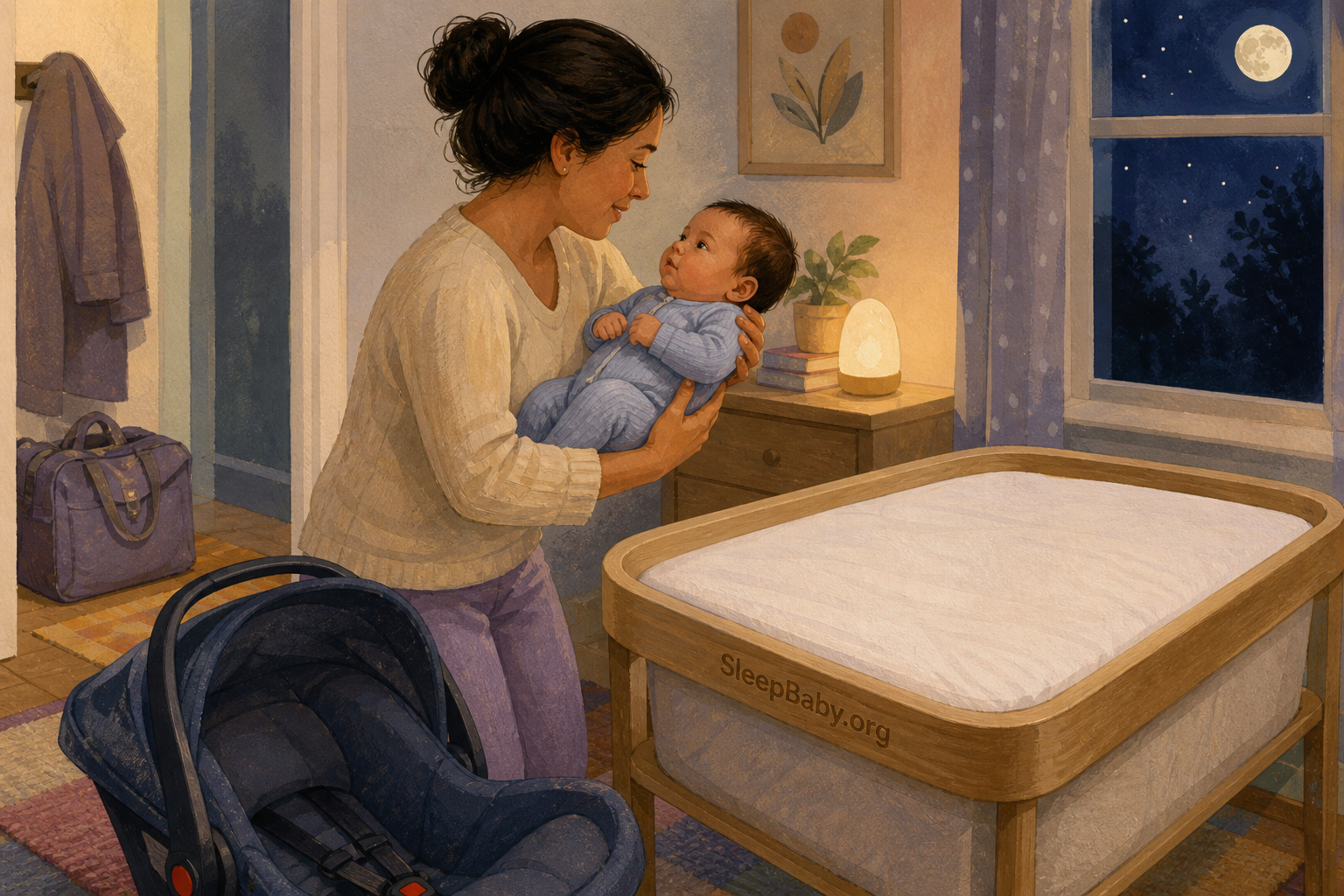
A baby may fall asleep in the car on the way there. Once you arrive and travel is over, a car seat is not the baby’s routine sleep space. The American Academy of Pediatrics advises moving a baby who falls asleep in a car seat, stroller, swing, carrier, or sling to a firm sleep surface on the back as soon as practical.[12]
If the facility cannot offer an approved infant sleep space, do not improvise on a patient bed, recliner, couch, adult mattress, or pile of blankets. One adult can leave with the baby, the visit can end, or the family can divide the visit. If you need a gentle transfer after the drive, see our guide to waking and moving a sleeping baby safely.
Watch before an outing nap
Safe sleep still applies away from home
The American Academy of Pediatrics’ video “Safe Sleep for Your Baby: Every Nap & Every Night” is a useful refresher before a visit that may collide with sleep. The written takeaway is simple: use a firm, flat approved sleep surface, place baby on the back, and keep the sleep space clear.
Protect bedtime without treating one unusual day like a sleep emergency
A hospital or nursing-home visit may shift a nap, make the baby quieter than usual in the car, or produce a louder wind-down at home. That does not automatically mean the schedule is broken. The visit included new faces, elevator sounds, fluorescent hallways, long stretches of being held, and a family emotion the baby may not understand but can still feel in the bodies around them.
Before the visit, protect the sleep opportunity that is easiest to protect. That might mean letting the baby finish a nap before departure, choosing the unit’s quieter time, or keeping the visit shorter instead of attempting to make the baby sleep there. Bring familiar sleep clothing or the usual sound cue for later, but do not bring loose bedding into a sleep space.
After the visit, return to the usual sequence without staging a full schedule rescue: feed if due, change the diaper, dim the room, use the familiar brief routine, and offer the normal safe sleep space. If the last nap was missed and the baby is plainly exhausted, an earlier bedtime may help some families. If the baby took a long car nap and is alert, bedtime may need a little flexibility. Use the baby in front of you, not a rule that cannot see the day.
One longer recovery nap can be ordinary when the baby wakes, breathes, feeds, and behaves normally. If extra sleep comes with weak feeding, fewer wet diapers, fever, unusual breathing or color, or difficulty waking, it is a health question first. Our guide to a baby napping longer than usual helps separate a schedule clue from a medical exit.

After the visit, watch the baby rather than replaying every doorknob
Clean adult hands, wash used feeding items according to their normal instructions, launder soiled clothing, and put the bag away. You do not need to bathe a well baby merely because they entered a healthcare building, and you should not apply disinfectant to the baby’s skin.
Over the following days, notice breathing, color, temperature, feeding, wet diapers, alertness, and whether the baby is acting like themselves. Exposure does not guarantee illness, and a visit cannot tell you which later sniffle came from where. The useful job is not detective work. It is recognizing when the baby’s condition needs help.
The medical exit stays visible
What to do if the baby seems unwell afterward
Call the pediatrician immediately
A baby 3 months or younger has a rectal temperature of 100.4°F (38°C) or higher.[2]
Call emergency services
Trouble breathing, blue or gray lips, markedly decreased alertness, severe dehydration signs, or another condition that appears life-threatening.[1]
Call for prompt guidance
New fever in an older baby, poor feeding, fewer wet diapers, worsening cough, repeated vomiting or diarrhea, unusual sleepiness, or behavior that is meaningfully unlike your baby.
Do not wait for a sleep problem to settle a medical question. When the baby seems ill, health comes before the schedule.
If the visit is not right today, make the connection smaller, not meaningless
A short video call can let a grandparent hear the baby’s voice. A recorded lullaby can travel into the room without bringing the baby. A photograph can be shared privately with consent. Some facilities can arrange a courtyard, doorway, or window visit when the resident is well enough and current policy allows. A healthy adult can carry a note, a handprint made safely at home, or a message from the family.
These alternatives are not emotionally identical to holding the baby. I would not pretend they are. They are ways to protect two vulnerable people while preserving the relationship until a safer in-person moment exists.
If you do go, let the visit be brief enough that you remember the person rather than the logistics. If you do not go, let the decision be loving without putting it on trial. A careful no today can protect a meaningful yes later.
Keep this beside the diaper bag
The complete visit plan in nine checks
- If baby needs urgent care, go or call 911.
- For an optional visit, call the exact unit today.
- Confirm consent, outbreak status, isolation, and child-visitor rules.
- Postpone for illness or a relevant recent exposure.
- Ask the pediatrician when age or medical vulnerability changes risk.
- Adults follow hand, mask, and PPE instructions; never mask a baby under 2.
- Keep feeding gear and diaper changes off patient surfaces.
- Plan a short connection and an easy exit.
- Use safe sleep every nap, then watch the baby rather than the schedule.
The decision in one sentence: necessary care proceeds with clinical instructions; an optional visit proceeds only when the exact facility allows it, everyone is well, the baby’s vulnerability has been respected, and leaving remains easy.
A note for parents: This article offers general educational information. It cannot assess your baby’s health, a patient or resident’s condition, or a facility’s current infection-control situation. Use the baby’s clinician and the exact facility for individualized guidance.
Sources
- American Academy of Pediatrics: When to Call Emergency Medical Services
- American Academy of Pediatrics: Fever and Your Baby
- CDC: Preventing Transmission of Viral Respiratory Pathogens in Healthcare Settings
- CDC: Viral Respiratory Pathogens Toolkit for Nursing Homes
- Centers for Medicare & Medicaid Services: Revised Long-Term Care Surveyor Guidance
- CDC: About Hand Hygiene in Healthcare Settings
- CDC: RSV in Infants and Young Children
- CDC: RSV Immunization Guidance for Infants and Young Children
- CDC: Vaccines for Family and Caregivers
- CDC: Risk Factors for Severe Illness from Respiratory Viruses
- CDC: Infant Formula Preparation and Storage
- American Academy of Pediatrics: A Parent’s Guide to Safe Sleep
- CDC: Norovirus Guidelines – Summary of Recommendations
When the visitor badge comes off
Bring the baby home without bringing the whole day into bedtime.
A missed nap, a long car sleep, or an emotional visit can make the evening feel unfamiliar. You do not need to repair every minute. Start with the baby’s needs, return to the familiar wind-down, keep sleep safe, and adjust only what the actual night asks you to adjust.