
I would skip a party that is excessively loud for your baby. If you need to raise your voice to speak to someone an arm’s length away, move to a quieter place. A baby who sleeps through the music has not shown you that the sound is safe. Properly fitted infant hearing-protection earmuffs can reduce exposure, but they do not make every venue suitable.
Before you agree to go, ask when amplified music starts, where you can retreat, and whether you can leave independently. A quiet lunch before the dancing may be a workable visit. Several hours beside a DJ is a different decision. If you’re already there and unsure, step out with your baby while you decide.
If you notice a sudden change in your baby’s response to sound after an event, seek urgent medical advice. Do not wait for another party to see whether it happens again.
SleepBaby.org · The original video
A little help
for the night ahead.
Take a moment to watch the original Baby Sleep Miracle presentation. Your article will be right here when you’re ready to keep reading.
What viewers said10 comments · 4 replies
Archived comments from the original Baby Sleep Miracle presentation. Not independently verified by SleepBaby.org; individual experiences vary.
Hi Mary-Ann. I have a question: Is method in any way similar to the ones recommended by Dr Bucknam, Dr. Weissbluth or Dr. Karp? We tried those but none of them help.
Hi Regina, thank you for your question. The short answer is no. The techniques I share in my guide are based on newest scientific research and this is why I have never seen any approach similar to the one I recommend.
This method really works! I tried it on my son Jesus and after just one week he went from waking up more than 5 times a night to waking up just once or twice. You are a lifesaver, Mary-Ann!
I'm truly impressed with how much information you share in your video. And all for free! I can feel that you truly care about mothers like myself, and that's hard to find these days. I have recommended your site to several of my friends already.
Mary-Ann, our child suffers from autism. Is your approach still suited?
Chloe, I made sure my method can be used with any child, even babies who are special like yours. Please note that I'm not a doctor and that I always advice to consult with your physician because nothing is more important than the safety and well-being of your love.
Hallo Mary-Ann, I'm from Germany. Do you have your guide in German?
Hello Heide, we do! Normally you should already see our video in German. If not, please contact our support so they can guide you
Thenk you for your answer, Mary-Ann!
I just completed your approach and I have to say, it worked almost too well. Yes, it took a bit of getting used to with your bedtime routine but the difference is huge. My son George used to take 1 hours to go down and now he's firmly asleep in no more than 10 minutes! You're the best!
It seems I'm the only man watching this video, lol! What you shared about the 'emotional backpack' made immediate sense to me and I can't wait to help my little girl Mila to unpack it!
Hey there, just discovered your site and this really sounds different. Just wanted to say thanks for sharing :)
For everyone who's still thinking about getting Mary-Ann's guide I want to advise you to go ahead. I wasn't sure myself but now I'm so thankful I invested in this program. It made a huge difference in our life as a family and yes, my baby girl does sleep through the night now.
Ready to get started?Take the next step with SleepBaby.
Pick your priceYou can attend part of the celebration
An invitation often makes an event sound like one indivisible thing: the wedding, the birthday, the family party. In practice, you may be able to separate a quiet ceremony or early meal from the amplified speeches, band, dancing, and late finish. I would ask about that sequence before deciding that your only choices are staying all night or missing everyone.
The American Academy of Pediatrics advises avoiding excessively noisy venues with young children. Its guidance also recommends protective earmuffs if children, including young infants, attend these events. Avoidance comes first. Packing protection is an additional precaution, not a reason to accept a plan you otherwise consider too loud.
Ask the host a practical question rather than “Will it be baby-friendly?” That phrase might mean high chairs, a changing table, or relatives who enjoy holding babies. None tells you where the speakers are. “Will the band be playing during dinner, and is there a separate room away from the music?” gives you information you can actually use.
There is no birthday after which loud music becomes harmless. A two-month-old, six-month-old, and one-year-old may have different feeding and sleep needs, but age alone cannot approve a noisy room. If your baby was premature, has hearing concerns, or needs individualized medical care, ask their clinician about the particular outing before making plans.
Before you say yes
Three answers to put beside the invitation
-
Which part can we attend quietly?
Choose a specific window, such as the meal before amplified entertainment. Confirm the plan with the host. -
Where will we go if that changes?
Identify a genuinely quieter space and check what it offers for feeding, supervision, and safe sleep. -
How will we get home?
Keep the keys, necessary transport, and a capable caregiver available. Include the trip home in your bedtime plan.
SleepBaby.org • A planning aid, not a sound-level assessment.
If one answer is missing, change that part before you go. A room you cannot access, a lift home that leaves at midnight, or a promise that the music “probably won’t be too bad” is not much of a backup. I would rather settle those details by message than negotiate them with a tired baby on my shoulder.
How can you tell whether the party is too loud?
Needing to raise your voice at arm’s length is a useful warning to move away. It is not a calibrated test, and being able to talk does not certify an entire evening as safe. Sound can change sharply when a microphone is switched on, a DJ starts, or guests move from dinner to dancing.
The National Institute on Deafness and Other Communication Disorders explains that hearing damage depends on sound intensity and exposure, and that a very intense sound can cause damage from a single event. Distance and duration matter too. You cannot judge the risk simply by whether the song feels pleasant or your baby looks relaxed.
I would not use an adult workplace limit as a baby’s party allowance. The AAP specifically cautions that the occupational standard of 85 decibels averaged over eight hours should not be assumed safe for children. There is no universal “safe number of minutes” I can give you for an infant at a reception without knowing the actual sound exposure.
A phone sound-meter reading may alert you to a problem, but I would not use one reading as permission to stay. The microphone, app, position, and changing music affect what you are assessing. A reading near your chair does not describe every place your baby is carried, and a quiet moment between songs does not describe the next announcement.
Moving farther from a speaker is sensible, but the far side of a small room may still be noisy. An outdoor party is not automatically quiet either. Check the actual area you will use, and leave it if you cannot get away from amplified sound. You do not need a perfect measurement before making the more cautious choice.
A quieter corner and a separate quiet room are different
“We can sit at the back” sounds reassuring until you arrive and discover another speaker behind the table. I would ask about the location, not just the distance from the dance floor. Where do you enter? Can you reach the exit without crossing the loudest area? Will the supposedly quiet room stay available throughout your visit?
A separate room may offer a useful retreat, but open the door and check it yourself. A dressing room can become a storage room. A lobby can contain its own loud music. A place that looks peaceful in a photograph may share a wall with the band. The label on the room cannot make the decision for you.

Keep a capable adult responsible for your baby in that space. Do not leave a baby alone in a hotel room or unfamiliar venue while you return to the party, even if you brought a monitor. A device does not arrange the supervision, access, or response your baby needs.
Choose hearing protection, not headphones that play sound
For a baby, look for hearing-protection earmuffs specifically intended for their age and size. These cover the ears to reduce outside sound. Music headphones with active noise cancellation, ordinary headphones with the volume off, and soft winter earmuffs are not interchangeable with appropriately rated hearing protection.
The AAP and American Speech-Language-Hearing Association recommend well-fitting earmuffs for young children instead of earplugs, which can be a choking hazard. I would not put foam plugs, cotton, tissue, or homemade inserts into a baby’s ears for a party.
Read the exact product’s instructions before the day. Check the age or size range, how the band should sit, how the cups adjust, and any use restrictions. “Baby” in a listing title is not the whole instruction manual. A pair that fits an older cousin may not fit your baby, even if the cups look small.
NIDCD’s hearing-protection guidance explains that earmuffs need to cover both ears properly and that gaps from items such as hats can reduce their effectiveness. No protector blocks all sound. A rating describes protection under specified conditions; it is not a personal promise that your baby can stay for the whole event.
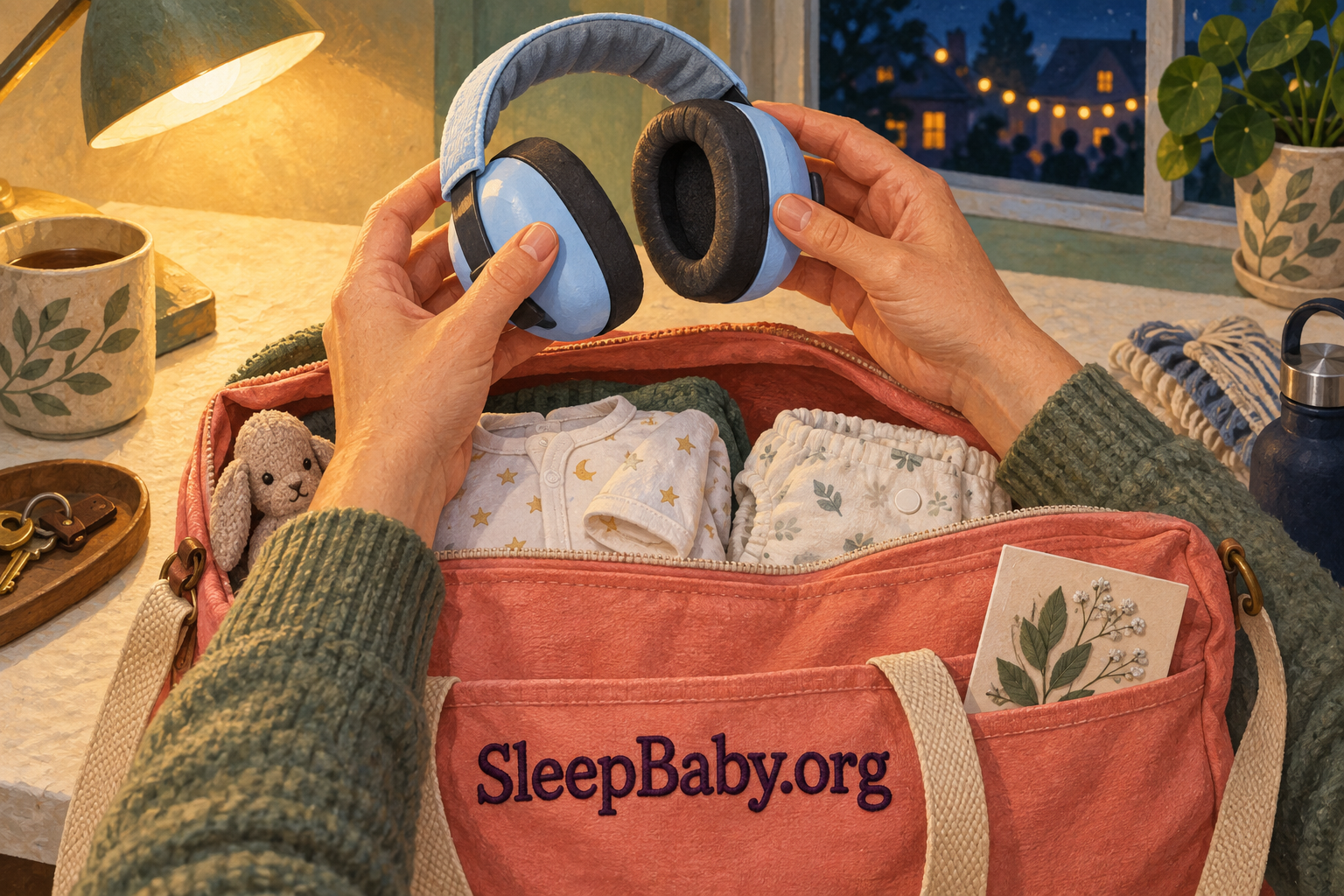
Try the fit in a quiet place first
Read: Use the instructions for that exact model and your baby’s size.
Check: Both ears should sit fully inside the cups, with the cushions fitting as directed and nothing disrupting the seal.
Respond: If your baby cannot tolerate them or the fit will not stay correct, choose a quieter plan. Do not tighten, tie, or improvise extra restraints.
Practice can reveal a fit problem. It cannot prove that a loud party will be safe or that your baby will sleep there.
Take any adjustment break somewhere quiet. Removing the earmuffs on the dance floor to settle your baby defeats the purpose. If the cups repeatedly slip, the band presses uncomfortably, or your baby keeps pulling them off, I would leave the noisy area rather than turn the evening into a contest over the equipment.

When the party clothes come off
Make room for the ordinary bedtime afterward

The music can end while your baby still needs feeding, comfort, and help settling. After any hearing or health concerns are addressed, you can explore the Baby Sleep Miracle presentation on SleepBaby.org if you want to consider its baby-sleep guidance.
You can review the presentation first or continue to the purchase page. The program does not assess hearing, treat sound exposure, or make a noisy venue suitable for a baby. No purchase is needed to follow the practical steps in this guide.
Sleeping through the music does not answer the hearing question
You may hear that another baby slept through a whole wedding. That describes the baby’s behavior, not a measurement of the sound reaching their ears. Hearing injury may not be immediately obvious, so I would not use sleep, smiling, or a lack of crying as a reason to stay in excessive noise.
The reverse is also true: crying does not tell you that hearing damage has occurred. A baby may be hungry, tired, uncomfortable, or ready for a break from being passed around. You can respond to that distress without diagnosing it. Move somewhere quieter first, then check the ordinary needs you can meet.
Look at what changes once you step away. Does your baby feed, look at you, or settle with familiar care? That can help with the next practical decision, but it does not retrospectively measure hearing exposure. I would keep comfort and hearing protection as separate questions throughout the evening.
If your baby often seems unsettled in ordinary social situations too, our guide to what to check when your baby seems anxious helps you describe the pattern without assigning a diagnosis from one difficult outing. A party does not need to become a test of how sociable your baby is.
Plan the nap before you pack the party outfit
If the visit overlaps sleep, decide where sleep can happen before you arrive. A spare adult bed, sofa, pile of coats, or padded chair is not a substitute for an appropriate infant sleep space. Nor does watching closely turn one of those surfaces into a safe choice.
The AAP recommends placing babies on their backs on a firm, flat, non-inclined infant sleep surface, with a fitted sheet and without loose bedding, pillows, or toys. An appropriate portable crib or play yard may work if it is used within its instructions. Check the actual setup rather than relying on a host’s description.
If your baby falls asleep in a car seat, stroller, carrier, or sling, move them to an appropriate firm sleep surface on their back as soon as possible. Do not plan the evening around leaving a sleeping baby strapped into a travel seat beside your table. For the journey itself, use the correctly installed car seat as intended.
I would not make hearing earmuffs part of the home sleep routine or use them to keep a baby asleep through party noise. Move to a suitable quiet sleep setting, follow the product’s restrictions, and remove outing equipment that is not appropriate for sleep. If the venue cannot support the sleep your baby needs, going home is the useful adjustment.
You also do not need to keep your baby awake beforehand to make them “sleep through anything.” Arrange the visit around the day you actually have. A delayed nap or unexpectedly early feed may change your arrival time. That is a reason to shorten the plan, not a reason to stretch your baby to match the invitation.
If bedtime timing is already confusing, finding your baby’s bedtime from their actual day is a better starting point than copying another family’s party schedule. Your departure time needs to include gathering your things and getting home, not just the moment you leave the table.
Give one adult the next decision
A crowded room makes vague handoffs easy. One person thinks another is watching the baby; someone else assumes the earmuffs have been checked. I would agree on one adult who is responsible at a time and make the handover explicit, including where the baby will be and when you will check back.
Choose a caregiver who can stay attentive and respond, and arrange a sober driver if you are travelling by car. Keep the diaper bag, feeding supplies, and keys with the person who may need to leave. Splitting essential things among three coats and a locked car makes a simple departure unnecessarily difficult.
You can also decide who will explain the early exit. “We’re leaving before the music starts, but we’re glad we could come for dinner” is enough. You do not owe every relative a presentation on decibels. A clear plan stated beforehand often leaves less to negotiate in the doorway.
Make feeding possible without waiting for a break in the programme
Check what you need for your usual feeding method and where you can use it. If you want a quieter place to breastfeed, ask about an actual seat and access rather than accepting “there’s probably somewhere upstairs.” If you use bottles, bring what you need to follow your normal preparation and storage guidance. An evening event is a poor time to discover that the bag is in someone else’s car.
I would not delay a needed feed until after speeches or try a new feeding arrangement just to fit the party. Tell the adult sharing care where the supplies are and what your baby needs next. You can step away from the schedule even when everyone else is sitting down for the same course.
A quieter feed can also give you a chance to decide whether to return. You do not have to go back into the room simply because you left your coat there. Ask another adult to collect it if that makes leaving easier.
If an older child wants to stay
Work out this possibility before the outing, especially if two adults are sharing care. Can one person take the baby home while the other stays with the older child? Does each person have transport and the things they need? If that arrangement is not workable, explain beforehand that the family may leave together.
This is also worth settling when you are attending alone. Ask whether a trusted adult can help with bags or accompany the older child while you gather the baby’s things. A departure plan should work with the actual people available, not depend on discovering a willing helper once everyone is tired.

If you are hosting, make the sound easier to control from the start. Tell whoever manages the music that the baby’s needs can change the plan. Set up a quiet, supervised care space and protect access to it. Asking guests to lower their voices briefly will do little if the speakers remain loud.
Do not stay because the photographs, cake, or final song are “only another ten minutes.” It is surprisingly easy for several small extensions to become another hour. Choose the part you care about most, then let that be a complete visit. The baby does not need to witness the playlist’s closing argument.
Already went to a loud party and now you’re worried?
You cannot work out from a description alone whether an individual exposure harmed your baby’s hearing. Nor can I promise that everything is fine because the visit was short or your baby seems content. Move away from further loud sound and contact your baby’s clinician if you are concerned about what happened.
Useful details include the type of event, roughly how long you were there, how close you were to speakers or sudden loud sounds, whether hearing protection stayed correctly fitted, and what you have noticed since. You do not need to reconstruct a perfect minute-by-minute account before asking for advice.
Ask for help based on the change you notice
A sudden reduction in response to sound: Seek urgent medical assessment. Sudden hearing loss needs prompt attention.
Hearing concerns with ear pain or drainage: Seek urgent medical advice, particularly after a sudden loud sound.
Any continuing uncertainty about hearing: Ask your child’s clinician about a hearing assessment. A previously normal newborn screening does not rule out a later problem.
NIDCD treats sudden hearing loss as a medical emergency. The NHS also advises urgent assessment for sudden hearing loss or hearing loss with earache or discharge. A baby cannot describe muffled hearing or ringing, so tell the clinician what seems different instead of waiting for a symptom your baby cannot explain.
The CDC recommends seeking a hearing screening when you suspect a hearing problem, including after a child has passed an earlier screening. Age matters when interpreting responses to voices and other sounds. Not turning once is not a diagnosis, and a reassuring response once is not a hearing test.
Do not clap next to your baby’s ears, turn up a speaker, or use headphones to “check” hearing. That adds noise without giving you a reliable answer. Keep your observations from normal interactions and let the clinician decide what testing is appropriate. Do not put drops or objects into the ears unless a clinician recommends them.
A visual explanation from NIH
Why stepping away is part of the plan
NIDCD’s classroom demonstration uses a blow dryer to illustrate how distance changes sound exposure. Watch it as an explanation for adults, not as an activity to try near a baby or a way to calculate a safe distance from a party speaker.
The practical takeaway: move away from the sound source and choose a quieter setting. Distance alone does not approve a venue. Watch NIDCD’s demonstration on YouTube.
Let coming home be quiet and ordinary
Once you are home, check feeding, a diaper change, clothing, and the sleep setup. Keep the next part familiar and manageable. You do not need to stage a second event called “the perfect recovery bedtime,” with a bath, three new soothing techniques, and a rigid deadline.
I would respond to your baby rather than assume that every wake-up afterward was caused by the party. A disrupted evening gives you context, but it does not diagnose pain, hunger, or a hearing problem. If your baby seems unwell or you have concerns about hearing, address those separately from sleep.
Avoid turning a sound machine up to overpower the noise outside. If ordinary household sounds are waking your baby, our guide to a baby who wakes at every noise looks at quieter, practical changes. Party-level sound and everyday home sounds do not need the same response.
For the next invitation, keep one useful note: perhaps the early meal worked but the speeches were louder than expected, or the separate room was unavailable. That is enough to improve your next decision. You can enjoy seeing people and still decide that this particular event needs a shorter visit, another caregiver, or a polite no.

If you need a properly fitting pair
An infant earmuff option to compare on Amazon
Baby BANZ infant hearing-protection earmuffs, Sky Blue. BANZ describes its baby range as passive hearing protection with cushioned ear cups and an adjustable band. The important question is whether the exact model fits your baby correctly.
- Why consider it
- An infant-sized design can be more appropriate than adult audio headphones when hearing protection is needed. It remains additional protection alongside reducing or avoiding noise.
- Check before ordering
- Confirm the current model, size guidance, instructions, and selected variant. Do not treat a noise-reduction rating as permission to remain in an excessively loud venue.
- When to skip buying
- You already have suitable earmuffs that fit, or you can choose a quiet visit or care elsewhere. If a comfortable secure fit is not possible, change the outing.
As an Amazon Associate I earn from qualifying purchases.
Sources
- AAP: children and excessive noise
- NIDCD: noise-induced hearing loss
- AAP and ASHA: protecting children’s hearing
- NIDCD: hearing-protector fit and use
- AAP: safe infant sleep
- NIDCD: sudden hearing loss
- NHS: hearing changes, pain, and discharge
- CDC: hearing concerns and screening
- NIDCD: distance demonstration
- BANZ: baby earmuff product information
After the goodbyes
The invitation can end before your evening does
You can put the party bag down and give the next feed and bedtime your attention. If ordinary settling remains difficult once health and safety concerns are addressed, explore the Baby Sleep Miracle presentation on SleepBaby.org and decide whether it interests you. It cannot assess hearing or make a loud event safe.
SleepBaby.org · The original video
A next step for
the next bedtime.
Still thinking about sleep? Watch the presentation here, then explore the SleepBaby program whenever you’re ready.
What viewers said10 comments · 4 replies
Archived comments from the original Baby Sleep Miracle presentation. Not independently verified by SleepBaby.org; individual experiences vary.
Thank you so much for this video! I had no idea about the dangers of baby swings :O
Hi Mary-Ann. I have a question: Is method in any way similar to the ones recommended by Dr Bucknam, Dr. Weissbluth or Dr. Karp? We tried those but none of them help.
Hi Regina, thank you for your question. The short answer is no. The techniques I share in my guide are based on newest scientific research and this is why I have never seen any approach similar to the one I recommend.
This method really works! I tried it on my son Jesus and after just one week he went from waking up more than 5 times a night to waking up just once or twice. You are a lifesaver, Mary-Ann!
I'm truly impressed with how much information you share in your video. And all for free! I can feel that you truly care about mothers like myself, and that's hard to find these days. I have recommended your site to several of my friends already.
Mary-Ann, our child suffers from autism. Is your approach still suited?
Chloe, I made sure my method can be used with any child, even babies who are special like yours. Please note that I'm not a doctor and that I always advice to consult with your physician because nothing is more important than the safety and well-being of your love.
Hallo Mary-Ann, I'm from Germany. Do you have your guide in German?
Hello Heide, we do! Normally you should already see our video in German. If not, please contact our support so they can guide you
Thenk you for your answer, Mary-Ann!
I just completed your approach and I have to say, it worked almost too well. Yes, it took a bit of getting used to with your bedtime routine but the difference is huge. My son George used to take 1 hours to go down and now he's firmly asleep in no more than 10 minutes! You're the best!
It seems I'm the only man watching this video, lol! What you shared about the 'emotional backpack' made immediate sense to me and I can't wait to help my little girl Mila to unpack it!
Hey there, just discovered your site and this really sounds different. Just wanted to say thanks for sharing :)
For everyone who's still thinking about getting Mary-Ann's guide I want to advise you to go ahead. I wasn't sure myself but now I'm so thankful I invested in this program. It made a huge difference in our life as a family and yes, my baby girl does sleep through the night now.
Ready to get started?Take the next step with SleepBaby.
Pick your price



Thank you so much for this video! I had no idea about the dangers of baby swings :O