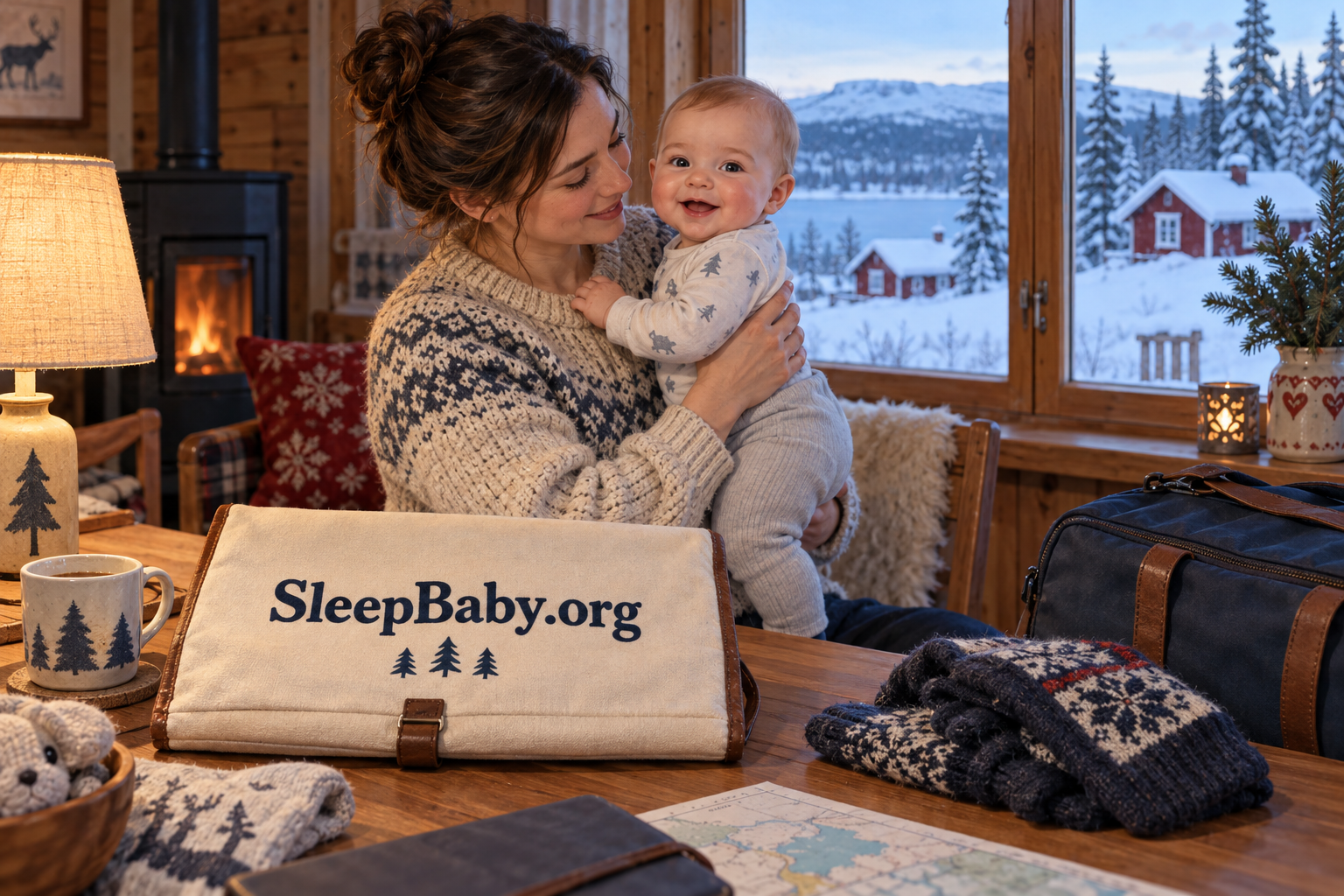
You can take a baby to Finnish Lapland, but I would choose the trip around easy access to warmth, feeding, and sleep before booking any snowy activities. A flexible stay near your accommodation is a different proposition from a tightly scheduled Santa day trip. Some operators advise against bringing under-twos, and some rides exclude them.
Start with one email: give the operator your baby’s age on the travel dates and ask which parts they can actually join, where you can wait indoors, and how you can leave early. Get those answers before paying for an itinerary built around experiences your baby may not be able to do.
The three answers I would want first
- A warm place: somewhere you can feed, change, and settle your baby without waiting for the group.
- A way back: a realistic return to your room if the weather, feeding, or your baby changes the plan.
- A safe night: a confirmed infant sleep space and a room where you can adjust heat and light.
If any answer is vague, keep planning. A photo of a snowy cabin cannot answer these questions for you.
Is Lapland a good holiday with a baby?
It can be, if you are happy with a smaller, slower holiday. Think a short visit, a warm lunch, time in your room, and perhaps one adult activity while another adult stays with the baby. I would be much less enthusiastic about a trip whose value depends on everyone completing every outdoor activity.
There is no single age that makes every Lapland trip suitable. A newborn, an older infant, and a walking toddler bring different feeding, transport, and sleep needs. Before you make expensive commitments, discuss the journey with your baby’s clinician, especially after premature birth or with heart, lung, feeding, or other medical concerns. Airline acceptance is not the same thing as individual medical advice.
This guide concerns Finnish Lapland. If you mean a UK Christmas attraction or a trip in another country, check that destination’s transport, facilities, and operator rules separately. Even within Finland, a stay in a town and a remote lodge can involve very different distances and access to help.
Check the actual infant policy, not just “family friendly”
At the time of this review, Santa’s Lapland says it does not recommend its trips for children under two because of the cold. Canterbury Travel permits infants but asks parents to consider the Arctic weather and terrain, provide suitable infant clothing, and account for a lack of baby-changing facilities at its activity locations. These are their policies, not a universal rule for visiting the region.
Lapland Safaris says children under two are not suited to its snowmobile and husky safaris. It also reserves the right to refuse participation by small children because of conditions. Another operator’s attractive photograph does not override the rules for the excursion you are booking.
Ask separately about a reindeer visit, a reindeer sleigh ride, meeting Santa, and any vehicle or animal-powered excursion. Those are different experiences. “Babies welcome” might mean a baby can accompany the family to a site, without meaning they can take part in the ride. I would want that distinction in writing.
If you have older children, decide who stays with the baby during activities. Can adults swap, or does the entire group leave together? Is the waiting area heated and staffed? Does the adult staying behind have the room key, milk, changing supplies, and transport? A plan that only works if the baby joins everything is too fragile.
For a Santa visit, find out whether the waiting area is indoors, whether you can step out and return, and whether your booked time is an appointment or a place in a longer queue. Your baby may be interested, indifferent, or ready for a feed. I would keep the photograph optional and let the visit end when it needs to. You can still make the occasion special for older children without asking the baby to tolerate the same pace.
A flexible stay gives you more room to change your mind
A day trip may look easier because you avoid unpacking. Look at the whole door-to-door day before choosing it: the journey to the airport, check-in, flying, transfers, activities, and the trip home. Your baby still needs feeding, changing, and opportunities to rest throughout that day. The advertised flight time is only one part.
A longer stay creates its own work, but it can give you somewhere to retreat. My preference would be accommodation close to the things you most want to see, with enough flexibility to do less on arrival day. I would put a convenient room ahead of a more impressive room that adds a long transfer to every outing.
Compare the part of the trip you will use most
Town or nearby family base: ask about walking routes, food shops, indoor stops, laundry, and short transfers. Check the actual address; “near Rovaniemi” can cover a lot of ground.
Remote cabin or lodge: ask how you obtain groceries, who clears the approach, how you reach medical care, and what happens if transport is delayed. Remoteness can be lovely, but it needs a workable support plan.
Organized excursion: ask which departures are fixed, where you can wait, and what you miss if you leave. Compare cancellation terms alongside the pictures.
Also check whether the room is usable while your baby sleeps. A separate sitting area can matter more than a dramatic view. Ask about stairs, space for the cot, cooking facilities, and whether heating is adjustable. If a property says it has a cot, ask what type and reserve it against your booking.
Check arrival time against access to the room. An early flight and a late check-in can leave several hours without the base you planned around. Ask whether there is a genuinely usable indoor waiting area, somewhere for feeds and changes, and a way to obtain food. If early access cannot be guaranteed, decide whether the travel schedule still works. The same question applies after checkout on the journey home.
The booking message you can send today
“Our baby will be [age] when we travel on [dates]. Please confirm the activities they can join and any age or size restrictions. Where can an adult wait indoors with them? Can we return to our accommodation before the group? What transport and infant restraint are available? Are baby-changing facilities and somewhere to prepare feeds available? Which cot and infant clothing sizes can you provide?”
Keep the reply with your booking confirmation. If the answer comes by phone, send a short email summarizing what you understood and ask the company to confirm it. That gives both sides something clear to work from when a different person handles your arrival.
Then ask the question people often leave until last: what happens if the forecast makes the outing unsuitable for your baby? You need to understand whether there is an alternative, a credit, a refund, or simply a missed activity. I would rather know that while choosing the trip than while standing in the lobby with a dressed baby.
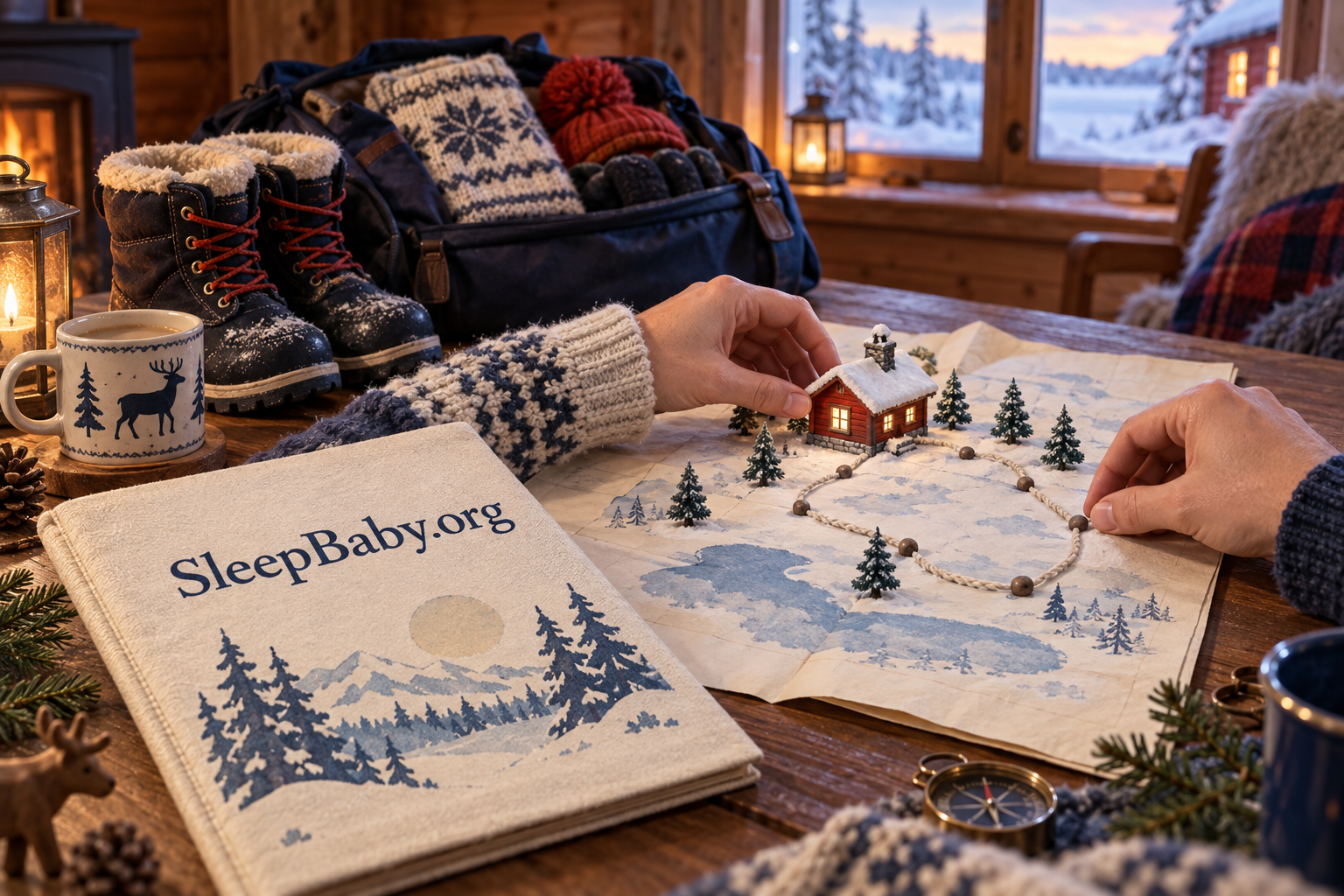
Plan each outing around the next warm door
Start with a small plan you can abandon easily. Choose the indoor place you will return to, check it is open, and work outward from there. A nearby café is only a useful backup if you can actually reach it with the baby and your belongings.
There is no responsible all-purpose temperature or number of outdoor minutes I can give you for every infant. Wind, wet clothing, your baby’s health, the available shelter, and the activity all matter. Use the current local forecast, the operator’s advice, and individualized guidance from your clinician. A pleasant-looking sky is not a temperature check.
Before you leave the room
Know the return: room key, route, transport contact, and an indoor destination that is open.
Carry the essentials: what you need for the next feeds, a change, and dry replacement clothing, kept accessible.
Agree on the exit: either caregiver can call time on the outing. You do not need to finish a queue to justify leaving.
Count waiting as part of the outdoor plan. The walk may be brief while the ticket line, group briefing, photograph, and return transfer take much longer. Ask what is indoors rather than relying on the activity’s name or advertised duration.
If your baby becomes uncomfortable, return to warmth and reassess. Do not keep going because you spent twenty minutes getting everyone dressed. I would also avoid making an outdoor stroller nap a holiday goal. Local customs and someone else’s baby do not establish the right conditions for yours.
WHEN THE OUTDOOR DAY IS DONE
Bring a familiar bedtime back to the cabin
The travel day can change almost everything around your baby. Start the evening with what you can make familiar: needed feeds, a clear sleep space, comfortable indoor clothes, and the same short bedtime sequence.
If you want to explore SleepBaby’s sleep resource, read about the SleepBaby.org method and decide whether it suits your family. A sleep resource cannot make an infant outing suitable or replace feeding, safe-sleep, or medical advice.
Dress for outside, then change for the car and the room
Think in removable layers rather than one enormous outfit. For outdoor time, you need suitable close-fitting layers, insulation, weather protection, and covered hands, feet, and head. Keep spare dry items handy. The American Academy of Pediatrics’ cold-weather advice emphasizes layers and the risks of getting wet and cold; a general layering rule is not a guarantee of safety in Arctic weather.
Try the clothes on before packing. Can you change a diaper without dismantling half the bag? Do the mittens stay on? Does the outer layer leave the face unobstructed? Take the clothes your baby needs rather than assuming a tour’s included thermal suit comes in an infant size.
Three doors, three clothing checks
Out of the building: check the weather, dry layers, covered extremities, and a clear face.
Into the vehicle: remove bulky clothing before fastening the harness; warmth can go over the secured straps.
Back into a heated room: take off the outdoor layers and hat, and check how warm your baby feels.
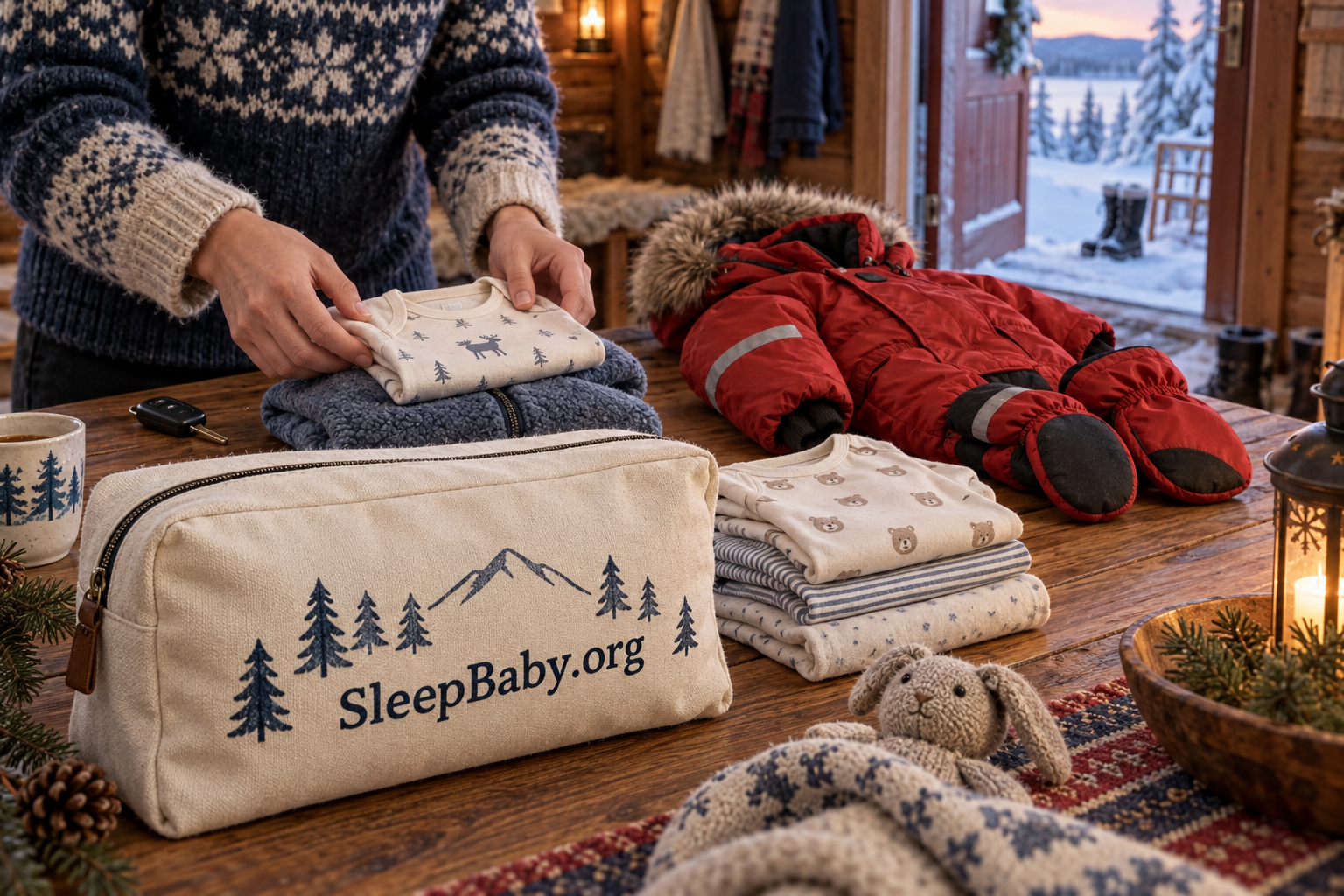
Keep changes easy to find. One pouch for dry replacements and a separate bag for damp items saves you searching through everything at the wrong moment. I would pack fewer decorative outfits and more usable spares. Take a spare set for yourself if a feed or diaper mishap would otherwise leave you in wet clothing too.
Rental gear is worth asking about, but confirm the exact items, sizes, collection time, and what your baby wears before you collect it. A suit waiting at the activity center does not help on the airport transfer. Build your arrival clothing plan independently of the excursion kit.

Sort out the car seat before you arrive
Ask the transfer company what restraint it can provide for your baby’s age and size, how it is installed, and whether it can guarantee that seat for each journey. If you are bringing your own, check compatibility with the vehicle, applicable local requirements, and the manufacturer’s instructions. “We have child seats” is not a complete answer for an infant.
For winter clothing, the AAP advises thin layers under a snug harness. Puffy coats and snowsuits can compress in a crash and leave dangerous slack. Add a coat or blanket over the buckled harness, keep the face clear, and remove excess warmth as the vehicle heats up. Do not put a stroller sleeping-bag insert underneath the baby or harness.
Arrange enough time to do this without rushing. The useful airport pickup is the one with the right seat and a patient driver, not merely the earliest departure. Keep essential supplies with you in case bags or transfers are delayed, and establish where you can stop for care during a longer road journey.
WATCH BEFORE THE AIRPORT TRANSFER · ABOUT 1 MINUTE
Winter Car Seat Safety Tips | AAP
This short American Academy of Pediatrics video shows a child’s winter coat and a car-seat harness check. It belongs in the packing conversation because an outfit for standing outside is not automatically suitable beneath the harness.
Takeaway: plan warmth around a correctly fitted harness, then follow your own seat’s instructions. The video is general car-seat advice, not approval of a particular Lapland transfer.
Will a stroller work in Lapland?
Sometimes, on the right route. It is not something I would assume for every activity site. Canterbury specifically warns that snowy, uneven terrain makes pushchairs impractical at its locations. Ask your accommodation and each operator about the routes you will actually use, including steps, packed snow, and where a stroller can be stored indoors.
A carrier is another tool, not an automatic solution. Use one appropriate for your baby’s age and size, follow its instructions, keep the face visible and airway clear, and think about your footing. It does not make a baby suitable for a snowmobile, husky sled, or any other ride that excludes them.
Consider the adult’s load too. Carrying a baby, a changing bag, and everyone’s outerwear through a slippery entrance is a very different task from a short walk at home. Split the bags between adults when possible. If you are traveling alone with the baby, choose routes and transport you can manage without an imaginary spare pair of hands.
Ask locally about cleared walking routes and avoid frozen water unless the relevant local authority or operator has explicitly established a safe route. Footprints are not a safety assessment. Visit Rovaniemi’s safety information is a useful starting point for local winter hazards and current advice.
Make feeding and changing ordinary parts of the day
Before an outing, identify somewhere warm where you can comfortably feed and change your baby. A restaurant reservation does not necessarily include a changing table, bottle preparation space, or somewhere private if that matters to you. Ask directly and pack a portable changing mat for the facilities you will use.
If you use formula, plan for your baby’s usual product and a safe preparation and cleaning setup. The CDC’s infant travel guidance discusses feeding hygiene and options such as sterile ready-to-feed formula. Follow your baby’s feeding plan and the product’s preparation and storage instructions; cold outdoor air is not a substitute for proper storage.
Carry supplies for delays in the bag that stays with you. Check airline and airport rules for milk, liquids, and equipment in advance. If your baby has allergies or uses a particular feed, do not make finding an equivalent after landing your only plan.
I would also locate a grocery shop or pharmacy before arrival and check opening hours against your flight. A kitchen is useful only if you can obtain what you need and use it safely. Tell your accommodation about essential requirements early, then confirm rather than assuming that a note on a booking form reached the right person.
Set up sleep before the first evening gets busy
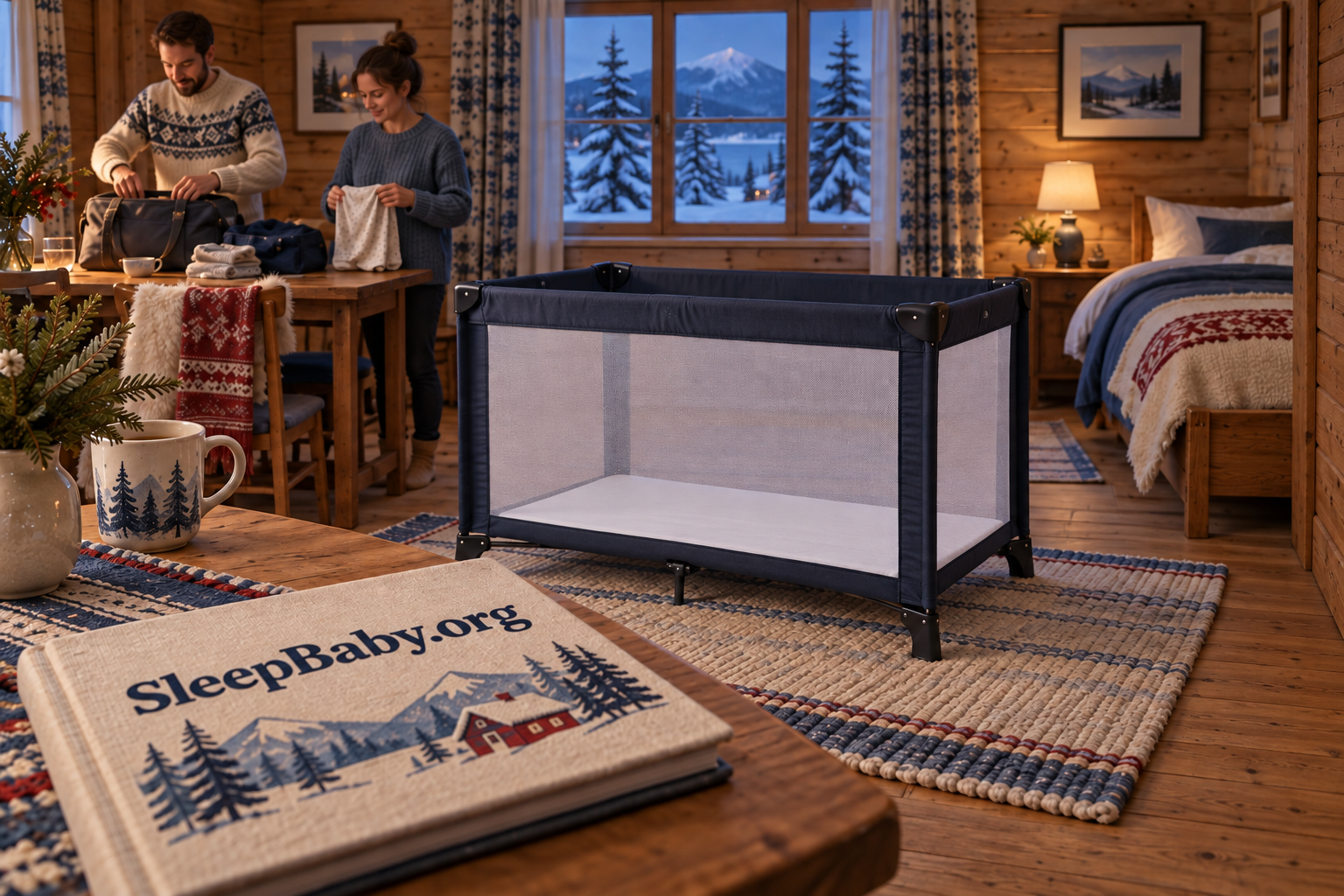
Inspect the cot when you arrive, while you still have time to ask for a replacement. It should be correctly assembled, in good condition, and suitable for your baby. Use its original firm, flat mattress and a fitted sheet; do not add a second mattress or padding to make a travel cot look softer.
Place your baby on their back in a clear, separate sleep space in your room. Keep it away from heaters, curtains, cords, and windows. Remove outdoor clothing and hats indoors. Check your baby’s chest or the back of their neck for overheating rather than dressing for the snow you can see outside. The Lullaby Trust’s holiday guidance covers these unfamiliar-room checks and recommends moving a baby out of a car seat to a suitable sleep space after the journey.
Our hotel safe-sleep checklist can help you inspect the room in a sensible order. I would do the cot, heat, and nearby hazards before unpacking every outfit. If the supplied cot is unsuitable, ask for a safe alternative rather than improvising with cushions or an adult bed.
Keep your bedtime routine portable. The familiar order of a feed, diaper change, sleep clothes, and a short song or book may be more useful than transporting every object from home. Leave room for a rough first night without deciding the whole holiday is going badly.
OPTIONAL FOR THE HEATED ROOM
Bring the room thermometer you already have
The outdoor forecast cannot tell you how warm your cabin bedroom is. If you already have a usable indoor thermometer, pack that. If you need one, the TempPro TP50, previously branded ThermoPro, is a small display for room temperature and humidity.
Place it out of your baby’s reach and away from direct heat. Read the actual temperature rather than treating a comfort icon as an infant-safety signal. It does not measure your baby’s body temperature, monitor breathing, or guarantee safe sleep; you still need to check the baby and room.
As an Amazon Associate, SleepBaby.org earns from qualifying purchases.
Dark winter days and bright summer nights need different plans
Choose the season for the holiday you actually want. Winter brings the snowy experiences many families picture, along with cold, limited daylight, and more clothing changes. Summer offers a different trip, with long daylight hours in the region. Exact conditions depend on your destination and dates, so check those rather than treating all of Lapland as one forecast.
In winter, organize daytime activity around available daylight without stretching your baby past needed sleep. In summer, ask what the room’s curtains actually block. Keep any blind or curtain cords out of reach, and do not cover a cot or stroller with fabric to create darkness.
If you cross time zones, offer ordinary daytime light when available, needed feeds, age-appropriate naps, and a quieter local evening. Avoid forcing a hungry or exhausted baby to follow an ambitious holiday timetable. Our baby jet-lag guide explains how to think about the clock change without promising an exact reset date.
I would leave a northern-lights outing optional. A long, late, cold wait can be a poor fit for a baby even when adults are excited about it. If adults take turns going out, the adult staying in needs a comfortable evening too. The holiday does not become less worthwhile because one person sees the sky while another does bedtime.
Pack for the parts of the day you cannot outsource
Work through one ordinary day on paper: waking, feeding, dressing, transfer, outing, return, bath or wash, and bedtime. Put each needed item beside the moment you use it. This usually reveals more useful gaps than an enormous generic packing list.
- Travel and delays: documents, required medication, feeds, diapers, spare clothes, and essential contacts in the bag you keep with you.
- Outdoor changes: correctly fitting layers, dry spares, and an easy way to separate wet clothes.
- Room and sleep: confirmed cot, suitable fitted sheet if needed, familiar sleep clothes, and a short bedtime routine.
- Adult logistics: appropriate footwear, charged phones, room keys, and a clear plan for who carries what.
Save the accommodation address, transfer details, operator contacts, and insurance assistance number somewhere both caregivers can access. Ask your insurer about your baby’s cover and the activities you plan to do. Keep essential medication in its original packaging and check any transport or entry requirements that apply to it.
Before leaving home, practice finding the essentials without unpacking the entire bag. Put the next diaper, a dry outfit, and feeding supplies where either adult can reach them. Tell your travel companion where they are. This is especially useful when one person is holding the baby and the other is dealing with tickets or coats.
When you get home, allow some recovery time if you can. Return to familiar feeds, naps, and evening cues rather than trying to correct every disrupted night at once. If sleep stays unsettled, our guide to sleep after travel helps separate a changed routine from a shifted body clock. Illness, poor feeding, or unusual sleepiness deserves medical attention, not more schedule adjustment.
What I would book, and what I would leave open
I would secure the essentials first: suitable accommodation, an infant restraint for transfers, a proper sleep space, and a realistic feeding setup. Then I would choose one or two things the family most wants to do, confirm the baby’s actual access, and keep the rest flexible.
You do not need to turn a baby into a tiny Arctic adventurer to enjoy being there together. A manageable visit, warm hands, a feed without a rush, and an uncomplicated journey back to the room are worthwhile outcomes. Let those count when you decide whether the trip is working.
Sources View sources
Reviewed September 26, 2026. Policies can change; confirm your exact dates and itinerary with the operator.
- American Academy of Pediatrics: cold-weather safety and winter car-seat safety.
- NHS: hypothermia; Finland Emergency Response Centre: 112.
- Operator policies: Santa’s Lapland, Canterbury Travel, Lapland Safaris.
- Travel and sleep: CDC Yellow Book, Lullaby Trust, Visit Rovaniemi, Visit Finland.
- Optional product: TempPro TP50 manufacturer information.
A smaller itinerary can make room for a better evening
Choose the warm return, protect the feeds and sleep your baby needs, and give yourself permission to finish the day early. When you want more help thinking through bedtime, you can explore the sleep resource at SleepBaby.org.