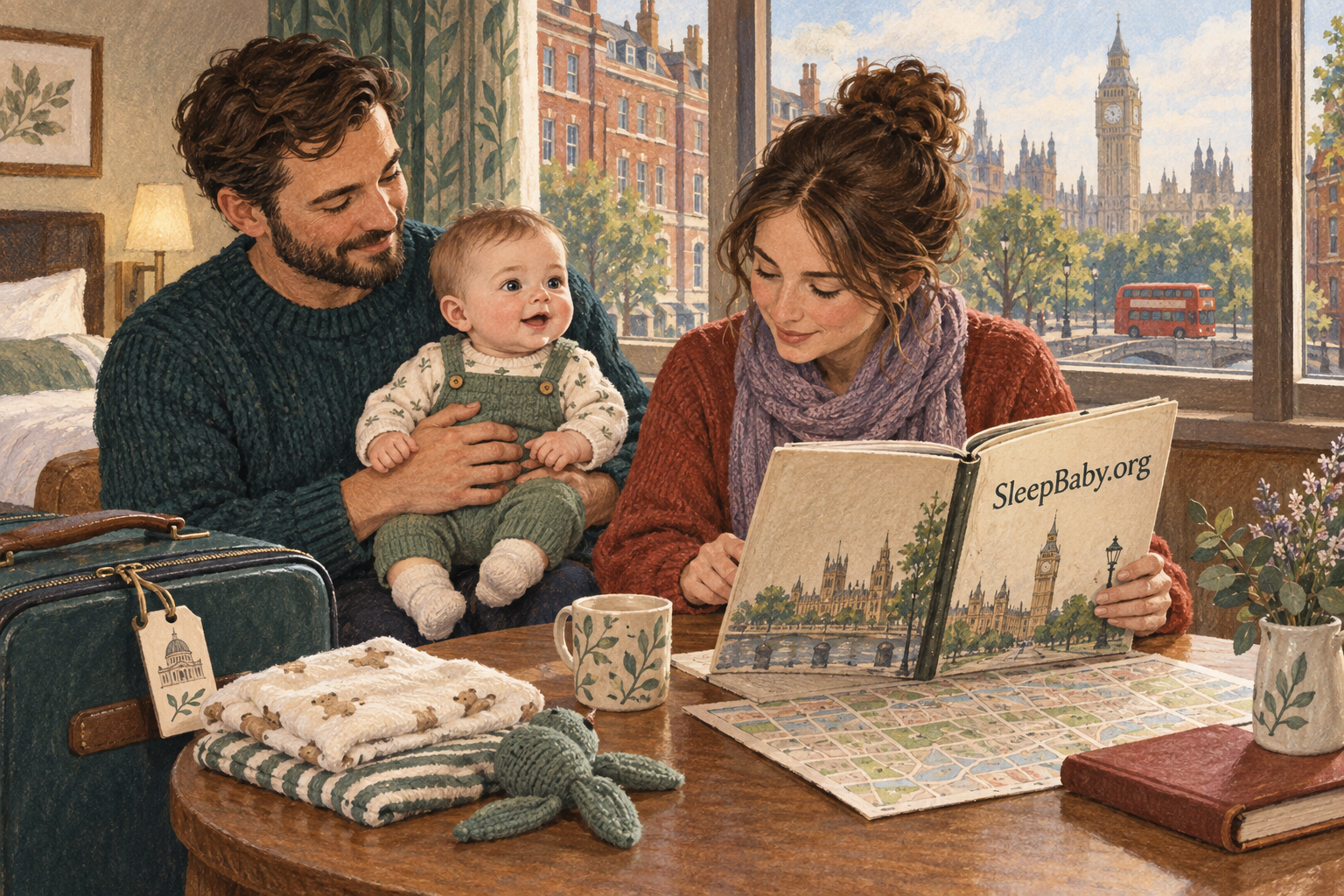
Taking a baby to London is easier when you choose a reachable place to stay, check the whole buggy route, and plan one main outing between feeds and sleep. Before buying attraction tickets, work out how you will get back to your room with a tired baby. A direct journey and a confirmed cot usually matter more than squeezing another landmark into the day.
I would start with that return journey today: find the hotel entrance, check the nearest usable station or bus stop, and save a second route. If either route depends on carrying an occupied buggy up stairs, change the route before you commit. You will have a useful test for the rest of your plans: can we get back when we need to?
London can give you a museum morning, a riverside walk, or lunch somewhere you have wanted to visit for years. Your baby does not need to appreciate the skyline for the trip to count. But the trip needs room for the ordinary things: a feed that takes longer, a nappy change before the queue, and an afternoon that ends sooner than the tickets suggested.
SleepBaby.org · The original video
A little help
for the night ahead.
Take a moment to watch the original Baby Sleep Miracle presentation. Your article will be right here when you’re ready to keep reading.
What viewers said10 comments · 4 replies
Archived comments from the original Baby Sleep Miracle presentation. Not independently verified by SleepBaby.org; individual experiences vary.
Hi Mary-Ann. I have a question: Is method in any way similar to the ones recommended by Dr Bucknam, Dr. Weissbluth or Dr. Karp? We tried those but none of them help.
Hi Regina, thank you for your question. The short answer is no. The techniques I share in my guide are based on newest scientific research and this is why I have never seen any approach similar to the one I recommend.
This method really works! I tried it on my son Jesus and after just one week he went from waking up more than 5 times a night to waking up just once or twice. You are a lifesaver, Mary-Ann!
I'm truly impressed with how much information you share in your video. And all for free! I can feel that you truly care about mothers like myself, and that's hard to find these days. I have recommended your site to several of my friends already.
Mary-Ann, our child suffers from autism. Is your approach still suited?
Chloe, I made sure my method can be used with any child, even babies who are special like yours. Please note that I'm not a doctor and that I always advice to consult with your physician because nothing is more important than the safety and well-being of your love.
Hallo Mary-Ann, I'm from Germany. Do you have your guide in German?
Hello Heide, we do! Normally you should already see our video in German. If not, please contact our support so they can guide you
Thenk you for your answer, Mary-Ann!
I just completed your approach and I have to say, it worked almost too well. Yes, it took a bit of getting used to with your bedtime routine but the difference is huge. My son George used to take 1 hours to go down and now he's firmly asleep in no more than 10 minutes! You're the best!
It seems I'm the only man watching this video, lol! What you shared about the 'emotional backpack' made immediate sense to me and I can't wait to help my little girl Mila to unpack it!
Hey there, just discovered your site and this really sounds different. Just wanted to say thanks for sharing :)
For everyone who's still thinking about getting Mary-Ann's guide I want to advise you to go ahead. I wasn't sure myself but now I'm so thankful I invested in this program. It made a huge difference in our life as a family and yes, my baby girl does sleep through the night now.
Ready to get started?Take the next step with SleepBaby.
Pick your price
Before you book: choose the trip your baby can manage
There is no single best age for taking a baby to London. A young baby may spend much of the day feeding and sleeping; an older baby may need space to crawl, familiar food, and breaks from being carried. Plan around your baby’s current needs, including any feeding, growth, or medical plan, rather than the age at which someone else’s holiday looked easy.
If your baby was premature, has a medical condition, or is unwell near departure, ask their clinician about the journey. The CDC advises checking with a healthcare professional before flying with children who have certain heart or lung conditions. Ask about vaccinations and travel health preparations early enough to act on the advice. [1]
For an international visit, check your baby’s passport and the entry requirements for their nationality, as well as your own. A baby who needs a UK electronic travel authorisation needs their own application; a parent’s approval does not cover them. Some travellers need a visa instead, and exemptions apply. Use the government’s current eligibility guidance before booking around an assumption. [2]
I would leave arrival day largely empty. You cannot know how long baggage, a delayed feed, or getting into the room will take. Keep milk, nappies, a change of clothes for the baby, and a spare top for yourself accessible during the journey. Save the accommodation address and its late-arrival contact somewhere available without mobile data.
For flights, ask your airline about approved infant restraints, baggage allowances, and where a checked buggy will be returned. Those are separate questions: being allowed to bring a buggy to the gate does not necessarily mean receiving it at the aircraft door. The CDC identifies an approved child restraint as the safest place for a child during a flight; confirm compatibility with the airline before travelling. [1]
Pick accommodation by the doorway, not just the postcode
A central address is only useful if the last part of the journey works. Check the route from the station to the building and then to your room. A property can have a lift while still having steps outside, a narrow entrance, or a lift too small for your open buggy. Ask for specifics, ideally with a recent photograph when the answer is unclear.
South Kensington may suit a trip centred on its museums. The South Bank may suit river walks and nearby attractions. Bloomsbury may suit a slower stay built around central walks and museums. These are starting points for comparing locations, not promises about every street, station, or hotel in those areas. I would choose a workable room and direct transport over an impressive neighbourhood name.
Search the actual address, not just the nearest station printed on the listing. Look at where you can buy everyday supplies, where you could sit for a feed, and whether your chosen outing requires a change of transport. If two properties look equally useful, a confirmed sleep space and straightforward access would break the tie for me.
Four answers to get from the property
- Can we reach the room?
- Ask about entrance steps, lift size, and somewhere to put the buggy without blocking your exit.
- What does “cot available” mean?
- Get the product type, confirmation that it is reserved, and the plan if the supplied unit cannot be used.
- Can we prepare our baby’s feeds?
- Confirm the facilities your own feeding method needs. A minibar and a small kettle are not a complete answer.
- What happens before check-in?
- Know whether you can leave luggage and where you will feed or rest if the room is not ready.
Check London’s transport one stage at a time
The shortest journey on a map can be awkward with a buggy. An extra change, a broken lift, or an inaccessible exit can matter more than a few minutes of travel time. Use TfL’s journey planner or TfL Go to check accessibility and current service information, then look at the walking section on both ends. [3]
Step-free to the platform and step-free onto the train are different things. You may still face a gap or a step between platform and carriage, or need boarding assistance. Check the stations, interchange, direction of travel, and the boarding information for your particular route. A familiar station name is not enough evidence that the route will work today. [3]
BEFORE THE FIRST TICKET
Trace the journey back to your room
- Street to station. Which entrance has the lift or ramp? Can you reach it from the attraction?
- Station to platform. Does every change work with your buggy? Check lift status before leaving.
- Platform to train. Check the gap, step, or assistance arrangements. Platform access alone does not settle this.
- Stop to room. Include the final pavement, doorway, and building lift.
- If one part fails. Save a workable bus, alternative station, or properly arranged car journey before you need it.
Your decision: if you cannot describe the return without an uncertain carry up stairs, revise the outing or the route.
I would avoid making the first London journey a test of how quickly I can fold the buggy while holding the baby and two bags. Practise the fold at home, keep the bag manageable, and decide who will hold what if two adults are travelling. If you are alone, a route that avoids needing to fold may be worth a longer ride.
Buses can help, but space is shared
TfL buses have low floors and space that can accommodate buggies, but a crowded bus may not have room. Wheelchair users have priority in the wheelchair space; you may need to fold the buggy or wait for another service. Keep your baby secured, apply the brake when stationary, and stay with the buggy. Use lifts where available rather than treating an escalator as the default. [4]
A baby under five travels free with a fare-paying adult on the TfL services covered by its guidance. Check fares separately for airport rail services, sightseeing buses, boats, and other operators instead of assuming every journey uses the same rule. You still need to arrange the adult fare and any operator-specific booking. [5]
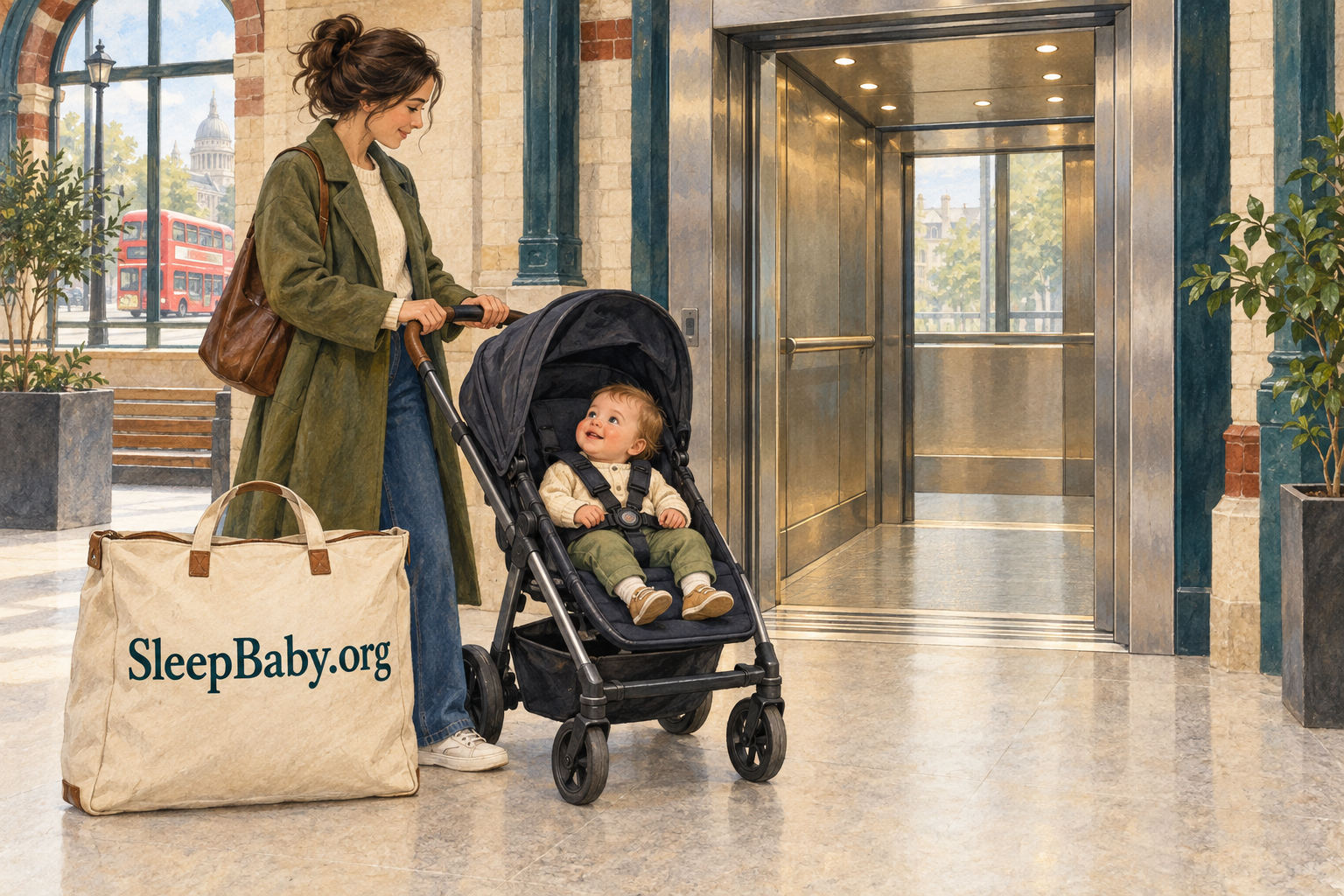
Arrange airport travel before the tired part of the day
Compare the whole airport-to-room journey: the terminal, luggage, any changes, the station exit, and the walk at the end. A train may work well if that chain is simple. A prebooked car may work better for your circumstances if an appropriate child seat is confirmed. Neither option becomes convenient merely because the first stage is direct.
UK law allows a child under three to travel in the rear of a taxi or minicab without a child restraint when the driver does not provide the correct one. That is a legal exception, not a reason to plan a journey without a suitable seat. I would arrange the appropriate car seat in advance and confirm its suitability for the baby and vehicle. An adult holding a baby does not replace a restraint. [6]
When booking, ask what seat will actually arrive, who supplies and installs it, and what happens if the vehicle changes. Leave time to check the setup before departure. Save the provider’s contact details rather than relying on a note in an app that a driver may not have seen.
Watch TfL’s buggy and luggage guidance
In this short official video, a DLR customer service officer explains her work and encourages travellers with buggies or luggage to use the lift where possible. Watch for the lift example, then check your own route’s access information.
Watch on YouTube · Transport for London. The video does not replace checking lift status and boarding access.

Set up a safe place to sleep before you go sightseeing
On arrival, check the cot or travel cot while you still have enough light and energy to ask for help. It should be intended for infant sleep, correctly assembled, suitable for your baby’s size and development, and complete with its proper firm, flat mattress or pad. Check the product instructions and condition. Do not add another mattress, folded towels, or a padded topper to make it feel more comfortable. [7]
Place your baby on their back for sleep, with a snug fitted sheet and no loose bedding, pillows, toys, or positioners. Keep the sleep space in your room for at least the first six months. A separate lounge is useful adult space, but it is not automatically the right place for a young baby’s cot. Keep the cot clear of blind cords, windows, heaters, and other hazards. [8] [7]
If the cot is damaged, missing parts, or cannot be identified and checked, ask for a suitable replacement. The adult bed, sofa, or car seat is not a substitute for the night’s sleep space. Our hotel safe-sleep checklist walks through the inspection and the questions to ask when the promised cot does not work.
I would unpack the bedtime essentials before the sightseeing clothes: nappies, ordinary sleep clothing, the feeding supplies, and the short book or song you usually use. Familiarity can come from the order of events and your voice. You do not need to fill the cot with familiar objects to make a new room feel familiar.

Make the feeding plan before leaving the room
Start with the way your baby already feeds. London does not require a new feeding routine, but an unfamiliar day can expose missing supplies quickly. Before heading out, ask: where can I sit, what will I need for the next feed, and what will I do if the outing lasts longer than expected?
If you breastfeed, choose somewhere you feel comfortable and allow time to stop. A designated feeding room is an option, not the only place to feed. Young V&A, for example, welcomes feeding throughout the museum and identifies its Reading Room on level -1 as a quieter space. Check the facilities at your own destination rather than expecting every museum to have the same arrangement. [9]
If you use formula, plan the method as well as the amount
Powdered formula is not sterile. NHS guidance uses water at least 70°C when it is mixed with the powder, followed by cooling the prepared feed safely before giving it to the baby. “There will be hot water somewhere” leaves too much unresolved: you need an appropriate preparation method, clean equipment, and time to cool the feed. [10]
Read the NHS instructions for making feeds away from home before packing. They describe carrying measured powder in a clean, dry container, a sterilised bottle, and freshly boiled water in a clean vacuum flask that keeps it sufficiently hot. Suitable ready-to-feed formula may be simpler when safe powder preparation is impractical; follow storage and use instructions, including after opening. [11]
Do not use a hotel’s minibar as an assumed solution for milk storage. Confirm whether the appliance and its temperature meet the requirements for what you are storing. Bring the equipment your feeding method needs, and check how you will clean and sterilise it. If your baby uses prescribed or specialist milk, ask your healthcare team about travel supplies and alternatives before departure.
For a baby who eats solids, bring familiar, age-appropriate food for the first stretch of the outing. A restaurant reservation does not guarantee the right food or a high chair will be ready when hunger arrives. Sit your baby upright and supervise eating; keep the feeding stop separate from a hurried walk to the next attraction.
I would pack the next nappy change so I could reach it without emptying the whole bag: nappies, wipes, a changing mat, spare clothes, and a bag for wet or dirty items. Check the venue’s changing facilities at arrival, before you need them. That small detour is often more useful than finding the best photograph first.
Choose one part of London for the day
A list of ten baby-friendly attractions does not tell you which two belong on the same afternoon. I would choose one main destination, one nearby place to pause, and the route home. Add another stop only if everyone still has the capacity for it. Travelling across the city because you have already paid for the next ticket is an expensive way to discover the day was full.
The examples below are alternatives, not a three-stop itinerary. Check opening arrangements, booking rules, access information, and transport on the day. Your accommodation location may make one much easier than the others.
Choose the outing that fits today’s energy
South Kensington: a museum visit
Pick one museum and a short visit. For the Natural History Museum, verify the accessible entrance before approaching with the buggy. Plan a feed and a return route before adding another museum.
South Bank: a walk with a clear turnaround
Choose a manageable stretch of riverside, then turn back while the return still feels easy. Make a London Eye ride an optional booked activity rather than the thing the whole day must rescue.
Bethnal Green: Young V&A
Check the museum’s feeding and changing information, and build the journey around an accessible route. A museum’s accessible interior does not guarantee that your nearest station exit is accessible.
Two attraction details worth checking properly
The Natural History Museum lists different access arrangements for its entrances. Its Exhibition Road entrance is not step-free; the Cromwell Road and Queen’s Gate approaches have ramp access, with details to check on the museum’s current page. Do not assume the entrance you happen to reach is the one you planned. [12]
The London Eye allows buggies that can be folded, but asks you to fold them before the boarding queue and keep them folded through the relevant boarding and exit areas. Babies under two need a ticket even though their admission is free with a paying adult. A rotation takes about 30 minutes, so feed and change your baby before joining the queue and consider whether everyone is ready for that commitment. [13] [14]
Young V&A has a buggy park and allows you to keep your buggy with you. Its visitor guidance identifies baby-changing facilities and quieter feeding space. Those details can make it a useful option, but they do not mean a baby will want a long museum visit. Leave while the outing still works rather than waiting to have seen everything. [9]
A realistic day has gaps in it
For example, start after a feed, travel to your chosen area, and visit one part of the museum. Stop for another feed or lunch, then decide whether a short walk is still appealing. Return for the next suitable sleep opportunity if that is what your baby needs. That is a complete London day, even if it contains only one attraction.
If the baby wakes early from a nap, shorten the visit. If you spend half the morning feeding, start later. If a lift fails, choose the saved alternative before everyone is depleted. I would keep these changes ordinary: you are responding to the day in front of you, not losing a competition with the itinerary.
Protect naps without expecting travel to run like home
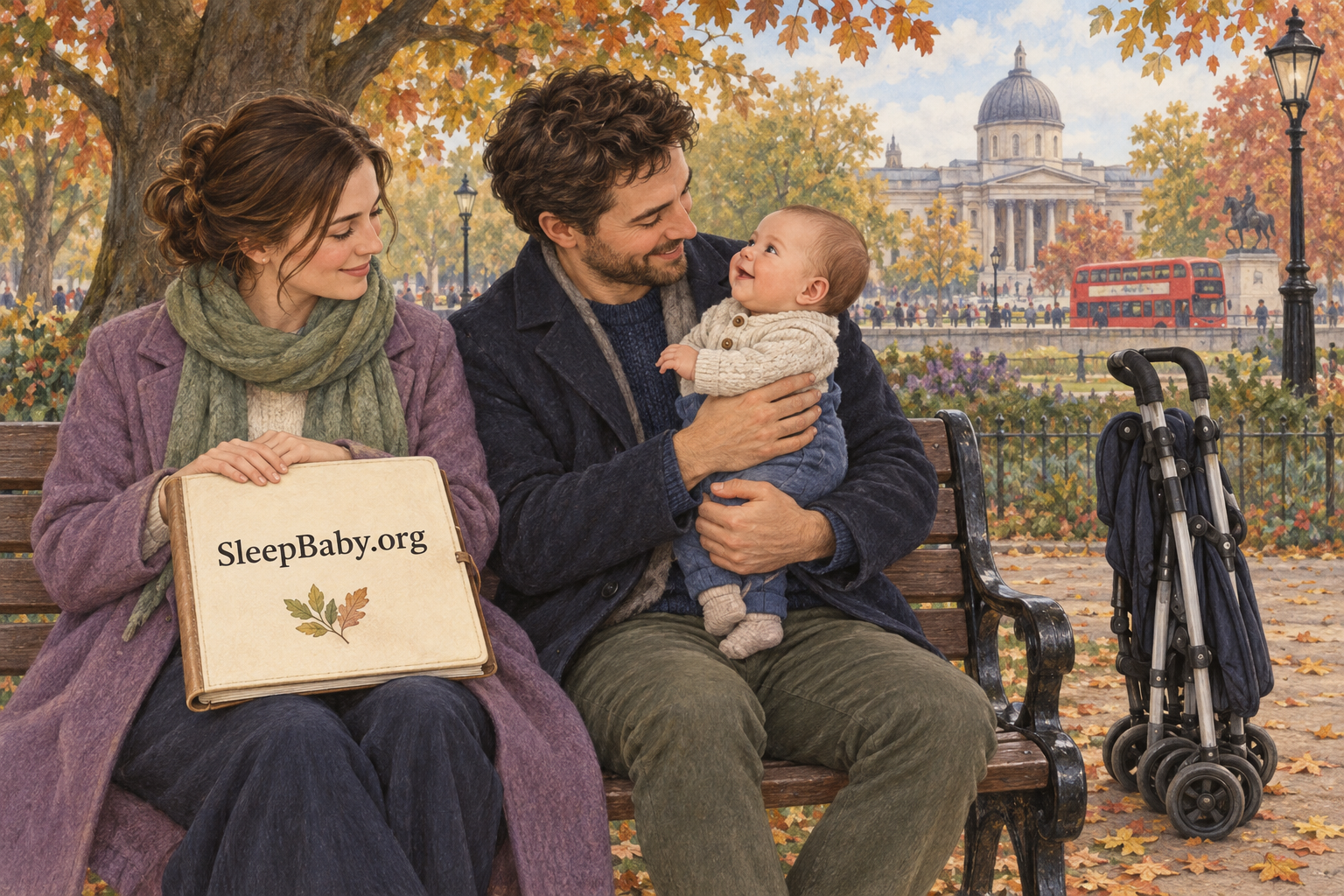
Try to give sleep a place in the day rather than hoping it appears between attractions. If a hotel nap is usually the most dependable option, make the main outing before or after it. With several naps, your workable sightseeing window may be short. That is a reason to stay near the things you most want to do.
A baby falling asleep in a car seat, stroller, carrier, or sling should be moved onto a firm, flat sleep surface on their back as soon as possible. Do not plan an entire nap around a seated buggy or leave a baby sleeping in a car seat in the hotel room. A reclining seat is not automatically an approved infant sleep space. [8]
Some carrycots are suitable for sleep when they meet the relevant requirements and are used exactly as their manufacturer directs; others are not. Check the exact product rather than the word “carrycot” on a listing. The Lullaby Trust’s holiday guidance explains the surface and ventilation considerations. Never drape a blanket over the buggy to create darkness. [7]
If you use a sling or carrier for getting around, follow its instructions and the TICKS checks: tight, in view, close enough to kiss, chin off chest, and supported back. Keep checking the baby’s airway and remove them from the carrier for feeds. A carrier may simplify a journey, but it also means carrying the baby’s weight and your supplies. Practise before relying on it for a long day. [15]
When the day stops working
Missed sleep: drop the next attraction and make room for a safe sleep opportunity.
Feeding takes longer: keep the feed; shorten the outing.
The route becomes awkward: use your backup, ask staff for access information, or change the destination.
Your baby seems unwell: switch from sightseeing decisions to getting appropriate medical help.
Handle the first nights gently, especially after a time-zone change
Travel fatigue, a different room, and jet lag can overlap. Crossing time zones can disturb infant sleep, but one difficult night does not tell you exactly which factor is responsible. [1] I would begin with ordinary care: feeds when needed, appropriate sleep opportunities, and the familiar bedtime sequence.
Use local daytime for ordinary daylight and activity when your baby is awake; make local nights quieter and dimmer. Do not keep an exhausted baby awake all day or delay a needed milk feed to force the clock. Our baby jet-lag guide explains the local-time cues and why adjustment cannot be promised on a fixed timetable.
Keep the evening manageable for the adults, too. Sort tomorrow’s bag before you are both exhausted. If there are two caregivers, agree who is handling the next part of bedtime and when the other can rest. If you are travelling alone, organise essentials within easy reach while keeping cords, bags, and supplies away from the baby’s sleep space.
There is no need to begin a new sleep approach on your first night in London. Check comfort, feeding, and the room setup before treating waking as a behaviour problem. When you return, the same distinction helps: a shifted body clock and a disrupted routine can look similar. Our guide to sleep problems after travel explains how to rebuild familiar cues at home.
Know where to get help before you need it
Save the accommodation address, your travel-insurance details, and your baby’s relevant health information. Ask where the nearest pharmacy is for ordinary supplies, but do not treat a pharmacy stop as the answer to serious symptoms. If your baby has a medical or feeding plan, carry that information with you instead of leaving it in checked luggage.
In the UK, call 999 for a life-threatening emergency, including severe breathing difficulty, blue or grey colour, or a baby who cannot be woken normally. Seek urgent medical advice for concerning symptoms such as poor feeding, dehydration, or fever in a young baby. A temperature of 38°C or higher in a baby under three months needs urgent assessment. Do not explain away illness as jet lag. [16]
If you need urgent medical advice and are unsure what to do, call NHS 111. For a child under five, call rather than using the online 111 service. Tell the adviser the baby’s age, symptoms, and where you are staying. [17]
Before leaving for the next outing, I would make one last check: the baby is fed as needed, the supplies are reachable, the sleep plan is realistic, and the return route still works. Then go and enjoy the part of London you chose. You can have a worthwhile trip without asking every day to be a full day out.
Sources and current visitor guidance
Checked September 26, 2026. Recheck access, ticket and entry rules before travelling.
- CDC: Traveling safely with infants and children.
- GOV.UK: Electronic travel authorisation eligibility.
- TfL: Wheelchair access and avoiding stairs.
- TfL: Getting around with your buggy.
- TfL: Free and discounted travel.
- GOV.UK: Child car seats: exceptions.
- The Lullaby Trust: Safer sleep on holiday.
- American Academy of Pediatrics: Safe sleep guidance.
- V&A: Visiting FAQs, including Young V&A.
- NHS: How to make up a feed.
- NHS: Formula milk questions, including feeds away from home.
- Natural History Museum: South Kensington access.
- London Eye: Visitor FAQs.
- London Eye: Tickets and infant admission.
- The Lullaby Trust: Slings and carriers.
- NHS: Urgent help for babies and children under five.
- NHS: When to use 111.
SleepBaby.org · The original video
A next step for
the next bedtime.
Still thinking about sleep? Watch the presentation here, then explore the SleepBaby program whenever you’re ready.
What viewers said10 comments · 4 replies
Archived comments from the original Baby Sleep Miracle presentation. Not independently verified by SleepBaby.org; individual experiences vary.
Thank you so much for this video! I had no idea about the dangers of baby swings :O
Hi Mary-Ann. I have a question: Is method in any way similar to the ones recommended by Dr Bucknam, Dr. Weissbluth or Dr. Karp? We tried those but none of them help.
Hi Regina, thank you for your question. The short answer is no. The techniques I share in my guide are based on newest scientific research and this is why I have never seen any approach similar to the one I recommend.
This method really works! I tried it on my son Jesus and after just one week he went from waking up more than 5 times a night to waking up just once or twice. You are a lifesaver, Mary-Ann!
I'm truly impressed with how much information you share in your video. And all for free! I can feel that you truly care about mothers like myself, and that's hard to find these days. I have recommended your site to several of my friends already.
Mary-Ann, our child suffers from autism. Is your approach still suited?
Chloe, I made sure my method can be used with any child, even babies who are special like yours. Please note that I'm not a doctor and that I always advice to consult with your physician because nothing is more important than the safety and well-being of your love.
Hallo Mary-Ann, I'm from Germany. Do you have your guide in German?
Hello Heide, we do! Normally you should already see our video in German. If not, please contact our support so they can guide you
Thenk you for your answer, Mary-Ann!
I just completed your approach and I have to say, it worked almost too well. Yes, it took a bit of getting used to with your bedtime routine but the difference is huge. My son George used to take 1 hours to go down and now he's firmly asleep in no more than 10 minutes! You're the best!
It seems I'm the only man watching this video, lol! What you shared about the 'emotional backpack' made immediate sense to me and I can't wait to help my little girl Mila to unpack it!
Hey there, just discovered your site and this really sounds different. Just wanted to say thanks for sharing :)
For everyone who's still thinking about getting Mary-Ann's guide I want to advise you to go ahead. I wasn't sure myself but now I'm so thankful I invested in this program. It made a huge difference in our life as a family and yes, my baby girl does sleep through the night now.
Ready to get started?Take the next step with SleepBaby.
Pick your price



Thank you so much for this video! I had no idea about the dangers of baby swings :O