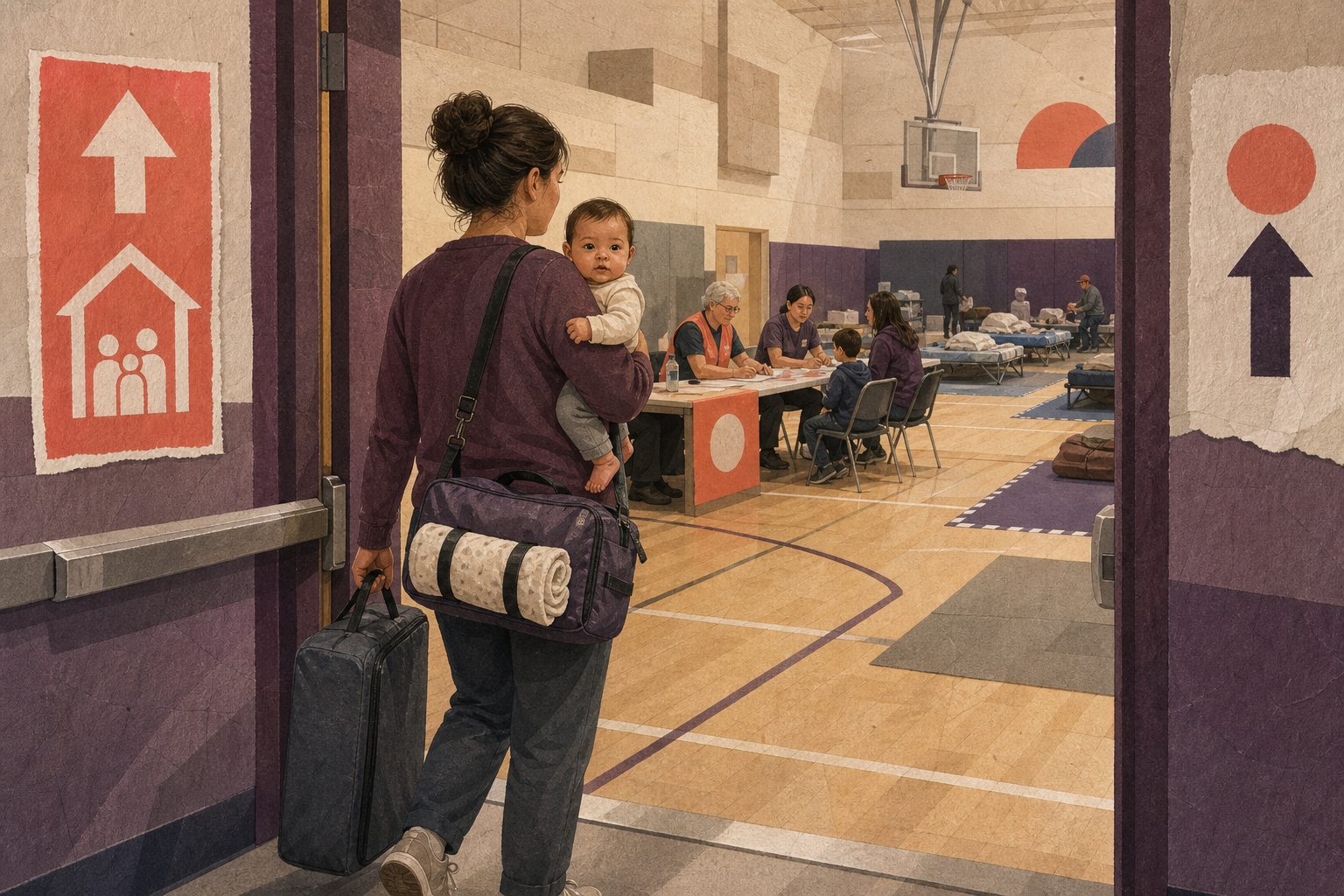
If officials tell you to evacuate, or staying where you are has become immediately unsafe, leave. Follow current local instructions and call emergency services if you or your baby are in immediate danger. A perfectly packed diaper bag is not worth losing the safe window to get out.
Use a live shelter locator or the destination given by local emergency management instead of driving to an address you remember from an older alert. Shelter locations, operators, and available services can change as an emergency changes. In the United States, the CDC currently lists the FEMA App and the option to text SHELTER plus a ZIP code to 43362; local alerts and emergency officials still control the route you should take now. 1
If you have time, bring the baby’s actual feeding supplies, medicines and equipment, health information, diapers, a way to charge essential devices, and an approved portable sleep space. If you do not have time, go. Missing supplies become specific requests at shelter intake, not reasons to stay in danger.
LEAVE / LOCATE / TELL / ESCALATE
Start here: leave, locate, tell, escalate
- Leave.Obey an evacuation order and move away from immediate danger. Do not finish a checklist while smoke, water, wind, fire, structural damage, or another threat closes in.
- Locate.Confirm that the destination is open and is an overnight shelter—not only a service point—through local emergency management, a current FEMA route, or the live Red Cross shelter map. 1 2
- Tell.At intake, say how your baby is fed and name any need for safe water, refrigeration, electricity, a compliant sleep surface, medicines, medical devices, accessibility support, or urgent health care. “I have a baby” is important; “my baby depends on refrigerated milk and this pump needs power” gives staff something they can act on.
- Escalate.If your baby has severe trouble breathing, blue or gray lips or skin, a seizure with loss of responsiveness, unusual unresponsiveness, uncontrolled bleeding, a severe injury, or signs of significant dehydration, call 911 in the United States. Tell the dispatcher the exact shelter or current location. Those examples are not a complete diagnostic list, and emergency numbers differ outside the United States. 15
What I want you to hear first is simple: protection comes before preparation. You can ask for a diaper. You can ask staff to help locate formula, a refrigerator, a charger, or a crib. You cannot recover a safe evacuation window after it closes.
What an evacuation shelter can—and cannot—promise
An evacuation shelter is temporary mass care, often set up in a school, community center, church, convention space, or another building converted for the emergency. FEMA’s planning definition includes basic functions such as a place to sleep, hydration, basic food, sanitation, disaster information, and some level of basic medical support. It also describes evacuation sheltering as short-term, often under 72 hours. 4
That definition is a planning target, not a promise about the exact room you are entering. A shelter may be run by the Red Cross, a government agency, or a local partner. The Red Cross says its shelters may provide a safe place to sleep, food, water, first aid, help with prescription replacement, charging, emotional support, and disaster information. Availability changes by site and event. 2
Do not assume the site has:
- a crib, bassinet, or portable play yard;
- the type or brand of formula your baby uses;
- a refrigerator with room for expressed milk or medicine;
- a safe formula-preparation area or enough safe water;
- an outlet beside your assigned space;
- a private feeding room or a quiet family room;
- pediatric care, childcare, laundry, or every accessibility support.
The useful promise is not “the shelter will have everything.” The useful plan is: make the need visible, ask what is available, and request escalation when the site cannot safely support it.
FEMA’s caregiver guidance also reminds families that congregate sheltering means sharing sleeping, restroom, and shower space with other people. Ask about the selected shelter’s rules and communicate accommodations early. 3
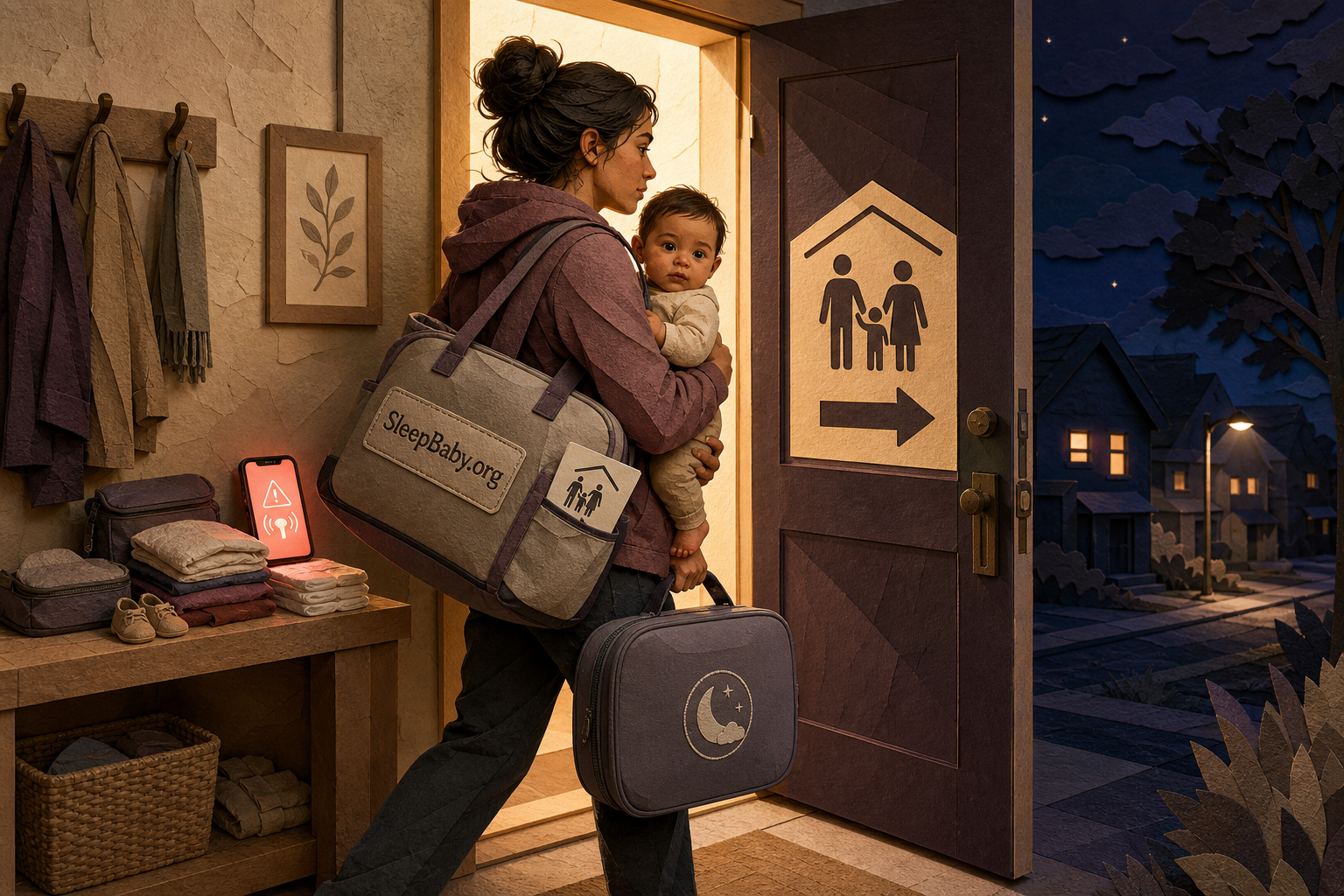

Keep the whole trip in four phases
The details feel less crushing when you organize them by the next doorway rather than one enormous emergency list.
1. Before leaving
Follow the order, confirm the live destination, and take the highest-consequence infant supplies only if time allows. Put the baby’s care information somewhere that can survive a dead phone or a wet bag.
2. During travel
Keep the destination and emergency contact visible. Protect milk, formula, medicine, and equipment within their exact handling requirements. This Article does not replace current vehicle-restraint guidance; do not improvise a new car-seat setup or feed a baby in motion based on a general shelter guide.
3. At intake
Describe the baby’s real feeding method, safe-sleep need, medicines, equipment, refrigeration, power, and health concerns. Ask staff to show you the approved water source and the areas for feeding, cleaning, diapering, sleeping, and medical help.
4. Before the first sleep
Secure a firm, flat, non-inclined, separate infant sleep surface. Keep it clear. A shared room does not change the baby’s need for a safe surface, and exhaustion does not make a car seat, adult mattress, couch, padded nest, or pile of blankets safer.
The four phases are not four tests you have to pass perfectly. They are four handoffs: from danger to movement, movement to intake, intake to essential care, and essential care to the first protected rest.
Pack by consequence, not by how complete the bag looks
The CDC’s emergency checklist changes according to how the child is actually fed. It includes feeding supplies, safe water, diapers, a carrier, extra clothing, health records, labeling materials, and a portable crib, but the checklist is a preparedness ideal—not a reason to delay leaving. 5
PACK BY CONSEQUENCE
Carry now, if there is time
Start with the items whose absence could create a feeding, medication, communication, or safe-sleep failure:
- prescribed medicines and the equipment used to give them;
- medical devices, chargers, backup batteries, and cold-storage materials required by the product or care plan;
- an offline and waterproof copy of the baby’s name, date of birth, allergies, diagnoses, medication names and doses, clinician and pharmacy contacts, vaccination record, and emergency contacts;
- the baby’s actual feeding supplies: nursing essentials, a labeled expressed-milk cooler, or ready-to-feed formula for a formula-fed baby;
- diapers, wipes, barrier cream, sealable waste bags, and a change of clothing;
- a phone, charging cable, and battery bank;
- a safety-compliant portable crib or play yard with its fitted sheet, if it can be taken without slowing the evacuation;
- a carrier for supervised awake movement when you need both hands.
For a child with special healthcare needs, CDC recommends planning with the child’s clinician and pharmacist, carrying the care plan and prescription information in both waterproof paper and offline electronic form, and preparing the power or cold-storage backup the child actually uses. 13
Add if time and space allow
Useful second-tier supplies can include a wash basin, dish soap, a dedicated brush, a drying bag, labeled milk or food containers, extra clothing, a thermometer, clinician-approved medicines, age-appropriate shelf-stable food, and weather-specific clothing. A clean comfort object can travel too, but it is for awake comfort and stays out of the infant sleep space.
Do not pack formula “just in case” as though every breastfeeding family needs to switch during an emergency. CDC’s specialist feeding guidance supports continuing the family’s established breastfeeding relationship. Formula supplies belong in the kit for a baby who receives formula. 6 8
Ask there
If you had to leave without enough diapers, ready-to-feed formula, safe water, a compliant sleep surface, charging, refrigeration, cleaning supplies, or medicine, say so at intake. Shelter staff may be able to locate supplies, connect you with health services or prescription help, or arrange a more capable placement. 2 8
I would rather you arrive with an incomplete bag and a clear list of needs than remain in danger trying to make the bag look complete.
Make one handoff card that works when the phone does not
Emergencies scatter information. One adult knows the medicine dose, another knows the pharmacy, and the address is trapped in a text thread on a phone with 4% battery. A short handoff card makes the baby’s needs understandable even if you are exhausted, separated briefly, or speaking with a staff member you have never met.
ONE HANDOFF RECORD
Write or print:
- Baby
- baby’s full name and date of birth;
- Caregivers
- caregiver names and phone numbers;
- Backup contact
- one out-of-area emergency contact;
- Health
- allergies and major diagnoses;
- Feeding
- how the baby is fed now;
- Medicines
- medication name, dose, schedule, purpose, prescriber, and pharmacy;
- Equipment
- medical devices and what needs power, refrigeration, or backup supplies;
- Feeding schedule
- clinician-directed feeding or wake-to-feed instructions;
- Destination
- the planned shelter or destination and the date/time it was confirmed;
- Intake concern
- the exact concern staff should know at intake.
Keep one paper copy in a waterproof sleeve and one offline copy on the phone. CDC’s medical-kit guidance specifically includes care plans, prescription information, identification, records, pharmacy contacts, backup power, and cold-storage planning for children with special healthcare needs. 13
During travel, keep milk, formula, and medicine within the instructions that apply to that exact product. Do not guess how long a temperature-sensitive item remains usable. Once you arrive, move a sleeping baby from a car seat, stroller, carrier, or sling to a firm, flat approved sleep surface as soon as possible. 12
Keep the supervision and regrouping plan just as clear
A shelter is shared living space, not automatic childcare. Keep the baby with an identified caregiver and closely supervised. If two adults are dividing tasks, say who has the baby before one person walks toward registration, supplies, the restroom, a health desk, or the parking area. CDC’s shelter guidance specifically tells caregivers to keep close supervision of children. 10
Choose one simple regrouping point inside the site and one out-of-area contact both adults can reach. Put the contact and the shelter’s exact name or address on the handoff card. FEMA’s caregiver guide emphasizes family communication planning and communicating support needs in congregate shelter settings. 3
If the only caregiver becomes ill, needs medical attention, or cannot safely continue holding the baby, tell staff immediately and name the safe handoff you need. Do not assume a volunteer can watch the baby, and do not leave the baby sleeping behind a curtain, under a blanket, or among bags while you solve another problem. Ask staff what supervised family or health-support route the site uses.
The plan does not need to be elaborate. It needs to prevent the sentence “I thought you had the baby” in a room where everyone is moving under stress.
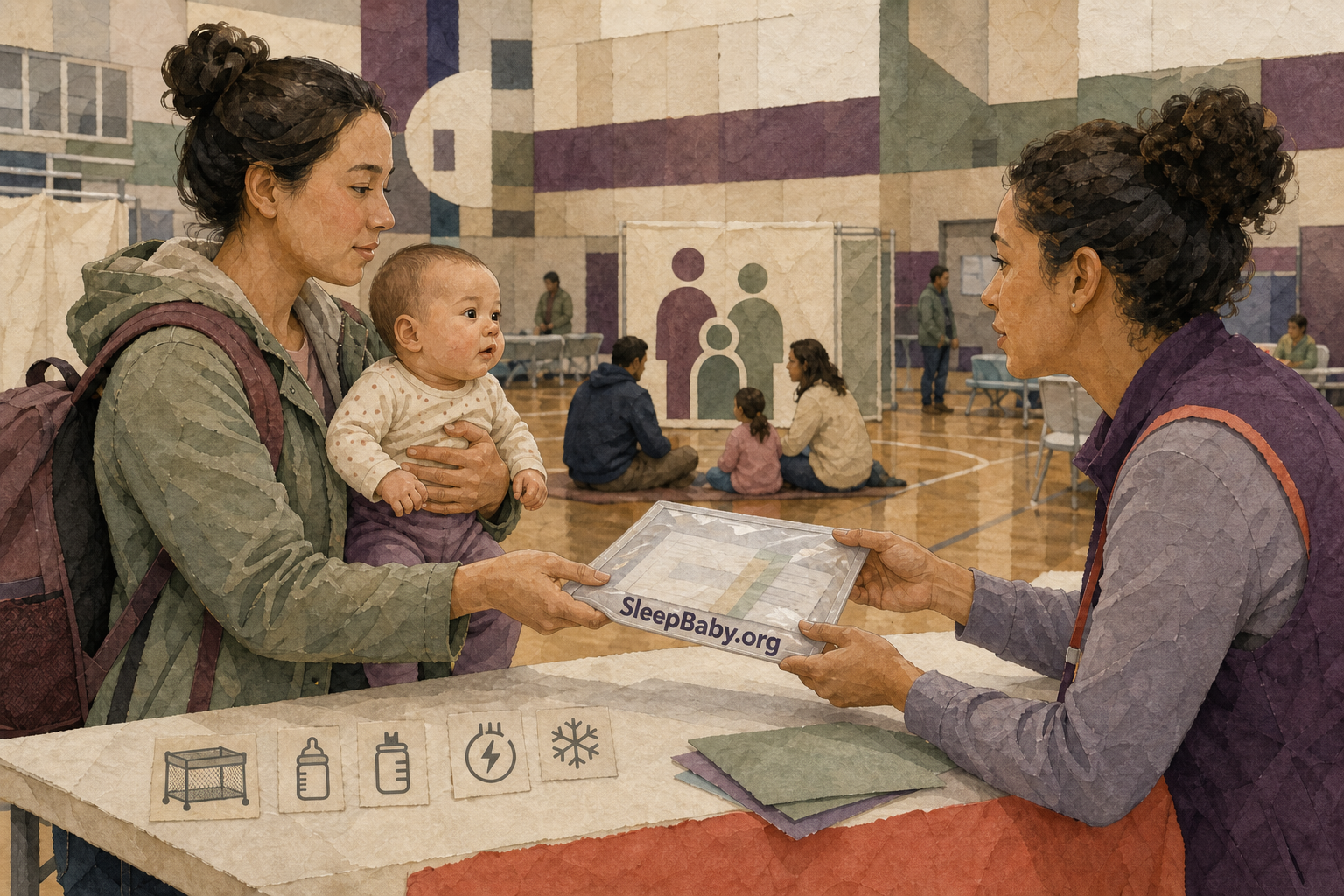
At intake, name the need—not just the category
The shelter team needs to know more than the baby’s age. A six-week-old who breastfeeds directly, a four-month-old who depends on refrigerated expressed milk, and a medically complex infant whose feeding pump needs electricity all arrive under the category “baby,” but they do not need the same response.
AT THE INTAKE DESK
Say
Begin with one direct sentence:
“My baby is ___ months old, is fed by ___, and needs ___ for feeding, medicine, equipment, and safe sleep.”
Then name urgent health concerns, allergies, medicines, devices, refrigeration, charging, accessibility, language, or dietary needs. Red Cross shelter guidance asks guests to tell staff about equipment, supplies, food needs, disability-related needs, and other accommodations on arrival. 2
Ask
Ask staff to identify:
- your assigned family sleeping area and an approved infant sleep surface;
- the water source currently approved for drinking and feeding;
- a feeding and formula-preparation area that is not a bathroom;
- the handwashing and feeding-item cleaning area;
- a separate diaper-changing and waste-disposal area;
- refrigeration for labeled expressed milk or temperature-sensitive medicine;
- power, charging, or backup support for pumps and medical equipment;
- lactation, WIC, health, prescription-replacement, disability, language, or mental-health support;
- a quieter family area, if one is available; and
- the site’s current illness-reporting, sanitation, security, pet, and re-entry rules.
CDC’s shelter-support guidance describes safe water, feeding space away from bathrooms, separate diapering, refrigeration for expressed milk, charging for feeding equipment, and lactation support as capabilities shelters should plan for. It is written for shelter staff. For a caregiver, that becomes a list of needs to disclose and verify, not a guarantee that every site has them at every moment. 8
Confirm
Repeat the critical answer back: which water is safe, where milk can be stored, where the baby will sleep, where to take a sick child, and what to do if a needed resource runs out. If there is a shift change, ask how the need will stay visible to the next staff member.
If a formula-dependent baby is at a site without ready-to-feed formula, safe water, or the ability to boil water, tell staff immediately. CDC’s staff guidance says a shelter without those capabilities should not house families whose infants depend on formula. The caregiver action is to request a safe response or capable placement—not to leave into danger without another destination and not to improvise an unsafe feed. 8
A shelter can be doing the hard work of emergency mass care and still not yet have the one infant-specific thing your baby needs. You are not being difficult by making that need visible. You are giving the response system a chance to solve the right problem.
Feed the baby who is actually in front of you
An emergency does not erase the feeding relationship that already exists. The safest plan begins with what your baby receives now and what that method requires under disrupted water, power, cleaning, and refrigeration conditions.
START WITH HOW THIS BABY IS FED
If the baby breastfeeds directly
Support continuation of the established breastfeeding relationship. Direct breastfeeding does not require formula-mixing water or electricity. A caregiver may feed in the shelter living area or ask for a clean, private space. A bathroom is not an appropriate place to breastfeed, pump, prepare a feed, or clean feeding equipment. 6 9
Do not distribute or recommend formula automatically to a breastfeeding family. CDC warns shelter staff that doing so can wrongly suggest that breast milk is inadequate or unsafe during an emergency. 8
If nursing becomes painful, milk transfer seems poor, the baby is not feeding close to usual, or the caregiver needs help, ask for lactation, WIC, or clinical support. A general Article cannot assess the baby’s intake, weight, hydration, or an individualized feeding plan.
If feeding depends on a breast pump
Tell staff that pumping may require three separate capabilities: electricity or charged batteries, safe water and space to clean pump parts, and refrigeration for the milk. A pump without a safe cleaning and storage path is not a complete feeding plan.
CDC advises families to prepare a manual pump as a power-outage backup when pumping is part of the feeding plan, but reusable equipment still needs safe cleaning. If safe water and soap are unavailable, do not keep using equipment that cannot be cleaned appropriately. 5
If you know how to hand express, it may provide a backup when power is unavailable. Ask for skilled support if you need it; a stressful shelter arrival is not the moment for an Article to pretend that a short paragraph replaces hands-on help.
If you are carrying expressed milk
CDC says freshly expressed milk can travel in a cooler with frozen ice packs for up to 24 hours. On arrival, label it, tell staff that it needs cold storage, and use, refrigerate, or freeze it according to its current condition. 6
Do not compress every milk state into one easy-sounding deadline. Previously frozen milk that still contains ice crystals is not the same as milk that has fully thawed. Milk that has warmed is not the same as milk continuously held at refrigerator temperature. Follow the current CDC storage branch for the milk in front of you, and ask shelter health staff or the baby’s clinician when you cannot establish its temperature history.
If the baby uses ready-to-feed formula
For a formula-fed infant, sterile ready-to-feed formula in single-serving containers is the safest emergency formula option because it does not need mixing water. 5 7
Check the expiration date and storage directions. Use a new container and clean feeding method as directed. Do not assume the shelter stocks the baby’s usual product, and do not accept an opened container with an unknown storage history.
Ready-to-feed formula is especially important when breast milk is not being provided to a baby younger than 2 months, born prematurely, or living with a weakened immune system, because powdered formula is not sterile. 7
If powdered formula is the only available option
Use bottled water or tap water that local authorities have declared safe. Follow the formula label exactly. Measure in the order and amounts the manufacturer directs; do not stretch the supply with extra water, make it “stronger” with extra powder, or estimate a scoop. Never make homemade formula. 7
Prepared formula timing matters:
- use it within two hours of preparation;
- once feeding starts, use it within one hour;
- if unused formula was refrigerated promptly before feeding, use it within 24 hours; and
- discard what remains after a feed.
Those windows come from CDC’s emergency powdered-formula guidance. They do not override a product label or a clinician-directed plan. 7
If the water is not safe, the ratio is uncertain, the container is damaged, or you cannot clean the feeding equipment, stop and ask staff for help. Hunger makes improvisation feel urgent; contamination and incorrect concentration can create a second emergency.
If the baby uses concentrated liquid formula
Concentrated liquid formula still requires added water. Use only water approved by local authorities and follow that product’s label exactly. Do not treat concentrated formula as ready-to-feed, and do not borrow the ratio from another product. CDC’s emergency guidance groups powdered and concentrated products under the safe-water requirement when ready-to-feed formula is unavailable. 6
If bottles and nipples cannot be cleaned safely
Hard-to-clean reusable feeding items should not be used when safe water and soap are unavailable. CDC shelter guidance describes disposable cups, paired with cup-feeding instructions, as one response because bottles, nipples, and sippy cups are difficult to keep clean in those conditions. Ask staff or a qualified feeding professional to show you the method rather than improvising from a sentence online. 5 8
What matters in every branch is the same discipline: preserve the feeding method when it is safe, use water the shelter or local authority approves, follow the exact product instructions, keep the equipment clean, and make a capability failure visible before you invent a workaround.
Created for SleepBaby.org

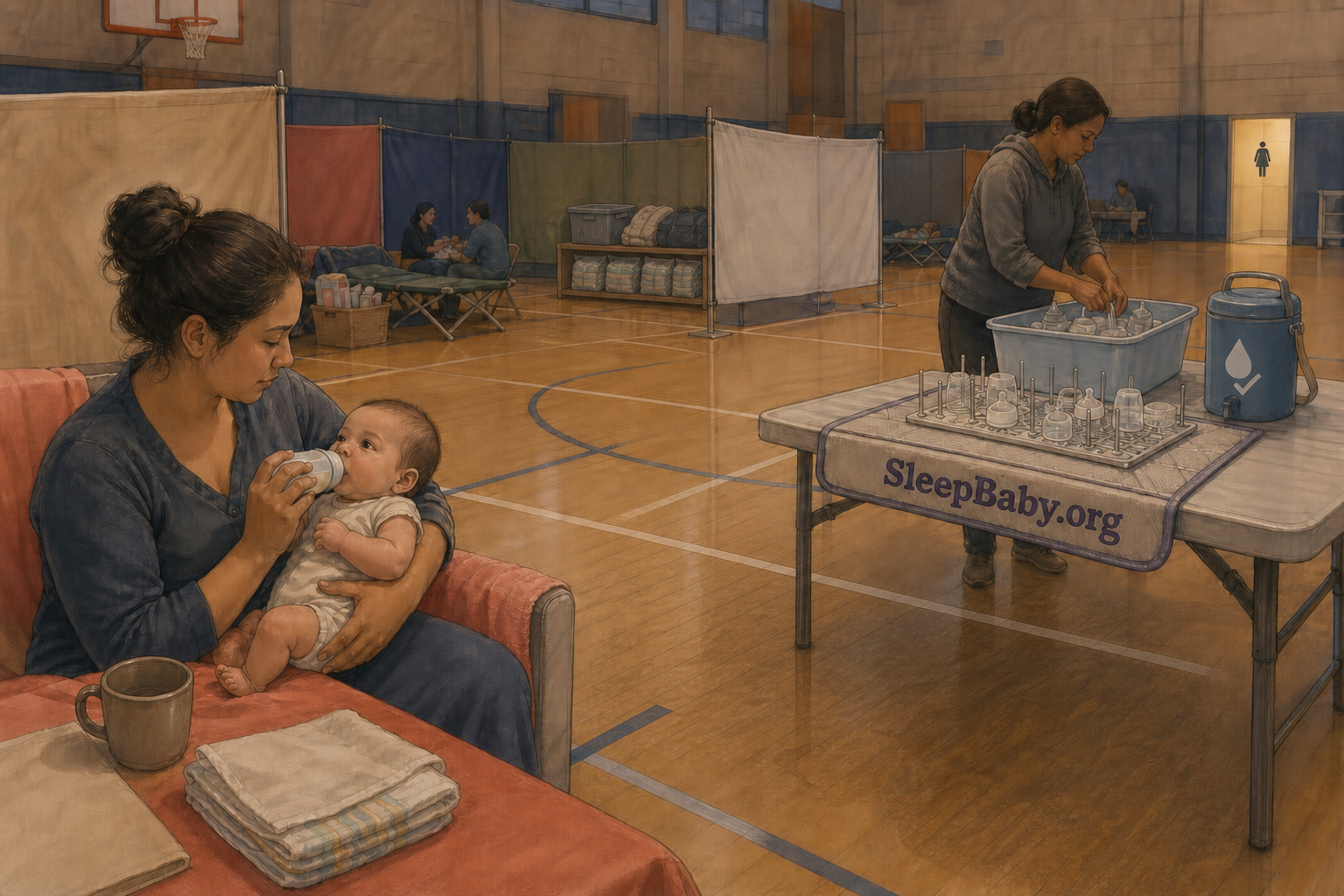
Keep feeding, cleaning, and diapering from becoming one shared zone
Congregate shelter space can make every flat surface look useful. It is still important to separate tasks that can contaminate one another.
KEEP THE SURFACES APART
Feed zone
Use the place staff identifies for breastfeeding, pumping, feeding, or formula preparation. It should not be a bathroom. Use only the water source currently identified as safe. Keep labeled milk and formula protected from shared handling.
Clean zone
Wash hands with soap and safe water before feeding and after diaper changes. When soap and safe water are unavailable, CDC advises hand sanitizer containing at least 60% alcohol. Clean feeding items only where the shelter directs and only when the water and method are safe for that purpose. 10 18
Diaper zone
Change diapers and dispose of waste in the designated area, away from food preparation, feeding, and cleaned equipment. Keep the baby closely supervised and avoid sharing bottles, feeding items, bedding, or personal supplies when possible. Report illness symptoms or known exposure to staff and follow the site’s infection-control instructions. 10
CDC’s family-friendly shelter guidance deliberately separates feeding, formula preparation, cleaning, handwashing, and diapering. It also says bathrooms should not be used for feeding, preparing feeds, or cleaning feeding items. 9
If the site does not yet have a clearly marked layout, ask where each task should happen. The goal is not to criticize a shelter during a crisis. The goal is to keep stool, dirty water, used feeding equipment, and prepared food from sharing the same improvised surface.
A short official video for powdered formula and pump-part cleaning
For a high-risk infant who must use powdered formula, CDC’s How to Prevent Cronobacter Infection in Infants demonstrates the preparation, storage, and separate-equipment cleaning steps discussed above. 7 10 The shelter-specific boundary still comes first: use only water and a preparation or cleaning area that staff have confirmed are safe, never a bathroom, and ask for a ready-to-feed alternative or clinical help when the setup is not safe. The written guidance above remains complete if the video cannot play.
Build the first safe sleep from the surface outward
The shelter may be bright, noisy, crowded, and unfamiliar. The safe-sleep foundation does not change.
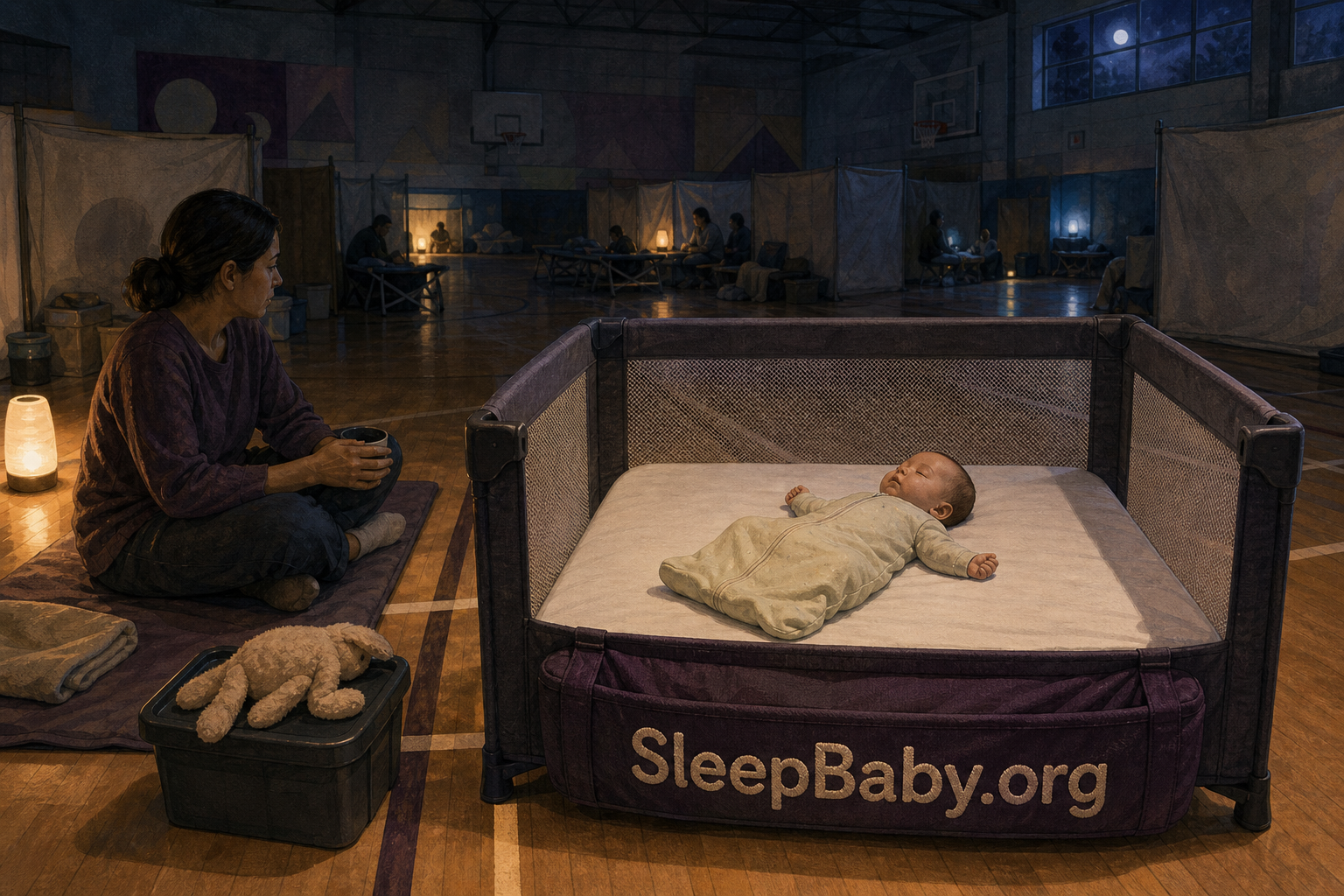
Place the baby on the back for every sleep. Use a firm, flat, non-inclined surface in a safety-approved crib, bassinet, portable crib, or play yard with only a fitted sheet. Keep pillows, blankets, quilts, bumpers, toys, loose fabric, positioners, nests, wedges, and weighted products out. Room sharing is safer than bed sharing. 11 12
Use suitable sleep clothing instead of a loose blanket when warmth is needed. Keep the crib or play yard beside the caregiver’s assigned sleeping area when the shelter layout allows, but keep the baby’s surface separate. 11
If the baby falls asleep in a car seat, stroller, swing, carrier, or sling, move them to the firm, flat approved surface as soon as possible. A transport product does not become an overnight sleep space because the room is chaotic or the baby finally closed their eyes. 12
BUILD THE FIRST SAFE SLEEP IN ORDER
-
First choice: an approved infant sleep product
Ask staff for a crib, bassinet, portable crib, or play yard that meets current safety requirements. Use its firm mattress and fitted sheet as intended. Do not add adult bedding to make it look softer.
-
If you cannot see one, ask and escalate
Tell staff that the baby needs a safe infant sleep surface now. Ask whether another family area, supply cache, partner organization, health service, or capable placement can provide one. Do not quietly place the baby on an adult cot or construct a padded nest because you are afraid of being a burden.
-
Temporary emergency bridge only when no approved surface is available
The American Academy of Pediatrics explains that during an emergency, when a compliant sleep surface is genuinely unavailable, a box, basket, dresser drawer, or similar container with thin, firm padding can serve as a temporary bridge. Move the baby to an approved surface as soon as one becomes available. 12
That is a last-resort harm-reduction boundary, not an endorsement of a cardboard “crib,” a product recommendation, or permission to add pillows, folded quilts, soft foam, an incline, or loose fabric. Keep the temporary surface stable, flat, clear, and away from hazards. If you are unsure, ask shelter health staff or emergency personnel to help assess the safest available option.
-
Comfort comes after the surface is safe
A clean familiar lovey can stay with the caregiver while the baby is awake. It does not go into the sleep space. A familiar phrase, the same brief feeding-and-diaper sequence, or the same sleep clothing may help the transition feel less abrupt, but none of those cues earns a compromise on the surface.
If your baby protests the unfamiliar crib, the answer is not to make the crib softer. Once the safety and health questions are settled, this separate guide can help you help a baby settle into a crib without replacing the safe-sleep rules.
What I would protect most fiercely in that first shelter night is the empty space around the baby. A bare crib can look almost too spare beside adult cots, blankets, bags, and coats. That spareness is the point. The comfort object can wait in your hand. The pillow can stay on your mat. The baby’s breathing space stays clear.

Protect medicines, devices, records, and power needs
Medicine and equipment failures are rarely solved by a universal keep-or-throw-away rule. The useful work is to protect what you can, record what happened, disclose the need, and reach someone who can make a product-specific decision.
For each medicine, keep the name, dose, schedule, purpose, prescriber, pharmacy, allergies, and storage instructions with the handoff record. Bring the original labeled package when possible. Protect it from water. If the label requires a temperature range, bring the appropriate cooler or cold pack and record when refrigeration was lost. 13 14
At intake, tell staff which equipment needs electricity, batteries, refrigeration, oxygen, specialized feeding supplies, or replacement parts. Ask early about charging, backup power, medicine refrigeration, prescription replacement, or referral to a health service. CDC advises families with medically complex children to seek help from emergency responders or shelter staff if the normal clinician or pharmacy cannot be reached. 13
FDA guidance says medicines touched by floodwater or contaminated water generally need replacement. Temperature-sensitive products should be replaced promptly after they have been outside required refrigeration, but stability depends on the exact product. A pharmacist, clinician, or manufacturer should answer product-specific questions. 14
FDA also describes a narrow situation in which a lifesaving medicine may need to be used when no replacement is available. That is not permission for an Article to declare every damaged medicine safe. If the medicine is essential and replacement is not immediately possible, contact shelter health staff, a pharmacist, the prescriber, emergency services, or the manufacturer and explain the exposure and timing.
Protect: labeled package, waterproof records, known temperature range.
Disclose: medicine, dose, device, power, refrigeration, and the time the failure began.
Verify or replace: use professional or manufacturer guidance for that exact product.
Lower the threshold for a very young, premature, immunocompromised, or medically complex baby
The same shelter may be workable for one infant and unsafe for another. Age, prematurity, immune status, feeding dependence, and medical technology can change how quickly a missing resource becomes urgent.
For a formula-fed baby younger than 2 months, born prematurely, or living with a weakened immune system, CDC places extra importance on sterile ready-to-feed formula when breast milk is not being provided. Powdered formula is not sterile. If ready-to-feed formula is unavailable, do not quietly treat that as a normal substitution; tell staff the baby’s age or condition and ask for feeding or clinical support. 7 8
For a baby with a clinician-directed feeding schedule, specialized formula, tube feed, oxygen, monitor, refrigerated medicine, seizure plan, or another care protocol, bring the written plan and use it over general internet guidance. Tell intake staff what the equipment does, what power source it needs, what backup you have, and what happens if the system fails. CDC’s special-healthcare-needs checklist recommends involving the child’s clinician and pharmacist in emergency quantities and storage planning before a disaster when possible. 13
Do not let the absence of dramatic symptoms make a device or supply failure invisible. A feeding pump without compatible power, an oxygen system approaching its reserve, or a critical medicine outside its required temperature range may need action before the baby looks ill. Ask shelter staff to connect you with health services or emergency responders when the usual clinic, pharmacy, or equipment supplier cannot be reached. 13
Safe-sleep guidance also remains general guidance for healthy infants up to age 1. If the baby’s specialist has given a different medically necessary plan, use that plan and make it visible to shelter health staff rather than trying to reconcile it alone at midnight. 12
The handoff sentence should be specific: “My baby was born prematurely and depends on this feeding plan,” or “This device must stay powered, and the backup lasts until ___.” Naming the condition is not asking for special treatment. It tells the response team how much time it has to protect the baby’s baseline.
Know which door to open for help
An exhausted caregiver should not have to decide between “do nothing” and “call 911 for everything.” The right door depends on the baby’s condition and the capability that has failed.
OPEN THE RIGHT DOOR FOR HELP
-
Emergency help now
In the United States, call 911 for severe or rapidly worsening danger such as major breathing difficulty, blue or gray lips or skin, a seizure with loss of responsiveness, unconsciousness or decreasing responsiveness, uncontrolled bleeding, severe injury, or significant dehydration. Give the exact shelter name, address, entrance, or current location. 15
If you believe the baby is in immediate danger for another reason, call. An online list cannot see the child or cover every emergency.
-
Urgent clinical guidance
Use the shelter health desk, the baby’s clinician, urgent care, or an emergency department when a symptom is concerning but not clearly in the 911 lane. The baby’s age, prematurity, medical history, feeding plan, and care plan can lower the threshold for assessment.
If the question began as “the baby will not sleep” but now includes feeding, hydration, breathing, color, fever, unusual responsiveness, pain, or a sharp change from baseline, move out of sleep troubleshooting. After the immediate action is clear, this deeper guide explains when a sleep change needs medical attention.
-
Shelter capability escalation
Tell staff immediately when the site cannot support safe feeding, safe water, a compliant sleep surface, critical refrigeration, essential electricity, accessibility, or the child’s care plan. Ask what supply, health, referral, transfer, or alternate-placement route is available. Do not quietly improvise around the missing capability. 8 10
-
Medicine or device advice
Use the pharmacist, prescriber, manufacturer, shelter health service, or emergency responder for temperature exposure, contamination, lost medicine, a device alarm, depleted power, or an unavailable replacement. Describe the product, time, temperature or water exposure, and why it is needed. 13 14
The examples in these lanes are not diagnoses. They are a way to make the next call more direct.
Keep smoke, heat, flood, and power advice in separate boxes
The emergency that sent you to a shelter changes which advice applies. A smoke rule is not a flood rule, and a heat response is not a formula recipe. Follow current local officials and the shelter operator first.
Floodwater or contaminated water
Use water the shelter or local authority identifies as safe for drinking and feeding. Wash hands before feeding and after diapering. CDC advises discarding food and hard-to-clean infant items affected by floodwater and keeping children away from floodwater and contaminated toys. 18
Do not rinse a flood-contaminated bottle, nipple, pump part, medicine package, or toy and assume it is safe because it looks clean. Ask which items must be replaced and which cleaning method the local response approves.
Wildfire smoke
Reduce the baby’s smoke exposure by following evacuation and air-quality instructions and using cleaner indoor air. EPA notes that children are more vulnerable to wildfire smoke and that masks or respirators should not be relied on for infants. Do not place a mask or respirator on a baby or treat one as permission to remain in smoke. 17
If the baby develops breathing difficulty, abnormal color, unusual responsiveness, or another severe symptom, use the emergency lane rather than trying another air-quality workaround.
Extreme heat
Infants depend on caregivers to keep them cool and appropriately hydrated. Never leave a baby in a parked vehicle, and seek medical care for signs of heat illness. 16
Do not turn “hydration” into generic advice to give a young infant plain water. Continue the baby’s age-appropriate feeding plan and ask a clinician or shelter health service when intake, vomiting, diarrhea, urine output, or heat symptoms are concerning.
Power loss
Power loss affects pumps, feeding devices, oxygen or monitoring equipment, milk storage, formula storage, medicine refrigeration, phones, and communication. Tell staff which need is time-sensitive. Ask for charging or backup power and record when cold storage stopped.
Milk, formula, medicines, and devices do not share one universal outage clock. Use the exact CDC, FDA, product-label, manufacturer, clinician, or care-plan boundary that applies. 6 13 14
This is where I want to be very plain about what I will not guess. I will not guess that the tap is safe, that a refrigerator stayed cold, that a drug survived floodwater, that a respirator fits a baby, or that a formula ratio can be stretched. Ask the person who can verify the actual condition.
Help the room feel less unfamiliar without making sleep less safe
Once evacuation, feeding, health, medicine, and the sleep surface are protected, small familiar cues can help a baby settle in a shared room. The word small matters. You are not trying to recreate the nursery inside a gym.
Ask whether a quieter family-friendly space is available. CDC describes these spaces as places that may offer feeding privacy, skilled support, and quiet time for an overstimulated baby, but availability depends on the facility. 9
Use a brief sequence the baby recognizes when the shelter’s rules and the baby’s condition allow it: feed, clean diaper, sleep clothing, the same soft phrase, a short hold while the caregiver remains fully awake, then the clear sleep surface. Keep lighting and voices as calm as the shared setting permits. A familiar comfort object can be held during awake soothing and removed before sleep.
If the shelter is loud or busy, do not block exits, cover a crib, surround it with bags, or add fabric in an effort to create a cocoon. Keep the path around the baby’s space clear and follow staff instructions. Safety should remain visible even when the room cannot become quiet.
For a separate, non-emergency look at feeding, naps, exits, and sensory load in a crowded indoor venue, you can plan for a crowded shared indoor space. A conference is not an evacuation shelter; the shelter’s safety and operating rules come first.
There is a particular tenderness to making a safe corner in a room you did not choose. It may be one fitted sheet, one labeled cooler, one charged phone, and one staff member who now understands what the baby needs. That is enough for the next step. The goal is not to make the emergency feel normal. It is to make the next feed, medicine dose, and sleep as protected as the setting allows.
Rebuild rhythm after the immediate danger has passed
Do not turn shelter sleep into a verdict about your baby’s habits. Bright rooms, alarms, unfamiliar voices, interrupted feeds, caregiver stress, and changing locations can disrupt sleep. The first job is not to “fix” that disruption. It is to keep the baby safe, fed, medically supported, and close to a responsive caregiver.
When the family has more stability, return to familiar cues gradually. Watch the baby rather than forcing the old clock onto a new environment. If feeding, health, medication, or a clinician-directed wake-to-feed plan has changed, settle those questions before changing sleep timing.
For a practical next step after crisis conditions pass, use a guide to rebuild a flexible sleep rhythm. If you are worried that the disruption has undone everything, it may help to remember that sleep can recover without forcing sleep training.
You did not fail because the baby woke in a shelter. You protected the next safe decision in a night that asked too much of everyone. Routine can be rebuilt later. Right now, safe water, the correct feed, the right medicine, a clear sleep surface, and the right person to call are the plan.
Sources and review notes
- CDC: Emergency Preparedness and Response for Pregnant Women, Infants, and Children. U.S.-specific preparedness and shelter-finding routes; specialist sources below control feeding and sleep details.
- American Red Cross: Find an Open Shelter and Other Services. Current shelter map, possible services, packing priority, and intake disclosure; services vary by site.
- FEMA/Ready.gov: Disaster Preparedness Guide for Caregivers. Congregate shelter expectations, accommodations, needs-based kits, and current shelter rules.
- FEMA: Evacuation Shelter, Version 1.4. Temporary shelter purpose and planned basic functions; not a capability guarantee.
- CDC: Emergency List for Families With Infants and Young Children. Method-specific feeding supplies, ready-to-feed formula, cleaning limits, records, and portable crib.
- CDC: Special Considerations for Emergencies. Breastfeeding continuity, milk transport, formula and safe-water preparation, storage, cleaning, and intake questions.
- CDC: Prepare and Store Powdered Infant Formula in an Emergency. Ready-to-feed preference, powdered-formula risks, exact preparation and timing, and higher-risk infants.
- CDC: Supporting Young Child Feeding in Emergency Shelters. Feeding assessment, water, preparation, refrigeration, power, lactation support, and capability escalation.
- CDC: Creating Safe, Family-Friendly Spaces in Emergency Shelters. Feeding privacy, quiet family space, and separation of feeding, cleaning, and diapering.
- CDC: Guidelines for Staying Safe at a Disaster Shelter. Safe water, hand hygiene, illness reporting, health/equipment disclosure, supervision, and shared-item limits.
- CDC: Helping Babies Sleep Safely. Back sleeping, firm flat surface, fitted sheet, room sharing without bed sharing, and clear sleep space.
- American Academy of Pediatrics: How to Keep Your Sleeping Baby Safe. Approved sleep products, transport-device transfer, unsafe surfaces, and temporary emergency bridge.
- CDC: Emergency Medical Kit Checklist for Children With Special Healthcare Needs. Care plans, prescriptions, records, power, cold storage, and responder/shelter help.
- FDA: Safe Drug Use After a Natural Disaster. Water exposure, refrigeration loss, replacement, and product-specific professional advice.
- American Academy of Pediatrics: When to Call Emergency Medical Services for Your Child. U.S. emergency examples and location handoff; not a complete diagnostic list.
- CDC: Infants and Children and Heat. Infant heat vulnerability, caregiver cooling, vehicle danger, and medical escalation.
- EPA: Protect Children From Wildfires, Smoke, and Volcanic Ash. Children’s smoke vulnerability, cleaner air, and the infant mask/respirator boundary.
- CDC: Prevent Diarrheal Illness After a Disaster. Hand hygiene, safe water, flood-contaminated items, and child separation from floodwater.
AFTER THE FIRST SAFE NIGHT
Let the next nights become familiar one small cue at a time.
An evacuation night is about protection, not perfect sleep. When the immediate danger is over and your baby’s feeding, health, and sleep surface are secure, SleepBaby can help you organize the gentler pieces that come next—timing, familiar cues, settling, and repeated waking—without pretending an emergency is a behavior problem.