
At 7:41 p.m., the bath towel is on the floor, one sock has vanished, and your four-year-old has developed an urgent interest in explaining every vehicle they have ever seen. This is often the exact moment a parent searches for a sleep schedule for a 4-year-old: not because they need a prettier chart, but because bedtime has become a nightly negotiation with a very small person who has surprising stamina.
Most four-year-olds need 10–13 hours of total sleep in 24 hours, including any nap. A practical schedule usually starts with a consistent morning wake time, then works backward to a bedtime that leaves enough opportunity for sleep. A child who naps may need a later bedtime; a child who has stopped napping may need an earlier one. The useful question is not “What bedtime is correct for every four-year-old?” It is “What timing lets this child get enough sleep and function well during the day?”
A separate baby-sleep resource
Baby sleep,
if it’s relevant to you.
If you’re also caring for a baby, our video offers a separate place to start with everyday sleep. Press play when that’s the help you’re looking for.
Prefer to read?Press play for a little help with your baby’s next bedtime.
Kind words about the original video
“Thank you so much for this video!”
“I'm truly impressed with how much information you share in your video.”
The SleepBaby Workshop
Get the Workshop.
For a separate look at the SleepBaby.org Workshop: 15 guides and five audio tracks in a simple browser hub. Read, listen, and return to the part you need.
Current price shown in the cart.
Digital Workshop. Nothing ships.
A conversation, if you want one.Night Owls is the SleepBaby chat room. Read what is there or join in.

The schedule I would try first
If your child no longer naps, I would begin with a day like this:
Sample no-nap schedule
- 6:45–7:00 a.m. Wake, light exposure, breakfast
- 12:30–1:15 p.m. Quiet time rather than required sleep
- 5:30–6:00 p.m. Dinner
- 6:45 p.m. Screens off; lights and activity begin stepping down
- 7:15 p.m. Bathroom, pajamas, teeth, two books
- 7:35–7:45 p.m. Into bed
- 7:45–8:00 p.m. Asleep target
That offers roughly 11 hours overnight if sleep begins near 8:00 and morning starts near 7:00. It sits comfortably inside the American Academy of Sleep Medicine’s 10–13-hour range for children ages three to five, but it is still only a starting point. Some children genuinely do well with ten hours. Others unravel by late afternoon unless they get closer to twelve. The number earns meaning only when you pair it with what the child looks like while awake.
If your child still naps, try a version like this:
Sample schedule with a nap
- 6:45–7:00 a.m. Wake
- 12:30–1:30 p.m. Nap opportunity, capped if a longer nap delays bedtime
- 7:15 p.m. Begin bedtime routine
- 8:00–8:30 p.m. Asleep target
A one-hour nap plus about ten and a half hours overnight creates an eleven-and-a-half-hour total. If that same child naps until 3:00 p.m. and then sings to the ceiling until 9:45, bedtime resistance may be a timing clue rather than a character flaw, a parenting failure, or evidence that your child has somehow defeated sleep as a biological concept.

Start with wake time, not bedtime
Bedtime gets all the attention because bedtime is loud. Morning wake time is quieter, but it is the stronger anchor. A roughly stable wake time helps organize light exposure, meals, activity, quiet time, and the buildup of sleep pressure across the day. If wake time drifts two hours later on weekends, an early Sunday bedtime may feel biologically impossible even when it looks perfect on paper.
I would choose a morning time your family can keep within about 30–45 minutes most days. Open curtains, offer breakfast, and let the day become clearly daytime. Then count backward from that wake time using the amount of sleep your child appears to need. For a 7:00 a.m. wake and an 11-hour overnight target, sleep needs to begin around 8:00 p.m. Because most children do not fall asleep the instant the blanket reaches their chin, “in bed” should happen earlier than “asleep.”
A simple bedtime calculator
Desired wake time − realistic overnight sleep need = asleep time.
Then subtract the child’s usual settling time to find the in-bed time. Example: 7:00 a.m. wake − 11 hours = 8:00 p.m. asleep. If settling normally takes 20 minutes, aim to be in bed near 7:40.
Do not manufacture a twelve-hour night for a child who consistently sleeps ten and a half hours, wakes cheerful, and functions well. An excessively early bedtime can create a long, frustrating stretch in bed without enough sleep pressure. But do not accept nine hours merely because your child can run on it for several days. Preschool tiredness often dresses itself as speed: louder play, faster feelings, sillier choices, more collisions, and a sudden inability to tolerate the wrong color cup.
Is a four-year-old supposed to nap?
There is no universal nap requirement at four. Some children still sleep at midday and go to bed easily. Some have clearly outgrown the nap. Others occupy the awkward middle: they cannot fall asleep at bedtime if they nap, but by 4:36 p.m. without one they are crying because a banana broke in a way that felt personally disrespectful.
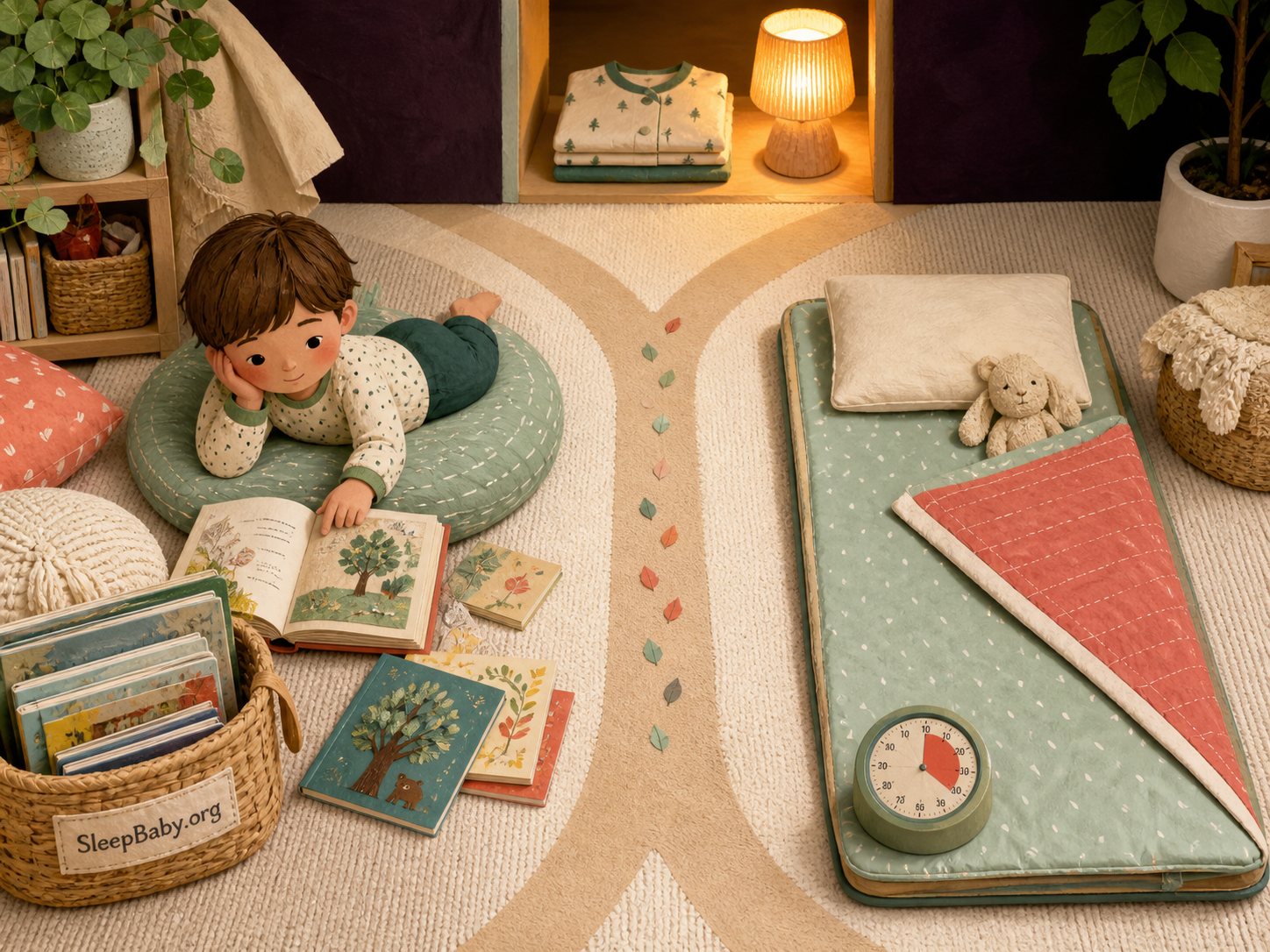
Watch the pattern for a week rather than judging one unusual day. A nap may still fit when your child falls asleep within about 15–20 minutes at midday, wakes reasonably, and can still fall asleep at bedtime. The nap may be interfering when it routinely takes a very long time to happen, pushes bedtime dramatically later, or creates a child who is wide awake in bed for an hour.
When naps are fading, replace them with a protected quiet-time block. Keep the room calm, offer books, simple puzzles, drawing, or audio stories, and make the expectation “your body rests here” rather than “you must sleep.” If sleep happens occasionally, you can decide whether to cap it based on what it does to bedtime. Quiet time is not a consolation prize. It preserves the midday reset while the child’s sleep architecture is changing.

A clearly labeled Kacey-and-Benjamin bedtime scene
That is the private question beneath many schedule searches: If bedtime is still difficult, does that mean I picked the wrong schedule? Not necessarily. Timing and boundaries are different variables. A perfectly timed child can still request seventeen additional services. A consistently resistant child may need a clearer limit, a better transition, a schedule adjustment, or some combination—but you learn more when you change one variable at a time.
Build a routine short enough to survive real life
The American Academy of Pediatrics’ parent guidance uses a beautifully plain sequence: brush, book, bed. Your version can include a bath, song, or cuddle, but a longer routine is not automatically more effective. Aim for 20–40 minutes with the same basic order. The sequence becomes a chain of cues: active day is ending; the body is clean and comfortable; the lights are lower; the last choice is small; sleep comes next.
A durable 30-minute routine
- Close the day: screens off, toys parked, one last snack if your child genuinely needs it.
- Do the body jobs: toilet, pajamas, teeth, water placed where your family allows it.
- Narrow choices: two acceptable books, one song, one stuffed animal.
- Use the same final words: brief, calm, affectionate, and not the opening statement in another negotiation.
Screens should end at least an hour before bedtime according to current HealthyChildren guidance. That helps in two ways: it removes stimulating content from the last stretch of the evening and makes room for a repeatable transition. If an hour feels impossible tonight, start by moving the cutoff earlier in manageable steps. The useful change is the one your household can repeat.
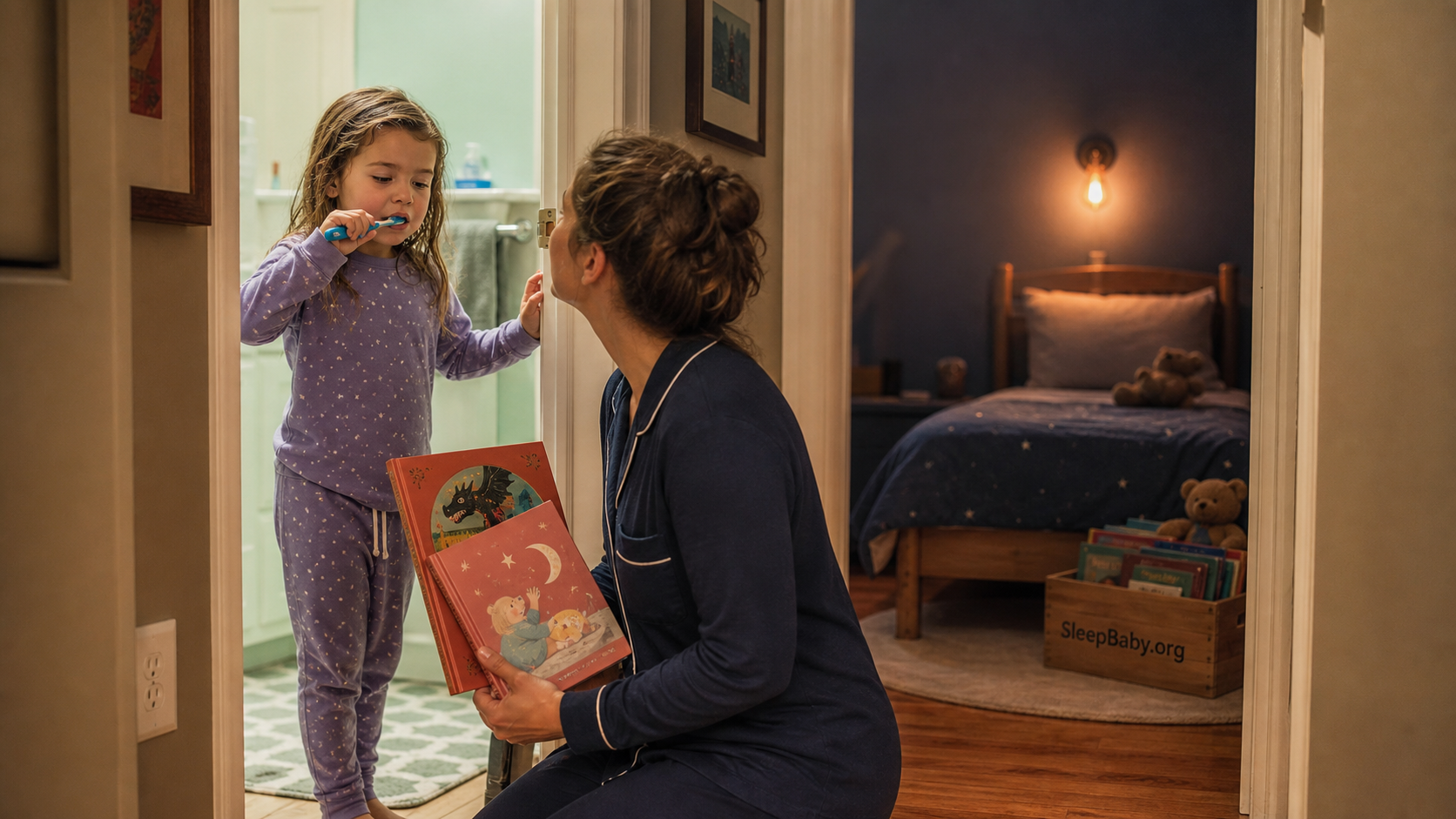
Watch the sequence, then make it yours
A preschool bedtime routine shown from start to finish
This short preschool demonstration makes the useful part visible: ordinary body jobs, a book, and a clear transition toward bed. Use it as a sequence example, not a promise that one routine fits every child.
SleepBaby takeaway: choose three to five steps you can repeat on an ordinary Tuesday, keep the order recognizable, and let the final choice get smaller rather than larger.
How to tell whether the schedule fits
I would judge the schedule across seven to fourteen days using five observations, not one bedtime:
- Sleep latency: Does your child usually fall asleep within roughly 15–30 minutes?
- Morning: Do they wake spontaneously or with reasonable help, rather than seeming impossible to rouse?
- Daytime regulation: Are mood, attention, and frustration broadly manageable for their age?
- Late afternoon: Is there a repeated crash that suggests the no-nap day is too long?
- Night quality: Is sleep reasonably continuous, without a new pattern of long waking?
One rough night is weather. A repeated pattern is climate. Illness, travel, excitement, a skipped meal, an accidental car nap, or a family event can distort a single evening. Keep notes simple: wake time, nap time, in-bed time, estimated sleep time, night waking, and one sentence about daytime behavior. You are looking for relationships, not building a preschool surveillance state.

Adjust the schedule without changing everything
If your child takes more than 30–45 minutes to fall asleep most nights and seems cheerful rather than distressed, bedtime may be too early or the nap may be too late or long. Shift the asleep target later by 15 minutes for several nights, or trim the nap, but do not do both on the same day if you want to learn which change mattered.
If your child is falling apart before dinner, falling asleep on short car rides, or waking with difficulty, try an earlier bedtime by 15–30 minutes. Children who are overtired do not always look sleepy. Some look impressively committed to parkour. If an earlier bedtime produces faster settling and a steadier morning, keep it. If it produces an hour of peaceful wakefulness in bed, you may have moved beyond the child’s current sleep capacity.
For an early-rising child, first protect a consistent “morning begins” time and keep the room dark and boring before it. Then ask whether bedtime is creating enough total sleep, whether the nap is shifting the whole day, and whether light or noise is cueing morning. Moving bedtime later is not always the answer; an overtired child can also wake early. Make a small change, hold it long enough to see a pattern, and resist the urge to rebuild the entire schedule after one 5:12 a.m. appearance.
A two-week schedule experiment
Days 1–3: observe without changing anything. Days 4–7: stabilize wake time and routine. Days 8–11: adjust bedtime or nap by 15–30 minutes. Days 12–14: judge the whole pattern—settling, night, morning, and daytime—not just whether the clock looks tidy.
What about preschool, daycare, and weekends?
A schedule has to survive the child’s actual week. If preschool requires a nap mat but your child no longer sleeps, ask whether quiet rest is acceptable. If daycare naps are nonnegotiable, you may need a later bedtime on care days and an earlier one on no-nap days. Consistency does not mean pretending Tuesday and Saturday are identical. It means each kind of day has a predictable version.
Try to keep weekend wake time and bedtime within about an hour of the weekday pattern. A special event can bend the schedule. The problem is not one late family dinner; it is a repeated two-hour swing that turns every Monday into miniature jet lag. After a late night, return to the regular morning anchor when possible and use quiet time or a modestly earlier bedtime rather than letting the entire day slide.
Three clock examples, because families do not all wake at 7:00
I would rather give you the calculation than declare one internet-approved bedtime. These examples assume a no-nap child who needs about 11 hours overnight and takes 20 minutes to settle. Move the times when your child’s observed sleep need differs.
| Required wake | Asleep target | In-bed target | Routine starts |
|---|---|---|---|
| 6:00 a.m. | 7:00 p.m. | 6:40 p.m. | 6:10–6:20 p.m. |
| 7:00 a.m. | 8:00 p.m. | 7:40 p.m. | 7:10–7:20 p.m. |
| 8:00 a.m. | 9:00 p.m. | 8:40 p.m. | 8:10–8:20 p.m. |
Those later times are not inherently unhealthy merely because another household starts earlier. The important pieces are total sleep, regularity, morning obligations, and daytime function. If school requires a 6:30 wake, a schedule that depends on sleeping until 8:00 is not a schedule; it is a weekend wish. I would build around the nonnegotiable morning first.
For a child who naps one hour, you may see the same wake time paired with a later asleep target because some of the daily total happened at midday. Do not simply subtract the full nap minute for minute. Watch the child. A 45-minute nap might delay sleep by 30 minutes in one child and by two hours in another. Nap timing and individual sleep pressure matter alongside duration.
The nap transition has more than two settings
Parents are often told either “four-year-olds still need naps” or “four-year-olds should be done napping.” Real children are less cooperative with categories. I see four common patterns worth separating:
- Reliable nap, reliable bedtime: Keep it. The nap belongs inside the 10–13-hour total and is not a problem merely because peers have stopped.
- Reliable nap, very late bedtime: Cap or move the nap earlier before removing it entirely. Hold the change for several days.
- No nap, steady evening: Preserve quiet time and use the earlier no-nap bedtime.
- No nap, late-day collapse: Experiment with occasional short naps, an earlier bedtime, or a quieter afternoon. A child can be “mostly done” with naps without being physiologically identical every day.
During the transition, I would keep two known schedules rather than improvising nightly. Name them if that helps the adults: nap day and quiet day. On a nap day, bedtime moves later. On a quiet day, dinner and bedtime move earlier. The child gets consistency inside each version, and the adults stop standing in the kitchen at 5:50 p.m. trying to reverse-engineer whether twelve minutes of car sleep counts. It counts. Annoyingly, it often counts.
Read the bedtime pattern before choosing the fix
If your child is happily awake in bed for a long time, I would examine timing first. They may not have enough sleep pressure yet. Shift bedtime later in small increments or reduce a late nap.
If your child becomes wild, tearful, clumsy, or combative before bed, I would test the opposite hypothesis: the day may be too long. Move the routine earlier, lower stimulation, and see whether settling becomes easier. Overtiredness is not proven by one dramatic evening, but a repeated late-day pattern deserves attention.
If your child falls asleep easily but wakes for long stretches overnight, look at total time in bed, nap timing, environment, illness, and what happens during the waking. Do not assume every night waking is behavioral. Persistent or concerning patterns belong in a clinician conversation.
If your child wakes early and cheerful after roughly the same amount of sleep, their overnight capacity may be shorter than the schedule expects. If they wake early and miserable, accumulate too little total sleep, or crash during the day, I would protect an earlier bedtime rather than chase a later morning by keeping them up.
If bedtime works for one adult but not another, compare the sequence and boundary, not the personalities. Does one routine quietly add forty minutes of choices? Does one adult return five times while the other returns once? I would agree on the last three steps and the response to leaving the room. A child is not manipulating anyone by noticing that two experiments produce different results. Four-year-olds are excellent field researchers.
What to do after a late night or an accidental nap
After a late night, keep the next morning reasonably close to the anchor unless your child is ill or truly depleted. Offer a calm day, use quiet time, and move bedtime modestly earlier. Sleeping several hours late can relieve the immediate morning but may push the next bedtime later and extend the disruption.
An accidental late car nap changes the evening’s sleep pressure. I would not punish the child with an impossibly early bedtime, nor would I turn the evening into a festival. Keep the routine, accept that asleep time may move later, and return to the normal morning. One strange day does not require a new philosophy.
Daylight saving changes work better as a series of small shifts. Move wake time, meals, quiet time, and bedtime by about 15 minutes over several days when possible, and use morning light to reinforce the new clock. I care less about executing the transition perfectly than about moving the whole set of cues together. Bedtime alone cannot drag the rest of the day behind it.
Bedtime stalling needs a boundary, not a longer chart
When repeated requests and leaving the room are the central pattern, the toddler sleep-training guide helps you match a boundary-and-presence response to the reason bedtime is hard.
Four-year-olds are skilled at discovering needs after lights-out. Build the likely needs into the routine: toilet, water, comfort object, one final question. Then use a calm response that does not improve with repetition. “You are safe. It is sleep time. I will see you in the morning.” The goal is not emotional coldness; it is making bedtime boring enough that it stops producing bonus programming.
If your child is afraid, address the fear during daylight too. Look at the room together, decide where the night-light sits, practice what happens after a bad dream, and give the child a specific way to call for help. A boundary and reassurance can coexist. Endless checking can accidentally teach the nervous system that there must be something to check.
When a schedule is not the whole answer
Bring persistent sleep concerns to your child’s pediatric clinician, especially loud habitual snoring, gasping or pauses in breathing, unusual repetitive movements, significant pain, frequent prolonged night waking, a dramatic change without an obvious cause, or daytime sleepiness and behavior that interfere with ordinary life. A schedule can support healthy sleep. It cannot diagnose or treat sleep-disordered breathing, anxiety, restless legs, seizures, pain, or another medical problem.
Also ask for help if bedtime has become so conflict-heavy that the family cannot implement a plan safely or consistently. The most useful notes are concrete: when sleep happens, how long settling takes, what you hear or see overnight, and what daytime functioning looks like. A short video or audio recording of concerning nighttime breathing may be useful to a clinician when safely obtained, but do not delay urgent care if breathing looks seriously impaired.
A schedule cue a four-year-old can understand
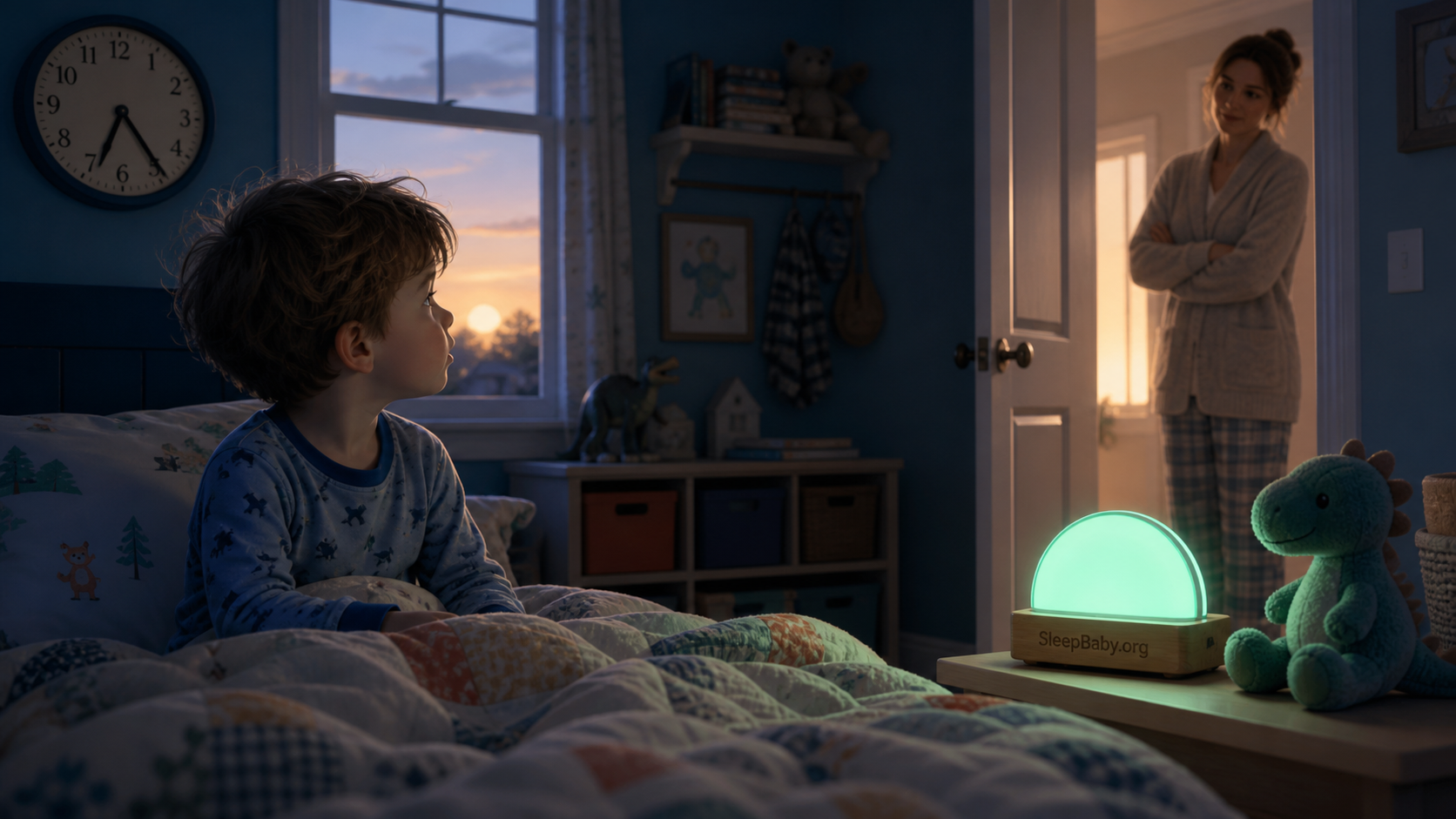
My article-specific pick: Hatch Rest 2nd Gen. A four-year-old usually cannot use “stay in bed until 6:45” the way an adult uses a clock. Hatch’s programmable color cue can make the invisible schedule visible: one color means the night is still resting time; another means morning has begun. Its sound and light routines can also make the same bedtime sequence easier to repeat.
I prefer it here to a plain digital clock because the child does not need to read numbers, and to a simple night-light because the cue can change at the chosen time. It will not make a poorly timed child sleepy or replace a calm boundary. Buy it for the communication job: giving a preschooler one consistent signal they can actually understand.
See the Hatch Rest 2nd Gen on Amazon
As an Amazon Associate, SleepBaby may earn from qualifying purchases.

Your schedule can be firm without becoming fragile
A useful four-year-old sleep schedule is not a minute-by-minute contract. It is a small set of dependable anchors: morning begins around the same time, nap or quiet time has a known place, screens and activity step down, the bedtime sequence stays recognizable, and the child gets enough opportunity to land inside that 10–13-hour daily range.
Return to that 7:41 p.m. room. The sock may still be missing. Your child may still have an important final observation about dump trucks. But now the evening does not need a brand-new answer. You know the wake anchor, the nap decision, the asleep target, and the next small adjustment if the pattern does not fit. The chart is not there to control a child. It is there so everyone in the room knows what happens next.
Sources
The SleepBaby.org Workshop
Make a plan for
the next bedtime.
Practical help for wake-ups, short naps, and sharing the night shift. Watch the original video, then get 15 guides and five audio tracks for $75.
$75 USD, paid once. No subscription. Digital access.
Watch the original Baby Sleep Miracle presentation
Press play for a little help with your baby’s next bedtime.
Original presentation. Watch before you decide.
15practical guides
5audio tracks
1one-time payment
Kind words about the original video
“Thank you so much for this video!”
“I'm truly impressed with how much information you share in your video.”
Inside the Workshop
Start with the night
you're having.
You don't need to read all 15 guides before bedtime. Choose the one that answers the question in front of you, then come back for the next part.
Before you buy
A few things
made clear.
A straightforward purchase, with space to decide what fits your family.
What am I buying?
The SleepBaby.org Workshop includes 15 digital guides, five audio tracks, and the original Baby Sleep Workshop PDF as an additional download. It costs $75 USD, paid once, with no subscription. Nothing is shipped.
Where should I start?
Try Tonight Rescue when you need a starting point. If your question is more specific, go straight to the guide on naps, a caregiver handoff, the sleep space, or another topic. You can read at your own pace.
Is this personal sleep coaching?
No. This is an educational collection for parents of babies and young children. Use the age-specific guidance, and bring feeding, breathing, growth, illness, or other health concerns to your child's clinician. It does not diagnose a problem or promise a sleep result.
Is the video the paid Workshop?
You can watch the original Baby Sleep Miracle presentation on this page. Your purchase is the SleepBaby.org Workshop collection of guides, audio tracks, and the original PDF described here.
How do I find it after checkout?
Choose Open my Workshop on your thank-you or order-status page to open the full Workshop portal. Download the guides and book as PDFs for reading offline. Keep your order confirmation so you can return to the portal and audio player. If you need help finding your access, use our Workshop download help.
The SleepBaby.org Workshop
Have somewhere to start
at the next bedtime.
15 practical guides. Five audio tracks. One $75 purchase.


Leave a comment