
Toddler sleep training works best when you match the response to the reason bedtime is hard. Check health and safety first. Then decide whether you are dealing with a mistimed bedtime, separation distress, dependence on one settling condition, or a well-practiced loop of water, hugs, songs and hallway appearances. Choose one boundary-plus-presence plan the adults can repeat. Watch the direction of the pattern, not one dramatic minute.
This is different from deciding when an infant is ready to begin sleep training. A toddler can walk, call your name, remember yesterday’s routine, fear the dark and present a closing argument about why the blue cup is medically necessary. The goal is not to outlast a small person. It is to make bedtime predictable enough that your child knows what happens next—and calm enough that you can actually keep doing it.
SleepBaby.org · The original video
A little help
for the night ahead.
Take a moment to watch the original Baby Sleep Miracle presentation. Your article will be right here when you’re ready to keep reading.
Ready to get started?Take the next step with SleepBaby.
Help my baby sleepYour useful plan for tonight
Four decisions, not fourteen tabs
-
Name the friction. Timing, separation, a settling habit, repeated requests—or something physical?
-
Choose one response. Presence, gradual reduction, checks, bedtime fading or a calm-return plan.
-
Write the sentence. Decide what every caregiver will say when the plan is tested.
-
Name the stop signals. Illness, pain, breathing trouble, unsafe climbing, unusual distress or an adult reaching their limit.
Why toddler bedtime is a different job
Infant sleep advice often centers on when to begin, feeding needs and how much help a baby needs to settle. Toddler bedtime adds language, mobility, memory, imagination and a powerful new hobby: checking whether the boundary still exists.
That does not make your child manipulative. It makes bedtime a learning environment with unusually low lighting. A toddler can genuinely need reassurance and also discover that requesting a fourth hug restarts the entire departure sequence. Both things can be true. The useful question is not, “Is this need real or fake?” It is, “What reasonable needs will I meet before goodnight, and what response will stay the same after that?”
Editorial composite: The water cup is on the nightstand. The final book is closed. A parent has one hand on the doorknob when a small voice announces an urgent interest in discussing tomorrow’s socks. This is the exact moment vague advice such as “be consistent” becomes irritating. Consistent how? Leave? Stay? Answer? Return? The answer depends on what happens when you do each one.
My starting point is simple: a boundary is not the opposite of comfort. It is comfort with a reliable edge. You can sit nearby without reopening negotiations. You can return a child to bed without being cold. You can decide that brief checks make your child more upset and choose a presence-based method instead. Method labels matter less than a response your child can predict and the adults can deliver without unraveling.
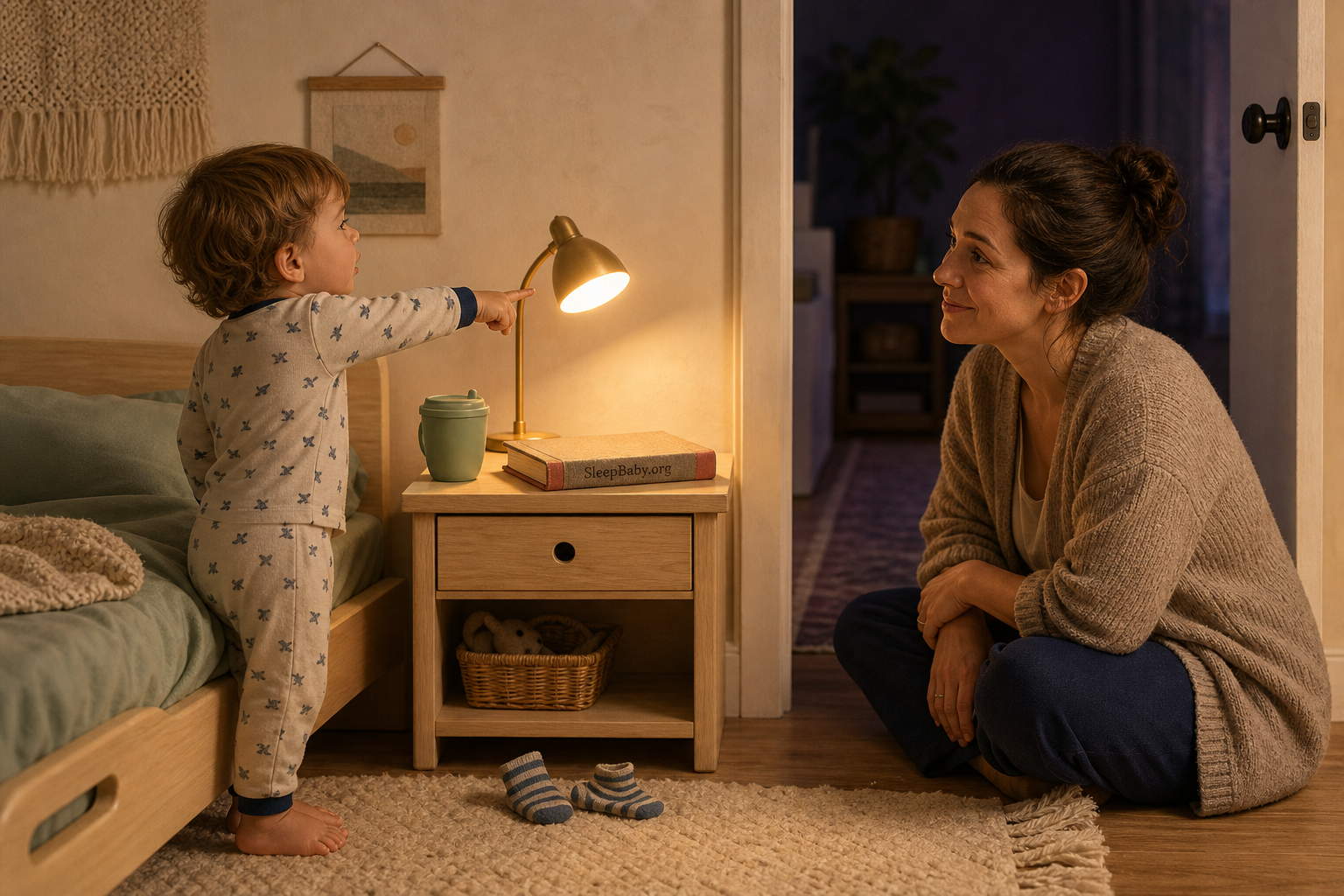

Find the friction before you pick the method
A timer can measure minutes. It cannot tell you why your toddler is awake. Before you choose graduated checks because a chart looked official, spend two or three ordinary bedtimes watching what the resistance actually looks like. You are not conducting a clinical study in the hallway. You are looking for one repeatable clue.
SleepBaby.org original decision tool
The Toddler Sleep Friction Finder
Start with the pattern you can see. Then test the smallest move that would make sense if that pattern is right.
Bright-eyed and nowhere near sleep
Look at first: nap timing and the selected bedtime.
Try first: a later, easier bedtime followed by gradual movement earlier—not a stricter exit.
Distress spikes at the doorway
Look at first: separation and whether leaving is the main trigger.
Try first: predictable parental presence that becomes quieter and more distant over time.
Every check starts the engine again
Look at first: whether intermittent returns are stimulating.
Try first: shorter, quieter checks or a steadier presence method.
Water, toilet, hug, song, hallway
Look at first: which needs can be closed before goodnight.
Try first: one script and a calm return; for an older toddler, possibly one bedtime pass.
A sudden change after sleep was manageable
Look at first: illness, pain, breathing, travel, a nap change, a new bed or room, fear, medication or another developmental disruption.
Try first: investigate the change. A new physical or safety problem is not a cue to intensify training.
One small study of 14 children ages 30 to 36 months found that a poorer match between the child’s circadian timing and the parent-selected bedtime was associated with longer settling and more bedtime resistance. That is far too small to prescribe a universal bedtime, but it supports a useful household observation: a calm child who talks for 50 minutes may have a timing problem, while a child who falls apart the moment you leave may have a separation problem. Those are not the same job.
Also separate bedtime resistance from breathing or sleep-quality concerns. Frequent snoring, gasping, breathing difficulty at night, unusual daytime sleepiness or meaningful daytime behavior changes deserve a conversation with your child’s pediatrician. A behavioral plan cannot fix an obstructed airway, and “more consistent” is not a medical treatment.

Five toddler sleep-training methods—and what each one asks of you
The American Academy of Sleep Medicine recognizes several behavioral approaches for bedtime problems and night waking in young children, including parental-presence approaches, graduated checks, positive routines and bedtime fading. That matters because the internet often presents one method as the brave choice and everything else as weakness. The evidence does not support that little morality play.
Choose by fit. Ask what your child does, what reliably makes the pattern better or worse, and what the adults can repeat calmly. A beautifully color-coded plan that nobody can perform at 1:20 a.m. is wall art.
Choose by fit, not by toughness
The Boundary + Presence Ladder
1. Parental presence or camping-out
Fits when: separation at the door is the main flashpoint, or brief exits repeatedly increase distress.
What you do: Sit near the bed or crib. Keep your voice and body calm. Offer a short repeated reassurance, but do not restart books, play or negotiations. Across later nights, reduce talking and touch, then move your position farther away.
What to watch: Your presence should become less active. Moving a chair while adding three new soothing rituals is not gradual withdrawal; it is furniture relocation.
Sample line: “I’m here. It’s sleep time. I won’t keep talking, but I’m staying nearby.”
2. Gradual reduction of one settling condition
Fits when: your child needs one specific input—lying beside them, hand-holding, rocking or repeated back rubbing—to cross from awake to asleep.
What you do: Change one dimension at a time. If you lie beside the bed, sit beside it. If you rub continuously, rub for a short predictable period and then rest your hand. Keep the routine and response language stable while the amount of help changes.
What to watch: “Gradual” still needs a direction. If the help looks different every night, your toddler cannot learn what comes next.
3. Graduated checks
Fits when: your child can settle between brief contacts and does not become more activated each time you return.
What you do: Finish the routine, leave, and return for brief predictable check-ins. Keep each check boring and reassuring. You do not need to copy a stranger’s interval chart as if it were a prescription; choose a simple pattern you can repeat while still responding to safety and real needs.
What to watch: If every return produces a fresh surge, longer intervals are not automatically the answer. A more continuous presence approach may fit better.
Sample line: “You’re safe. It’s bedtime. I’ll check again.”
4. Bedtime fading with a positive routine
Fits when: your toddler is routinely alert and content at the selected bedtime, especially after a late or generous nap.
What you do: Temporarily place bedtime closer to when sleep arrives readily. Keep a short pleasant routine. Once settling is easier, move bedtime earlier in small steps while protecting enough total sleep across 24 hours.
What to watch: This is not permission to keep a toddler chronically short on sleep. It is a timing tool, not an endurance contest.
5. A bedtime pass plus calm return
Fits when: an older toddler or preschooler understands a token exchange and the main pattern is repeated requests or leaving the room after ordinary needs are met.
What you do: Give one pass that can be exchanged for one brief request or parent visit. After it is used, follow the response you explained beforehand—usually a low-drama return to bed with minimal conversation.
What to watch: The evidence is small: one randomized trial included 19 children ages 3 to 6, and a component study included four 3-year-olds. The studied programs also included extinction after the pass was used. Do not present the pass as a proven no-cry trick, and do not use it with a child who cannot understand the rule.
Sample line: “Your pass was for one request. I helped with that. Now I’ll take you back to bed.”
More direct independent practice can also be a family’s chosen approach when the child is healthy, the sleep space is safe and caregivers agree on the plan. This article is not going to crown the method that involves the least parental presence. Less presence is not automatically more effective, more loving or more advanced. The method should earn its place by improving the pattern—not by having the most confident name on the internet.


Build the plan the adults can actually repeat
“Be consistent” is incomplete advice. Consistency means the important parts remain recognizable: the routine ends in the same place, the response uses the same few words, genuine needs still receive care, and the stop conditions do not move because somebody on the internet said night three is sacred.
Bedtime routines are associated with better sleep in young children, but a routine is a cue and an implementation tool—not a magic treatment. In a recent pilot trial of 86 toddlers, the routine intervention was feasible and acceptable, and families added more reading, but there were no overall between-group outcome differences. So keep the useful part and skip the mythology: a short routine makes the transition predictable. It does not guarantee sleep.
Write this before pajamas
The Five-Line Family Plan
- Our one goal: “Fall asleep without an adult lying in the bed.” Not “sleep perfectly all night.”
- Our short routine: Toilet or diaper, pajamas, teeth, two books, water placed, hug, lights low, bed.
- Our response: “I’m sitting beside the door. It’s sleep time. I’ll help if you truly need me, but we are done talking.”
- Needs we will answer: Pain, illness, breathing, toileting and safety. We will not reopen the book menu.
- Our stop signals: Something physically wrong, distress becoming unusual or steadily worse, unsafe climbing, or a caregiver nearing loss of control.
Let each caregiver say the script out loud before bedtime. If it requires a paragraph, shorten it. A tired adult carrying a wriggling toddler back to bed is not going to deliver a keynote address. The words should be warm, dull and easy to remember.
Also decide what counts as progress. Silence is not the only measure. Your child may still protest while settling sooner, making fewer room exits, accepting less hands-on help, calming between calls or returning to sleep with a shorter version of the plan. Those changes matter. A plan can be working before bedtime becomes photogenic.
A two-minute reset before you choose
Start with routine and expectations, then choose the response
This American Academy of Pediatrics video explains the basic settling framework. Watch it for the foundation—not for a toddler-specific method prescription. Then come back to the friction you identified above.
Your takeaway: Write the final step of your routine and the one sentence every caregiver will repeat. Those two details make “consistent” visible.
What to do when the plan meets an actual toddler
A plan becomes useful when your child does the thing you hoped they would not do. Room exits, renewed calling and louder protests are not proof that the method is wrong. They are also not proof that you must repeat it harder. Read the pattern.
The Progress Compass
Easing
Settling, exits or required help are trending down. Keep the important parts steady.
Flat
Nothing is shifting. Repair one likely input—timing, check style or amount of presence.
Worsening
Distress or disruption is steadily growing. Reassess method fit and check for a changed need.
New or unusual
A physical symptom, breathing change, unsafe behavior or out-of-character cry means pause and respond.
If your toddler keeps leaving the room
Make the room and route safe, keep your language brief and return your child calmly. Do not add a fresh lecture with every trip. The first return and the ninth should look boringly related. If your child is newly climbing out of a crib, treat that as a sleep-space safety decision rather than a behavior to ignore. There is no prize for preserving the crib after it stops containing the climber safely.
If every check-in makes the crying louder
Notice that. Some children calm when a caregiver returns; others experience every entrance as a brand-new goodbye. Shorten and quiet the checks, or switch to a steadier presence method. A small trial comparing checking-in with camping-out in 91 children ages 9 to 18 months found improvement with both approaches; separation anxiety appeared to affect which one helped more. That is young-sample evidence, not a command for every older toddler, but it supports the practical point: fit matters.
If your toddler still cries
No high-quality source provides one cry-duration limit that fits every toddler, health history and method. First check the child, not the stopwatch. Is the cry familiar or unusual? Is there illness, pain, breathing trouble, overheating, a toileting need or another change? Once immediate needs are addressed, compare the direction across similar nights: shorter, flat or longer; calm moments or none; typical daytime behavior or a meaningful change.
If you need a fuller way to read that pattern, use the crying-after-sleep-training troubleshooting guide. The sentence I want you to keep is this: a rough night is a field note, not a verdict on your parenting. Use the information. Do not make the child or the adult prove anything to the timer.
If bedtime improves but night waking does not
Falling asleep at bedtime and sleeping continuously are not the same outcome. Use your chosen response after ordinary needs are checked, but keep settling decisions separate from night-weaning. A toddler may wake because of illness, discomfort, schedule changes, fear or a feeding plan that still matters. If you do not know whether an overnight feed can change, ask the clinician who knows your child’s growth and health rather than letting a sleep chart decide.

Timing, naps and a bedtime that is fighting biology
Sleep pressure builds across awake time, while the body clock helps organize when sleep comes readily. Toddler sleep becomes especially interesting because naps are changing at the same time your child is gaining stamina and opinions. If bedtime resistance is cheerful, prolonged and remarkably creative, look at the 24-hour pattern before making the response firmer.
The American Academy of Sleep Medicine recommends 11 to 14 hours of sleep per 24 hours, including naps, for children ages 1 to 2, and 10 to 13 hours for ages 3 to 5. Those are ranges, not report cards. They do not tell you that every 2-year-old needs the same nap or that one bedtime is correct. Use them to protect adequate sleep opportunity while you test timing.
A bounded timing test
- Keep the wind-down sequence the same.
- Temporarily place bedtime closer to when sleep usually arrives.
- Watch whether settling becomes easier without reducing total sleep too far.
- If it helps, move bedtime earlier gradually. If it does not, return to the friction finder.
If your child is around 2 and you need schedule-specific examples, see the flexible 2-year-old sleep schedule guide. Keep early rising separate too: a child who falls asleep smoothly and wakes at 4:55 a.m. has a different problem from a child who cannot settle at bedtime. The early-waking guide gives that pattern its own troubleshooting space.
What the research can—and cannot—promise
The broad evidence is encouraging but less tidy than many method pages suggest. An American Academy of Sleep Medicine review covered 52 behavioral-treatment studies of bedtime problems and night waking in infants and young children; most reported clinically meaningful improvements. The evidence supports several method families. It does not identify one approach that must win in every household.
A randomized trial of 43 infants ages 6 to 16 months found measured sleep benefits from graduated extinction and bedtime fading compared with sleep education, and did not detect adverse attachment or emotional-behavioral differences at follow-up. A separate five-year follow-up of an infant sleep intervention found no evidence of group differences in the child, parent-child and maternal outcomes it assessed.
That is useful reassurance within limits. These were particular interventions, many participants were younger than the verbal, mobile toddler you may be parenting, and the studies measured particular outcomes. They cannot prove that every online protocol, intensity or family context is equivalent. Research should make your decision more informed. It should not make it falsely automatic.
Supported—and not established
The evidence supports
- Behavioral approaches can improve many bedtime and night-waking problems.
- More than one method family is legitimate.
- Routine and predictable structure can support the plan.
- Timing and child characteristics can affect method fit.
The evidence does not establish
- One universally best method.
- A guaranteed number of nights.
- One safe crying limit for every child.
- That sleep training and night-weaning are the same decision.
- That selected infant studies prove every toddler protocol harmless.
I would be skeptical of any plan that promises certainty the evidence does not have. “This method can help” is a useful claim. “Your child will be fixed by Friday if you do not interfere” is sales copy wearing a lab coat.

When to pause toddler sleep training and get help
Stop the plan and respond when your child seems ill, is in significant pain, has a new or out-of-character cry, is repeatedly vomiting, shows signs of dehydration or has breathing that looks difficult or different. Severe breathing difficulty, blue or gray coloring, unusual unresponsiveness, seizure or another apparent emergency needs emergency care.
Tell your pediatrician about frequent snoring, gasping, breathing problems at night, unusual daytime sleepiness or important attention and behavior changes. Ask for individualized guidance when medication, neurodevelopmental differences, reflux, feeding or growth concerns, seizures or another health condition may be shaping sleep. If a clear, reasonable behavioral plan does not improve the pattern—or the problem causes major daytime impairment—a pediatric or pediatric-sleep evaluation can help identify what a method chart cannot.
Unsafe climbing changes the problem immediately. If your toddler can climb out of the crib, review the sleep-space transition rather than treating each escape as a behavior to extinguish. Keep the room secured against falls, furniture tipping, cords and access to stairs or doors as appropriate for your home.
Adult capacity belongs in the safety plan too. If crying or repeated returns push a caregiver toward rough handling or loss of control, place the child in the safest available sleep space, step away briefly and contact another adult or urgent support. A method can wait. Nobody has to demonstrate commitment by becoming unsafe.
Stop, reassess or keep going?
- Stop and respond now
- Illness, pain, breathing change, unsafe climbing, unusual distress or caregiver safety risk.
- Reassess the fit
- Checks reliably worsen distress, the pattern stays flat, bedtime looks mistimed or the adults cannot repeat the plan.
- Keep the core steady
- Needs are checked, the child is safe and well, and settling, exits or required help are moving in a useful direction.

Toddler sleep-training questions parents ask in the hallway
Can I sleep train a toddler without leaving the room?
Yes. Parental-presence and gradual-withdrawal methods are legitimate behavioral approaches. Define what staying means: perhaps you sit quietly near the bed, use one reassurance line and reduce interaction or distance over time. Staying becomes confusing only when the response keeps expanding into new books, play or negotiation.
How long should toddler sleep training take?
There is no honest universal countdown. Look for directional change across comparable opportunities: easier settling, fewer exits, less hands-on help, calmer gaps or shorter night-waking responses. If the pattern stays flat or worsens, repair one likely input or change methods. Stop sooner for a health, safety or caregiver-capacity concern.
What if my toddler is afraid of the dark or being alone?
Acknowledge the fear without reopening the whole evening. Check the room together once, use a dim appropriate nightlight if helpful, give the same short reassurance and choose a presence level you can gradually change. New, intense or persistent anxiety with daytime effects deserves discussion with your child’s clinician rather than simply firmer exits.
Should I use rewards?
A simple morning acknowledgment or small age-appropriate reward can reinforce a specific behavior, such as staying in the room after the final goodnight. Keep the target visible and achievable. Do not reward “sleeping all night,” which is not fully under voluntary control, and do not remove comfort or needed care as punishment.
Does choosing a gentler or more direct method affect attachment?
Selected infant intervention studies did not detect adverse attachment or broad emotional-behavioral differences in the outcomes they measured, but that does not prove every protocol is equivalent. Choose a plan that protects real needs, fits your child and can be delivered calmly. Connection is a relationship across the whole day, not a score assigned to one bedtime technique.
Your smallest useful next move is not to announce a seven-night transformation. Watch one bedtime. Name the friction. Pick one response and one sentence. Write the stop signals. Then let the pattern—not the loudest opinion online—tell you what to keep.
Sources
- American Academy of Sleep Medicine: Practice Parameters for Behavioral Treatment of Bedtime Problems and Night Wakings.
- American Academy of Sleep Medicine evidence review of behavioral treatments.
- American Academy of Sleep Medicine: Insomnia in Children Health Advisory.
- American Academy of Sleep Medicine: Child Sleep Duration Health Advisory.
- American Academy of Pediatrics / HealthyChildren.org: Toddler Bedtime Trouble.
- American Academy of Pediatrics / HealthyChildren.org: Healthy Sleep Habits.
- American Academy of Pediatrics / HealthyChildren.org: Sleep Apnea Detection.
- American Academy of Pediatrics / HealthyChildren.org: Big Kid Beds.
- American Academy of Pediatrics / HealthyChildren.org: Separation Anxiety and Sleeping.
- Centers for Disease Control and Prevention: Milestones by Two Years.
- Centers for Disease Control and Prevention: Tips for Building Structure.
- Gradisar et al.: randomized trial of graduated extinction and bedtime fading.
- Price et al.: five-year follow-up of behavioral infant sleep intervention.
- Behavioral interventions for pediatric insomnia: checking-in and camping-out trial.
- Circadian phase and nighttime sleep in toddlers.
- Randomized controlled trial of the Bedtime Pass Program.
- Bedtime pass component analysis with 3-year-olds.
- Bedtime routines in early childhood: consistency and nighttime sleep.
- Pilot bedtime-routine intervention for toddlers in primary care.
When the boundary is clear but the night still feels tangled
Turn your toddler’s actual bedtime pattern into one calmer next step
SleepBaby.org can help you connect timing, naps, separation, repeated requests and the amount of presence your family can sustain—without pretending every toddler needs the same method.
This guide supports practical decision-making and does not replace care from a clinician who knows your child.
SleepBaby.org · The original video
A next step for
the next bedtime.
Still thinking about sleep? Watch the presentation here, then explore the SleepBaby program whenever you’re ready.
Ready to get started?Take the next step with SleepBaby.
Help my baby sleep