
If your baby ate something off the floor, check their breathing first, then work out what went into their mouth. Trouble breathing, inability to cry, collapse, a seizure, or difficulty waking needs emergency help. If the item is unknown, could be medicine or a chemical, or may be a dangerous object, get professional advice now instead of waiting for symptoms. In the U.S., call Poison Control at 1-800-222-1222 for a possible poison exposure. A known food crumb and an unidentified floor find are different decisions.
I would put the search for an explanation behind the check on your baby. The floor can wait while you make the call.
Get help before searching the room
Call 911 now for the emergency signs above. A choking baby may make little or no sound. If your baby cannot cough or cry effectively, follow the dispatcher’s instructions and infant choking first aid. If they can cough forcefully or cry, stay with them and watch closely; do not interrupt effective coughing with a blind finger sweep.
Possible swallowed battery, magnet, sharp object or water bead? Seek urgent medical care. Do not wait for a change in behavior to decide whether it matters. The object-specific steps below explain the next call.
Outside the U.S., use your local emergency and poison-information numbers.
These emergency distinctions follow Poison Control’s first-aid guidance and the American Red Cross infant choking guide.
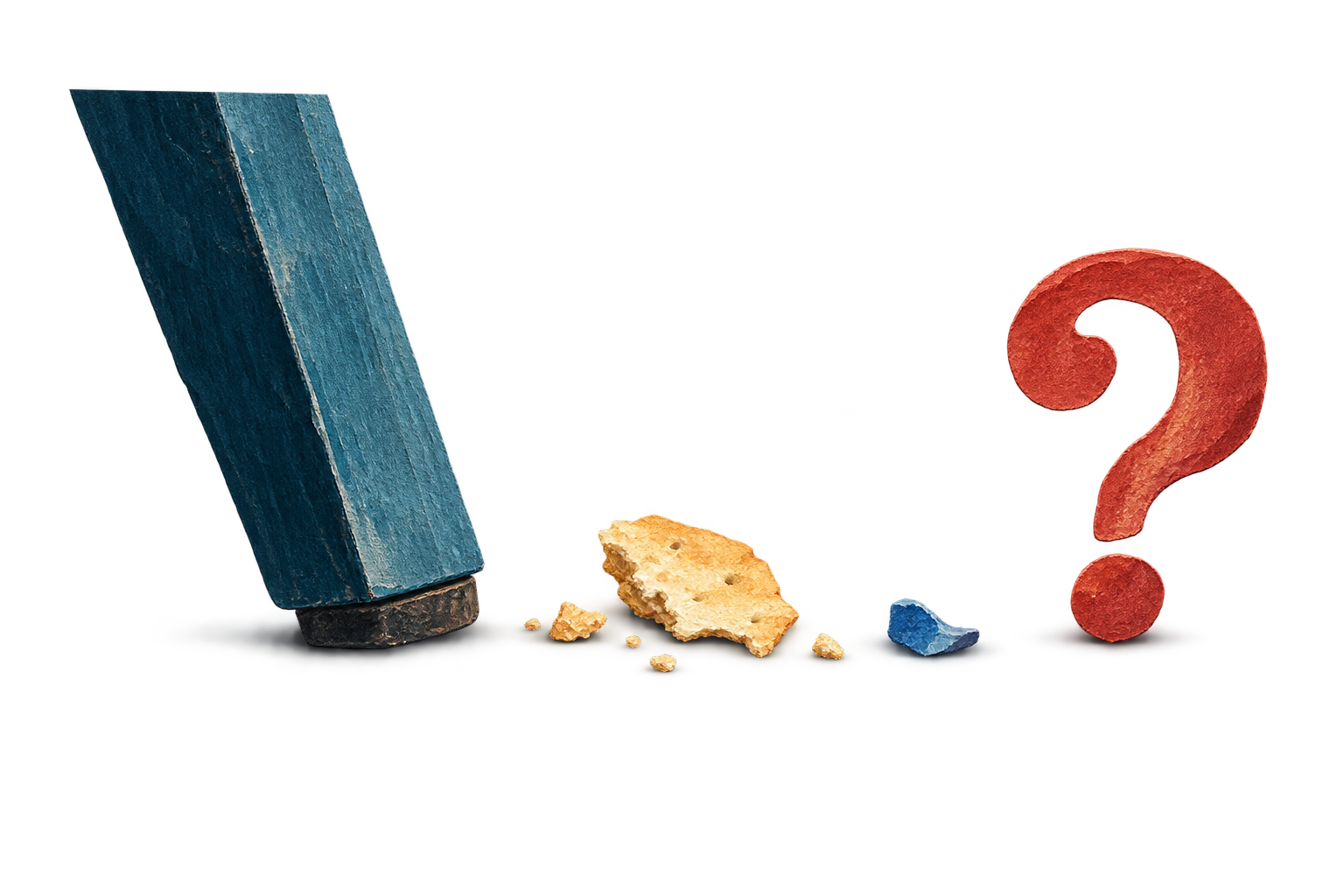
My three-part check: Child. Clue. Clock.
When the object has disappeared, it is tempting to stare at the floor and reconstruct every second. I would use three headings to keep the useful information together. This is a way to organize a call, not a test that clears your baby to stay home.
CHILD: what is happening right now?
Describe breathing, responsiveness, coughing, drooling, swallowing and any vomiting. Say your baby’s age. Start with a concerning symptom instead of saving it until the end of the story.
CLUE: what do you actually know?
Separate “I saw a piece of cracker” from “it looked like a crumb.” Look for a matching piece, an open container, a damaged toy or a missing part. Keep a sample or photo if readily available, out of your baby’s reach. Do not delay urgent care to finish a search.
CLOCK: when could it have happened?
Give the time you saw the hand go to the mouth, or the earliest and latest possible times if you missed it. Say when any symptoms started. An honest range is more useful than a precise time you guessed.
Poison Control explains the information its specialists need, including the exact product, amount if known, age, symptoms and timing. Have a recent weight available if you know it; do not invent one. You do not need to solve the mystery before asking for help.
Which kind of floor find was it?
A pill, chemical residue or something you cannot identify
Call Poison Control for a possible substance exposure, even if your baby looks well. Tell the specialist that identification is uncertain. I would not select a harmless substance in an online form just because its color looks close. A white speck beside an open bag may have a different source from one below a high chair.
If you think an unknown solid object was swallowed, seek urgent medical assessment. The Royal Children’s Hospital advises hospital care when the swallowed object is uncertain. A phone call about a possible poison must not delay that assessment or emergency help for symptoms.
A button battery, magnet or water bead
Suspected button battery: go for emergency care now and call Poison Control or the National Battery Ingestion Hotline at 1-800-498-8666. Do not wait for pain. Do not give honey to a baby under 12 months. For children 12 months or older, the National Capital Poison Center’s battery guideline has a specific honey recommendation when a lithium coin cell may have been swallowed within 12 hours, the child can swallow, and honey is immediately available: 2 teaspoons every 10 minutes, up to six doses, while going to the ER. Never delay transport to obtain it. Otherwise, do not give food or drink while awaiting the battery assessment.
Suspected magnet: seek immediate medical attention. Do not assume only one was swallowed; multiple magnets can attract across internal tissue. CPSC’s magnet guidance explains this risk.
Suspected water bead: seek medical treatment right away. A tiny dry bead can expand after swallowing. A “non-toxic” description does not remove that physical hazard. See CPSC’s water-bead advice.
A coin, toy part or sharp piece
Get prompt medical advice for a baby who may have swallowed a non-food object; Seattle Children’s places children under two in its seek-care-now group. Sharp items need urgent assessment. Do not transfer reassurance about a smooth, identified object to a broken piece whose shape you do not know.

While you get advice, skip improvised fixes
Do not make your baby vomit. Do not reach blindly into the mouth or probe the throat with fingers or a tool. Remove an object only if it is clearly visible and easily accessible without pushing it deeper. Poison Control warns that attempts to retrieve a swallowed object can injure the throat. Its swallowed-object guidance also explains why appearing comfortable does not settle the question.
I would not give bread, a large drink or another food to “push it down.” Whether your baby should eat or drink depends on what happened. Ask the person advising you, and follow the specific instructions rather than a general home remedy.

AFTER THE CARE PLAN IS CLEAR
Put the floor scare and bedtime on separate pages
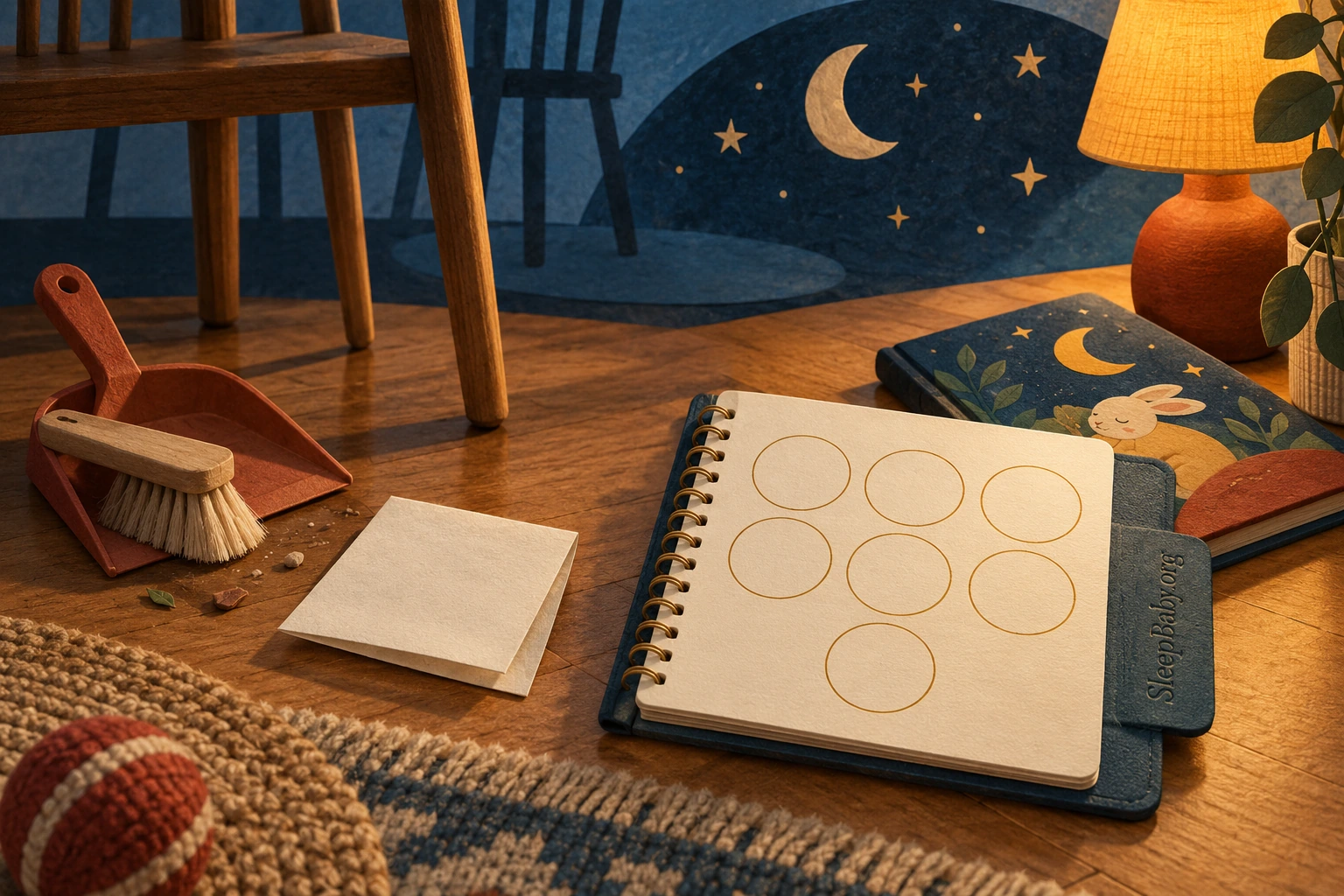
Once a professional has told you what care or observation your baby needs, you can leave those instructions intact and make a separate plan for an ordinary evening. The free planning preview on SleepBaby.org offers three choices and one suggested starting step, without a sign-up or card.
The optional paid SleepBaby.org Workshop is an online sleep guide with short lessons you can revisit and a seven-night tracker. A useful starting point might be deciding who handles the floor check and who keeps the bedtime routine familiar after the medical question has been addressed.
I would keep the clinician’s instructions on one page and ordinary sleep notes on another. Neither the preview nor the Workshop assesses an ingestion, gives medical clearance, or tells you when it is safe to stop monitoring. You can use your own notebook for this separation too.
If it really was a dropped piece of food
Once you are certain what it was, the question becomes more specific: was it an appropriate food and texture for your baby, and was there a separate concern such as chemical contamination or a known allergy? Do not use the food branch if you only saw something small disappear.
The five-second rule does not establish safety. In Rutgers research on food-to-surface contact, bacterial transfer sometimes began in less than a second. Moisture, surface and contact time affected transfer. That study cannot tell you whether one particular crumb will make your baby ill.
I would throw away the remaining dropped food and offer fresh food when normal feeding is appropriate. There is no benefit in finishing the piece to avoid waste. If you are worried about what was on it, or your baby develops symptoms, ask their clinician or Poison Control as appropriate.
A freshly dropped piece that you watched fall is useful information. So is a crumb found beside cleaning supplies. Those descriptions should stay separate when you explain what happened; “ate off the floor” hides the very detail the professional needs.
A floor reset you can actually repeat
After the immediate medical question is handled, I would work on one accessible area before tackling the whole house. Start with where the item came from. Sweeping up one loose piece will not solve a toy that keeps shedding parts.
- Choose the next play area. Keep your baby supervised elsewhere while you inspect it. Get down low enough to see under the chair rails, beside the rug edge and along the baseboard.
- Pick up the small finds. Check where an older child opened a building set, where a visitor put a bag, and where a remote or toy was dropped. Look at the source as well as the visible floor.
- Remove the source from reach. Put medicines and adult bags in secure storage. Set aside damaged toys. Check battery compartments rather than assuming the cover is still attached.
- Finish the cleanup. Empty collected debris somewhere your baby cannot reach. Put the cleaning tools away too. Then check the space once more before bringing your baby back.
That sequence applies Poison Control’s advice to inspect at a child’s eye level. The room-specific examples are my practical way of making the check easier to remember. A floor that looks clean from standing height can still have a tiny object under a chair.

I would attach the check to events: after a meal, after small toys have been out, and before floor play in an unfamiliar room. A visitor’s bag does not become a problem because the visitor was careless; it becomes one when the bag is within reach. Agree on a high, secure place for it before your baby gets there.
Do not try to teach this entirely through “no.” Set up a space that does not require your baby to remember which tiny things are food. Keep age-inappropriate small toys separate from the baby’s play area, and inspect toys for loose parts. The Royal Children’s Hospital prevention advice supports suitable toys and secure battery compartments.

Optional help for the small cleanup
As an Amazon Associate, I earn from qualifying purchases.
If a small brush would make your after-meal sweep easier, the OXO Good Grips Compact Dustpan & Brush Set, model 1334280, is one optional choice. OXO describes a brush that snaps into the pan and a soft rubber lip for collecting small debris. It is a compact cleanup tool, not a way to certify that a room is safe or prevent an ingestion.
I would choose this only for a small cleanup job. For a whole floor, use your usual broom or vacuum. Your existing brush and dustpan are a perfectly reasonable alternative; a new purchase is unnecessary if they already do the job. Store either option out of reach.

What changes the plan after the first call?
If a professional recommends home observation, ask for the actual observation instructions: which symptoms matter, how long to watch, whether feeding can continue, and where to go if something changes. Write those down instead of relying on the phrase “keep an eye on them.”
After a swallowed object, new trouble swallowing, persistent drooling, chest or abdominal pain, ongoing vomiting, or blood in vomit or stool needs medical attention. Breathing trouble is an emergency. The hospital’s swallowed-object guidance describes these warning signs. Follow your baby’s specific plan if it gives additional or earlier thresholds.
Leave a useful handoff, not just “seems fine”
What happened: item known or unknown, amount known or unknown, and time range.
Who advised us: service or clinician, call time, and the instructions they gave.
What happens next: observation period, feeding guidance, warning signs, and where to seek help.
Keep this beside the phone or share the same note with the next caregiver. Include uncertainty exactly as you reported it; a guess should not turn into a fact during a handoff.
Can my baby go to sleep afterward?
Do not use a nap to wait out an unidentified ingestion. Ask the clinician or Poison Control whether sleep and normal feeds fit the plan for this particular exposure. I would settle that question before starting the bedtime routine, even if bedtime is already late.
Once ordinary sleep is appropriate, keep the usual safe setup: place your baby on their back on a firm, flat, level sleep surface with only a fitted sheet, without pillows, loose bedding or toys. Do not prop the mattress or add a positioner because something was swallowed. These are the NICHD safe-sleep principles; they do not replace instructions about medical observation.
Learn the infant choking sequence before you need it
The American Red Cross demonstration below shows care for a responsive choking infant. Do not stop an emergency call to watch a video. Hands-on training helps you practice positioning and support.
Written takeaway: for a responsive infant who cannot cough or cry effectively, call emergency services and give cycles of five back blows and five chest thrusts, supporting the head and keeping it lower than the body. Stop when the obstruction clears and effective coughing or crying returns. If the baby becomes unresponsive, begin CPR according to your training and the dispatcher’s guidance. Never use abdominal thrusts on an infant or sweep blindly inside the mouth.
If the player is unavailable, use the Red Cross written infant choking instructions.
The questions that tend to come next
My baby seems normal. Does that rule out a problem?
No. Some swallowed objects cause no immediate symptoms. What the item was still matters. Poison Control advises getting help for swallowed non-food items rather than waiting for symptoms. Tell the professional that your baby is acting normally; do not use that observation to rule out a battery or other hazardous item.
Should I look through every diaper?
Ask the clinician whether there is any reason to do that for the identified object. Do not delay assessment while waiting to see it pass. Seattle Children’s describes different follow-up approaches, depending on the object and situation. Your baby needs the approach chosen for them, not a generic timetable from another child’s story.
What if I only saw my baby chewing?
Say exactly that. A missing object, a piece still in the mouth and an observed swallow are different pieces of information. You do not have to claim certainty to deserve advice. I would report what I saw, what was nearby and what I could not account for.

ONE DECISION AT A TIME
Know the next step before changing the night
Your first job is to get the right advice for what your baby may have swallowed. Keep the care instructions, remove the source of the floor find, and make sure the next caregiver has the same information.
When ordinary sleep planning is appropriate, the free SleepBaby.org preview can help you choose a starting step. The optional Workshop and your own simple notes can support that planning; neither replaces the medical plan.
Sources
- Poison Control: First aid for poisoning
- Poison Control: What specialists need to know
- Seattle Children’s: Swallowed foreign object
- National Capital Poison Center: Battery treatment guideline
- CPSC: Magnet ingestion
- CPSC: Water beads
- American Red Cross: Infant choking
- Rutgers: Food dropped on the floor
- OXO: Compact Dustpan & Brush Set specifications
- NICHD: Ways to reduce sleep-related risk
- Royal Children’s Hospital: Swallowed objects
- Poison Control: Kids will swallow anything






What viewers said10 comments · 4 replies+
Archived comments from the original Baby Sleep Miracle presentation. Not independently verified by SleepBaby.org; individual experiences vary.
Thank you so much for this video! I had no idea about the dangers of baby swings :O
Hi Mary-Ann. I have a question: Is method in any way similar to the ones recommended by Dr Bucknam, Dr. Weissbluth or Dr. Karp? We tried those but none of them help.
Hi Regina, thank you for your question. The short answer is no. The techniques I share in my guide are based on newest scientific research and this is why I have never seen any approach similar to the one I recommend.
This method really works! I tried it on my son Jesus and after just one week he went from waking up more than 5 times a night to waking up just once or twice. You are a lifesaver, Mary-Ann!
I'm truly impressed with how much information you share in your video. And all for free! I can feel that you truly care about mothers like myself, and that's hard to find these days. I have recommended your site to several of my friends already.
Mary-Ann, our child suffers from autism. Is your approach still suited?
Chloe, I made sure my method can be used with any child, even babies who are special like yours. Please note that I'm not a doctor and that I always advice to consult with your physician because nothing is more important than the safety and well-being of your love.
Hallo Mary-Ann, I'm from Germany. Do you have your guide in German?
Hello Heide, we do! Normally you should already see our video in German. If not, please contact our support so they can guide you
Thenk you for your answer, Mary-Ann!
I just completed your approach and I have to say, it worked almost too well. Yes, it took a bit of getting used to with your bedtime routine but the difference is huge. My son George used to take 1 hours to go down and now he's firmly asleep in no more than 10 minutes! You're the best!
It seems I'm the only man watching this video, lol! What you shared about the 'emotional backpack' made immediate sense to me and I can't wait to help my little girl Mila to unpack it!
Hey there, just discovered your site and this really sounds different. Just wanted to say thanks for sharing :)
For everyone who's still thinking about getting Mary-Ann's guide I want to advise you to go ahead. I wasn't sure myself but now I'm so thankful I invested in this program. It made a huge difference in our life as a family and yes, my baby girl does sleep through the night now.