
A baby may cry during diaper changes because the routine is cold, abrupt, badly timed with hunger or tiredness, or deeply inconvenient to an older baby who had other plans. But crying by itself cannot tell you the cause. Prepare everything first, keep the baby’s chest comfortably warm, move slowly, say what is happening, and change one ordinary variable at a time. At the same time, look for raw skin, crying during actual urination or stool, pain with a particular movement, fever, vomiting, poor feeding, reduced urine, swelling, injury, or distress that continues away from the changing surface.
I would not spend my best energy deciding whether the cry sounds angry, scared, hungry, or painful. A cry is communication, but it is not a home lab test. The useful question is much more concrete: At what exact moment does the crying begin? Before the baby is touched? When pajamas open? When a wipe meets skin? When the hips move? During a pee or bowel movement? Or long after the fresh diaper is fastened?
That is the spine of this guide: do not grade the cry; locate the moment. Then repair one low-risk input if the baby is otherwise well, and use the medical or safety exit when the pattern points beyond ordinary dislike. If you are tempted by an app that promises to name a cry, our guide to an AI baby cry translator explains why context, examination, and a clinician still outrank a label on a screen.
Locate the moment the diaper change turns hard
Watch one ordinary change in slow motion. You are not trying to catch the baby doing something wrong, and you are not trying to prove a diagnosis. You are separating six moments that ask for different next steps. If a red flag appears at any point, stop observing and call for care.
SleepBaby.org original observation map
The six stops of one diaper change
Begin at the first stop that reliably brings the cry. Notice the clue; do not force the moment to happen again.
- 1. Before touch
The baby may already be hungry, tired, overstimulated, or upset by an abrupt wake-up. Check the whole moment before blaming the diaper. - 2. Clothes open
Exposure and a temperature shift may be unpleasant. Cover the chest and test a comfortably warm room without overheating the baby. - 3. Cleaning touches skin
Tender or raw skin may sting. Look, clean gently, stop scrubbing, and use the skin-care and call boundaries below. - 4. Hips or legs move
A new sharp cry tied to one touch, lift, position, or limb movement deserves attention. Do not repeat the motion to prove it. - 5. Urine or stool passes
Notice whether the distress coincides with actual urination or a hard, painful stool, then check for the additional clues that change urgency. - 6. After the change
If distress continues away from the surface, the diaper routine may not be the whole story. Reassess feeding, illness, injury, and overall behavior.
Why this matters tonight: a 2 a.m. pileup of light, cold, hunger, and sudden movement can often be made smaller. A pain-linked cry should not be kept quiet merely to protect sleep.
The pattern matters more than perfection. One change may begin with a hungry cry and end with a cold complaint. Another may be calm until a wipe reaches one tender patch. Write down the first reliable moment, not every sound the baby makes. That keeps the observation useful and prevents a normal messy routine from turning into a minute-by-minute forensic drama.
Also notice where the crying stops. A baby who protests only while uncovered and settles promptly when dressed gives you a different starting point from a baby who remains distressed in your arms, will not feed, vomits repeatedly, or seems unusually sleepy. “It happens at the changing table” is context; it is not automatic reassurance.
Use one-variable thinking, not a seven-trick scramble
If the baby is otherwise well and there are no red flags, change one low-risk thing for the next ordinary change. Warm the room a little, cover the chest, prepare before lifting the baby, use quieter words, or adjust the timing when feasible. Do not warm a wipe to a temperature you have not safely checked, use improvised hot objects, or assume a wipe warmer is required. A clean, comfortably warm damp cloth may be a reasonable trial when appropriate, but heat and contaminated water create new problems rather than solving this one.
Changing everything at once may produce a calmer baby and no idea why. The goal is not a perfect no-cry diaper change. The goal is a repeatable routine, a safer caregiver, and a clearer signal if one specific touch or body function hurts.
What one calmer change can—and cannot—tell you
If covering the baby’s chest or preparing the supplies leads to a calmer change, you have learned that this ordinary input may have contributed. You have not proved that cold was the one true cause, and you have not ruled out tender skin or another concern that could appear later. Keep the successful change because it is kind and practical, not because it earned a medical certificate.
If nothing changes, resist the urge to pile on more stimulation. A louder song, brighter toy, video, bouncing leg, new wipe, new cream, and faster hands can make the routine harder to read. When the baby is otherwise well, try one different low-risk input at the next necessary change. When the pattern is new, persistent, or worrying, call rather than building a longer experiment.
If the crying becomes sharper at one precise moment, stop treating the routine as a general comfort puzzle. Do not wipe the same tender spot again, repeat the same hip movement, or wait for another pee or stool just to confirm your notes. One naturally observed pain-linked pattern is enough to describe to the clinician.
Also compare caregivers and settings without assigning blame. A baby may be calmer with the adult who lays everything out first, the room that is warmer, or the floor-level setup that does not require a hurried grip. That is information about the sequence, not evidence that one caregiver is “better.” Copy the useful preparation and language across caregivers so the baby gets a more predictable routine.
A mixed result is still a result. Babies are allowed to be hungry one time, startled the next, and simply furious about missing a floor toy after that. Look for a repeatable first trigger, keep the low-risk improvements, and let health clues—not the drama level—set the call threshold.
Build a calmer change before the diaper comes off
A diaper change goes better when the adult has fewer reasons to reach, improvise, and hurry. Put the fresh diaper, gentle cleaning supplies, clothing, disposal bag or pail, and anything the baby’s clinician has recommended within reach before placing the baby on the surface. On an elevated changing product, keep one hand on the baby throughout; a strap or barrier is not permission to turn away.89
Five laid-out steps
Prepare, warm, announce, move, notice
- Prepare. Lay out only what this change needs. The safety limit is simple: nothing important should require a step away.
- Warm the transition. Keep the room comfortable and the chest covered when possible. Warm means comfortable, never hot.
- Announce the next touch. Use the same short words: “Pants open. Wipe next. Fresh diaper.” Your voice cannot guarantee calm, but predictability removes one surprise.
- Move gently. Support the body, avoid yanking both legs high, and never repeat a movement that appears painful. Follow the changing product’s instructions.
- Notice, then finish. Record the first trigger moment, complete necessary care, and return the baby to comfort. Do not prolong exposure for the sake of observation.
Night version: keep enough light to inspect skin and clean safely, but avoid stacking a bright room, loud conversation, cold air, and repeated repositioning onto an already sleepy baby.
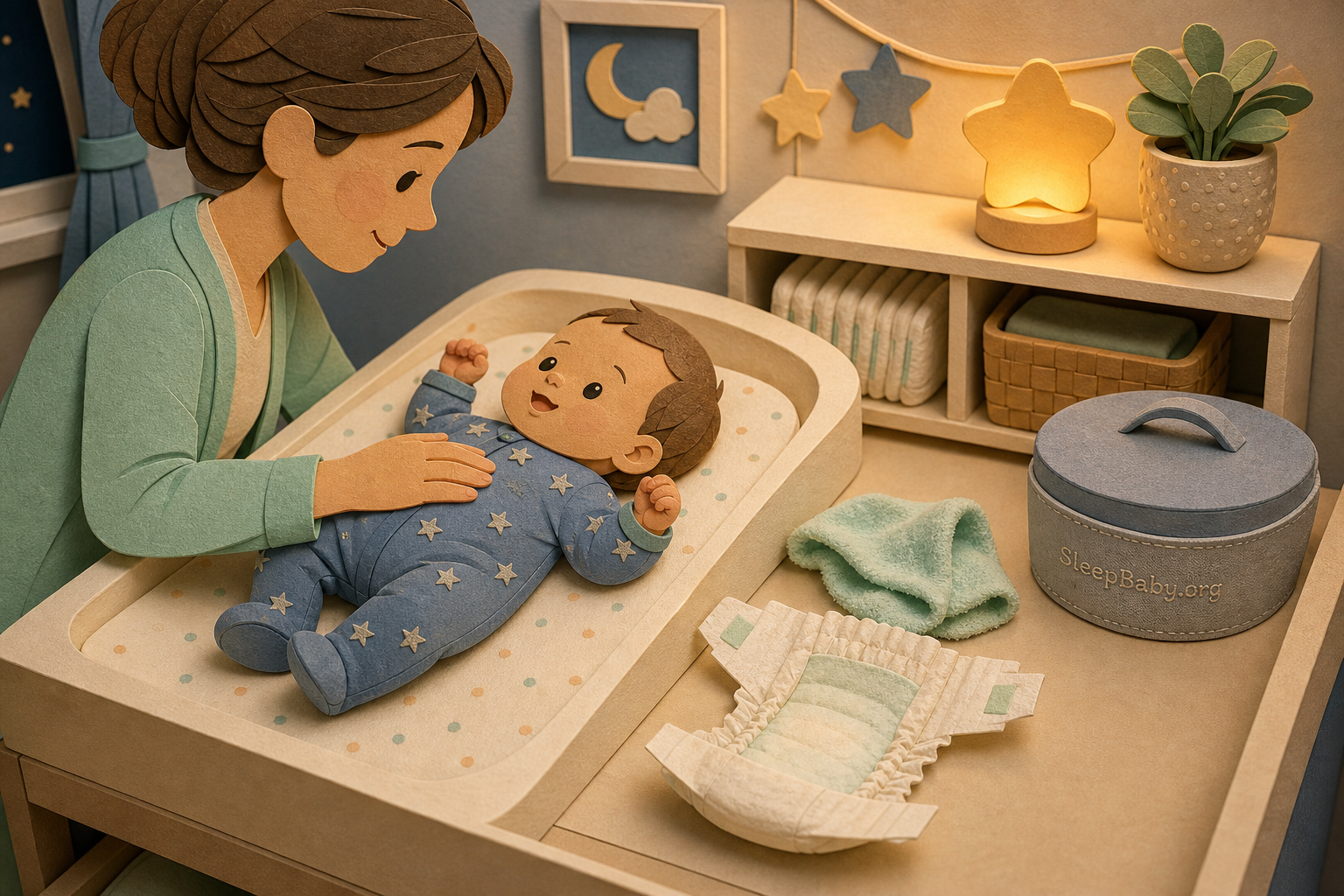
For a newborn, reduce the sensory pileup
Newborns do not need a behavior plan. They communicate through crying, and ordinary contexts include hunger, tiredness, overstimulation, temperature, needing a change, illness, and pain.1 A young baby may have very little patience for being moved from a warm chest into cool air, especially when already hungry or abruptly awakened. That makes the routine understandable; it does not make every episode harmless.
When feasible, avoid beginning at the baby’s most frantic hungry moment. That does not mean delaying a necessary soiled-diaper change or a medically important feeding schedule. It means preparing before you lift, speaking before you open the clothes, and deciding whether the feed-change order can be adjusted safely for this baby. If feeding questions or a clinician’s instructions determine the order, those instructions win.
A newborn who cries at every change but feeds normally, has expected wet diapers, settles afterward, has no fever, and has no skin or movement clue may simply hate the transition. Still, a new pattern in a very young infant deserves a lower threshold for calling. Young babies can show illness through nonspecific changes such as poor feeding, vomiting, unusual sleepiness, or inconsolability rather than a neatly labeled symptom.6
When a rolling baby or toddler says no with the whole body
An older baby may cry because the change interrupts motion, removes a fascinating object, or asks for stillness at the exact age stillness has become offensive. Pain still gets checked first. Once the baby is otherwise well and the crying is clearly tied to interruption, cooperation can be invited without turning hygiene or safety into a negotiation.
Offer two real choices inside the nonnegotiable change: “This clean diaper or that clean diaper?” “Song or quiet?” “Hold the clean cloth or point to the pajamas?” For an older toddler, a small helper job and playful narration can support collaboration. ZERO TO THREE recommends bounded choices and playful imagination for this age, including during resistant routines.11 The choice is never whether the needed change happens.
Keep the chosen object large, clean, and safe for the child’s age. A cap, wipe packet, cream tube, pin, or other small or squeezable care item is not a toy. If the child is rolling hard enough that an elevated setup is no longer controllable with one steady hand, reset on an appropriate clean floor-level changing mat, supervised and away from hazards, rather than trying to win a wrestling match at height.
The useful boundary: give agency around the change, not over the baby’s health or the changing-surface rules.
Predictability often helps more than a bigger distraction. Use the same place, the same two or three phrases, and the same finish: diaper, clothes, hands, done. If routine rigidity is becoming a larger daily problem, the ideas in helping a toddler who is obsessed with routine can extend this cooperation plan after pain has been excluded.

Look at the skin without trying to name the rash
Skin that is red, raw, or tender may make cleaning painful. The job at home is to notice what is visible, clean without adding friction, and know when a clinician should assess it. The job is not to decide from a paragraph or photo that a rash is yeast, bacterial, allergic, or something else.
Common care principles include prompt changes, gentle cleaning with water and a soft cloth or an alcohol- and fragrance-free wipe, allowing the area to dry, and using barrier care that is appropriate for the child and consistent with product labeling or the clinician’s guidance.3 If wiping causes a sharp cry, do not scrub harder to make the skin look perfectly clean. Gentle contact and medical guidance matter more than winning a cleanliness contest against already sore skin.
The AAP notes that diaper rashes can look similar even when their causes differ. Observable features such as sharply edged shiny redness, small surrounding bumps, crusting, weeping, or bright redness around the anus are useful details to report, not verdicts to announce at home.2 If the clinician asks for a photo, use it as part of that conversation rather than posting exposed images publicly. Protect the baby’s privacy as carefully as the skin.
Official AAP video
Dermatologist vs. diaper rash
The American Academy of Pediatrics video below demonstrates general diaper-rash care and explains when to see a pediatrician. It cannot diagnose this baby’s skin, and it does not explain crying linked to urination, stool, movement, or whole-body illness.
Prefer YouTube directly? Watch the AAP diaper-rash video.12

If crying lines up with urine, stool, movement, or illness
This is where the timeline earns its keep. A cry that begins when the diaper opens is not the same observation as a cry that begins during actual urination. A red face while passing a soft stool is not the same as repeated hard, dry, painful stool. A baby who dislikes having both legs lifted is not the same as a baby with a new sharp cry whenever one hip moves.
Parents do not need to name the condition. They need to identify where the clue lives, stop any action that appears painful, and choose the right level of care. The map below is deliberately not a quiz. More than one branch can be true, and a whole-baby red flag overrides every home step.
Where does the clue live?
Four paths, one rule: observe without reproducing pain
Use the first accurate path, then read its call boundary. If the baby looks very sick, is hard to wake, has breathing or color change, or cannot be consoled, use urgent care rather than the map.
Urine path
Notice: distress during actual urination, not merely when clothes open; fever, poor feeding, vomiting, unusual urine, or overall illness.
Route: call the child’s clinician. A urine test is needed to confirm a bladder infection.
Stool path
Notice: hard, dry, lumpy, difficult, or painful stool; bloating; blood; vomiting; or constant abdominal pain.
Route: ask for age-specific guidance. Blood, constant pain, vomiting, persistent bloating, or weight loss needs prompt care.
Movement path
Notice: a new sharp cry with one touch, lift, position, hip or leg movement, especially after a fall or with swelling or reduced use.
Route: stop reproducing the motion and arrange prompt assessment.
Whole-baby path
Notice: fever, breathing or color change, unusual sleepiness, repeated vomiting, poor feeding, reduced urine, swelling, injury, or prolonged inconsolability.
Route: urgent assessment; emergency services for life-threatening signs.
Why this matters tonight: do not file a new pain-linked cry under “night waking,” “resistance,” or “a bad sleeper.” Health and safety come first.
Crying during urination needs context and testing
Infants with a urinary infection may have nonspecific symptoms such as fever, fussiness, poor feeding, vomiting, or diarrhea. Older children may show burning, urgency, unusual urine, or abdominal discomfort. The NIDDK is clear that testing urine is how a bladder infection is confirmed.4 Odor alone, a wet diaper, or crying when the diaper tab opens cannot establish it.
If you can safely notice that the cry begins during the stream of urine, tell the clinician exactly that. Also report temperature measured by the method your pediatric team recommends, feeding, vomiting, urine amount, urine appearance, and whether the baby seems well between changes. Do not delay a call while waiting to catch the pattern again, especially in a young infant or a baby who appears ill.
Hard or painful stool is different from ordinary effort
Babies can grunt, turn red, and work hard while passing a soft stool. Those sights alone do not prove constipation. Hard, dry, lumpy, difficult, or painful stool and abdominal bloating are more useful clues.5 Blood, constant abdominal pain, vomiting, persistent bloating, or weight loss changes the urgency.
Because age, milk intake, solids, growth, and medical history affect what treatment is safe, this article will not tell you to give water, juice, a suppository, or medicine. Call the child’s clinician for an age-specific plan. A diaper-change trick cannot solve a bowel problem, and repeating leg-bicycling when movement seems painful is not a safe diagnostic test.
A new cry with touch or movement ends the comfort experiment
Some babies dislike being repositioned. The concerning pattern is a new, sharp, repeatable cry connected to one touch, lift, leg movement, hip position, or side of the body—especially after a fall or other possible injury, or when you see swelling or reduced use. AAP symptom guidance treats crying with touch or movement and possible injury as reasons for prompt assessment in a young baby.6
Stop the motion. Support the baby in a comfortable position. Do not force both knees upward, repeatedly bicycle the legs, compare sides through repeated maneuvers, or press on a tender area to see whether the baby cries again. Tell the clinician what movement happened naturally when the cry began, what you observed, and whether there was any fall, swelling, vomiting, or change in limb use.
A swollen groin or scrotum in a young crying baby is an urgent clue. So are a baby who looks very sick, repeated vomiting, poor intake, or prolonged inconsolability. Settling briefly after the diaper is closed does not erase those observations.
Keep the young-infant fever line exact
For a baby three months or younger, a rectal temperature of 100.4°F (38°C) or higher requires an immediate call to the pediatrician.7 Touching the forehead, using the cry itself, or deciding the baby “feels a little warm” does not replace a temperature measurement. Follow the pediatric team’s method advice and do not give medicine to a young infant without clinical guidance.
For an older baby, fever urgency depends on age, temperature, symptoms, and medical history. Call when the baby looks ill, feeds poorly, has markedly reduced urine, vomits repeatedly, is hard to wake, has breathing or color change, or your pediatric team has given a lower threshold. The purpose of a threshold is to open the right door to care, not to persuade a worried parent to stay home.
Keep the changing surface safer when the baby kicks and rolls
A routine task can become a fall risk in one sudden roll. Prepare a cleanable surface and all supplies first. On an elevated changing surface, keep one hand on the child at all times. Wipe front to back, contain soiled items, wash hands, and clean the surface, but never leave the baby to retrieve something or wash your hands midway through the change.8
Changing products are designed around fall, stability, entrapment, and other safety requirements, but a barrier or retention feature does not make stepping away safe.9 Follow the product instructions. Assume mobility can change before you receive a polite calendar invitation.
The one-hand-stays strip
Reach, contact, reset
- 1. Everything in reach
Fresh diaper, gentle cleaning supplies, clothes, and disposal are laid out before the baby arrives. - 2. One hand in contact
On an elevated surface, a steady hand stays on the child even when a strap or barrier is present. - 3. Floor-level reset
If rolling or kicking defeats safe control, use an appropriate clean floor-level changing mat when feasible, supervise continuously, and clear nearby hazards.
Why this matters tonight: preparation can shorten an overnight change without rushing. Fast is not the safety goal; no unnecessary step-away is.
A floor-level reset is not permission to use a couch, adult bed, counter, or another soft or elevated surface. Choose a clean, firm setup appropriate for an awake, supervised diaper change; keep pets, cords, medications, creams, plastic bags, and small objects out of reach. The baby is still supervised every second.
Audit the setup from the baby’s point of view
Sometimes the irritating part of the routine is hiding in plain sight. A clothing snap may press into the back. A stiff waistband may catch while the hips are lifted. The clean diaper may be opened only after the baby is already exposed. A bright ceiling light may point directly into the baby’s face. None of those details diagnoses the cry, but each is a reasonable thing to notice and correct.
Before the next ordinary change, kneel or lean to the baby’s sight line while the surface is empty. Check the draft from a vent, glare from the light, hard seams, unstable supplies, cords, and anything tempting enough to trigger a roll. Make sure the pail or disposal bag can be used without turning away. Open the clean diaper and loosen the clothing before the baby arrives.
Look at the diaper and clothing fit after the change. Deep pressure marks, repeated leaks, chafing, or a fastening pattern that suddenly no longer reaches comfortably are practical reasons to review size and fit according to the manufacturer’s guidance. They are not reasons to diagnose the skin. If marks persist, skin breaks down, swelling appears, or the baby seems painful, ask the clinician.
For a mobile child, remove the audience of fascinating care products. Close creams, bags, wipe packs, and containers; place them out of reach when the change is over. Offer one safe helper item before the child begins hunting for the forbidden tube. The best setup does not require a caregiver to say “no, not that” twelve times while trying to keep one hand on a rolling body.
If the crying is pushing you toward anger, put safety first
A screaming, twisting baby can flood a tired caregiver’s nervous system. That fact deserves a direct plan, not shame. If you feel yourself getting rough, freezing, shouting, or losing control, stop the hands-on struggle. Put the baby in a safe place such as the baby’s empty crib or another age-appropriate safe space, step away briefly, breathe, and call another trusted adult or the child’s clinician for help.
Never shake, hit, slam, jerk, or roughly restrain a baby. AAP guidance specifically recommends placing a baby in a safe location and getting help when frustration rises.10 If you think the baby may already have been hurt, seek emergency medical care and say exactly what happened so the baby can be assessed.
If you are alone, the diaper can wait for the brief moment required to make the baby and your hands safe. Once regulated help is present, complete necessary cleaning and reassess the baby. Caregiver overload is not a character verdict. It is a safety signal that changes the next action.
Use a three-change note only when the baby is otherwise well
When there is no red flag and the distress is confined to the routine, a short note across up to three ordinary changes can reveal a pattern. It can also give the pediatrician something better than “the cry seemed different.” Do not wait for three entries if pain, fever, illness, injury, reduced urine, severe skin changes, or persistent inconsolability appears.
SleepBaby.org observation tool
The three-change note
| Change | First trigger moment | Visible clue | One variable tested | What happened after |
|---|---|---|---|---|
| 1 | Before touch / clothes / cleaning / movement / urine-stool / after | Skin, urine, stool, movement, feeding, temperature, or none seen | Prepared / chest covered / timing / predictable words / gentle cleaning | Settled promptly / continued / new clue |
| 2 | Record the first reliable moment | Describe, do not diagnose | Change only one low-risk input | Better / same / worse |
| 3 | Use only if still safe to observe | Add measured temperature if relevant | Do not repeat painful motion | Question for the clinician |
Bring the useful facts: baby’s age; when the pattern began; first trigger moment; whether it happens every time; temperature and measurement method; feeding and wet-diaper change; stool description; visible skin; movement clue; injury history; what happens away from the changing surface; and the one ordinary variable you tested.
Keep the note private and practical. Avoid exposed photos unless the clinician specifically requests one through an appropriate channel. You are not building a dossier on the baby; you are handing a medical professional a short, accurate pattern.
Make the pediatric call short, specific, and useful
Begin with age and urgency: “My baby is six weeks old,” or “My nine-month-old looks well between changes.” Then give the first trigger moment: “The cry starts when urine passes,” “The cry begins when I move the left leg,” or “The skin is open and oozing.” Add measured temperature and method when relevant, feeding, wet-diaper change, vomiting, stool, visible swelling, injury history, and whether the baby settles away from the surface.
Say what you have already stopped doing: “I did not repeat the movement,” or “I stopped scrubbing the raw area.” Ask what level of care is appropriate and what the clinician wants you to do before the visit. If the office cannot see the baby promptly and the symptoms are urgent, use the urgent-care or emergency route they recommend. For life-threatening signs, call emergency services directly.
Do not soften the description because the baby is calm during the call. A video-call smile does not erase a rectal fever in a young infant, a swollen groin, repeated vomiting, or a sharp movement-linked cry. The observation is the information. Your job is not to sound certain; it is to be accurate.
If another caregiver saw the episode, compare notes before calling, but do not delay. “We disagree about whether it sounded painful” is less useful than “both of us saw the cry begin when urine passed.” Locate the moment one more time—in words, not by recreating it on the baby.

Make an overnight diaper change smaller, not medically quieter
At night, the goal is to handle the need safely without turning one change into a full sensory fireworks show. Prepare supplies before undressing, use low light that is still bright enough to inspect skin and clean properly, speak softly, limit unnecessary repositioning, and return to the family’s established safe sleep plan when the baby is comfortable and the health question is handled.
Do not skip a necessary change, painful skin check, feeding need, fever response, or other medical concern to protect a schedule. Sleep is not improved by ignoring the reason the baby cannot settle. When a sleeping baby needs to be awakened for care, the gradual approach in how to wake a sleeping baby can help you avoid stacking every stimulus at once.
After the fresh diaper is on, bring the room back down in the same order each time: clothes closed, hands clean, light lower, voice quieter, safe sleep space. If the larger problem is a feed-change-settle loop that occupies the whole night, move next to what to do when a newborn will not sleep at night. If frequent diaper checks are only one part of wake-ups every hour, use the broader troubleshooting in why a baby wakes every hour rather than assuming the diaper is the sole cause.

Focused questions parents ask about diaper-change crying
Is it normal for a newborn to scream during every diaper change?
It can happen when a newborn dislikes exposure, movement, hunger-tired timing, or the abrupt transition. “Common” is not the same as “always harmless.” Check feeding, wet diapers, temperature, skin, movement, and behavior away from the table. Call promptly for a new persistent pattern in a young infant, any red flag, or the exact fever threshold above.
Does crying mean the wipe is too cold?
Not necessarily. If crying begins when cleaning touches otherwise healthy skin, a comfortably warm room, covered chest, or clean damp cloth may be a low-risk one-variable test. A wipe warmer is not required, and hot or improvised warming methods can burn. If skin is tender, raw, blistered, oozing, crusted, or very painful, stop experimenting and seek guidance.
Should I change the baby before or after a feed?
There is no one order for every baby. A very hungry baby may tolerate a change poorly; a baby who spits up easily may not enjoy lots of movement right after feeding. Necessary changes, feeding needs, and the pediatric team’s instructions come first. Prepare in advance and observe which safe order reduces the sensory pileup for this baby.
What if the baby only cries when I lift the legs?
Stop repeating the movement. Support the baby comfortably and call the clinician, especially if the cry is new or sharp, follows a fall, or comes with swelling, reduced limb use, vomiting, fever, or a baby who looks unwell. Do not force the legs upward to test the pattern.
Can diaper rash make every wipe hurt?
Yes, tender or raw skin can make contact painful, but the appearance alone may not tell you the cause. Clean gently, avoid scrubbing, use only appropriate barrier or treatment guidance, and call for persistent, worsening, infected-looking, fever-associated, or substantially painful skin.
How can I keep a rolling baby still?
Prepare everything first, keep one hand on the baby on an elevated product, use a safe helper object or bounded choice when age-appropriate, and move to an appropriate clean floor-level mat if rolling makes the elevated setup unsafe. Do not leave, roughly restrain, or use a soft elevated bed or couch as the backup.
Should I distract the baby with a phone?
A phone may interrupt the crying without telling you what triggered it, and it can create another battle at the finish. Predictable words, one safe helper job, or a simple song often preserve more connection. If a distraction is needed to complete safe care, keep it age-appropriate and never let it pull the caregiver’s eyes or hand away from an elevated baby.
When should I call even if the baby settles afterward?
Call for the young-infant fever threshold; a baby who looks very sick; breathing or color change; crying with touch or movement; suspected injury; swollen groin or scrotum; repeated vomiting; poor feeding or reduced urine with illness; severe or infected-looking skin; distress during urination with concerning symptoms; hard painful stool with red flags; or prolonged inconsolability. Brief settling does not cancel an important clue.
Sources
- UNICEF Parenting: Why do babies cry?
- American Academy of Pediatrics / HealthyChildren: Common diaper rashes and treatments
- American Academy of Dermatology: How to treat diaper rash
- NIDDK: Bladder infection symptoms and causes in children
- NIDDK: Constipation symptoms and causes in children
- American Academy of Pediatrics / HealthyChildren: Crying baby before three months old
- American Academy of Pediatrics / HealthyChildren: Fever and your baby
- CDC: Healthy diaper changing at home
- U.S. Consumer Product Safety Commission: Baby changing products
- American Academy of Pediatrics / HealthyChildren: Responding to your baby’s cries
- ZERO TO THREE: Development from 13–24 months
- American Academy of Pediatrics: Dermatologist vs. diaper rash
When the 2 a.m. change becomes the whole night
Make the change smaller—then bring the room back down
The last snap closes, your hands are washed, and somehow the whole room is still wide awake. Once pain, illness, and skin concerns have the right care plan, SleepBaby can help you rebuild the larger feed-change-settle rhythm around this tiny, noisy interruption. It is a sleep next step—not a replacement for medical care.