
Clearly disclosed SleepBaby editorial composite — not biography or medical evidence
At 2:17 a.m., the clean diaper is already unfolded beneath the night-light. In this disclosed composite, imagine me, Kacey, leaning over Benjamin’s crib while he stays gloriously asleep and one unmistakable smell changes the assignment. I know the private question under the search tonight: if I wake him now, am I protecting his skin or volunteering the entire house for another hour of darkness with opinions again tonight?
If you know or strongly suspect your baby pooped during sleep, change the diaper promptly instead of waiting for the next ordinary wake. Stool can irritate skin. Keep the change small: prepare everything before you open the diaper, use only enough light to see safely, clean gently, pat dry, apply the barrier product already appropriate for your baby when needed, and return your baby to the normal safe sleep space. Start sleep on the back on a firm, flat, level surface with only a fitted sheet.
I am not going to pretend the baby will stay asleep because you used the right sequence. Sometimes the snap of a sleeper is apparently a brass band. The useful goal is smaller: protect skin, notice whether the stool itself looks ordinary for this baby, and avoid turning one necessary change into a fully lit new day.
THE ANSWER FOR THIS DIAPER
Change the poop; keep the night
Known or strongly suspected poop: change promptly.
Wet only: that is a separate decision based on leakage, skin condition, age, and any clinician-directed plan.
Not sure: make one quiet smell-and-waistband check instead of repeatedly waking your baby for every grunt.
Different-looking stool or a sick baby: the medical clues matter more than the sleep schedule. Use the call guide below.

Why a baby can poop without waking up
Sleep does not switch the digestive tract off. Food entering the stomach can activate the gastrocolic reflex, an automatic signal that prompts the colon to move material already farther along. That is why many young babies pass stool during or soon after a feed. If your baby fed, drifted off, and then filled the diaper, the milk did not race straight through in twelve minutes; one part of digestion cued another part to move.
Newborn stool schedules are especially democratic: everyone gets a vote and no one agrees on a meeting time. Some babies stool after many feeds. Some breastfed babies later go several days between soft stools and remain well. Formula-fed stool often looks and behaves differently from breastfed stool. Solids can change color, odor, frequency, and texture again. A bowel movement that happens during sleep can be ordinary even when the timing is deeply inconvenient.
I would not use the clock alone to decide that something is wrong. I would compare this diaper with your baby’s recent pattern and look at four things together: texture, color, frequency change, and the baby attached to the diaper. Feeding well, making usual wet diapers, behaving close to normal, and passing a familiar-looking stool is a different picture from repeated watery diapers, poor intake, fewer wet diapers, vomiting, fever, pain, or an ill-looking baby.
The night-stool timing map
DURING DEEP SLEEPThe baby may not signal. If you discover stool, the skin-care decision is still to change it.
WITH EVERY WAKELook for a recent pattern change, repeated watery stool, feeding changes, medicine, illness, or new solids; do not diagnose from timing alone.
SUDDENLY NEWRecord what changed and use symptoms, hydration, stool appearance, and age to decide whether to call.
SleepBaby.org original teaching component
Should you wake a sleeping baby for a poopy diaper?
Yes—when you know or strongly suspect there is stool, make the change. The reason is not that the diaper has crossed an invisible one-minute deadline, and it is not that every poop creates an infection. Stool and moisture are irritating to skin, and leaving them in contact longer does not protect sleep in a useful way. A clean diaper is the route back to comfort.
That answer is different from a wet-only diaper. Absorbent diapers are designed to pull urine away from skin, and families may receive different nighttime instructions based on a baby’s age, skin, feeding needs, leakage, prematurity, or medical care. I am deliberately not turning a poop answer into a universal wet-diaper rule, and I would not let one search result overrule an individual care plan. If the diaper is only wet, use the plan your baby’s clinician has given you and the condition of the skin and diaper.
If you are uncertain, avoid a full-room search operation. Pause near the crib, smell once, and check the back waistband with just enough light to see safely. Newborns grunt, squirm, and make astonishingly committed faces during normal sleep; noise alone is not proof of stool. On the other hand, if the smell or quick check confirms it, do not talk yourself out of the evidence because the baby stayed asleep.
One quiet gate before you unzip the sleeper
| What you know | Next move | What not to infer |
|---|---|---|
| Poop confirmed | Prepare, change, clean, dry, protect, return to safe sleep. | Waking means the whole bedtime routine failed. |
| Wet only | Follow the baby’s skin, leak, age, and clinician-directed plan. | Every wet diaper has the same urgency as stool. |
| Uncertain | One smell-and-waistband check; stop if there is no evidence. | Every grunt, red face, or sleep sound is a bowel movement. |
Override: a sick-looking baby, breathing trouble, unusual difficulty waking, repeated vomiting, blood, very pale stool, or dehydration signs belongs in the medical route below—not the ordinary night-change route.
SleepBaby.org original teaching component
If the bowel movement itself wakes your baby on many nights, the related guide to what to do when a baby wakes up to poop can help you separate the wake pattern from the diaper-care decision. The article you are reading keeps its focus on the baby who may remain asleep through the event.
The low-stimulation nighttime change runway
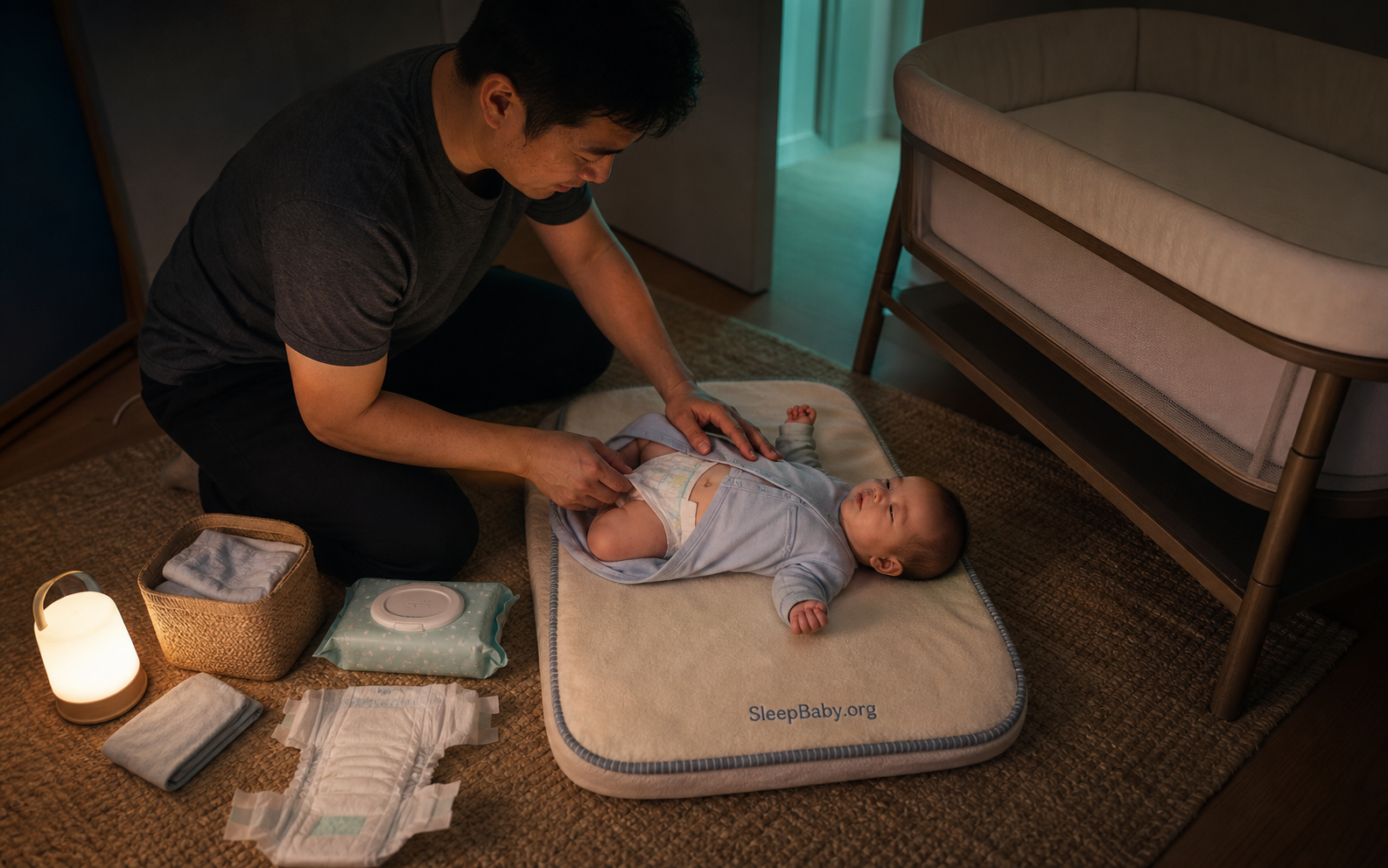
The best nighttime diaper change starts before the diaper opens. I want the clean diaper unfolded, wipes or warm water ready, the disposal bag open, the barrier within reach, and a clean sleeper close enough to grab with one hand. This is not nursery styling. It is fewer decisions while you are tired and one hand is keeping the baby secure.
Use a stable change surface. The floor with an easy-clean changing pad is a practical option; a changing table can work when used within its instructions and while your hand stays on the baby. Do not leave a baby unattended on a raised surface, even for the wipe packet that is somehow six inches beyond human reach. Do not use the crib as a change mat or leave a towel, liner, pad, or spare diaper in the sleep space afterward.
DIM ROOM · CLEAR HANDS · ONE SAFE RETURN
Prepare → open → clean → dry → shield → return
- Prepare before lifting. Put the clean diaper, cleaning supplies, disposal, barrier, and clothing in reach. Use enough light to see skin and stool accurately.
- Move to the stable change surface. Support the baby and keep one hand on them whenever the surface is raised.
- Open with the clean diaper ready. When practical, slide it underneath before removing the old diaper. Fold the old diaper over to contain the bulk of the stool.
- Clean without polishing. Use water, a soft cloth, or a fragrance-free alcohol-free wipe that does not sting. Clean folds gently and wipe front to back for babies with a vulva.
- Pat dry; do not scrub. A short pause for the skin to dry is useful while the baby remains awake and attended.
- Use the right barrier, if it is already part of the plan. Plain petrolatum or zinc-oxide barriers are common options, but follow your pediatric clinician when skin is broken, infected-looking, recurrent, or already being treated.
- Close the loop. Fresh diaper, comfortable clothing, short familiar cue, then back-first into the normal firm, flat, level, bare sleep space.
Sleep connection: quiet is helpful; safe visibility and complete cleaning come first.
SleepBaby.org original teaching component
I keep conversation minimal, but I do not recommend turning into a mysterious silent technician if your baby wakes frightened. A calm phrase and steady hands are still low stimulation. The night stays recognizable when the sequence and voice are familiar, even if the baby is suddenly wide-eyed and interested in payroll.
If you are actively sleep training, treat the poop as care, not a test of consistency. Change the diaper, then return to the response plan you chose for ordinary waking. The focused guide to handling a poop interruption during sleep training covers that seam without asking you to ignore a real need.

Protect the skin without turning the change into a treatment experiment
Stool is rough on the skin barrier, especially when diarrhea makes contact more frequent or a rash is already open and tender. The first job is simple: remove stool gently and reduce the next round of moisture and friction. More scrubbing is not more care. I keep that instruction deliberately boring because tired hands do not need a ten-product routine. If a wipe makes your baby flinch, warm water and a soft cloth or cotton pad may be kinder.
Barrier paste works by sitting between skin and the next diaper contents. The American Academy of Pediatrics describes zinc oxide and petrolatum as common choices and emphasizes a thick layer. If clean paste remains at the next change, you do not have to rub the skin back to bare; remove visible stool and add more as appropriate. That is particularly useful at night, when a cleanliness performance can become twenty extra wipes on already irritated skin.
Clean only what is dirty; protect what is tender
Lift away stool with water or a gentle fragrance-free option.
Pat or pause; do not rub raw skin.
Use a generous layer of an already appropriate barrier.
Pain, spread, folds, blisters, crust, drainage, fever, and direction of change matter.
SleepBaby.org original teaching component
Do not use this article to decide that every rash is yeast, bacterial, allergic, or caused by one food. Those rashes can overlap in appearance, and treatment differs. Call the pediatrician when the rash is worsening, unusually painful, spreading, not improving after two to three days of consistent care, or accompanied by pimples, blisters, peeling, pus, oozing, yellow crusts, fever, or a baby who seems ill.
If the skin is already the main problem, move next to the focused guide on what helps diaper rash and when to call. That is a better place for rash-type clues than squeezing a diagnosis into a sleep-time question.
Read the whole stool signal—not one scary color on a phone screen
Baby poop has a larger color palette than any reasonable person requests. Meconium is thick, sticky, and dark green-black during the first days. Breastfed stool is often loose, yellow, and seedy, and green can be normal. Formula-fed stool is often tan or yellow and more formed, but still soft. Iron, food, and developmental changes can shift color. I use color as one clue, not a verdict: one familiar green diaper in a well baby is not the same signal as pale gray stool or blood.
Texture and change over time matter too. Normal breastfed stool may be loose; diarrhea is more than the existence of liquid. A sudden increase in both number and wateriness, especially with poor feeding, fever, vomiting, blood or mucus, or an ill-looking baby, is more concerning. Frequent watery stool matters because dehydration can follow. Watch urine output, mouth moisture, tears, energy, and the soft spot in a young infant rather than watching the bowel-movement count alone.
Stool signal decoder
| Signal | What can be ordinary | What changes the response |
|---|---|---|
| Frequency | Many stools in a young breastfed baby, or days between soft stools later. | A sudden sustained jump plus watery stool, poor feeding, vomiting, fever, pain, or ill appearance. |
| Texture | Loose, seedy breastfed stool; soft clay-like formula stool. | Repeated very watery stool, hard dry pellets, blood, pus, or black-tarry appearance outside expected meconium. |
| Color | Yellow, tan, brown, or green depending on age and feeding; dark meconium in the first days. | White, chalky, pale yellow-gray stool; red blood; or new black-tarry stool after the meconium transition. |
| The baby | Feeding, waking, wetting, and behaving close to the baby’s usual pattern. | Fewer wet diapers, dry mouth, no tears, sunken soft spot, unusual sleepiness, repeated vomiting, severe pain, fever, poor feeding, or a baby who looks very sick. |
Photo boundary: a photo can help a clinician see color and texture, but an article or image search cannot diagnose the cause.
SleepBaby.org original teaching component
Very pale yellow, gray, chalky, or white stool in a young infant deserves prompt medical advice because it can signal a bile-flow problem, particularly when jaundice is also present. Blood, black-tarry stool after the newborn meconium period, or a dramatic change with illness also belongs in a call. Foods and iron can alter stool color, but do not use that possibility to dismiss a concerning diaper without asking.
Do not rearrange needed feeds to engineer a poop-free night
The legacy version of this advice suggested regulating feeding times to manage nighttime poop. I would not use that as a general solution. Young babies need feeding based on age, growth, feeding method, and their clinician’s guidance. Delaying a needed feed, stretching intervals, adding extra cereal, diluting formula, or changing milk to move a bowel movement to daylight creates a bigger problem than the diaper.
A feed can trigger the gastrocolic reflex, but that does not mean the feed is wrong. If your baby is growing, feeding, wetting diapers, and passing familiar soft stool, the inconvenient timing may simply be part of this season. If the pattern changes sharply after a new formula, medicine, illness, or solid food, write down the timing and symptoms and ask the pediatrician rather than removing multiple foods at once.
I also would not call frequent stool proof of overfeeding. Stool frequency by itself cannot tell you whether a baby ate too much, has an allergy, or needs a new schedule. Look for the whole pattern: feeding comfort, growth, vomiting, blood or mucus, skin symptoms, pain, hydration, and the clinician’s assessment. A tidy internet explanation is not worth an unnecessary feeding change.
Three myths to leave outside the nursery
- “Night poop means the bedtime feed was too much.” Not from timing alone.
- “A consistent feed clock will train the bowel to wait.” Infant feeding needs outrank a cleaner schedule.
- “More than five stools means a reaction.” Age, feeding method, texture, change from baseline, symptoms, hydration, and growth matter together.
SleepBaby.org original teaching component
ONE PRACTICAL TOOL FOR THE CLEAN-DRY-SHIELD STEP
Bumco Original Baby Bum Brush
If thick barrier paste is already appropriate for your baby, this soft silicone applicator helps spread the product you have chosen without coating your fingers. The suction base lets it stand beside the diaper stack while you finish fastening the clean diaper.
It fits this situation better than an overnight diaper because absorbency does not make it appropriate to leave stool against the skin. It fits better than my choosing a medicated cream for you because rash treatment depends on the actual skin problem. The specific reason to buy it is wonderfully unglamorous: at 2 a.m., it can make the barrier step easier without requiring a bright-light handwashing detour halfway through the change.
See the Bumco Original Baby Bum Brush on Amazon
This tool does not prevent or treat diaper rash and does not replace handwashing, gentle cleaning, prompt changing, or a clinician’s advice. Use only with a product already appropriate for your baby, clean the applicator as directed, and keep it outside the crib or bassinet and out of reach.
Disclosure: As an Amazon Associate, SleepBaby.org may earn from qualifying purchases.
OPTIONAL SHOPPING IDEAS — PRESERVED
Helpful Amazon finds already attached to this article
These existing paths remain separate from the guidance and from the article-specific recommendation above. They are not medical advice or a substitute for professional care.
As an Amazon Associate, SleepBaby.org may earn from qualifying purchases.
If it happens night after night, track the pattern—not the parent guilt
One nighttime poop is a diaper change. A repeated new pattern is information. For three nights, I would record only what can change the next decision: feed time, stool time, texture, color, any vomiting or pain, recent medicine or solids, number of clearly wet diapers, and whether your baby fed and behaved close to usual. That is enough to make a pediatric conversation useful without turning the nursery into a gastrointestinal research institute.
Do not change six variables while you collect the pattern. If you move every feed, swap formula, remove foods, start a supplement, change diaper brands, and add a new cream, neither you nor the clinician can tell what mattered. Keep needed feeds and safe sleep stable. Change only what has a clear reason, and call sooner when the baby is young, ill, dehydrated, in pain, not feeding, or passing concerning stool.
The three-line observation note
- Before: feed, medicine, new solid, illness, or no obvious change.
- Diaper: time, texture, color, blood or mucus, and whether this is truly different.
- Baby: feeding, wet diapers, vomiting, fever, pain, energy, and return to sleep.
Do not use the note to diagnose. Use it to show the clinician what changed and how quickly.
SleepBaby.org original teaching component


When nighttime poop needs more than a diaper change
The smell may wake you first, but the baby’s condition sets the urgency. I want the medical route written plainly because a sleepy parent should not have to extract it from a charming stool-color wheel.
Match the signal to the next door
Emergency help now
Severe breathing trouble; blue or gray color; seizure; unresponsiveness; extreme difficulty waking; or any situation you believe is life-threatening.
Urgent medical advice
Blood; black-tarry stool after meconium; white, chalky, pale yellow, or gray stool; dehydration signs; repeated vomiting; severe or persistent pain; fever in a young infant; very frequent watery stool; poor feeding; or a baby who looks very sick.
Call during office hours
A persistent new nighttime pattern, recurrent hard or painful stool, ongoing loose stool, poor weight gain, repeated rash, or a change that worries you even without emergency signs.
Age matters: young infants can become ill or dehydrated quickly. When you are unsure, call the child’s clinician or local nurse line rather than waiting for a search result to become more certain.
SleepBaby.org original teaching component
For diarrhea, fewer wet diapers, a dry mouth, fewer or no tears, a sunken soft spot, unusual sleepiness, or an ill appearance can signal dehydration. Do not rely on the nighttime stool count alone. Do not give anti-diarrheal medicine, alter formula concentration, or begin an oral rehydration plan for a young baby from this article; ask a clinician for age- and symptom-specific instructions.
A newborn’s first stools are expected to be dark meconium. The concern is a new black-tarry appearance after that transition, especially with illness, pain, or bleeding signs. Likewise, pale or gray stool is not a “wait for the next diaper” color in a young infant. A clinician can decide whether the appearance needs testing.
WATCH THE BARRIER STEP IN DAYLIGHT
AAP dermatologist: diaper-rash care and cream application
This American Academy of Pediatrics video is useful when you want to see how gentle care and barrier application look before the next half-awake change. The written clean-dry-shield sequence above remains the complete plan if you cannot watch now.
SleepBaby takeaway: use the video to learn the hand motion and amount, not to diagnose the rash. Fever, spreading redness, drainage, blisters, severe pain, or a baby who seems ill belongs with the pediatric clinician.
Open the AAP video on YouTube if the embedded player is unavailable.
The clean diaper is not the end of the sleep plan
After the change, remove every supply from the sleep area. The wipe packet, disposable pad, towel, spare sleeper, cream tube, brush, and night-light stay outside the crib or bassinet. Place your baby on their back on the firm, flat, level surface with only the fitted sheet. A fresh diaper does not make an adult bed, couch, chair, lounger, or padded changing surface safe for sleep.
If the baby is now fully awake, you can repeat one short cue: feed if needed, hold or rock while you remain alert, use the familiar phrase, and try the safe landing again. I would rather repeat a small cue than launch a second complete bedtime routine. If you are becoming too sleepy to hold the baby safely, put the baby in the safe sleep space and wake another safe adult. Crying in a safe crib while you secure an alert handoff is safer than drifting off together on a couch or chair.
Back in the disclosed composite, the clean diaper under the night-light is no longer an accusation. Benjamin wakes enough to object to one cold snap, I clean what needs cleaning, and another alert adult takes the sleeper while I clear the change pad. The crib looks ordinary again: fitted sheet, no supplies, one safe destination. This is not evidence that the sequence guarantees sleep, and it is not a claim about my family history. It is the changed meaning I want you to carry out of the room.
A nighttime poop is not a ruined night. It is one care task with a beginning, a medical boundary, and a safe return.
Sources
- American Academy of Pediatrics / HealthyChildren.org, “Baby’s First Days: Bowel Movements & Urination” (updated November 14, 2024).
- Cleveland Clinic, “Gastrocolic Reflex: Why You Need To Poop After Eating” (medically reviewed; updated July 16, 2025).
- American Academy of Pediatrics / HealthyChildren.org, “Common Diaper Rashes & Treatments” (updated December 18, 2024).
- American Academy of Pediatrics / HealthyChildren.org, “Changing Diapers”.
- Seattle Children’s, “Diarrhea (0-12 Months)” (reviewed May 5, 2025; revised March 4, 2025).
- National Institute of Diabetes and Digestive and Kidney Diseases, “Symptoms & Causes of Chronic Diarrhea in Children”.
- Seattle Children’s, “Spotting Neonatal Cholestasis Early”.
- NICHD Safe to Sleep, “Safe Sleep Environment for Baby”.
- American Academy of Pediatrics / HealthyChildren.org, “Safe Sleep: 9 Ways to Reduce a Baby’s Risk of SIDS & Suffocation” (updated April 30, 2026).
- American Academy of Pediatrics, “Dermatologist vs. Diaper Rash” (video).
- Bumco, “Original Baby Bum Brush (Blue)” (product identity and physical features only).
WHEN THE CLEAN DIAPER IS ON
Bring the room back to sleep without skipping the care
A poopy diaper can split one quiet stretch into a skin decision, a stool question, and a fully awake baby. You now have a shorter map: confirm, change, clean, dry, shield, notice the red flags, and return to the bare sleep space. SleepBaby can help you connect that safe return to a bedtime rhythm that still works after the unexpected parts.
SleepBaby guidance is educational and does not replace your child’s clinician, emergency care, or an individualized feeding or treatment plan.