The one-month reality
Your one-month-old needs a rhythm, not a timetable
At 2:26 a.m., a printed baby schedule can look almost accusatory. Its neat boxes say sleep; your one-month-old says excellent time for another feed and a long inspection of the ceiling. If that is your house, the schedule is not proving that you failed. It is proving that newborns cannot read.
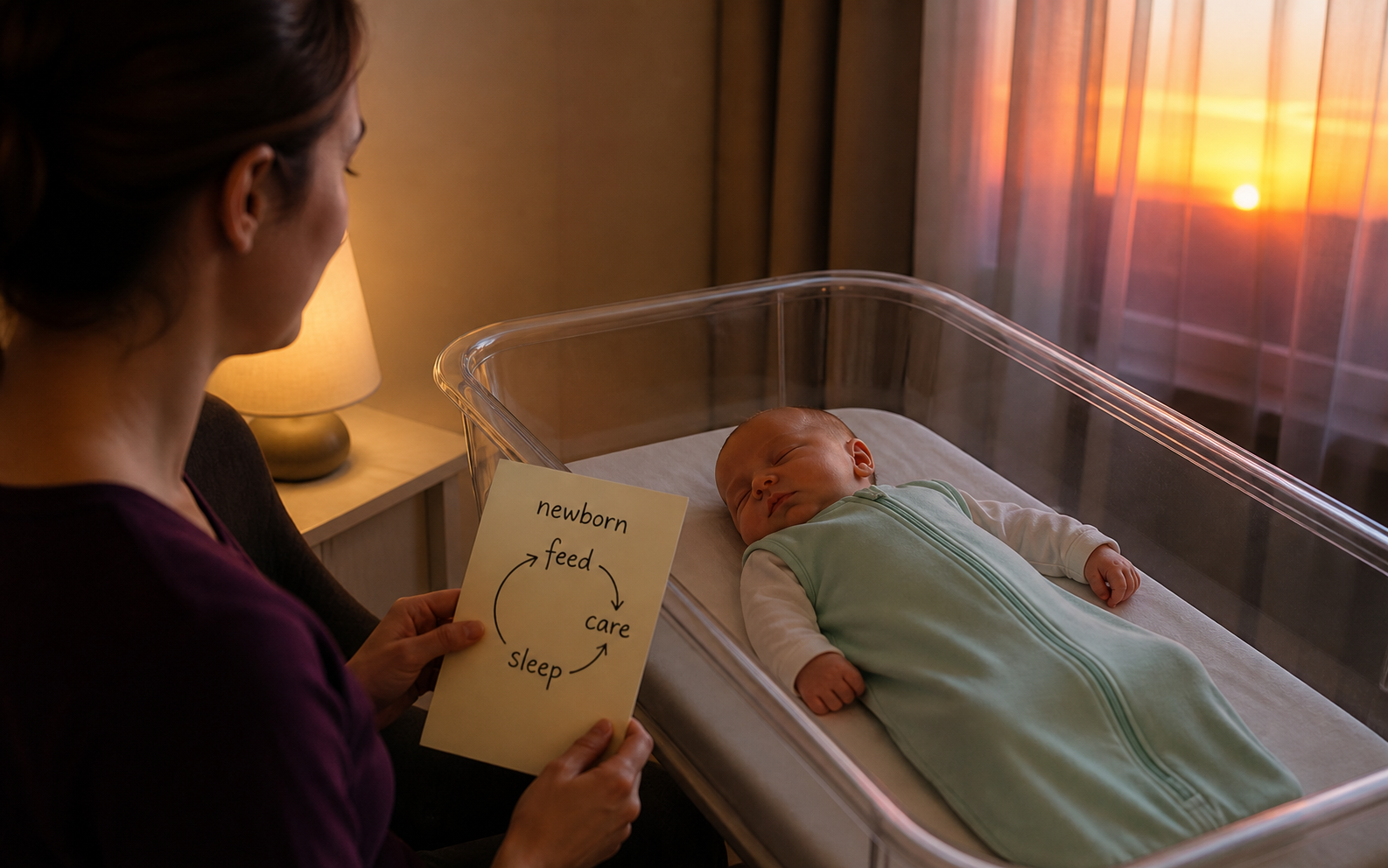
A realistic one-month-old sleep schedule is a responsive loop: wake, feed, care, a little calm alert time, then another safe sleep opportunity when your baby looks ready. The clock times move. Feeding, growth guidance, comfort, and safe sleep come first. You can begin teaching the difference between day and night with daylight and ordinary household life during the day, then lower light and quieter care at night. But this is not the age to force fixed naps, stretch awake time, remove night feeds, or expect “sleeping through.”
I would use a sample schedule only to see the shape of the day. If your baby wakes earlier, feeds longer, sleeps for 28 minutes, or needs the pediatrician’s waking-to-feed plan, the living baby outranks the pastel chart every time.
Before timing anything, protect feeding and safe sleep
One month is still deep newborn territory. Sleep arrives in pieces across day and night because feeding is frequent and the body systems that organize a mature day-night pattern are still developing. Some babies sleep more than others; some stack several short naps; some occasionally give a longer stretch and then take it back the next night with no apology.
The Centers for Disease Control and Prevention lists 14–17 hours as general orientation for newborns ages 0–3 months. That is a population guide, not a daily quota, diagnosis, or promise. The NHS describes newborn totals that can be around 18 hours while emphasizing wide individual variation. I would not grade a one-month-old on one number. I would look at the whole baby: feeding, growth, wet diapers, comfortable alert periods, breathing, color, responsiveness, and the pattern their clinician expects.
The schedule never gets to overrule these
- Follow hunger cues and any clinician instruction about waking for feeds. Ask before intentionally lengthening feeding gaps, especially with prematurity, jaundice, feeding difficulty, slow weight gain, or uncertain intake.
- Place baby on the back for every nap and nighttime sleep on a firm, flat, level, non-inclined surface intended for infant sleep.
- Use the approved crib, bassinet, portable crib, or play yard with its fitted sheet only. Keep pillows, loose blankets, toys, bumpers, positioners, nursing pillows, and weighted products out.
- Room-share without bed-sharing. If baby falls asleep in a swing, carrier, stroller, or car seat outside travel, move them to the proper sleep surface as soon as practical.
- Do not keep a sleepy newborn awake to “earn” a longer night. Overtiredness is not a sleep-training ingredient.
If your baby is younger than three months and has a rectal temperature of 100.4°F (38°C) or higher, contact the pediatrician immediately. Seek urgent help for breathing difficulty, blue or gray color, a seizure, limpness, unresponsiveness, or extreme difficulty waking. Poor feeding, fewer wet diapers, repeated vomiting, or a marked change in alertness also belongs in a medical conversation, not a schedule experiment.
The four-part loop that works better than fixed nap times
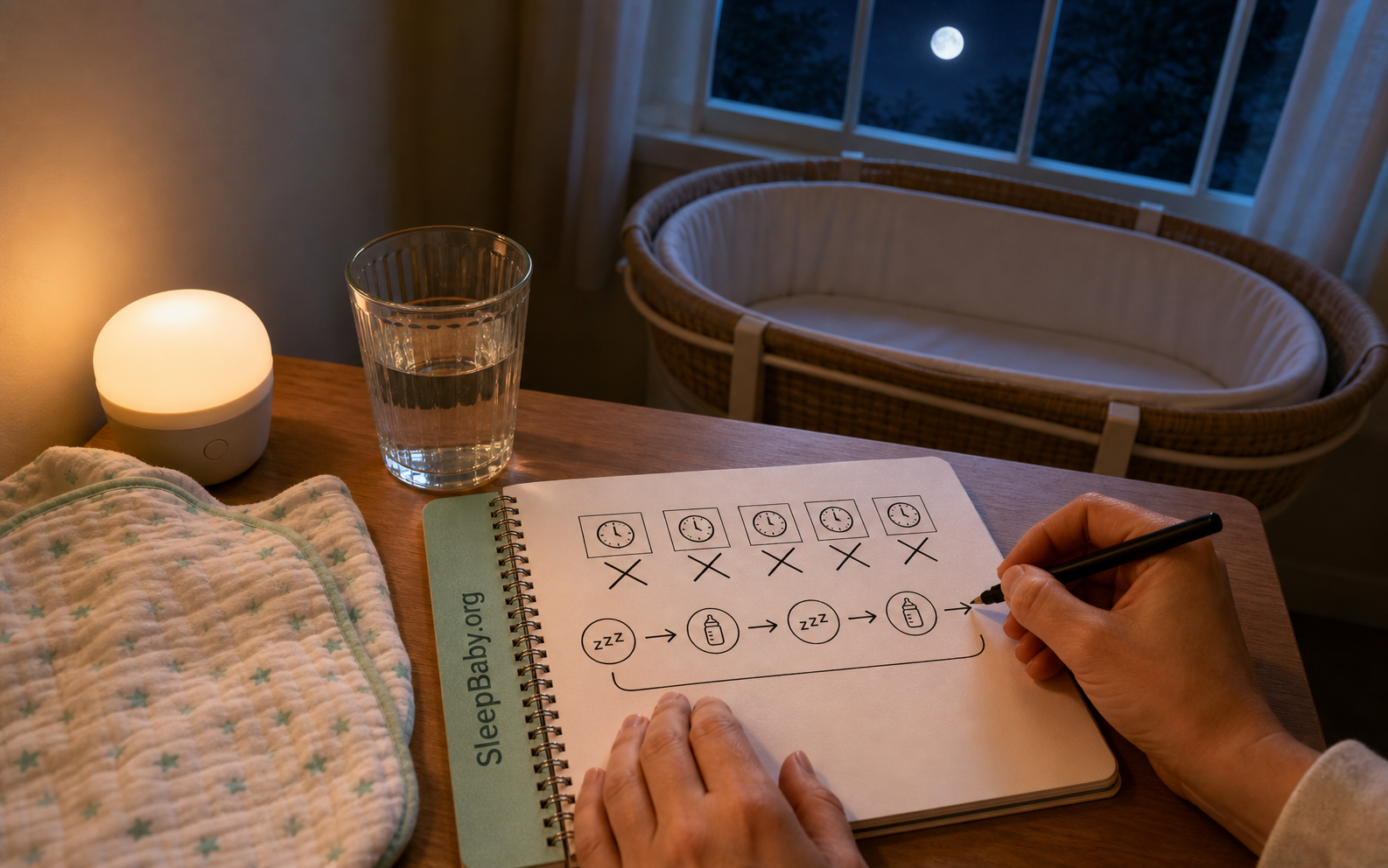
A one-month-old day is less like a train timetable and more like a revolving door. The same four jobs keep returning, but not at identical minutes. That is not chaos; it is the developmental design of the stage.
- Wake and assess. Notice how the last sleep ended. Is baby quietly alert, rooting, crying, uncomfortable, or still drowsy? The answer changes the next step.
- Feed and care. Respond to hunger and follow the feeding plan. Burp, hold upright if advised for comfort, and change the diaper when needed. A feed is not a scheduling error.
- Offer a small awake pocket. If baby is comfortably alert, use a few minutes for face-to-face contact, cuddling, or brief supervised tummy time. There is no prize for keeping a fading newborn entertained.
- Return to sleep safely. When baby disengages, grows still, yawns, fusses, or simply seems finished with the world, repeat a tiny settling cue and offer the bare safe sleep space.
SleepBaby.org original teaching note: the sequence is the anchor; the clock is only a timestamp.
After a short nap, the next awake pocket may be short. After a deeper sleep and a satisfying feed, it may be a little longer. At this age I would not turn an internet wake-window range into a deadline. Watch the baby in front of you, especially because feeding itself can occupy much of an awake period.

A sample one-month-old day—written as ranges, not orders
Parents often ask for actual times because “be flexible” is not very helpful when you are trying to shower, eat, or remember which side of the burp cloth is currently clean. So here is a sample shape. It is not a feeding prescription. It assumes a healthy baby whose own clinician has not given different waking, growth, or feeding instructions.
6:00–8:00 a.m. — Call it morning when morning really begins.
Open curtains, use a normal voice, feed as needed, and allow ordinary household sounds. If baby wakes at 5:30, eats, and returns to sleep, you do not have to hold a ribbon-cutting ceremony for daytime.
Morning — Repeat feed, care, brief awake contact, sleep.
Naps may be short or long. Start each new loop from the actual wake time, not the nap time printed here.
Midday and afternoon — Keep daylight and normal life present.
Offer feeds according to cues and the clinical plan. Use calm alert pockets for cuddling, looking at faces, or supervised tummy time. Let sleep happen when baby is ready rather than stretching to a target.
Early evening — Expect less elegance.
Many newborn evenings include frequent feeding, fussiness, contact, and several attempts at settling. A cluster of small loops can still be normal. Reduce stimulation without trying to force the “final” bedtime too early.
Evening — Repeat one six-minute closing sequence.
Feed, change if needed, use sleep clothing appropriate to the room, dim the light, cuddle or sing briefly, then place baby on the back in the safe sleep space.
Overnight — Meet needs quietly.
Use low light, a quiet voice, minimal play, and only necessary diaper changes. Feed according to cues and instructions, then return baby to the separate sleep space. Night waking is part of the schedule at one month, not evidence that the schedule failed.
You may see feeds and sleep roughly every few hours. You may also see cluster feeding, a 22-minute nap, a surprisingly long stretch, then an evening that resembles a small customer-service department with no closing time. Use the pattern to prepare the next safe step, never to make the baby wait.
The night Kacey and Benjamin “missed” every box
Composite scene based on common newborn schedule questions: Imagine Kacey at the kitchen counter with Benjamin asleep against her shoulder and a handwritten schedule tucked beneath a clean bottle. The page says he should have finished a nap 40 minutes ago. He has instead fed twice, stared solemnly at the refrigerator light, and fallen asleep during the burp.
In this composite moment, I can hear the private question: If I cannot make one ordinary Tuesday look organized, how will either of us ever sleep? Benjamin does not need Kacey to repair the whole day. He needs the next correct handoff. She checks that the feed is finished, moves through the short settling sequence, and places him on his back in the bassinet. Then she crosses out three clock times and writes one sentence: “The loop repeated safely.”
That sentence does more useful work than a perfect chart. It changes the measure of success from obedience to responsiveness: fed when needed, slept safely, daylight looked like daylight, night stayed quiet, and the adults did not redesign every nap because one stretch wandered.

Teach day and night without demanding a bedtime
You can begin creating contrast from the early weeks. The goal is not to make a one-month-old stay awake all day or sleep all night. It is to make the two halves of the clock feel different enough that the developing rhythm receives consistent clues.
| During the day | During the night |
|---|---|
| Open curtains and use natural daylight. | Use the lowest practical light for feeding and care. |
| Let ordinary conversation and household sound continue. | Keep voices low and interaction simple. |
| Offer brief alert contact when baby is comfortable. | Avoid play; return to sleep after needs are met. |
| Begin the next loop from the real wake. | Do not call every feed the start of a new day. |
Do not keep daytime naps in a bright room if light makes it hard for your baby to settle. The larger distinction matters more than theatrical perfection: daytime begins with light and life; nighttime care stays dim and boring. Boring is a compliment here.
A simple evening routine can start now, but keep it short enough to survive an exhausted night. A diaper check, sleep clothing, lowered light, one song, and the safe sleep space is a routine. You do not need a bath, massage, three books, aromatherapy, and a tiny string quartet. If the routine delays a hungry baby’s feed, it has promoted itself above its pay grade.
A useful cue for the caregiver
Hatch Rest 2nd Gen sound machine and night light
For this exact stage, I prefer one adjustable device that can keep nighttime feeds dim and give the same quiet sound cue during the short settling sequence. The Hatch Rest is a stronger fit than a schedule clock, wake-window timer, weighted product, or sleep positioner because it supports what the caregiver repeats; it does not ask a newborn to perform longer sleep. Keep the unit and cord well outside the crib or bassinet, use sound conservatively, and treat it as a cue—not a medical tool or a promise.
See the Hatch Rest 2nd Gen on Amazon
As an Amazon Associate, SleepBaby may earn from qualifying purchases.
When the whole day slides sideways
One odd nap should not trigger a total reset. First ask what changed: Was the last sleep short? Did feeding take longer? Was baby overstimulated, uncomfortable, congested, unusually sleepy, or simply awake at a different time? Meet the need you can actually see.
Baby wakes early from a nap: feed or comfort as needed, keep the awake period gentle, and watch for the next sleep sooner. Do not hold baby awake until the chart catches up.
Baby sleeps longer than expected: follow any instruction to wake for feeds. Otherwise use the actual wake as the next starting point and consider the whole feeding and growth picture.
Evening becomes frequent feeding and fussing: lower stimulation, rotate safe adult support if available, and keep offering the same safe landing. Do not label cluster feeding a behavioral sleep problem.
Baby seems genuinely different: pause schedule work. Check feeding, wet diapers, temperature, breathing, color, and responsiveness, and contact the clinician when the change is concerning.
The best newborn reset is surprisingly small: feed the baby, make the sleep space safe, dim the room when it is night, and begin again from the next real wake. You are not repairing a broken calendar. You are caring for a changing nervous system.

Feeding is not the part to optimize away
Parents often arrive at a sleep schedule search because they want to know when the baby can go longer without eating. That decision cannot come from a generic chart. At one month, many babies still need frequent feeds around the clock, and some need to be awakened. The right interval depends on feeding effectiveness, birth history, weight gain, jaundice, milk supply or formula intake, and the baby’s individual plan.
If your clinician has told you to wake the baby, keep doing that until the clinician changes the instruction. If your baby has not regained birth weight, was born early, is difficult to wake for feeds, feeds weakly, has fewer wet diapers, or has growth concerns, ask before allowing longer stretches. A surprisingly long sleep can feel like winning the lottery, but it is not automatically permission to cancel the next feeding appointment with the kitchen.
During overnight feeds, the practical goal is calm completion. Keep supplies within reach, use enough light to feed safely, and avoid positioning yourself on a couch or armchair when you might fall asleep. If you feel your eyes closing, change the situation before sleep takes the decision away. Return the baby to the separate sleep space before you sleep.
I would also separate feeding support from sleep performance. Feeding to sleep can be ordinary at one month. Holding a newborn while they settle can be ordinary. Waking on transfer can be ordinary. None of those facts means you have created a permanent “bad habit.” Your immediate jobs are nourishment, safety, responsiveness, and enough repetition that the night feels less stimulating than the day.
Track only what helps the next decision
A record can be useful when it supports feeding care, reveals day-night patterns, or gives the pediatrician accurate context. It becomes less useful when every yawn turns into a data-entry emergency. For three ordinary days, capture only what changes a decision.
- Feeds: approximate time and any concern about duration, volume, latch, transfer, or unusual sleepiness.
- Sleep: when sleep actually began and ended—not when you hoped the nap would start.
- Wet diapers: follow the counting guidance given by your baby’s care team.
- Day-night cues: note whether daytime began with light and nighttime care stayed low-key.
- What looked different: fever, congestion, vomiting, pain, breathing changes, or a baby who was harder to wake than usual.
Then look for relationships, not a score. Does the longest stretch tend to follow a calm evening feed? Does baby become frantic when an awake period runs long? Are daytime feeds being missed because naps are being protected? Is the parent trying to fix six variables at once?
For a broader approach as your baby’s rhythm matures, use this flexible guide to putting a baby on a sleep schedule. If clock-watching itself is making every nap feel like an exam, the distinction in wake windows are not deadlines may be the more useful next read.

What “good sleep” means at one month
Good newborn sleep is not necessarily long, independent, or predictable. At one month, I would call sleep “working” when it happens on a safe surface, feeding and growth needs remain protected, the baby has comfortable alert moments, and caregivers can identify the next step without gambling on an unsafe shortcut.
A baby who wakes repeatedly may be doing exactly what newborns do. If the immediate struggle is tonight rather than the whole schedule, use this safe plan for a newborn who will not sleep at night. It separates ordinary fragmented sleep from the signs that need medical attention.
Over the coming months, sleep may begin to gather into more recognizable stretches and bedtime may become easier to locate. The month-by-month first-year sleep schedule shows how the rhythm can gain anchors without pretending that development happens on one exact birthday.
Do not rush there. A one-month-old is not behind because the day is still fluid. You are laying groundwork through contrast and repetition: light, feed, care, brief connection, safe sleep; then dimness, quiet, feed, safe sleep. Those are small signals, but newborn life is built from small signals repeated while everyone is tired.
Make the adult sleep plan before the adult is desperate
A one-month-old schedule is also a caregiver-safety document. Broken nights change judgment. The unsafe decision rarely announces itself as a decision; it arrives as “I will just sit here for one minute” on a soft couch while holding a fed baby. If you are nodding off, change the setup immediately. Put the baby in the separate safe sleep space, wake another safe adult if one is available, or move to a safer feeding plan before your body chooses for you.
When two adults are sharing care, divide jobs rather than demanding that both people remain awake for every part. Depending on the feeding plan, one person might feed while the other handles the diaper, refill, burp cloth, or return to the bassinet. A breastfeeding parent may need the partner to own everything around the feed. A formula-feeding family may alternate complete feed blocks. The exact arrangement matters less than creating one protected stretch in which the off-duty adult is genuinely off duty.
If you are caring for the baby alone, practical help counts. A trusted person can hold the awake baby while you sleep, prepare food, wash bottles or pump parts according to your plan, take laundry, or sit nearby during a difficult evening. The helper does not need to “fix sleep” to make the night safer. Sometimes the most useful newborn sleep intervention is somebody else removing the casserole dish from the counter and finding the missing clean pajamas.
Write this down before midnight
- Safe landing: the approved crib or bassinet is clear and ready before every feed.
- Red flag phrase: “I am too sleepy to hold the baby safely” ends debate and triggers the handoff.
- Next adult: name who can take over and which tasks they can safely perform.
- Solo fallback: place baby safely down even if baby protests, then stand, drink water, turn on enough light, and reset.
- Daytime protection: choose one rest window for the caregiver and let nonessential household work lose.
I would rather hear a baby fuss safely in a bassinet for a few minutes while a caregiver regains alertness than watch an exhausted adult try to prove they can keep holding on. Responsiveness includes responding to your own dangerous sleepiness. It is not abandonment to put the baby down safely; it is the handoff that protects both of you.
The questions hiding behind the sample chart
Should a one-month-old have a bedtime?
You can use a repeatable evening wind-down, but the actual sleep time may move with feeding and the last nap. Think “familiar closing sequence,” not “must be asleep at 7:00.”
How many naps should a one-month-old take?
Newborn sleep is distributed in many pieces, and counting a fixed number of naps can create false precision. Focus on total pattern, feeding, alertness, and safe sleep rather than demanding a specific nap count.
Can I let my one-month-old sleep longer at night?
Follow the baby’s individualized feeding and growth guidance. Ask the clinician before intentionally lengthening overnight gaps, particularly with prematurity, jaundice, slow weight gain, poor feeding, uncertain intake, or instructions to wake.
Should I wake the baby to keep daytime naps short?
Not to force a generic schedule. Wake when the feeding or medical plan requires it. Otherwise, one long nap should be interpreted in the context of the whole baby and the whole day, not punished with forced wakefulness.
Is day-night confusion normal?
It is common for newborn sleep to remain scattered across the clock. Use daylight and normal interaction by day, then dimmer and quieter care at night. The contrast teaches gradually; it does not usually flip in one evening.
Is this the age for sleep training?
No. At one month, respond to feeding and comfort needs, use safe sleep, and build gentle cues. Formal sleep-training plans are not the job of this newborn schedule.

WATCH: THE SAFE LANDING FOR EVERY LOOP
See the bare infant sleep space the schedule must protect
This American Academy of Pediatrics video makes the article’s nonnegotiable endpoint visible: back sleeping on a firm, flat, bare surface, every time the newborn rhythm returns to sleep.
Takeaway: the clock may move, but the safe sleep destination does not. Watch on YouTube if the embedded player is unavailable.
Sources
At 2:26 a.m., the chart may still be wrong. But the room can be dim, the feed can be protected, the bassinet can be clear, and the next handoff can be safe. At one month, that is not a consolation prize. That is the schedule beginning to do its real job.
WHEN THE CLOCK KEEPS MOVING
Build the next safe handoff, not the perfect day
The feed ran long. The nap ended early. The evening became six small loops wearing one enormous trench coat. You do not need to repair every hour. Keep feeding and safety protected, choose one repeatable cue, and let the next real wake tell you where the day goes.






What viewers said10 comments · 4 replies+
Archived comments from the original Baby Sleep Miracle presentation. Not independently verified by SleepBaby.org; individual experiences vary.
Thank you so much for this video! I had no idea about the dangers of baby swings :O
Hi Mary-Ann. I have a question: Is method in any way similar to the ones recommended by Dr Bucknam, Dr. Weissbluth or Dr. Karp? We tried those but none of them help.
Hi Regina, thank you for your question. The short answer is no. The techniques I share in my guide are based on newest scientific research and this is why I have never seen any approach similar to the one I recommend.
This method really works! I tried it on my son Jesus and after just one week he went from waking up more than 5 times a night to waking up just once or twice. You are a lifesaver, Mary-Ann!
I'm truly impressed with how much information you share in your video. And all for free! I can feel that you truly care about mothers like myself, and that's hard to find these days. I have recommended your site to several of my friends already.
Mary-Ann, our child suffers from autism. Is your approach still suited?
Chloe, I made sure my method can be used with any child, even babies who are special like yours. Please note that I'm not a doctor and that I always advice to consult with your physician because nothing is more important than the safety and well-being of your love.
Hallo Mary-Ann, I'm from Germany. Do you have your guide in German?
Hello Heide, we do! Normally you should already see our video in German. If not, please contact our support so they can guide you
Thenk you for your answer, Mary-Ann!
I just completed your approach and I have to say, it worked almost too well. Yes, it took a bit of getting used to with your bedtime routine but the difference is huge. My son George used to take 1 hours to go down and now he's firmly asleep in no more than 10 minutes! You're the best!
It seems I'm the only man watching this video, lol! What you shared about the 'emotional backpack' made immediate sense to me and I can't wait to help my little girl Mila to unpack it!
Hey there, just discovered your site and this really sounds different. Just wanted to say thanks for sharing :)
For everyone who's still thinking about getting Mary-Ann's guide I want to advise you to go ahead. I wasn't sure myself but now I'm so thankful I invested in this program. It made a huge difference in our life as a family and yes, my baby girl does sleep through the night now.