A flexible age-by-age map for newborn nights, changing naps, and the first birthday
The first-year sleep chart on your phone looks beautifully calm: neat rows, tidy naps, bedtime at a civilized hour. Meanwhile, the baby beside you has fallen asleep during a feed, awakened during the transfer, and treated the next 23 minutes as a complete restorative experience. A chart can make an ordinary baby look as though they have failed an appointment.
A useful baby sleep schedule for the first year is a flexible age-banded rhythm, not twelve exact clocks. In the newborn months, sleep is fragmented and feeding-led. Later, morning light, naps, and a repeatable bedtime routine can become stronger anchors. From 4 through 12 months, the American Academy of Sleep Medicine recommends 12–16 total hours of sleep per 24 hours, including naps. It does not give a duration recommendation for babies younger than 4 months because normal patterns vary so widely.
If your baby does not resemble a sample schedule, the kinder question is not What did I do wrong? It is Which parts of our day are becoming predictable, and which parts still need room to move? I would use the schedules below as pencil sketches. Keep the parts that fit your baby’s feeding, health, development, and temperament. Erase the rest without holding a disciplinary hearing.
SleepBaby.org · The original video
A little help
for the night ahead.
Take a moment to watch the original Baby Sleep Miracle presentation. Your article will be right here when you’re ready to keep reading.
What viewers said10 comments · 4 replies
Archived comments from the original Baby Sleep Miracle presentation. Not independently verified by SleepBaby.org; individual experiences vary.
Hi Mary-Ann. I have a question: Is method in any way similar to the ones recommended by Dr Bucknam, Dr. Weissbluth or Dr. Karp? We tried those but none of them help.
Hi Regina, thank you for your question. The short answer is no. The techniques I share in my guide are based on newest scientific research and this is why I have never seen any approach similar to the one I recommend.
This method really works! I tried it on my son Jesus and after just one week he went from waking up more than 5 times a night to waking up just once or twice. You are a lifesaver, Mary-Ann!
I'm truly impressed with how much information you share in your video. And all for free! I can feel that you truly care about mothers like myself, and that's hard to find these days. I have recommended your site to several of my friends already.
Mary-Ann, our child suffers from autism. Is your approach still suited?
Chloe, I made sure my method can be used with any child, even babies who are special like yours. Please note that I'm not a doctor and that I always advice to consult with your physician because nothing is more important than the safety and well-being of your love.
Hallo Mary-Ann, I'm from Germany. Do you have your guide in German?
Hello Heide, we do! Normally you should already see our video in German. If not, please contact our support so they can guide you
Thenk you for your answer, Mary-Ann!
I just completed your approach and I have to say, it worked almost too well. Yes, it took a bit of getting used to with your bedtime routine but the difference is huge. My son George used to take 1 hours to go down and now he's firmly asleep in no more than 10 minutes! You're the best!
It seems I'm the only man watching this video, lol! What you shared about the 'emotional backpack' made immediate sense to me and I can't wait to help my little girl Mila to unpack it!
Hey there, just discovered your site and this really sounds different. Just wanted to say thanks for sharing :)
For everyone who's still thinking about getting Mary-Ann's guide I want to advise you to go ahead. I wasn't sure myself but now I'm so thankful I invested in this program. It made a huge difference in our life as a family and yes, my baby girl does sleep through the night now.
Ready to get started?Take the next step with SleepBaby.
Pick your price
Start here: the parts that change, and the parts that do not
- Sleep timing changes. Newborn sleep comes in short pieces. Longer nighttime stretches and more recognizable naps often emerge gradually.
- Total sleep has a broad range. For 4–12 months, think 12–16 hours across the whole day, not a mandatory nighttime number.
- Feeding can change the plan. Do not stretch feeds, drop night feeds, or wake a young baby simply to make a chart work without guidance that fits your baby.
- Safety does not change. Place baby on the back for every sleep on a separate, firm, flat, noninclined approved surface with a fitted sheet and nothing else in the sleep space.
- Your observation matters. Mood, feeding, growth, settling, and the pattern across several days tell you more than one strange Tuesday.

The first-year map at a glance
I would not memorize six sample days before breakfast. I would first locate the age band, notice the main developmental shift, and choose one or two anchors the household can repeat. The table is a map of what often becomes possible—not a guarantee about when your baby will sleep through the night.
| Age band | What sleep often looks like | A realistic scheduling goal |
|---|---|---|
| Birth–8 weeks | Short sleep periods around the clock; frequent waking and feeding | Protect feeds and safety; create a quiet night/day contrast |
| 2–3 months | A longer night stretch may appear, but timing remains variable | Repeat a short wind-down and notice the first dependable morning pattern |
| 4–5 months | Sleep cycles and naps may feel newly visible—and newly messy | Use total sleep, a morning anchor, and three or four nap opportunities |
| 6–8 months | Two or three naps are common; some babies still need night feeds | Strengthen morning and bedtime anchors; protect the late-day handoff |
| 9–10 months | Two naps often organize the day; development can disrupt settling | Keep the two-nap shape while flexing timing after short naps |
| 11–12 months | Many babies still need two naps; some begin resisting one | Avoid rushing the one-nap transition; judge the week, not one refusal |
How strong should the schedule be?
Level 1: sequence
Feed, awake care, sleep; daylight by day, low stimulation by night. This is enough for many newborn weeks.
Level 2: anchors
A fairly steady morning start and a familiar bedtime sequence appear, while naps still float.
Level 3: age-band shape
Two, three, or four nap opportunities give the day a recognizable outline.
Level 4: clock ranges
Older babies may settle into useful time ranges, but the ranges still bend after illness, travel, teething, or a short nap.
I would climb only as high as the baby can comfortably support. More precision is not automatically more maturity.
Birth to 8 weeks: let feeding lead
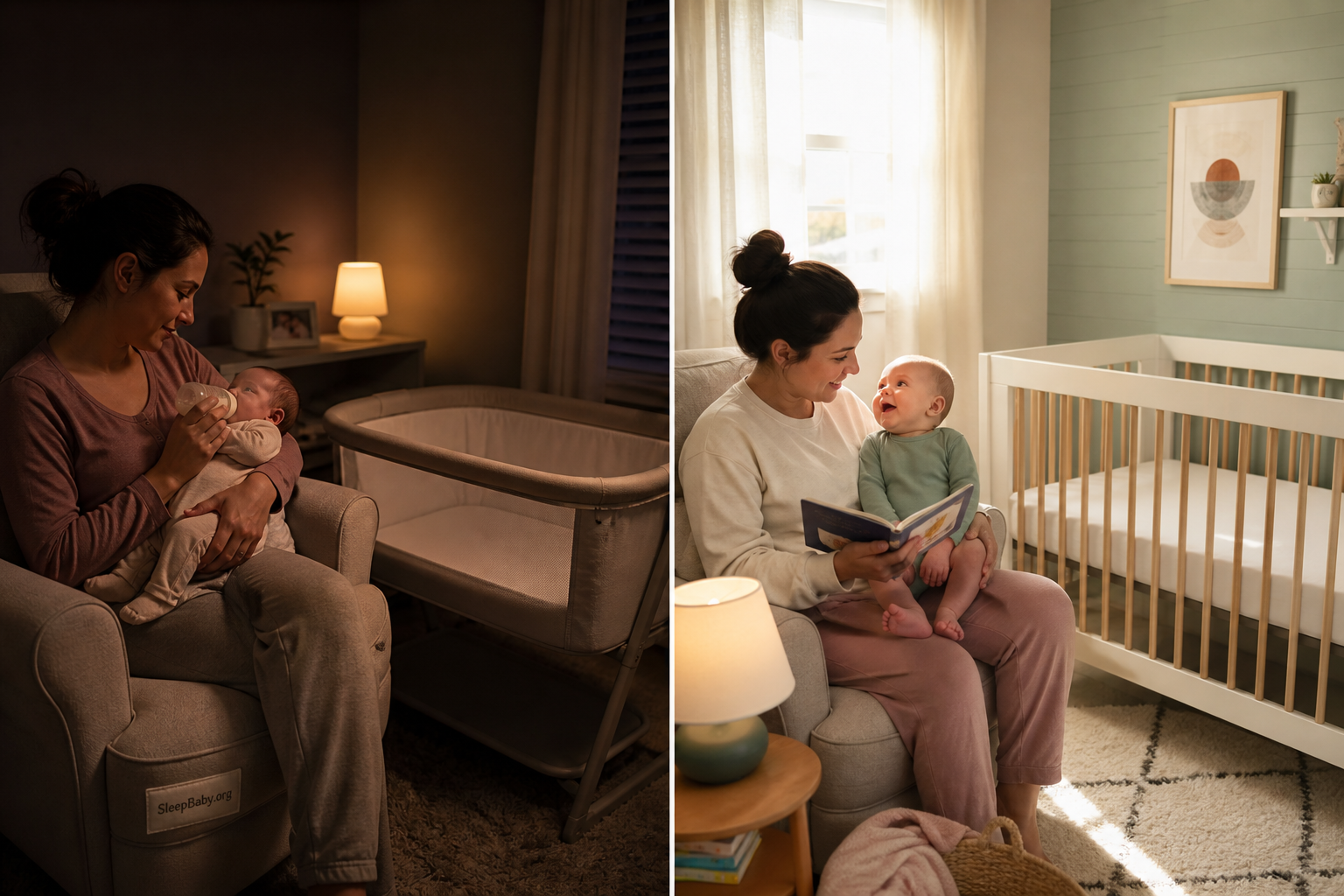
Newborn sleep is less a schedule than a collection of small islands. Babies may sleep much of the day but wake every hour or two, especially to feed. Day and night are not yet organized in the way an adult hopes they will be. I would treat that fragmentation as expected biology, not a habit that needs fixing.
A useful newborn rhythm is simple: feed responsively and according to your clinician’s plan, offer calm awake contact when baby is alert, then provide a safe sleep opportunity when baby is ready. During the day, open the curtains and allow ordinary household sound. At night, keep light low, voices quiet, and care boring in the most loving sense of the word. The goal is not to make a newborn perform bedtime. It is to begin giving the body clock different clues.
A sample day cannot responsibly tell you when a newborn should feed or how long they may sleep without knowing gestational age, weight, feeding method, jaundice risk, and the baby’s individual plan. If you were told to wake for feeds, keep doing that until the clinician who knows your baby changes the instruction. A timetable from the internet does not outrank a growth plan.
For safety, place your newborn on their back in a bassinet, crib, portable crib, or play yard that meets current standards, on a firm flat mattress with a fitted sheet only. If the baby falls asleep in a car seat, swing, carrier, or stroller, move them to a firm flat surface as soon as practical. Exhaustion makes couches and armchairs especially dangerous places to drift off while holding or feeding a baby.
Two to three months: watch for the first anchor
Somewhere in this stretch, a parent may notice that the first night sleep begins at roughly the same part of the evening, or that morning arrives in a recognizable range. Other babies remain cheerfully unconcerned with this development. I would look for one repeated pattern before trying to create three.
Try a short bedtime sequence that can survive a difficult evening: feed as appropriate, fresh diaper, sleep clothing, dim light, one song or book, safe sleep space. A bath is optional. If the routine requires stage lighting, a warmed towel, and everyone in the house maintaining ceremonial silence, it is less a routine than a touring production.
A sample rhythm might include several naps of uneven length, a longer nighttime stretch, and multiple night feeds. That is deliberately vague. At this age, the useful information is the sequence and the emerging anchor, not whether the second nap began at 10:07. If baby is hard to wake, feeds poorly, has fewer wet diapers, seems unusually floppy or lethargic, has breathing trouble, or has a fever that requires urgent age-specific advice, stop adjusting sleep and seek medical guidance.

Four to five months: build around total sleep, not a perfect nap
This is where many parents expect the schedule to become easier and instead discover that sleep has become more legible. You can suddenly see every short nap, every false start, and every wake at the end of a sleep cycle. Legibility is not the same as failure.
For 4–12 months, the AASM range of 12–16 hours per day includes naps. A baby near one end of that range may not follow the same clock as a baby near the other. I would total several ordinary days, then look at mood, feeding, and how settling unfolds. One 32-minute nap is not a diagnosis. Three days of short naps plus miserable evenings is a pattern worth responding to.
A flexible example could be: morning starts within a 30–60 minute range; three or four nap opportunities follow based on how the prior sleep went; bedtime moves earlier after poor naps and later after a late, restorative nap. The first nap can become a useful anchor, but pulling it extremely early after every early wake may lock the whole day to dawn.
If swaddling is still in use, stop when baby shows signs of trying to roll. Continue placing baby down on the back. If baby can roll both ways independently, you do not have to spend the night repeatedly flipping them, but the sleep space must remain completely clear.
A clearly labeled composite Kacey-and-Benjamin schedule moment
Composite scene, not documentary family history: Imagine Kacey at the kitchen counter with Benjamin’s first-year schedule printed in color. The page says “Nap 2: 12:30.” Benjamin has slept from 11:58 to 12:24 and is now inspecting a wooden spoon with the concentration of a person reviewing legal evidence. Kacey is deciding whether 26 minutes counts as the nap, an appetizer to the nap, or a clerical error.
I would use that moment to make one decision: the next sleep opportunity needs to move earlier because the preceding nap was short. I would not declare the entire schedule broken, cut the next nap, and move bedtime all at once. The story is useful because it shows what the chart cannot: the middle of the day must respond to the sleep that actually happened. Benjamin’s name belongs here because this scene is about the absurd arithmetic of a first-year schedule, not generic parenting decoration.
Six to eight months: protect the handoffs
Many babies in this band use two or three naps. The difficult part is often not the basic schedule; it is the handoff from the last nap to bedtime. A late third nap can push bedtime. Refusing that nap can leave a long, frantic final stretch. I would decide whether today is a three-nap day or an early-bedtime day rather than forcing both a late nap and the usual bedtime.
One example rhythm is morning near 7, first nap in the midmorning, second nap in the early afternoon, and either a brief third nap or an earlier bedtime. Those times are illustrations, not prescriptions. A baby who wakes at 6, takes short naps, attends childcare, or needs different feeding times requires a different clock.
Night feeds may still be normal and necessary. Age alone does not tell you whether to remove them. I would consider growth, daytime intake, feeding method, prematurity, medical history, and the clinician’s guidance. If a baby wakes and feeds fully, that is different information from a baby who wakes repeatedly and barely feeds. A schedule can help organize observation; it cannot make a feeding decision on its own.
Before changing a night feed
- Do not use age alone. Confirm that growth and daytime intake support the change.
- Notice what the feed looks like. A substantial feed, brief comfort suck, and restless wake are not interchangeable.
- Ask what else changed. Illness, teething discomfort, travel, new skills, and feeding changes can temporarily alter nights.
- Get individual guidance when needed. Prematurity, poor weight gain, feeding difficulty, medical conditions, or a clinician-directed plan take priority.
Nine to ten months: keep the shape when development gets loud
Two naps often give this age a recognizable shape: morning, first nap, lunch and play, second nap, bedtime. Then crawling, pulling to stand, separation awareness, or a burst of babbling arrives and bedtime acquires several new agenda items. A baby may practice the very skill that made the day exhausting.
I would keep the broad two-nap shape while allowing timing to bend. If the first nap runs long, the second may move later or need a cap that fits the baby’s overall sleep. If the second nap is short, bedtime may move earlier. If both naps are good and bedtime suddenly becomes a long cheerful vigil, the final awake period may need a small adjustment.
Change one lever for several days when you safely can. Moving both naps, bedtime, and morning at once creates plenty of activity but very little information. I want to know what helped. The baby is already running an uncontrolled experiment; the adults do not need to add four variables.
Eleven to twelve months: do not rush the one-nap transition
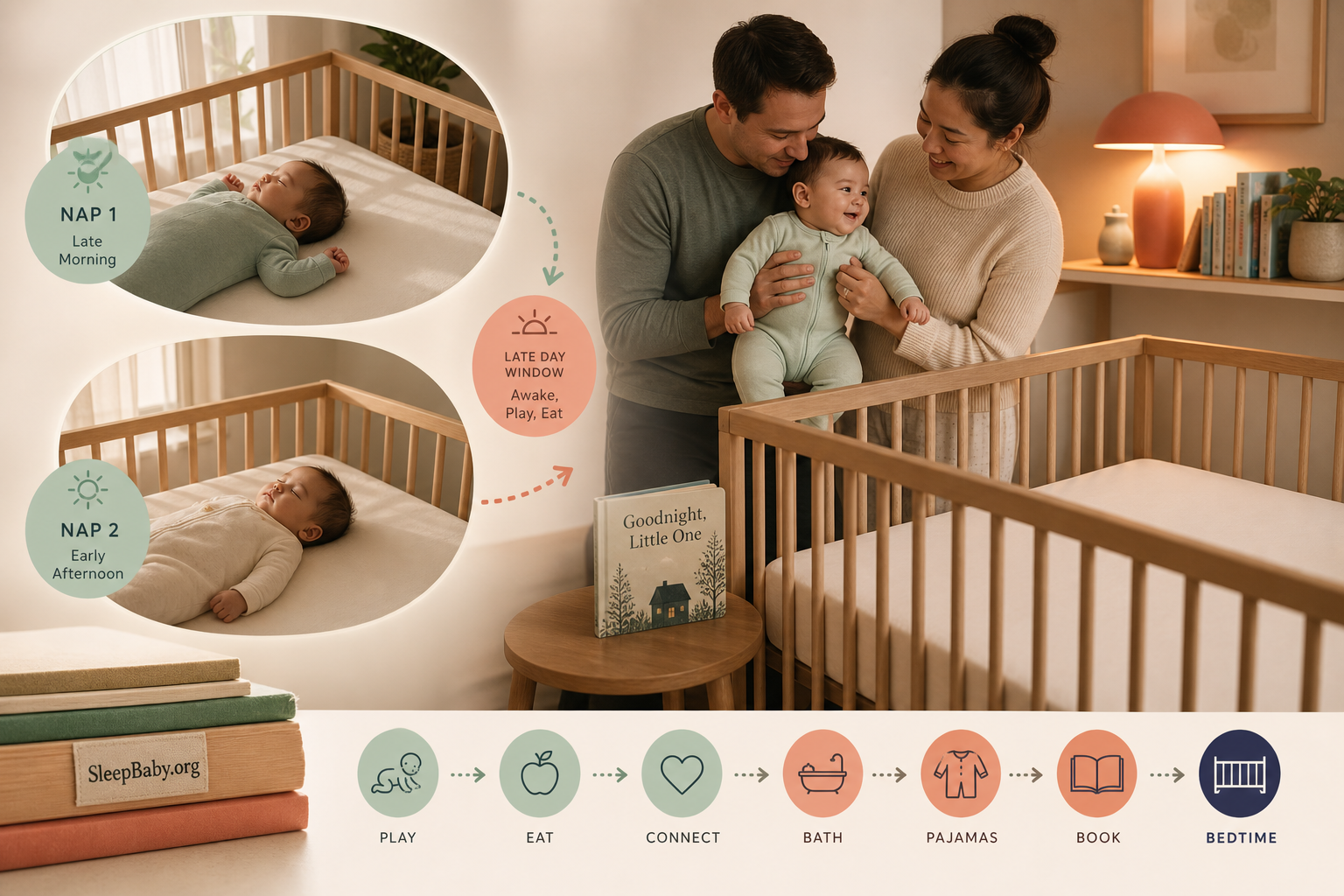
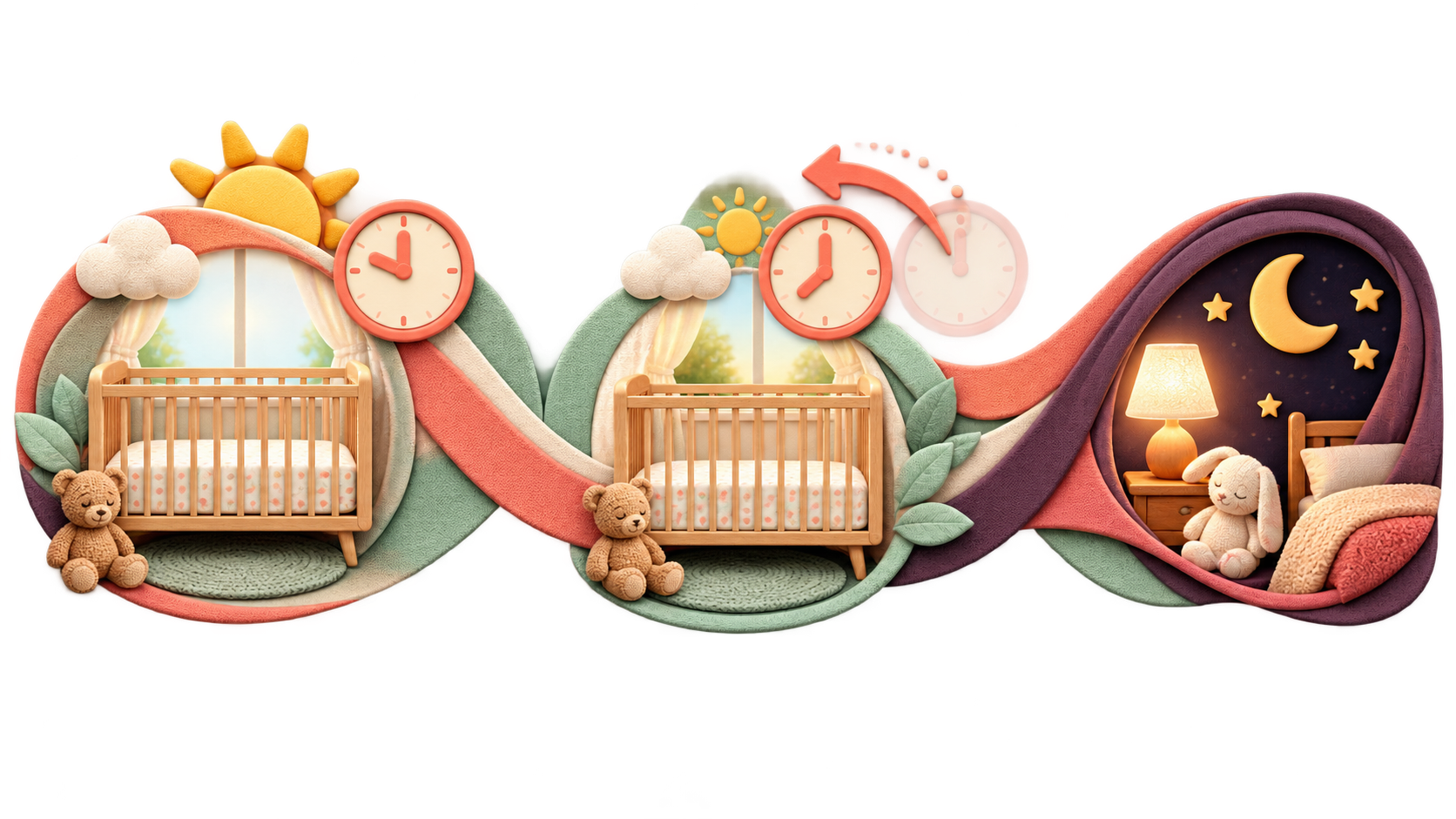
Around the first birthday, one nap may be refused occasionally. That does not automatically mean the two-nap era is over. Development, stimulation, travel, illness, or an unusually good night can produce a nap protest. I would judge the pattern across one or two weeks: Is the refusal consistent? Is bedtime becoming impossible after two naps? Can the child comfortably reach midday without unraveling?
Many babies still do better with two naps at twelve months. A transitional plan may shorten the morning nap, protect an afternoon nap, or use an occasional one-nap day followed by an early bedtime. The least useful plan is often stretching an exhausted baby to noon every day because the birthday candle apparently issued a new employment contract.
At 12 months, the AASM age category changes: children 1–2 years are generally recommended to get 11–14 total hours including naps. The birthday itself is not a switch. Use the range as context and watch how the child functions.
When the whole day slides, find the first domino
Morning moved
Use light and the desired morning routine near the target time. Avoid moving every nap by the full amount immediately.
A nap was short
Offer the next sleep earlier or use an earlier bedtime. Do not assume the baby needs less total sleep.
A nap ran late
Allow a modestly later bedtime or gently cap the repeated late nap when age and feeding context support it.
Everything changed
After travel, daylight saving time, illness, or a transition, restore morning and bedtime anchors first, then move one middle-of-day period at a time.
What a schedule should never ask you to trade away
No schedule earns an exception from safe sleep. For every nap and night through the first birthday, start baby on the back on a firm, flat, noninclined sleep surface in a crib, bassinet, portable crib, or play yard that meets safety standards. Use a fitted sheet only. Keep pillows, blankets, toys, bumpers, positioners, and weighted products out. Room sharing without bed sharing is recommended for at least the first six months.
Do not use a monitor, positioner, inclined product, or wearable as a substitute for the safe setup. If baby sleeps in a car seat or stroller during travel, move them to an appropriate flat sleep surface when you reach a safe opportunity. Contact naps require an awake caregiver; if you feel drowsy, transfer baby to their own sleep space.
I would also stop schedule experiments when sleep changes alongside breathing difficulty or pauses, blue or gray color, unusual difficulty waking, poor feeding, fewer wet diapers, repeated vomiting, marked pain, a concerning fever in a young infant, or growth concerns. Seek urgent help for immediate breathing or responsiveness concerns. A pattern that remains dramatically different without an obvious explanation belongs in a pediatric conversation, especially when daytime function or feeding changes too.
How I would read a three-day sleep log
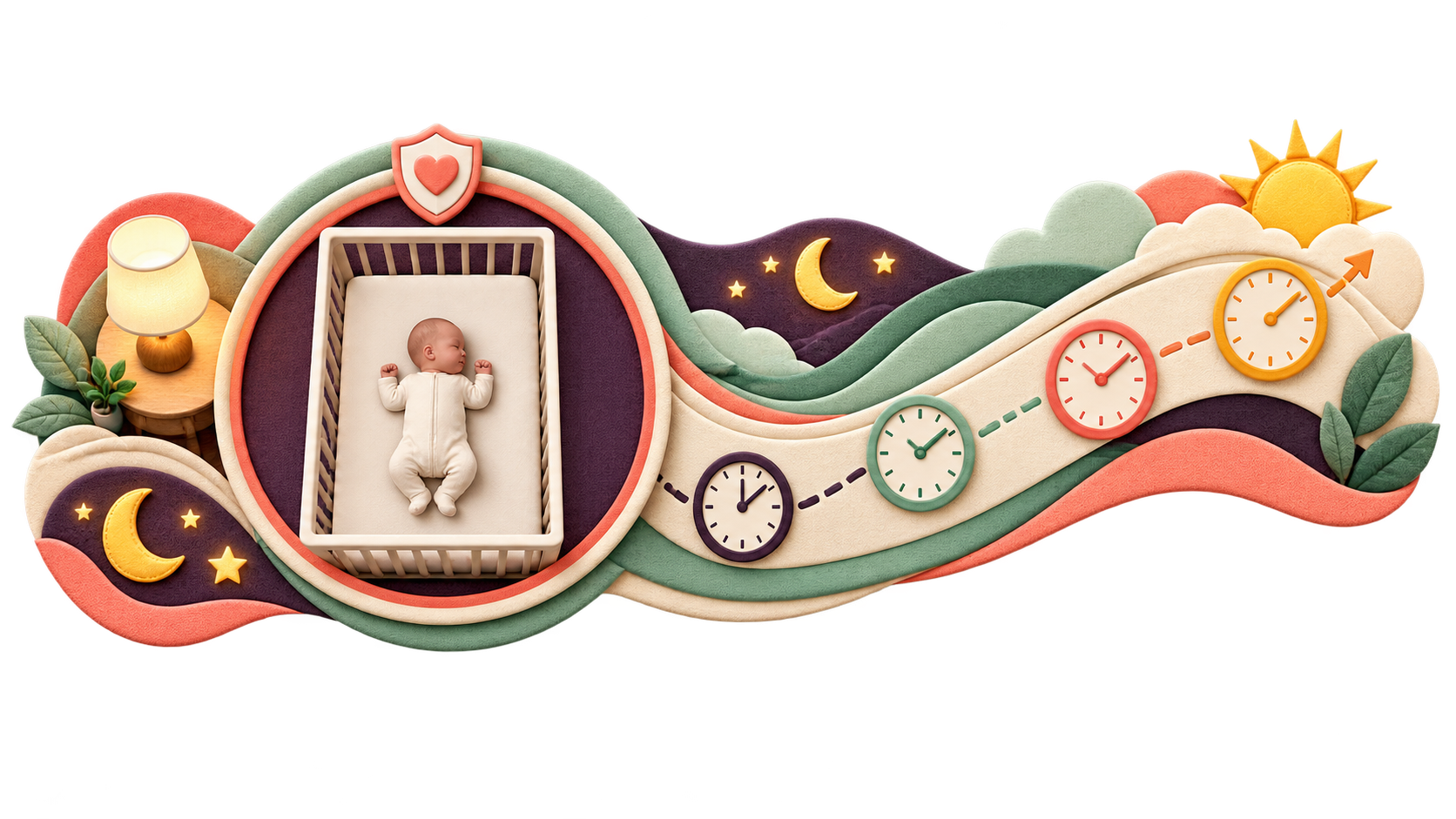
I would begin at the left edge of the day, not at the bedtime that finally went wrong. I would mark the real morning start, then draw a line under every sleep period and feed. I would note whether a nap ended naturally, was interrupted, happened in transit, or required an early transfer for safety. I would also write down illness, visitors, childcare, travel, or an unusually stimulating afternoon. Those details keep the clock from taking credit—or blame—for everything.
Next, I would look for repetition. Did the first nap begin early after every early morning? Did the final nap drift later on all three days? Did bedtime trouble appear only after a long afternoon nap? I care more about a repeated sequence than a single total. If one day contains a stroller nap, a missed feed, and a family dinner that ran late, I would label it “life happened” and resist building a new system around it.
Then I would choose the smallest useful change. I might hold morning light steady, move one nap by 10–15 minutes, or begin the bedtime routine slightly earlier after short naps. I would not change the nap schedule, feeding pattern, sleep space, and bedtime response together. I want the next three days to teach me something. A schedule is most helpful when it turns worry into a question you can actually observe.
Finally, I would ask whether the proposed clock makes sense for the baby’s total sleep and behavior. Is the baby settling within a reasonable time, feeding well, and waking with ordinary energy? Or are we repeatedly stretching an exhausted baby because the chart says bedtime is still 47 minutes away? I would rather move the chart than spend those 47 minutes pretending the baby has not submitted several strongly worded objections.
Questions parents actually ask about first-year schedules
When should a baby have a bedtime?
A recognizable bedtime often emerges gradually in the first months. Start with a brief sequence and the part of the evening when the longest stretch naturally begins. Later, move it in small steps if it is drifting too late or early.
How many naps should my baby take?
The number changes and overlaps by age. Newborns sleep in many periods; 4–5 month olds may need three or four naps; many 6–8 month olds use two or three; many 9–12 month olds use two. Nap quality, total sleep, and function matter more than winning the exact number.
Should I wake a sleeping baby?
Newborn feeding and growth plans come first. Older babies may sometimes need a late nap capped to protect bedtime, but the decision depends on age, total sleep, feeding, and health. Ask your clinician when growth, prematurity, or feeding concerns are involved.
Why does the schedule work one day and fail the next?
Because sleep pressure, nap length, feeding, stimulation, illness, teething, and development change. One odd day is noise. Record three to five days before redesigning the month.
Watch: safe sleep stays underneath every schedule
This pediatric safe-sleep demonstration reinforces the setup that applies whether the day’s timing was perfect, improvised, or somewhere in between.
Takeaway: the schedule may flex; back placement and a firm, flat, clear sleep space do not.
Turn the chart back into a pencil sketch
Return to that first-year chart on your phone. Its neat rows are useful when they remind you what may come next. They become harmful when they persuade you that a 24-minute nap has violated policy.
I would write down the morning start, naps, bedtime routine, asleep time, feeds, and anything unusual for three ordinary days. Circle the first repeated drift. Keep one or two anchors. Change one lever. Then give the baby enough time to answer.
By the first birthday, the calendar may still have eraser marks. That is not evidence that you failed to create a schedule. It is evidence that the schedule stayed connected to a growing person. The best first-year plan is not the one with the straightest lines. It is the one that helps you recognize what your baby needs tonight and what can reasonably wait until morning.
Build a sleep rhythm that can survive a real week
If the first-year chart keeps changing faster than you can update it, explore SleepBaby’s practical sleep support for help reading naps, nights, routines, and transitions without pretending every baby runs on the same clock.
Sources
- American Academy of Sleep Medicine. Recommended Amount of Sleep for Pediatric Populations.
- American Academy of Pediatrics, HealthyChildren.org. How to Keep Your Sleeping Baby Safe.
- American Academy of Pediatrics, HealthyChildren.org. Infant Sleep.
- Centers for Disease Control and Prevention. Safe Sleep in Maternity Care.
- National Health Service. Helping Your Baby to Sleep.
SleepBaby.org · The original video
A next step for
the next bedtime.
Still thinking about sleep? Watch the presentation here, then explore the SleepBaby program whenever you’re ready.
What viewers said10 comments · 4 replies
Archived comments from the original Baby Sleep Miracle presentation. Not independently verified by SleepBaby.org; individual experiences vary.
Thank you so much for this video! I had no idea about the dangers of baby swings :O
Hi Mary-Ann. I have a question: Is method in any way similar to the ones recommended by Dr Bucknam, Dr. Weissbluth or Dr. Karp? We tried those but none of them help.
Hi Regina, thank you for your question. The short answer is no. The techniques I share in my guide are based on newest scientific research and this is why I have never seen any approach similar to the one I recommend.
This method really works! I tried it on my son Jesus and after just one week he went from waking up more than 5 times a night to waking up just once or twice. You are a lifesaver, Mary-Ann!
I'm truly impressed with how much information you share in your video. And all for free! I can feel that you truly care about mothers like myself, and that's hard to find these days. I have recommended your site to several of my friends already.
Mary-Ann, our child suffers from autism. Is your approach still suited?
Chloe, I made sure my method can be used with any child, even babies who are special like yours. Please note that I'm not a doctor and that I always advice to consult with your physician because nothing is more important than the safety and well-being of your love.
Hallo Mary-Ann, I'm from Germany. Do you have your guide in German?
Hello Heide, we do! Normally you should already see our video in German. If not, please contact our support so they can guide you
Thenk you for your answer, Mary-Ann!
I just completed your approach and I have to say, it worked almost too well. Yes, it took a bit of getting used to with your bedtime routine but the difference is huge. My son George used to take 1 hours to go down and now he's firmly asleep in no more than 10 minutes! You're the best!
It seems I'm the only man watching this video, lol! What you shared about the 'emotional backpack' made immediate sense to me and I can't wait to help my little girl Mila to unpack it!
Hey there, just discovered your site and this really sounds different. Just wanted to say thanks for sharing :)
For everyone who's still thinking about getting Mary-Ann's guide I want to advise you to go ahead. I wasn't sure myself but now I'm so thankful I invested in this program. It made a huge difference in our life as a family and yes, my baby girl does sleep through the night now.
Ready to get started?Take the next step with SleepBaby.
Pick your price



Thank you so much for this video! I had no idea about the dangers of baby swings :O