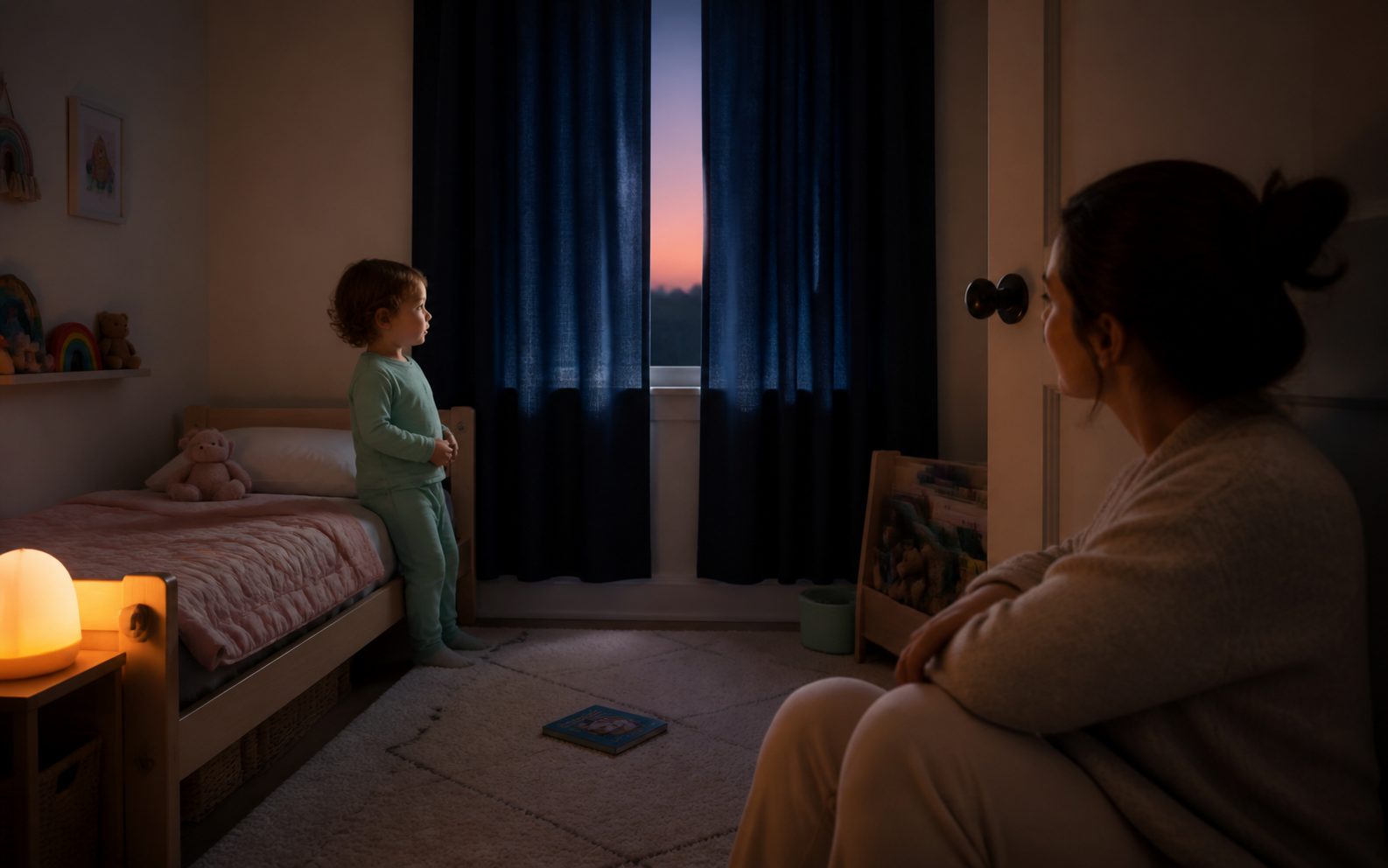
The clock says 4:47 a.m. Your toddler says, with the confidence of a tiny airport announcer, that morning has begun. Before you automatically move bedtime later—or assume you have somehow broken sleep—check three things: whether your child is safe and well, how much sleep they are getting across the full day, and which repeated cue may be pulling morning earlier.
If your toddler is waking at 4 a.m., handle it as a night waking while you check discomfort, hunger, breathing, room conditions, bedtime, and nap pressure. A 5 a.m. waking needs the same first checks, but it may be either an unfinished night or the end of a biologically reasonable night. The difference lives in total sleep, daytime function, and the pattern you see over several mornings—not in the clock number alone.
That is the useful answer. My practical plan is to identify whether the strongest pull is coming from the body clock, the sleep-pressure clock, or the household’s morning cues. I then change one lever while the rest of the day stays boringly consistent. Boring is underrated at dawn. Boring is practically a spa treatment.
A clearly labeled composite Kacey-and-Benjamin dawn scene
Imagine me outside Benjamin’s room at 4:47 a.m., one hand on the doorknob and the other holding a phone whose brightness has suddenly become a personal attack. He is awake, cheerful, and completely certain the day is late. I would feel the private panic behind this search: if I respond, am I locking in the waking; if I do not, am I ignoring something he needs?
The useful move is neither automatic celebration nor automatic refusal. I would first check Benjamin himself, then the amount of sleep he actually had, then the cue waiting on the other side of that door. That order turns “How do I make him sleep later?” into a kinder question: “Which signal is telling his body that morning has arrived?”
This is a composite scene, not a claim about Benjamin’s documented sleep history, and it is not medical evidence.
Is this an early wake—or the end of enough sleep?
I would not call a wake “too early” from the clock alone. A child who falls asleep at 6:30 p.m., wakes cheerfully at 5:15 a.m., naps, and functions well is telling a different story from a child who falls asleep at 8:30 p.m., wakes crying at 4:15 a.m., and is face-down on the sofa by late afternoon. Same worried parent. Different sleep math.
The American Academy of Sleep Medicine recommends 11–14 hours of sleep in 24 hours for children ages 1–2, including naps, and 10–13 hours for ages 3–5. Infants ages 4–12 months are generally in the 12–16-hour range, including naps. These are ranges, not pass/fail grades. Your first job is to add up actual sleep—not time offered in bed—and notice how your child functions.
The Early-Wake Triage Card
- Start with the child, not the spreadsheet. Are they sick, in pain, hungry, wet, frightened, cold, hot, or having trouble breathing?
- Count actual sleep. Write down when sleep began, each meaningful waking, when the day started, and naps.
- Look at daytime function. Cheerful and steady is different from frantic energy, accidental dozing, or a late-day collapse.
- Find the pattern. One odd morning may be a wet diaper, a barking dog, or the world’s least considerate garbage truck. Repeated mornings deserve a pattern log.
- Choose one test. Adjust the room, nap, bedtime, or response—not all four on Monday because Tuesday will tell you nothing.
Sleep ranges help you orient; they do not diagnose the reason for one child’s waking.
Use sleep ranges to orient the morning—not to grade your child
Before changing bedtime or naps, this short pediatric overview helps you place your child’s total sleep in an age-appropriate range.
Kendra Krietsch, PhD, a WashU Medicine pediatric specialist at St. Louis Children’s Hospital, explains age-based sleep ranges and why stable bed and rise times matter. Watch “Sleep Guidelines for Kids” on YouTube.
Early-waking takeaway: compare the wake with actual 24-hour sleep and daytime function before deciding that the clock time itself is the problem.


The Three Clocks behind a too-early morning
Here is the framework I come back to when the whole house feels personally victimized by 4:52 a.m. A child’s wake time is being negotiated by three clocks at once. None of them can read the cute wooden clock on the nursery wall.
SleepBaby.org Three Clocks Control Panel
- 1. The body clock
- Light, darkness, activity, meals, and a regular rise time help tell the brain when day and night belong. Dawn leaking around a curtain can be a powerful vote for morning.
- 2. The sleep-pressure clock
- Time awake builds pressure for sleep; naps release some of it. A late or long nap may leave too little pressure for a long night. Too little daytime sleep can also backfire when an overtired child sleeps restlessly or wakes distressed.
- 3. The household-cue clock
- Lights, voices, breakfast, screens, cuddles in the big bed, and getting dressed all announce that the day has started. Those cues are not “bad habits.” They are simply information, and information can be made more consistent.
The control-panel rule: Follow the strongest clue. If sunrise hits the mattress at 4:55, fix light before moving bedtime. If a two-hour nap ends at 4 p.m., inspect nap pressure. If every early call produces lights, snacks, and cartoons, clarify the morning cue. One clue, one lever, one readable result.
At 4:07 a.m., I am not asking a tired parent to calculate a flawless wake window while crouched beside a crib. I am asking for one honest note: What happened immediately before sleep, immediately before waking, and immediately after the first call? Those three details often reveal which clock is doing the loudest talking.
What changes between 4 a.m. and 5 a.m.?
The phrase toddler waking up at 4am usually describes a night that is ending far earlier than the family and child can reasonably use. I treat 4 a.m. as night while my first check still covers real needs: low light, little conversation, no exciting food parade, and no pressure to perform sleep on command. If your toddler cannot return to sleep, calm rest still protects the difference between night and day.
A toddler waking up at 5 am is more ambiguous. Five may still be much too early if the child slept only eight hours, wakes miserable, or cannot function through the day. But a child who has had a full night plus adequate naps may be showing you an early biological preference. Your desired morning time matters to family life; it just is not, by itself, a medical diagnosis.
What stays the same? You do not need to turn either wake into a showdown. A boundary can be calm. Comfort can be responsive. The goal is not to make your toddler pretend they are unconscious; it is to keep the cues before morning different from the cues after morning.
Audit the room before you rebuild the schedule
Schedules get blamed for everything because they are visible and editable. The room is quieter about its crimes. I check it at the actual waking time, because my bedtime impression cannot reveal the neighbor’s porch light or the delivery truck’s dramatic reverse-beeping solo.
- Light: Stand where your child sleeps and let your eyes adjust. Dawn can sneak around blackout curtains, through the top edge, or under a door. Keep strong morning light for the chosen start of day; the American Academy of Pediatrics notes that morning light helps set body clocks.
- Noise: Listen for heating systems, birds, pets, plumbing, a parent’s alarm, traffic, or siblings. If you use steady background sound, keep it at a safe volume and place the device away from the sleep space.
- Temperature and clothing: Check the child’s chest or back rather than judging from cold hands. Avoid overheating, loose bedding for infants, and any product that conflicts with safe-sleep guidance.
- Wetness, pain, and illness: Teething discomfort, eczema, congestion, constipation, an ear problem, or a soaked diaper can show up at the lightest part of the night. Persistent pain belongs with a clinician, not an ever-more-complicated schedule.
- Hunger: Consider age, dinner, milk intake, growth, and medical guidance. A young infant waking to feed is not a toddler habit to extinguish. For an older toddler, a balanced evening meal or planned snack may help if dinner is early—but breakfast at 4:30 every day also becomes a strong morning cue.
Make the smallest safe environmental fix first. A folded towel over a window gap is not a sleep philosophy. It is just a folded towel doing honest work.


Nap pressure: too much, too late, too early—or not enough
Naps are not stolen night sleep in a neat one-for-one exchange. I read them as part of the total sleep system, and my next question is always where the nap sits in the day. Toddlers still need daytime sleep, but the timing and amount change quickly during nap transitions. This is why the same 90-minute nap can be perfect for one child and leave another happily discussing excavators at 9:45 p.m.
Clues the nap may be reducing night sleep pressure
- Bedtime takes a long time even though the routine is calm.
- The nap ends late and the child is energetic at the expected bedtime.
- Total 24-hour sleep is adequate, but more and more of it has moved into daytime.
- The early wake appeared after a nap lengthened or shifted later.
Clues the child may be overtired
- The nap is routinely missed, brief, or interrupted.
- The child is frantic, clumsy, or falling asleep in the car late in the day.
- Bedtime brings a second wind, tears, or repeated waking rather than a peaceful longer night.
- The early wake is upset and the child clearly cannot make it comfortably to the planned nap.
Also watch the first nap. If a toddler wakes at 4:45 and then naps very early every morning, the body may begin treating that nap as the missing end of night. Shift it later only gradually and only as the child can comfortably manage; do not drag an exhausted toddler through hours of misery to satisfy a chart. Families navigating the one-to-two-nap edge can compare the practical clues in this 17-month-old sleep schedule. Infant readers will get a better age-specific example from the 10-month-old nap schedule.
There is no universal toddler wake window that solves early rising. Use the child’s age, actual sleep, mood, bedtime ease, and nap transition together. If you change a nap, preserve bedtime and morning response long enough to see what the nap change actually did.
Should bedtime move earlier or later?
Later bedtime is the most tempting answer because it looks like simple arithmetic: move sleep thirty minutes later, receive morning thirty minutes later. I resist that arithmetic until my bedtime clues support it. Children, unhelpfully, have not signed that contract. Real-world infant and toddler sleep data have found that later bedtimes are associated with shorter nighttime sleep, not reliably later mornings.
Choose the bedtime test from the evidence
- Consider a slightly earlier bedtime when…
- your child is short on total sleep, the nap was poor, late afternoon is unraveling, or bedtime has become an overtired struggle.
- Consider a slightly later bedtime when…
- your child gets adequate total sleep, naps well, lies awake contentedly for a long time at bedtime, and wakes early cheerful and ready.
- Do not move bedtime yet when…
- the room is bright at dawn, the nap just changed, illness is present, or the family also changed the early-morning response. Fix or observe the clearer variable first.
Move in small increments—often 10 to 15 minutes is enough for a clean test—and judge the result by sleep onset, total sleep, waking mood, and daytime function. The exact observation period is practical, not magical; several consistent days are more informative than one morning after a birthday party. For a deeper look at finding a realistic sleep-onset time, use the bedtime timing guide.
A consistent wind-down still matters. In a randomized study of infants and toddlers, a regular bedtime routine improved sleep onset, night waking, sleep continuity, and parents’ perception of sleep problems. Keep the sequence short enough to repeat: wash, pajamas, teeth, books, cuddle, bed. The routine is a runway, not a two-hour variety show.


Set a morning boundary without turning it into a battle
A morning boundary is simply the difference between “I will care for you” and “the household is open for business.” Before the chosen time, meet needs with low light, a quiet voice, and as little novelty as practical. At the chosen time, make morning obvious: curtains open, warm connection, breakfast, clothes, movement. The contrast teaches more than a lecture about why 4:48 is unreasonable.
Choose a response you can repeat kindly:
- Responsive return: Check the child, offer brief reassurance, and return at predictable intervals while the room stays nighttime-like.
- Gradual presence: Sit nearby and reduce help slowly over days if separation is the main difficulty.
- Quiet room time for an older toddler: If the sleep space is safe and the child can understand, allow a book or safe comfort object until the morning cue. Infant safe-sleep rules are different; keep an infant’s space firm, flat, and empty.
- Okay-to-wake cue: For a developmentally ready toddler, use a simple color change at a realistic first goal. Move the goal gradually. The device is a cue, not a tiny electronic parole officer.
If my kitchen officially opens at 5:03 one morning and 4:31 the next, I have taught the household that persistence—not the clock—sets breakfast. That is not a moral failure; it is what tired families do. The repair is a response you can actually sustain, including on the morning when a sibling is asleep six feet away and every floorboard has chosen violence.
You do not have to use formal sleep training to create consistent cues. If you want a more responsive or gradual path, read how children can learn sleep skills without one mandatory sleep-training method. Consistency describes the message, not the amount of closeness you are allowed to offer.
The seven-morning early-waking reset
This is not a seven-day guarantee. It is a clean observation window designed to stop the frantic sequence of earlier bedtime, later bedtime, shorter nap, longer nap, new clock, old clock, and pleading with the moon—all before Thursday.
Seven-Morning Reset Tracker
- Morning 1: Record, don’t repair. Note actual sleep onset, wakes, nap start/end, first call, out-of-bed time, and mood.
- Morning 2: Check the room at wake time. Record light, noise, temperature, wetness, discomfort, hunger, and breathing.
- Morning 3: Name the strongest clock. Body clock, sleep pressure, or household cue—which has the clearest evidence?
- Morning 4: Start one change. Seal the light gap, adjust the nap or bedtime slightly, or hold one calm morning boundary.
- Morning 5: Watch the whole child. Did sleep onset, total sleep, mood, appetite, accidental dozing, or bedtime resistance change?
- Morning 6: Keep the test clean. Resist adding a second change unless the first is unsafe or clearly making things worse.
- Morning 7: Decide. Keep a helpful change, reverse an unhelpful one, or choose the next evidence-backed lever. Escalate health concerns instead of extending the experiment.
Write these eight fields: bedtime, actual sleep onset, naps, first waking, room clue, caregiver response, official day-start, and daytime function. That is enough data to be useful without becoming the unpaid administrator of a very small sleep laboratory.
Progress is not only a later number on the clock. A child who wakes at the same time but rests calmly, returns to sleep some mornings, or reaches afternoon in a steadier mood may be moving in the right direction. If the wake shifts later but total sleep shrinks and daytime life deteriorates, the clock has improved while the child has not.
Babies need a different safety and feeding lens
This page serves baby and toddler families, but I change my decision lens for a newborn or young infant instead of copying the toddler boundary plan wholesale. Babies wake frequently by design. Their sleep cycles, feeding needs, and ability to organize day and night are developing. A young baby who wakes early to eat may be doing exactly what their body needs.
For infants, keep every sleep on a firm, flat, non-inclined surface designed for infant sleep, with a fitted sheet and no loose bedding or soft objects. Place babies on their backs for sleep. Do not bring an infant onto a sofa, armchair, or adult bed because everyone is desperate for another hour. Exhaustion is real; it is also the moment to ask another safe adult for relief when one is available.
Do not delay, reduce, or drop a feed based on this article when your baby is young, was born early, has growth concerns, is ill, or has a clinician-directed feeding plan. If feeding has become the only way an older baby returns to sleep, you can discuss age-appropriate options with the child’s clinician and make gradual changes that protect intake. “Push breakfast later” is toddler schedule advice, not a universal infant feeding rule.
Room cues still matter for babies: keep overnight care calm and dim, use normal daytime light and interaction once morning begins, and preserve a repeatable bedtime routine. But normal waking is not evidence that a baby has failed to learn sleep.

When to stop experimenting and call the pediatrician
Early waking is often a timing, environment, or response pattern. It can also be the first visible clue that sleep is being disrupted by something a schedule cannot fix. I would stop adjusting naps and ask for medical guidance when any of these are present:
- loud habitual snoring, gasping, labored breathing, or witnessed breathing pauses;
- a sudden persistent change paired with fever, pain, significant congestion, vomiting, diarrhea, rash, itching, or another illness sign;
- unusual thirst or urination, recurrent hunger with growth concerns, or a feeding change that worries you;
- persistent restless sleep, unusual movements, or a child who is difficult to wake;
- daytime sleepiness, behavior change, or accidental dozing that interferes with normal activities;
- a pattern that persists despite a consistent, age-appropriate plan—or simply a parent instinct that something is off.
The American Academy of Pediatrics specifically flags snoring and breathing symptoms as reasons to consider sleep apnea evaluation. Record a short description of what you see and when it happens. A clinician needs the pattern more than a heroic theory. If breathing is actively difficult or your child looks seriously unwell, seek urgent help rather than waiting for a routine appointment.
Early-waking questions parents ask at 4:57 a.m.
My toddler wakes up at 5am happy. Do I need to fix it?
Not necessarily. Add up actual 24-hour sleep and look at daytime function. If your child is within an age-appropriate range, steady through the day, and the schedule works for the family, 5 a.m. may be an early natural morning. If family life cannot sustain it, shift cues gradually rather than declaring war on a healthy child’s body clock.
What if my toddler waking up at 5 am is exhausted by dinner?
That changes the answer. A cheerful first ten minutes does not prove the child has slept enough. Review total sleep, nap timing, and actual sleep onset. Try the clearest small change—often protecting the nap, preventing a too-late accidental nap, or using an earlier bedtime after a short-nap day—then watch the whole afternoon.
Will putting my toddler to bed later stop a 4 a.m. wake?
Sometimes a child with adequate sleep who lies awake at bedtime benefits from a small later shift. But later bedtime can also shorten the night and worsen overtiredness. Use the bedtime decision clues rather than the clock equation.
Should I offer breakfast before the official morning time?
Meet genuine hunger, especially for babies or children with health or feeding needs. For a healthy older toddler whose breakfast has crept earlier through repetition, make sure dinner and any planned snack are adequate, then move the full breakfast cue gradually toward morning. Keep any necessary pre-dawn response plain and predictable.
Can an okay-to-wake clock help?
It can help a toddler who understands the cue and can wait safely for a realistic interval. Begin close to the child’s current wake time so success is possible, celebrate quietly when the cue changes, and shift it in small steps. It is not appropriate as a substitute for responding to illness, fear, a dirty diaper, breathing trouble, or an infant’s needs.
What if my response wakes the sibling?
Plan the quietest version before bed: clothing ready, a dim path, white noise used safely if desired, and one parent assigned when possible. A short calm check is often less disruptive than a long negotiation through the wall. Family logistics matter; a theoretically perfect plan that wakes three children is not perfect.
Sources
- American Academy of Sleep Medicine: Pediatric Sleep Duration Consensus Recommendations.
- American Academy of Pediatrics: Sleep and Health—Why Rest Matters for Your Child and Your Whole Family.
- American Academy of Pediatrics: Toddler Bedtime Trouble.
- American Academy of Pediatrics: A Lullaby for Good Health.
- American Academy of Pediatrics: How to Keep Your Sleeping Baby Safe.
- Mindell et al.: A Nightly Bedtime Routine—Impact on Sleep in Young Children and Maternal Mood.
- Mindell et al.: Bedtime Routines for Young Children—A Dose-Dependent Association with Sleep Outcomes.
- Mindell et al.: Development of Infant and Toddler Sleep Patterns—Real-World Data from a Mobile Application.
When dawn keeps arriving before the family is ready
Turn one too-early morning into a sleep plan you can actually read
You have already done the hardest part: stopped treating 4:47 like a verdict and started looking for the clock that is pulling first. SleepBaby can help you connect that clue to the rest of the night—bedtime, naps, wake-ups, and the household rhythm waiting on the other side of sunrise.
SleepBaby offers educational guidance and does not replace your child’s clinician.






What viewers said10 comments · 4 replies+
Archived comments from the original Baby Sleep Miracle presentation. Not independently verified by SleepBaby.org; individual experiences vary.
Thank you so much for this video! I had no idea about the dangers of baby swings :O
Hi Mary-Ann. I have a question: Is method in any way similar to the ones recommended by Dr Bucknam, Dr. Weissbluth or Dr. Karp? We tried those but none of them help.
Hi Regina, thank you for your question. The short answer is no. The techniques I share in my guide are based on newest scientific research and this is why I have never seen any approach similar to the one I recommend.
This method really works! I tried it on my son Jesus and after just one week he went from waking up more than 5 times a night to waking up just once or twice. You are a lifesaver, Mary-Ann!
I'm truly impressed with how much information you share in your video. And all for free! I can feel that you truly care about mothers like myself, and that's hard to find these days. I have recommended your site to several of my friends already.
Mary-Ann, our child suffers from autism. Is your approach still suited?
Chloe, I made sure my method can be used with any child, even babies who are special like yours. Please note that I'm not a doctor and that I always advice to consult with your physician because nothing is more important than the safety and well-being of your love.
Hallo Mary-Ann, I'm from Germany. Do you have your guide in German?
Hello Heide, we do! Normally you should already see our video in German. If not, please contact our support so they can guide you
Thenk you for your answer, Mary-Ann!
I just completed your approach and I have to say, it worked almost too well. Yes, it took a bit of getting used to with your bedtime routine but the difference is huge. My son George used to take 1 hours to go down and now he's firmly asleep in no more than 10 minutes! You're the best!
It seems I'm the only man watching this video, lol! What you shared about the 'emotional backpack' made immediate sense to me and I can't wait to help my little girl Mila to unpack it!
Hey there, just discovered your site and this really sounds different. Just wanted to say thanks for sharing :)
For everyone who's still thinking about getting Mary-Ann's guide I want to advise you to go ahead. I wasn't sure myself but now I'm so thankful I invested in this program. It made a huge difference in our life as a family and yes, my baby girl does sleep through the night now.