The short answer
The subscription is optional; your safe-sleep setup is not
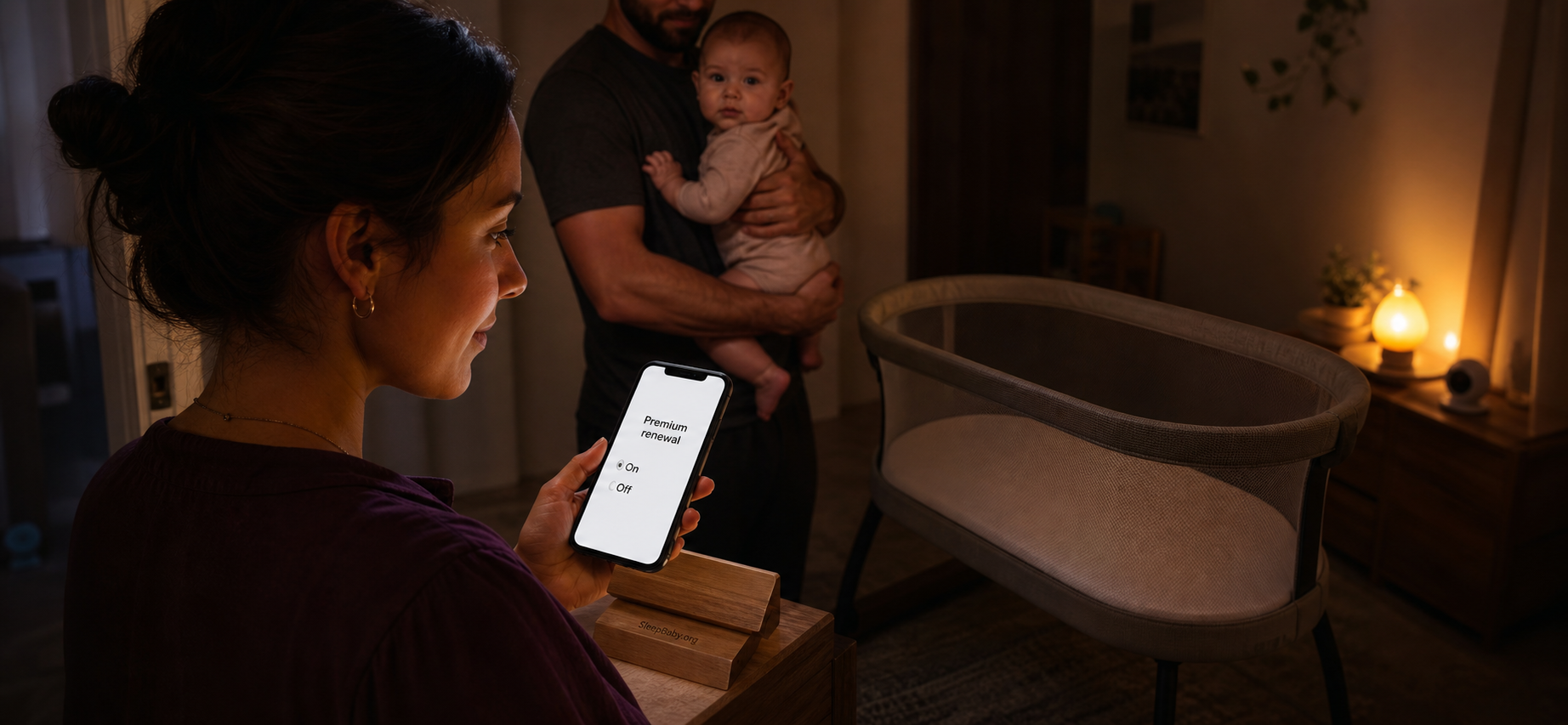
The phone lights up beside a cooling bottle and asks for another subscription decision before the hallway lamp has even gone dark. You do not need a Premium subscription to make safe infant sleep rules count, and declining a plan does not make a bassinet automatically unsafe. Premium pays for named app controls, reports, sounds, modes, and guidance. Whether it is worth paying depends first on how you got the SNOO, how many complimentary months are attached to that route, and which paid features you will repeatedly use.
As of August 20, 2026, Happiest Baby lists Premium at $19.99 monthly, $99.99 every six months, or $149.99 every twelve months, with automatic renewal until canceled. Those terms can change. Before paying, open the current in-app offer and check your own eligibility, billing date, and store policy.
I would not buy a long plan because the renewal screen made the expensive bassinet feel suddenly incomplete. I would count the months that actually overlap bassinet use, name the Premium feature I expect to use every week, and let that answer—not the original purchase price—make the decision.
SleepBaby.org · The original video
A little help
for the night ahead.
Take a moment to watch the original Baby Sleep Miracle presentation. Your article will be right here when you’re ready to keep reading.
Ready to get started?Take the next step with SleepBaby.
Help my baby sleepA clearly hypothetical Kacey-and-Benjamin scene
The renewal screen arrives exactly when nobody needs another decision
Imagine Benjamin awake with another caregiver while I stand at the kitchen counter, looking at a subscription screen beside a cooling bottle and the soft hallway light. The bassinet is empty, bare, and ready for the next sleep. My phone, meanwhile, has decided this is an excellent moment to ask whether I want six more months of features.
In this hypothetical scene, I feel the particular irritation of buying a sophisticated object and then meeting a second price tag inside its app. That feeling is real enough for many parents; this Bailey-family moment is illustrative, not documentary history and not evidence about the product.
Hypothetical Kacey puts the phone face-down. Hypothetical Benjamin checks the actual renewal date. We ask a less emotional question: Which feature would we miss next week? If neither of us can name one, the app has not earned a six-month commitment merely by appearing during the most tired part of the day.
Start with the door your bassinet came through
The same device can arrive with very different Premium access. I would begin with how this particular bassinet entered the family, because that fact changes the access question. That is why a blanket answer to “Does SNOO require a subscription?” creates more confusion than it clears.
The practical first move is not comparing plans. It is signing into the intended account and finding the included-access end date. Paying for months you already have is a particularly joyless form of nighttime administration.
Free operation and Premium convenience are different questions
The official app page currently names Premium examples including sleep logs and reports, Level Lock, Motion Start Level and Responsiveness customization, Sleepytime Sounds, Weaning Mode, Car Ride Mode, multiple-SNOO control, personalized guidance, and sleep analytics. I would verify the current list inside the exact account before paying. Feature lists can change, so treat this as a dated snapshot—not a lifetime promise.
| Question | What to verify | Decision signal |
|---|---|---|
| What remains usable without Premium? | Open the current official feature comparison and test the free controls on your own account before the trial ends. | The bassinet still performs the functions your family actually needs. |
| Which Premium feature changes a repeated task? | Name the exact control, report, mode, or guidance you use—not “the app” in general. | You would notice its absence several times a week. |
| What requires internet, an account, or the app? | Check current product instructions and support material for connectivity, offline behavior, account transfer, and setup. | Your household can tolerate the failure mode and knows the manual fallback. |
| What happens at resale or handoff? | Confirm reset, account removal, data handling, and non-transferability before another family takes possession. | No personal account or sleep data remains attached unintentionally. |
I would screenshot the current comparison and cancellation date for my own records. I would not assume that a feature named “guidance” is individualized medical advice, or that analytics can diagnose why a baby slept differently.
Run a seven-night use audit before the trial decides for you
A feature list tells you what a subscription contains. It does not tell you what your household uses. For one ordinary week, keep a plain tally beside the changing table or in a note on the phone. Each time someone opens a Premium control, write the feature name and the job it completed: changed a responsiveness setting, checked a report, started a sound, managed another SNOO, or prepared for a transition. Do not count opening the app out of habit. Count the moments when the paid feature changed a decision or removed a repeated step.
At the end of seven nights, sort those marks into three piles. Essential to our routine means the feature repeatedly saves work and there is no acceptable free or manual route. Useful but replaceable means it is pleasant, but the household can perform the same job another way. Interesting but unread includes reports that are opened, admired, and then change absolutely nothing. I know the power of an attractive chart at an unreasonable hour. The chart still has to earn the next charge.
Then test the likely free state while access is still active. Read the current official comparison, identify the controls expected to remain, and practice the supported fallback in daylight. Ask the other caregiver to do it too. A fallback that exists only in one person’s memory is not yet a household plan. If both adults can operate the bassinet for the routine they actually use, the decision becomes less dramatic: Premium may still be worthwhile, but it is no longer carrying imaginary responsibility for the whole night.
I would also separate information from action. A sleep report may help a family notice timing patterns; it does not explain every waking, establish a diagnosis, or tell you whether a baby is medically well. Personalized guidance may organize suggestions; it does not replace current product instructions or a pediatrician. The useful question is not, “Does this app know more than I do?” It is, “Which specific piece of information helps me make a better, safer, calmer next decision?”

Calculate the overlap, not the lifetime price
A twelve-month plan may look cheaper per month, but a bassinet is used for a limited developmental window. The useful number is the paid time that overlaps the months you realistically expect to use both the bassinet and Premium.
- Write down your included-access end date. Use the date shown for the correct account and acquisition route.
- Estimate the remaining bassinet-use window. Follow the current manufacturer instructions, limits, and your baby’s development rather than a generic calendar.
- Subtract the included months. The remainder is the maximum period worth pricing.
- Then price uncertainty. If you may transition out soon, a monthly plan can cost more per month but less in total than unused prepaid time.
Example: if included Premium lasts through nearly all of your expected use, a discounted twelve-month plan is not a bargain. I would price only the months that can overlap real bassinet use. Anything longer is a very organized way to buy months after the bassinet may be out of the room.
Put three dates on one calendar
The cleanest comparison uses three dates: the end of complimentary access, the next store renewal, and the earliest realistic point when your family may stop using the bassinet. The third date is not a promise. Babies develop on their own schedules, and the manufacturer’s current instructions and limits control the transition. It is simply the edge of uncertainty you need to price honestly.
Suppose included access ends while several months of likely bassinet use remain. Compare the total charge for those remaining months under the offers shown in your store. A longer plan can have a lower monthly equivalent and still cost more overall if much of its term extends beyond use. A monthly plan can have a higher rate and still be the cheaper decision when the remaining window is short. If the two totals are close, flexibility has value too; you do not need a spreadsheet with the emotional intensity of a mortgage closing.
Now add a fourth line: the date you will reassess. That might be shortly before an auto-renewal or after a planned week of testing a feature. The reassessment protects you from two opposite mistakes. One is paying indefinitely because the first decision felt exhausting. The other is canceling immediately because the policy feels annoying, then discovering that one repeatedly used control was worth the temporary expense. A dated experiment is more informative than either reflex.
For an authorized rental, do not assume the billing clock and equipment-return clock are identical. The current official terms describe Premium through the rental duration plus one month, so record the actual access date shown for the account. For a borrowed or secondhand bassinet, begin from zero assumptions: the previous family’s subscription does not transfer, and any paid offer belongs to the current account and store. For an authorized purchase, confirm which purchase-date rule applies and whether the complimentary period is already visible. The acquisition route is not trivia; it is the first number in the calculation.
Finally, treat every price in this article as a snapshot dated August 20, 2026. Happiest Baby’s official app page currently lists $19.99 monthly, $99.99 every six months, and $149.99 every twelve months, with automatic renewal until canceled. The offer on your Apple App Store or Google Play screen is the one you are actually considering. If it differs, use the store’s current price, term, and renewal date rather than trying to make an older article win an argument with the checkout screen.

Keep, pause, or skip: use behavior instead of sunk cost
You use one or more named paid features repeatedly, the remaining use window justifies the term, and the renewal price fits without resentment.
The transition window is close, use is uncertain, or one specific feature might help temporarily. Verify whether pausing and later resubscribing is supported before relying on it.
The free operation covers your actual routine, reports are going unread, or the main reason to pay is that the original bassinet was expensive.
The purchase price is already behind you. A subscription should justify the next charge. I am not impressed by a dashboard merely because it contains elegant curves; it has to make a repeated family task clearer or easier.
Make the household vote on jobs, not feelings
Two caregivers can look at the same subscription and answer different questions. One may value a customization control used during every handoff. The other may see a report that creates more checking without changing the routine. Before renewing, let each caregiver name one paid feature they would miss, one they would not notice, and the manual fallback they can actually perform. This keeps the conversation away from “Do you care about sleep?”—an unfair question with a very obvious answer—and returns it to the service being purchased.
If the subscription supports multiple-SNOO control and the household truly uses more than one device, that repeated job may carry unusual weight. If the family uses one bassinet and never opens that control, it carries none. The same is true of Weaning Mode, Car Ride Mode, sounds, customization, reports, and guidance: a named feature is valuable only in the family’s current phase. You are buying access to a set of jobs, not admission to the category of parents who are taking sleep seriously.
I would keep a paid plan when the seven-night tally shows repeated use, the remaining overlap is long enough, and the charge fits the budget without quietly souring every app notification. I would choose the shortest sensible term when the benefit is real but the transition is near. I would skip when free operation covers the routine or when the strongest argument is the bassinet’s original price. Expensive hardware can make another charge feel inevitable. It is not. The next dollar deserves its own reason.
I would make this decision in daylight. I would write down what we use, what we can replace, and what our next stretch of bassinet sleep actually needs.

The ownership test matters before you buy, borrow, rent, or resell
A smart bassinet is both a physical sleep product and an account-connected service. Those two layers do not always travel together. Before money or equipment changes hands, ask the questions that become surprisingly difficult after the bassinet is already assembled beside the bed.
- Account: Can the device be removed cleanly from the previous owner’s account and added to yours? What proof of authorized purchase or rental affects included Premium access?
- Data: What sleep history is stored, where is it visible, and can it be exported or deleted? Do not promise yourself a data archive unless the current app actually provides one.
- Connectivity: Which controls depend on Wi-Fi, the app, or an active account? Read the current instructions and identify the supported manual or offline behavior before an outage happens at bedtime.
- Support: Does the acquisition route change warranty, service, returns, replacement parts, or technical help? A cheap secondhand price can still be reasonable, but it should not borrow benefits that belong only to an authorized sale.
- Handoff: Before resale, remove the device from your account, follow the manufacturer’s reset instructions, and verify that personal sleep information and billing access no longer follow the hardware.
This is also the place where I would resist a tidy internet answer about “what still works.” App versions, account status, connectivity, and commercial terms can change. Test the exact free-state behavior your family cares about while you still have time to solve a setup problem in daylight.
That last word—daylight—is doing useful work. A login failure at 2:11 p.m. is an administrative nuisance. The same failure at 2:11 a.m., with a tired baby and a phone requesting a password nobody remembers, can feel like the bassinet itself has broken. Write down the supported fallback while everybody is awake enough to read the instructions.
Do one account-and-bedtime handoff drill
Choose an ordinary afternoon and have the caregiver who does not usually manage the app take the controls. Can that person identify the correct account, find the current plan and renewal date, use the routine controls, and locate the manufacturer’s instructions without borrowing someone else’s phone? If not, fix the access problem before deciding whether Premium is valuable. Sometimes the apparent subscription problem is really a household-password problem wearing a much fancier outfit.
Keep billing ownership clear as well. In-app purchases are managed through the Apple App Store or Google Play, so the person who can operate the bassinet may not be the person whose store account controls renewal. Record which store owns the subscription and where cancellation status appears. Do not share passwords in a note beside the bassinet. Use the household’s normal secure password-sharing or account-recovery method, and make sure an authorized caregiver knows that method exists.
For a resale or family handoff, separate the physical checklist from the digital one. The physical checklist follows current cleaning, component, setup, and safety instructions. The digital checklist covers removing the device from the departing account, following the supported reset process, checking what data remains visible, and confirming that the incoming family understands that Premium access does not transfer automatically. A handoff is complete when the new household can set up its own account without inheriting the old household’s billing or sleep history.
Plan the exit before the bassinet leaves the room
A subscription decision can become tangled with the larger transition away from the bassinet. Keep those decisions related but separate. The product’s current instructions, your baby’s development, and any pediatric guidance determine when and how the sleep-space transition happens. A prepaid app term does not extend the appropriate use window, and an expiring plan does not require an early move.
As that transition approaches, repeat the seven-night audit with a narrower question: which paid feature is still doing work now? A mode or customization used during an earlier phase may no longer matter. Reports may become less useful once the family has already chosen the next sleep arrangement. Or one feature may remain temporarily valuable during the supported transition. Let current use replace nostalgia. The plan served its purpose even if canceling it feels oddly like closing a chapter.
Before access ends, save only what the current app genuinely allows you to retain and what you expect to use. Do not turn months of sleep data into a new preservation project out of guilt. If a summary helps you describe a pattern to a pediatrician, record the relevant dates and observations in a factual form. If the data is merely a beautiful archive of nights you survived, you are allowed to decide that the baby in front of you is more important than keeping every curve.
The safety boundary
Premium does not upgrade the physical rules of safe sleep
For every sleep, place an infant on their back on a firm, flat, non-inclined sleep surface that meets applicable safety standards. Keep the bassinet bare except for its fitted sheet and manufacturer-required components used exactly as directed. Follow current instructions, age and developmental limits, recall information, and safety notices.
The FDA’s De Novo database describes SNOO as an infant supine sleep system intended to facilitate a supine position. I keep that narrow description separate from every marketing promise. That narrow regulatory description does not mean a paid subscription prevents SIDS, guarantees sleep, diagnoses a problem, or replaces direct caregiver observation. The Consumer Product Safety Commission identifies 16 CFR part 1218 as the federal bassinet and cradle standard; an app tier does not substitute for compliance with the physical product standard.
If your baby seems unwell, has breathing or color changes, is unusually difficult to wake, or has another urgent symptom, respond to the baby and seek appropriate medical help. Do not wait for an app report. For product-specific fit, movement, transition, or medical questions, check current instructions and talk with your pediatrician or the manufacturer as appropriate.
Watch before the next sleep
Safe sleep stays visible when the app goes quiet
The American Academy of Pediatrics demonstrates the physical sleep-space boundary that remains unchanged by an app tier: place baby on a separate firm, flat surface and keep that sleep space bare.
Takeaway: Whatever your subscription choice, back placement, a firm flat surface, and a bare bassinet remain the work that matters in the room.
Video by the American Academy of Pediatrics: watch on YouTube.
Before the included period ends
- Confirm the Apple App Store or Google Play account that owns billing.
- Record the renewal date, term, and current price shown in the store.
- Check which free controls remain on your exact account and current app version.
- Export or record any sleep information you want to retain, if the current app supports it.
- Cancel through the store early enough to prevent the next renewal; cancellation generally stops future billing rather than creating an automatic refund.
- After canceling, verify the store shows the expected expiration status.
Subscriptions are small machines built to keep moving until somebody stops them. Give the future, sleepier version of you a favor: set the reminder while the terms are open, not at 11:58 p.m. on renewal night.

When the billing screen has had enough of your night
Put the renewal date on paper, then return to the baby in the room
The app can keep its feature list until morning. Tonight, you can make one clear subscription decision, keep the safe sleep space simple, and let the next sleep cue—not the sunk cost—set the pace. SleepBaby’s practical guidance is here when you want help turning the rest of the night into smaller decisions.
Sources
- Happiest Baby: SNOO app and Premium features — current price, renewal, cancellation, and named feature snapshot; reviewed August 20, 2026.
- Happiest Baby: fees, returns, and Premium eligibility — current complimentary-access periods, secondhand access, and non-transferability; reviewed August 20, 2026.
- U.S. Food and Drug Administration: De Novo DEN210039 — narrow regulatory device description.
- American Academy of Pediatrics / HealthyChildren.org: A Parent’s Guide to Safe Sleep — back placement, firm flat surface, and bare sleep-space guidance.
- U.S. Consumer Product Safety Commission: Bassinets and Cradles FAQ — applicable federal bassinet and cradle standards.
SleepBaby.org · The original video
A next step for
the next bedtime.
Still thinking about sleep? Watch the presentation here, then explore the SleepBaby program whenever you’re ready.
Ready to get started?Take the next step with SleepBaby.
Help my baby sleep