
The tiny jailbreak can be a safety message
If your baby breaks out of the swaddle, check for rolling before you tighten anything
An escaped hand does not automatically mean your baby is rolling, but any sign that your baby is trying to roll means swaddling needs to stop now. Do not solve that moment with a tighter wrap, another layer, a weighted product, or a restraint. Put your baby down on the back in a firm, flat, level, empty sleep space and switch to fitted sleepwear or a correctly sized, non-weighted, non-swaddling wearable blanket that leaves both arms and the body free to move.
If you have seen no rolling attempt, look at what the escape actually did. A fist poking out while the top edge or neckline remains in the manufacturer-specified position, securely clear of the chin, mouth, and nose, is different from fabric loosening or sliding toward the face. A wrap that unravels or rides up is not a challenge to out-muscle. Stop using that setup, check the product instructions and fit, and choose a safer alternative rather than making it tighter than the chest-fit guidance allows.
I know the private question is often, “If the swaddle is over, is sleep over too?” No. The first arms-free nights may be bumpier, especially while the startle reflex is still lively, but you can keep the familiar wind-down, feeding, song, room, and response while changing the one thing development has made unsafe. The goal is not to defeat your tiny escape artist. It is to notice which stage you are in and make tonight’s next safe decision.
The Swaddle Escape Decoder: Roll, Ride, Restless, or Ready
At two in the morning, every loose corner can look like one problem: the swaddle failed. I want to slow that down. “Breaking out” describes the final picture, not the cause. The useful question is what happened immediately before and what the fabric looks like now.
This decoder is qualitative, not diagnostic. It will not tell you why a baby is crying or replace a pediatrician’s advice. It gives you four practical lanes so you can stop treating every determined elbow as an invitation to wrap harder.
Roll
You observe any attempt to turn or roll
Stop swaddling. The American Academy of Pediatrics says to stop as soon as a baby shows signs of trying to roll; this can happen earlier than a family expects. The calendar does not overrule the movement you can see. Move to arms-free, non-swaddling sleep clothing for the next sleep.
Ride
The fabric rides toward the chin, mouth, or nose, or the wrap comes loose
Stop using that setup. Loose swaddle fabric can become loose bedding. Do not leave it in the sleep space, tuck it under the mattress, pin it, tape it, or layer another wrap over it. Recheck the manufacturer’s size and directions or use fitted sleepwear instead.
Restless
Baby squirms, roots, grunts, flexes, or works a hand upward without rolling signs
Pause before assuming the garment is the whole problem. Your baby may be hungry, warm, wet, ready to burp, still settling, or simply moving like a baby. Meet the actual need. If the wrap stays secure and baby has no rolling sign, you can review fit without making it tighter than comfortably snug.
Ready
Baby repeatedly settles better with hands available and the safe-use window is still open
Some young babies like hands near the face. Follow the specific product’s instructions if it allows that position, but remember the rolling override: once a baby is trying to roll, any garment that compresses the arms, chest, or body is no longer the answer. Move fully out of swaddling.
The decoder is ordered on purpose. Roll and Ride are stop signs; they come before comfort troubleshooting. Restless and Ready invite observation only when the sleep space and garment remain safe and you have not seen a rolling attempt.
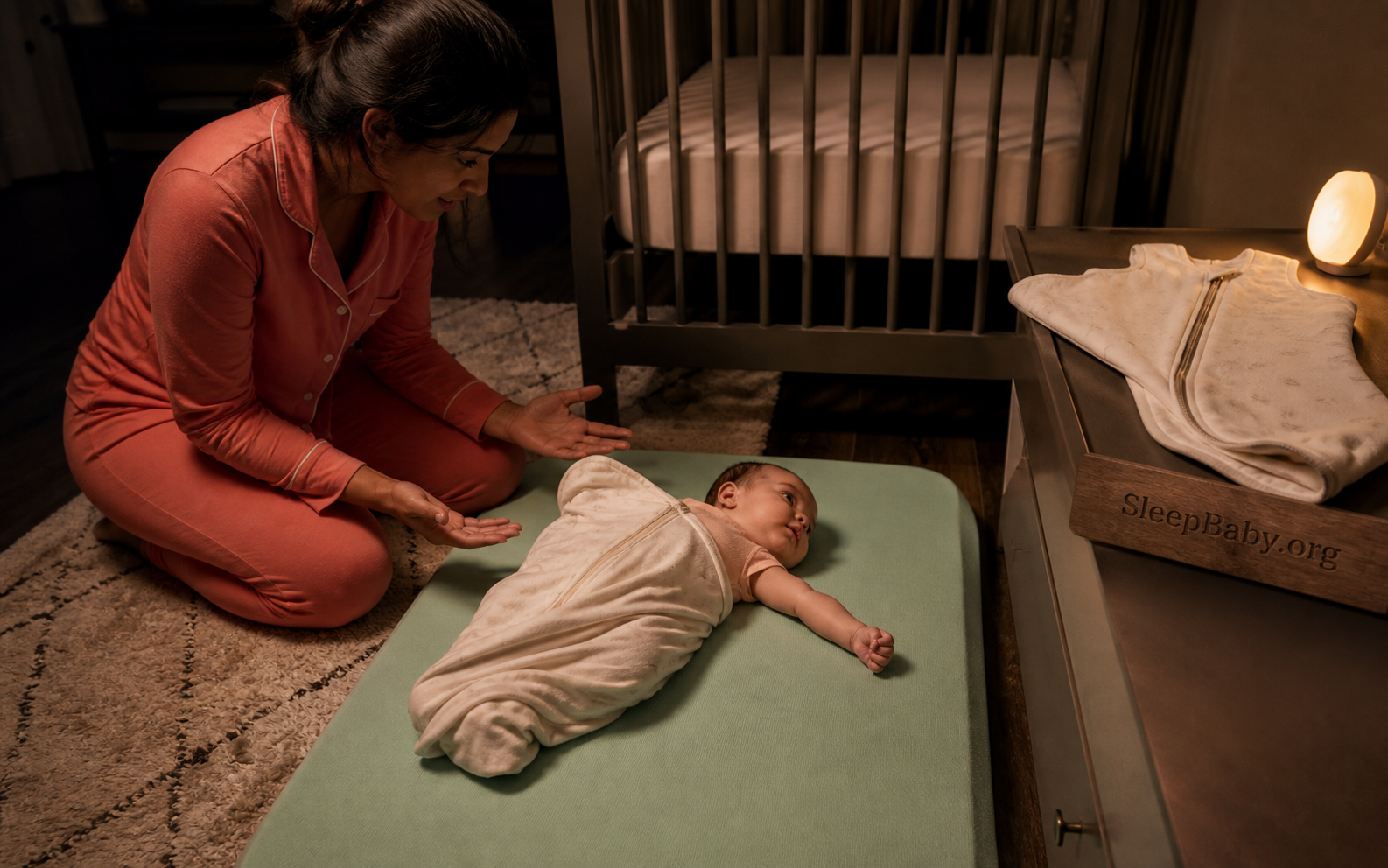
A clearly hypothetical Kacey-and-Benjamin teaching scene—not a memory or evidence
In the imagined nursery, one sharp Velcro sound changes my plan
Picture a hypothetical night with me, Kacey, standing beside a crib after an imagined Benjamin makes that unmistakable rrrip. One arm appears over the top of the swaddle, fist closed with the confidence of someone who has just completed a major engineering project. If this were only a comedy scene, the fist would deserve a tiny flag.
But first I look at his body, not my failed wrapping technique. Have I observed any attempt to turn or roll? Is the cloth still securely positioned and clear of his chin, mouth, and nose, or has it crept toward his face? I do not begin with, “How can I make this escape-proof?” I begin with, “What changed?”
In this hypothetical, Benjamin gives me a clear rolling attempt. That ends the debate. I remove the swaddle, choose fitted pajamas or a correctly sized non-swaddling wearable blanket, and place him on his back in the empty crib. I keep the same low light and same quiet phrase. He may fling both arms wide. He may object to this sudden expansion of personal territory. Neither reaction gives me permission to put the restriction back.
The emotional work belongs to me. I can be disappointed that a reliable settling cue is gone. I can miss the neat little parcel stage. I can also decide that development has delivered new information and I am going to believe it. The safest answer is not always the one that preserves last night’s routine. Sometimes it preserves the baby’s freedom to move.
Rolling signs override every swaddle troubleshooting trick
The AAP’s boundary is about signs of trying to roll, not only a completed back-to-belly roll. That matters because nobody wants the first successful roll to happen while a baby’s arms are pinned. Rolling often appears around three or four months, but it may begin earlier. Age is context; movement is the decision.
Pay attention during awake time as well as at bedtime. If you observe any attempt to turn or roll, stop swaddling rather than waiting for a completed milestone. If you are unsure whether a movement was an attempt, choose the conservative path: stop swaddling and go arms-free.
Once the boundary arrives, “one arm out” is not a loophole if the garment still restrains the other arm or compresses the chest and body. HealthyChildren specifically notes that wearable products that continue to swaddle or compress the arms, chest, or body should stop when a baby shows signs of rolling. An ordinary non-swaddling sleep sack leaves the arms out and allows the body to move freely.
-
See a rolling attempt? End swaddling before the next sleep
Remove the swaddle rather than fastening it again. Choose fitted sleep clothing or a correctly sized, unweighted, arms-free wearable blanket. Keep baby on the back at the start of every sleep.
-
No rolling attempt, but fabric is loose or near the face? End that setup
Take the loose fabric out of the crib. Review the exact product instructions and size in daylight. If the top edge or neckline cannot remain in the manufacturer-specified position, securely clear of the chin, mouth, and nose, without excessive tightness, use another appropriate garment.
-
No rolling sign and the wrap stayed secure? Check the baby before the technique
Feed, burp, change, cool a warm room or layer, or give a brief calm wind-down as needed. Re-wrap only within the product instructions and the chest/hip fit boundary.
-
Unsure what movement you saw? Choose the less restrictive plan
You do not need courtroom-level proof to move to arms-free sleepwear. If the movement looked like a rolling attempt or the wrap no longer feels reliably safe, stop swaddling and ask your pediatrician about what you observed.
Continue placing your baby on the back for every sleep. If a baby later rolls independently in an empty safe sleep space, do not use positioners, rolled towels, wedges, or restraints to hold a position. Our guide to handling wakes when a baby starts rolling can help with the next stage without putting the swaddle back on.

If rolling has not started, check fit without chasing “escape-proof”
A swaddle is meant to be snug across the upper body, not rigid. HealthyChildren describes a practical chest check: you should be able to fit two or three fingers between the swaddle and the baby’s chest. Breathing must not be restricted. The hips and knees need room to bend up and out in a relaxed frog-leg position.
I would inspect the wrap in good light before trying it again. A sleep-deprived hand can miss that a garment is too small, the fastening panel is misaligned, the neckline is riding up, or a blanket has become slick after washing. Follow the exact instructions for that product rather than combining techniques from three videos and a relative’s memory.
| What you see | What it may mean | Safer next step |
|---|---|---|
| Top edge or neckline stays in the manufacturer-specified position, clear of the chin, mouth, and nose; chest is comfortably snug; hips flex freely | The basic geometry may be within the intended fit | Continue only if there are no rolling signs and the product instructions, age/size limits, and baby’s breathing and comfort all support use |
| Neckline gaps, armholes gape, or fabric can travel toward the face | The size, wrapping method, or product may not fit reliably | Stop using that setup; do not fill the gap with another blanket or tighten beyond guidance |
| Chest looks compressed or you cannot slide two or three fingers underneath | The wrap may be too tight | Remove it and recheck the instructions; never trade breathing room for escape resistance |
| Legs are held straight together or hips cannot bend and spread | The lower wrap is too restrictive | Loosen or stop; hips and knees need free movement |
| Sweating, damp hair, flushed or hot skin, heat rash, or unusually rapid breathing | Baby may be overheated or unwell | Remove a layer, check the room and baby, and seek medical advice for concerning breathing, behavior, or illness signs |
Watch for supported signs of overheating, including sweating, damp hair, flushed or hot skin, heat rash, rapid breathing, or a chest that feels hot to the touch. Use the garment maker’s guidance for room temperature and layers; do not assume a particular fabric or TOG is right for every room or baby. If sweating during sleep is a recurring concern, our guide to why a baby may sweat during sleep and what to check adds context.
And keep the sleep space boring in the best possible way: a firm, flat, level mattress with a fitted sheet, baby placed on the back, and no loose blanket, pillow, bumper, positioner, toy, or added object. The swaddle is not permission to change any of those rules.
What if my baby only wants one hand or both hands out?
Hands near the face can be comforting. Some babies work an arm upward because that is where they want it, not because they are staging a complete rejection of sleep. If your baby is young, has shown no sign of trying to roll, and your specific swaddle product explicitly supports a hands-to-face or arms-out configuration, you can follow those directions.
But “arms out” has two different meanings in the marketplace. One product may simply be an ordinary sleeveless wearable blanket: arms free, no wings, no chest compression. Another may still wrap or compress the torso and one or both arms. The second is still functioning as a swaddle. Once rolling attempts begin, choose the first category.
There is no evidence that putting the arms in or out makes swaddling a SIDS-prevention strategy. Swaddling does not reduce SIDS risk. Its role is a settling preference for a limited stage, and all safe-sleep guidance still applies. I would rather lose a technique on time than stretch its label past the movement in front of me.
If your baby fusses on the back once the arms are free, keep the back-first placement and work on soothing, timing, and the transition itself. Do not switch to side or stomach placement to quiet the protest. The article on what to do when a baby cries on the back can help you separate safe positioning from the soothing problem.
My first-three-nights plan: change the garment, keep the landing
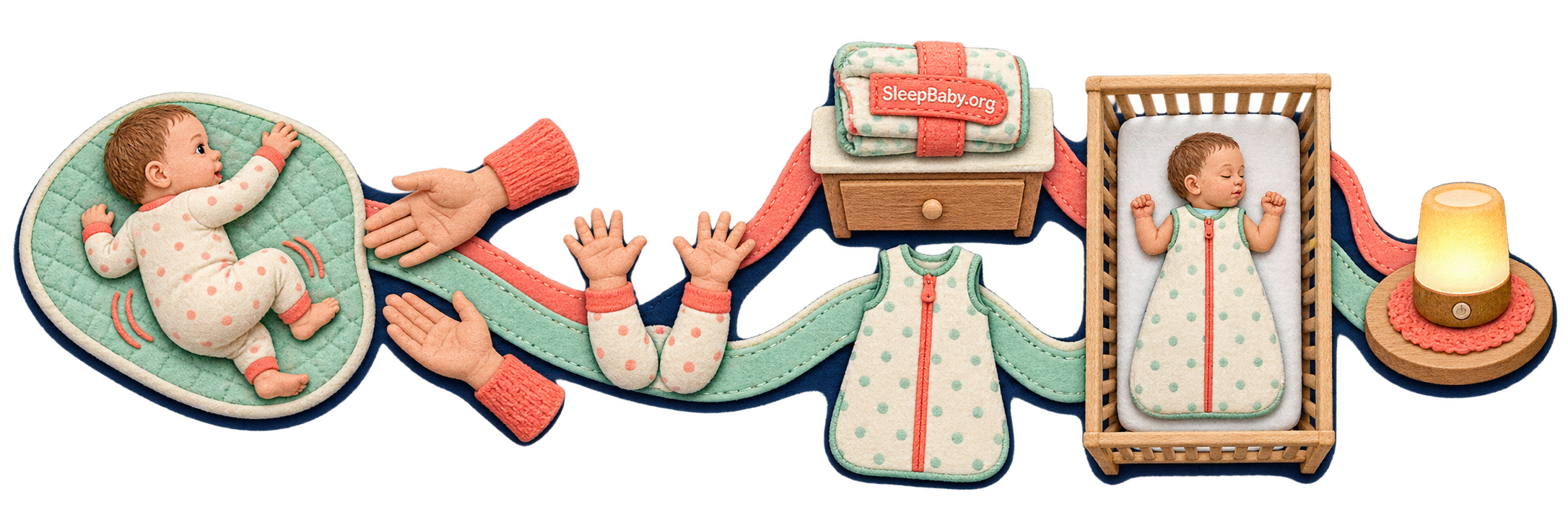
The transition does not need an elaborate new sleep program. When a rolling sign is present, gradual one-arm-out experiments can prolong a boundary that already arrived. Go arms free. Then preserve as much of the familiar landing as you reasonably can.
Before the first arms-free sleep
Choose and fit the new layer while everyone is awake
Use fitted pajamas or a correctly sized, non-weighted, non-swaddling wearable blanket. Check the neck and arm openings, zipper, fabric, current size chart, and care label. The garment should not ride over the face, bind the chest, or restrict the hips.
Night one
Expect the arms to look very busy
Keep your ordinary wind-down and place baby on the back. Pause through brief grunts and flails if baby is settling safely, and respond to real crying or need. You may soothe with your voice, hands, feeding, rocking, or another age-appropriate routine, then return baby to the safe sleep space.
Night two
Repeat before you redesign
If the setup is safe, give the same garment and sequence another chance rather than changing sacks, music, feeding, bedtime, and response style at once. One changed variable lets you learn what is merely unfamiliar.
Night three and beyond
Adjust the routine, not the safety boundary
If settling remains hard, look at hunger, wake time, overtiredness, temperature, illness, and the usual sleep supports. Ask your pediatrician if you are unsure. Do not restore swaddling after a rolling attempt just because an arms-free night was rough.
I call this “keep the landing” because babies recognize more than a garment. The same dim room, same voice, same short song, same last feed pattern, and same caregiver response can carry continuity. The arms are free; the whole world has not vanished.
If your baby is not yet rolling and you are choosing to stop early because escapes keep making fabric loose, you may still use the same arms-free plan. There is no prize for swaddling until the latest possible evening. A safe, workable setup is enough.

Do not outsmart the milestone with a stronger restriction
Products that promise to contain a determined baby can sound especially persuasive after three broken transfers. This is where I want the rule to be plain: the more urgently a baby needs freedom to roll and reposition, the less sense it makes to make the restriction harder to escape.
A product described as “transition” is not automatically appropriate after rolling begins. Read what it actually does. Does it leave both arms and the torso free, or does it add compression, padding, a wrap panel, or resistance? Marketing language cannot replace the movement test or the manufacturer’s current safety instructions.
Similarly, a home monitor does not make a restricted or cluttered setup safe. Do not use an oxygen, movement, or video monitor as permission to continue swaddling after rolling signs. A device can alert or inform; it cannot change the physical hazard.
What if the baby sleeps worse with arms free?
They might, at least for a while. A newborn startle can look enormous when nothing contains the elbows. The hands find the face. The legs lift. The baby seems shocked to discover the full dimensions of the crib. A difficult transition does not prove the old setup became safe again.
I separate disruption from danger. More wakes, shorter stretches, and extra settling are disruption. A rolling attempt inside a swaddle, loose fabric near the face, restricted breathing, overheating, or an unsafe sleep surface is danger. We can work patiently on disruption without bargaining with danger.
During an ordinary wake, respond as you normally would for age and need. Feed when hungry. Change when needed. Burp or hold upright while awake when appropriate. Use a calm voice, brief rocking, a pacifier if your baby uses one, or your usual low-stimulation routine. Then return baby to the back in the empty sleep space. If you feel yourself drifting off while holding the baby, move away from sofas and armchairs and put the baby back in the safe sleep space.
Look at timing, too. The swaddle may have been blamed for a night that also contains a growth spurt, illness, a missed nap, a too-long awake stretch, or a developmental burst. Do not promise yourself one explanation. Change the restriction when safety requires it, then observe the rest of the night with ordinary curiosity.
The arms-free setup in under two minutes
Changing the garment does not mean adding a blanket
This official NICHD Safe to Sleep video shows the larger environment that matters after a swaddle comes off. Watch it for the visual reset: a clear crib, an appropriate sleep surface, and wearable clothing rather than loose bedding. The written safety guidance in this article still stands on its own.
Watch “Clear the Crib to Reduce the Risk of Sleep-Related Infant Death” on YouTube if the privacy-enhanced player is unavailable.
Takeaway for this article: after swaddling, warmth comes from appropriate fitted sleep clothing or a correctly sized wearable blanket—not from placing a loose blanket, pillow, positioner, or comfort object in the crib.

When the escape needs a pediatrician, not another sleep product
Call your pediatrician when you cannot tell whether a movement was a rolling attempt, need help choosing safe sleep clothing for your baby’s size or medical needs, or have another concern about your baby’s health or development. If you are unsure about rolling in the meantime, stop swaddling and go arms-free.
Seek urgent or emergency help for trouble breathing, blue or gray color, severe limpness, unresponsiveness, or another immediate danger. Remove a tight or face-covering garment while you get help. Do not wait for a sleep article to settle an acute concern.
If your baby was born early, has a hip condition, breathing issue, low muscle tone, reflux plan, or another medical concern, ask the baby’s clinician how the general swaddling guidance applies. A product label and a social video do not know your child’s history.
Quick answers for the questions parents ask at the crib
Does one arm out mean my baby can roll?
No. One escaped arm by itself is not proof of rolling. If you observe any attempt to turn or roll—or you are genuinely unsure—stop swaddling and choose arms-free sleep clothing.
Should I tuck the loose swaddle under the mattress?
No. Loose or unraveled fabric should come out of the infant sleep space. Do not tuck, pin, tape, clip, or add another blanket to hold it. Use a correctly fitted product within its instructions or move to fitted sleepwear.
Can I double-swaddle a strong baby?
No. More layers can add heat and more fabric that may loosen, and strength is not the issue once rolling begins. Keep the chest comfortably snug only within instructions, hips free, and stop swaddling at rolling attempts.
Can my baby sleep on the side if that stops the escape?
No. Place your baby on the back for every sleep. Do not use a prop or positioner to hold the side or back position. A baby who later rolls independently in an empty safe sleep space should not be restrained in place.
Is a sleep sack the same as a swaddle?
Not always. A non-swaddling wearable blanket leaves both arms free and allows the body to move. Some products called sleep sacks include swaddle wings or compression around the arms, chest, or body. Read the design and instructions, not only the category name.
What if my newborn simply hates being swaddled?
Swaddling is optional. You may use fitted pajamas or a correctly sized, unweighted, non-swaddling wearable blanket from the beginning. Keep the safe sleep environment the same and ask your pediatrician if crying is intense, persistent, or accompanied by symptoms.
Sources
- American Academy of Pediatrics: Sleep-Related Infant Deaths—Updated 2022 Recommendations for Reducing Infant Deaths in the Sleep Environment.
- HealthyChildren.org: Swaddling—Is it Safe for Your Baby?
- HealthyChildren.org: Good Night, Sleep Tight—How to Swaddle Your Baby.
- NICHD Safe to Sleep: Frequently Asked Questions About SIDS and Safe Infant Sleep.
- NICHD Safe to Sleep: Ways to Reduce Baby’s Risk.
- U.S. Consumer Product Safety Commission: Safe Sleep—Cribs and Infant Products.
- U.S. Consumer Product Safety Commission: Beware—Weighted Infant Swaddles and Blankets Are Unsafe for Sleep.
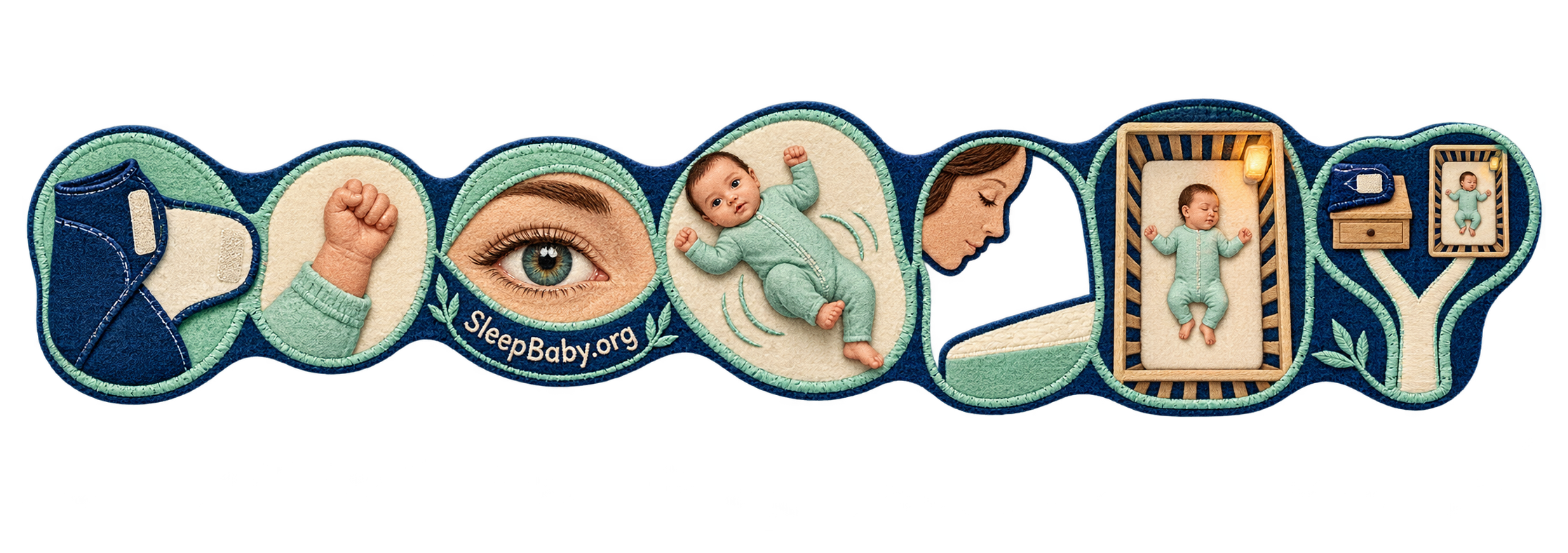
When the Velcro stops being the plan
Build a bedtime landing that can grow with your baby
The first arms-free night can look gloriously untidy: elbows everywhere, a startled fist, and a parent wondering whether anyone will ever settle again. You do not need to rebuild every part of bedtime. Keep the safe sleep space, choose one familiar cue, and make the next decision small enough to repeat.
SleepBaby can help you turn that noisy transition into a calmer sequence for your household—without promising a perfect night or asking you to ignore the movement your baby is showing you.






What viewers said10 comments · 4 replies+
Archived comments from the original Baby Sleep Miracle presentation. Not independently verified by SleepBaby.org; individual experiences vary.
Thank you so much for this video! I had no idea about the dangers of baby swings :O
Hi Mary-Ann. I have a question: Is method in any way similar to the ones recommended by Dr Bucknam, Dr. Weissbluth or Dr. Karp? We tried those but none of them help.
Hi Regina, thank you for your question. The short answer is no. The techniques I share in my guide are based on newest scientific research and this is why I have never seen any approach similar to the one I recommend.
This method really works! I tried it on my son Jesus and after just one week he went from waking up more than 5 times a night to waking up just once or twice. You are a lifesaver, Mary-Ann!
I'm truly impressed with how much information you share in your video. And all for free! I can feel that you truly care about mothers like myself, and that's hard to find these days. I have recommended your site to several of my friends already.
Mary-Ann, our child suffers from autism. Is your approach still suited?
Chloe, I made sure my method can be used with any child, even babies who are special like yours. Please note that I'm not a doctor and that I always advice to consult with your physician because nothing is more important than the safety and well-being of your love.
Hallo Mary-Ann, I'm from Germany. Do you have your guide in German?
Hello Heide, we do! Normally you should already see our video in German. If not, please contact our support so they can guide you
Thenk you for your answer, Mary-Ann!
I just completed your approach and I have to say, it worked almost too well. Yes, it took a bit of getting used to with your bedtime routine but the difference is huge. My son George used to take 1 hours to go down and now he's firmly asleep in no more than 10 minutes! You're the best!
It seems I'm the only man watching this video, lol! What you shared about the 'emotional backpack' made immediate sense to me and I can't wait to help my little girl Mila to unpack it!
Hey there, just discovered your site and this really sounds different. Just wanted to say thanks for sharing :)
For everyone who's still thinking about getting Mary-Ann's guide I want to advise you to go ahead. I wasn't sure myself but now I'm so thankful I invested in this program. It made a huge difference in our life as a family and yes, my baby girl does sleep through the night now.