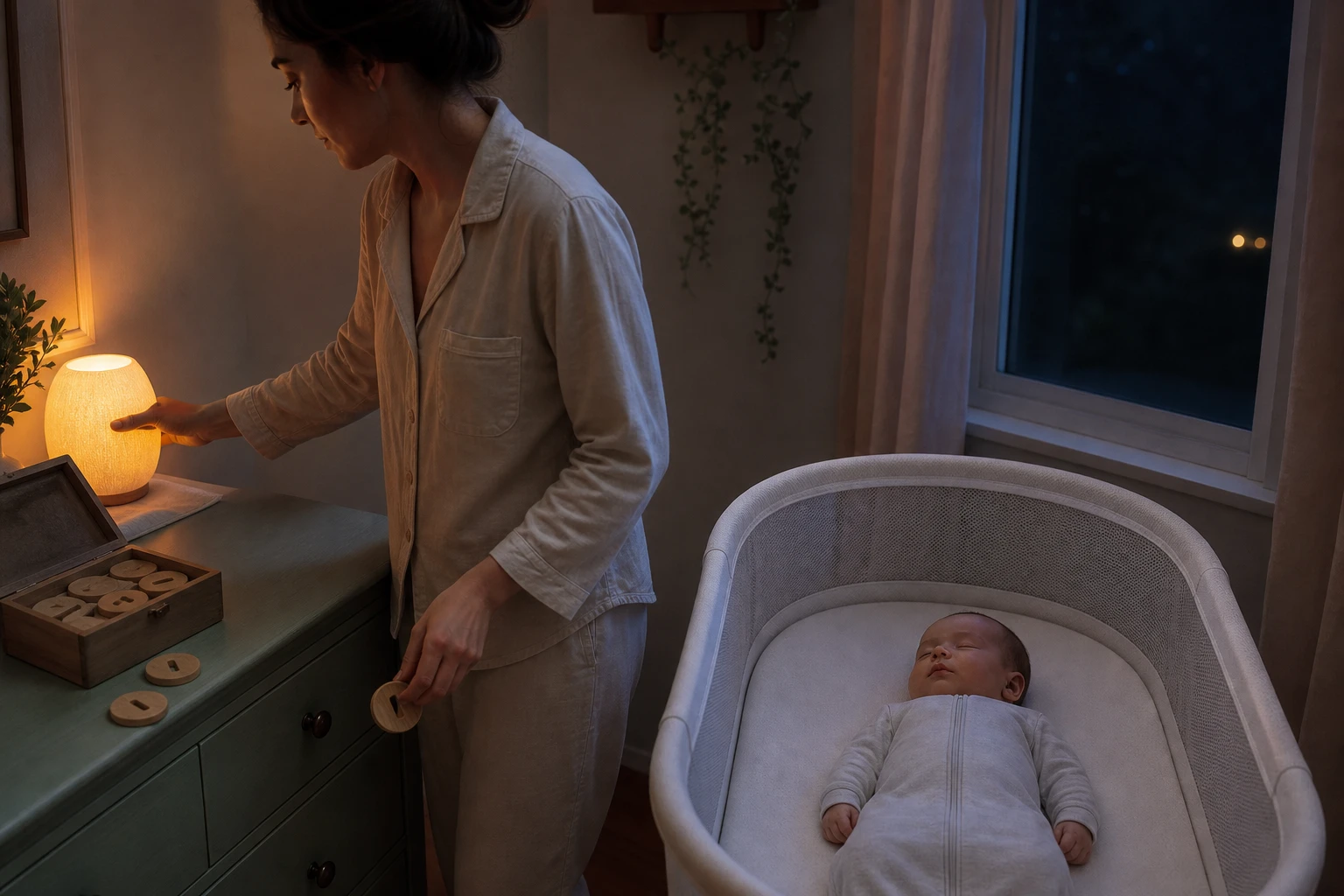
The useful answer before tonight
The baby sleep hacks that help are small, safe, and repeatable
Start with a safe sleep space, clearer day-and-night cues, a short familiar wind-down, and one change at a time. Those steps may make settling simpler or remove a needless disturbance. They cannot make every baby sleep through hunger, illness, development, or temperament, and they never outrank safe-sleep guidance.
For a newborn, waking to feed and sleeping in short stretches are expected. For an older baby, repetition may become more useful. In either case, the test is the same: is the idea safe, is it simple enough to repeat, and does it reduce a specific piece of nighttime friction without creating another job?
Baby sleep advice tends to arrive when your judgment is least interested in hosting a committee meeting. The monitor makes that small pre-cry rustle. Your phone offers twelve “game-changing” tricks, several of which require a subscription, a courier, and apparently a minor degree in nursery engineering.
I would remove the magic from the word hack. A useful hack is a modest nudge: open the curtains when the household starts its day, lower the light and stimulation at night, repeat the same compact wind-down, or stop changing four variables during one nap. It is reversible. It leaves feeding and infant safety alone. You can describe it to another caregiver without drawing a flowchart on the refrigerator.
The private question beneath this search is rarely “Which viral trick is cleverest?” It is usually, “I am tired; what can I try tonight without making this harder or less safe?” That is a kinder question because it has a usable answer.
What makes a baby sleep hack worth trying?
I use four questions before I let a sleep tip into the house: Is it safe? Is it plausible? Is it simple enough to repeat? Can I tell whether it helped? A warm bath may be lovely but impossible on a frantic Tuesday. A long routine may work until another caregiver takes bedtime. A louder sound machine may cover the dishwasher while adding a different concern. “Natural” drops may sound gentle while still being an unregulated substance given to a baby.
The goal is not to assemble the perfect night. It is to remove one avoidable bit of friction while keeping the important things steady. A tip that demands constant shopping, tracking, or performance from the baby should have to prove it is worth the family’s effort.
Sort the advice before you try it
The SleepBaby.org Hack Filter
Safe and worth trying
Ordinary daylight and activity by day, dim and quiet care at night, a brief repeated wind-down, and one-variable troubleshooting.
Tonight: choose one small change.
Optional, with guardrails
Blackout curtains, a low sound machine placed away from the crib, or “drowsy but awake.” Useful for some families, unnecessary or frustrating for others.
Tonight: use it safely, not religiously.
Probably not worth the work
Complicated transfers, gadget stacking, or a routine so long that everyone needs an intermission.
Tonight: caregiver effort counts as an outcome.
Skip for safety
Incline, positioners, loose bedding, weighted sleep products, cereal in bottles, or medicines and supplements improvised for sleep.
Tonight: do not test it.
Why this matters for sleep: a modest experiment can teach you something. An unsafe or overcomplicated one adds risk, labor, and confusion without making rest more dependable.
Original teaching framework created for SleepBaby.org.
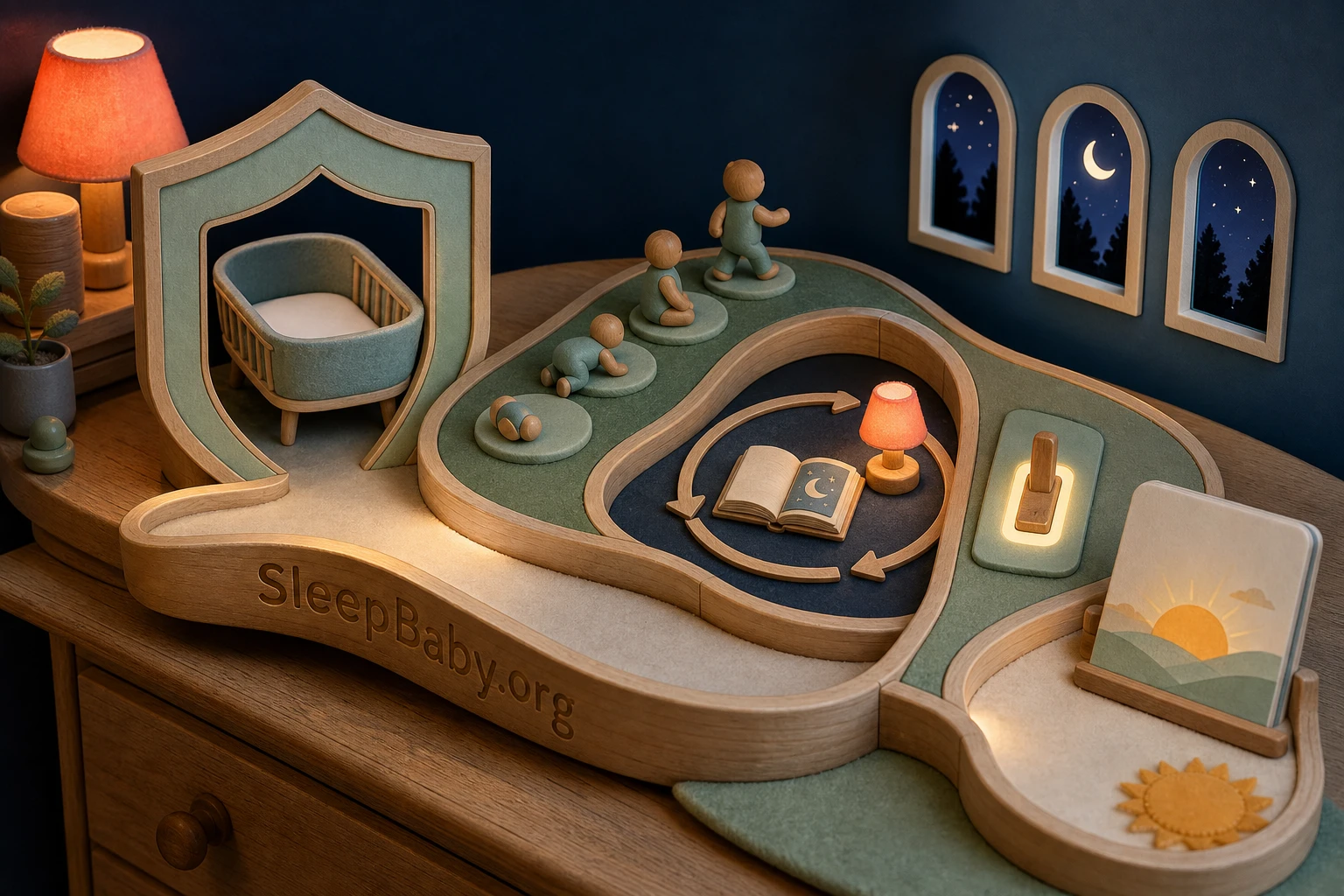
Clearly labeled hypothetical Kacey-and-Benjamin moment
The night when every hack tried to volunteer
Imagine me at 1:52 a.m., Benjamin warm against my shoulder, a burp cloth sliding toward the floor, and my phone glowing with six different ideas. In this hypothetical scene, I dim the room, change the sound, stretch the transfer, reconsider the last nap, and briefly become suspicious of a perfectly innocent pair of pajamas. By morning I have changed so much that I cannot tell whether anything helped.
That is the exact trap I want to keep you out of. The scene is hypothetical, not family history and not evidence. Its practical point is real: when every variable moves, the baby cannot teach you which household change reduced friction. The night becomes busy, and the parent becomes the exhausted manager of an experiment with no control group.
I would put the phone face down, meet the real need in front of me, return Benjamin to a safe sleep space, and save one modest idea for the next appropriate night. Less drama. Better information. Fewer suspicious pajamas.

Newborn sleep hacks and older-baby sleep hacks are not the same job
Newborn sleep is scattered across day and night. Newborns wake to feed. Their day-night rhythm is still developing, and one stretch can change because of feeding, growth, contact, illness, and ordinary newborn unpredictability. A trick that claims to make a healthy newborn stop waking for needed feeds is answering the wrong question.
In the early weeks, I would define success more modestly: daylight reaches the room during the day, nighttime care stays dim and calm, the feeding plan is protected, and the route back to a safe sleep space has fewer unnecessary steps. If a baby sleeps only while being held, the answer is not for an exhausted adult to keep holding while drifting off. Trade shifts with another alert adult when possible, and place the baby back on their own approved surface before the adult sleeps.
As babies grow, repeated cues may become easier to recognize. A short routine can begin to predict what comes next. Nap timing may become less random. That still does not make every wake a behavior problem. Teething, illness, feeding changes, new motor skills, and separation awareness can all rearrange a week that had been looking rather pleased with itself.
Newborn priority
Protect feeding, safety, and contrast
- feed responsively and follow the baby’s clinical plan;
- make daytime light and ordinary sound distinct from dim, quiet nighttime care;
- keep the route back to a safe sleep surface simple; and
- treat frequent waking as expected, not a parental defect.
Older-baby priority
Use repetition without chasing control
- repeat a compact wind-down in roughly the same order;
- use recent sleep and current cues as context;
- change one variable rather than rebuilding the whole day; and
- expect development and health to change the pattern.
If you need age-and-stage context rather than another list of tricks, the guide to sleep patterns across the first year is the better next page. I am not going to smuggle a full schedule into this article and call it a shortcut.

Hack 1: Let day and night look different
The NHS recommends opening curtains, playing, and allowing ordinary household noise during the day, then keeping lights low, voices quiet, and nighttime interaction minimal.[5] I like this because it asks the environment to do a little signaling without asking the baby to perform.
Morning does not need a theatrical reveal. Open the curtains when the household begins its day. Feed and play in normal light. Go outside when that fits the weather and your baby’s needs. At night, use enough light to feed, change, and move safely, but skip the bright overhead setting that makes the nursery look ready for inventory. Keep your voice and movements calm. Do not turn a 3 a.m. feed into daytime play.
This is a cue, not a switch. It will not prevent a newborn from waking hungry. It will not repair illness or force a longer stretch. What it may do is stop the environment from sending the same message at noon and midnight.
Optional Amazon recommendation
A dim light for the care you still need to do
For night feeds, diaper changes, and quick checks, I would choose the G Keni L2 Nursery Night Light. Its touch control matters when one arm is occupied, and its stepless dimming and brightness memory let you set only the light the task needs instead of turning on an overhead fixture.
It fits this situation better than a sound machine, which adds volume and distance decisions, or an app-connected smart light, which adds setup and account friction. The specific reason to buy it is simple: one tap gives a caregiver usable light during a wake-up without turning the whole room into morning.
Placement matters: keep the lamp on a stable caregiver-controlled surface outside the crib or bassinet, and keep its charging cable out of the baby’s reach. It is a caregiving light, not an infant sleep product, and it does not promise longer sleep.
As an Amazon Associate, SleepBaby may earn from qualifying purchases.
Hack 2: Make the routine shorter than your patience
A bedtime routine can be useful because it is recognizable. It does not need to be long. NHS guidance suggests simple calming activities such as sleep clothes, a story, dim lights, a cuddle, or a lullaby.[5] A three-week study of children ages 7 to 36 months also found improvements after families adopted a consistent three-step routine, although the study used supplied bath and massage products and had company funding and author conflicts.[6]
Those limitations matter. This was not a newborn trial, and it does not prove that a branded lotion or one exact sequence makes babies sleep. It makes me more interested in repetition than merchandise. A practical routine might be feeding as needed, a fresh diaper and comfortable sleep clothes, one short book or song in lower light, and then the safe sleep space.
If a bath wakes your baby up, it is not a bedtime requirement. If massage becomes wrestling, retire it. If the book is mostly being eaten, shorten the literary program. Consistency means the baby can recognize the next few steps; it does not mean the household performs an immaculate ceremony every night.
When the routine keeps growing, remove one step before adding another. The useful question is not “Did we do everything?” It is “Which two or three cues can still happen when the evening is messy?”

Hack 3: Fix the room without adding sleep-surface clutter
A room can support sleep without becoming a gadget habitat. Keep it comfortably cool rather than overheated, dress the baby appropriately, use darkness or low light when practical, and reduce abrupt stimulation. Then stop before “cozy” reaches the crib.
The AAP advises keeping weighted blankets, weighted swaddles, and other weighted objects away from infant sleep.[1] A properly sized, non-weighted wearable blanket can provide warmth without loose bedding. The crib or bassinet remains firm, flat, non-inclined, and empty except for a fitted sheet.[2]
Blackout curtains can help without becoming compulsory
Some babies settle more easily in a darker room, especially for daytime naps. If curtains help, use them. Keep cords completely inaccessible and make sure the room does not become hot. If darkness changes nothing, you do not need to enter a fabric arms race with the sun.
White noise belongs to the room, not the baby’s ear
A steady sound may soften abrupt household noise. It is not required, and louder is not better. Researchers measured 14 infant sleep machines at maximum volume and found potentially hazardous sound exposure at close distances.[7] That study tested output, not sleep benefit.
If you use a machine, place it well away from the crib and the baby’s head, choose the lowest setting that does the job, and do not use it to drown out sounds a caregiver needs to hear. I would rather hear the occasional dishwasher than turn the nursery into an audio endurance event.
Watch the safety floor
Clear the crib before you optimize anything else
This short NICHD Safe to Sleep video turns an abstract rule into a visible room check: the approved sleep surface stays firm, flat, and clear even when the rest of the nursery feels warm and personal.
Takeaway: a bare sleep space may look unfinished to an adult; for a baby, that emptiness is the protective design. Watch it directly on YouTube if the privacy-enhanced frame does not play.
Hack 4: Use timing and cues as context, not a verdict
“Watch the baby’s cues” is advice that becomes useful only after someone explains which cues and what to do with them. A yawn, looking away, slower movement, reduced engagement, fussing, or burying the face can all matter. None is a laboratory result. Hunger, boredom, overstimulation, and illness can wear similar clothes.
I would look for a cluster and compare it with the baby’s recent sleep. If a baby has been awake longer than is comfortable for them and begins turning away, losing interest, and escalating, start the wind-down. If the baby is bright-eyed, feeding well, and still engaged, one yawn does not require an emergency evacuation to the crib.
Use the clock as a handrail, not a judge. Exact wake windows vary with age and with the baby in front of you. If the whole day seems shifted rather than one bedtime feeling difficult, read how to adjust a baby’s sleep schedule gradually. If you mainly need a practical framework for naps and bedtime, these age-aware baby sleep schedule tips answer that next question without pretending one number fits every day.
Timing advice fails when it makes the parent watch the minute hand instead of the child. I care more about a repeatable range and a recognizable change in behavior than whether bedtime began at 7:02 or 7:07. Babies do not award points for administrative precision.
Hack 5: Keep feeding out of the trick drawer
Newborn and young-infant waking often protects feeding. Do not stretch, drop, delay, thicken, or otherwise change feeds merely to chase a longer sleep stretch. Follow the baby’s feeding plan and any guidance from the clinician who knows their growth and health.
The CDC is direct: putting cereal or other food in a bottle does not make a baby sleep longer and can increase choking risk. Do not prop a bottle or put a baby to bed with one.[4] A full stomach is not a safety strategy, and a longer-looking stretch is not automatically a better outcome if the method interferes with appropriate feeding.
I would treat a feeding change as a feeding decision, not a sleep hack. If night waking suddenly increases alongside poor feeding, fewer wet diapers, vomiting, pain, lethargy, or a meaningful change from the baby’s baseline, stop troubleshooting the routine and call the baby’s clinician.

Hack 6: Run one tiny experiment for three ordinary nights
When the baby is well and feeding normally, change one safe variable and hold the rest as steady as family life allows. Three nights will not prove cause and effect. They can tell you whether a change looks promising enough to keep, clearly useless, or so labor-intensive that any benefit is not worth the bargain.
Choose something specific: open the curtains at the same morning anchor, shorten the routine from six steps to three, lower the nighttime light, move the sound machine farther away and reduce its volume, or begin winding down at the first reliable cluster of cues. “Fix sleep” is not a variable.
A test for people who do not want a new spreadsheet hobby
The Three-Night Tiny Test
Night 1
Name and notice
- name the one change;
- note a rough settling range;
- count wakes that needed help;
- record feeding or health context; and
- rate caregiver effort in plain language.
Night 2
Repeat without stacking
Keep the same small change. Do not “improve” the experiment by adding a different sleep garment, later nap, louder sound, and new transfer method.
Night 3
Decide what the family keeps
Keep it if friction fell without a larger cost. Drop it if nothing useful changed. Ask for help if feeding, breathing, pain, illness, or development makes the pattern unclear.
Do not score the baby. You are testing a household change, not grading a child’s sleep.
Original decision tool created for SleepBaby.org.
Here is the human detail I care about: can you remember the change without opening an app in a dark hallway? Can another caregiver repeat it? Did it reduce the amount of time everyone spent escalating? A ten-minute improvement that requires forty minutes of preparation is allowed to lose.

How can you tell whether a baby sleep hack is helping?
A useful change does not have to produce a twelve-hour night. That is an especially poor scoreboard for a young baby who still needs to feed. Look for the smaller job the hack was supposed to improve: a calmer handoff, a shorter stretch of escalating, one less room change, a routine another caregiver can repeat, or fewer minutes spent rebuilding conditions after every wake. Name the job before you judge the result.
Leave room for ordinary variation. A single smooth bedtime can be luck; one spectacularly messy bedtime can follow a short nap, a growth day, an unfamiliar room, or a baby simply being a baby. Three reasonably comparable nights give you a better view, but home notes do not become a clinical study. The point is to make a household decision with less guesswork, not to prove a theory about your child.
The dark-hallway scorecard
Keep it, question it, or stop it?
Keep it for now
The change is safe, simple, and repeatable. It reduces a named point of friction without delaying feeds, changing the sleep surface, or making the next wake harder.
Question the bargain
There may be a small benefit, but it takes elaborate timing, constant app-checking, or one exhausted adult doing every bedtime. Simplify it once and judge again.
Stop and reassess
The tactic changes feeding against the baby’s plan, adds weight, incline, loose items, or sedation, creates distress, or coincides with new illness or pain signs.
Caregiver load counts. “It worked” is incomplete if the method requires a complicated negotiation at every nap. A sustainable improvement gives the family some capacity back.
Write down only what you will use: the one change, a rough settling range, wakes that needed help, feeding or health context, and how hard the process felt. “About twenty minutes and calmer than yesterday” can be honest, useful information. “Exactly seventeen minutes, therefore the new curtain caused success” is a bedtime detective novel.
If nothing improves, you have still learned something: this was not the lever, at least not this week. Remove it without replacing it immediately. A quiet return to the familiar routine is a decision, not a failure.
Baby sleep hacks I would skip
The tired-parent internet sometimes places a dim lamp and a weighted sleep sack in the same cheerful list. They do not belong in the same risk category. This is where I stop being flexible.
The unsafe-hack red line
Do not test these for sleep
Incline and positioners
Do not incline the infant sleep surface or add a wedge, nest, pod, pillow, or positioner. Firm, flat, non-inclined, and bare remains the standard.[2]
Weighted sleep products
Skip weighted blankets, swaddles, sleep sacks, and other weighted objects. A “calming” label does not make added weight appropriate for infant sleep.[1][3]
Routine sitting-device sleep
Car seats, swings, strollers, carriers, and slings are not regular sleep spaces. Move a sleeping baby to an approved firm, flat surface as soon as practical.[1]
Cereal or food in a bottle
It does not make a baby sleep longer and can increase choking risk. Do not turn feeding into a sleep experiment.[4]
Melatonin or improvised sedating products
Do not improvise medicine, antihistamines, supplements, or “sleep drops” for a baby. The AAP describes melatonin as a clinician conversation for children and notes product-content and poisoning concerns; it does not provide an infant sleep-hack dose.[8]
Swaddling after rolling begins to emerge
Stop swaddling when a baby shows signs of trying to roll. Do not wait for a perfect successful roll before changing the sleep setup.[1]
Tonight’s rule: if a tactic changes the approved sleep surface, adds weight or incline, sedates the baby, or interferes with feeding, it is outside the experiment.
I would also retire harmless tricks that become exhausting: the exact number of pats, the transfer performed in increasingly superstitious stages, the sound that must play from one particular phone. If a simple ritual helps and you can repeat it, fine. But a sequence that keeps growing should have to prove its value. Parents are part of the sleep ecosystem too.

What should you try tonight?
- Protect the floor. Back, firm, flat, non-inclined, fitted sheet, empty sleep space.
- Meet the real need. Feed, diaper, comfort, temperature, pain, illness, and recent sleep come before technique.
- Pick one small lever. Day/night contrast, a shorter routine, lower stimulation, or one timing adjustment.
- Keep the rest boringly familiar. Do not stack new sound, new sleep clothing, a new feeding plan, and a new settling method.
- Watch the next three well nights. Keep what reduces friction without adding a larger burden.
- Stop guessing when health changes. Call the baby’s clinician when feeding, breathing, pain, fever, illness, or a marked change from baseline enters the picture.
A baby 3 months or younger with a rectal temperature of 100.4°F (38°C) or higher needs immediate pediatrician contact.[9] If you are worried that the baby is seriously ill or having an emergency, seek urgent help instead of continuing a home sleep experiment.
This is where I stop being interested in cleverness. A tired parent deserves a decision path, not a scavenger hunt. Protect the baby, protect feeding, try one modest change, and let “nothing magical happened” be an acceptable result.
That imaginary phone from the opening does not need to win the night. Put it down after you choose one safe, specific job. When the monitor rustles again, you will know what stayed steady, what changed, and what matters more than any hack.
Sources
- American Academy of Pediatrics: Safe Sleep—9 Ways to Reduce a Baby’s Risk of SIDS and Suffocation.
- NIH/NICHD Safe to Sleep: Safe Sleep Environment.
- U.S. Consumer Product Safety Commission: Safe Sleep—Cribs and Infant Products.
- CDC: About Feeding From a Bottle.
- NHS: Helping Your Baby to Sleep.
- Mindell et al.: A Nightly Bedtime Routine—Impact on Sleep in Young Children and Maternal Mood. The study discloses company funding and author conflicts.
- Hugh et al.: Infant Sleep Machines and Hazardous Sound Pressure Levels.
- American Academy of Pediatrics: Melatonin for Kids.
- American Academy of Pediatrics: Fever and Your Baby.
When bedtime has collected too many moving parts
Build a night you can explain in one quiet sentence
The monitor rustles, one hand is occupied, and the last thing you need is to remember which of five new tricks happens next. SleepBaby helps you turn scattered advice into a calmer, repeatable plan for your family’s nights—without promising perfection or replacing feeding and medical care.






What viewers said10 comments · 4 replies+
Archived comments from the original Baby Sleep Miracle presentation. Not independently verified by SleepBaby.org; individual experiences vary.
Thank you so much for this video! I had no idea about the dangers of baby swings :O
Hi Mary-Ann. I have a question: Is method in any way similar to the ones recommended by Dr Bucknam, Dr. Weissbluth or Dr. Karp? We tried those but none of them help.
Hi Regina, thank you for your question. The short answer is no. The techniques I share in my guide are based on newest scientific research and this is why I have never seen any approach similar to the one I recommend.
This method really works! I tried it on my son Jesus and after just one week he went from waking up more than 5 times a night to waking up just once or twice. You are a lifesaver, Mary-Ann!
I'm truly impressed with how much information you share in your video. And all for free! I can feel that you truly care about mothers like myself, and that's hard to find these days. I have recommended your site to several of my friends already.
Mary-Ann, our child suffers from autism. Is your approach still suited?
Chloe, I made sure my method can be used with any child, even babies who are special like yours. Please note that I'm not a doctor and that I always advice to consult with your physician because nothing is more important than the safety and well-being of your love.
Hallo Mary-Ann, I'm from Germany. Do you have your guide in German?
Hello Heide, we do! Normally you should already see our video in German. If not, please contact our support so they can guide you
Thenk you for your answer, Mary-Ann!
I just completed your approach and I have to say, it worked almost too well. Yes, it took a bit of getting used to with your bedtime routine but the difference is huge. My son George used to take 1 hours to go down and now he's firmly asleep in no more than 10 minutes! You're the best!
It seems I'm the only man watching this video, lol! What you shared about the 'emotional backpack' made immediate sense to me and I can't wait to help my little girl Mila to unpack it!
Hey there, just discovered your site and this really sounds different. Just wanted to say thanks for sharing :)
For everyone who's still thinking about getting Mary-Ann's guide I want to advise you to go ahead. I wasn't sure myself but now I'm so thankful I invested in this program. It made a huge difference in our life as a family and yes, my baby girl does sleep through the night now.