
The first baby-led weaning meal can look almost comically underproduced: one soft broccoli floret, one loaded spoon of oatmeal, and one baby who may wear more dinner than they swallow. That is fine. The point of the first week is not to produce a tiny restaurant critic. It is to let a developmentally ready baby practice eating while an adult handles every part that still belongs to the adult.
Baby-led weaning is a flexible self-feeding approach for a baby who is usually around 6 months old and shows the full cluster of readiness signs. Your baby decides whether to pick up the food and how much to eat. You decide whether they are ready, how each food is prepared, where and when they eat, and when a symptom means the experiment stops.
I would not treat this as a no-spoon purity test. Soft finger foods, mashed food on a preloaded spoon, and responsive help can all live at the same table. The safer question is not “Does this count as proper BLW?” It is “Can my baby sit and manage this food, and have I prepared it for the skill they have today?”
If your baby cannot breathe, cry, or cough effectively
Treat it as severe choking. Call 911, or tell someone else to call, remove your baby from the high chair, and use current infant choking first aid: cycles of 5 back blows and 5 chest thrusts. Do not use abdominal thrusts on an infant and do not sweep a finger into the mouth unless you can see the object. If your baby becomes unresponsive, begin CPR and follow the emergency dispatcher’s instructions. A hands-on infant CPR and choking course is worth taking before solids begin.

What baby-led weaning is—and what it is not
In baby-led weaning, a ready baby participates in feeding by grasping soft foods or bringing a preloaded spoon to their mouth. The method shifts some control over pace and quantity to the baby. It does not shift responsibility for safety, nutrition, or supervision away from the caregiver.
The word weaning can be misleading in the United States. At the beginning, solids complement human milk or infant formula; they do not abruptly replace it. Your baby’s milk feeds remain important throughout the first year while eating skills and food variety grow.
A flexible approach is often the most practical one. Iron-fortified oatmeal does not become nutritionally less useful because it needs a spoon. Well-mashed beans do not need to be transformed into a photogenic baton. Load the spoon, place it on the tray, and let your baby decide whether to pick it up. That still respects self-feeding.
The evidence does not support turning BLW into a contest with conventional complementary feeding. It has not been proved to prevent picky eating, obesity, or choking. A modified, safety-focused version has performed similarly to usual feeding in small trials, but “similar in a supported trial” is not the same as “risk-free in every kitchen.” Preparation is the work.
Is your baby ready to start?
Most babies begin complementary foods at about 6 months. The CDC advises against starting before 4 months, and age alone is not enough. I would look for the skills together, because a baby who stares intently at your toast has demonstrated excellent interest in toast—not necessarily readiness to swallow it.
The high-chair readiness path
Begin, pause, or call first?
Ready to practice
- Sits upright in the high chair with steady head and neck control.
- Reaches, grasps, and brings objects to the mouth.
- Opens for food and moves it backward to swallow instead of consistently pushing it out.
- Can stay alert and engaged for the meal.
Pause for now
- Slumps, tips, or cannot keep the head steady.
- Pushes nearly all food out with the tongue.
- Is drowsy, frantic with hunger, or too upset to participate.
- Is younger than the clinician-approved starting point.
Ask before starting
- Prematurity or uncertainty about corrected developmental timing.
- Known oral-motor, airway, neuromuscular, developmental, or swallowing concerns.
- Poor growth, tiring with feeds, or repeated coughing or choking.
- A clinician has already given an individualized feeding plan.
If you landed here while wondering about an even younger baby, our guide to why 3 months is too early for jar food and other solids handles that timing question directly. The short version is that waking more at night, watching you eat, or being a large baby does not move the developmental gate forward.
Set up the first meal before you cut the food
A safe piece of broccoli in an unsafe position is not a safe meal. Seat your baby fully upright in a stable high chair, with the trunk supported and the head free to move. A reclined seat, stroller, moving car, or wandering snack is not the place to practice solids.
Choose a time when your baby is awake, calm, and interested—not drifting toward a nap and not furious because a milk feed is overdue. If the planned practice meal collides with sleep, skip it; BLW practice is not a reason to wake a baby. When a clinician has told you to wake for nutrition, use a separate, gentle wake-a-sleeping-baby plan. Stay within arm’s reach and watch the whole meal. Put food on the tray or hand over a loaded spoon; do not place a chunk into your baby’s mouth. They need control of when the food enters and a chance to move it forward again.
Keep the scene quiet enough to pay attention. Screens, toys, rushing, and eating on the move pull attention away from the mouth. This is not a demand for a serene beige kitchen. A dish towel can be on the floor and dinner can be cooling on the counter. The important calm is functional: baby upright, caregiver present, food prepared, airway visible.
Then watch the stop signals. Closing the mouth, turning away, pushing food aside, or losing interest means the meal can end. Your job is to offer; your baby’s job is to decide whether and how much. A clean tray is not a developmental milestone.
The three-check prep board: texture, geometry, grip
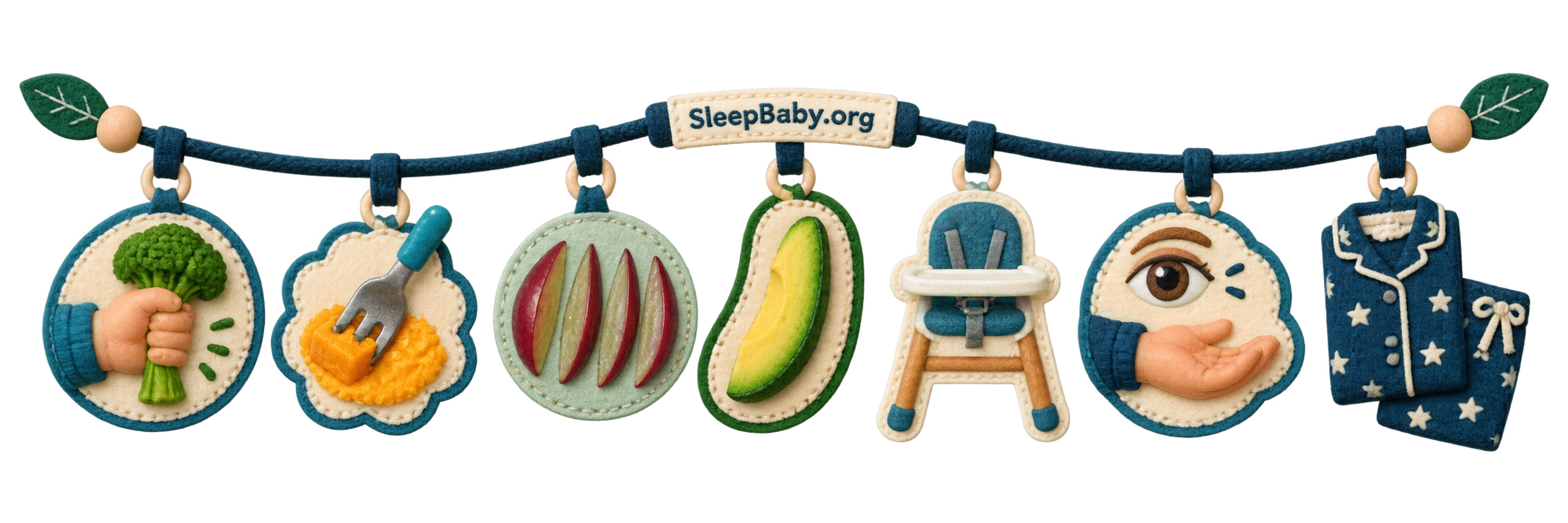
“Cut it about the size of an adult finger” is memorable, but it is only one check. A raw carrot can be finger-shaped and still be far too hard. A soft sausage can be easy to bite and still form a round airway plug. Before food reaches the tray, check all three.
Signature teaching tool
Run every BLW food through these three cuts
-
1. Texture: does it yield?
Cook or ripen the food until it flattens easily with light pressure from your fingers or a fork. Test the thickest part, not the soft edge. This quick “squish test” helps, but it does not guarantee a food cannot cause choking.
-
2. Geometry: could it plug?
3. Grip: can this baby hold it?
The part I would not skip: retest after cooking, cooling, or reheating. A food can be soft at the edge and firm in the center, or turn rubbery as it cools.
SleepBaby.org original teaching framework. It supports—not replaces—food-specific guidance and close supervision.

BLW foods that teach a preparation pattern
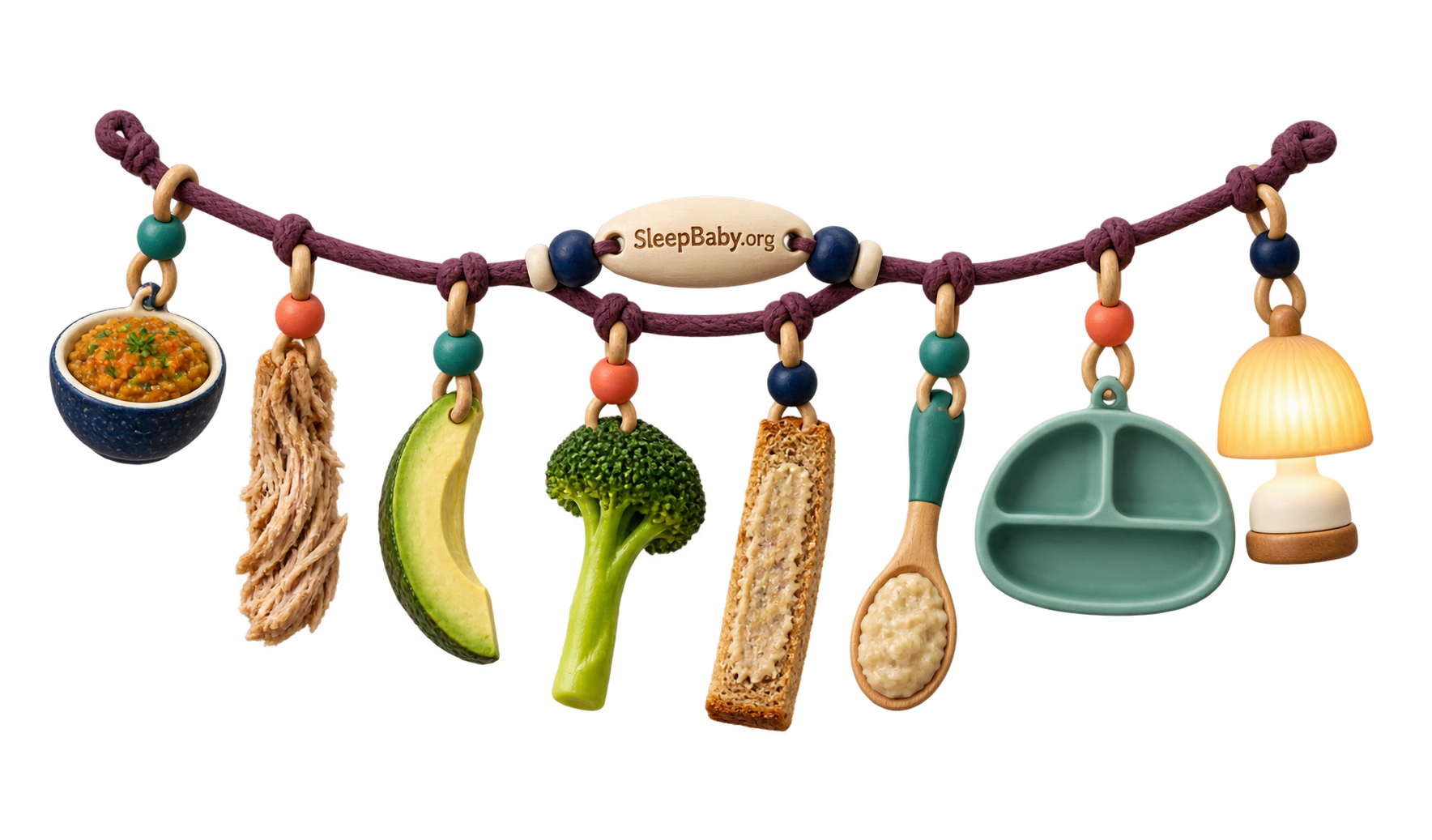
You do not need a list of 100 first foods. You need a handful of patterns you can reuse. These examples are options for a ready baby; they are not a prescribed menu, and every unfamiliar ingredient still needs your allergy plan.
Iron-fortified oatmeal
Mix it thick enough to cling to a preloaded spoon. Place the spoon on the tray and let your baby bring it to their mouth. Thin, running cereal is harder to self-feed; cereal in a bottle is unsafe.
Beans or lentils
Cook until very soft and mash on a preloaded spoon. Choose low-sodium options and rinse canned beans. Loose firm beans are not a beginner shape merely because they are small.
Ground meat
Cook fully without added salt and form a moist, soft strip or patty that breaks down easily. Avoid dry crumbles that are hard to gather and tough cubes that require advanced chewing.
Broccoli
Steam a large floret until the stalk and crown yield easily, leaving the stalk as a handle. Raw or still-crunchy broccoli does not pass the texture check.
Avocado or ripe pear
Offer a large soft wedge with a grippable surface. Peel tough skin and remove pits, cores, and hard sections. A slippery wedge may need a textured edge, but never coat it in an unintroduced allergen.
Egg or yogurt
After the allergen plan is clear, offer fully cooked egg as a soft omelet strip or plain full-fat pasteurized yogurt on a preloaded spoon. Introduce unfamiliar common allergens one at a time.
Foods to avoid or modify
Whole nuts, popcorn, hard raw produce, whole grapes or cherry tomatoes, sausage or hot-dog coins, hard candy, tough meat chunks, hard cheese chunks, bones, pits, and sticky spoonfuls of nut butter belong off the beginner tray. The CDC choking-hazard list is the one I would keep handy while you learn the patterns.
Gagging versus choking: listen, look, then act
This distinction deserves more than a reassuring sentence. Gagging is a protective reflex while a baby learns where food is in the mouth. It can look dramatic. Severe choking is an airway emergency. It may look quieter.
Usually noisy
Gagging
- Baby can make sound and move air.
- May cough, retch, push the tongue forward, water at the eyes, or vomit.
- Color generally remains normal, though the face may redden.
- Stay calm, watch closely, and let the baby work the food forward. Do not hook it out with a finger.
May be quiet
Severe choking
- Baby cannot breathe, cry, or cough effectively.
- May make little or no sound or show an ineffective cough.
- Color may change; on darker skin, check the gums, inside the lips, and nail beds as well as the face.
- Call 911 and begin current infant choking first aid immediately.
If your baby is coughing forcefully and making sound, encourage the cough and watch closely. If the cough becomes ineffective or breathing is impaired, move to emergency action. Do not turn a baby upside down, use abdominal thrusts on an infant, or put your fingers into the mouth blindly.
The current AHA/AAP pediatric basic-life-support guidance uses repeated cycles of 5 back blows and 5 chest thrusts for a conscious infant with severe foreign-body airway obstruction. If the infant becomes unresponsive, begin CPR. A dispatcher can coach you, but the best time to learn hand position and force is in a class, not during the emergency.
See the difference
What ordinary gagging can look and sound like
Watch this short example before the first finger-food meal so a noisy gag does not look identical to a silent severe airway obstruction. The NHS links this clip as an observational example of gagging; it does not teach emergency first aid.
Takeaway: gagging is usually noisy; severe choking may be quiet or ineffective. Learn infant choking response hands-on and call 911 for ineffective breathing. If the player does not load, open the NHS-recommended gagging example.
Build nutrition around iron, not just variety
It is easy for a beginner tray to become a parade of soft fruit because fruit is simple to cut and babies often accept it. Fruit is useful. It is not the whole nutritional job. At about 6 months, babies need a source of iron outside human milk, according to the CDC’s infant iron guidance.
That does not mean every bite must be optimized or every meal must have four perfect sections. I would give the meal an iron-rich anchor, then build variety around it as foods are tolerated. If your baby was premature, has poor growth, or has an existing iron or feeding plan, ask the pediatrician what applies; do not start or change a supplement from a general article.
The flexible tray builder
Four jobs—not four required portions
Iron-rich anchor
Iron-fortified cereal, soft meat, mashed beans or lentils, egg after appropriate introduction, or another culturally familiar iron source.
Energy and texture
Avocado, full-fat pasteurized yogurt, or a familiar food prepared with an appropriate unsaturated fat. Use a safe texture, not a spoonful-sized sticky glob.
Produce or grain
A soft fruit, vegetable, or whole grain adds flavor, texture practice, and variety. New foods can arrive gradually rather than all on one crowded tray.
Milk continues
Human milk or iron-fortified infant formula remains central through the first year. Early solids add nutrition and practice; they do not justify abruptly dropping milk feeds.
Responsive rule: you choose what safe options are offered. Your baby chooses whether and how much to eat. Repeat exposure counts even when intake is tiny.
Allergens and foods that need their own boundary
Common allergens belong in developmentally appropriate forms, not in choking-hazard forms. Smooth peanut butter can be thinned or spread very thinly after other solids are tolerated; whole peanuts and spoonfuls of nut butter are not infant foods. Egg should be fully cooked. Dairy should be pasteurized.
If your baby has severe eczema, egg allergy, or a previous immediate food reaction, contact the pediatrician before peanut or other allergen introduction. The NIAID peanut-prevention guideline uses different pathways for different risk groups. A generic first-week menu cannot safely replace that decision.
Call 911 for a severe allergic reaction
Breathing difficulty, swelling involving the mouth or tongue, collapse, or a rapidly worsening reaction affecting more than one body system needs emergency care. Do not attempt a home rechallenge after an immediate reaction.
Also keep honey off the menu before 12 months. Avoid unpasteurized foods, high-mercury fish, added sugar, and excess sodium. Do not serve cow’s milk as the main drink before 12 months, and do not use juice or sweet drinks to encourage intake. Food safety still applies: wash hands and surfaces, cook meat and egg thoroughly, and chill leftovers promptly.
A calm first-week baby-led weaning plan
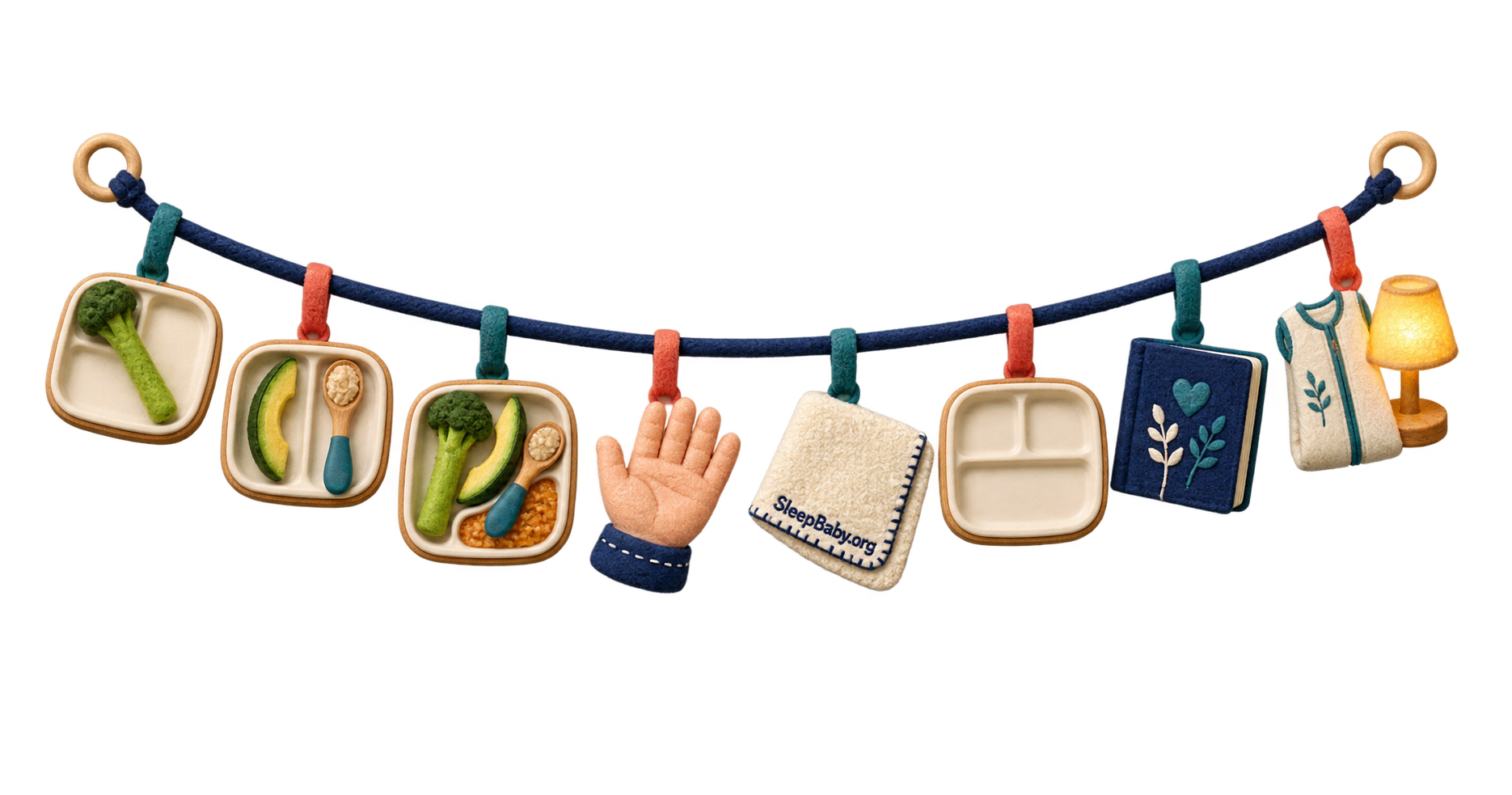
This is a practice plan, not a prescription. It deliberately moves slowly so you can watch tolerance and build one repeatable safety routine. Your pediatrician’s plan wins when your baby has medical, growth, allergy, or feeding considerations.
Seven days, two new foods
The first week is for a safe loop, not a full menu
-
Before day 1: set the conditions
Confirm the readiness cluster. Set the high chair upright. Review infant choking response and register for hands-on training if you have not taken it. Pick a calm daytime or early-evening window that ends before the wind-down, and choose one iron-rich starter.
-
Days 1–3: repeat one iron-rich food
Offer the same new food once a day while normal milk feeds continue. Examples include thick iron-fortified oatmeal or well-mashed lentils on a preloaded spoon. Let your baby touch, smell, squash, lick, swallow, or decline it. Track tolerance and skill—not grams.
-
Days 4–6: add one soft second food
If the first food was tolerated, repeat it and add one soft produce or energy food prepared for your baby’s grasp. Keep only one ingredient unfamiliar at a time. Stop at fullness cues. If an allergen is involved, use the family’s risk-appropriate plan rather than this generic sequence.
-
Day 7: combine tolerated foods and review
Offer the iron anchor with the second tolerated food. Review the chair position, texture, geometry, grip, and your baby’s response. Decide whether you are ready to add another food next week or whether a symptom deserves a call.
The week’s actual win: you can repeat the same calm sequence without forcing intake. Two tolerated foods and a reliable safety routine are more useful than a seven-day photo collage.
During week 2 and beyond, continue offering iron-rich foods regularly and widen the variety across proteins, energy-rich foods, vegetables, fruit, grains, and appropriate allergens. Repetition is normal. A baby can learn from touching and tasting a food before they eat much of it.

What if almost nothing gets eaten?
Very little may be swallowed at first. The tray, bib, sleeves, and nearby floor can all receive a more decisive serving than the baby. Look at the whole pattern: Is your baby alert? Are milk feeds continuing? Are wet diapers and growth on track? Are they gaining skill over time? A small first meal is different from persistent difficulty eating.
Do not respond by pushing food into the mouth or making every bite a negotiation. Keep the practice short, repeat familiar preparations, and offer one or two options rather than a crowded spread. If the baby is too hungry to explore, protect the milk feed and try solids at a calmer point next time.
Pause and ask for a feeding or swallowing review when
- coughing or choking happens repeatedly during meals;
- breathing or the voice sounds wet or gurgly after swallowing;
- chewing takes a long time or food remains pocketed in the mouth;
- meals cause pain, unusual fatigue, or intense distress;
- chronic congestion, repeated respiratory illness, poor growth, or loss of skills is present.
Start with your baby’s pediatrician and ask whether a pediatric feeding or swallowing evaluation is appropriate. Acute ineffective breathing is 911, not a routine appointment.
What the baby-led weaning evidence can—and cannot—promise
The best-known trials studied BLISS, a modified baby-led approach that explicitly taught families about choking hazards, iron-rich foods, and energy intake. In a randomized trial of 206 healthy infants, choking reports did not differ significantly from usual feeding, but families in both groups still offered hazardous foods. Another trial did not find worse iron status when iron-rich foods were deliberately emphasized. A growth trial did not show a more favorable body mass index.
A 2026 systematic review found only a small number of randomized trials. My translation is deliberately unglamorous: a supported, flexible baby-led approach can be reasonable for many healthy, ready infants, but it has not earned a superiority badge. It cannot promise easier parenting, perfect nutrition, less picky eating, obesity prevention, no choking, or better sleep.
If the practical question is what happens between a later milk feed or solids meal and the crib, keep that as a separate sleep-and-comfort decision. Our guide to putting a baby down after feeding can help you think through that transition without turning dinner into a sleep treatment.
Baby-led weaning beginner questions
Does my baby need teeth for BLW?
Teeth are not the readiness test. Babies can mash many appropriately soft foods with their gums. The food still needs to pass the texture and geometry checks, and your baby still needs upright control and oral-motor readiness.
Can I combine baby-led weaning and purees?
Yes. Use smooth or mashed food on a preloaded spoon and let your baby bring it to their mouth, or offer responsive spoon help without forcing. The nutrition and safety of the food matter more than defending a method label.
How much should a 6-month-old eat?
There is no single target portion for a first week. Start with a small amount, keep milk feeds, and follow hunger and fullness cues. Your pediatrician should individualize intake when growth, prematurity, iron, or medical concerns are present.
Should I remove food when my baby gags?
Do not put your fingers into the mouth blindly. If your baby is making sound and moving air, stay close and let the protective reflex work while you watch. If breathing or an effective cough is lost, treat it as choking and act immediately.
Will solids help my baby sleep longer?
Do not start solids to fix night waking. Putting cereal or other solid food in a bottle increases choking risk and does not make an infant sleep longer. Keep eating upright and fully awake, then let cleanup and the normal wind-down happen later.
Sources
- CDC: When, What, and How to Introduce Solid Foods
- CDC: Choking Hazards
- CDC: Iron
- American Academy of Pediatrics: Baby-Led Weaning—Is It Safe?
- NHS: Preparing Food Safely
- NHS: Choking and Gagging on Food
- AHA/AAP: 2025 Pediatric Basic Life Support Guidelines
- NIAID: Addendum Guidelines for Peanut Allergy Prevention
- Pediatrics randomized trial: Baby-led approach and choking risk
- 2026 systematic review of randomized baby-led weaning trials