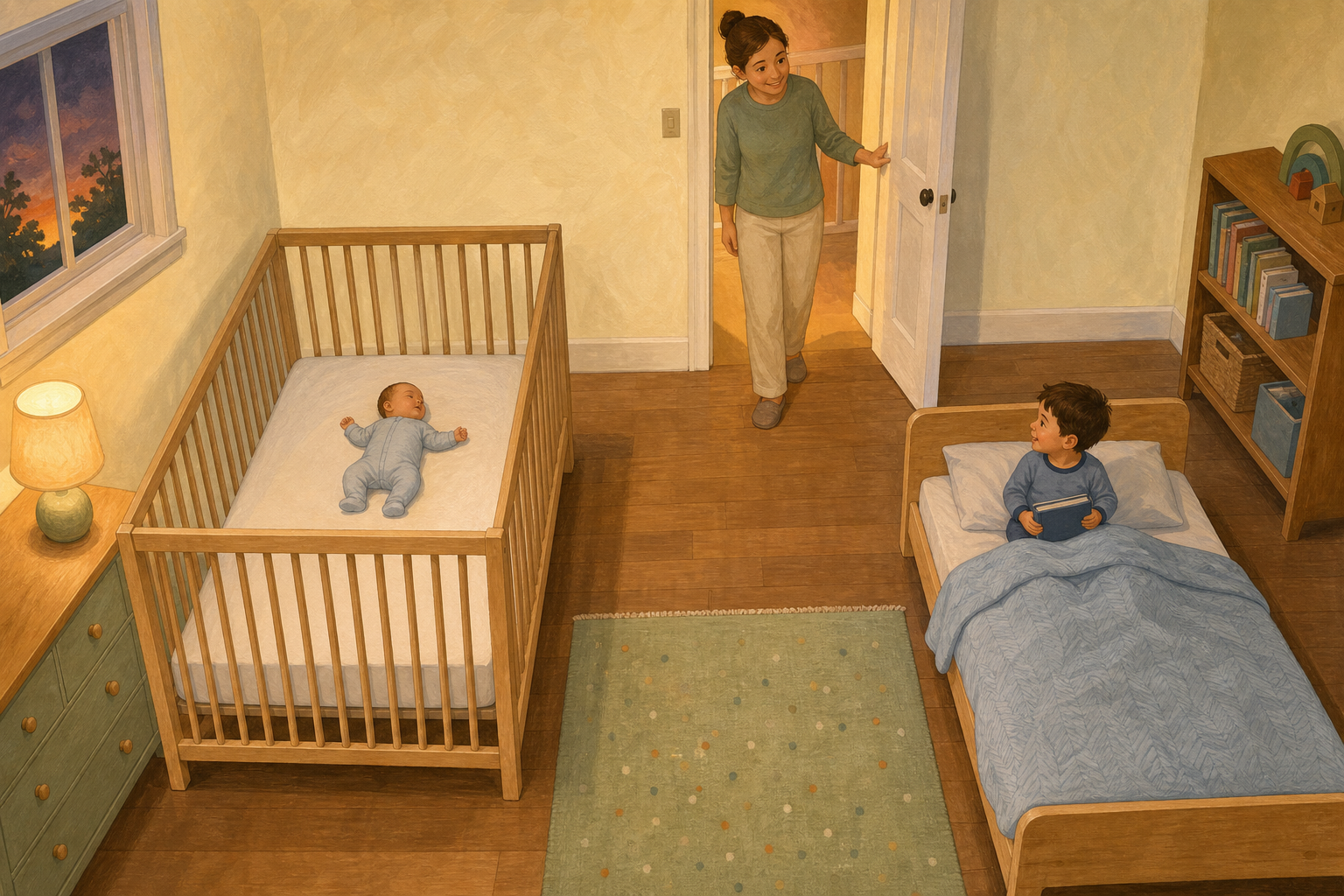
Yes, a baby and toddler can share a room—but only when the baby keeps a completely separate, safety-approved sleep space and the room can protect that space after the adults leave. For a baby in the first year, that means a firm, flat, level infant sleep surface with a fitted sheet, the baby placed on their back for every sleep, and no pillows, loose blankets, stuffed toys, bumpers, positioners, weighted products, or sibling on that surface.
This question usually arrives holding a tape measure. You are not daydreaming over matching wallpaper; you are trying to make two children, two sleep schedules, and one actual floor plan coexist. I understand the urgency. But the first question is not “Can the crib and toddler bed fit?” It is “Can toddler bedding, toddler hands, cords, furniture, and nighttime shortcuts stay out of the baby’s sleep space?”
There is one important timing boundary before we arrange a single piece of furniture: the American Academy of Pediatrics recommends that a baby sleep on a separate infant surface in the parents’ room, ideally for at least the first six months. A toddler’s presence in another bedroom is not the same as caregiver room sharing. After that recommended period, there is no universal birthday that automatically makes sibling room sharing safe. Readiness depends on the baby’s plan, both sleep surfaces, the toddler’s behavior around the crib, the room itself, and whether adults can respond to either child without improvising.
First decide whether the baby is ready to leave your room
If your baby is younger than six months and parent-room sharing is feasible, keep the baby’s separate sleep surface in your room. If housing, disability, caregiver health, work arrangements, or another real constraint makes that default impossible, tell your baby’s clinician what the available setup actually looks like. The answer should be built around your real home while preserving back-to-sleep placement, a separate approved surface, and a bare infant sleep area.
For a fuller look at the recommended timing and the move from a caregiver’s bedroom, see how long a baby should stay in the caregiver’s room. This guide begins where that one leaves off: with the mixed-age sibling room itself.
A baby sleeping a long stretch is not a safety certificate. Neither is a toddler who is gentle during the day. The details that change my answer are more concrete:
- Does the baby have a separate infant sleep product that is appropriate for their age and within its limits?
- Can the toddler reach into that space from their bed, a chair, a toy bin, a shelf, or an open drawer?
- Has the toddler been climbing into the crib or pushing objects through the rails?
- Can every cord, curtain, window, heater, lamp, and top-heavy piece of furniture be controlled?
- Can an adult reach the baby for a feed or urgent need without placing the baby on the toddler’s bed “for a second”?
- Does a clinician need to weigh in because the baby was premature, had a low birth weight, is medically fragile, or has a prescribed monitoring plan?
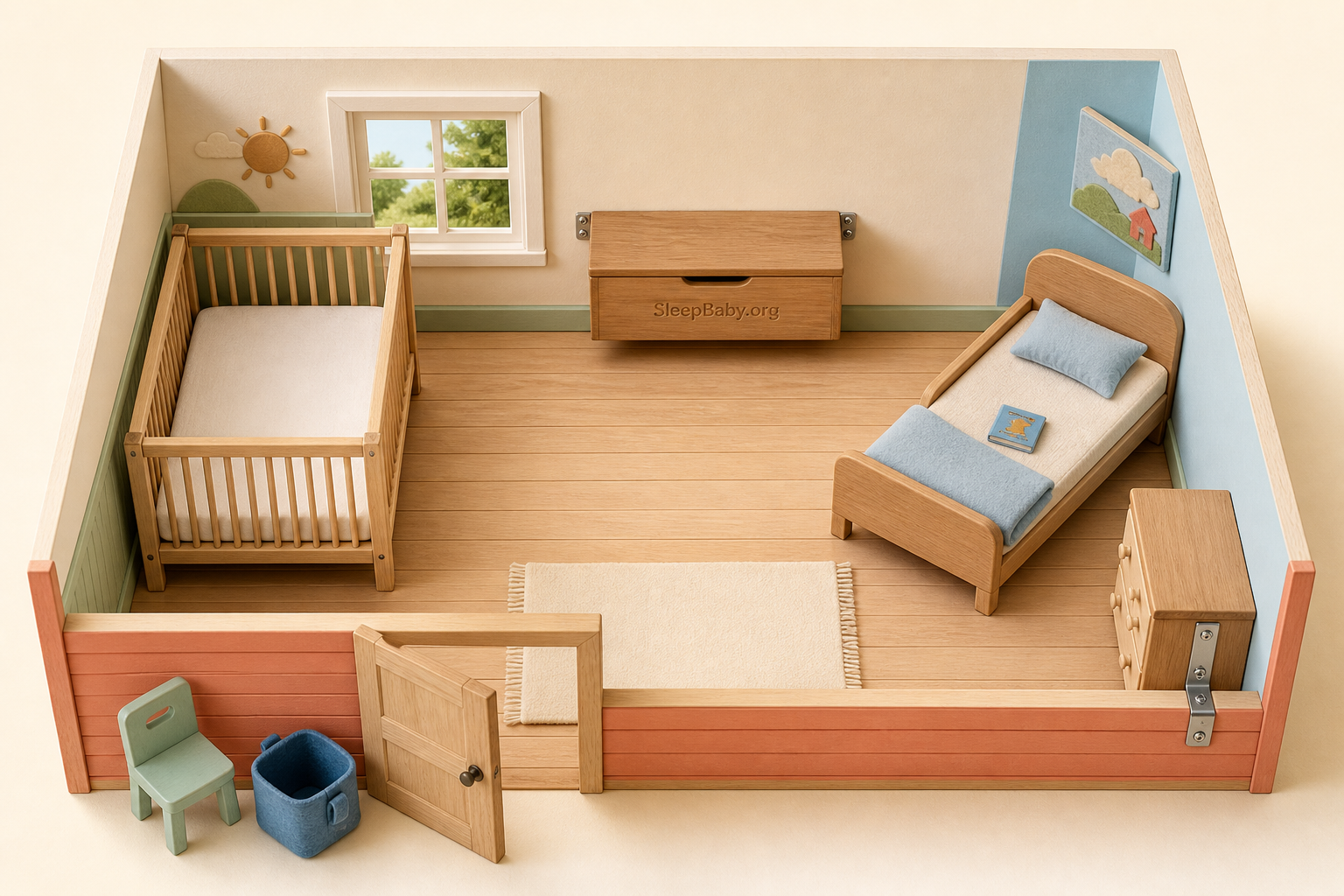
The two-island floor test
A shared room works better when you stop seeing one children’s room and start seeing two sleep islands. The baby island follows first-year infant rules. The toddler island follows the toddler’s age, development, and product instructions. The open water between them is not decorative space; it is the reach, throw, climb, and caregiver route that keeps the two systems from colliding.
Can this floor plan protect two different sleep systems?
Baby island
- Approved infant sleep surface within product limits
- Firm, flat, level mattress and fitted sheet
- Baby placed on the back for every sleep
- No loose or soft objects and no sibling access
Toddler island
- Age-appropriate sleep surface within its instructions
- Toddler bedding and comfort objects stay here
- No furniture “steps” toward the crib
- No upper bunk for a child younger than six
The water between: Stand at toddler height. Test whether a blanket can be thrown into the crib, a mattress can become a launch point, a toy bin can become a step, or a charging cable can be reached by moving one light object. If yes, redraw the islands.
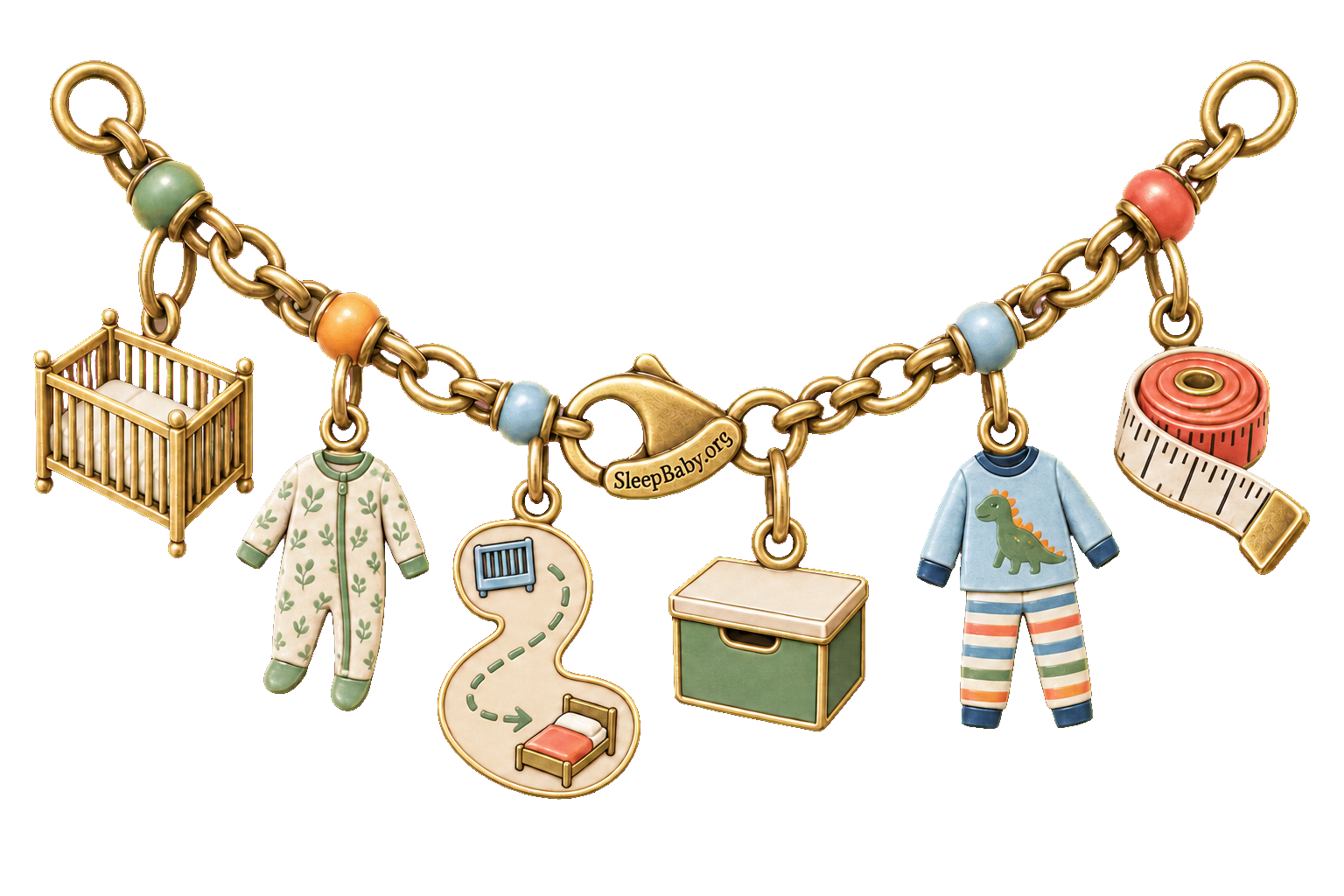
The toddler is not the safety system. Affection, curiosity, and impulse control can all arrive at the crib rail together, especially at night. A toddler who tucks a stuffed rabbit beside the baby is not being reckless; they are being lovingly, developmentally ordinary. Our adult job is to design a room that does not require preschool-level judgment to protect an infant airway.
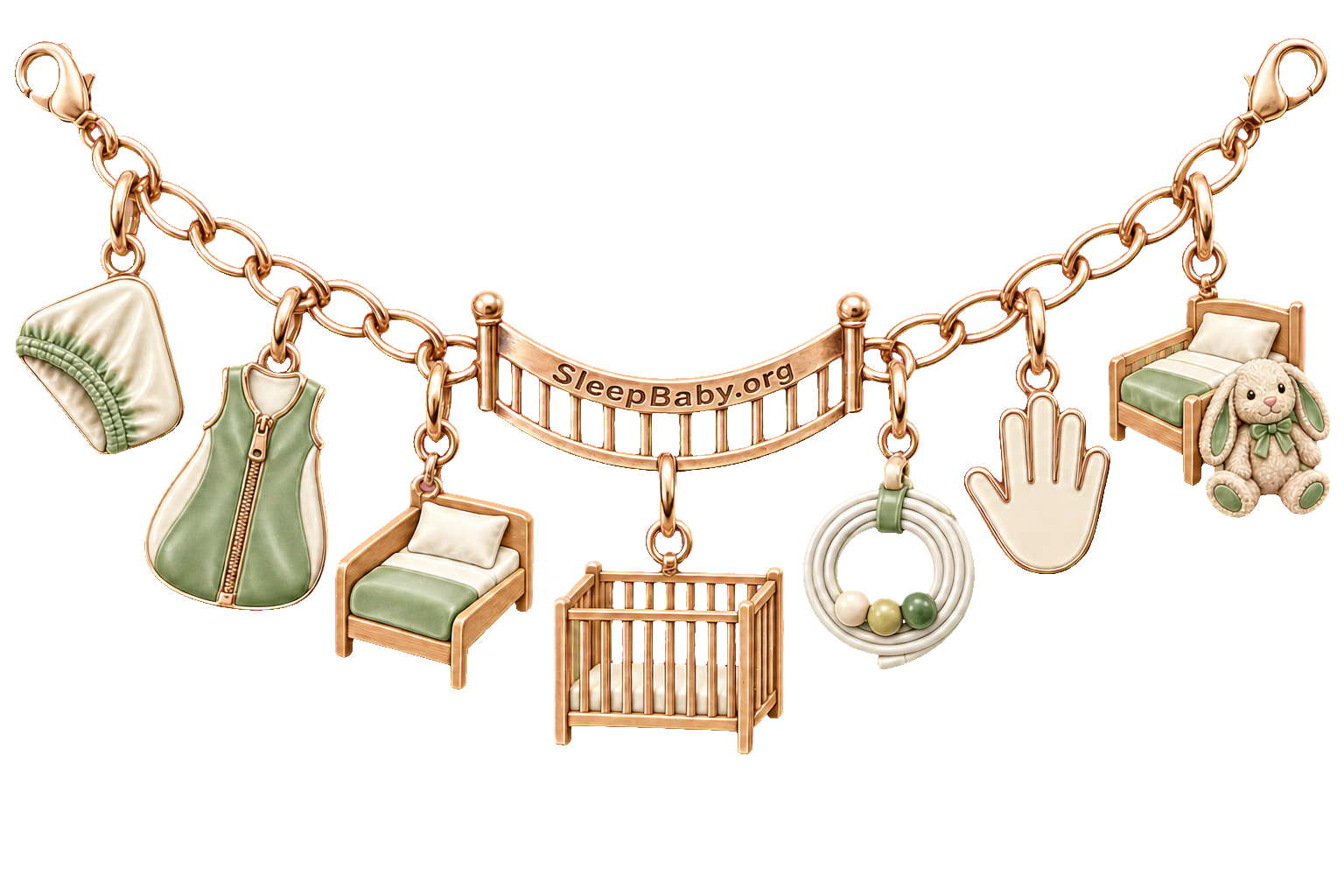
Why baby and toddler bedding rules are incompatible
The phrase “separate beds” is not enough. A baby and toddler sharing a room bring two different bedding systems into one space. During the baby’s first year, the infant surface stays bare except for a fitted sheet. When warmth is needed, use appropriate sleep clothing or a wearable blanket rather than a loose blanket. Keep pacifier clips, cords, and stuffed attachments out of the sleep space too.
The toddler may use age-appropriate comfort objects on the toddler side according to the family’s pediatric and product guidance. This article does not need to declare one universal age for a toddler pillow or blanket. It needs to draw the border: whatever belongs on the toddler’s surface cannot fall, be carried, or be tossed into the baby’s crib.
If the toddler sleeps on a floor bed and can roam, assume the entire room is reachable. A bare crib at bedtime can become a non-bare crib at 1 a.m. if the toddler can walk over with a pillow. Do not add a crib tent, improvised screen, tie, or homemade barrier. If the room cannot prevent object transfer without an unapproved fix, pause the shared-room plan.
Nothing crosses the crib rail
A tired-parent sorting rule for ordinary objects in a mixed-age room
| Item | Where it belongs | Why the boundary matters | If it gets transferred |
|---|---|---|---|
| Pillow or loose blanket | Toddler surface only | Soft, loose bedding does not belong in an infant sleep area. | Remove it immediately; pause the trial if transfers repeat. |
| Stuffed toy or lovey | Toddler side or closed storage | A toy that is fine for a toddler can obstruct an infant’s clear sleep space. | Remove calmly; redesign access rather than scolding. |
| Book, cup, bag, or dress-up item | Closed storage outside crib reach | Hard pieces, straps, and cords create hazards and invite delivery missions. | Clear the crib and relocate the storage. |
| Monitor or charging cord | At least three feet away and inaccessible | Cords are a strangulation hazard; a moved chair can change reach. | Do not use the room until the cable route is corrected. |
Arrange the shared room in daylight
Do the safety walk when you are awake enough to notice the room you actually have. Get down to toddler height. Open the drawers. Move the chair. Stand on the edge of the toddler mattress. A charging cable that looked unreachable yesterday can become reachable the day a toy bin learns to moonlight as a step stool.
Start with reach, not a made-up furniture distance
There is no authoritative universal number of inches that a crib must sit from a toddler bed. The functional test is stronger: the toddler cannot reach, climb, or transfer objects into the infant surface. Put the crib where the toddler cannot reach it from their mattress or nearby furniture. Keep adult pillows and laundry off the crib rail and away from anything that could drop into the crib.
Move cords and control windows
Keep every baby-monitor cord and monitor part at least three feet from babies and young children, and make the whole route inaccessible. CPSC identifies cordless window coverings as the safest option in homes with young children. Move cribs, beds, furniture, and toys away from windows and window-covering cords, preferably to another wall. A short cord can become reachable when a child can drag a chair; audit the room as a system, not a still photograph.
Anchor what can tip
Anchor dressers, bookcases, televisions, and other top-heavy furniture according to the manufacturer’s instructions and current CPSC guidance. Store heavier items low. Remove tempting toys, glowing gadgets, and favorite books from furniture tops if they invite climbing. Recheck anti-tip hardware whenever the room is rearranged.
Keep both surfaces within their limits
Follow each sleep product’s instructions. Move a toddler out of a crib when the child can climb out or reaches the product limit; the federal full-size crib standard uses 35 inches (89 centimeters) as a use limit. That transition does not make the toddler’s mattress suitable for the baby. It means the whole shared-room layout needs another audit because the toddler may now roam.
A bunk bed is not the clever solution it first appears to be. An infant does not sleep on either bunk as an infant surface, and a child younger than six must not use the upper bunk. In most baby-and-toddler rooms, two low, separate surfaces are the clearer arrangement.
Preserve the tired-adult route
Walk from the doorway to the baby’s sleep space in low light. Can you reach the baby for a feed, diaper change, or unusual cry without stepping over the toddler, catching a cord, or setting the baby on the toddler bed? Keep essential nighttime supplies in an anchored, inaccessible location or just outside the room. The setup should work when someone is tired and holding a fussy baby, not only when the floor is freshly vacuumed.

Same room, two clocks
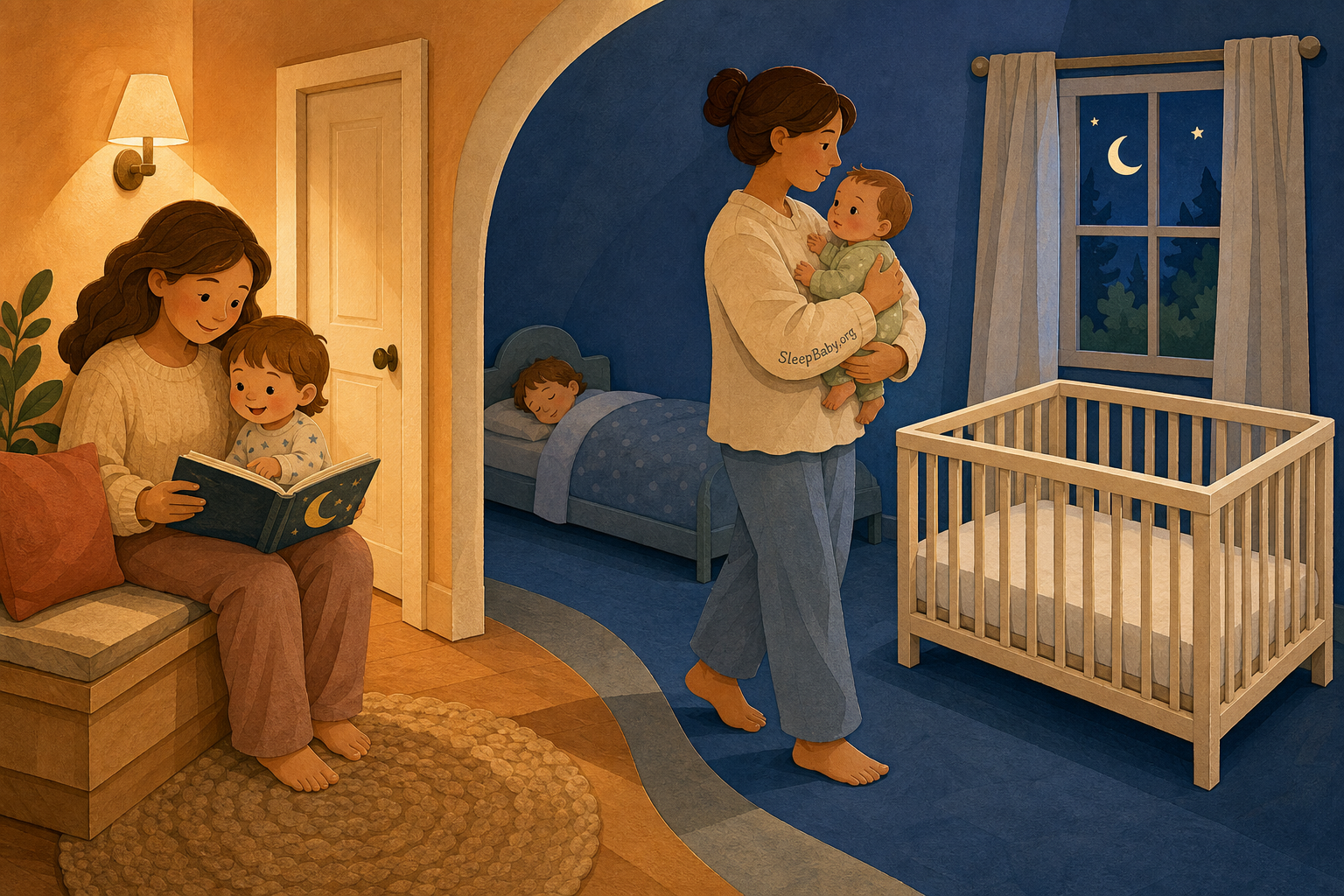
Room sharing does not erase age. The American Academy of Sleep Medicine recommends 12–16 hours of sleep per 24 hours, including naps, for babies 4–12 months; 11–14 hours for children 1–2 years; and 10–13 hours for children 3–5 years. Those are ranges, not matching schedules. Two children can share a ceiling and still need different naps, bedtimes, feeds, and morning expectations.
Protect each child’s total sleep opportunity. Do not postpone an infant feed to preserve the toddler’s sleep. Do not leave the baby on an unsafe temporary surface while settling the toddler. Do not ask the toddler to monitor the baby or wake an adult. If you are working through the baby side of the day, this 10-month-old nap schedule can help you think about an older infant’s rhythm without changing safe-sleep rules. For the older child, use the 17-month-old sleep schedule as toddler-side context, not as a command that both children share one bedtime.
The bedtime traffic controller
Choose a starting lane from the household facts. None is medically superior, and none promises a silent night.
Lane A: baby first
Try when: the baby sleeps earlier and the toddler can finish quiet steps outside the room.
- Feed and settle the baby.
- Place the baby on the back in the bare infant space.
- Finish the toddler’s book, teeth, and connection elsewhere.
- Enter for a quiet final tuck-in.
Lane B: toddler first
Try when: the toddler settles predictably and the baby’s final feed comes later.
- Complete the toddler routine.
- Feed and settle the baby elsewhere.
- Use a clear route and low light to place the baby in the crib.
- Accept that the door may wake the toddler sometimes.
Lane C: share, then split
Try when: both children enjoy the same calm book or song but need different final care.
- Share the supervised calm part.
- Split for feeding, diapering, teeth, and toddler comfort objects.
- Put each child on their own surface.
- Keep every toddler item out of the crib.
Run a three-night observation, not a three-night performance review. Change one variable at a time. Judge the sequence by safety, adequate sleep opportunity, and caregiver sustainability—not by whether nobody woke.
What to do when one child wakes the other
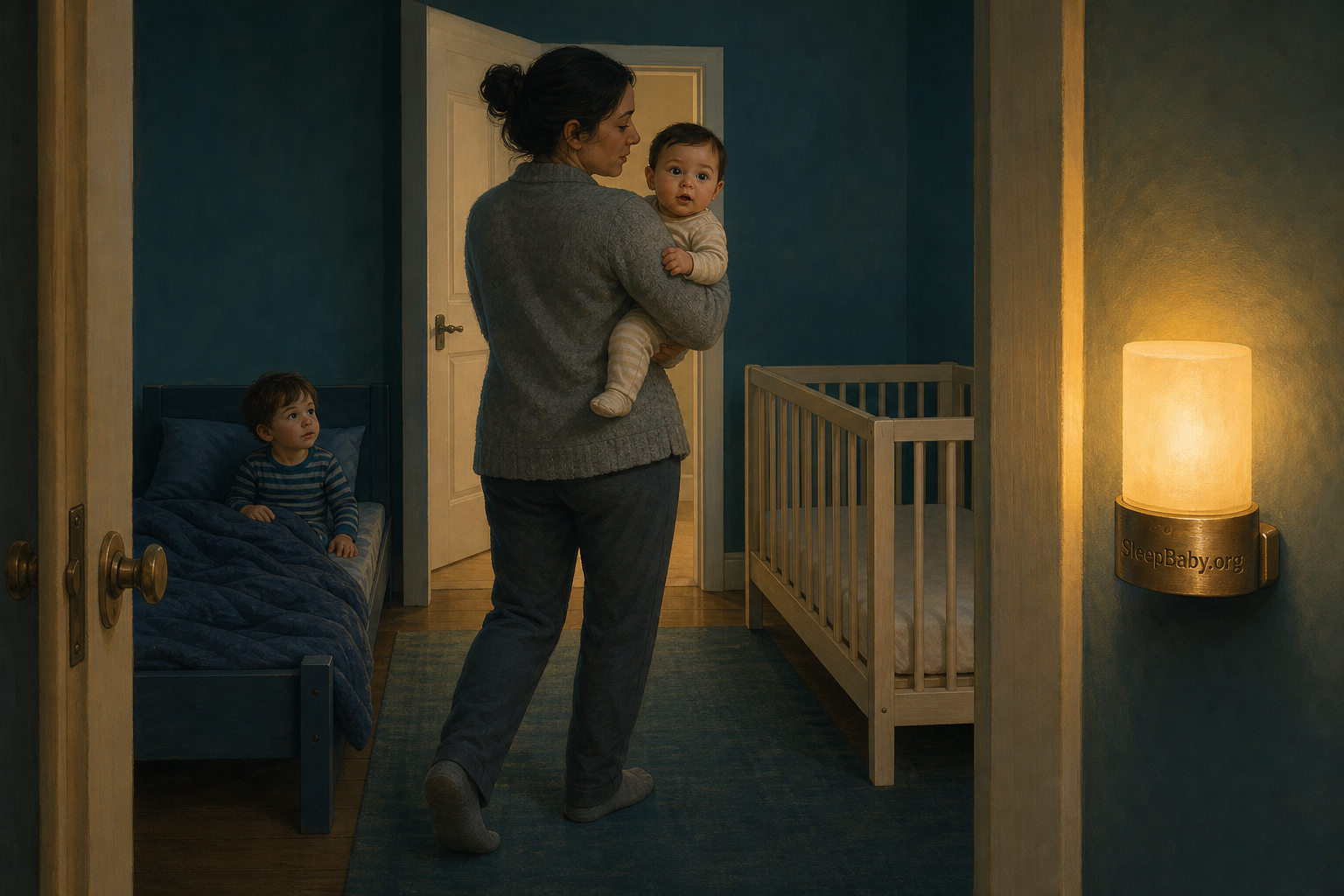
Waking is an inconvenience; delayed care can become a problem. Meet the need in front of you, keep the room low-stimulation, and refuse unsafe shortcuts.
The baby wakes and the toddler sleeps
Respond to the baby as needed. If feeding or longer settling is required, leave the room with the baby when that is safe and practical, then return the baby to the infant surface. Do not feed or settle the baby on the toddler bed if you might fall asleep there.
Both children wake
Meet urgent needs first. Use a brief, boring reassurance for the toddler while you feed or change the baby. With one adult, it may be easier to move the awake toddler to a safe quiet place while caring for the infant—or to carry the baby out while the toddler resettles—depending on who needs hands-on care. The plan does not have to be elegant. It has to keep both sleep surfaces safe.
The toddler approaches the crib
Return the toddler to their surface and remove anything transferred into the crib. Do this calmly and consistently. If the toddler repeatedly climbs into the crib, reaches for the baby, tries to lift the baby, or adds objects after adults leave, stop unsupervised room sharing for now. A daytime promise is not a nighttime barrier.
Early waking keeps repeating
Look first at each child’s total sleep opportunity, nap timing, ordinary light and noise, hunger or feeding plan, illness, and whether one child is going down long before they are ready. Adjust one part of the schedule at a time. There is no magic fixed-minute bedtime shift that solves every shared room.
One child is ill or has unusual symptoms
Temporary separate arrangements may be easier during illness, but the baby still needs an approved infant sleep surface. Seek medical guidance for breathing difficulty, unusual color, poor feeding, fever concerns by age, unusual sleepiness, or difficulty waking. Call emergency services for severe breathing difficulty, blue or gray color, unresponsiveness, or another emergency sign. Do not wait because waking the sibling would be inconvenient.
Special room-sharing setups
Newborn and toddler
A toddler’s bedroom is not the recommended default for a newborn. Keep the newborn on a separate infant surface in the caregiver’s room for at least the first six months when feasible. If your living situation makes that impossible, bring the actual floor plan to the pediatrician rather than hiding the constraint. Safe guidance should fit real families without pretending every home has a spare room.
Mobile baby and floor-bed toddler
A floor bed gives the toddler free access to the room. The setup works only if the toddler cannot add anything to the infant crib or climb into it after lights-out. Treat every object in the room as reachable. A decorative screen or homemade crib barrier is not the fix.
Two cribs
Two separate compliant cribs may make the bedding boundary clearer while both children remain within product limits. The cribs still need safe clearance from cords, windows, climbing routes, and reach-through hazards. When the toddler climbs out or reaches the crib limit, re-audit the entire room rather than swapping only one piece of furniture.
A bunk bed is already there
Do not use either bunk as the baby’s infant sleep space, and do not put a child younger than six on the upper bunk. Follow the manufacturer’s age, mattress, guardrail, and assembly instructions for any older child who uses the bed. For a baby and toddler, the bunk may consume more safe space than it saves.
White noise and a monitor
These can be optional household tools, not safety equipment. A monitor can help you hear or see a waking child. It does not prevent SIDS, make loose bedding safe, or substitute for checking a child. Keep its cord and parts at least three feet away and inaccessible. White noise does not justify delaying a feed or leaving the baby on an unsafe surface.
Prematurity, low birth weight, or prescribed monitoring
Premature and low-birth-weight babies have higher sleep-related risk. Consumer monitors do not replace safe sleep, while a clinician-prescribed monitor or sleep plan may include individual instructions. Before changing rooms, reconcile the plan with the clinician overseeing that care.
A 60-second safe-sleep reset
The sibling-room details can become complicated, but the baby’s sleep surface should remain beautifully boring. This official NIH/NICHD Safe to Sleep video reviews the core: a separate sleep area, a firm mattress, nothing else in the crib, back placement, and avoiding overheating.

The last check before the first shared night
Stand in the doorway after both sleep spaces are ready. Is the infant surface firm, flat, level, fitted-sheet-only, and unreachable from the toddler side? Are cords controlled, window coverings safe, furniture anchored, and the path to each child clear? Can you feed, soothe, and respond without using the wrong bed? Do you know what behavior would end the trial?
If those answers are yes, try the bedtime sequence that best fits your children and observe for three nights. Keep the safety rules fixed while changing only one schedule variable at a time. If the toddler turns the crib into a delivery address, if the layout creates a workaround, or if necessary care is being delayed, stop. A shared room should reduce a household constraint; it should not create a new safety gamble.
That is the distinction I would keep on the wall: the children can share a room without sharing a sleep surface, a bedding system, or one synchronized clock. The room is ready when the adult-designed boundaries still work during the least photogenic part of the night.
Sources
- American Academy of Pediatrics: 2022 safe-sleep recommendations
- CDC: Providing Care for Babies to Sleep Safely
- NIH/NICHD Safe to Sleep: Safe Sleep Environment
- U.S. Consumer Product Safety Commission: Safe Sleep
- CPSC: Baby-monitor cord safety
- CPSC: Window-covering cord safety and Anchor It! furniture guidance
- American Academy of Sleep Medicine: Child Sleep Duration Health Advisory
Two children, one room, two sleep plans
Build a bedtime rhythm that keeps both children’s boundaries intact
Once the room itself is safe, the next job is a repeatable household rhythm: who goes down first, how you handle feeds, and what you do when one small person wakes the other. SleepBaby can help you turn those moving parts into a calmer plan without asking two different children to run on one clock.
Sleep education is not a substitute for your pediatrician’s guidance or an individualized medical and safe-sleep plan.