The plan-first answer
Are baby monitors FSA eligible?
Ordinary audio and video baby monitors are not automatically FSA eligible. A health FSA reimburses qualified medical expenses, not nursery gear simply because it has an app, sensor, or health-sounding feature. An exact physiologic monitoring device may have a stronger eligibility basis when its function and your reason for buying it meet the plan’s medical-expense rules. But a product-page badge—or even a successful FSA-card swipe—is not a reimbursement guarantee. Before checkout, ask your plan administrator about the exact model, covered person, documentation, and claim procedure.12
If you are holding an FSA card in one hand and a monitor listing in the other, I know the private question is less tidy than “what does the tax code say?” You want to use limited account money wisely without receiving a denial later—and you do not want the word eligible to blur into safer. Those are two different decisions. I will keep them separate all the way through.
Two tests decide more than the word “monitor”
I would not start with the product category. “Baby monitor” can mean a basic audio receiver, an internet-connected camera, a motion-alert system, an over-the-counter pulse-rate and oxygen-saturation device, or equipment ordered for a particular medical need. Those are not interchangeable purchases.
Test 1 · What does this exact item do?
A device used for diagnosis, mitigation, treatment, prevention of disease, or to affect a body structure or function may fit the federal definition of medical care. An item used primarily for general health, convenience, or ordinary childcare usually does not become a medical expense merely because it collects data.13
Test 2 · Why are you buying it?
The exact medical purpose, covered person, and plan terms matter. A clinician’s recommendation or a letter of medical necessity may be required for some expenses, but neither document turns every nursery camera into eligible equipment. Ask what your plan needs before you spend.26
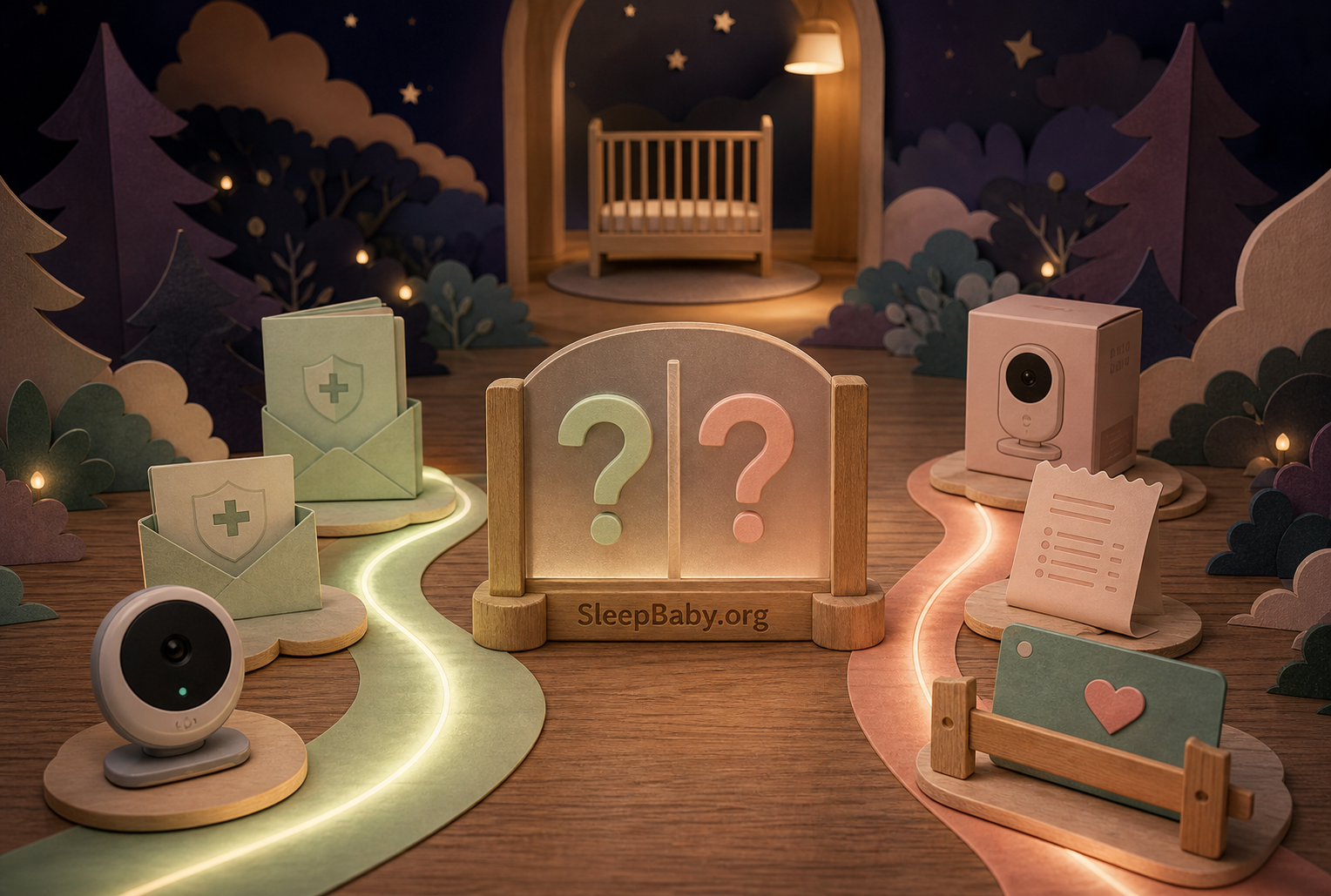
I think of these as two doors that both have to open: the item’s actual function and the plan’s treatment of your exact purchase. A vague “health features” label cannot hold either door open by itself.
Which kind of baby monitor are you actually buying?
The table below is a decision aid, not a promise of reimbursement. I would bring the exact product name and model number to the administrator rather than asking the broad question, “Are baby monitors covered?”
| Monitor type | Primary job | Plan-first reading | What to ask |
|---|---|---|---|
| Basic audio or video monitor | Ordinary listening, viewing, and childcare convenience | Not automatically eligible; the ordinary personal-use purpose is a weak medical-expense fit | Does the plan list this exact item or require a medical-purpose exception? |
| Smart camera with alerts | Video plus app-based motion, sound, sleep, or movement notifications | An alert feature does not automatically change a general childcare device into medical equipment | Which exact function, model, and purchase purpose does the plan evaluate? |
| Physiologic wearable | Measures specified body-function data within its labeled intended use | May have a stronger medical-expense basis, but exact-plan approval and documentation still control | Is this exact model eligible for this covered person, and what proof is required? |
| Clinician-prescribed monitor | Monitoring connected to a documented medical need | Follow the clinician’s order and plan process; do not substitute a consumer device on your own | Which equipment, supplier, prescription, or LMN does the plan require? |
| Camera-and-sensor bundle | Combines ordinary camera functions with another device | The entire bundle may not receive the same treatment as one component | Will the plan reimburse the whole SKU, only one item, or neither? |
FSAFEDS, for example, lists named medical monitoring and testing devices with varying documentation requirements; it does not declare every nursery camera eligible as a category.5 Your own employer plan can differ, which is precisely why the model number matters.
Use CHECK BEFORE CARD before you buy
The acronym is intentionally practical. I want you to be able to read it while a product page is open, not memorize a tax seminar.

- C — Confirm the account. Is this a health FSA, an HSA, an HRA, or a dependent-care FSA? Similar cards do not make the accounts interchangeable.
- H — Hold the exact model. Keep the product name, model number, SKU or ASIN, and bundle contents in front of you while you ask.
- E — Explain the medical purpose accurately. Describe the real reason for the purchase. Do not invent a diagnosis or convert ordinary childcare into treatment language.
- C — Collect the required proof. Ask for the exact itemized-receipt fields and whether a prescription, LMN, or other form is needed.
- K — Keep safety separate. Eligibility does not prove that a monitor prevents SIDS, replaces direct care, or makes an unsafe sleep space safe.
A plan-administrator script
“I am considering [exact product and model] for [covered person]. Does my account reimburse this exact item for its stated purpose? If yes, what itemized receipt, prescription, letter of medical necessity, or other documentation must I submit? If it is a bundle, is the whole SKU covered?”
I would save the administrator’s written response with the receipt. That is not a guarantee if facts change, but it is far more useful than trying to reconstruct a phone call after the claim system asks a question three months later.
What an “HSA/FSA eligible” label actually tells you
A manufacturer or retailer label can be useful. It may tell you that the seller has identified a medical-expense basis for the exact product or that its checkout system accepts certain benefit cards. It does not tell you that every plan, every purchase purpose, every covered person, or every bundled component will be approved.
Useful evidence
- Exact product identity and labeled function
- Manufacturer eligibility statement
- FDA classification when one exists
- Itemized receipt and purchase date
Not established by the badge
- Your plan’s final reimbursement decision
- Medical necessity for your child
- Prevention of SIDS or another outcome
- Safety, accuracy, or suitability beyond the label
The FDA’s De Novo record classifies the exact Dream Sock device as an over-the-counter infant pulse-rate and oxygen-saturation monitor; that regulatory fact is about the device’s intended function, not your FSA claim.7 The manufacturer currently describes the product as HSA/FSA eligible and labels it for babies 1–18 months and 6–30 pounds.8 I would give both facts to the plan administrator without pretending either one makes the decision for them.
Three plan answers—and what each one means before checkout
Plan searches and customer-service replies are not always a clean yes or no. Sometimes the result is a named eligible item. Sometimes it is a category marked “eligible with documentation.” Sometimes the database has no useful match at all. I would not treat those three answers as different spellings of permission; each one creates a different next step.
The exact item is listed
Match the model, SKU, covered person, purchase date, and seller—not just the brand name. Ask whether an itemized receipt is enough and save the plan’s current entry with your records. A list match strengthens the reimbursement answer; it still says nothing about whether the device is medically appropriate or makes sleep safer.
It is eligible only with documentation
Ask the plan to name the required document and the facts it must contain. “LMN required” is not an invitation to buy first and find a diagnosis later. Use the plan’s form when it has one, give the clinician the exact device information, and let the clinician decide whether the medical-purpose statement is accurate.6
The item is missing or the answer is unclear
Send the exact model, SKU or ASIN, manufacturer description, and honest purchase purpose to the administrator. Ask for a written determination or the formal pre-service review path, if the plan offers one. If the plan will not confirm it, decide whether you are comfortable paying with ordinary funds rather than treating a card swipe as the test.
Bundles deserve one more line in the message: “Is the complete SKU reimbursable as sold, or only a separately priced component?” A camera, sensor, base station, and subscription can perform different jobs even when one box puts them together. Do not create your own price allocation unless the seller’s receipt and the plan both support it.
FSAFEDS illustrates why this model-level reading matters: its search shows named monitoring and testing expenses with different documentation categories, not one blanket rule for anything called a monitor.5 The most useful answer is the one you can tie to the exact item before the return window, claim deadline, and your patience all begin competing with one another.
What proof might your FSA ask for?
Health FSAs generally require independent third-party substantiation. The record needs to identify what you bought, when you bought it, and how much you paid; the plan may request more information depending on the item and its rules.24 I would keep the following together instead of scattering them across an inbox, a photo roll, and the mysterious drawer where warranties go to retire:
- An itemized receipt showing seller, exact product, purchase date, and amount
- The product page or manufacturer document that identifies the model and function
- The administrator’s written eligibility and documentation guidance
- A prescription or signed letter of medical necessity only when the plan requires one
- The claim confirmation and any explanation of benefits or denial notice
A letter of medical necessity usually connects an expense to a diagnosed condition or treatment need and includes the information the plan requests. It is not a creative-writing exercise, and I would never stretch a clinician’s words to fit a product. Ask the administrator for its form and the clinician whether the device is appropriate before expecting a signature.6
Why an approved card swipe can still become a paperwork problem
A benefit card can authorize a transaction before the plan has all the details needed to substantiate it. The plan may later ask for a receipt or other proof. If the documentation does not establish eligibility, the amount can be treated as an improper payment and require correction.4
The card is accepted.
The plan checks the transaction.
You may receive a documentation notice.
The plan substantiates, denies, or asks for correction.
So I would treat the swipe as payment mechanics, not a tiny green light from the tax code. Save the proof even when the terminal says approved.
If the claim is denied, slow down before you appeal
A denial does not always mean the same thing. The plan may be missing an itemized receipt, unable to identify the exact SKU, waiting for an LMN, excluding the item under its terms, or deciding that the purchase purpose does not qualify. I would read the explanation before sending a larger pile of the same documents.
- Match the notice to the exact purchase. Confirm model, amount, date, seller, and covered person.
- Ask what fact is missing. Request the plan’s written rule and appeal procedure.
- Correct a documentation gap. Submit an accurate receipt, product description, or required clinician form.
- Appeal only with truthful support. Do not invent a medical purpose or change the product description.
- Follow the correction instructions if it remains ineligible. Plans may require repayment or another permitted correction.
This is plan administration and general tax information, not individualized tax or legal advice. If the amount or account consequence is significant, ask the administrator and a qualified tax professional about your facts.
FSA, HSA, HRA, or dependent-care FSA: the card name matters
Health FSA
An employer-established arrangement that reimburses qualified medical expenses under the plan. It has substantiation rules and plan-specific procedures.2
HSA
A different tax-favored account connected to HSA eligibility. Qualified medical-expense principles overlap, but ownership, recordkeeping, and reimbursement timing differ.2
HRA
An employer-funded arrangement governed by its plan terms. Ask the administrator rather than assuming an HSA/FSA label answers the HRA question.
Dependent-care FSA
Generally supports eligible care expenses that allow you and a spouse, when applicable, to work or look for work. It is not a general account for nursery equipment.
Before I let any card near checkout, I would read its full account name. Benefit cards have a talent for looking more alike than the rules behind them.
One exact model to take to your plan
Owlet Dream Sock, Mint
If you want to ask about a physiologic-monitoring device rather than an undefined “baby monitor,” the exact Dream Sock gives the administrator a specific product, function, and documentation trail to evaluate. It fits this question better than an ordinary camera because the FDA record identifies the exact device’s pulse-rate and oxygen-saturation monitoring function. It is also a cleaner reimbursement question than a camera-and-sock bundle, where the ordinary video component may receive different treatment.
Why consider this one: if your plan confirms this exact model and your baby fits the manufacturer’s current labeled age and weight range, you can make a precise purchase decision instead of guessing across a broad camera category. That is a documentation advantage—not a reimbursement, medical, safety, SIDS-prevention, or sleep guarantee.
View the exact Owlet Dream Sock model on Amazon
Disclosure: As an Amazon Associate, SleepBaby may earn from qualifying purchases.
Previously available shopping paths
These existing SleepBaby shopping links remain available while the exact monitor recommendation is added and verified:
Eligibility does not make a sleep setup safer
This is the line I would put on the nursery door if reimbursement language were allowed to wander around unsupervised: an eligible device is not a SIDS-prevention device unless authoritative evidence and its exact label say so—and home monitors do not replace safe sleep.
Keep the baseline boring and dependable
- Place babies on their backs for every sleep.
- Use a firm, flat, level sleep surface with only a fitted sheet.
- Keep blankets, pillows, bumpers, toys, and other soft items out of the sleep space.
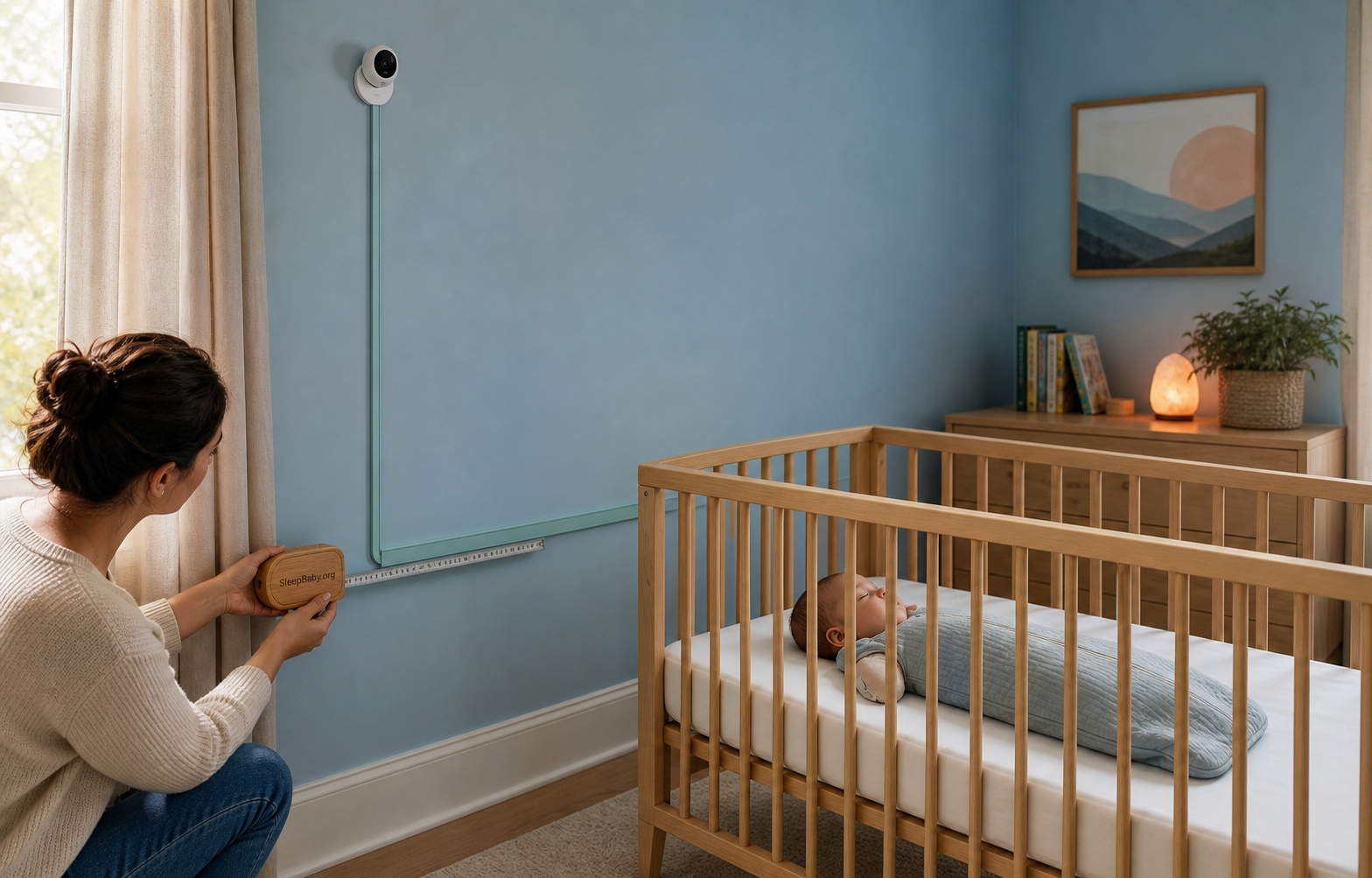
- Keep monitor cords and parts at least three feet away from the crib or other sleep area.
- Use the device only within its labeled purpose and never as a substitute for checking a baby who seems unwell.
NICHD and the American Academy of Pediatrics both explain that home heart, breathing, motion, or cardiorespiratory monitors are not recommended as the primary way to detect or reduce SIDS risk.910 If your baby is struggling to breathe, is blue or gray, is unresponsive, or has another emergency sign, use emergency services; do not wait for an app interpretation. If a clinician has prescribed monitoring, follow that plan rather than replacing it with consumer guidance.
If you are choosing an alert-based device, my next stop would be our guide to what a smart baby-monitor alert can and cannot tell you. It helps separate useful notification settings from false reassurance, emergency decisions, and privacy tradeoffs.
Watch before the monitor goes near the crib
The sleep-space rules the benefit card cannot answer
The American Academy of Pediatrics walks through the safe-sleep baseline that stays in place whether a monitor is reimbursable, denied, prescribed, or never purchased. I would watch this with the nursery setup in view, because product labels are much easier to evaluate once the sleep space itself is settled.
The takeaway for this purchase: choose the firm, flat, level, empty sleep space and cord-safe placement first. A monitor has a limited information job; FSA eligibility does not expand it.
If the player does not load, watch the AAP safe-sleep video on YouTube.
The questions that tend to appear right before checkout
Can I use my FSA card for any baby monitor marked “eligible”?
Do not assume so. Confirm the exact item with your plan, then retain the itemized receipt and any required documentation. The card’s ability to process the sale is not the same as final substantiation.
Does a prescription make an ordinary camera eligible?
Not automatically. The item’s function, medical purpose, plan terms, and documentation all matter. Ask the plan whether it requires a prescription or LMN and whether the exact model qualifies; do not ask a clinician to describe ordinary childcare as treatment.
Are fetal Dopplers or generic pulse oximeters an easier FSA option?
A medical-sounding name does not prove eligibility, appropriate use, or safety. I would not substitute one device for another based on checkout language. Use equipment only for its labeled purpose and follow clinician guidance when monitoring is medically indicated.
Can an HSA reimburse the monitor if my FSA will not?
Both use qualified-medical-expense principles, but account rules and your facts matter. A denial from one administrator does not prove the other account should pay. Keep the records and confirm the exact expense under the account you actually have.
Can I claim the camera portion of a monitor bundle?
Possibly only if the plan says the entire exact SKU or a separately priced component qualifies. Do not invent an allocation. Ask whether the bundle is reimbursable as sold and what the receipt must show.
Does FSA eligibility mean the monitor prevents SIDS?
No. Tax eligibility, FDA status, medical necessity, and SIDS-risk-reduction guidance answer different questions. Keep back sleep, a firm flat level surface, an empty sleep space, and cord-safe placement in place regardless of the monitor.910
Return to the card only after you have the answer
Back at that imaginary kitchen counter, the FSA card has not changed. The plan portal is probably still less friendly than it could be. What has changed is the question: not “Does this product page look medical?” but “Does my plan reimburse this exact device, for this covered person and purpose, with this proof?”
That is the answer I would want beside Benjamin’s quiet doorway. Confirm the account. Hold the model. Explain the purpose truthfully. Collect the proof. Keep safe sleep separate. Then the card becomes the last step instead of the first guess.
Sources
- Internal Revenue Service, Publication 502: Medical and Dental Expenses (2025) — medical-care and personal-use-item definitions.
- Internal Revenue Service, Publication 969: Health Savings Accounts and Other Tax-Favored Health Plans (2025) — health FSA and substantiation principles.
- IRS FAQ: medical expenses related to nutrition, wellness, and general health — disease/body-function purpose versus general health.
- IRS Chief Counsel Letter 2021-0003 — health FSA debit-card substantiation.
- FSAFEDS Health Care FSA eligible-expense search for “monitor” — named monitoring products and documentation categories.
- FSAFEDS Letter of Medical Necessity resource — plan documentation process.
- U.S. Food and Drug Administration De Novo record DEN220091 — exact Dream Sock device classification.
- Owlet Dream Sock product page — manufacturer-stated function, HSA/FSA language, and labeled age/weight range.
- NICHD Safe to Sleep FAQ — home monitors, SIDS, safe sleep, and cord placement.
- American Academy of Pediatrics: A Parent’s Guide to Safe Sleep — safe-sleep baseline and home cardiorespiratory monitors.
When the paperwork is finally closed
Let the monitor return to its smaller job
Once the model, receipt, and plan answer have stopped taking over the kitchen counter, the real night is still waiting: a safe sleep space, a routine you can repeat, and a parent who does not need another browser tab. SleepBaby can help you build that calmer plan without asking a gadget to do more than it can.






What viewers said10 comments · 4 replies+
Archived comments from the original Baby Sleep Miracle presentation. Not independently verified by SleepBaby.org; individual experiences vary.
Thank you so much for this video! I had no idea about the dangers of baby swings :O
Hi Mary-Ann. I have a question: Is method in any way similar to the ones recommended by Dr Bucknam, Dr. Weissbluth or Dr. Karp? We tried those but none of them help.
Hi Regina, thank you for your question. The short answer is no. The techniques I share in my guide are based on newest scientific research and this is why I have never seen any approach similar to the one I recommend.
This method really works! I tried it on my son Jesus and after just one week he went from waking up more than 5 times a night to waking up just once or twice. You are a lifesaver, Mary-Ann!
I'm truly impressed with how much information you share in your video. And all for free! I can feel that you truly care about mothers like myself, and that's hard to find these days. I have recommended your site to several of my friends already.
Mary-Ann, our child suffers from autism. Is your approach still suited?
Chloe, I made sure my method can be used with any child, even babies who are special like yours. Please note that I'm not a doctor and that I always advice to consult with your physician because nothing is more important than the safety and well-being of your love.
Hallo Mary-Ann, I'm from Germany. Do you have your guide in German?
Hello Heide, we do! Normally you should already see our video in German. If not, please contact our support so they can guide you
Thenk you for your answer, Mary-Ann!
I just completed your approach and I have to say, it worked almost too well. Yes, it took a bit of getting used to with your bedtime routine but the difference is huge. My son George used to take 1 hours to go down and now he's firmly asleep in no more than 10 minutes! You're the best!
It seems I'm the only man watching this video, lol! What you shared about the 'emotional backpack' made immediate sense to me and I can't wait to help my little girl Mila to unpack it!
Hey there, just discovered your site and this really sounds different. Just wanted to say thanks for sharing :)
For everyone who's still thinking about getting Mary-Ann's guide I want to advise you to go ahead. I wasn't sure myself but now I'm so thankful I invested in this program. It made a huge difference in our life as a family and yes, my baby girl does sleep through the night now.