
First-Birthday Sleep, Decoded
Yes, a recognizable 12-month sleep regression can happen: sleep may wobble around the first birthday as naps shift, standing or walking becomes irresistible practice, and separation protest grows louder. But it is not a universal diagnosis or a timer that starts on every baby’s birthday. Look for the pattern, protect the parts of the schedule that still work, and use the seven-day reset below to stabilize and observe—not to promise a cure by next Tuesday.
The first-birthday pattern in one glance
Four changes can look like one dramatic regression
- Naps become noisy. One nap is refused, delayed, or shortened, but that alone does not prove your child is ready for a permanent one-nap schedule.
- New movement follows them to bed. Pulling to stand, cruising, or first steps may show up as crib practice and a harder time settling.
- The doorway suddenly matters. A child who was content with the routine may protest when you leave or call for another reassuring return.
- Everything else can still be the cause. Illness, pain, hunger, travel, light, noise, or a schedule that no longer fits can imitate a developmental wobble.
Start small: keep the morning, bedtime routine, response, and safe sleep space recognizable. Change one schedule variable at a time, then watch the direction of travel across ordinary days.
The human question beneath “is there a 12 month sleep regression?” is usually less academic: Why did the baby who slept yesterday suddenly stand at the crib rail, reject the second nap, and howl when I touched the doorknob? That cluster can be real. It can also be three ordinary changes arriving in one sleep-regression trench coat.
I would resist two tempting conclusions. The first is “nothing is wrong; it is only a phase.” The second is “the whole schedule is broken; change everything tonight.” Both skip the useful work in the middle: noticing which sleep changed, what happened immediately before it, how your child functions during the day, and which one adjustment would actually test the theory.
SleepBaby.org · The original video
A little help
for the night ahead.
Take a moment to watch the original Baby Sleep Miracle presentation. Your article will be right here when you’re ready to keep reading.
Ready to get started?Take the next step with SleepBaby.
Help my baby sleepIs there a 12-month sleep regression?
There is evidence for a recognizable first-birthday sleep disruption, but not for a universal clinical event that appears at exactly 12 months. A review of sleep and development in the first year describes associations between new motor milestones such as crawling, cruising, and walking and temporary sleep fragmentation in some infants. The American Academy of Pediatrics also notes that separation anxiety can bring more bedtime protest and waking during the second half of the first year. Those are plausible contributors, not a diagnosis stamped on the calendar.
A longitudinal study of 704 infants found substantial individual variation and relatively stable sleep measures for many babies between 6 and 12 months rather than one universal cliff at the birthday. In a French birth cohort of 11,783 one-year-olds, average sleep was about 13 hours 36 minutes per day including naps, yet real families showed wide variation and meaningful minorities reported difficulty settling or waking. A separate longitudinal study of uninterrupted infant sleep found that, depending on whether six or eight hours counted as sleeping through, many infants at 6 or 12 months did not meet the definition. In other words, a rough patch can be common without being compulsory, and not sleeping through is not proof of a regression.
The label is useful when it opens a better question: what changed around this child? It is less useful when it closes the case. If the disruption began earlier and the main question is the previous developmental stage, the 11-month sleep regression guide keeps that boundary clear. This page owns the first-birthday collision among nap pressure, mobility, separation, and routine.

What changed at one year: naps, mobility, separation, and routine
At one, the day can feel as if someone quietly rearranged the furniture while you were making coffee. The child who needed help pulling up is suddenly cruising the sofa. The first nap still works, the second one looks personally offensive, and leaving the bedroom creates a protest that was not on yesterday’s agenda. These changes overlap, but they do not ask for the same response.
Nap pressure is changing, not issuing a one-nap order
By 12 months, some children are moving toward one nap while many still do well with two. The longitudinal cohort above averaged about 1.9 naps at 12 months, and NHS guidance for ages one to two allows for either one or two. Age tells you the transition is possible. It does not tell you that a refused nap on Thursday is the final vote.
A temporary developmental burst can make a child too interested, too practiced, or too keyed up to take a familiar nap. So can a late morning wake, an unusually long first nap, travel, illness, a car snooze, or separation protest. A real transition is a sustained reorganization of sleep pressure across ordinary days, not one theatrical afternoon.
Mobility can spill into settling
Pulling to stand and walking while holding furniture are common one-year milestones. Research suggests that acquiring major motor skills may coincide with more fragmented sleep or movement at night for some infants, though the relationship may run both ways and does not prove cause. The practical translation is modest: give generous safe practice while awake, help your child learn how to bend knees and sit back down, and avoid turning every crib stand into a midnight lesson with bright lights and applause.
If your child stands in the crib and seems stuck, calmly help once if needed, then keep the response boring and repeatable. Lower the crib mattress according to the manufacturer’s guidance before a child can climb or topple over the rail. Do not add a bumper, pillow, positioning device, loose blanket, or weighted product to soften standing or encourage lying down.
Separation protest is not proof of a bad schedule
Separation anxiety can intensify during the second half of the first year. It may appear as crying when you leave, reaching toward the door, or waking and calling until you return. A loving, predictable response is appropriate. Extra reassurance does not automatically create a permanent habit, and protest does not automatically mean bedtime is mistimed.
Use a response your tired future self can repeat: a brief return, the same phrase, the same gentle touch if you use one, then another chance to settle. The goal is not to prove that your child can tolerate your absence. It is to make departure and return understandable enough that the nervous system is not solving a brand-new puzzle at every wake.
Routine becomes the control group
When several developmental variables move at once, the routine helps you see what is changing. It does not need to be elaborate. A short sequence such as wash, pajamas, milk or snack at the usual appropriate point, two books, song, and bed can provide the same landmarks even when settling takes longer. Consistency is not a promise of instant sleep. It is how you stop the investigation from changing its own evidence every night.
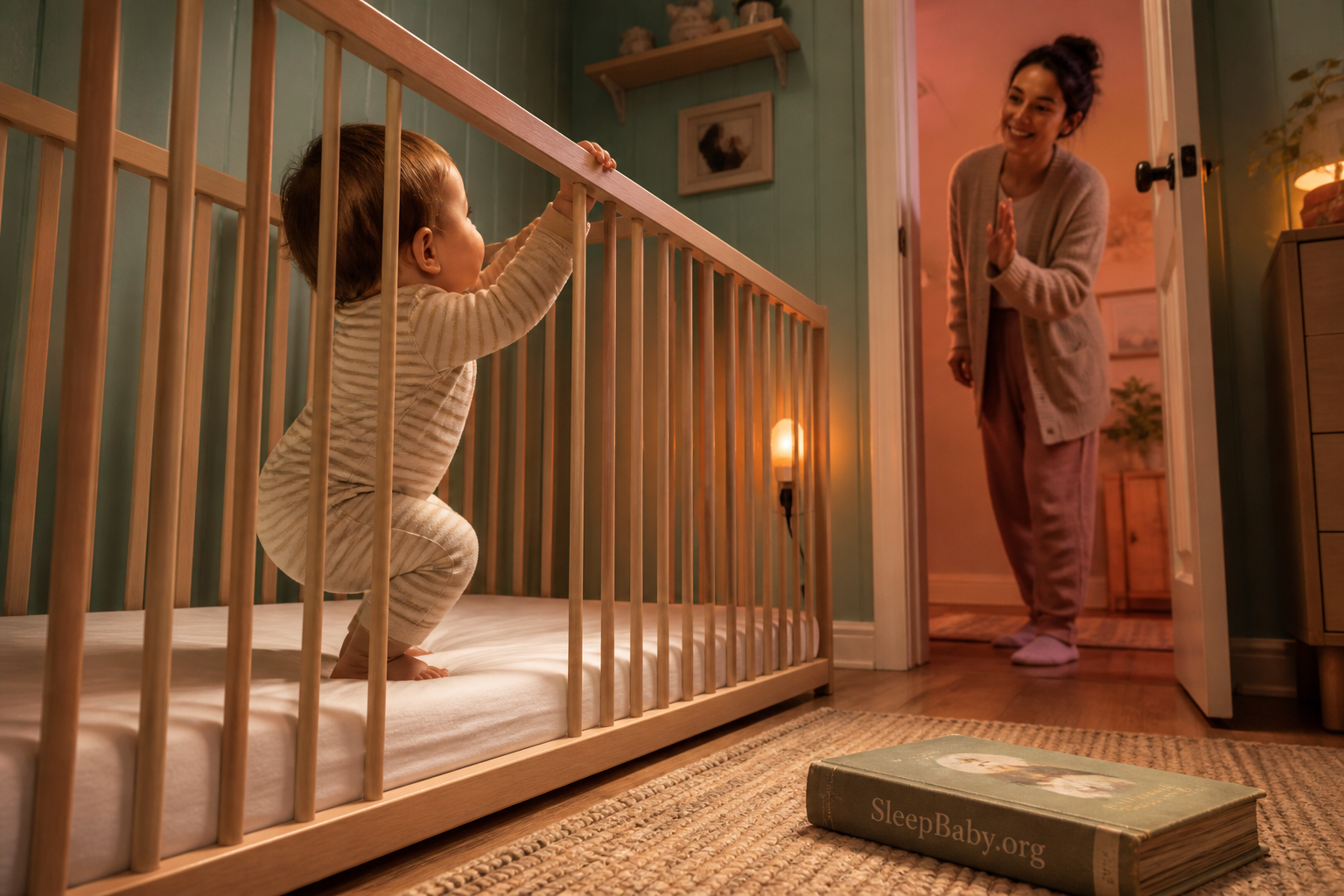
A pattern decoder for bedtime, naps, and night waking
Start with the sleep event that changed most. Then ask what observation would support the likely cause and what would make you widen the lens. This keeps a parent from solving a nap problem with a night-waking intervention or treating separation protest as proof that a nap must disappear.
First-birthday pattern decoder
What happened, what to check first, and what not to assume
Bedtime resistance
Check first: the last nap’s end, total daytime sleep, new standing practice, and whether protest begins at separation.
Do not assume: bedtime must move dramatically or the routine has stopped working.
One refused nap
Check first: wake time, nap-one length, accidental car sleep, stimulation, illness, and whether refusal repeats on ordinary days.
Do not assume: one nap is now the permanent schedule.
Repeated standing in the crib
Check first: daytime practice sitting down, crib setup, fatigue, and whether your response has become exciting.
Do not assume: your child is defiant or needs an object added to the crib.
Waking soon after bedtime
Check first: overtiredness, a late or long nap, discomfort, room conditions, and how much help was needed to fall asleep.
Do not assume: separation, hunger, pain, or schedule is the cause without supporting clues.
Calling at every departure
Check first: whether your child is calm while you are present and distressed exactly when you leave.
Do not assume: reassurance is harmful or a later bedtime will solve separation.
Waking plus daytime changes
Check first: fever, pain, breathing, feeding, hydration, unusual sleepiness, skill loss, or a child who looks unwell.
Do not assume: development gets to explain away a medical concern.
SleepBaby.org pattern decoder: choose the smallest useful test, then let the child’s response update the theory.
If bedtime itself has drifted and you need a separate way to estimate the anchor, use this guide to determine your baby’s bedtime. Keep this article’s job narrower: decide whether the first-birthday cluster needs reassurance, more skill practice, a nap adjustment, or a different explanation.

Two naps or one? Require a pattern before dropping a nap
A one-nap day can look beautifully simple on paper and spectacularly long in a real kitchen at 4:37 p.m. Dropping a nap too early can create overtired bedtime resistance, false starts, early waking, and a child who looks energetic because they are running on fumes. Holding two naps too long can also make bedtime drift. The answer comes from a sustained pattern, not loyalty to either schedule.
| Observation | More consistent with a temporary wobble | More consistent with an emerging transition |
|---|---|---|
| Pattern length | A few irregular days around travel, illness, a new skill, or separation. | A repeatable pattern across multiple ordinary days after temporary causes settle. |
| Which nap changes | Either nap is refused unpredictably, or the child sleeps normally when the day is quieter. | The same nap repeatedly becomes difficult despite reasonable timing and a stable morning. |
| Late afternoon | Marked fussiness, accidental dozing, or a very long stretch to bedtime after one nap. | The child stays reasonably regulated and can reach bedtime without a chronic overtired crash. |
| Night response | One-nap experiments produce false starts, more waking, or earlier mornings. | A careful transition preserves or improves total sleep and night settling. |
| Total sleep | Daytime sleep drops sharply and the lost sleep does not return at night. | Sleep redistributes without a persistent loss of rest or daytime functioning. |
The American Academy of Sleep Medicine recommends 12 to 16 hours per 24 hours, including naps, for infants 4 through 12 months and 11 to 14 hours for children 1 through 2 years. A child at the first-birthday boundary sits between those age bands. Use the numbers as a broad guardrail, not a minute-by-minute assignment.
A cautious nap test
Protect sleep while the evidence accumulates
- Keep morning wake time reasonably steady.A wildly different start makes nap pressure difficult to interpret.
- Cap or shift one nap before deleting it.A small timing change can preserve two useful rest opportunities while reducing bedtime conflict.
- Use an occasional bridge, not a new permanent rule.A brief assisted catnap or earlier bedtime may protect a rough transition day when it works safely for your family.
- Watch the whole 24 hours.Bedtime, night waking, early morning, mood, and accidental sleep matter as much as whether the nap happened.
- Move gradually when the pattern holds.Shift toward one central nap in small steps instead of asking a tired child to absorb a huge wake stretch at once.
For example schedules and ways to shape the transition after the decision is clearer, see the nap schedule for a 1-year-old. That page can help with clock placement. This decision still belongs to the evidence in front of you.


What not to change all at once
When sleep becomes chaotic, changing everything feels like action. New nap times, a later bedtime, a new settling method, extra milk, a new sleep object, and a different night response can all arrive in the same evening. By morning, no one knows what helped, what hurt, or whether the child simply had a different night.
Protect these anchors while you investigate
Keep the night recognizable enough to read
- The safe sleep space stays safe. Through the first birthday, keep the surface firm, flat, non-inclined, and clear, with a fitted sheet only. Follow your clinician’s individualized advice if it differs.
- The bedtime sequence stays familiar. You can add patience without replacing every cue.
- The response stays predictable. Decide what a brief reassurance return looks like before everyone is exhausted.
- The morning anchor stays reasonably steady. This keeps daytime sleep pressure interpretable.
- Feeding changes follow feeding evidence. A night wake alone does not prove hunger, and development does not make a genuinely hungry child less hungry.
- Only one schedule experiment gets the spotlight. Change a nap cap, nap timing, or bedtime timing—not all three at once.
More reassurance during a clingy week can fit inside consistency. So can a temporary earlier bedtime after a failed nap. The question is not whether every night looks identical. It is whether your response has a shape your child can recognize and you can evaluate.
A seven-day reset: stabilize, observe, and decide
This reset is not a seven-day cure for a named regression. It is a bounded observation window. Research on consistent bedtime routines in children 8 to 18 months found that caregiver-reported improvements appeared most quickly in the first several nights for some families, with smaller gains continuing over two weeks. That supports watching for direction within a week. It does not guarantee that mobility, separation, illness, or a nap transition resolves on command.
Seven days, three jobs
Observe, steady, then make one decision
- Day 1: write the baseline.Record wake time, naps, bedtime, wakes, major help used, illness or pain clues, and the newest motor or separation behavior. One line per event is enough.
- Day 2: restore the anchors.Use a reasonable morning start, the familiar bedtime routine, safe awake-time skill practice, and one repeatable night response.
- Day 3: check the obvious confounders.Review room light, temperature, noise, travel, accidental sleep, hunger or feeding change, constipation, teething discomfort, fever, congestion, and other illness signs.
- Day 4: choose one schedule test if the evidence supports it.Cap or shift one nap, or adjust bedtime modestly. Do not launch a nap drop and a new settling method together.
- Day 5: repeat before judging.Use the same test on another ordinary day unless it clearly worsens sleep, daytime functioning, feeding, or safety.
- Day 6: look for direction.Improvement can mean a shorter protest, one fewer wake, easier sitting after standing, a nap that returns, or a calmer recovery—not necessarily a perfect night.
- Day 7: decide the next smallest move.Keep what is helping, reverse what clearly worsened the pattern, or widen the investigation when nothing fits.
SleepBaby.org seven-day path: steadiness makes the pattern visible; the pattern earns the next change.
Keep the log small enough that it does not become a second bedtime job. You are looking for repeated relationships: the second nap ends late and bedtime stretches; standing practice peaks on the same days settling worsens; crying begins exactly at separation; the wake pattern remains even when the supposed trigger disappears. Those relationships are more useful than a row of red marks labeled “bad night.”
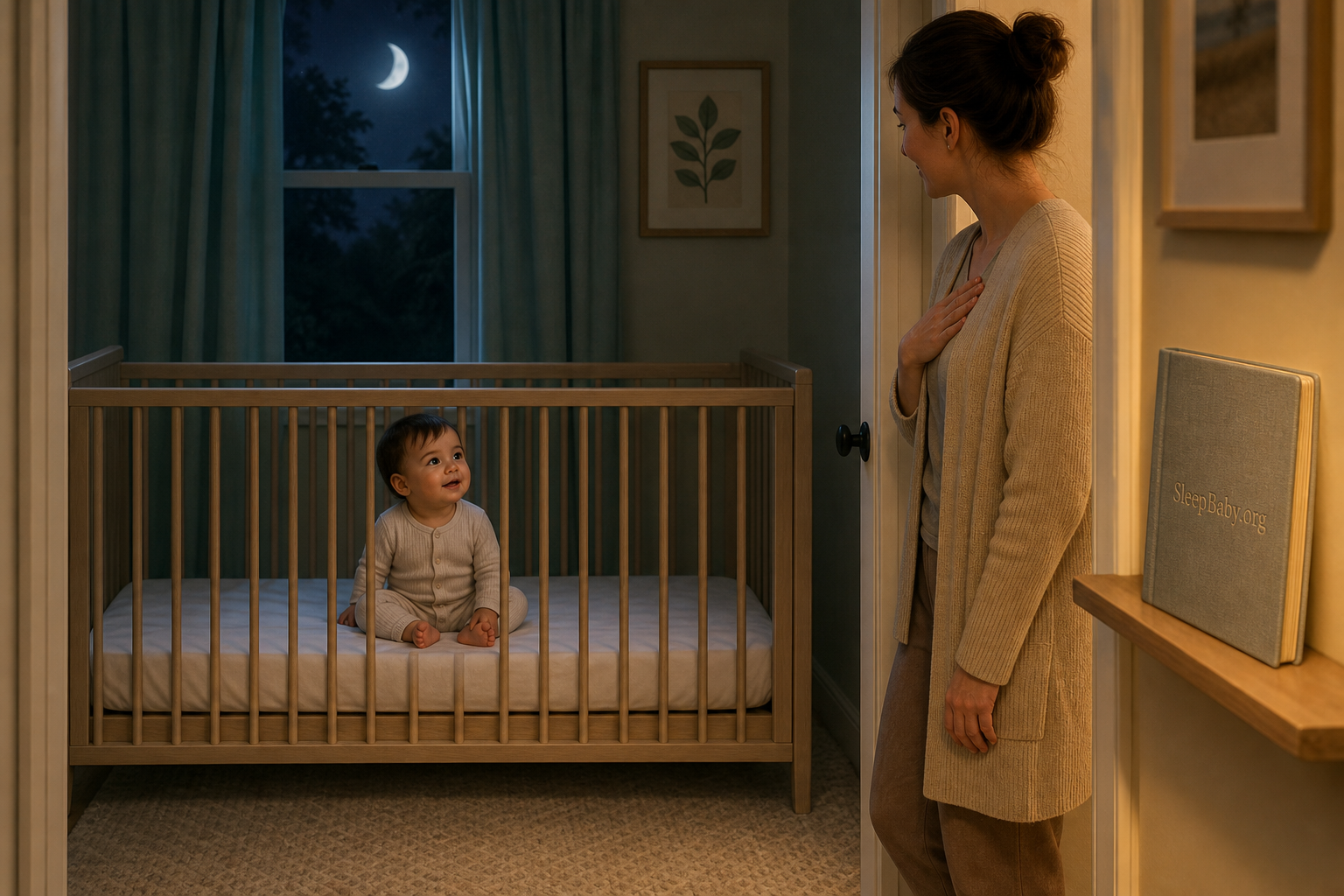
How long does the 12-month sleep regression last?
There is no reliable evidence-based duration that applies to every child. A stock answer such as “two to six weeks” sounds satisfyingly precise, but it bundles different causes into one countdown. A few days of novelty from standing practice is not the same problem as a nap transition, persistent separation anxiety, illness, discomfort, or a routine that has become mismatched.
| Likely driver | What directional improvement looks like | When to widen the lens |
|---|---|---|
| New movement | Less crib practice, easier sitting, or faster settling as awake practice grows familiar. | Waking persists without a movement link, worsens, or comes with pain, weakness, or skill loss. |
| Separation protest | The same reassurance becomes enough, departures feel less explosive, or returns become shorter. | Distress is intense across the day, sleep is steadily deteriorating, or the response plan is impossible to sustain. |
| Nap mismatch | A modest timing change improves nap acceptance, bedtime, and the full 24-hour sleep pattern. | Every schedule test trades one major problem for another or total sleep keeps falling. |
| Routine disruption | Settling starts moving in the right direction after several nights of recognizable cues. | No directional change appears after a consistent week, or a different cause is becoming clearer. |
| Illness or discomfort | Sleep improves as the child recovers and daytime symptoms resolve. | Symptoms are persistent, severe, recurrent, or concerning enough that you would seek care during the day. |
Use day seven as a decision point, not a deadline for the child. If the pattern is clearly easing, keep the helpful anchors and allow more time. If it is unchanged, worsening, or repeatedly needs heroic amounts of intervention, revisit the cause. The right question is not “has the regression expired?” It is “what evidence do we have now that we did not have a week ago?”
When sleep trouble points beyond a developmental phase
Before calling the week developmental, check for fever, ear or dental pain, congestion, cough, vomiting or diarrhea, constipation, reflux symptoms, a meaningful feeding change, travel, unusual room conditions, or a schedule change imposed by daycare or family life. Development can coexist with illness. One does not cancel the other.
The point where bedtime advice stops
Get help for the child, not the regression label
Emergency help
Seek emergency care for severe breathing difficulty, a breathing pause longer than 20 seconds, blue-gray or very pale color, a seizure, collapse, concerning limpness, or inability to wake normally.
Prompt pediatric advice
Call for frequent snoring, breathing struggle, repeated pauses, significant pain, poor feeding, dehydration signs, persistent fever, unusual daytime sleepiness, or a child who seems meaningfully unwell.
Developmental concern
Contact your child’s clinician when a previously acquired skill is lost or you are worried about movement, communication, interaction, or development beyond the sleep change.
Persistent sleep concern
Widen the investigation when the problem lasts, intensifies, harms daytime functioning, or never develops a plausible nap, mobility, separation, routine, or health pattern.
The American Academy of Pediatrics advises discussing frequent snoring, breathing difficulty, pauses, daytime sleepiness, or behavior changes rather than trying to diagnose sleep apnea at home. If you are deciding whether the pattern has moved beyond ordinary troubleshooting, the guide on when to worry about a baby not sleeping offers a broader next step after these immediate red flags.

12-month sleep regression: common questions
What are the most common signs of a 12-month sleep regression?
A meaningful change from your child’s baseline may include bedtime resistance, a refused nap, shorter naps, more night waking, early waking, repeated standing in the crib, or stronger protest when you leave. None is specific enough to diagnose a regression. The useful sign is the pattern connecting sleep with naps, mobility, separation, routine, or another cause.
Can the 12-month sleep regression start at 11 months?
Yes. Development does not follow a date stamp, and new movement or separation protest can appear before or after the birthday. Use age as context, then look at the actual change. The separate 11-month guide helps when the earlier-stage pattern is the main question.
Does fighting the second nap mean my baby needs one nap?
Not by itself. Look for the same nap repeatedly failing across ordinary days, an ability to reach bedtime without a chronic overtired crash, and stable or improved total sleep when the day is reorganized. Protect sleep and move gradually rather than deleting a nap after one rough week.
Should I change bedtime during the regression?
Change bedtime modestly only when nap timing, total daytime sleep, or tiredness gives you a reason. An earlier bedtime can help after a failed nap; a later bedtime may help when a late nap leaves too little sleep pressure. Separation protest or standing alone does not prove the clock time is wrong.
How long does a 12-month sleep regression last?
There is no universal evidence-based duration. Watch for direction over seven consistent days, then reassess the likely cause. New-skill novelty, separation, a nap transition, routine disruption, and illness can follow different timelines. Persistent, worsening, or concerning symptoms deserve a wider sleep or medical evaluation.
Will comforting my child create a bad habit?
Warm reassurance during a separation-heavy week does not automatically erase sleep skills. Use a calm response you can repeat, keep the routine recognizable, and reduce extra help as the need fades. Consistency is not the absence of tenderness; it is the shape that lets tenderness fit without redesigning the whole night.
Can sleep training fix the regression?
No single method fixes every cause. A consistent settling approach may help when sleep associations and response patterns are part of the picture, but it will not cure illness, make a child developmentally ready for one nap, or remove separation feelings. Solve the cause you have evidence for.
What if nothing improves after seven days?
Do not simply repeat the same reset louder. Review the log for a hidden nap mismatch, pain or illness, feeding change, room problem, or an unsustainable response. Reverse a clearly harmful schedule experiment. Call your pediatric clinician when health, breathing, development, or daytime functioning concerns you.
Sources
- CDC: Milestones by 1 Year
- American Academy of Sleep Medicine: Recommended Sleep Duration for Children
- American Academy of Pediatrics: Separation Anxiety and Sleeping Trouble
- American Academy of Pediatrics: How to Keep Your Sleeping Baby Safe
- Pediatric Research: Sleep and Infant Development in the First Year
- Journal of Clinical Sleep Medicine: Sleep Behavior During the First Year
- Sleep Medicine: Sleep Habits and Characteristics at Age One
- Infant Behavior and Development: Implementation of a Nightly Bedtime Routine
- Pediatrics: Uninterrupted Infant Sleep, Development, and Maternal Mood
- Sleep Medicine Reviews: Normal Sleep Patterns in Infants and Children
- NHS Wirral: Safer Sleep for Ages 1 to 2 Years
- American Academy of Pediatrics: Sleep Apnea Detection and Treatment
SleepBaby.org · The original video
A next step for
the next bedtime.
Still thinking about sleep? Watch the presentation here, then explore the SleepBaby program whenever you’re ready.
Ready to get started?Take the next step with SleepBaby.
Help my baby sleep