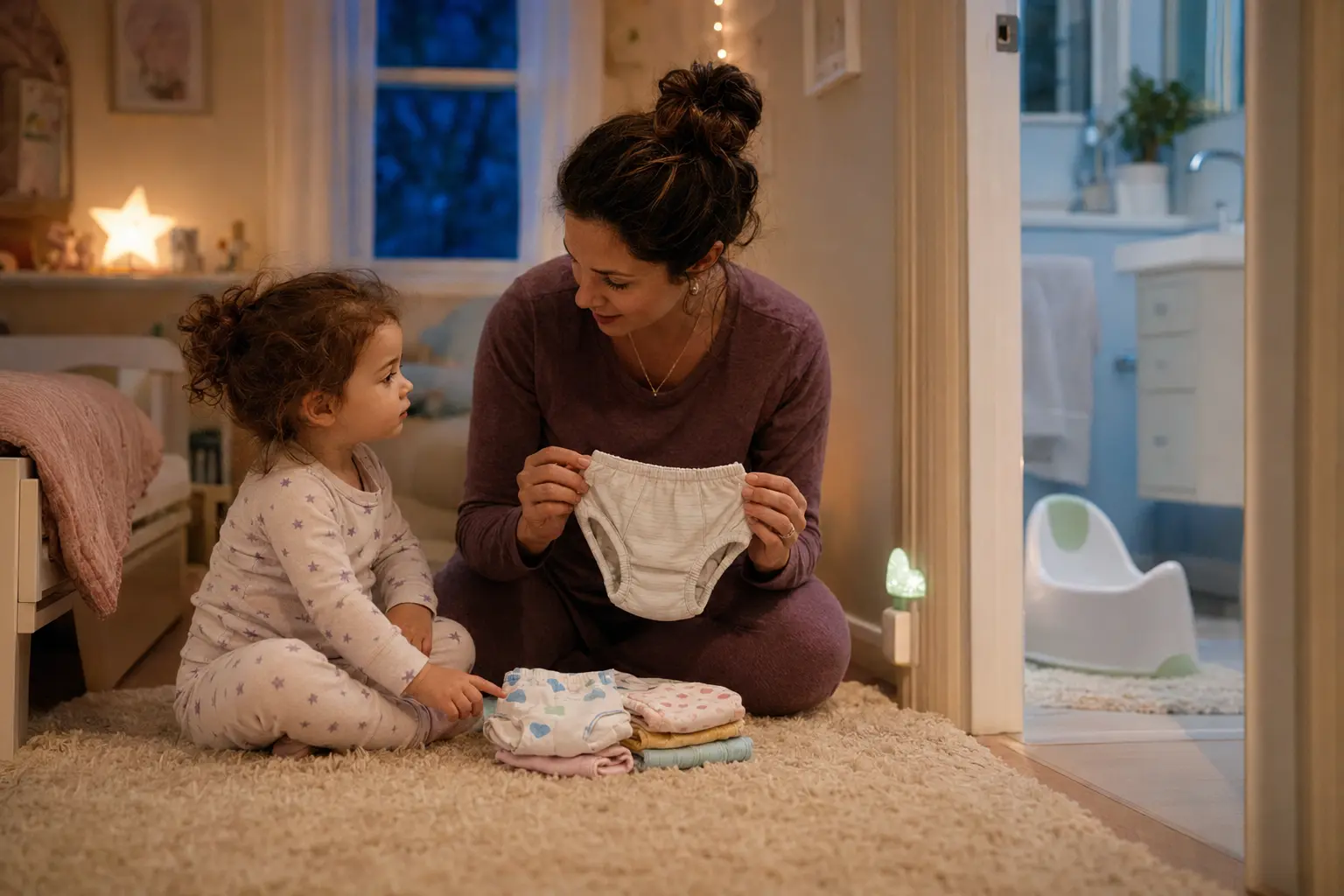
Daytime toilet learning and nighttime dryness are two different jobs. Keep practicing the daytime skills your toddler can control, but protect sleep with a calm bedtime potty stop, overnight protection, and a boring, kind response to wakes or accidents. A wet pull-up does not erase a dry day, and a child cannot decide their sleeping body into producing less urine or waking to a full bladder.
Tonight, do not cut off needed fluids, wake your toddler on a schedule, force a long sit, or turn dry sheets into a performance review. Offer a brief, predictable toilet chance; use a diaper or pull-up if it keeps everyone comfortable; and praise the parts your child actually did—telling you, trying, helping, or returning to bed. Pain, blood, constipation, urinary symptoms, unusually intense thirst or much more frequent or high-volume urination, or major sleep disruption belong with your pediatrician.
The answer for tonight
Protect the night while the daytime skill grows
- Separate the goals: daytime practice can continue while nighttime protection stays.
- Keep hydration normal: offer fluids across the day and never deny genuine thirst to chase a dry bed.
- Use one repeatable bedtime route: bathroom, pajamas and protection, connection, then lights out.
- Make accidents emotionally small: low lights, few words, clean clothes, back to bed.
- Pause pressure—not care: pain, withholding, fear, or collapsing sleep means adjust the plan and ask for help when needed.
Why this matters tonight: your toddler can learn without having to rehearse the lesson at 2 a.m.
Day practice and night dryness run on different clocks
I would write this distinction on the bathroom mirror if it saved one family from a week of unnecessary midnight laundry: night dryness is a body milestone, not a bedtime behavior grade.
Daytime toilet learning asks a toddler to notice a body signal while awake, name or communicate it, pause a fascinating activity, reach the bathroom, manage clothes, sit securely, release, wipe, flush, and wash. That is a heroic little chain of skills for someone who recently considered a banana an acceptable phone.
Nighttime dryness adds jobs the sleeping child cannot simply practice harder: the bladder must hold enough, the kidneys must make an age-appropriate amount of urine overnight, and the brain must respond to a full-bladder signal during sleep. Those pieces mature on their own schedule. A child may use the toilet confidently all day and still need nighttime protection for months or years.
The Two-Clock Night Bridge
One child. Two timelines. No contradiction.
The daylight skill clock
- Notice the body cue
- Tell a caregiver
- Reach and use the toilet
- Practice the routine again
Grows through: readiness, repetition, access, language, motor skills, and calm support.
The sleeping-body clock
- Make less urine overnight
- Store it comfortably
- Register a full bladder during sleep
- Wake and reach the toilet—or stay dry until morning
Grows through: physical maturation. It is not a test of motivation, intelligence, or obedience.
Sleep connection: teach the clock that can learn while your child is awake; protect the clock that is still maturing during sleep.
Original SleepBaby.org teaching framework

Imagine a three-year-old who proudly wears underwear through breakfast, daycare, and an entire grocery run, then soaks a pull-up before midnight. A parent might stare at that pull-up as if it had delivered a quarterly performance report. It has not. It has delivered urine. The daytime learning is still real.
This is also why ordinary wet nights in toddlers should not be treated like a diagnosis or a failure. Pediatric guidance uses “nocturnal enuresis” for bedwetting beyond age five. In the toddler years, the useful question is not “How do I make this stop?” It is “How do I support learning without asking sleep to prove it?”

Start only the part your toddler is ready to learn
Readiness is a cluster, not a birthday. Your toddler does not need every skill to be perfect, but the process is usually kinder when several of these are beginning to show:
- interest in the potty, toilet, underwear, or watching the bathroom routine;
- awareness before, during, or soon after peeing or pooping;
- some predictable patterns or stretches of daytime dryness;
- the ability to sit stably and get up safely;
- enough communication to signal a need, with words, signs, gestures, or a device;
- the ability to follow one or two simple steps;
- some participation in pulling easy clothing down and up;
- curiosity about doing a familiar care task more independently.
Sleep connection: readiness is easiest to read in daylight; you do not need a nighttime experiment to prove that practice can begin.
Parent and caregiver readiness matters too. A plan that depends on one exhausted adult noticing every wiggle, carrying a potty through three rooms, and maintaining monk-like serenity during a work deadline is not yet a sturdy plan. Choose a stretch when the adults can be reasonably consistent and the child is not already absorbing a move, a new sibling, illness, a major daycare transition, or travel.
What low-pressure daytime practice looks like
Use easy clothes, a stable potty or toilet reducer, and foot support so your toddler does not feel as if they are balancing over a canyon. Offer brief chances at predictable times—after waking, around meals, before leaving, after returning, and before sleep—without making a child sit for a long time. If nothing happens, the attempt is complete.
My editorial rule is simple: an invitation has an exit. “Your body can try the potty now” is an invitation. Holding a crying child on the seat until something happens is force. Pressure can feed fear and withholding, especially after a painful bowel movement.
Nighttime protection is equipment, not a demotion
A diaper, pull-up, training pant, or other familiar overnight protection can stay while daytime underwear begins. Use the family term that carries the least emotional charge: “sleep underwear,” “night pants,” or simply the product name. Do not make the protection a threat—“If you wet again, you go back to diapers”—or a prize that disappears after one dry morning.
If your child has been dry for several nights and wants to try underwear, you can make a low-stakes experiment with a waterproof mattress protector and spare pajamas ready. If the trial creates repeated wet beds, distress, or lost sleep, return to protection and try again later. That is data, not defeat.

A child who chooses star pajamas and a soft pair of night pants is not choosing failure. They are choosing a comfortable bridge between two developmental clocks.

A bedtime bathroom routine that does not eat bedtime
The best routine is short enough to remember and boring enough not to become a nightly negotiation festival. Keep daytime fluids generous and ordinary. Near bedtime, avoid presenting an enormous “just in case” drink, but do not refuse genuine thirst or reduce the child’s needed daily fluids. Constipation and concentrated urine are not good trades for a dry sheet.
The Bathroom-to-Books Route
Five predictable handoffs from busy day to sleep
-
Close the active day.
Finish ordinary food and fluids without turning the evening into a hydration test. -
Offer the planned toilet chance.
Keep it brief, use foot support, and accept “all done” when the attempt is over. -
Dress for the actual night.
Choose pajamas and whatever protection keeps the child comfortable now. -
Give connection its own place.
Read, cuddle, sing, or talk before lights out so “I need the potty” does not have to carry every need for closeness. -
Use one neutral final invitation.
If it fits your child, offer one quick last try before lights out. Then repeat the same closing words.
Why this matters tonight: the toilet is part of bedtime, not a trapdoor that restarts bedtime.
Some children need only the planned bathroom visit before pajamas. Others do better with a second brief invitation after the book. The number matters less than predictability. If your toddler reliably uses “potty” the moment the light goes off, do not accuse them of stalling. Honor the body message with one calm trip, keep the lights low, offer no bonus entertainment, and return to the same final phrase.
“I believe your body. We can make one quiet potty trip, then it is back to bed.”
If nothing happens, say, “Your body tried. Now it is sleep time.” If they ask again immediately, you can keep the boundary without teaching them to ignore their body: “I hear you. We just tried. I will help if your body feels painful or urgent; otherwise we are resting now.” A child who seems genuinely uncomfortable, frightened, constipated, or unusually urgent needs a closer look, not a stronger bedtime script.

Neutral phrases for the moments that usually grow teeth
- When your toddler refuses the planned try
- “You do not have to make pee come out. Your body can sit for a short try, or we can be all done.”
- When they ask after lights out
- “Yes. One quiet potty trip, then back to bed.”
- When the pull-up is wet in the morning
- “Your night pants did their job. Let’s get comfortable and start the day.”
- When it is dry
- “Your body stayed dry last night. Bodies change as they grow.”
- When the night was messy
- “The bed got wet. You are safe. We know what to do.”
Why this matters tonight: a few rehearsed words keep the bathroom available without letting the conversation become a second bedtime routine.
Notice what is missing: “big kid,” “baby,” “good,” “bad,” “lazy,” and “You know better.” Those words turn a body process into an identity test. Praise the attempt, communication, hand washing, clothes practice, or calm return to bed—actions your child can influence.
When the night gets wet: low lights, low language, no shame
At 2:07 a.m., nobody needs a lesson. They need dry fabric and a route back to sleep.
The 2 a.m. Small-Voice Sequence
Say less, restore comfort, resume the night
-
Say:
“The bed is wet. You are not in trouble.” -
Do:
Help with a quick toilet visit if the child is awake and willing, then clean and dry the child’s skin and change pajamas, protection, and the wet sleeping layer. -
Resume:
Repeat the ordinary bedtime ending. Save problem-solving for daylight.
Sleep connection: the goal of a nighttime cleanup is not education. It is safety, comfort, and the shortest kind path back to rest.
Prepare before you need it: a waterproof mattress protector, a fitted sheet, spare pajamas, wipes or a washcloth, a clean protector, and dim lighting. Keep supplies close but safely out of a young child’s unsupervised reach. If you use layered protectors and sheets, make sure the bed remains flat, comfortable, and consistent with the mattress and bed manufacturer’s instructions.
Your toddler may help in the morning if they enjoy having a job: carry pajamas to the hamper, choose the clean sheet, or press the washer button with you. If that participation feels like a sentence being served, skip it. Cleanup is a household task, not restitution. Never punish or shame a child for an accident.

If your toddler wakes to use the toilet
Respond when a young child wakes spontaneously and asks to go. Use the same route every time: dim light, brief help, little conversation, back to bed. That is different from repeatedly waking or carrying a sleeping child to the toilet on an adult schedule. Routine “lifting” may create a temporarily dry bed, but it does not teach the sleeping body to become dry and it can break up restorative sleep.
A one-off parent wake-up may be a practical choice for travel or an unusual event, but it is not a required stage of toilet learning. If you are setting multiple alarms every night for a toddler, the plan is borrowing too heavily from sleep. Put protection back on and let everyone rest.
If the potty request arrives at 4:55 a.m.
Treat a real request as a real request, then decide whether the day is beginning. Keep the room dark, use the toilet, and return to bed with the same words you would use after any early waking: “It is still sleep time. I will see you when the morning light comes on.” If your family uses an okay-to-wake clock, keep its rule separate from toileting: the bathroom is always available; play, breakfast, and bright lights wait for morning.
If early waking repeats, look for patterns in daylight: bedtime timing, nap changes, a very full bedtime drink, constipation, discomfort, fear of the dark route, or a child who now needs easier bathroom access. Do not solve it by making your child thirsty. A small nightlight, clear floor path, familiar potty, and easy pajamas may do more than another rule.
For travel, protect the familiar parts
A hotel toilet can roar like an aircraft hangar to a three-year-old. Pack the familiar reducer or potty if practical, overnight protection, disposal bags, two changes of pajamas, and a compact waterproof layer. Show your child the bathroom before bedtime, decide what words every caregiver will use, and avoid making a vacation the deadline for removing night protection.
Temporary accidents around travel, holidays, illness, a move, or a new childcare setting are common enough to treat first as information. Restore familiar cues and watch the pattern. Sudden or persistent regression—especially with pain, constipation, fever, or urinary changes—deserves pediatric advice rather than a behavioral label.

Constipation can quietly turn potty learning into a sleep problem
Constipation is not only “did not poop today.” Look for hard, dry, lumpy, large, or painful stool; fewer bowel movements than is normal for your child; belly discomfort or bloating; stool smears that can be mistaken for diarrhea; urinary accidents; and withholding postures—tiptoes, stiff legs, buttock clenching, rocking, hiding, or an elaborate dance that somehow convinces adults the child is “trying to go” when the body is trying very hard not to.
One painful poop can teach a toddler to hold the next one. Holding keeps stool in the bowel longer, where it can become harder and more painful. That loop can disturb bedtime, create toilet refusal, increase wetting, and make a child fear unfamiliar bathrooms at daycare or while traveling.
I would never try to win that standoff with a longer sit. Remove pressure, support the feet, protect painless stooling, maintain normal fluids, and call the pediatrician for a child-specific plan. When constipation is part of the picture, follow an individualized pediatric plan instead of pushing through a painful toilet routine. Your child’s clinician can help decide when gentle practice is comfortable and when a break from toilet demands is wiser. Do not start a laxative or enema without clinician guidance.
For a fuller look at hard stools, withholding, food and fluid context, and escalation signs, use SleepBaby’s guide to toddler constipation alongside your pediatrician’s advice.
Stop the experiment and check the child
When wetting or toilet trouble needs pediatric advice
Bowel concerns
- painful stooling, persistent withholding, or constipation not improving;
- blood in stool or rectal bleeding;
- bloating, constant abdominal pain, vomiting, or weight loss.
Urinary concerns
- burning, crying, pain, or straining with urination;
- cloudy or foul-smelling urine;
- fever, frequent tiny voids, strong urgency, or a weak stream;
- new wetting after a long dry stretch.
Whole-child concerns
- markedly increased thirst plus much more frequent or high-volume urination;
- unusual hunger, fatigue, or weight loss with those changes;
- loud snoring, gasping or other nighttime breathing trouble, or daytime sleepiness;
- sleep loss or distress that is wearing down your child or family.
Get urgent help for trouble breathing, fainting, severe dehydration, fruity-smelling breath with vomiting or abdominal pain, or a child who appears seriously ill.
Why this matters tonight: a sudden body change is not a potty-training problem to out-discipline.
Daycare and home need matching messages, not matching bathrooms
Daycare may use a tiny toilet, scheduled group bathroom trips, different words, or protection at nap. Home may use a floor potty and one caregiver who can spot the pre-poop bookshelf retreat from across the room. Consistency does not require identical equipment. It requires the adults to agree on what the child is learning and how they will respond.
The daycare handoff
The five-line caregiver handoff
- Words
- “We say pee, poop, potty, and sleep underwear.”
- Cues
- “They often freeze, hide, or squeeze their legs before a bowel movement.”
- Timing
- “Please offer a brief chance after lunch and before nap; do not keep them sitting.”
- Protection
- “Use this for nap. Daytime underwear and sleep protection are separate in our plan.”
- Response
- “Accidents get neutral words, clean clothes, and no loss of a reward already earned.”
Sleep connection: a familiar message helps nap remain a resting place instead of another test.
Ask what the setting can realistically support. If the daycare cannot take a child every twenty minutes, do not build a home plan that depends on that. If nap protection is required, tell your child plainly: “At school, these help your body rest. When you are awake, pee and poop go in the potty.” Children can handle context better than adults sometimes give them credit for.
If daycare naps, travel, or a schedule change have also shifted bedtime, compare the broader pattern rather than blaming the potty. A day with a missed nap can create bedtime resistance; a long late nap can make lights-out harder. Ask for the time your child actually slept—not only the scheduled rest block—then build bedtime around the nap your toddler actually slept.

Morning praise works best when it lands on practice: “You told me your body had to go,” “You helped choose dry pajamas,” or “You tried before bed.” Dryness can be noticed without turning it into a trophy. The tender part is not the empty pull-up. It is the child learning that body surprises do not end belonging.
Continue, adjust, or pause? Use the sleep-protecting decision path
You do not need to choose between “push through” and “give up.” Most families need a smaller decision.
The Continue–Adjust–Pause Path
Choose the smallest change that protects learning and sleep
-
Continue
Your toddler is willing, daytime cues are growing, stools are soft and comfortable, accidents are emotionally small, and sleep is mostly intact.
Do: keep the daytime routine and keep overnight protection until the night pattern changes naturally.
-
Adjust
Day learning is going well, but bedtime requests, early waking, wet-bed cleanup, daycare differences, or travel are costing sleep.
Do: simplify the bedtime route, restore protection, improve access and lighting, and align caregiver language. Change the container, not the child.
-
Pause
Your toddler is frightened, fighting every sit, withholding, in pain, sleeping much worse, or the household is in a major transition.
Do: remove the pressure for a few weeks, keep bathroom language neutral, address health concerns, and revisit when bodies and days are steadier.
Why this matters tonight: pausing pressure can preserve the trust you will need when practice resumes.
SleepBaby.org decision aid; educational, not diagnostic
A regression after illness, a move, a new sibling, a new classroom, or a frightening poop does not mean the skill vanished. It means the current plan needs context. Return to the last version that felt safe: protection, predictable offers, easy clothes, fewer words, more connection. Then rebuild one step at a time.
If bedtime itself has become the battleground—potty request, new song, one more hug, another potty request—the child may be mixing a real body-learning moment with ordinary toddler resistance. Keep honoring bathroom requests while making every trip brief and every return identical.
If repeated night waking continues even when toileting feels calm, zoom out. Pain, snoring, fear, schedule changes, hunger, temperature, and learned sleep cues can overlap with potty training. Potty learning may be the newest thing in the house without being the only thing waking your child. If your toddler is fully awake and ready to play, use the same meet the need, keep night boring, investigate in daylight pattern.

What I would do tonight
- Choose daytime learning as the skill and nighttime comfort as the goal.
- Offer ordinary fluids through the day; do not use dehydration as a training method.
- Set one predictable, brief potty chance in the bedtime routine.
- Use overnight protection without apology if wet nights are still common.
- Prepare a low-light cleanup kit and one neutral sentence.
- Let a sleeping child sleep unless they wake and ask for help or there is a real reason to check them.
- Watch for constipation, pain, urinary changes, unusual thirst or urination, and escalating sleep loss.
- Tomorrow, praise communication and practice—not the sheet.
Why this matters tonight: the plan keeps every teachable step in the waking day and gives the sleeping body room to mature.
I know the temptation to turn a good daytime start into an all-night campaign. The underwear is adorable. The child is proud. The adults can almost see the diaper aisle receding into the distance. But protecting sleep is not backing away from learning. It is choosing the hours when learning can actually happen.
Watch the readiness conversation
A practical readiness refresher from an early-childhood educator
Why this video is here: “Toilet Training,” presented by early-childhood teacher specialist Lori Hanczaryk for AACPS Family Academy, is a short, no-pressure primer on readiness, routine, accidents, and when to step back.
Written takeaway: Notice readiness, keep the tone matter-of-fact, and lower the pressure if learning turns into a power struggle. The video supports readiness and low-pressure daytime practice; it does not teach nighttime physiology. Daytime practice can continue while nighttime protection stays in place because dry nights follow a separate developmental timeline.
Watch the video on YouTube if the embedded player is unavailable.
Let the morning stay kind
Open the curtains. Change the protection. Put the tiny underwear back in the drawer for daytime. Last night was not a verdict on readiness, and this morning does not need a score.
The skill will grow in bathroom trips, missed cues, proud announcements, damp socks, daycare handoffs, and the astonishing toddler ability to need privacy while also requiring an audience. The body will grow in sleep. Your job is not to make both clocks strike midnight together. It is to keep the bridge between them safe.
Sources
- Canadian Paediatric Society — toilet learning
- American Academy of Pediatrics — bedwetting
- NICE — bedwetting recommendations
- NIDDK — bladder control and bedwetting treatment
- NIDDK — constipation symptoms and causes
- NIDDK — constipation treatment
- American Academy of Pediatrics — potty-training regression
- American Academy of Pediatrics — sleep-apnea detection
- NIDDK — diabetes symptoms and causes
When the potty has moved into bedtime
Keep the new skill. Give the night one calm ending.
The one-more-sip request has become one more potty trip, the pajamas are halfway down again, and you are wondering whether every good choice now costs an hour of sleep. SleepBaby can help you put bedtime cues, timing, and night responses into one repeatable order—without treating a wet pull-up as failure or asking toilet learning to solve the whole night.
The free guide above is complete without a click. SleepBaby does not replace pediatric care.