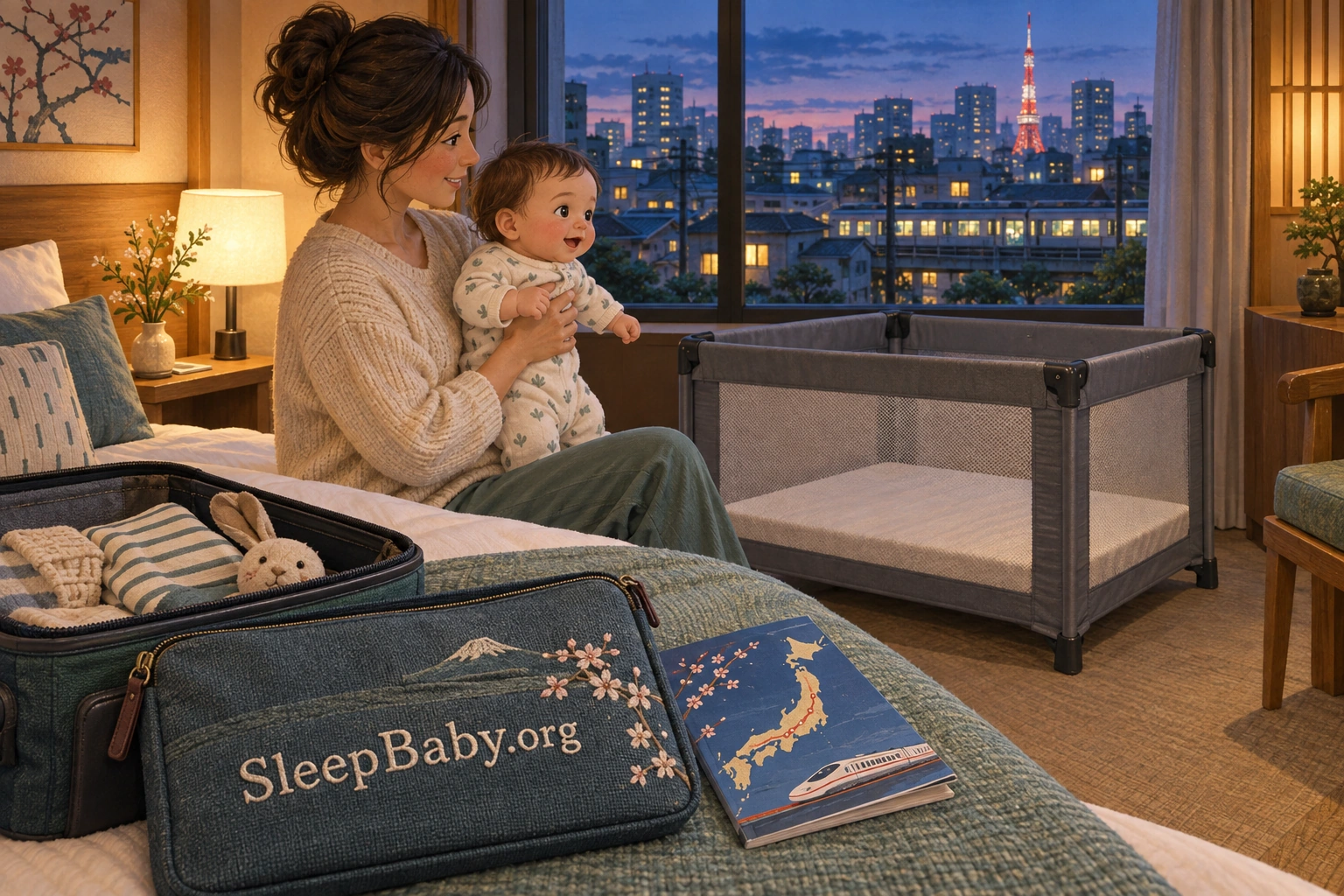
Yes, you can take a baby to Japan, but I would book around a confirmed safe sleep space and an easy trip back to your room. Those two choices affect your day more than squeezing another famous stop into the itinerary. Trains, feeding rooms and well-equipped shops can help; they do not make every station exit, hotel room or restaurant convenient.
Start by asking your hotel to confirm the exact infant bed, its availability for your dates, and space to use it safely. A clear answer with the bed model or a photo gives you something to check. “Children welcome” does not. Then map the airport journey all the way to that room, including luggage and the elevator exit.
Decide what kind of Japan trip your baby can join
You do not need a baby who sleeps perfectly to travel. You do need plans that still work after a short nap, a delayed feed or an afternoon when nobody wants another train. I would choose fewer hotel changes and leave the first full day lightly booked. Packing and checking out repeatedly can consume the same hours you hoped to spend exploring.
A single city base with short outings is a different undertaking from Tokyo, Kyoto, Osaka and a mountain stay in one week. Neither itinerary is automatically right. Count the transitions: airport, station, platform, train, taxi, reception, unpacking. If most days contain several of those, reduce a stop before trying to buy equipment that will make the schedule manageable.
Your baby’s age changes the practical questions. A young infant needs frequent milk feeds and a suitable sleep arrangement. A baby starting solids adds food preparation and seating. A crawling baby needs somewhere clean and supervised to move after hours of being carried. Use what your baby needs now, allowing for development before departure, instead of a generic “best age to travel” promise.
Arrange a health conversation before departure
Review the itinerary with your baby’s clinician, ideally at least a month ahead when possible. The CDC Japan guidance distinguishes routine vaccination from recommendations that depend on the trip, including Japanese encephalitis risk. City sightseeing and a long rural stay are not interchangeable. Prematurity, ongoing treatment or feeding and growth concerns deserve individual planning.
For international travel, CDC recommends an early MMR dose for eligible babies aged 6–11 months. That dose does not replace the two doses after the first birthday. Babies younger than 6 months are not recommended to receive MMR; discuss the travel risk and timing with their clinician. Check the current measles travel advice rather than assuming the usual appointment schedule covers departure.
Check documents for your baby as carefully as your own
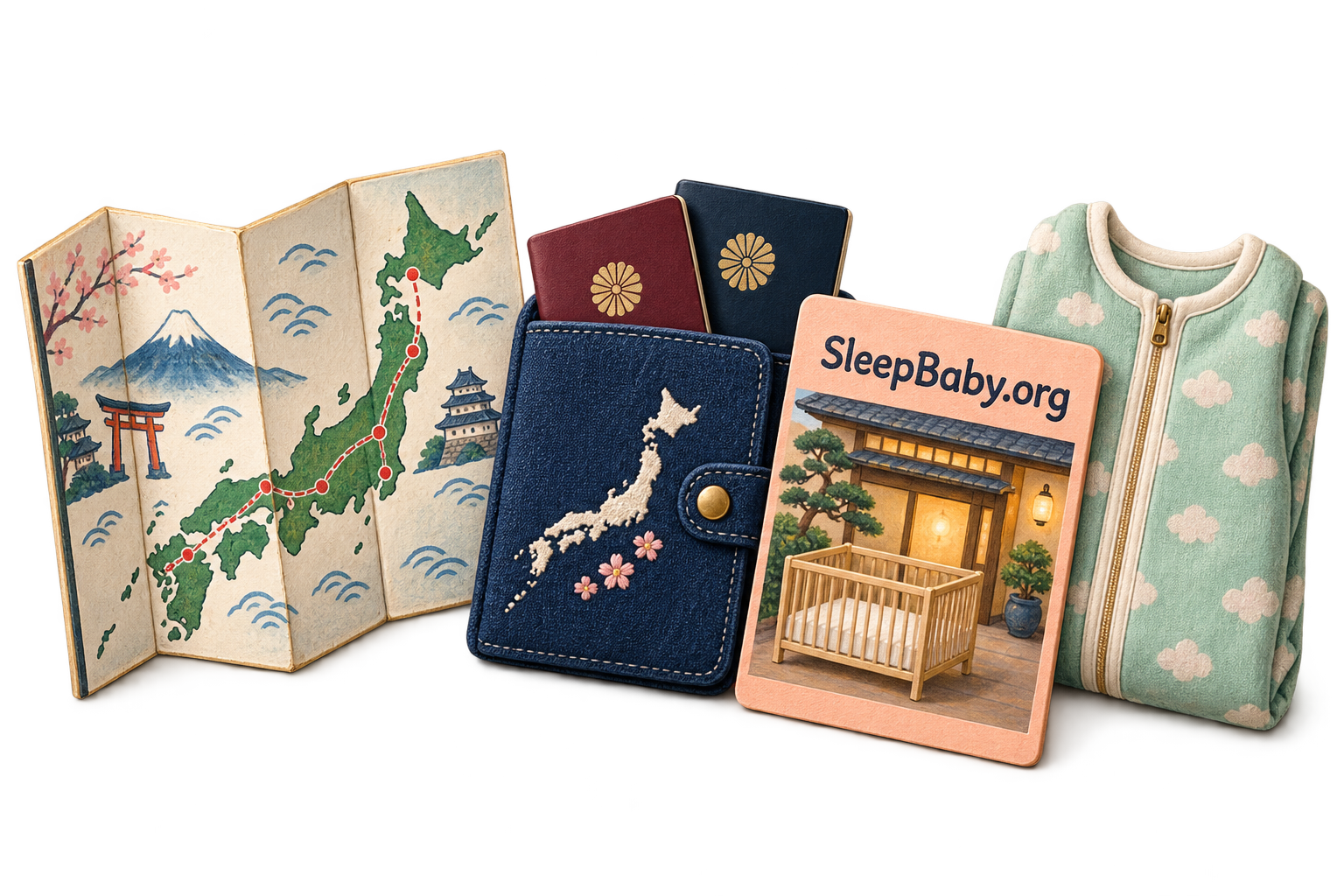
Confirm passport, visa and entry requirements for each traveler’s nationality through Japan’s Ministry of Foreign Affairs and the relevant embassy. Also check transit and return requirements. If one parent travels alone, ask the relevant authorities and airline about any consent or supporting documents for your circumstances. Save copies separately from the originals.
I would finish the paperwork check before paying for nonrefundable extras. Keep your baby’s documents in the bag that stays with you, along with insurance details, medicines and feeding essentials. A beautifully organized suitcase is little help if it disappears into the hold with the thing you need at immigration.
Choose the room before choosing the view
A hotel’s location needs a more useful description than “near a station.” Which entrance has an elevator? How far is it from that entrance to your room? Can you reach somewhere to buy dinner without another connection? I would compare the actual walking route and room layout before paying more for a famous neighborhood.
Check whether the crib is guaranteed or merely requested, whether it fits your baby’s size and developmental stage, and whether a fee applies. For a rental, ask who supplies and assembles it. If bringing your own approved travel crib, confirm usable floor space. Do not assume a photograph taken with a wide-angle lens proves there is room beside the bed.
BEFORE YOU CONFIRM THE ROOM
Send three specific questions
- Which infant crib or cot can you reserve for our dates? Please send its model, size limits and a photo.
- Will it fit in this room, fully assembled, clear of curtains, cords and other furniture?
- Where can we wash feeding equipment, and what refrigeration is available if our feeding plan needs it?
Ready to book? You can identify the bed and its limits, understand the space, and explain how feeds will work. If an answer is vague, resolve that part first.
Traditional accommodation can be lovely, but an adult futon or shared adult bed is not a substitute for an infant sleep space. For sleep, place your baby on their back on a firm, flat, separate approved surface with its fitted sheet and no pillows, blankets, bumpers or toys. Use the manufacturer’s intended mattress or pad; do not add cushioning to make a travel crib feel more comfortable. These principles follow AAP safe sleep guidance.
Inspect the setup when you arrive, while you can still ask staff for help. Our hotel safe sleep checklist walks through the room and crib checks. If the promised bed is absent or unsuitable, ask for an appropriate replacement or change the accommodation. Keep money and time available for that possibility; “we will work it out at bedtime” leaves you very few good choices.
For the adults, consider what happens after bedtime. Is there somewhere to sit with a low light without crowding the crib? Can one person get food while the other stays with the baby? A larger room or kitchenette can be more useful than a second attraction ticket. Those are personal budget choices, but I would price them before calling the cheapest room a bargain.
Make the flight and airport arrival one plan
Compare flight times with the whole arrival journey, not just the fare. A late landing may leave a tired family with fewer comfortable options before check-in and feeding. A very early arrival creates a different gap if your room is unavailable until afternoon. Ask about confirmed early access or choose a place to wait with feeding and changing facilities.
Do not assume an infant flies free internationally. Airlines have their own fares, taxes, age rules and booking arrangements; JAL’s international infant guidance, for example, distinguishes lap travel from a purchased seat. Check every operating airline on a connecting booking. Bassinets also have limits and availability rules, so treat a request as a request until the airline confirms what it means.
The FAA recommends an approved child restraint in a purchased seat as the safest place for a child under 2 on an aircraft. Check your restraint’s aircraft approval, installation instructions and fit, plus the airline’s requirements. A baby carrier does not provide equivalent turbulence protection. An aircraft bassinet is not a substitute when a restraint is required.
Keep an accessible bag for the part of the journey between leaving home and opening your room: enough milk or feeding supplies for delays, diapers, spare baby clothes, a spare adult top, necessary medicines and the documents. Check security rules at your departure and transfer airports. Split essential supplies between adults’ bags when practical, so one misplaced bag does not contain everything.
WATCH BEFORE YOU PACK THE CAR SEAT
Rear-facing installation on an aircraft
The FAA’s demonstration helps you see how an aircraft lap belt secures a rear-facing child seat. Use your own seat’s instructions and confirm your airline’s rules; a demonstration cannot establish that your model fits your flight.
Notice: the rear-facing direction and how the aircraft belt passes through the seat. Rehearse with the manual before departure, while you have time to ask for help.
Choose the airport transfer before you land. A direct train may be easier than a car if you can manage the station and luggage. If using a car, arrange a suitable rear-facing child seat in advance, confirm its model and availability, and check installation on arrival. Do not rely on finding an appropriate infant seat in whichever taxi is next in line. Have a workable alternative if the promised seat is missing.
I would save the hotel’s name and address in Japanese, the reservation, and the final station exit offline. Add a screenshot of the route from the exit to reception. That small preparation earns its place when mobile data is slow, one adult is carrying the baby, and neither of you wants to solve a new map.
Stroller, carrier and trains: match the route to the load
A stroller and a carrier solve different problems. A stroller takes weight off your body during a long walk; a suitable carrier can help on a short route with steps or a crowded entrance. I would not choose either because someone else’s baby preferred it. Try your intended arrangement with your baby and the bag you will actually carry.
A compact stroller is useful only if it supports your baby’s age and stage. A carrier needs a safe fit according to its instructions, with your baby’s face visible and airway unobstructed. If you cannot comfortably carry the baby, folded stroller and luggage together, choose routes that do not require that combination. Ask another adult or station staff for help instead of attempting a precarious carry.
Check station maps for an accessible route before leaving, and allow time for elevators and longer transfers. Tokyo Metro permits stroller use without automatically requiring folding, but follow staff directions and the conditions on the day. Keep control of the stroller, use its brake when stopped, and stay clear of platform edges. Avoid a commuter crush when your plans are flexible.
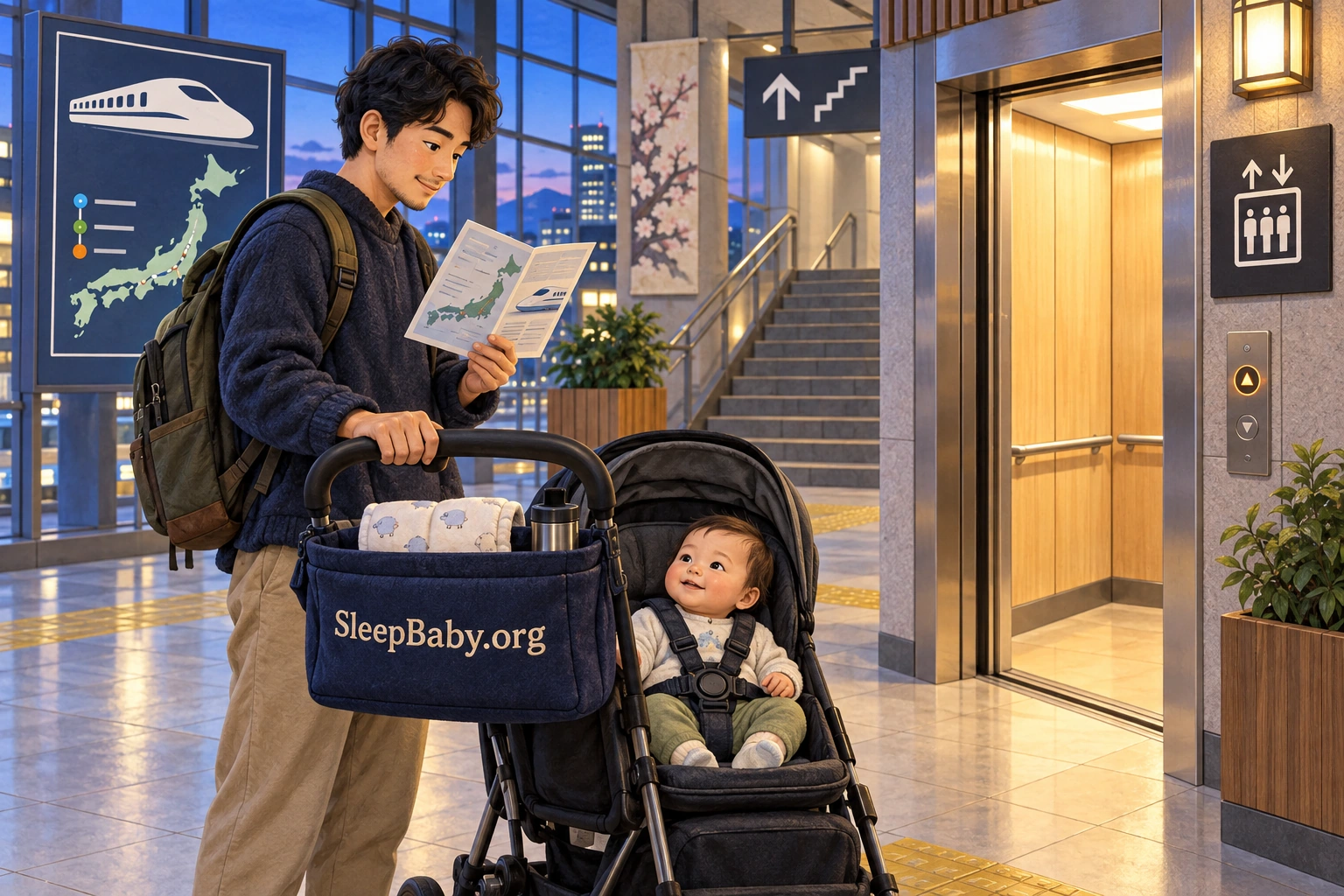
BUILD THE DAY FROM THE WAY BACK
Can you get back when the plan changes?
Confirm the crib and feeding setup. Find the usable station entrance, not just the nearest dot on the map.
Check the journey, a place to feed and change, and somewhere to pause. Keep the next stop optional.
If your baby needs the room now, can you reverse the route without a difficult transfer or an unbooked car seat?
Choose the simpler day when the return depends on several things going right. A nearby stop can still be a full outing for your baby.
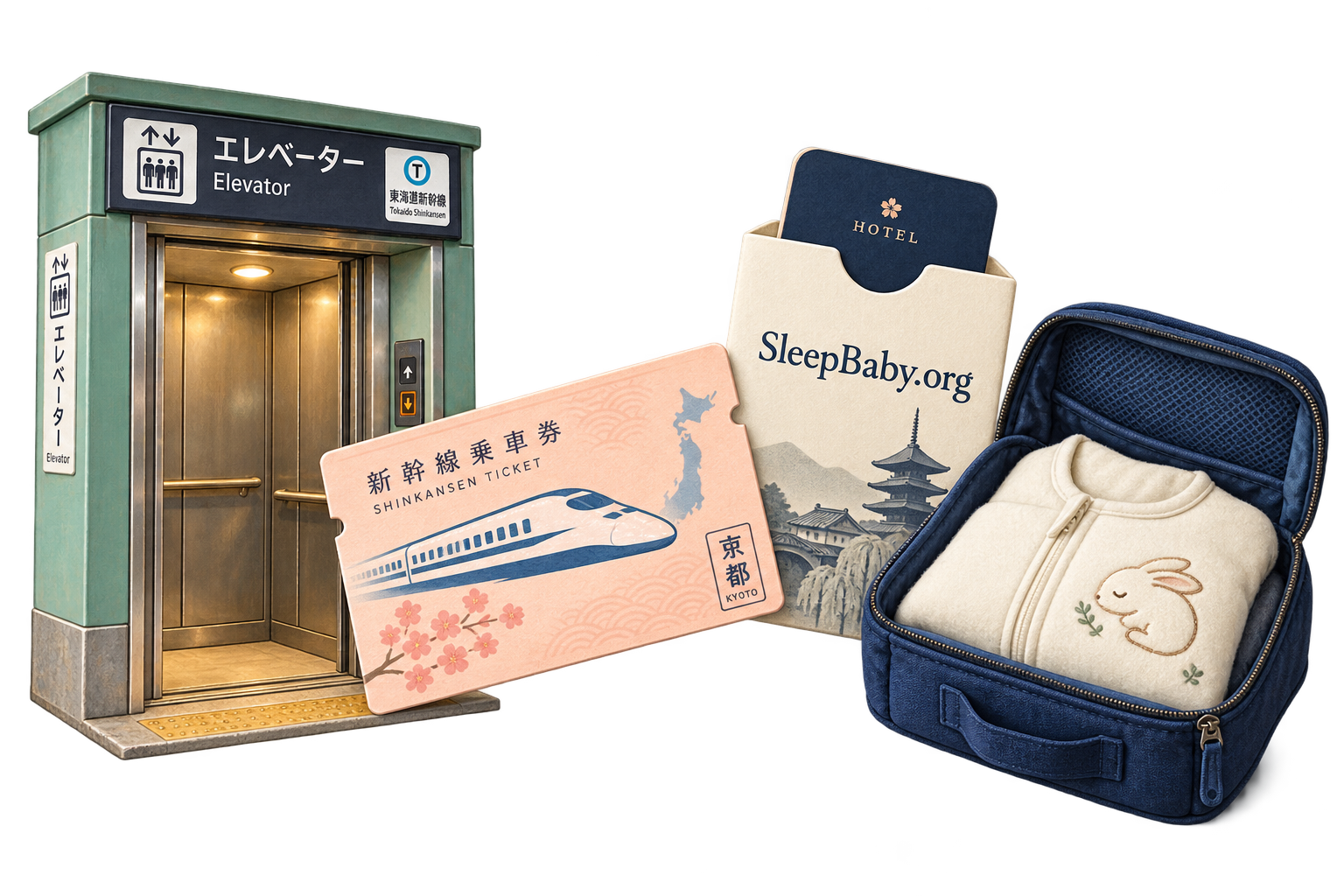
For a Shinkansen journey, think about both the baby’s place and your luggage. JR Central generally allows babies and young children to travel without a child fare in certain circumstances, but an occupied reserved seat is an important exception. If you want your baby to have their own reserved seat, check the appropriate ticket instead of assuming “under 6” means every seating arrangement is free.
JR Central treats strollers differently from ordinary oversized baggage, but using designated rear luggage space still has reservation conditions. Check the specific baggage guidance and child ticket rules for your service. Do not block aisles or assume the space behind the last row is unclaimed storage.
Pack so the feeding and changing kit comes out without opening the large suitcase. Decide who handles each bag before boarding. If the arrangement requires both adults to deal with luggage at once, simplify it. Sending fewer belongings between hotels is a planning option; first confirm the provider’s delivery timing and keep everything essential for the intervening nights with you.
Make a feeding plan that survives a closed shop
Bring enough familiar feeding supplies to cover the journey, delays and the first stretch after arrival. The useful question is not simply whether Japan sells formula or diapers. It is whether you can get the exact item your baby needs, in the right size or formulation, when you need it. Specialist formula deserves a specific supply plan made with your clinician.
If breastfeeding, identify places where you can comfortably stop rather than letting the day’s route postpone feeds. JNTO notes that many larger facilities have baby-care rooms, sometimes with nursing areas, changing facilities or hot water. Availability and access vary. Check the actual building’s facilities and hours, and keep an alternative nearby; a map symbol does not guarantee an open room.
For formula, follow the product’s preparation directions and current CDC preparation and storage advice. Measure water first, then add the exact amount of powder. Powdered formula is not sterile; babies younger than 2 months, born prematurely or with weakened immune systems need extra precautions. Discuss the travel preparation method with their clinician. Bottled water is not automatically sterile, and a dispenser labeled hot water does not establish the temperature you need.
Use prepared formula within 2 hours of preparation and within 1 hour after feeding begins; discard leftovers from a feed. Follow the applicable refrigeration instructions when preparing ahead. Do not microwave a bottle. Work out how you will clean and dry equipment before buying a room on the assumption that its kettle solves every feeding problem.
If your baby already eats solids, pack some familiar, age-appropriate options and the utensils you use. Read ingredient and allergen information carefully; a food that looks familiar can have a different recipe. Ask for help when a label is unclear. Restaurant plans should leave room for a feed before the adults’ meal if service is slow.
I would choose somewhere with space to sit safely over somewhere with the longest queue. Confirm a suitable high chair or make another supervised feeding arrangement; do not feed a baby while walking with the stroller. Keep food texture and shape appropriate for your baby’s skills, and stay with them while they eat, following CDC choking-prevention guidance. A travel day is not a reason to rush through a meal.
Pack for the diaper change after the diaper change
Carry a changing mat, wipes, diapers, spare clothes and a way to contain used items until you find the appropriate disposal point. Follow the facility’s signs and ask staff when unsure. Do not assume every changing table has a diaper bin. Repack the small kit each evening so tomorrow’s first change does not reveal yesterday’s empty packet.
Buy a small pack when trying an unfamiliar diaper size or brand. If your baby has sensitive skin or you rely on a particular product, bring enough to avoid an urgent switch. Keep a photo of the packaging and size information on your phone. That is easier to compare in a shop than a half-remembered description after a long day.
Choose outings with a place to stop
Plan one main outing and make the rest optional. A neighborhood walk, a garden visit or a short museum stop can give you something you wanted from Japan without using the whole day’s patience on transport. Decide what you would cancel first. Having that answer before leaving makes it easier to turn around without debating whether you have wasted the ticket.
Look at facilities alongside photographs of the attraction. For example, the Kyoto Railway Museum publishes baby-care information, including nursing and changing facilities. That makes it possible to plan a break. It does not mean every baby will enjoy a long museum visit or that a borrowed stroller will always be available.
Check the weather and the site’s current opening and access information before leaving. In hot weather, shorten outdoor stretches and plan an indoor break; in heavy rain, reconsider routes with long exposed walks. Keep your baby’s face and airflow unobstructed. The NHS advises against covering a stroller with a blanket because of overheating. If the weather makes the route uncomfortable or unsafe, choose a different day.
Temples, shrines and small restaurants may involve stairs, narrow passages or places where a stroller is awkward. Read the specific venue’s guidance. A carrier can be useful when appropriate, but it does not erase the adult’s fatigue or the baby’s need for a break. I would rather enjoy one place at a comfortable pace than carry an unhappy baby through three places I barely notice.
If your baby falls asleep in a stroller, carrier or car seat, move them to a firm, flat sleep surface on their back as soon as possible. Do not build the whole itinerary around prolonged sleep in sitting devices. The room should remain a realistic place to return for rest, not somewhere so far away that you feel committed to staying out.
Give the first evening a small job
After crossing time zones, your baby’s sleepy period may arrive at an inconvenient local hour. The CDC describes jet lag as a mismatch between the body clock and local time. That explanation is useful; adult medication and nap prescriptions are not a baby travel plan. I would focus first on feeding, a safe sleep space and a manageable evening.
Use ordinary local daytime light and activity when your baby is awake, and keep nighttime care quieter and dimmer. Offer needed milk feeds and age-appropriate naps. Do not keep an exhausted baby awake for hours to reach an impressive bedtime on the hotel clock. For a more detailed approach, see our baby jet lag guide.
YOUR FIRST NIGHT IN THE ROOM
Three things are enough to start
- Set up the next feed
- Put the needed supplies within adult reach. Confirm the cleaning plan before bags spread across the room.
- Check the sleep space
- Inspect the crib and keep it clear. Ask for help now if it differs from what was promised.
- Repeat a familiar short sequence
- A change, a feed as needed, a quiet book or song, and the usual settling approach. Leave tomorrow’s sightseeing decisions until morning.
You may have a wide-awake baby at an hour when everyone else is asleep. Keep the expectations modest. If two adults are traveling, agree on a manageable division of care before both become overtired. If you are alone, keep the following day’s commitments especially light. The goal is to make care possible, not to demonstrate how little the trip has affected you.
Do not use melatonin or sedating medicines to make a baby sleep through a flight or adjust to Japan without specific medical advice. The AAP advises discussing melatonin with a pediatrician. A medicine suggested for an adult traveler is not an infant recommendation. Ask your clinician before departure if sleep or medication questions are worrying you.
Save the help you might need before you need it
Save your accommodation’s full address, your insurance assistance number and a nearby medical option that can assess a baby. The JNTO emergency page links to medical information and lists its 24-hour Japan Visitor Hotline, 050-3816-2787, for visitor assistance. It is not a substitute for emergency services.
For an ambulance in Japan, call 119. The Tokyo government’s ambulance guidance explains what to tell the dispatcher. Ask hotel staff for help communicating when available, but do not delay an emergency call while looking for someone to translate. Have the address visible so you can give the location clearly.
Seek emergency help for breathing difficulty, blue or gray color, a seizure, unresponsiveness or a baby who is extremely difficult to wake. A baby younger than 3 months with a temperature of 100.4°F (38°C) or higher needs urgent medical assessment. Get medical advice for poor feeding, markedly fewer wet diapers, persistent vomiting, fever or other signs of illness. The AAP’s guide to urgent and emergency care explains these distinctions. Do not explain a baby who seems unwell as “just jet lag.” Before travel, ask your clinician for age-specific illness instructions.
Know the accommodation’s evacuation instructions and follow local weather and emergency advice. Keep a small supply of feeding essentials, diapers and medicines accessible rather than scattered across several drawers. You do not need to spend the holiday anticipating every problem; you need the basic information somewhere both caregivers can find it.
Leave a little room for coming home
If you can, leave the first day home free of unnecessary commitments. Put the usual sleep space and feeding supplies back into service before unpacking every souvenir. Return to familiar local-day cues and routines without expecting the first night to prove that everything is back to normal.
Our guide to sleep problems after travel separates a time-zone shift from changes in routine and environment. That distinction helps you choose the next step. Illness or feeding concerns still take priority over adjusting the schedule.
I would judge the trip by whether you found a pace your family could use, not by how many places you reached. A confirmed crib, a route you can reverse and supplies for the next feed leave you more room to enjoy being there. Start with those, and let the extra stops earn their place.
Sources and planning references
Travel and service details checked September 26, 2026. Recheck rules and availability for your dates.
- JNTO: traveling with children; emergency help.
- CDC: Japan traveler health, measles and travel, formula preparation, and jet lag.
- AAP: safe sleep; melatonin guidance.
- FAA: flying with children; JAL: international travel with infants.
- JR Central: child fares and baggage; Tokyo Metro: passenger safety.
- Japan Ministry of Foreign Affairs: visa exemptions; Tokyo government: ambulance calls.
- Munchkin: dispenser specifications; Kyoto Railway Museum: facilities for children.






What viewers said10 comments · 4 replies+
Archived comments from the original Baby Sleep Miracle presentation. Not independently verified by SleepBaby.org; individual experiences vary.
Thank you so much for this video! I had no idea about the dangers of baby swings :O
Hi Mary-Ann. I have a question: Is method in any way similar to the ones recommended by Dr Bucknam, Dr. Weissbluth or Dr. Karp? We tried those but none of them help.
Hi Regina, thank you for your question. The short answer is no. The techniques I share in my guide are based on newest scientific research and this is why I have never seen any approach similar to the one I recommend.
This method really works! I tried it on my son Jesus and after just one week he went from waking up more than 5 times a night to waking up just once or twice. You are a lifesaver, Mary-Ann!
I'm truly impressed with how much information you share in your video. And all for free! I can feel that you truly care about mothers like myself, and that's hard to find these days. I have recommended your site to several of my friends already.
Mary-Ann, our child suffers from autism. Is your approach still suited?
Chloe, I made sure my method can be used with any child, even babies who are special like yours. Please note that I'm not a doctor and that I always advice to consult with your physician because nothing is more important than the safety and well-being of your love.
Hallo Mary-Ann, I'm from Germany. Do you have your guide in German?
Hello Heide, we do! Normally you should already see our video in German. If not, please contact our support so they can guide you
Thenk you for your answer, Mary-Ann!
I just completed your approach and I have to say, it worked almost too well. Yes, it took a bit of getting used to with your bedtime routine but the difference is huge. My son George used to take 1 hours to go down and now he's firmly asleep in no more than 10 minutes! You're the best!
It seems I'm the only man watching this video, lol! What you shared about the 'emotional backpack' made immediate sense to me and I can't wait to help my little girl Mila to unpack it!
Hey there, just discovered your site and this really sounds different. Just wanted to say thanks for sharing :)
For everyone who's still thinking about getting Mary-Ann's guide I want to advise you to go ahead. I wasn't sure myself but now I'm so thankful I invested in this program. It made a huge difference in our life as a family and yes, my baby girl does sleep through the night now.