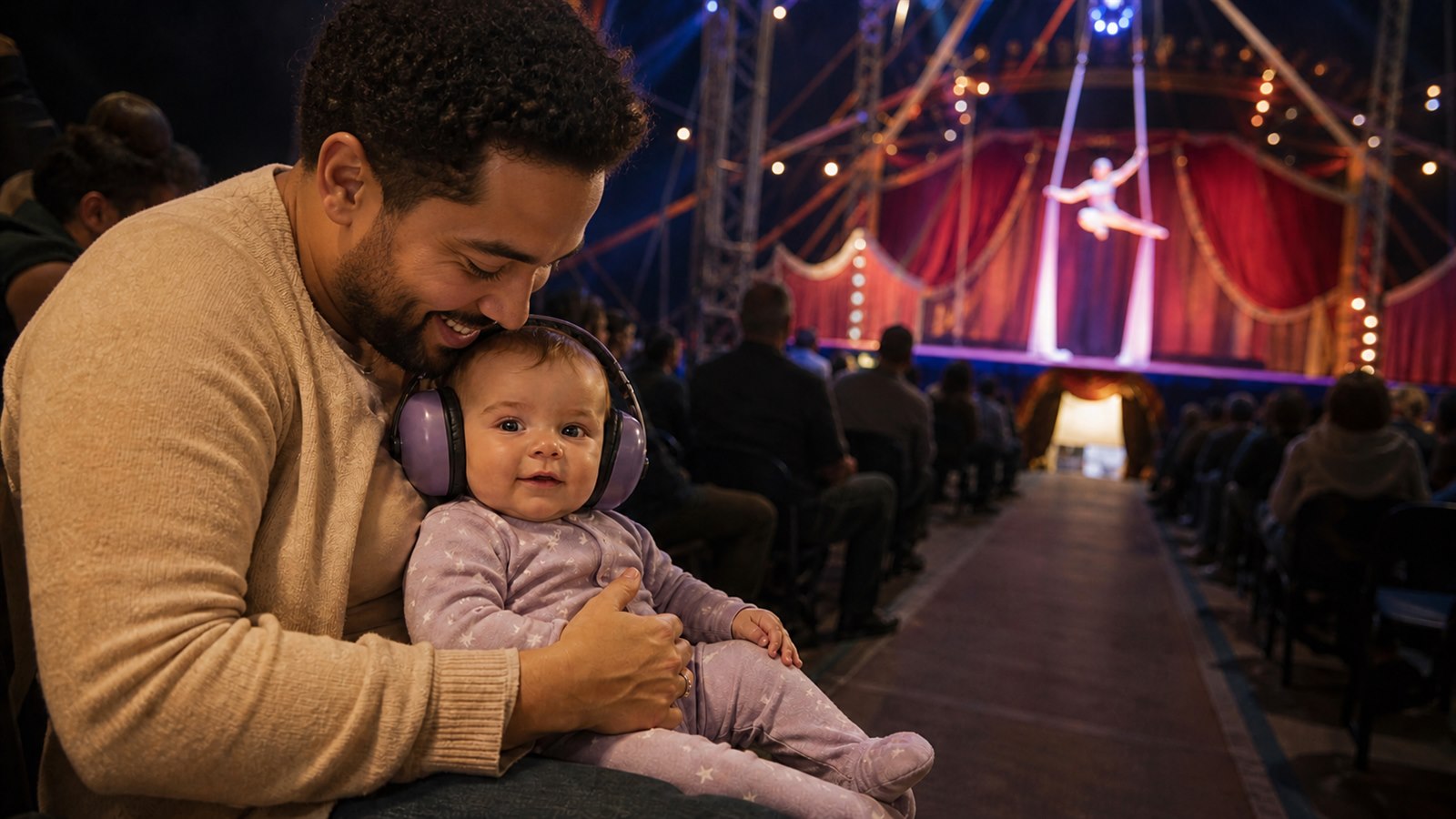
Yes, you can often take a baby to the circus—but only if the show and venue admit infants, you can protect your baby’s hearing, and you are willing to leave the moment the environment stops working for your child. There is no universal “safe circus age.” Noise, show length, lighting, your baby’s health and temperament, and your ability to make a quick exit matter more than finding one magic birthday.
Parents can spend an impressive amount of energy choosing the “best” view. With a baby, I think the premium seat is usually the one nearest an aisle, comfortably away from speakers, with a clear path to somewhere quiet. The acrobat may be hanging by one ankle over the ring; you do not also need to be trapped in the center of Row J with a crying infant and four apologetic strangers between you and freedom.
Can a baby go to the circus?
A healthy baby may be able to attend a family circus performance when the venue permits it and the adults can control the important variables. I would not use age alone as the decision. A calm six-month-old at a short daytime show, wearing hearing protection in an aisle seat far from the speakers, may have a much easier outing than an overtired toddler at a loud evening production with strobe effects and no re-entry.
The question beneath “Can I take my baby?” is usually, “Am I being reckless if I try?” Trying is not automatically reckless. Treating the outing like an obligation is where judgment gets cloudy. Your job is not to prove your baby can tolerate a circus. Your job is to make the environment easy to leave.
I would postpone the trip if your baby is ill, recently medically fragile, cannot comfortably wear the hearing protection you plan to use, or has care restrictions that make a crowded performance a poor fit. If your baby was born prematurely, has a hearing condition, or has another health concern that changes what environments are appropriate, ask the clinician who knows your child rather than relying on a general outing guide.
THE THREE-RING CHECK
Three yeses before you buy the tickets
This is a practical planning framework, not a medical scoring tool. If one ring is missing, fix that part or choose another day.
-
The venue ring
You know the infant-ticket, stroller, bag, re-entry, changing-space, run-time, intermission, and special-effects rules. You can choose an aisle seat away from speakers.
-
The baby ring
Your baby is well, the show does not collide badly with feeding or sleep, and your child has already tolerated the earmuffs for a short calm practice at home.
-
The exit ring
You know where the quietest reachable area is, who carries what, and what cue means you leave without debate.
Tonight connection: choose the show time and exit plan before the outing so a tired baby does not have to negotiate the final act and bedtime at once.
Original decision framework created by SleepBaby.org.

Protect your baby’s hearing before anything else
Circus sound can change quickly. Recorded music may feel manageable, then an announcer, crowd cheer, drum hit, air cannon, or amplified finale can arrive much louder. That is why I would plan for the loudest part of the show, not the gentle music playing while people find their seats.
The National Institute on Deafness and Other Communication Disorders warns that sounds at or above 85 decibels can damage hearing and that louder sound can cause harm more quickly. It recommends moving away from loud sound and using well-fitting hearing protection when sound cannot be avoided.[1] The American Academy of Pediatrics also cautions that adult occupational limits should not simply be treated as safe limits for children.[2]
I would use child-sized protective earmuffs that fully surround the ears, practice with them before the event, and check the seal after every feed, cuddle, hat adjustment, and enthusiastic attempt to remove them. Hearing protection helps only while it fits correctly. It does not make every volume, seat, or exposure length safe.
A useful real-world warning sign from the American Academy of Pediatrics is this: if you need to raise your voice to be heard by someone an arm’s length away, the setting is probably too loud for a child.[2] Do not spend the next twenty minutes trying to settle your baby over the noise. Move farther away, step into a quieter area, or leave. Distance and shorter exposure are part of the plan too; the Centers for Disease Control and Prevention recommends turning sound down when possible, moving away from it, limiting exposure, and using hearing protection.[3]

THE SEAT IS PART OF THE SAFETY PLAN
Choose for distance, access, and options
- Best starting zone
- An aisle seat with a short route out, comfortably away from speaker stacks and effects equipment.
- Ask before booking
- Which sections are loudest? Are there sudden effects? Is there a lobby or family area where you can still hear less?
- Do not assume
- The most expensive seat is not necessarily the most baby-friendly, and “family show” does not mean quiet.
- Your move if it is too loud
- Leave the seating area promptly. Do not wait for your baby to prove the sound is uncomfortable.
Tonight connection: an easy exit can protect both hearing now and the calmer wind-down you will need after a stimulating show.
A 105-second hearing-protection refresher
The American Academy of Pediatrics made this short video for families attending loud events. It is worth watching before you fit the earmuffs, not while the opening music is already rattling the cup holder.
Written takeaway: use hearing protection that fits your child, create distance from loud sound, and leave when you cannot control the exposure. The video supports the plan; it does not replace the written safety guidance above.
Check the circus rules and the venue rules
There is no one circus policy for babies. A touring production may publish one rule while the arena, theater, tent, fairground, or ticketing partner applies another. For example, Ringling’s FAQ says children age two and older need a ticket, but it also tells families to check the local arena because some venues require a ticket for every age.[7] That is a useful example, not a universal rule.
Call or message both the promoter and the venue. A vague “babies are fine” is not the answer you need. Ask these exact questions:
- Are infants admitted, and does a lap baby need a ticket?
- Is there a minimum recommended age for this particular production?
- Can a stroller enter the building? Can it enter the seating area? Where is stroller parking?
- What bag size is allowed, and are bottles, formula, pumped milk, snacks, or cooling packs handled differently?
- Does the venue allow re-entry if you step outside?
- How long is the show, and is there an intermission?
- Are there strobe lights, smoke, pyrotechnics, air cannons, very loud music, or surprise bangs?
- Is there a changing table or family restroom?
- Which seating area is farthest from the main speakers and easiest to leave?
Save the reply or screenshot the policy. The person scanning tickets at the door may not know what someone told you on the phone. Discovering that the stroller must be parked outside while you are holding a baby, diaper bag, earmuffs, bottle, and your last remaining scrap of optimism is a problem we can prevent.
Practice the awkward parts before show day
The earmuffs should not make their debut under a spotlight. Try them at home for a few short, calm periods. Check whether they stay over both ears when your baby turns their head, feeds, leans against you, or gets sleepy. If your baby repeatedly pulls them off, treat that as a planning problem, not a personality challenge.
Then rehearse the exit. Decide which adult takes the baby, which adult gathers the bag, and where you will meet if only one person steps out. If you are going alone, bring only what you can carry with one free arm. The best plan is the one you can still execute while your baby is crying and the aisle is dark.
This is also when I would choose a personal stop cue. Mine would be simple: if the earmuffs will not stay sealed, the baby cannot settle in the quieter area, or the sound still feels excessive after moving, we leave. A preset rule is useful because a paid ticket has a strange way of turning otherwise sensible adults into negotiators.

Pack for a short outing, not a small relocation
You need enough to solve the predictable problems without creating a bag so large it becomes its own circus act. Check the venue’s bag and food rules first, then pack for the actual length of the event plus the travel time.
If you bring a stroller, always use its harness, apply the brake when stopped, and keep supervising your baby. Those are core stroller-safety steps from the U.S. Consumer Product Safety Commission.[5] A stroller can help with transport, but it is not a quiet room, a sound barrier, or a substitute for safe sleep.
Plan feeds, naps, and the ride home
I would choose a performance that works with the easiest part of your baby’s day rather than trying to defend the perfect schedule at all costs. Feed before you enter if that fits your baby’s routine. Arrive with enough time to change a diaper and find your seat without sprinting through the lobby. A matinee may be easier than a late show, but the best time is the one that does not place your baby at the edge of hunger and exhaustion before the first act begins.
One outing may make the next nap or bedtime messy. It does not automatically “ruin” a schedule. Keep the return home boring in the best possible way: lower the lights, reduce extra stimulation, feed as usual, and return to the familiar sequence your baby already knows. Do not add three new sleep strategies because the circus ran long.
If your baby falls asleep in a car seat, stroller, carrier, sling, or swing, the American Academy of Pediatrics advises moving them to a firm, flat sleep surface on their back as soon as possible.[4] A sitting device is for transport, not routine sleep. If the ride home lands directly on bedtime, the SleepBaby.org guide to what to do when your baby falls asleep in the car before bed can help you decide what to do next without turning one awkward transfer into a referendum on the entire night.
There is a tender version of this outing that I do love: a baby tucked safely against a caregiver’s chest, eyes wide at one quiet ribbon of light crossing the ring, then slowly softening as the familiar arms become more interesting than the spectacle. You do not have to stay until the curtain call to keep that memory. Sometimes the whole successful outing is twelve beautiful minutes and a very competent exit.
If the circus includes animal contact
Many modern circus productions do not include animals. If yours does not, skip this section. If the event includes a petting area, pony interaction, animal enclosure, or hands-on exhibit, treat that as a separate hygiene decision rather than an automatic part of the ticket.
The CDC advises washing hands after touching animals or anything in the areas where they live and supervising children closely at animal exhibits. Young children are at higher risk of illness from germs carried by animals or their environments.[6] Keep pacifiers, bottles, toys, and other mouth-contact items out of the animal area. Do not let a baby touch an enclosure and then immediately reclaim a dropped pacifier as though the floor has signed a cleanliness waiver.
If you cannot reach a proper handwashing station, skip the contact. Hand sanitizer can be useful when soap and water are not immediately available, but wash with soap and running water as soon as you can.[6] The animal act is optional. Clean hands are not.

Know your leave-now cues
Babies do not need to meet a formal checklist before you respond. Repeated startling, crying that grows rather than settles, turning away, stiffening, trying to escape the earmuffs, frantic feeding, or being unable to calm in a quieter space can all be your signal that the event has become too much. You know what “not okay here” looks like for your baby better than the audience around you does.
THE NO-DEBATE EXIT PATH
What to do when your baby starts struggling
-
Check the sound first
If the environment is excessive or the earmuffs have shifted, move away immediately. Do not try to soothe through uncontrolled noise.
-
Use the quiet-space test
Step into the lobby or another quieter approved area. Check the diaper, hunger, temperature, and whether your baby can settle.
-
Make one decision
If your baby settles and the environment can be controlled, you may choose to return. If not, leave. Do not cycle in and out until everyone is exhausted.
Tonight connection: a calm early exit often gives you a better chance of returning to your normal bedtime rhythm than pushing an overstimulated baby through the finale.
I want to be blunt about this: leaving early is not evidence that your baby “failed” the circus. It is evidence that you noticed. Parenting at a public event can make us oddly aware of everyone else’s experience, but nobody else in that row has to take your overstimulated baby home and help them settle.
If loud family events are something you enjoy, the SleepBaby.org guide to taking a baby to a fireworks display goes deeper on planning around sudden noise. For another look at aisles, crowds, and live-event logistics, see taking a baby to a basketball game.
Adjust the plan to the baby you have today
A birthday does not tell you whether your baby will sleep through the announcer, stare peacefully at the lights, or object to the earmuffs with the focus of a tiny labor organizer. Think about today’s baby.
For a young infant
Keep the outing short, choose the least intense performance you can, and make feeding, changing, temperature, and a fast exit easy. I would be particularly conservative with noise and crowds. If your baby has medical considerations, ask their clinician first. Do not count on the baby sleeping through the show; if sleep happens in a sitting or carrying device, follow the safe-sleep transfer guidance above.
For an older baby
Movement, lights, faces, and music may be fascinating for a while. The challenge is that fascination can flip into fatigue quickly. Bring one familiar object for supervised awake time, plan a feed before your baby becomes frantic, and expect to walk out before the adults feel finished.
In the version of this outing I can picture most clearly, Benjamin would watch the bright costume crossing the ring for perhaps fifteen seconds and then devote serious investigative effort to the silver zipper on the diaper bag. Babies are loyal to no production budget. Let their attention wander; you are not there to make them appreciate the choreography.
For a toddler
Explain the simplest version of what will happen: it may be dark, it may be loud, you will wear earmuffs, and you can step out. Choose an aisle, bring a quiet approved activity, and do not expect a toddler to sit silently for the full run time. A toddler who needs a lobby walk is not ruining the show. They are behaving like a toddler in a building designed to overwhelm the senses on purpose.

A simple circus-day timeline
-
Before buying
Confirm both policy sets, effects, run time, re-entry, quiet-area options, and the seat location.
-
The day before
Practice the earmuffs, pack to the venue rules, save the policy, and choose your leave-now cue.
-
Before entering
Feed or change as needed, check the earmuff fit, and identify the nearest route out.
-
During the first loud moment
Check the fit, sound, distance, and your baby’s response. Move or leave early rather than waiting for distress to build.
-
On the way home
Lower stimulation, return to familiar bedtime cues, and move a sleeping baby from a sitting device to an appropriate firm, flat sleep surface as soon as possible.
Tonight connection: the outing ends when you begin the calm return home, not when the performers take their final bow.

Questions parents ask before a baby’s first circus
Does a baby need a circus ticket?
Maybe. The answer depends on both the production and the venue. Some shows admit lap infants without a ticket; some venues require a ticket for every person; others set an age cutoff. Get the policy in writing before you travel.
Can I take a newborn to the circus?
There is no universal age rule, but I would be very conservative with a newborn because you have less room for noise, feeding, temperature, crowd, and sleep complications. Check the exact event rules and ask your baby’s clinician when health history or prematurity changes the decision. Waiting is a perfectly good plan.
Are baby earmuffs enough for a circus?
No. Properly fitting child-sized earmuffs are one layer. You also need distance from loud sound, shorter exposure, a lower-intensity seat when available, and a willingness to leave. Earmuffs are not a permission slip for unlimited noise.
Can I bring a stroller into the circus?
Ask the local venue. A stroller may be permitted in the building but barred from the seating area, or the venue may provide a designated parking location. If you need the stroller for medical or accessibility reasons, contact guest services in advance rather than relying on the general FAQ.
What if my baby sleeps through the show?
Continue protecting their hearing; sleep does not prove the environment is safe. If your baby falls asleep in a stroller, car seat, carrier, sling, or swing, move them to a firm, flat sleep surface on their back as soon as possible, following current AAP guidance.[4]
How long should we stay?
There is no prize for completing the run time. Stay only while the sound is controlled, the hearing protection fits, and your baby remains comfortable. For one family that may be most of the show; for another it may be one act. Both can be successful.
The best first circus may be a short one
A baby’s first circus does not need to look like the family in the promotional photo. It may be one beautiful aerial act, half a bottle in the lobby, a diaper change at intermission, and an exit before the finale. That still counts.
What I would remember is not whether we saw every trick. I would remember the small weight of a baby settling against my chest while the room glowed, the moment I realized the sound had changed, and the quiet satisfaction of leaving before wonder became distress. The goal is not to get your money’s worth out of your baby. It is to give them a little wonder while keeping every easy way home.
WHEN THE BIG TOP FOLLOWS YOU HOME
Let bedtime be the quiet act
A bright, busy outing can leave a baby wide-eyed long after the car is parked and the earmuffs are back in the bag. If tonight’s usual rhythm has wandered off with the circus, the SleepBaby.org Workshop can help you think through a calmer, more manageable plan for your baby’s sleep—without pretending one unusual day has ruined everything.
Sources
- National Institute on Deafness and Other Communication Disorders, “Protect Your Child’s Hearing”.
- American Academy of Pediatrics / HealthyChildren.org, “Sounds the Alarm on Excessive Noise and Risks to Children”.
- Centers for Disease Control and Prevention, “Preventing Noise-Induced Hearing Loss”.
- American Academy of Pediatrics / HealthyChildren.org, “A Parent’s Guide to Safe Sleep”.
- U.S. Consumer Product Safety Commission, “Carriages and Strollers FAQ”.
- Centers for Disease Control and Prevention, “Staying Healthy at Animal Exhibits”.
- Ringling Bros. and Barnum & Bailey, “Frequently Asked Questions”.