Pregnancy & postpartum sleep
Sleep Apnea During Pregnancy and Postpartum: The Signs Worth Hearing
New snoring, breathing pauses, gasping, morning headaches, insomnia, or exhaustion that feels bigger than the night you had deserve a real clinical conversation.
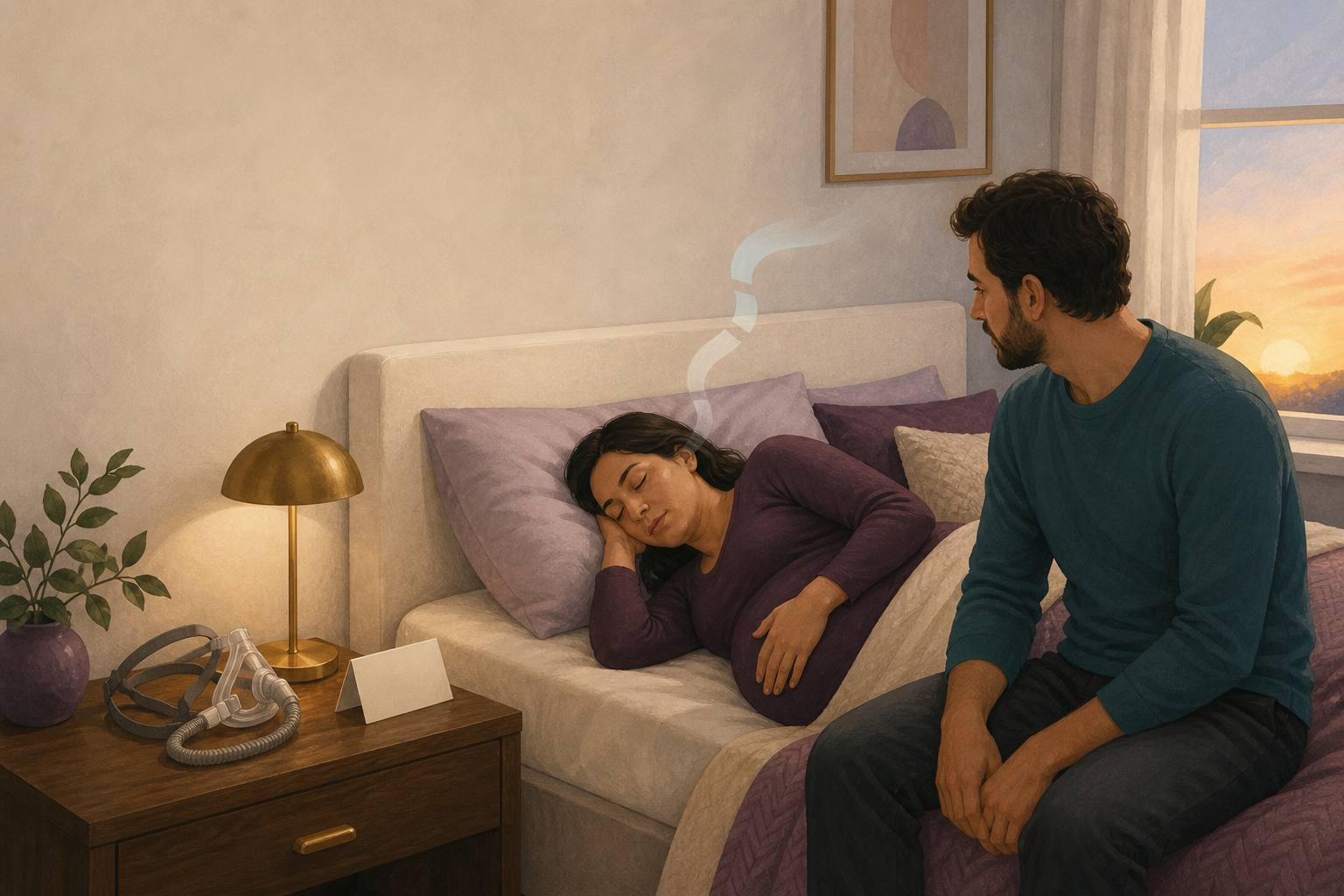
The room is finally quiet. Then your partner hears it: your breathing stops for a few seconds, followed by a snort or gasp that seems to restart the whole room.
New loud snoring, witnessed pauses, gasping, morning headaches, insomnia, or heavy daytime exhaustion during pregnancy or after birth should not be dismissed as ordinary pregnancy or new-parent fatigue. These symptoms do not prove sleep apnea, but they are enough to contact your obstetric clinician or primary-care clinician. Diagnosis usually requires a sleep study. Pregnancy can reveal or worsen obstructive sleep apnea, and delivery does not guarantee that it disappears immediately.
The private question beneath the search is often not simply, “Am I snoring?” It is, “Is my body asking for help while everyone expects me to be tired?” That is a kinder, more useful question—and one your care team can investigate.
First: name what was heard or felt
Sleep apnea repeatedly reduces or stops airflow during sleep. In obstructive sleep apnea, the upper airway repeatedly narrows or closes. Those interruptions can lower oxygen and fracture sleep even when you do not remember waking.
Snoring is one clue, not a diagnosis. The pattern matters more than a single noisy night.
What someone else may hear
Loud or newly intensified snoring, pauses in breathing, choking sounds, or a gasp followed by a restart.
What you may feel at night
Insomnia, repeated waking, dry mouth, or frequent nighttime urination beyond what you would otherwise expect.
What follows you into the day
Morning headache, sleepiness, poor concentration, or fatigue that seems out of proportion to the sleep opportunity you had.
Women may show up with fatigue, headache, or insomnia rather than the stereotype of dramatic snoring. That is why “I do not sound like the person in the commercial” is not a useful screening test.

A small record can make the appointment more useful
You do not need to become your own sleep laboratory. Bring a short, factual record instead. For three to seven nights, note:
- whether snoring is new, louder, or present most nights;
- whether anyone witnessed pauses, choking, or gasping;
- morning headache, dry mouth, insomnia, or unusual daytime sleepiness;
- pregnancy week or how many weeks postpartum you are;
- blood-pressure concerns or other symptoms your obstetric team is monitoring;
- any current PAP treatment, including whether you are having trouble using it.
A diary supports the conversation; it cannot diagnose or rule out apnea. If recording audio is useful, ask the person being recorded and keep privacy in mind. A partner’s plain description—“I counted repeated pauses followed by gasps”—may be more useful than a phone app’s unsupported score.
Then: tell the clinician the pattern, not just “I am tired”
Pregnancy and early parenthood provide endless explanations for exhaustion. Be specific enough that the breathing concern does not disappear inside that larger story.
“This snoring is new, and my partner has seen pauses followed by gasping. I am also waking with headaches and struggling to stay alert during the day. Could this be sleep apnea, and do I need a sleep evaluation?”
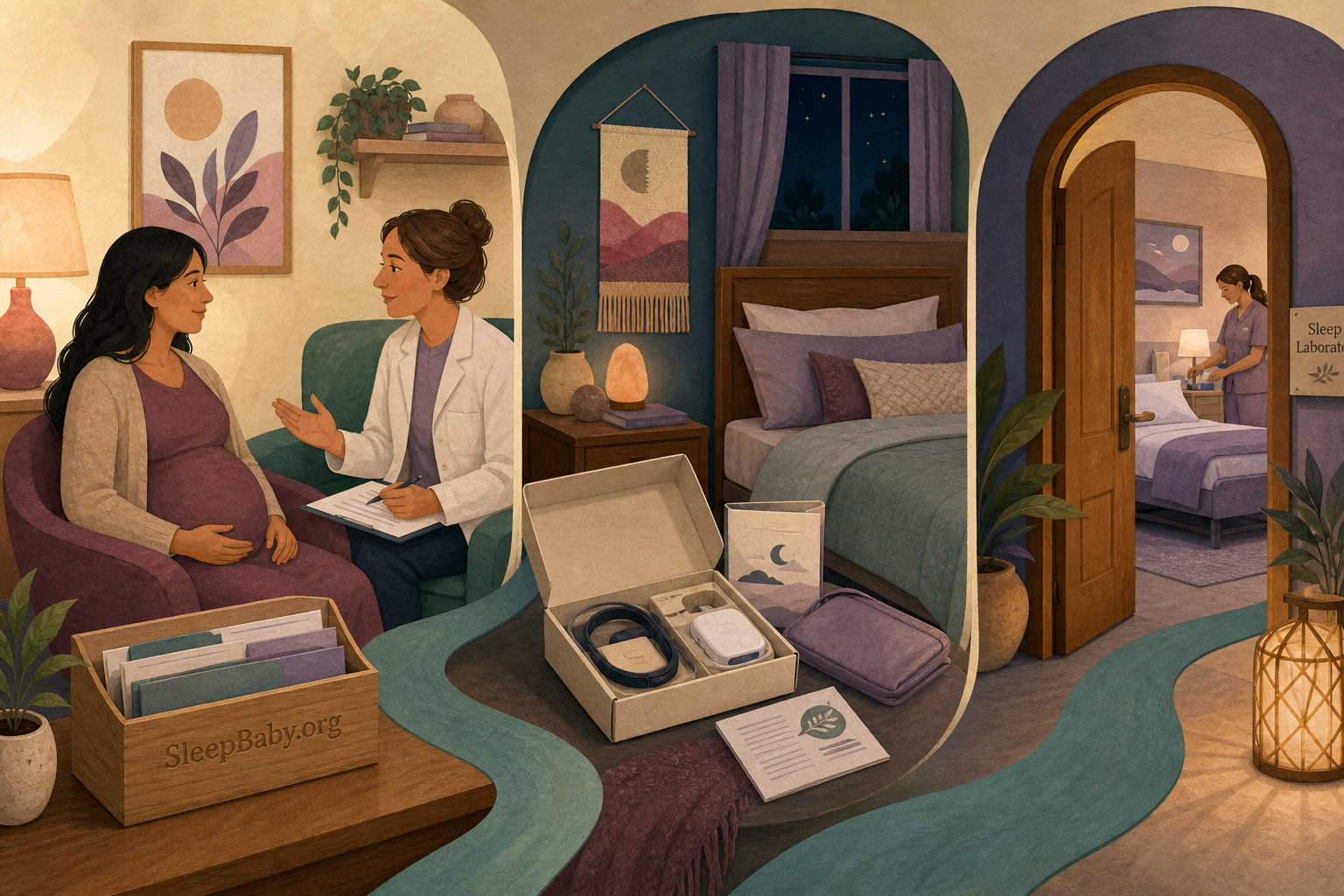
Your clinician may review symptoms, medical history, pregnancy-related risk factors, medications, and blood pressure, then decide whether a sleep study is appropriate. A sleep study identifies whether apnea is present and helps determine its type and severity. Neither snoring alone nor the absence of remembered awakenings settles the question.
If the answer is sleep apnea, treatment belongs to your care team
Positive airway pressure is the most common treatment. CPAP supplies continuous pressure that helps keep the airway open. Pregnancy-specific management should be coordinated with the clinicians caring for your pregnancy and sleep, because your symptoms, other health conditions, and study results matter.
Do not change pressure settings, start sedating sleep aids, or stop prescribed PAP on your own. If the mask leaks, feels intolerable, or your changing body makes treatment harder, tell the prescribing team. A fit or comfort problem is a treatment problem worth solving—not proof that treatment is impossible.

After delivery: reassess, do not assume
Delivery changes the body quickly, but it is not an automatic cure date. Research following people with gestational obstructive sleep apnea found that it did not universally resolve postpartum. Some people improve; others still need evaluation or treatment.
Keep the handoff simple
- Before birth: ask who will own follow-up and when.
- After birth: continue prescribed treatment unless your clinician changes the plan.
- At follow-up: report what improved, what persisted, and whether witnessed pauses or gasping continue.
- If symptoms worsen: contact the appropriate clinician sooner rather than waiting for a routine visit.
Postpartum sleep is fragmented for obvious reasons. That does not make repeated breathing pauses irrelevant. The useful comparison is not “Am I tired with a newborn?” but “Are breathing symptoms still present, and is my daytime function worse than the sleep opportunity alone explains?”

Keep the adult breathing plan separate from the baby’s sleep space
An adult apnea diagnosis does not make bed-sharing or unsafe infant positioning safer. Keep following infant safe-sleep guidance: place baby on their back for every sleep on a firm, flat, noninclined surface in an empty sleep space. Do not use sitting devices for routine sleep. If nighttime treatment, feeding, or exhaustion makes the setup difficult, ask your care team for a plan that protects both adult breathing and infant sleep safety.
Sources
The quiet room is not the test
Tonight, the room may still hold the bassinet rustle, the monitor glow, and the ordinary noise of a family trying to sleep. You are not listening for perfect silence. You are listening for a pattern—and turning that pattern into a plan.




What viewers said10 comments · 4 replies+
Archived comments from the original Baby Sleep Miracle presentation. Not independently verified by SleepBaby.org; individual experiences vary.
Thank you so much for this video! I had no idea about the dangers of baby swings :O
Hi Mary-Ann. I have a question: Is method in any way similar to the ones recommended by Dr Bucknam, Dr. Weissbluth or Dr. Karp? We tried those but none of them help.
Hi Regina, thank you for your question. The short answer is no. The techniques I share in my guide are based on newest scientific research and this is why I have never seen any approach similar to the one I recommend.
This method really works! I tried it on my son Jesus and after just one week he went from waking up more than 5 times a night to waking up just once or twice. You are a lifesaver, Mary-Ann!
I'm truly impressed with how much information you share in your video. And all for free! I can feel that you truly care about mothers like myself, and that's hard to find these days. I have recommended your site to several of my friends already.
Mary-Ann, our child suffers from autism. Is your approach still suited?
Chloe, I made sure my method can be used with any child, even babies who are special like yours. Please note that I'm not a doctor and that I always advice to consult with your physician because nothing is more important than the safety and well-being of your love.
Hallo Mary-Ann, I'm from Germany. Do you have your guide in German?
Hello Heide, we do! Normally you should already see our video in German. If not, please contact our support so they can guide you
Thenk you for your answer, Mary-Ann!
I just completed your approach and I have to say, it worked almost too well. Yes, it took a bit of getting used to with your bedtime routine but the difference is huge. My son George used to take 1 hours to go down and now he's firmly asleep in no more than 10 minutes! You're the best!
It seems I'm the only man watching this video, lol! What you shared about the 'emotional backpack' made immediate sense to me and I can't wait to help my little girl Mila to unpack it!
Hey there, just discovered your site and this really sounds different. Just wanted to say thanks for sharing :)
For everyone who's still thinking about getting Mary-Ann's guide I want to advise you to go ahead. I wasn't sure myself but now I'm so thankful I invested in this program. It made a huge difference in our life as a family and yes, my baby girl does sleep through the night now.