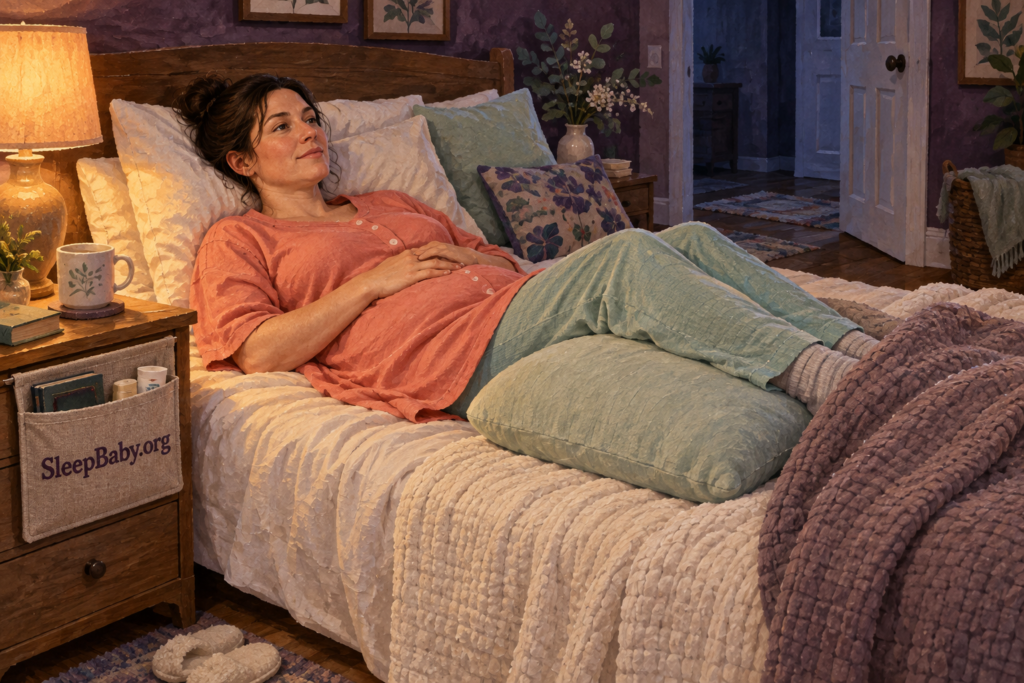
The short answer: postpartum sleep paralysis can happen. The classic episode begins as you are falling asleep or waking up: you know you are in the room, but for a few seconds or minutes you cannot move or speak. You may sense someone nearby, see a shape, hear a sound, or feel pressure on your chest. Then movement returns completely.
That pattern is a recognized REM-sleep transition—not a sign that you are “losing it,” not proof of a supernatural visitor, and not automatically postpartum psychosis. Broken sleep, too little sleep, irregular timing, and stress are all established sleep-paralysis triggers. Newborn care can supply that entire list before sunrise.
But postpartum is not a season for using one reassuring label to explain every frightening symptom. The hinge I care about is exact: Did it happen only at the edge of sleep, did you remain aware, did it end quickly, and did your movement, speech, breathing, vision, and orientation return fully? If any part of that answer is no—or you simply cannot tell—contact a clinician promptly.

The four hinges of a classic sleep-paralysis episode
No web page can diagnose what happened in your bedroom. These four questions do give you a cleaner way to describe it—and to notice when the experience does not fit.
The SleepBaby four-hinge sorter
All four pointing in the same direction makes classic sleep paralysis more plausible. One broken hinge is a reason to stop self-sorting.
-
01 · Timing
At the edge of sleep
It begins while you are drifting off or just waking—not halfway through a fully awake conversation, feed, shower, or walk across the room.
-
02 · Awareness
You know you are there
You are aware of the bed or room and later remember the event, even though dream imagery may still be mixed into what you see, hear, or feel.
-
03 · Duration
Seconds to a few minutes
The episode feels much longer than it is, but it ends on its own or sometimes after a voice, touch, or successful small movement.
-
04 · Recovery
Your body comes all the way back
Movement, speech, breathing, vision, and orientation return to your ordinary baseline. There is no lingering one-sided weakness, confusion, or breathlessness.
The sleep connection: this sorter is not permission to ignore symptoms. It is a way to describe the border between sleep and wakefulness clearly enough to choose the next safe action.
Created by SleepBaby.org for the exact postpartum sleep-paralysis decision.
What to do during the next episode
Most advice for sleep paralysis is written for a calm reader at noon. An episode needs a much smaller plan—something you can find while your alarm system is shouting and your voluntary muscles are still offline.
-
Name the state
Use one rehearsed sentence: “This is a sleep transition. It ends.” You are not debating the shadow or solving the room. You are giving your waking brain the correct file folder.
-
Choose one tiny movement
Try a fingertip, toe, tongue, or deliberate blink rather than commanding the whole body at once. Evidence for a particular escape move is limited, so treat this as a low-risk focus—not a guaranteed off switch.
-
Let the exhale be ordinary
Do not demand a heroic deep breath from a chest that feels pinned. Notice one normal exhale. This can reduce panic; it does not replace urgent care if breathing trouble remains when movement returns.
-
Run the full-recovery check
Once you can move, sit up only when steady. Check both arms, your smile, a simple sentence, vision, orientation, chest, and breathing. A clean ending supports the sleep-paralysis pattern; a lingering symptom changes the action.
There is no prize for “breaking out” quickly. Fighting every muscle can amplify the sense of threat. The goal is to ride a short neurologic transition without turning it into a second emergency made of panic and lost sleep.
A partner plan that does not require midnight improvisation
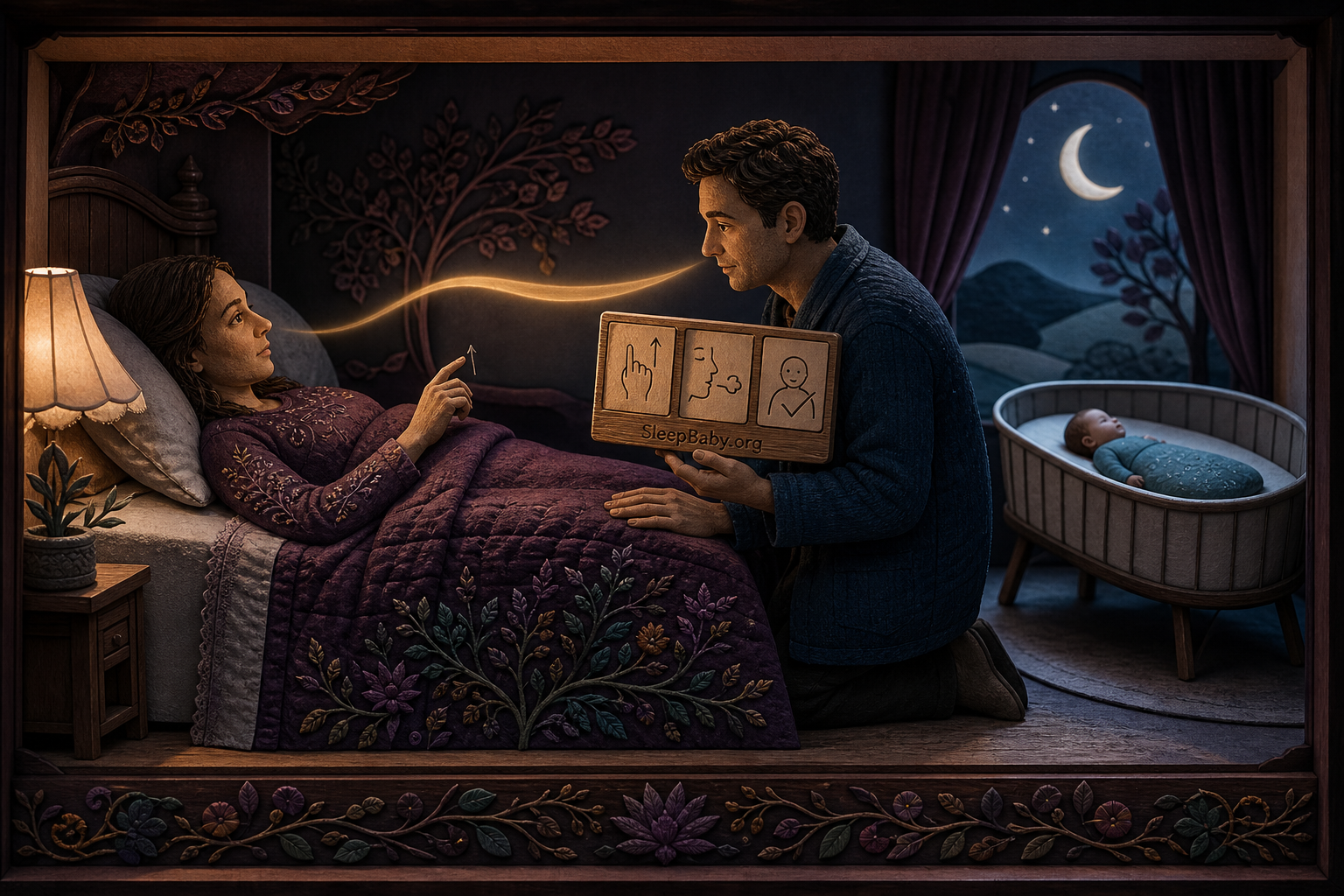
If another adult shares your nights, explain the plan in daylight. During an episode, they can say your name, remind you that you are waking, and gently touch your shoulder or hand. Sleep-medicine descriptions note that voice or touch can sometimes interrupt an episode. They should not shake you, restrain you, flood the room with questions, or confirm that the perceived intruder was real.
The bedside script
Voice, touch, check—then choose the care path
- Say
- “You’re waking up. You’re safe. I’m here. Try one finger.”
- Do
- Use a gentle touch if that was agreed in advance. Keep the baby in the separate safe sleep space.
- Check
- Confirm ordinary movement on both sides, speech, orientation, vision, chest comfort, and breathing after the episode.
- Escalate
- Call emergency services for persistent deficits, maternal warning signs, fully awake psychosis symptoms, or immediate danger.
The sleep connection: a rehearsed script shortens the household’s decision time and makes it easier to settle safely after a classic episode instead of holding an anxious two-person investigation at 3 a.m.
Created by SleepBaby.org for postpartum sleep-paralysis nights.

How to reduce recurrences when “sleep more” is not a plan
Sleep advice becomes insulting when it treats a newborn like a calendar setting. You may not control how often the baby wakes, whether feeding takes 12 minutes or 70, or whether your body can fall asleep the moment somebody else takes over. You can still look for the most destabilizing parts of the pattern.
Protect one block instead of chasing a perfect night
If your household has another safe caregiver, choose one block when that person owns everything they safely can: diapering, soothing, bringing the baby for a feed if needed, bottle feeding when that fits your feeding plan, and returning the baby to the separate sleep surface. The exact length depends on feeding needs, milk supply goals, recovery, available help, and your clinician’s guidance. The principle is continuity.
A protected block is different from “nap when the baby naps.” It has an owner, a start, and a handoff. Even if feeding interrupts it, reducing the number of decisions and fully awake intervals around the feed may make the block less fragmented.
Anchor the parts of timing you can actually reach
Irregular sleep–wake timing is associated with sleep paralysis. Postpartum regularity will be approximate, not military. Start with one or two anchors:
- Keep your first nighttime sleep opportunity within a similar window when possible.
- Use morning light and a roughly consistent get-up time after the longest sleep block.
- Avoid deliberately staying awake after the baby settles because you are afraid of another episode.
- If a late rescue nap repeatedly precedes episodes, note the pattern rather than banning all naps.
- Try side sleeping if it is comfortable and medically appropriate; supine sleep is associated with sleep paralysis in general sources, but changing position is not a guaranteed cure.
The point is not to turn recovery into a second job. It is to give your sleep–wake system a few repeatable cues.
Treat fear of sleep as part of the problem
After an episode, staying awake can feel protective. Unfortunately, fear-driven sleep loss can strengthen the same conditions associated with another episode. If bedtime anxiety is growing, tell your clinician. The 2024 clinical review of recurrent isolated sleep paralysis notes that cognitive behavioral therapy may be useful when anxiety and frightening hallucinations accompany episodes.
You do not have to wait until the fear becomes a full insomnia disorder. A practical conversation might include what you believe will happen if you fall asleep, how often you check the room, whether you avoid certain positions or naps, and whether you are so tired that feeding or driving feels unsafe.
Review medications and substances with a clinician, not a search box
Some medicines and substances can affect sleep architecture, alertness, or dream intensity. The postpartum period can also involve pain medicine, blood-pressure treatment, psychiatric medication, antihistamines, supplements, caffeine used as structural support, and changing alcohol or cannabis patterns.
Do not stop a prescribed psychiatric medication abruptly because sleep paralysis appeared, and do not start a sedative because the episode frightened you. Medication changes can carry their own risks, especially with bipolar disorder, postpartum mental health, lactation, breathing disorders, or severe sleep deprivation. Bring the full list—including over-the-counter products and supplements—to the prescriber.
Why sleep paralysis may show up after having a baby
The honest answer is less tidy than “postpartum hormones did it.” We do not have strong evidence that a particular hormone change directly causes postpartum sleep paralysis. We do have a postpartum environment full of established triggers.
Your sleep is broken into pieces
Newborn care does not always reduce sleep to one dramatic total. It often turns sleep into scraps: settle, sleep, feed, burp, transfer, listen, repeat. In a longitudinal actigraphy study of non-depressed mothers with healthy infants, average nighttime sleep across postpartum weeks 2 through 16 was about 7.2 hours. That number sounds almost civilized until you read the rest: early postpartum sleep was highly fragmented and inefficient. Total hours hid the quality of the night.
This matters because both sleep deprivation and irregular sleep–wake schedules are recognized predisposing factors for sleep paralysis. The useful target is not a perfect eight-hour block—an instruction written by somebody who has never heard a newborn object to 4:47 a.m. It is reducing the sharpest fragmentation where your household has any room to do so.
Your REM timing may become less predictable
When sleep is repeatedly interrupted, delayed, or squeezed into unfamiliar windows, transitions into and out of REM can become less orderly. A late afternoon crash after an impossible night, sleeping much later on the one morning help arrives, or dozing on your back after a feed may combine several common sleep-paralysis associations at once.
That is a plausible pathway, not a personal diagnosis. Pain, anemia, mood symptoms, medication changes, sleep apnea, infant feeding demands, birth recovery, another child waking, and the ordinary vigilance of listening for a baby can all change postpartum sleep. A clinician needs the whole pattern, not a single internet cause.
There is direct postpartum evidence—but it is limited
A 2023 study surveyed 325 women about parasomnias before pregnancy, during pregnancy, and in the first three months after delivery. Reported sleep-paralysis episodes increased after delivery. That finding is worth taking seriously because postpartum sleep paralysis is often treated as if nobody has studied it at all.
It is not proof of a postpartum syndrome. The study used a retrospective online questionnaire, only a third of initial respondents completed all required questions, and episodes were not confirmed through a clinical interview or sleep recording. It cannot tell us a reliable postpartum prevalence, prove that childbirth caused an individual episode, or isolate hormones from sleep loss, stress, pain, and other changes. An older questionnaire study found a different timing pattern, with sleep paralysis increasing during later pregnancy. The small literature is not consistent enough for certainty.
What the evidence earns
Fair: “Sleep paralysis can occur postpartum, and postpartum sleep disruption overlaps with known triggers.”
Too far: “Postpartum hormones cause sleep paralysis,” “this is a normal postpartum symptom,” or “the study proves your event was harmless.”

Sleep paralysis, postpartum psychosis, or another emergency?
The word hallucination appears in descriptions of both sleep paralysis and postpartum psychosis. That shared word can send a frightened parent in either dangerous direction: assuming a brief sleep-transition image means psychosis, or dismissing fully awake psychotic symptoms as “just sleep paralysis.” Timing, insight, duration, and full recovery separate the patterns.
On a narrow screen, scroll the comparison sideways if needed. Every action appears again below the table.
|
The hinge |
Classic sleep paralysis |
Possible postpartum psychosis |
Neurologic or maternal emergency signs |
|---|---|---|---|
|
When |
Only while falling asleep or waking. |
While fully awake; may change rapidly over hours or days. |
May begin suddenly at any time, including outside sleep. |
|
Awareness and reality |
You know you are in bed; dream imagery may overlap the room; insight returns fully. |
Delusions, paranoia, hallucinations, mania, marked confusion, disorganization, or poor insight may be present. |
Confusion may occur, but focal signs such as facial droop, one-sided weakness, speech or vision change are especially concerning. |
|
Body |
Temporary whole-body inability to move or speak; ordinary movement returns. |
No required paralysis pattern; severe insomnia, agitation, unusual energy, or behavior may stand out. |
Persistent or one-sided weakness, severe headache, vision loss, fainting, chest pain, or ongoing breathing trouble. |
|
How long |
Seconds to a few minutes, ending with full wakefulness. |
Symptoms persist while awake and can worsen quickly. |
Even brief stroke-like symptoms are an emergency; maternal warning signs should not be watched at home. |
|
What to do |
Check full recovery; record the pattern; discuss repeated or distressing episodes with a clinician. |
Emergency psychiatric assessment now. Do not leave the affected parent alone with the baby. |
Call 911 or the local emergency number now. |
The “fully awake” test matters more than how vivid the image was
A terrifying intruder image that exists only during a brief inability to move at awakening can fit sleep paralysis. A quiet voice issuing commands while you are making breakfast, a fixed belief that the baby is possessed, hours of paranoia, racing thoughts with no need for sleep, or severe confusion while awake does not. The National Institute of Mental Health calls postpartum psychosis a psychiatric emergency and advises immediate emergency help.
Postpartum psychosis is treatable, and recovery is possible. Urgency is not a verdict on someone’s character or parenting. It is the correct level of care for an illness that can impair insight and become dangerous quickly.
Persistent weakness is not “sleep paralysis that lasted longer”
Sleep paralysis is a whole-body REM-transition phenomenon that resolves. If one side of the face or body is weak or numb, speech is slurred, vision changes suddenly, balance disappears, or a severe unexplained headache arrives, use the American Stroke Association’s B.E. F.A.S.T. guidance and call 911. Even symptoms that go away can require emergency evaluation.
Postpartum headache, vision, chest, and breathing signs get their own exit
Pregnancy-related complications can occur up to a year after delivery. A headache that will not go away or becomes thunderclap-severe, blurred or double vision, flashes or blind spots, fainting, chest pain, a fast or irregular heartbeat with disorientation, or trouble breathing while lying flat belongs on the urgent maternal pathway—not under a sleep label.
How the classic pattern looks when you replay it in daylight
The four hinges near the top are the quick check. Here is the slower version, for the part of your brain that will otherwise keep reviewing the episode every time the room goes dark.
1. It happened while you were falling asleep or waking
The medical words are hypnagogic for an episode at sleep onset and hypnopompic for one on waking. You do not need either word at 3:14 a.m. What matters is the boundary: one part of your brain has reached wakefulness while the REM-sleep system that keeps most muscles quiet has not switched off yet.
If the inability to move began while you were fully awake, lasted well beyond the transition, or returned with walking, speaking, or seeing problems during the day, do not file it under sleep paralysis. New neurologic symptoms need medical assessment.
2. Your awareness was present, even if the room felt wrong
In classic sleep paralysis, awareness and memory are usually preserved. That does not mean perception is clean. Dream material can arrive in the real bedroom: footsteps that have no owner, a shadow that seems to lean over the doorway, pressure on the mattress, a voice, a touch, or the powerful sense that somebody is there.
The experience can be convincing because your eyes may be open and the room may be familiar. Your brain is not inventing fear for sport; it is trying to explain a strange combination of wakeful awareness, REM imagery, and a body that will not answer. The explanation it produces can feel horribly personal. The event is still a sleep phenomenon when it stays tied to that transition and clears with full wakefulness.
3. It was brief, though fear stretched the clock
The National Library of Medicine describes episodes lasting a few seconds to one or two minutes. Sleep-medicine criteria use “seconds to a few minutes.” Neither measurement captures how long a minute feels when you are trying to call for help with a mouth that will not cooperate.
If symptoms persist, recur without a sleep transition, or leave you uncertain about your breathing or neurologic function, the stopwatch is no longer the useful tool. Get assessed.
4. Movement and ordinary reality returned completely
A classic episode resolves. A fingertip may move, your jaw may unlock, the pressure may release, or the whole body may return at once. You can be shaky, tearful, wide awake, and deeply uninterested in closing your eyes again. Those after-effects are understandable. What should not remain is weakness, facial asymmetry, slurred speech, confusion, visual loss, chest pain, or true shortness of breath.

What your body is doing during sleep paralysis
During rapid eye movement (REM) sleep, the brain naturally quiets most voluntary muscles. This REM atonia helps keep a dream from turning into a full-body performance. Sleep paralysis is a mixed state: wakeful awareness arrives while that muscle inhibition briefly remains.
The physiology explains three parts of the experience that otherwise feel impossible:
- You cannot move or speak: the voluntary muscles are still under REM inhibition.
- You may see, hear, or feel something: dream imagery is still active while you are aware of the actual room.
- Your chest may feel pressed or breathing may feel restricted: classic sleep paralysis does not stop ordinary respiration, but REM breathing mechanics, the stillness of accessory muscles, body position, and panic can make breathing feel effortful.
That last distinction needs a bright line. A suffocation sensation that ends when the episode ends can belong to sleep paralysis. Breathlessness that continues after you can move, trouble breathing while lying flat, chest tightness or pain, blue or gray color, fainting, or difficulty speaking because you cannot catch your breath does not get waved away. The CDC treats postpartum breathing trouble and chest symptoms as urgent maternal warning signs.
A small laboratory study gives the REM-overlap explanation some mechanical footing. Researchers used scheduled nocturnal awakenings in 16 healthy participants and elicited six episodes of isolated sleep paralysis, mostly around sleep-onset REM periods. It was not a postpartum study and cannot tell us what caused your episode. It does show that interrupted sleep can help produce the exact REM/wake dissociation recorded during sleep paralysis.
Make the baby’s sleep plan safer before exhaustion chooses for you
This is the section nobody should have to need, and the section a severely tired household deserves anyway. Sleep paralysis itself does not make someone an unsafe parent. The combination of repeated awakenings, fear of going back to sleep, and a feed that begins when your eyes are already closing can create an unplanned-sleep problem. The answer is not shame. It is a plan made while everybody is awake enough to be honest.
The safest place for a baby to sleep is on their back on a firm, flat, level, safety-approved surface covered only by a fitted sheet, in the parent’s room but on a separate infant sleep surface. A couch or armchair is never a safe fallback for a baby, and it becomes especially dangerous when an exhausted adult falls asleep there. If you notice yourself drifting during a feed, call the handoff early. Do not wait until you are bargaining with your eyelids.

Before the next overnight feed
Build the short route back to the bassinet
Clear first
If feeding in bed is possible, move pillows, loose blankets, and other soft items away before the feed begins. This reduces hazards if you accidentally doze; it does not make the adult bed a safe infant sleep space.
Name the handoff
Choose the person to call, the words to use, and where they will take the baby. “I’m fading; please finish the transfer” is enough. An alarm or check-in can cover a solo feed.
Return on waking
If you wake and the baby is still on the adult sleep surface, return them to their separate safe space as soon as you are awake. If you cannot stay awake safely, wake another adult or put the baby down safely and step away for a reset.
The NIH Safe to Sleep guidance is deliberately plain about separate surfaces, couches, armchairs, and extreme tiredness. It is worth reading with the person who shares your nights, not saving as a tab you alone are expected to remember. If a baby keeps sleeping through the moment you hoped to finish the feed or reset the night, our guide to waking a sleeping baby gently can help you decide when waking is actually useful without turning every drowsy feed into a campaign.
When to call 911, call today, or make a routine appointment
A care ladder works better than the two internet settings of “ignore it” and “panic.” Choose the rung by the symptoms that remain when you are fully awake, not by how frightening the dreamlike part felt.
Call 911 or your local emergency number now
Call for fully awake hallucinations, delusions, severe confusion, mania, paranoia, thoughts of harming yourself or the baby, one-sided weakness or numbness, facial droop, speech or vision change, seizure, fainting, a severe or thunderclap headache, chest pain, blue or gray color, or breathing trouble that continues after movement returns. Do not leave a parent with possible postpartum psychosis alone with the baby.
Call your maternity team, primary-care clinician, or urgent advice line today
Call when you are unsure the episode fits a sleep transition, symptoms do not resolve cleanly, episodes are suddenly frequent, you are avoiding sleep, exhaustion is making infant care unsafe, a new medicine or substance may be involved, or headaches, blood-pressure concerns, swelling, fever, mood changes, or other postpartum symptoms accompany the event. “It stopped” is useful information, not a reason to omit the call.
Book a routine clinician or sleep-medicine conversation
Book one for repeated classic episodes, major distress, loud snoring or witnessed breathing pauses, or overwhelming daytime sleepiness. Mention sudden sleep attacks and any episodes of emotion-triggered muscle weakness—such as knees buckling with laughter or the jaw going slack with surprise. Those are narcolepsy clues worth evaluating; sleep paralysis by itself is not a narcolepsy diagnosis.
The National Heart, Lung, and Blood Institute’s narcolepsy guidance explains why daytime sleepiness, sleep attacks, cataplexy-like weakness, and sleep-transition hallucinations belong in the same history. A clinician may use a sleep diary and, when indicated, overnight and daytime sleep testing. Postpartum exhaustion can look like almost any sleep disorder from across the room; the point of evaluation is to stop guessing from across the room.
Give your clinician an episode, not a fog
You do not need to become the night-shift court reporter. A sixty-second note after you are calm can show whether the pattern stays tied to REM transitions or has features that deserve a different path. Use ordinary language; “I woke at 4:20 and could not move for about forty seconds” is more useful than a perfect medical term with no timeline.
|
Write down |
The useful detail |
Why it helps |
|---|---|---|
|
Timing |
Falling asleep, waking, or fully awake; clock time if known. |
A sleep-transition boundary is a central clue. |
|
Duration and recovery |
Best estimate; whether movement, speech, vision, breathing, and orientation fully returned. |
Persistent or focal symptoms do not fit classic isolated sleep paralysis. |
|
Experience |
Stillness, sensed presence, sight, sound, touch, chest sensation, and body position. |
The pattern can distinguish REM overlap from a fully awake event. |
|
The night before |
Fragmented sleep, an unusual schedule, stress, illness, alcohol, cannabis, caffeine timing, or medication change. |
It reveals associations without pretending one night proves a cause. |
|
Daytime clues |
Sleep attacks, unsafe drowsiness, cataplexy-like weakness, snoring, breathing pauses, headache, mood or reality changes. |
These details can change urgency and the kind of evaluation needed. |
Bring the list of medicines, supplements, nicotine, alcohol, cannabis, and other substances you actually use, including anything started or stopped around delivery. This is not a confession booth. It is pharmacology. If you are breastfeeding or pumping, say so before making changes; the right decision depends on the medicine, dose, timing, symptoms, and the health of both parent and baby.

Questions that tend to arrive after the room feels ordinary again
Can sleep paralysis hurt me?
A correctly identified episode of isolated sleep paralysis is generally brief and does not injure the body. The fear is real, though, and repeated episodes can make people avoid sleep, dread the bedroom, or function poorly the next day. That impact deserves care even when the REM-transition event itself is not dangerous. The phrase “generally harmless” applies only after the emergency look-alikes have been excluded; it is not a coupon for dismissing symptoms that remain after you are awake.
Can I stop breathing during an episode?
Ordinary breathing continues in classic sleep paralysis, although chest pressure, REM breathing changes, body position, and panic can make it feel restricted. Use the recovery boundary: if breathing feels normal once movement returns, that can fit the episode. If shortness of breath continues, you cannot speak comfortably because you are breathless, you have chest pain, you faint, or your lips or skin look blue or gray, call emergency services. Postpartum cardiopulmonary symptoms require their own assessment.
Does seeing or hearing something mean postpartum psychosis?
Not automatically. Brief dreamlike sights, sounds, touch, or a sensed presence that occur only while falling asleep or waking can be part of sleep paralysis. Postpartum psychosis happens in wakefulness and may involve delusions, paranoia, mania, marked confusion, disorganization, hallucinations, little insight, or behavior that is far outside the person’s baseline. If symptoms continue while fully awake—or you are not sure reality testing has returned—treat that as an emergency and get immediate assessment. Do not make the affected parent prove the distinction alone.
Did breastfeeding or postpartum hormones cause this?
The available evidence cannot support that conclusion. One questionnaire study found more reported sleep-paralysis episodes after delivery, but it could not separate hormones from fragmented sleep, pain, stress, feeding schedules, medication changes, mood symptoms, or other postpartum conditions. Breastfeeding may shape when and how often someone wakes; that is not evidence that lactation itself causes sleep paralysis. You deserve a plan that works with your feeding choices without inventing a biological certainty.
Is it safe to pick up the baby right after an episode?
First make sure movement, speech, vision, breathing, balance, and orientation have fully returned. Sit up, turn on a light, and take a moment to notice whether you are merely frightened or genuinely faint, weak, confused, or overwhelmingly sleepy. If you are not steady, place or keep the baby on a separate safe sleep surface and call another adult. A baby can complain safely in a clear bassinet for the minute it takes you to become a safe pair of arms.
How many episodes are “too many”?
There is no magic number that matters more than the pattern. A single classic episode can be worth mentioning if it caused severe distress or you have other postpartum symptoms. Repeated episodes, sleep avoidance, daytime impairment, sleep attacks, cataplexy-like weakness, loud snoring or breathing pauses, or events outside sleep transitions are reasons to arrange clinical evaluation. The appointment is not an admission that something catastrophic is happening. It is how you trade midnight theories for a history someone can actually assess.
Sources behind this guide
Sleep-medicine criteria, maternal-safety guidance, postpartum psychiatric guidance, infant-safe-sleep recommendations, and the limited direct postpartum research.
- National Library of Medicine: Sleep paralysis
- Clinical review: Nightmare Disorder and Isolated Sleep Paralysis
- Laboratory study of isolated sleep paralysis and sleep-onset REM
- Questionnaire study of parasomnias before, during, and after pregnancy
- CDC HEAR HER: Urgent maternal warning signs
- NIMH: Perinatal depression and postpartum psychosis
- American Stroke Association: Stroke symptoms
- NHLBI: Narcolepsy
- NIH Safe to Sleep: Reduce baby’s sleep-related risk