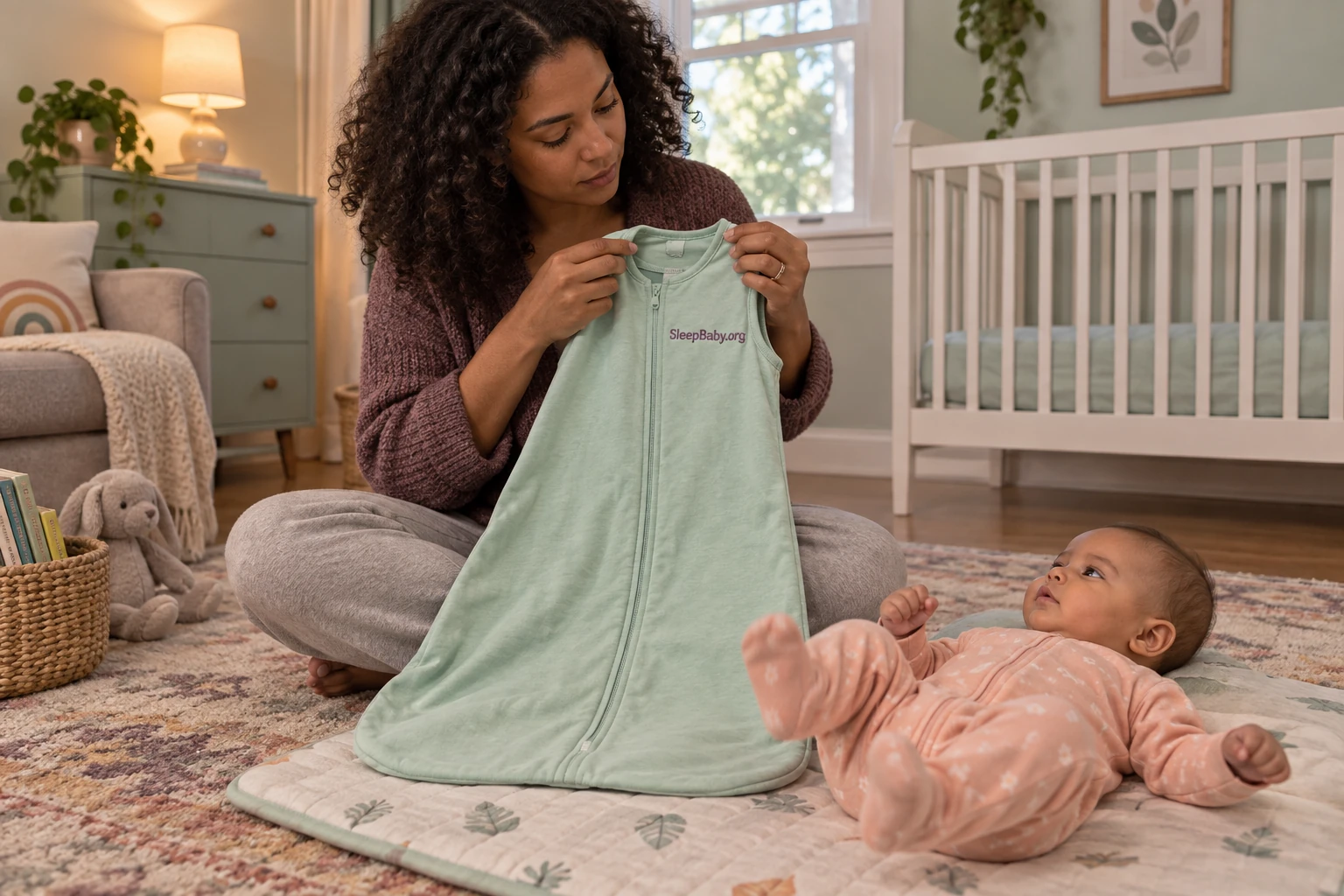
If your baby hates sleep sacks, you do not have to make one work. A plain, nonweighted sleep sack is one way to dress a baby for sleep. Appropriate pajamas and clothing layers can be another. I’d first check the garment’s fit, your baby’s warmth, and exactly when the crying starts. I would not replace a rejected sack with a loose blanket in the crib.
The most useful question is smaller than “Why does my baby hate this?” Does the trouble start while you put it on, continue while your baby wears it, or begin when you put your baby down? Those moments point you toward different things to check.
You can pause the dressing, comfort your baby, and choose suitable sleepwear you already own. Tonight does not have to become a contest between you and a zipper.
SleepBaby.org · The original video
A little help
for the night ahead.
Take a moment to watch the original Baby Sleep Miracle presentation. Your article will be right here when you’re ready to keep reading.
Ready to get started?Take the next step with SleepBaby.
Help my baby sleepA little permission to simplify
Your baby needs suitable sleepwear. A particular sack is optional.
I’d judge the choice by comfort, correct fit, and safe use, rather than by whether it matches the bedtime routine you pictured when you bought it. Keeping the receipt can be more helpful than keeping the pressure on.
Start with the moment the fussing begins
A baby who cries when laid down for a clothing change may be protesting the interruption. A baby who becomes upset after the zipper closes may be uncomfortable in that garment. A baby who happily wears the sack through a book but cries at the crib may need help with something beyond clothing.
These are clues to observe, not diagnoses. I would not decide that a baby has a sensory problem, a sleep association problem, or a stubborn personality from a few difficult bedtimes. “Hates the sack” describes what the evening feels like. It does not yet explain what is happening.
Where does the evening get tangled?
When the zipper starts
Pause. Check whether your baby needs feeding, a diaper change, comfort, or a gentler clothing change before you try again.
Once it is on
Look at fit, fabric, seams, the zipper, and warmth. Remove a garment that seems uncomfortable instead of trying to outlast the reaction.
After putdown
Clothing may not be the main issue. Respond to your baby and consider the timing and settling routine before ordering another sack.
For example, imagine your baby relaxes in your arms wearing the sack, looks at a book with you, and only begins crying as you lower them into the crib. I would keep the garment question open, but I would also look at that transition. Buying a softer sack may leave you facing the same moment tomorrow.
Now imagine the neckline bunches toward your baby’s chin immediately after you zip it. That is a fit concern to resolve now. It is not an opportunity to practice tolerating the sack. Watching the sequence helps you avoid treating every protest as the same problem.
Check which kind of garment you actually have
“Sleep sack” gets used for several products. A plain wearable blanket usually leaves the arms free and allows movement. A swaddle or transitional garment may hold the arms in or compress the chest or body. The word on the package matters less than what the garment does.
The American Academy of Pediatrics’ swaddling guidance says to stop swaddling when a baby shows signs of trying to roll. That also applies to wearable products that compress the arms, chest, or body. Plain sleep clothing that allows free movement is a different category.
If you recently stopped swaddling, the change in how your baby settles can overlap with trying a new sack. I would not respond by going back to restrictive wrapping once rolling signs have appeared. Our guide to a baby who will not sleep without a swaddle walks through that specific transition.
I’d also check the label before accepting a hand-me-down. Two garments that look similar when folded may have different closures, minimum weights, or instructions. Ask for the exact model information rather than relying on “we used this at the same age.”
Fit starts at the openings, not at the extra fabric by the feet
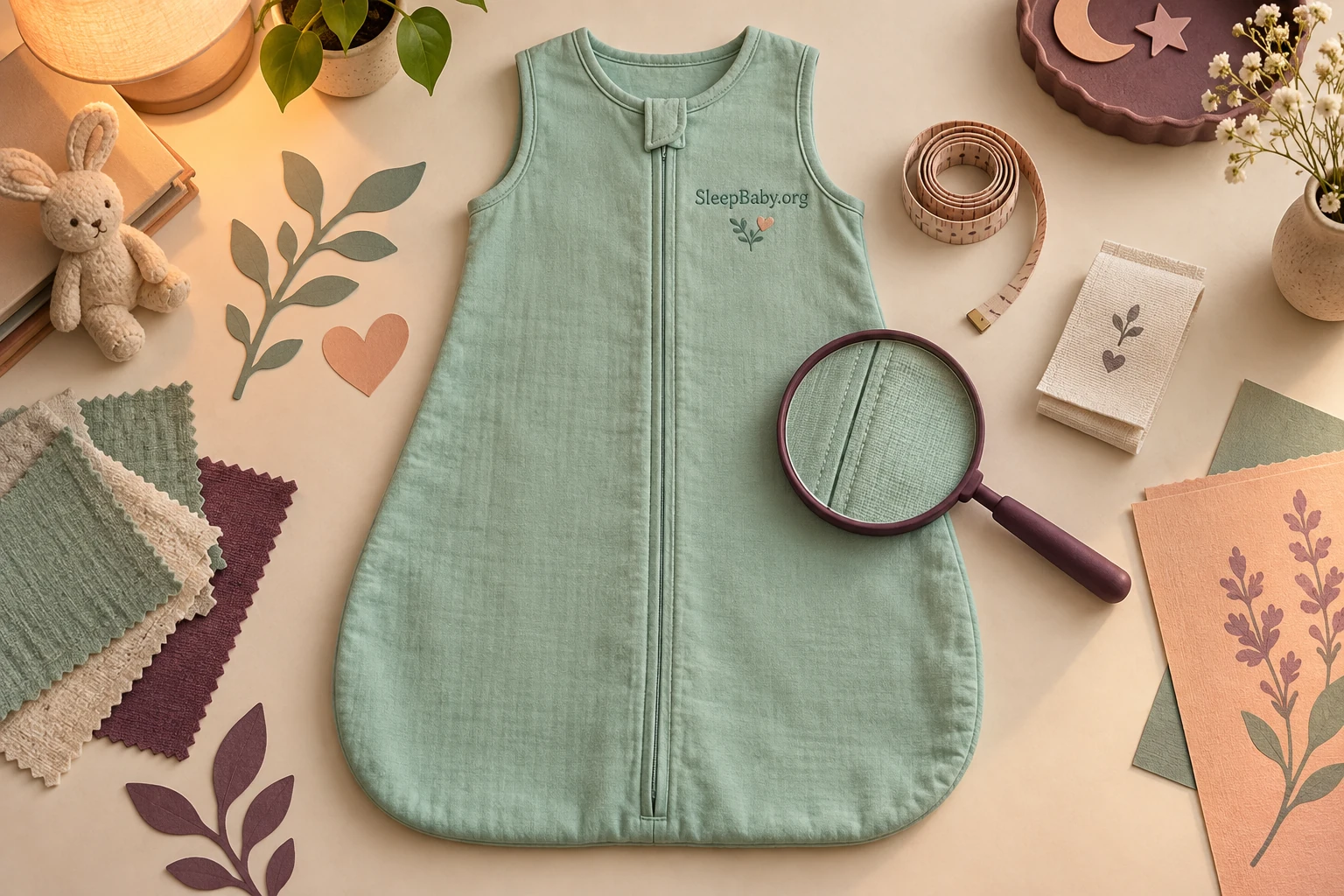
It is easy to hold up a sleep sack and think, “There is so much material below those tiny feet.” A roomy lower section can be part of the design. The important question is whether the correct size fits safely at the neck, shoulders, and arm openings while allowing comfortable movement.
Use your baby’s current measurements and the exact manufacturer’s sizing instructions. An age range is not enough if your baby does not meet the stated weight or other requirements. Do not choose a larger sack simply to get another few months out of it.
My before-bed garment check
- Neck and shoulders: The garment should stay in its intended position. Your baby must not be able to slip down inside it.
- Arm openings: Check the manufacturer’s fit instructions. Oversized openings are not extra growing room.
- Lower section: Your baby should have the movement the design allows, without the garment pulling tight as the legs bend.
- Closures and seams: Look for trapped fabric, rough areas, broken fasteners, and a zipper pressing against skin.
If the fit is wrong, change the garment. Do not pin, tie, sew, or fold it into a homemade smaller size for sleep.
The Lullaby Trust’s clothing guidance explains why fitting at the neck and shoulders matters: a baby should not wriggle down inside the bag. I would take that concern seriously even if the sack has excellent reviews or belonged to a baby the same age.
Look at the garment while your baby is calmly wearing it, following its instructions. A folded sack on a dresser cannot show you where the neckline sits on your baby. If you cannot confidently tell whether the fit is right, use an appropriate alternative and contact the manufacturer rather than experimenting overnight.
Keep the packaging or save the model name somewhere easy to find. “The green one” becomes confusing when a grandparent is doing bedtime or you own two sizes in the same print. One clear label check is more useful than repeatedly guessing from memory.
Could your baby be too warm?
A sleep sack is an added clothing layer, and its warmth varies with the fabric and construction. I would not assume every cotton sack is light, every sleeveless sack is cool, or every baby needs a onesie plus pajamas underneath.
Check the manufacturer’s guidance for that exact garment, consider the room conditions, and feel your baby’s chest or the back of the neck. Hands and feet can feel cooler without meaning the baby needs more clothing. Sweating or a hot chest can be a sign to reduce warmth; the AAP’s safe sleep guidance warns against overheating.
TOG describes insulation: a higher number generally means a warmer garment. It is not a quality score, and a higher TOG is not automatically better for sleep. A number alone cannot choose the right outfit without the product instructions and the conditions in your room.
For a practical example, think of a baby dressed after a bath in a warm bathroom and then carried into a different room. I would assess the sleeping setup where sleep actually happens. The temperature you felt while getting ready may not describe the space beside the crib later.
A room thermometer can supply useful information, but I would not turn it into another number you must keep perfect. Use it alongside the clothing guidance and your baby’s condition. Avoid changing the thermostat, pajamas, sack, and bedtime all at once if a simple clothing adjustment addresses the concern.
Look for the small clothing problem before buying a whole new system
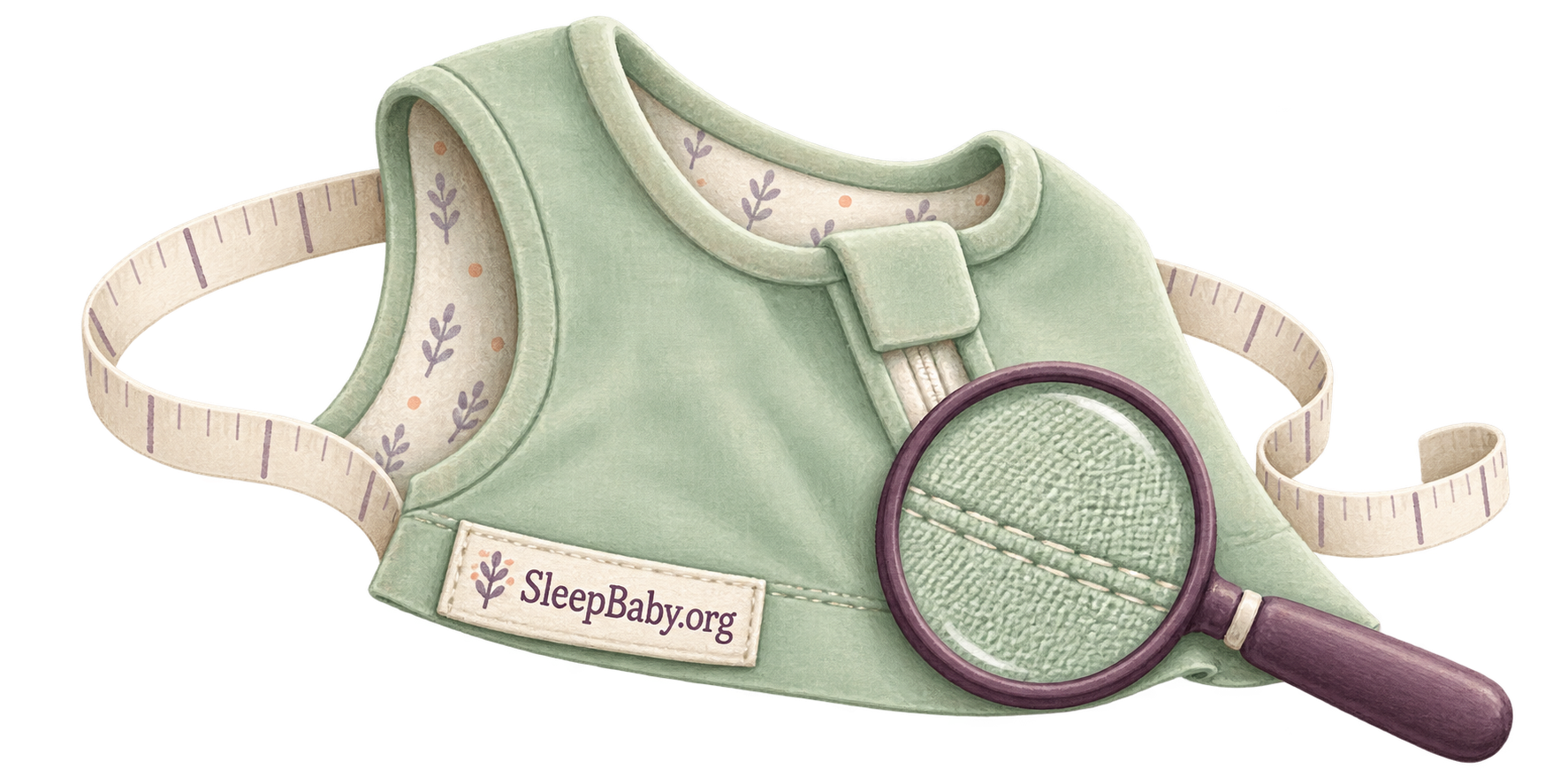
Sometimes the useful discovery is very ordinary: a pajama sleeve has bunched under an arm, the zipper guard has folded back, or the sack feels different after washing. Start with what you can see and feel. Run your hand along the inside seams and check the garment’s condition in good light.
I would compare the exact item with its care instructions, especially if it has shrunk, become rough, or developed a damaged closure. A spare that used to fit may no longer be the same shape as the one in regular use. “Same brand and size” is a starting point, not proof that both garments are still suitable.
Follow the washing instructions rather than adding strongly scented products in the hope of making bedtime more soothing. If a rash or apparent skin irritation is part of the problem, speak with your baby’s clinician. A shopping recommendation cannot tell you whether fabric, detergent, a skin condition, or something else is responsible.
I would stop using a sack with a broken zipper or fastener. Tape, safety pins, and improvised knots are not bedtime repairs. You can sort out a replacement in daylight while your baby uses other appropriate sleepwear.
Make getting dressed a smaller part of bedtime
If the garment fits and your baby is comfortable once it is on, consider the dressing moment itself. Are you trying to complete it when your baby is already hungry, exhausted, or upset? Are you repeatedly putting it on and taking it off to see whether the crying changes?
I’d start by preparing the clothes before picking up your baby. Open the zipper, check which way the garment goes, and have the diaper supplies within reach. That removes some fumbling without adding a new bedtime technique for you to learn.
Then choose a calmer point in your existing routine. That might mean dressing before a short book instead of making the zipper the final event before putdown. It is a modest experiment with the order of care, not a promise that the sack will become a sleep cue.
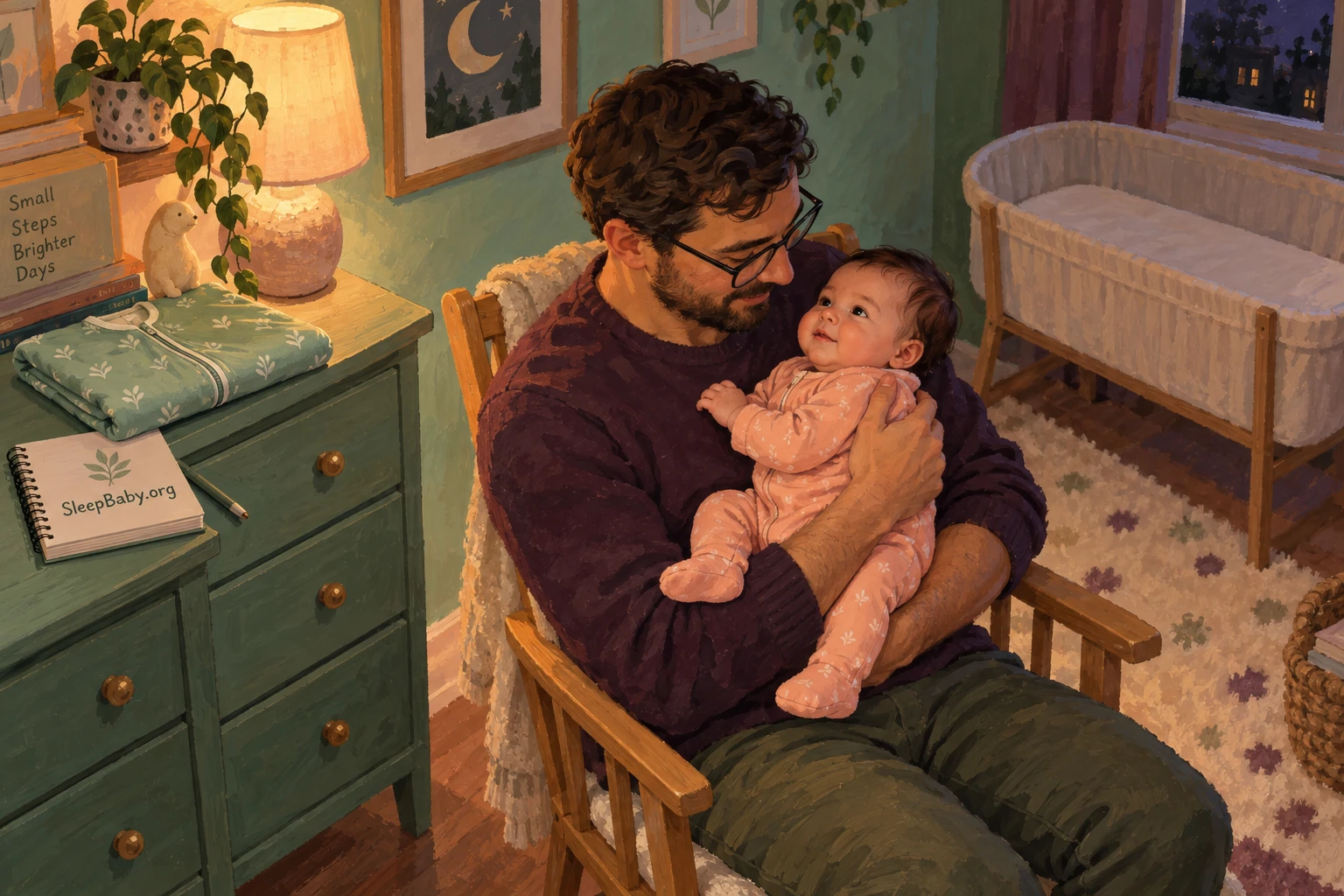
A gentler getting-ready sequence
- Prepare: Set out correctly sized clothing and check the closures before bringing your baby over.
- Meet the immediate need: Respond to hunger, a dirty diaper, or distress. The garment can wait.
- Dress without rushing: Support your baby, watch for caught fabric, and pause if something seems uncomfortable.
- Reconnect: Offer your usual comforting interaction, then continue with your ordinary settling routine.
If the struggle continues, use suitable pajamas and reassess later. You do not need to repeat the sequence until your baby accepts the sack.
A brief, supervised try while your baby is calm and awake can help you observe fit and movement. It should not become a training session or a reason to keep an unhappy baby dressed in something uncomfortable. There is no required number of practice minutes or nights to finish.
I also would not make every caregiver perform an elaborate ritual. A routine that only works when one person follows twelve steps is hard to hand over. Keep the information simple enough that another adult can understand what fits, what your baby wears underneath, and what to do if dressing becomes difficult.
If your baby is comfortable until you put them down
Once you have checked the clothing, widen the question. Was the last nap different? Is your baby asking to feed? Has bedtime stretched into a long series of changes? Does your baby cry at putdown in pajamas too?
I would not interpret one comfortable cuddle followed by crying in the crib as proof that the sack is the problem. The observation tells you where to look next. You can respond to your baby while keeping the sleepwear decision simple.
If timing seems to be part of the pattern, our guide to finding your baby’s bedtime explains how to work from the evening you actually have. There is no need to stretch a tired baby to a particular clock time just so the clothing experiment feels controlled.
For your own notes, one sentence can be enough: “Calm in the sack during the book; cried at putdown.” That is more useful than recording every minute or declaring the entire night a failure. If the next evening looks different, keep your conclusion tentative.
Yes, your baby can sleep without a sleep sack
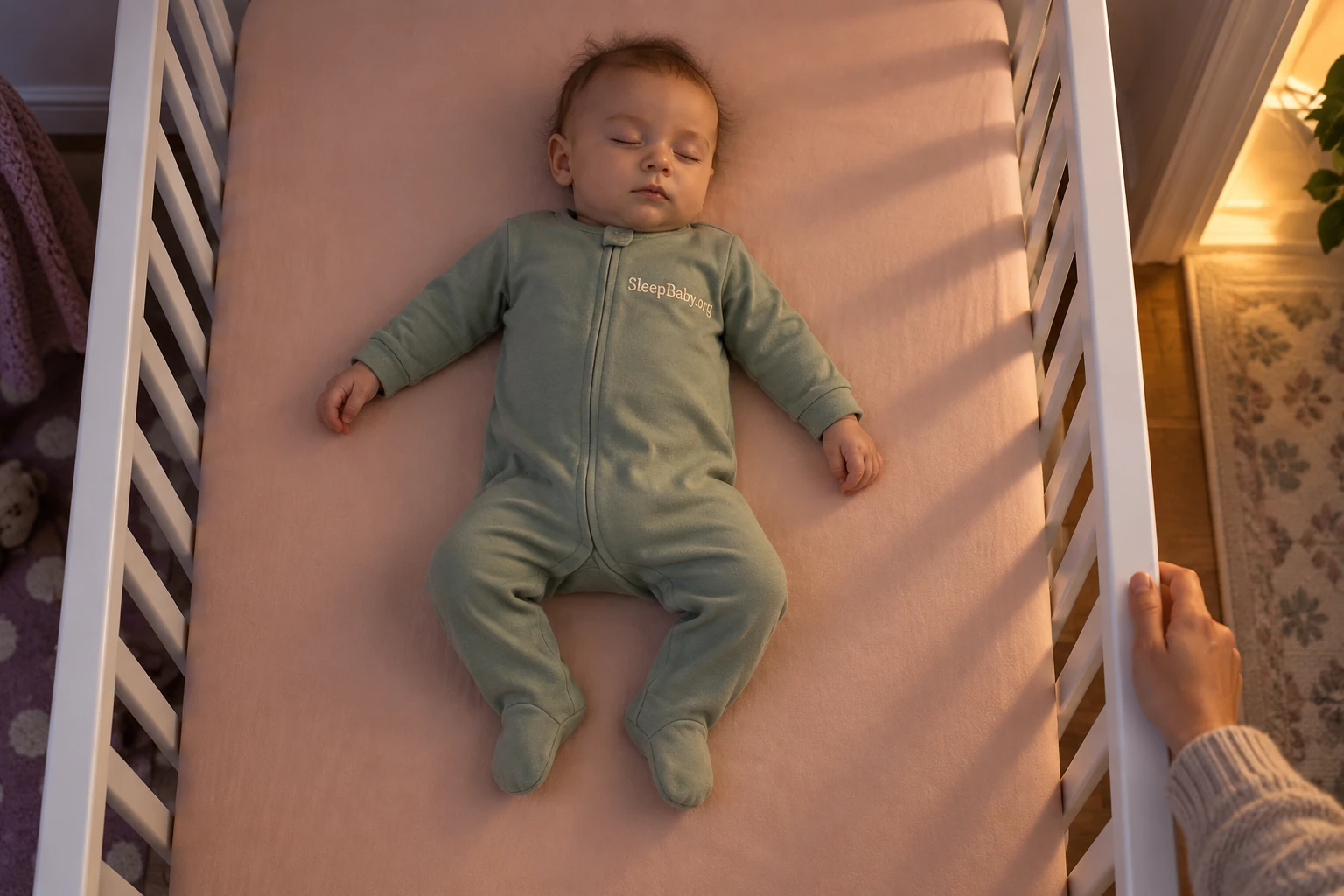
If suitable pajamas keep your baby appropriately dressed for the room, you can use them without a sack. Choose the clothing for warmth and fit, and keep the sleep space clear. The absence of a wearable blanket does not create a need for a loose blanket.
Place your baby on their back on a firm, flat, approved infant sleep surface with a fitted sheet. Keep pillows, loose bedding, toys, and positioners out. Those basics remain the same whether your baby wears a plain sleep sack or appropriate pajamas, as described in the AAP’s guide to a safe sleep environment.
I’d think of this as choosing an outfit, not abandoning a sleep skill. You have not spoiled bedtime by discovering that one garment does not suit your baby. You also do not need to keep reintroducing it if a simpler, appropriate option is working for your family.
A quick visual check • NICHD
What stays out of the crib when the sack stays off?
This short NICHD video, Clear the Crib to Reduce the Risk of Sleep-Related Infant Death, shows the sleep-space basics. It helps answer the practical follow-up: what should the crib look like when your baby sleeps in pajamas?
If the video does not load: use a firm, flat infant sleep surface with a fitted sheet, place your baby on their back, and leave loose items out. You can also find the video and related resources on NICHD’s Safe to Sleep website.
What changes when your baby rolls, stands, or tries to escape?
Rolling does not automatically mean a baby must stop using a correctly fitted, plain sack that allows free movement. It does mean you must distinguish that garment from a swaddle or other restrictive product. Follow the current instructions and your baby’s development, rather than a transition date printed in someone else’s routine.
For an older baby who stands, check whether the garment still fits as intended and allows the movement described by its manufacturer. Do not assume a new skill means you need the next size up. Compare the actual measurements and fit, just as you would with any clothing change.
If your baby gets an arm or head into an unintended opening, stop using that garment and reassess the fit. I would not solve escaping by tightening, pinning, taping, or adding restraints. I would not put a sack on backward unless that exact manufacturer explicitly permits that use.
A sleep sack is not a device for preventing crib climbing. If climbing is becoming an issue, discuss an appropriate sleep-space transition with your child’s clinician and follow the crib’s limits. Trying to restrict movement with clothing leaves the underlying sleep-space question unresolved.
Keep it, pause it, or replace it?
Keep it: The garment fits correctly, is in good condition, and your baby seems comfortable wearing it. Look beyond clothing if the difficulty happens later.
Pause it: Dressing has become a repeated struggle and suitable pajamas are available. Simplify tonight and revisit the question when you can look calmly.
Replace it: The size, condition, or warmth is wrong. Choose for that specific problem rather than buying a product because it promises better sleep.
Leave the weighted options and improvised fixes out
A baby seeming to prefer pressure does not make weighted sleepwear the next step. The CPSC warning about weighted infant sleep products is a reason to leave those products out of this decision. I would choose an appropriate nonweighted garment or pajamas.
I would also skip advice to add a loose blanket over the sack, hold it down with another object, or improvise a tighter wrapping method. An outfit should not require a collection of workarounds to stay usable. If ordinary, intended use is not working, that is useful information about the choice.
What if your baby used to like the sack?
A sudden change deserves a fresh look at the situation, even when the garment is familiar. I’d ask what changed recently: the size your baby needs, the clothes underneath, the room, the laundry, or the point in the routine when you get dressed. Start with the most concrete change you can identify.
For example, if the problem began with a newly opened size, compare its instructions with your baby’s measurements before assuming it needs breaking in. If the same sack was comfortable yesterday but your baby seems uncomfortable in other clothes today too, widen the concern beyond that item. The history helps you choose the next question; it does not prove a cause.
I would avoid labeling every new protest a sleep regression. That label can make an observable clothing problem feel like something you simply have to wait out. You can check the practical details and respond to your baby without knowing the name of a developmental phase.
What if naps and nights are different?
You do not have to use identical sleepwear for every sleep. The room conditions and appropriate clothing may differ. Keep the safety basics consistent, but let the outfit suit the situation rather than making matching garments the goal.
If the sack is comfortable at night but disliked before naps, compare the dressing moments before buying another one. Perhaps the nap routine is more rushed, or the daytime room is warmer. Those are possibilities to check, not reasons to force a longer trial. A useful observation might simply be that pajamas make the daytime clothing change easier while the correctly fitted sack remains comfortable at night.
Make the daycare or caregiver handoff easy
If another adult handles naps, ask what clothing they use and whether they have noticed the same reaction. “Cries during the change, then settles” is different information from “keeps pulling at the neck opening.” A specific observation gives everyone something concrete to check.
Send the exact fitting garment and its instructions if it is used away from home. Check the care setting’s policies, too. Avoid assuming that a spare from last month still fits or that another caregiver will know which sack is lighter.
Your backup can be straightforward: suitable pajamas, the same clear sleep space, and ordinary responsive care. You do not need to create a second complicated routine for the days the preferred garment is in the wash.
When I would ask for medical advice
If your baby seems to be in pain when moved or dressed, has a persistent rash, feeds poorly, or remains unusually distressed in different appropriate clothing, contact their clinician. You do not need to finish a trial of another sack first. Describe what happens and when, rather than only saying that sleep has become difficult.
Get urgent medical help for trouble breathing, blue or gray coloring, or a baby who is difficult to wake. The NHS guidance on urgent help for babies and young children explains warning signs. These situations need assessment, not a bedtime product change.
An optional sleepwear choice
An Amazon sleep sack option if fit or fabric is the problem
HALO SleepSack 100% Cotton Wearable Blanket, Cream, Small
- Why it fits this problem
- A plain, arms-free, nonweighted option if you have identified a reason to replace the current garment. HALO lists this cotton version at 0.5 TOG with a roomy lower section.
- Check before buying
- Compare the current sizing and layering instructions with your baby and room. The linked Small must fit your baby’s measurements; do not buy it to grow into. Check the selected variant before checkout.
- You can skip it if…
- Your existing sack fits comfortably or suitable pajamas solve the clothing question. A different sack cannot promise easier putdowns or longer sleep.
As an Amazon Associate I earn from qualifying purchases.
After the clothing question is settled
You deserve an evening that feels less like troubleshooting
If the outfit is comfortable but bedtime still leaves you wondering what to try next, you can watch the Baby Sleep Miracle video featured on SleepBaby.org and decide whether its approach fits your family. You can start there without buying another sleep sack tonight.
Sources and references
- AAP: safe sleep, clothing, and overheating.
- AAP: swaddling, rolling, and wearable blankets.
- AAP: the safe sleep environment.
- Lullaby Trust: garment fit, TOG, and dressing for sleep.
- HALO: cotton wearable blanket specifications and sizing.
- CPSC: warning about weighted infant sleep products.
- NICHD: Safe to Sleep videos.
- NHS: when babies need urgent medical help.
SleepBaby.org · The original video
A next step for
the next bedtime.
Still thinking about sleep? Watch the presentation here, then explore the SleepBaby program whenever you’re ready.
Ready to get started?Take the next step with SleepBaby.
Help my baby sleep