
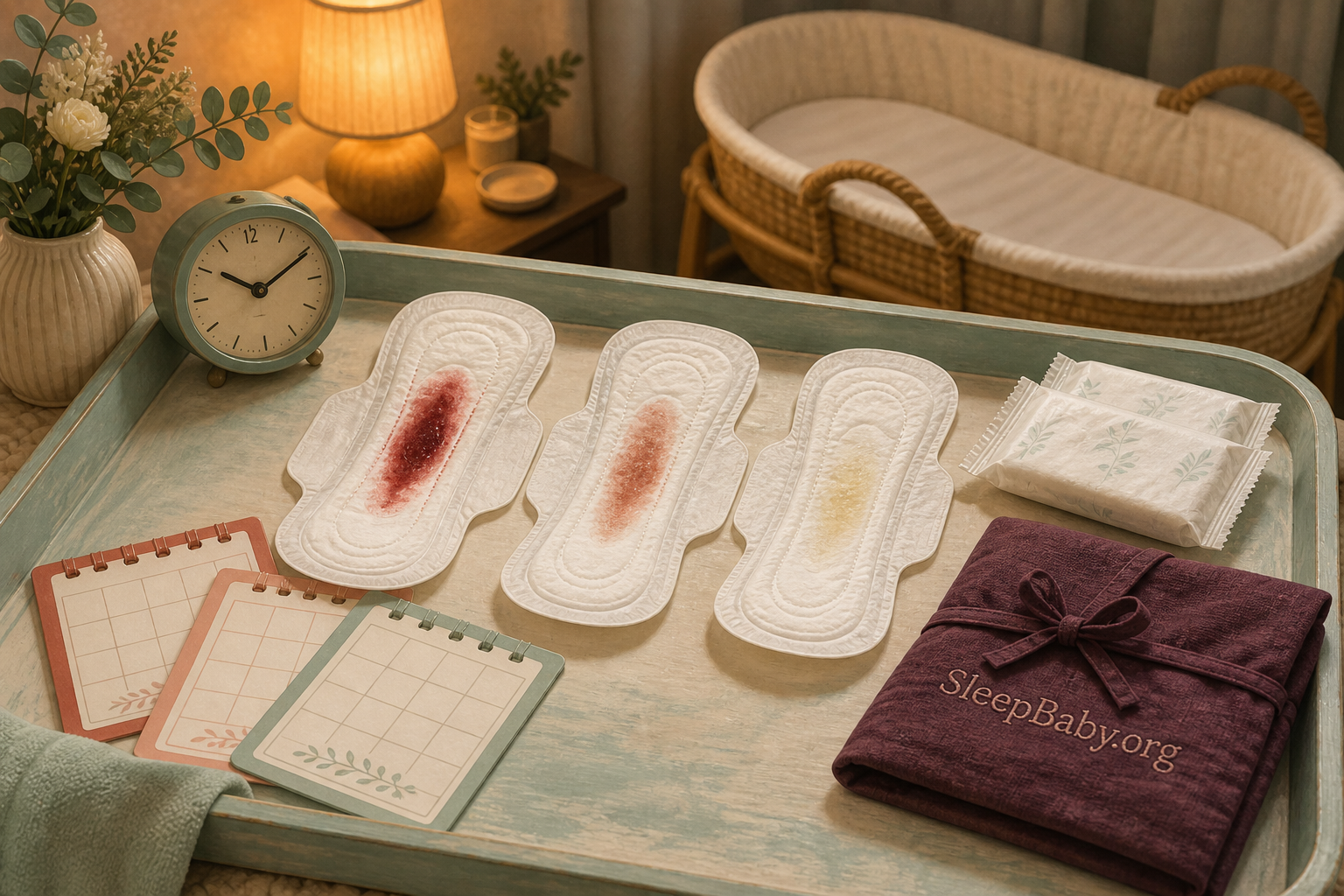
Lochia is the vaginal discharge that follows birth. It contains blood, mucus, and tissue from the uterus as the placental site heals. It happens after a vaginal birth and after a cesarean birth. The usual lochia timeline moves from red and relatively heavy, to pink or brown and lighter, to yellow-white or cream with much less blood. The dates overlap; the overall direction matters more than matching a chart on a particular morning.
Postpartum bleeding can be expected and still deserve your attention. A brief increase after standing, feeding your baby, or doing more activity may happen. Bleeding that is suddenly heavy, keeps getting heavier, returns bright red and stays that way, comes with large or repeated clots, smells foul, or arrives with fever, worsening pain, dizziness, or feeling very unwell needs medical assessment.
The first nights after birth have a peculiar way of making every ordinary task feel like it requires a clipboard: feed the baby, find the clean pad, remember the last dose on the discharge sheet, work out whether the room is spinning because you stood too fast or because something is wrong. I would not ask a recovering parent to solve that puzzle by color alone. Look at flow, trend, clot size, odor, pain, temperature, and how your whole body feels. Those details change the next step.
What lochia is doing after birth
After the placenta separates, the uterus has a large healing area where it was attached. The uterus contracts and gradually shrinks while the lining, blood, and tissue leave through the vagina. That discharge is lochia. It is not a menstrual period, although the early red stage can look and smell similar.
The amount varies with the birth, the day, and the person. The reliable pattern is not a perfectly smooth fade. It is a general move toward less blood and lighter discharge across several weeks. Pregnancy, Birth and Baby describes three broad stages, while the NHS notes that bleeding commonly continues for six to eight weeks and can last longer. Many people finish sooner. A calendar cannot overrule a concerning trend.
The lochia stages
A fading sequence, not a stopwatch
The ranges below are approximate and can overlap. Use the direction of change and the warning signs, not the stage name, to decide when to call.
-
About days 1-4
Lochia rubra
Red or deep red, usually the heaviest stage. It may look like a heavy period. A few small clots can occur, especially in the first day or two or after getting up. Flow should not be gushing or soak a pad in an hour.
-
About days 4-10
Lochia serosa
Pink, reddish-brown, or watery brown, with less blood and a lighter flow. Some red may still appear. A sustained return to heavier bright-red bleeding is a reason to contact your maternity or obstetric team.
-
Around day 10 onward
Lochia alba
Yellow-white, cream, or nearly clear discharge with little blood. It can taper on and off for weeks. Foul odor, fever, increasing pain, or renewed heavy bleeding is not explained by reaching this stage.
What I would remember at 2 a.m.: red to rose-brown to cream is the common direction. More flow, bigger clots, a bad smell, fever, worsening pain, or whole-body symptoms matter more than the color label.
How the timeline often feels in real life
During the first 24 to 48 hours, lochia is usually at its reddest and heaviest. Hospital staff may check your pads, uterine firmness, blood pressure, pulse, and symptoms because amount and whole-body signs matter together. Small early clots can occur, especially after lying down, but a sudden gush, rapid pad saturation, an egg-sized clot, tissue, dizziness, or weakness belongs to the urgent pathway rather than the stage chart.
Across the rest of the first week, you are looking for a gradual easing: less flow, fewer or no clots, and a move toward reddish-brown or pink. There may be uneven moments. A feed, getting out of bed, a shower, or doing more around the house can briefly reveal more discharge. The reassuring part is that it settles and the broader direction remains lighter. If bright-red flow returns and continues, the amount rises, or pain and odor change, call your maternity team.
During weeks two through four, many people see mostly pale brown, yellow, cream, or white discharge. It may be enough for a light pad one day and barely visible the next. That does not mean everyone must be finished by a certain date. It does mean that new heavy red bleeding, repeated clots, fever, foul odor, or worsening pain deserves a fresh assessment rather than being filed under “still postpartum.”
By weeks four through eight, lochia is often minimal or finished, though a small amount may continue longer. The late end of a normal range is not a permission slip for a worsening pattern. A light fading discharge at seven weeks can fit recovery; sudden heavy bleeding at seven weeks is a different clinical question. If you cannot tell whether a later change is remaining lochia or another kind of bleeding, contact your obstetric or maternity clinician instead of trying to identify it from an online color chart.
What can change the flow for a little while
Lochia can collect in the vagina while you are lying or sitting. When you stand, you may feel a brief gush and see more blood on the pad. Feeding at the breast can also make the flow look temporarily redder or heavier because oxytocin causes the uterus to contract. The same crampy contractions are often called afterpains. Activity can briefly make discharge look redder as well.
The word briefly is doing important work. A short increase that settles and returns to the overall fading pattern is different from bleeding that remains heavier, repeatedly surges, soaks pads, or comes with large clots or dizziness. The NHS describes temporary changes with breastfeeding, but neither feeding nor standing is an explanation to use when a red-line sign is present.
If activity seems to bring back brighter bleeding and you otherwise feel well, stop the activity and contact your maternity team if the change does not settle or if you are unsure. If bleeding is sudden, gushing, or at the one-pad-an-hour threshold, skip the experiment and get emergency help.
Clots: size, timing, repetition, and symptoms
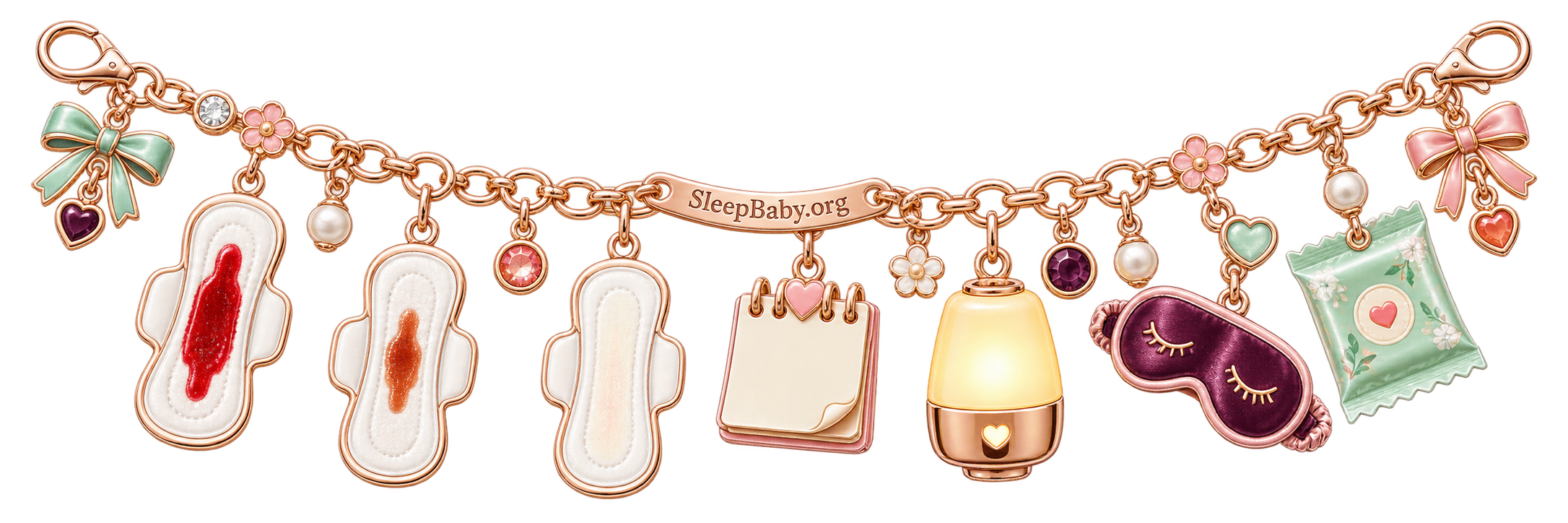
A few small clots can occur in the first one or two days, particularly after you have been lying down. That is not the same as passing clots again and again, seeing a clot larger than an egg, passing tissue, or having a clot alongside heavy flow, faintness, or severe pain. Current CDC urgent maternal warning signs treat a clot larger than an egg or tissue as a reason for immediate care.
Do not make yourself estimate millimeters while frightened. Compare the clot with a familiar object, note the time if you safely can, and use the full pattern. Size is one branch. Timing, repetition, pad saturation, pain, and whole-body symptoms are the others.
A fast bedside check
Size, timing, repetition, symptoms
Larger than an egg, tissue-like material, or a clot you cannot confidently call small means immediate medical care.
A few small clots are more expected in the first day or two. New clots later, especially with renewed red or heavier flow, deserve a prompt call.
Repeated clots, increasing clot size, or clots arriving with pads that fill faster are more concerning than one small early clot.
Faintness, dizziness, weakness, confusion, a racing heart, clammy skin, chest pain, breathing trouble, severe pain, or feeling very ill moves the answer to emergency care.
A red line ends the checklist. Do not keep measuring, photographing, or waiting for a second occurrence before getting help.
Smell, fever, and pain are part of the answer
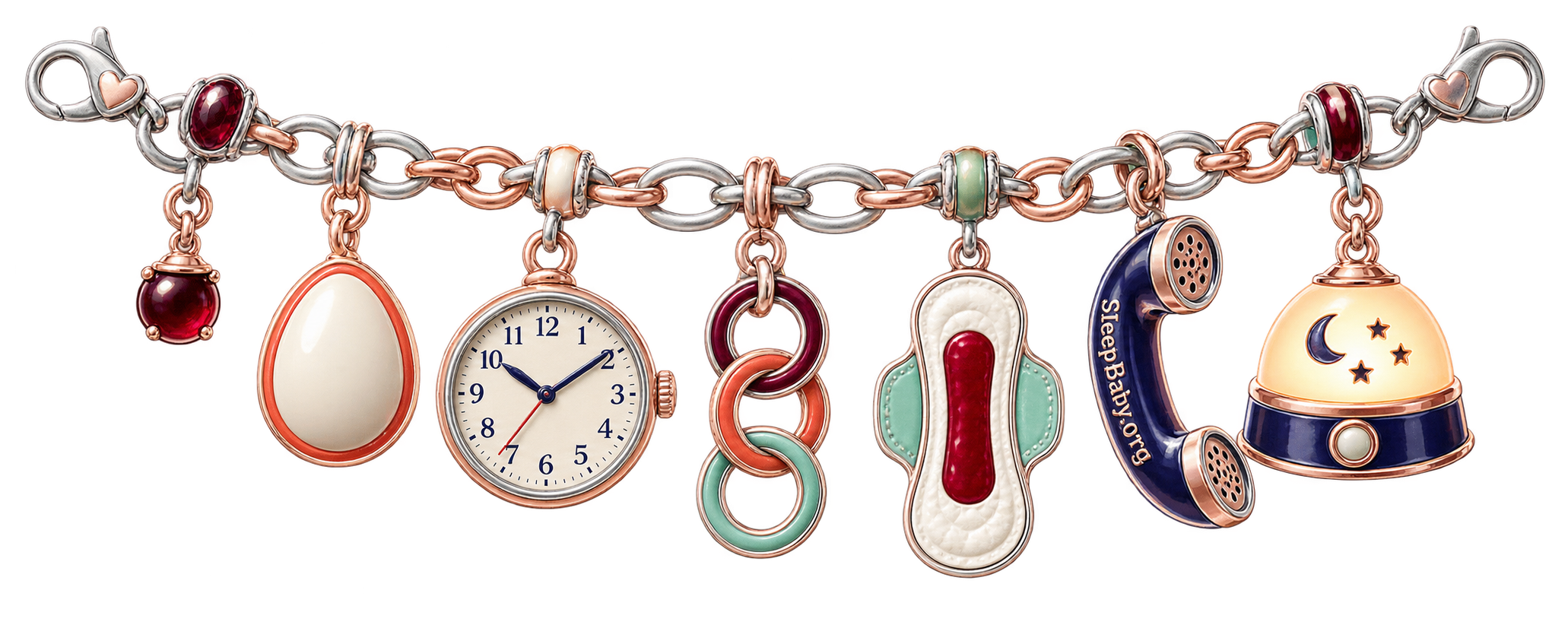
Normal lochia can have a blood-like, menstrual, metallic, or iron smell. It should not smell rotten, sharply foul, or unusually offensive. The odor question becomes more urgent when it arrives with fever, chills, worsening lower abdominal or pelvic pain, uterine tenderness, increasing bleeding, or feeling unwell.
NICE postnatal guidance advises prompt assessment for unpleasant-smelling discharge with abdominal, pelvic, or perineal pain, fever, or shivering. ACOG also lists foul-smelling discharge, fever, worsening abdominal pain, and feeling ill among signs that can accompany postpartum uterine infection. You cannot diagnose an infection by smell at home, and you do not need to. You only need to recognize that a foul odor is not a detail to cover with scented products and ignore.
Call your maternity or obstetric team promptly for a temperature of at least 100.4°F (38°C), chills, foul-smelling discharge, worsening abdominal, pelvic, or perineal pain, or a general sense that you are becoming sick. Use emergency care when those symptoms accompany heavy bleeding, faintness, breathing trouble, confusion, or another emergency sign.
When postpartum bleeding needs care now
Postpartum hemorrhage is not limited to the delivery room. Heavy bleeding can occur after you go home, and ACOG notes that delayed postpartum hemorrhage can occur weeks after birth. That is why a later date on the calendar does not make sudden heavy bleeding safe.
Choose the level, not a diagnosis
Expected monitoring, prompt call, or emergency care
Usually reasonable to monitor
The flow is gradually fading, stage colors are moving lighter overall, a brief increase settles, clots are small and limited to the early days, there is no foul odor or fever, pain is not worsening, and you feel steady and generally well.
Contact your maternity or obstetric clinician promptly
Bleeding is increasing instead of fading, brighter red flow returns and persists, clots repeat, you have fever at least 100.4°F (38°C), chills, foul odor, worsening abdominal or pelvic pain, painful or worsening perineal symptoms, or you simply feel increasingly unwell. If the flow is heavy or whole-body symptoms appear, use emergency care instead.
Get emergency help now
Sudden or gushing heavy bleeding; soaking one or more pads in an hour; a clot larger than an egg or tissue; faintness, dizziness, weakness, confusion, pale or clammy skin, a fast heartbeat, chest pain, or trouble breathing; severe pain; or a sense that something is seriously wrong. Nighttime is not a reason to delay. Another adult can take over newborn care while you get help.
This is where I stop asking a parent to be a detective. You do not need to identify retained tissue, uterine atony, infection, or another cause from the bathroom floor. Clinicians evaluate causes. Your job is to recognize the care level and say the plain sentence: “I gave birth recently, and I am having heavy bleeding” or “I have foul-smelling discharge with fever and worsening pain.”
Yes, you still have lochia after a C-section
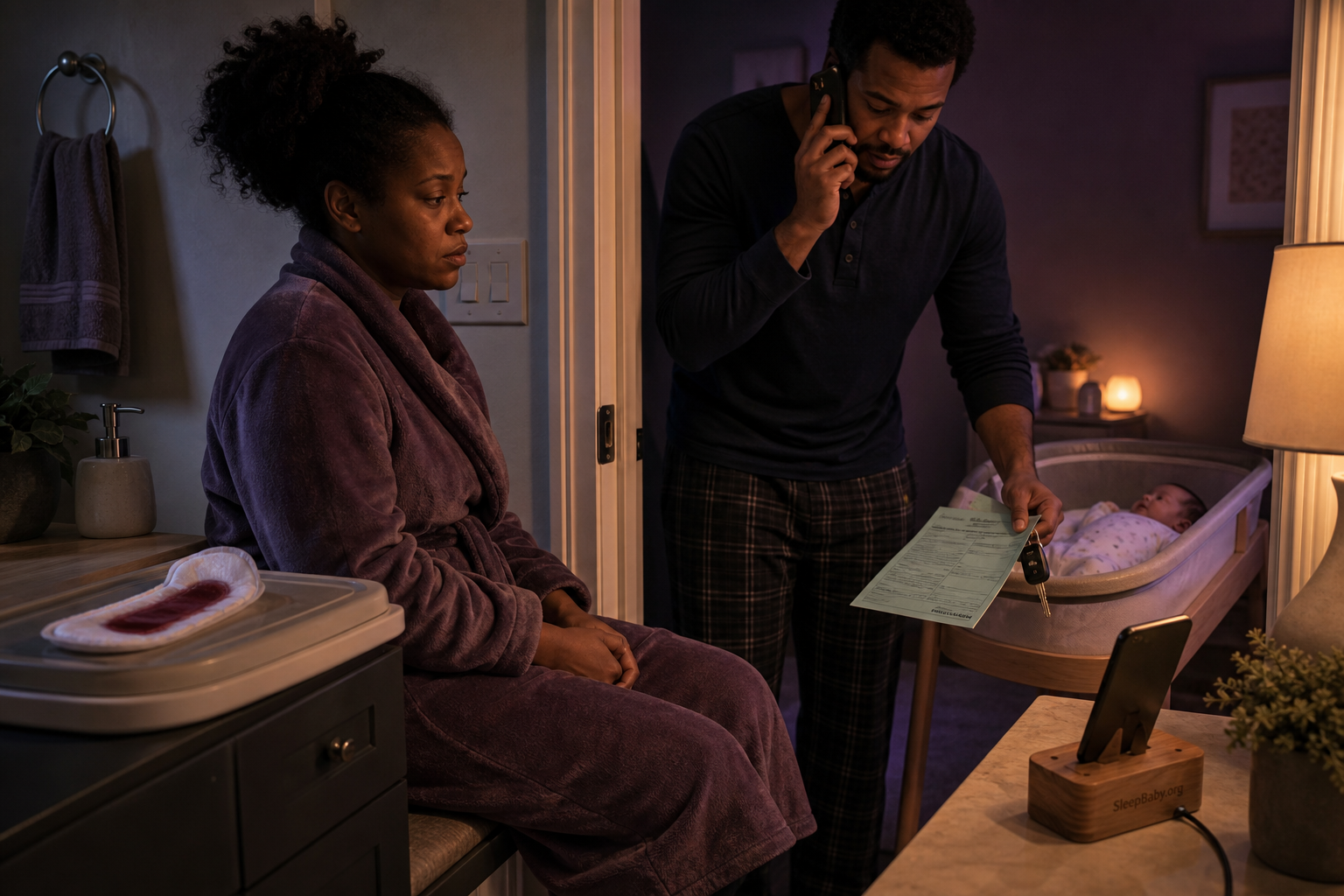
A cesarean birth does not bypass lochia. The uterus still has to heal where the placenta was attached, so vaginal discharge continues even though the baby was born through an abdominal incision. ACOG describes vaginal bleeding and discharge after cesarean birth, often for about four to six weeks, and MedlinePlus notes that lochia can continue for up to six weeks.
The same red lines apply after a C-section: sudden or increasing heavy bleeding, soaking a pad in an hour, an egg-sized clot or tissue, faintness, fever, foul odor, worsening pain, or feeling very ill. Incision questions are a separate care track. Do not let a reassuring incision make you dismiss concerning vaginal bleeding, and do not let a normal-looking lochia chart make you dismiss a concerning incision symptom.
Pads, hygiene, and a useful 24-hour note
Use maternity or sanitary pads so you can see the amount and trend. The NHS advises avoiding tampons until after the postnatal check because internal products can increase infection risk while the body is healing. The same practical caution applies to menstrual cups during early postpartum recovery unless your own clinician has specifically cleared them.
Change pads regularly, wash your hands before and after, and use plain water or the care instructions your maternity team provided. Skip scented sprays, deodorizing products, or douches. They do not treat the cause of a bad smell and can make irritation harder to interpret.
If there is no emergency sign, a brief private note can help you explain a change. It should make the clinical conversation easier, not turn recovery into an all-night surveillance project.
For a call or appointment
A concise 24-hour note
Write only what you can observe. This is not a score and should never delay urgent care.
- Time and trigger
- When it changed; after standing, feeding, activity, sleep, or without an obvious trigger.
- Pad saturation
- Light, partly filled, full, or soaked; how long that took.
- Color and trend
- Red, pink, brown, yellow-white; lighter, unchanged, or getting heavier.
- Clots or tissue
- Approximate familiar-object size, how many, and whether they are increasing.
- Odor
- Ordinary blood or iron smell versus a new foul or offensive smell.
- Temperature and pain
- Measured temperature, chills, and whether abdominal, pelvic, or perineal pain is worsening.
- Whole-body signs
- Dizziness, faintness, weakness, fast heartbeat, breathing trouble, clammy skin, confusion, or feeling very ill.
Emergency exit: a pad soaked in an hour, sudden or gushing flow, an egg-sized clot or tissue, or heavy bleeding with whole-body symptoms means stop documenting and get emergency help.
A useful message sounds like this: “I am seven days postpartum. My bleeding had turned brown, but it became bright red and heavier this afternoon. I filled most of a pad in 45 minutes, passed two clots about the size of grapes, and now have increasing pelvic pain. My temperature is 100.6 degrees.” That gives a clinician something they can triage. It does not require you to name the cause.
If you are preparing for follow-up logistics, this guide can help you plan the postpartum appointment with your baby in tow. Do not wait for that scheduled visit when a warning sign needs prompt or emergency care.

The night-shift handoff: protect the recovering parent first
Lochia is not a sleep problem, and sleep advice does not treat postpartum hemorrhage or infection. The sleep connection is practical: warning signs are easy to minimize when the house is dark, the baby has just settled, and the recovering parent does not want to wake anyone. Maternal care still comes first.
Set up a small night station before you are exhausted: clean pads, a lined disposal bag, water, your discharge instructions, a thermometer, and the maternity number. Keep the phone charged. If you have a support person, agree on the sentence that starts the handoff: “I need you to take the baby while I check this and call.” Place the baby on their back in a clear, firm, flat bassinet or crib before either adult focuses on the bleeding.
If a red-line sign appears, the support person handles the diaper, bottle or feeding setup, safe bassinet transfer, and transport or emergency call. The parent does not postpone care to complete the feed, clean the room, or prove that the next pad is also heavy. That is the only-SleepBaby truth I want left on the nightstand: the safest next sleep starts with the recovering parent still safe enough to be there.
Separate newborn questions belong on their own track. If your baby’s clinician has already told you to wake the baby for feeds, use a gentle plan for waking a newborn when the feeding plan says to. If your separate concern is unusual sleepiness or a much longer nap, check what an unusually long newborn nap can mean. Neither question should delay care for heavy postpartum bleeding.

Watch with the person sharing the night shift
Recognize urgent postpartum warning signs – and believe them
Texas Department of State Health Services created this Hear Her video to reinforce a simple safety habit: listen when a pregnant or postpartum person says something feels wrong, and act. The specific bleeding, clot, fever, odor, pain, and whole-body thresholds in this article remain the triage guide.
Takeaway: if a red-line sign appears, stop documenting and get medical care. A calm response is not a slow response.
Written fallback: review the emergency strip and care ladder above, or open the official Texas DSHS video on YouTube.

Questions that do not fit neatly into a stage chart
Can lochia stop and start again?
It can look intermittent as the amount becomes small, and a little collected discharge may appear when you stand. Activity or feeding can also produce a temporary increase. What matters is whether the overall trend still fades. Call promptly for renewed bright-red bleeding that persists, an increasing flow, repeated clots, foul odor, fever, worsening pain, or feeling unwell. Use emergency care for sudden heavy bleeding or whole-body symptoms.
How long does postpartum bleeding last?
Several weeks is common. Many descriptions place the main transition across roughly four to six weeks; the NHS notes that bleeding often continues six to eight weeks and can last longer. Your care team may give you a range based on your recovery. Duration alone does not determine safety. A light fading discharge at week six is a different question from sudden gushing bleeding at week six.
Is bright-red bleeding always an emergency?
No. Red is expected in the early rubra stage, and a brief redder appearance can occur with feeding or activity. Color alone is not the emergency threshold. Amount, persistence, trend, clot size, pain, fever, odor, and whole-body symptoms decide the care level. Bright-red bleeding that returns and stays heavier deserves a prompt call even if it has not reached the pad-per-hour threshold.
Is a bad smell just old blood?
Lochia can smell like blood, iron, or a menstrual period. A foul, rotten, or distinctly offensive odor is different. Contact your clinician promptly, especially if you also have fever, chills, increasing abdominal or pelvic pain, uterine tenderness, heavier flow, or feel sick.
Should I wait until my six-week visit?
Not for a warning sign. Scheduled postpartum care is important, but urgent symptoms belong to the maternity or obstetric team now, and emergency signs belong to emergency care now. Postpartum recovery is not a test of how quietly you can endure a problem.
Sources
- CDC: Urgent Maternal Warning Signs and Symptoms
- NICE: Postnatal care recommendations
- Pregnancy, Birth and Baby: Your first few days after giving birth
- Pregnancy, Birth and Baby: Postpartum haemorrhage
- NHS: Early days after birth
- NHS: Your body after the birth
- ACOG: 3 Conditions to Watch for After Childbirth
- ACOG: Cesarean Birth
- ACOG: Post-pregnancy vaginal bleeding warning resource
- MedlinePlus: Going home after a C-section
- Kent and Medway NHS: Post-birth bleeding
- Texas DSHS: Hear Her postpartum warning signs video
After the medical question is handled
Make the next night easier on the whole household
Heavy bleeding, fever, foul odor, worsening pain, or whole-body warning signs need medical care, not a sleep plan. Once your clinician has answered the recovery concern, SleepBaby can help you build a gentler night handoff around feeds, safe newborn sleep, and the rest your household can realistically protect.
Sleep guidance does not diagnose or treat postpartum bleeding and never replaces your maternity, obstetric, or emergency care.