
Gestational diabetes is high blood glucose first diagnosed during pregnancy, and it is usually found by screening rather than by how you feel. Many people have no noticeable symptoms. If a screening result is high, the next step may be a diagnostic glucose test, depending on the protocol your care team uses. If the diagnosis is confirmed, treatment usually combines a personalized eating plan, care-team-directed glucose checks, movement when it is safe for your pregnancy, and medication when needed.
That is the medical outline. The human version is this: a result can land in your patient portal and instantly make breakfast, the baby, birth, and every number on a meter feel like one large verdict. They are not. A glucose reading is information for a care plan, not a grade on whether you are being a good mother. The useful questions are smaller: Which test did I have? Is this a screening result or a diagnosis? When does my team want readings? What counts as a reason to call?
This guide explains those questions using current guidance from the Centers for Disease Control and Prevention, the American College of Obstetricians and Gynecologists, and the American Diabetes Association’s 2026 Standards of Care. It cannot diagnose you, interpret your result, or set your glucose or medication targets. Those belong to the clinicians who know your pregnancy.
Three facts to hold onto first
Symptoms are not the test
Feeling normal does not rule gestational diabetes out. Feeling thirsty does not confirm it.
Food is not a moral scorecard
Pregnancy changes insulin needs. A diagnosis is not proof that you ate the wrong thing.
Medication is not failure
Some bodies need medication despite careful meals and activity. Treatment protects; it does not judge.

What gestational diabetes is
During pregnancy, hormones made by the placenta can make insulin less effective. The pancreas has to produce more insulin to keep glucose moving from the bloodstream into cells. Gestational diabetes develops when the body cannot meet that increased demand well enough. It most often appears in the second half of pregnancy, which is one reason routine screening commonly happens between 24 and 28 weeks. The CDC notes that high glucose discovered very early in pregnancy may instead represent previously unrecognized type 1 or type 2 diabetes, which is why early results need clinical interpretation rather than a label from an article.
Risk factors can affect whether a clinician recommends earlier testing, but a person can develop gestational diabetes without fitting a neat risk-factor profile. That matters because risk lists are not permission to skip screening, and they are not a way to assign blame after a diagnosis. Placental hormones do not read character references.
For many people, glucose levels improve after the placenta is delivered. That does not make follow-up optional. A history of gestational diabetes raises the parent’s later risk of type 2 diabetes, and occasionally postpartum testing identifies diabetes that was not limited to pregnancy. The diagnosis belongs in your long-term medical history even if your readings settle quickly after birth.
Gestational diabetes symptoms: often there are none
The most important answer to the symptoms question is not a list: many people with gestational diabetes notice no symptoms at all. The CDC and the National Institute of Diabetes and Digestive and Kidney Diseases both describe symptoms as often absent or mild. Increased thirst or more frequent urination can occur, but pregnancy can cause both for other reasons. If you are pregnant and unusually thirsty, tell your care team; do not use thirst alone to diagnose or dismiss gestational diabetes.
What you may notice — and what it can tell you
Possible but nonspecific
- More thirst than usual
- More frequent urination
- Symptoms that feel mild or easy to explain as pregnancy
What actually answers the question
- The glucose test ordered for your pregnancy
- The protocol and thresholds your clinic uses
- Your clinician’s interpretation of the complete result
Bottom line: no symptoms does not mean no gestational diabetes, and one symptom does not mean you have it.
Some symptoms should not be filed under “maybe it is the diabetes” and watched at home. Severe or worsening headache, vision changes, trouble breathing, chest pain, severe abdominal pain, fainting, heavy bleeding, fluid leakage, fever, inability to keep fluids down, marked swelling of the face or hands, one-sided limb pain or swelling, or decreased fetal movement need prompt or emergency guidance. These are general pregnancy warning signs, not a symptom checklist for gestational diabetes. The escalation section below explains where to turn.
Screening and diagnosis are related, but they are not always the same step
For someone who does not already have diabetes, screening commonly takes place at 24 to 28 weeks. ACOG recommends screening during pregnancy, and the U.S. Preventive Services Task Force recommends screening asymptomatic pregnant people at or after 24 weeks. Some clinicians test earlier because of history, risk factors, or concern about previously unrecognized diabetes. The USPSTF says evidence is insufficient to recommend universal screening of every asymptomatic person before 24 weeks; that is not the same as saying a clinician should never test early.
Clinics use more than one accepted testing pathway. In a common two-step approach, you drink a glucose solution and have blood drawn after a set interval. If that screening result is above the clinic’s threshold, you return for a longer oral glucose tolerance test that can establish the diagnosis. In a one-step approach, the longer oral glucose tolerance test is used as the diagnostic test from the start. The drink, fasting instructions, number of blood draws, and thresholds can differ, so your appointment instructions outrank anything you remember from a friend, an older pregnancy, or a chart online.
The question each step answers
- 1. Screening: Does this result suggest that diagnostic testing or clinical follow-up is needed?
- 2. Diagnostic testing: Do the complete results meet the criteria used by this clinic for gestational diabetes?
- 3. Care planning: What monitoring, food support, movement guidance, and follow-up fit this pregnancy?
- 4. Pattern review: Is the plan meeting the clinician-set goals, or does treatment need to change?
If your portal says “abnormal glucose screen,” ask whether that result is the diagnosis or whether another test is required. If your care team has already confirmed gestational diabetes, do not delay the plan while trying to reverse-engineer the lab threshold. The next useful information is the monitoring and follow-up they want from you.
Before test day, confirm the logistics
Glucose testing instructions are not interchangeable. One appointment may be a screening test that does not require fasting; another may be a diagnostic oral glucose tolerance test with specific fasting and timing rules. Call the ordering office or laboratory if the written instructions are missing, contradictory, or different from what you were told. Ask the name of the test, whether you should fast, whether water is allowed, how to handle usual medicines or supplements, how long you should expect to stay, and what to do if you are sick or vomiting that morning.
Unless the clinician gives you different directions, do not try to “pass” by skipping food, sharply cutting carbohydrate, overexercising, or changing medication before the test. The point is to get an interpretable result under the protocol your care team uses. If nausea, transportation, work, childcare, needle fear, or a history of fainting could make the appointment hard, tell the office before you arrive. That is planning information, not a reason to feel embarrassed.
Five questions that close the test-day loop
- Which test is this? Ask whether it is a screen, a diagnostic test, or follow-up for an earlier result.
- What preparation applies to me? Get the exact eating, drinking, medication, arrival-time, and activity instructions from the ordering team.
- What if I cannot complete it? Ask whom to tell if you vomit, become unwell, arrive late, or cannot tolerate the drink.
- When will the result be ready? Know whether the office, laboratory, or portal will deliver it and who will explain what it means.
- What happens next? Ask whether an abnormal result triggers another test, a clinician call, or a care-planning appointment.
Bring something quiet for the waiting periods and leave enough time that you are not choosing between a required blood draw and another fixed commitment. If you receive a result without an explanation, read the test name and collection times to the office rather than comparing one isolated number with a stranger’s screenshot. The protocol is part of the meaning.

Your first week after a diagnosis
A diagnosis can arrive with several appointments, a glucose meter, food advice, and a new vocabulary all at once. I would not try to master pregnancy, diabetes, nutrition, and birth planning in one evening. I would get the care plan onto one page.
A calm first-week checklist
- Confirm the diagnosis and the test you had. Ask what the result means in your clinic’s protocol.
- Write down when to check. Fasting, after-meal, bedtime, or other checks should match the plan you were given.
- Write down your targets. Keep the numbers your clinician prescribed with the meter; do not substitute a web chart.
- Ask what to do with an out-of-range result. One reading, repeated readings, illness, and a very high or low reading may have different instructions.
- Request nutrition support. A registered dietitian nutritionist or diabetes educator can turn general guidance into food that fits your culture, budget, nausea, schedule, and glucose pattern.
- Ask about movement and medication. Learn what is safe for this pregnancy and what would trigger a treatment change.
- Put postpartum testing on the calendar now. Newborn weeks are not famous for making future appointments easy to remember.
If you do not currently have prenatal care or the result came from a setting that did not arrange follow-up, use this guide to find the right pregnancy doctor and tell the office that you have an abnormal screen or confirmed gestational diabetes. The exact result and gestational age will help them triage the appointment.

Monitoring and clinician-set targets: what the numbers are for
Current ADA guidance recommends fasting and post-meal glucose monitoring in pregnancies affected by diabetes. Your team decides exactly when you check and what target applies. The timing matters because a fasting reading and a reading after a meal answer different questions. So do the meter, testing technique, meal timing, medication, sleep, illness, and whether you could keep food down.
This article intentionally does not give you a universal target table. A number without your clinic’s timing, units, and instructions can create false reassurance or unnecessary panic. Keep the prescribed targets in the meter case, on the refrigerator, or in the app where you log results. If the units on a chart online do not match your meter, stop there and ask your team rather than converting by guesswork.
| Check | Reading | Meal or timing context | Question for the care team |
|---|---|---|---|
| Fasting | Your result | Bedtime food, sleep, illness, medication if prescribed | What pattern should prompt a call? |
| After a meal | Your result | What and when you ate; timing of the check | Which part of the meal or timing should we review? |
| Unexpected result | Your result | Technique, symptoms, missed food, vomiting, activity if cleared | Should I repeat, call now, or follow the usual plan? |
Logs are useful because patterns guide treatment. They are not improved by hiding an uncomfortable number, checking compulsively outside the plan, or changing medication on your own. Record the result accurately, add the context your team requested, and follow the call instructions you were given. If the plan is unclear, ask for a written version.
Meter technique matters too. Wash and dry your hands, use the device as instructed, store supplies properly, and ask what to do if a reading seems inconsistent with how you feel. Do not share lancets or blood-testing equipment. If you are having trouble affording supplies or using the meter, say so plainly; a plan you cannot perform is information the care team needs.
A useful pattern review is more than a neat spreadsheet
At the first review, bring the meter or app, the written targets you were given, and whatever record you actually used. Exact times matter: “after breakfast” is less useful if no one knows whether the check was taken at the interval your clinic requested. Add short context only when it helps explain the day—illness, vomiting, a missed meal, a timing mistake, a medication dose that could not be taken, activity your clinician cleared, or a night of unusually broken sleep. Context helps the team interpret a pattern; it is not an apology.
Ask the clinician to show you what they are looking for. Is the concern a repeated pattern at one time of day, readings across several meals, difficulty obtaining reliable checks, or symptoms that need separate evaluation? Ask how many out-of-range readings should prompt contact and which result or symptom should trigger a same-day call. Those instructions belong beside your targets, not buried in an after-visit summary you cannot find at night.
Also name the parts of the plan that are not working. Maybe the meter hurts, the strips are unaffordable, your job does not allow a break at the requested time, nausea makes the proposed breakfast impossible, or the instructions are not available in the language you use most comfortably. A care plan is not safer because it looks perfect on paper. It is safer when the team knows what you can reliably do and adjusts the teaching, tools, or treatment accordingly.
One surprising result deserves accuracy, not punishment. Follow the repeat-or-call instructions your clinician gave you, record what happened, and keep eating and taking medication according to the plan unless the team tells you to change it. Extra checks, skipped meals, or an improvised dose can create a new problem without answering why the first number appeared.
A gestational diabetes diet is a pattern, not a punishment
There is no single gestational diabetes diet that fits every pregnancy. The amount and timing of carbohydrate that works for one person may not fit another person’s glucose pattern, nausea, culture, work schedule, food access, weight history, medication, or fetal growth. ADA guidance emphasizes an eating pattern with vegetables, fruits, legumes, whole grains, nuts, seeds, fish, and other lean proteins, with a balance of macronutrients. ACOG commonly describes regular meals and snacks, but the exact structure should be individualized.
Carbohydrate is not a contaminant to remove from pregnancy. It is a nutrient found in foods including grains, fruit, milk, yogurt, beans, starchy vegetables, and sweets. The care job is usually to choose amounts and combinations that meet pregnancy nutrition needs while helping glucose stay within the targets your team set. That is different from eliminating whole food groups or trying to “earn” carbohydrate with exercise.
If you need broad pregnancy-food guidance, keep this page focused on GDM and use our separate guide for what to eat during pregnancy. A registered dietitian nutritionist can connect the two without handing you a generic menu that ignores your readings.
Build meals around four questions
Where is the carbohydrate?
Name it instead of fearing the whole plate: bread, rice, fruit, beans, milk, potatoes, or another food in your plan.
What adds protein or fat?
Eggs, yogurt, cheese, tofu, beans, fish, poultry, nuts, seeds, or another pregnancy-safe option may make the meal more balanced.
Where is the fiber?
Vegetables, legumes, whole grains, nuts, seeds, and fruit can add fiber and staying power.
Does this fit the actual day?
A plan has to survive nausea, work, cost, appetite, family food, and the timing your clinician gave you.
Flexible meal and snack ideas
These are combinations to discuss or adapt, not a prescribed menu or carbohydrate count:
- Eggs or tofu with vegetables and a portion of whole-grain toast.
- Plain yogurt with berries and nuts or seeds.
- Oatmeal in the portion that fits your plan, paired with nuts, seeds, yogurt, or another protein.
- A grain, tortilla, potato, or other starch alongside vegetables and fish, poultry, tofu, beans, or lentils.
- Fruit paired with nut butter, cheese, yogurt, or another protein-containing food.
- Hummus or bean dip with vegetables and a planned portion of crackers or bread.
Your own readings may show that timing, portion, or a particular breakfast needs adjustment. That is a pattern to review, not proof that the food is universally “bad.” A dietitian can help preserve foods that matter to you while changing the combination, amount, or time.
When regular eating is hard
Pregnancy does not pause nausea, reflux, food aversions, shift work, money problems, or the simple fact that you may be feeding other people too. If you are eating only once a day during pregnancy, tell the clinician or dietitian helping with GDM rather than trying to force a perfect schedule privately. If every meal makes you feel sick, the vomiting or poor intake needs its own care plan. Inability to keep fluids down can become urgent.
Do not respond to a high reading by skipping the next meal, cutting all carbohydrate, or adding unapproved exercise. Do not respond to a low reading by improvising from a social-media post. Ask your team for written instructions covering high readings, low readings if your treatment can cause them, sick days, vomiting, and missed meals.
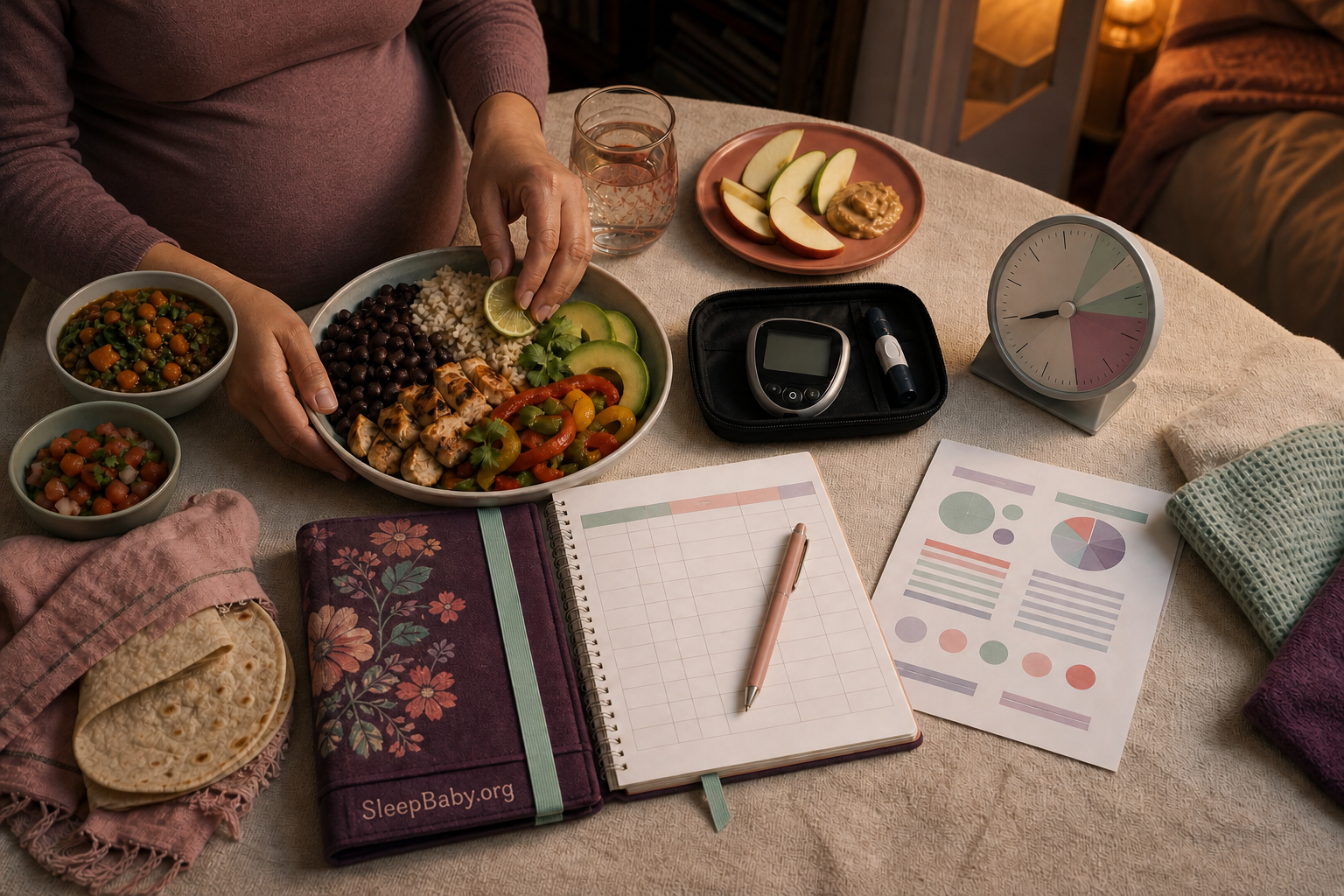

Movement and medication are treatment tools, not a pass-fail test
Movement can help the body use glucose, and lifestyle changes are an essential part of GDM treatment in the ADA’s 2026 standards. But pregnancy complications, pain, bleeding, contractions, placenta concerns, blood pressure, and other conditions can change what is safe. Ask the obstetric team what type, intensity, and timing of activity are appropriate for you. A gentle walk may be suggested for one person and restricted for another.
Activity is not a substitute for indicated medication, and it is not a way to chase a meter reading until it looks better. If your clinician has cleared movement, use it as part of the agreed plan. Stop and seek guidance for warning symptoms such as chest pain, significant shortness of breath, faintness, bleeding, fluid leakage, painful contractions, or decreased fetal movement.
Some people meet their targets with nutrition and activity changes; others need medication. Current ADA standards identify insulin as the preferred medication for gestational diabetes when medication is needed. ACOG notes that insulin and some oral medications may be used in clinical practice. The choice depends on glucose patterns, pregnancy details, benefits, limitations, feasibility, and the care team’s judgment.
What changes — and what never changes
Needing medication does not mean you failed at food. It means the current plan needs another tool. If cost, injections, schedule, storage, health literacy, or fear makes the prescription hard to use, say that before leaving the appointment. A theoretically perfect plan that cannot be followed safely is not a finished plan.

What the care team watches during pregnancy
Gestational diabetes is associated with higher chances of complications, but association is not destiny. ACOG describes risks that can include a larger baby, difficult delivery or birth injury, cesarean birth, high blood pressure or preeclampsia, newborn low glucose, jaundice, breathing problems, or a need for additional newborn care. The USPSTF found that treating screen-detected GDM improves several maternal and newborn outcomes.
Your team may review glucose logs, medication needs, blood pressure, fetal growth, amniotic fluid, fetal movement, and other pregnancy-specific information. Some people need additional fetal surveillance; some do not. One ultrasound estimate does not write the birth plan by itself, and an article cannot predict whether you will be induced or have a cesarean birth.
Questions worth bringing to an appointment
- What pattern in my readings would make you change the plan?
- Do I need extra ultrasounds or fetal surveillance, and what question will each test answer?
- How should I contact the team after hours?
- What should I do if I am ill, vomiting, unable to eat, or unable to keep fluids down?
- What signs of low glucose should I know if my treatment can cause it, and what is my exact response plan?
- Will medication or monitoring change during labor?
- How will my baby’s glucose be checked after birth?
- What is my postpartum medication plan and when is my 4-to-12-week test?
Write the answers somewhere a support person can find them. The goal is not to make pregnancy feel like a medical project. It is to move the important decisions out of the 2 a.m. guessing window and into a plan you can follow when you are tired.
Know who owns which part of the plan
“Ask your care team” is only useful if you know whom to ask. The exact lineup varies. Your obstetric clinician or midwife usually keeps the pregnancy picture together: blood pressure, fetal growth, movement concerns, labor planning, and the timing of follow-up. A maternal-fetal medicine clinician may help when the pregnancy needs closer surveillance. An endocrinology or diabetes clinician may guide glucose goals and medication. A registered dietitian nutritionist can turn medical nutrition guidance into meals that fit your culture, budget, schedule, nausea, and food access. A diabetes care and education specialist can help with meter technique, logs, supplies, injections if prescribed, and practical problem-solving.
You may not need every specialist, and job titles overlap between systems. What matters is ownership. Ask who reviews routine logs, who changes medication, who answers after hours, who handles a meter or supply problem, and who is responsible for the postpartum test. If one office tells you to call another, ask for the exact name or department rather than carrying a vague referral home.
Before birth, ask how the obstetric, diabetes, labor, and newborn teams will share the plan. The clinicians may need to coordinate monitoring and medication during labor, while the newborn team decides how and when to check the baby’s glucose after delivery. That does not predict that your baby will have a problem. It means the team is planning for a known possibility instead of improvising after birth.
After discharge, primary care becomes important even if pregnancy glucose levels improve. Give that clinician the gestational-diabetes history, the postpartum test result, and the recommended interval for future screening. If you do not know who will receive the result, settle that before the test. A result that sits in a portal without an owner is not a completed follow-up plan.
A short official video overview
The American Diabetes Association’s brief overview below explains the basic idea of gestational diabetes and why early treatment matters. It is an older video, so use the current written guidance and your care team’s plan for testing, targets, nutrition, and medication details.

What happens after birth
Delivery is a major treatment boundary because the placenta is delivered too. Glucose needs can change quickly. Some people no longer need pregnancy medication; others need continued monitoring or treatment because glucose remains high or previously unrecognized diabetes is found. Do not automatically stop or continue medication based on a general article. Get the exact hospital and discharge instructions.
Keep the plan connected after the placenta is delivered
- Before discharge: confirm medication, home-monitoring, feeding, warning-sign, and follow-up instructions for you; ask how the baby’s glucose will be monitored.
- At 4 to 12 weeks: complete the postpartum glucose test ordered by your team. ADA recommends a 75-gram oral glucose tolerance test using nonpregnancy criteria.
- After a normal result: keep gestational diabetes in your medical history and arrange repeat diabetes screening every 1 to 3 years.
- Return sooner when needed: follow up promptly for abnormal postpartum readings, urgent warning signs, or symptoms your clinician tells you to watch.
The 4-to-12-week test is easy to lose between feeding, recovery, pediatric visits, and sleep arriving in short pieces. Put it in the discharge plan, not only in your memory. Ask which clinician will order it, where it will be done, whether fasting is required, and who will explain the result.
Breastfeeding or formula feeding is not a pass-fail test for your recovery. If you breastfeed, glucose and medication needs may change, so ask whether your monitoring or treatment plan needs adjustment. Make sure every prescriber knows you recently gave birth and how you are feeding the baby before making medication decisions.
Longer term, the useful message is “keep screening,” not “future diabetes is inevitable.” A history of GDM is a reason for preventive care, not a forecast carved into stone. Share the history with primary care even years later.

When to call the care team promptly — and when to seek urgent care
Use the contact thresholds your team gave you for glucose readings. Call promptly if readings are repeatedly outside your prescribed range, you cannot perform the monitoring plan, you are vomiting or unable to keep food or fluids down, medication or supplies are unavailable, or you do not know what to do with a high or low result. If your treatment can cause low glucose, follow the personalized response plan rather than inventing one when you are symptomatic.
Do not wait on general pregnancy warning signs
The CDC advises urgent evaluation during pregnancy and up to a year after birth for serious warning signs. Seek emergency help now for trouble breathing, chest pain, fainting, severe confusion, seizure, thoughts of harming yourself or the baby, heavy bleeding, or another life-threatening concern.
Contact the obstetric team urgently for severe or worsening headache, vision changes, severe abdominal pain, fever, fluid leakage, inability to keep fluids down, marked swelling of the face or hands, one-sided limb pain or swelling, or fetal movement that stops or slows. Follow the team’s instructions about where to go.
These are not “gestational diabetes symptoms.” They are pregnancy or postpartum warning signs that should not be explained away by a glucose diagnosis.
If worry itself is keeping you awake after you have a clear nonurgent plan, our guide for when you are pregnant and cannot sleep can help with tonight, and a realistic pregnancy sleep schedule can help you protect rest around appointments and monitoring. Those sleep strategies do not replace a call for urgent symptoms.
Frequently asked questions
Did I cause gestational diabetes by eating sugar?
No single food or dessert explains a GDM diagnosis. Pregnancy-related insulin resistance and the body’s ability to meet increased insulin needs are central. Eating patterns are part of treatment, but treatment advice should not be turned backward into blame.
Can I have gestational diabetes with no symptoms?
Yes. Many people have no symptoms, which is exactly why routine screening matters. Thirst or frequent urination can occur but are not specific enough to diagnose GDM.
Does an abnormal one-hour screening result mean I have it?
Not always. In a two-step protocol, the first glucose challenge is a screen, and a longer oral glucose tolerance test may be needed for diagnosis. In a one-step protocol, the oral glucose tolerance test is diagnostic. Ask which protocol your clinic used.
What can I eat with gestational diabetes?
A personalized plan usually spreads carbohydrate-containing foods through the day and combines them with vegetables, protein, fat, or fiber in ways that fit your readings and pregnancy needs. You do not need a universal forbidden-food list. Ask for dietitian support if the advice you received does not fit your culture, budget, appetite, schedule, or nausea.
Do I need to avoid all fruit, bread, rice, or potatoes?
Not automatically. These foods contain carbohydrate, but the appropriate portion, pairing, and timing are individualized. Removing entire categories without guidance can make it harder to meet pregnancy nutrition needs. Review your actual pattern with the clinician or dietitian managing GDM.
What if my fasting readings are high even when I follow the meal plan?
Record them accurately and contact your care team according to the plan. Fasting glucose can be affected by pregnancy physiology and may not respond to food changes alone. Do not skip dinner, add unapproved exercise, or change medication to chase the number.
Does needing insulin mean the condition is severe?
It means your current plan needs medication to meet the clinical goals. ADA identifies insulin as the preferred agent for GDM when medication is needed. Needing it is not a measure of effort or character, and only your care team can explain what it means for your pregnancy.
Will gestational diabetes mean an induction or cesarean birth?
Not by itself in a way an article can predict. Glucose control, medication, fetal growth, blood pressure, testing, obstetric history, gestational age, and other clinical factors influence birth planning. Ask what information your team is using and when the plan will be revisited.
Will my baby have diabetes?
A GDM diagnosis does not mean the baby is born with diabetes. Babies may need glucose monitoring after birth because low glucose can occur, and the history is associated with later metabolic risk. Your newborn team can explain the monitoring plan and the baby’s actual results.
Does gestational diabetes go away after birth?
Glucose often improves after delivery, but that is not guaranteed and cannot be assumed without testing. Complete postpartum glucose testing at 4 to 12 weeks and continue screening every 1 to 3 years if the result is normal.
Can I manage gestational diabetes without medication?
Some people can meet clinician-set goals with personalized nutrition and activity when cleared; others need medication. There is no prize for delaying indicated treatment. The safest plan is the one that works for the pregnancy and is reviewed by the care team.
What should I bring to my next appointment?
Bring the meter if requested, your complete log, the prescribed targets, medication list, notes about meals or symptoms, and the questions you keep trying to answer at night. Include practical barriers such as cost, nausea, work hours, food access, or fear of injections. They belong in the treatment discussion.
Sources
- CDC: Gestational Diabetes (updated May 14, 2024)
- ACOG: Gestational Diabetes (reviewed April 2026)
- ADA: Management of Diabetes in Pregnancy, Standards of Care in Diabetes—2026
- ADA: Diagnosis and Classification of Diabetes, Standards of Care in Diabetes—2026
- USPSTF: Gestational Diabetes Screening (August 10, 2021)
- NIDDK: Gestational Diabetes
- CDC Hear Her: Urgent Maternal Warning Signs and Symptoms (updated May 15, 2024)
- American Diabetes Association: Gestational Diabetes