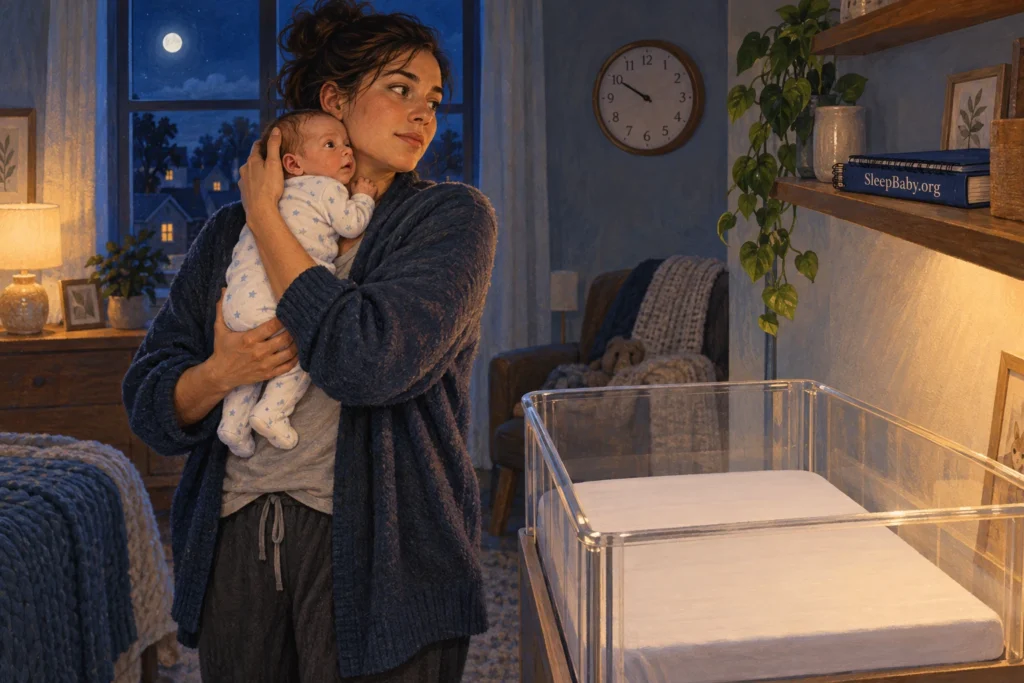
The room is almost dark, but the television keeps repainting the wall—blue, white, blue again. Your baby has not opened their eyes. Can a baby sleep with the TV on? Yes, some babies can, but I would not use the television as part of their sleep environment. My practical default is TV off in the room where baby sleeps. Because the moving light and soundtrack are variable, I treat them as possible settling disruptors—not as proven infant harms—even when a baby appears to sleep through them.
That is a sleep-quality answer, not a SIDS claim. The safety answer comes first: baby sleeps on the back on a firm, flat, clear infant sleep surface, and a tired adult does not doze with baby on a couch, recliner, chair, or adult bed. If you watch in another room, keep an open path to hear or monitor baby. If the TV is in the same room, turn it off for the final wind-down and let the last cue be something baby can meet again at 2 a.m.—your voice, a short song, darkness, and the same safe bed.
There are two questions hiding inside “Can baby sleep with TV on?”
Question 1: Is the sleep setup safe?
Baby is on the back in a crib, bassinet, portable crib, or play yard that meets CPSC standards, with a firm, flat, noninclined surface and no pillows, loose blankets, positioners, or soft objects. Keep the television, remotes, and speakers outside the sleep space. Keep every monitor part and cord at least three feet from any part of the crib, bassinet, portable crib, or play yard.
Question 2: Is the television making sleep harder?
Moving light reaches the sleep space, dialogue and music keep changing, volume peaks produce repeated startles, or baby wakes and turns toward the screen. Those are setup observations, not diagnoses. They are enough reason to move or turn off the television.
I separate these because parents sometimes spend their energy perfecting screen brightness while the baby is asleep on their chest and they are blinking slowly on a sofa. The American Academy of Pediatrics’ safe-sleep guidance puts the urgent risk in the surface and the adult’s sleepiness. Television does not make a sofa safer. An interesting show does not reliably keep an exhausted body awake.
Sleeping through the television is not the same as benefiting from it
Babies are often startlingly good at sleeping through ordinary household life. A dishwasher starts, an older sibling drops a cup, the dog shakes its collar, and the nap continues. That does not mean every sound must disappear. It also does not mean a television is neutral just because there was no full wake-up.
A TV is unusually variable. A quiet conversation becomes theme music. A dark scene becomes a white advertisement. The average volume can feel modest while one scene lands much louder. In the 2026 AAP technical report on digital media, the sleep concern is not reduced to one villain called blue light. Time displacement, arousing content, bedroom access, and light exposure all belong to the larger picture. Much of that evidence concerns older children and adolescents, so I would not borrow it to claim that one adult program damages an infant. I would use it for a gentler conclusion: a television is a poor choice for the cue you want a baby to depend on at sleep time.
My test is not “Did baby survive the episode without crying?” It is “What is this room asking the baby’s nervous system to follow?” A sleep room works best when the last few cues become simpler, not more changeable. The television can be adult downtime in another room. It does not need a job in the crib-side routine.
A four-signal TV audit
- Light: Does the screen flash across baby’s face, the bassinet sheet, or the wall nearest the sleep space?
- Sound: Do commercials, music, or action scenes produce peaks that cluster around startles or wake-ups?
- Distance: Is the screen in the sleep room when it could be watched from somewhere else?
- Handoff: When baby wakes, does the program pause so your face and voice return to the foreground?
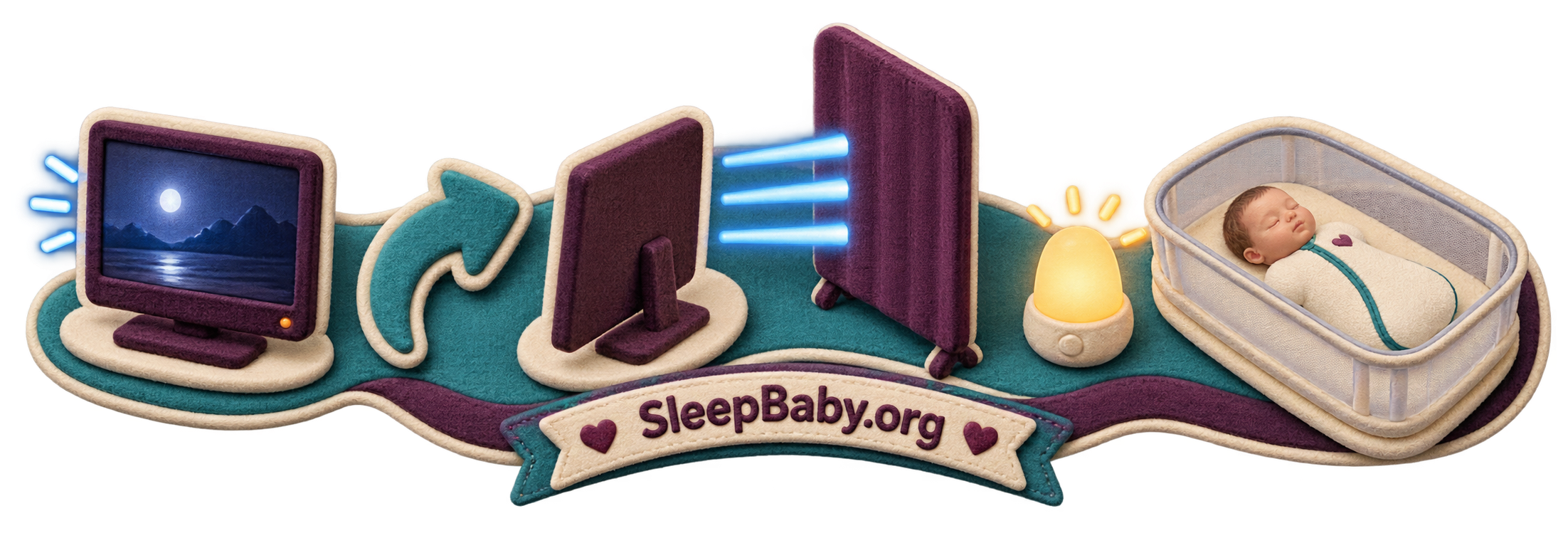
What if the TV and baby are in the same room?
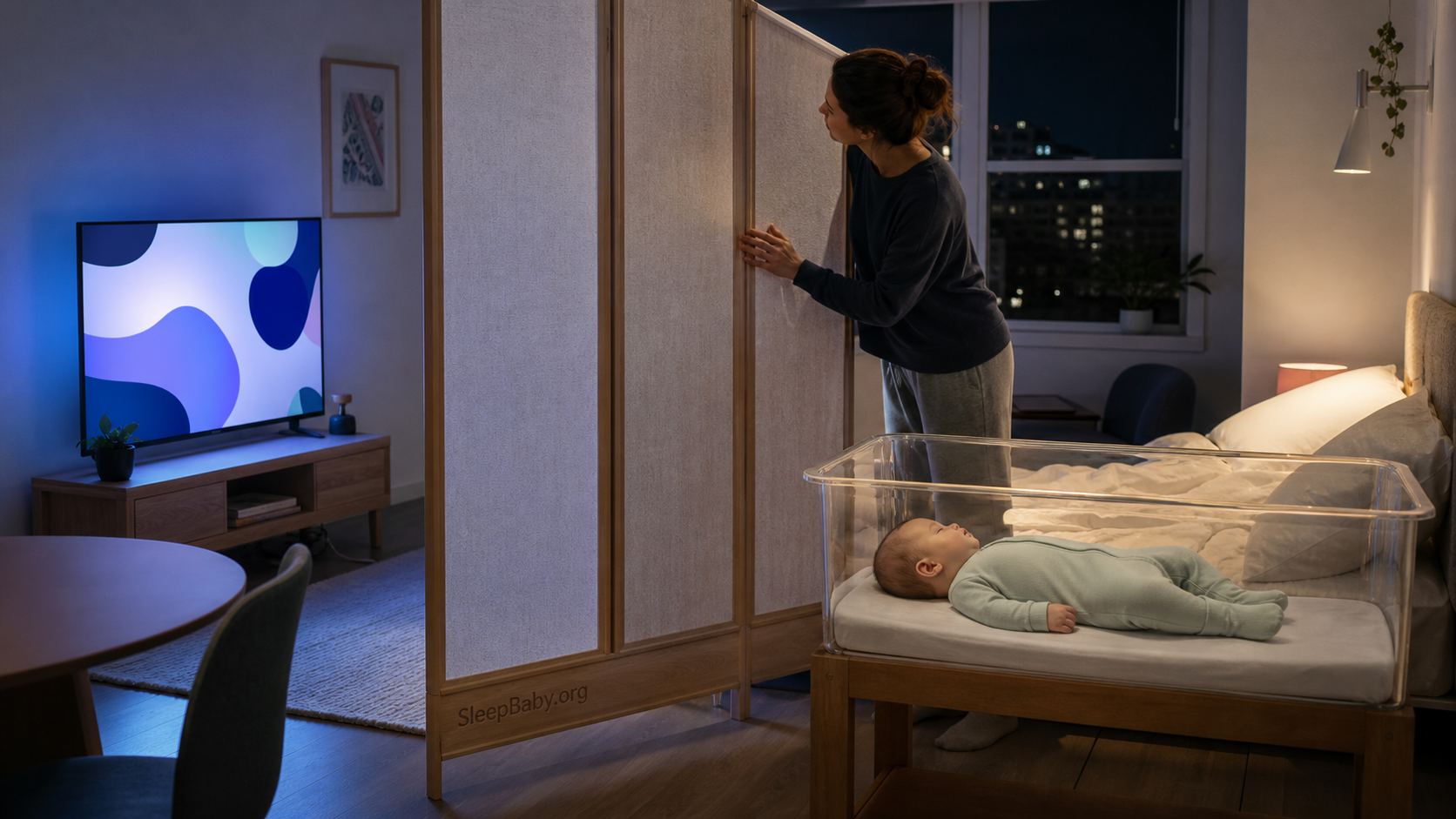
Same-room television is the version I would change first. You do not need to panic or wake a sleeping baby simply because a screen is on. Lower the volume, turn the screen away, and finish the transition to TV off. If you want to keep watching, move yourself once baby is settled safely.
A newborn bassinet beside the sofa is a common real-life arrangement. It can coexist with adults talking, eating, and moving through the room. But a bright television can become the strongest light source in that space, especially at night. I would not drape a blanket over the bassinet or improvise a cover to block the glow; that creates a new hazard. Change the source, angle, or room instead.
If moving the adult is impossible—one-room home, hotel, temporary housing—use the smallest workable version of the screen. Face it away from the sleep space. Reduce brightness. Choose captions over louder dialogue. Avoid content with abrupt peaks. Then turn it off before your own attention and sleepiness blur together. A constrained home deserves a workable plan, not shame.
For the separate adult question—how to watch without disturbing a sleeping baby—use the more detailed guide to watching TV while baby sleeps. This page stays with what the baby experiences and how to read the room.
The answer changes when the baby is awake, older, or still learning day from night
Newborn or young infant
Newborn sleep is scattered across day and night. During awake daytime care, ordinary daylight, faces, feeding, and household activity help mark daytime. At night, dimmer light, quieter voices, and less stimulation make the contrast clearer. The television is not needed to teach day and night. If it is on during a night feed, keep it out of baby’s sightline and turn it off for the return to bed.
Older infant who notices the screen
Once baby tracks the pictures, turns toward sound, or lifts their head to find the screen, the television is no longer merely scenery. If the goal is sleep, move it out of view. When baby wakes for a feed or cuddle, pause it so your face, voice, and response are not competing with a bright moving target.
Toddler in a shared family room
A toddler may understand that the show continues after bedtime and protest the separation. I would make the boundary concrete: the program pauses or moves rooms when the bedtime sequence begins. The rule is not “screens are evil.” The rule is that sleep has a repeatable ending.
WHO says sedentary screen time is not recommended for infants, while AAP family-media guidance prioritizes real-world interaction and protecting sleep routines. That awake-time guidance should not be stretched into a claim that an adult’s distant program during infant sleep is identical to a baby watching television. It does support one clean handoff: when the baby is awake and present, pause the background TV and let the relationship become the main event.
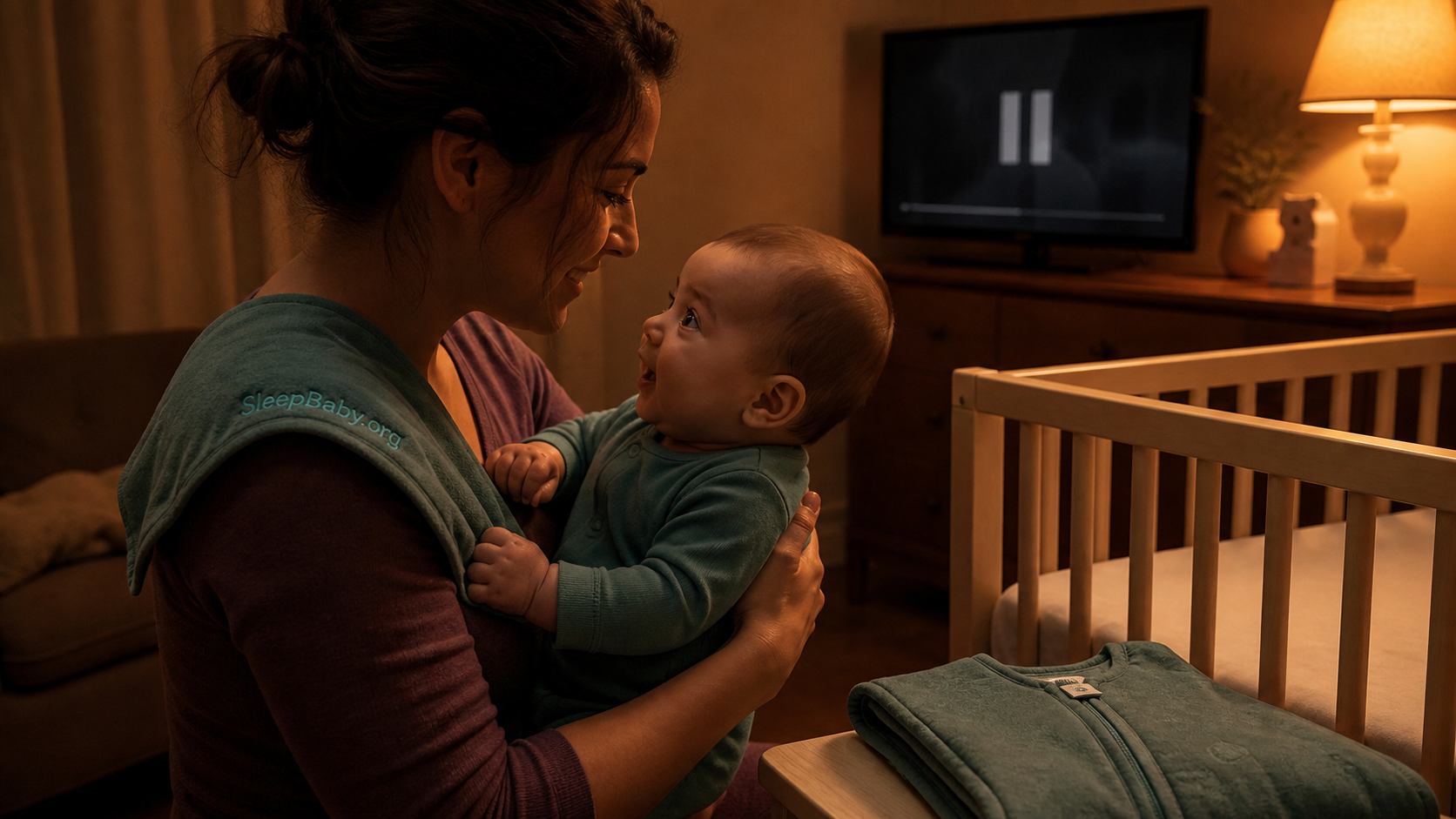
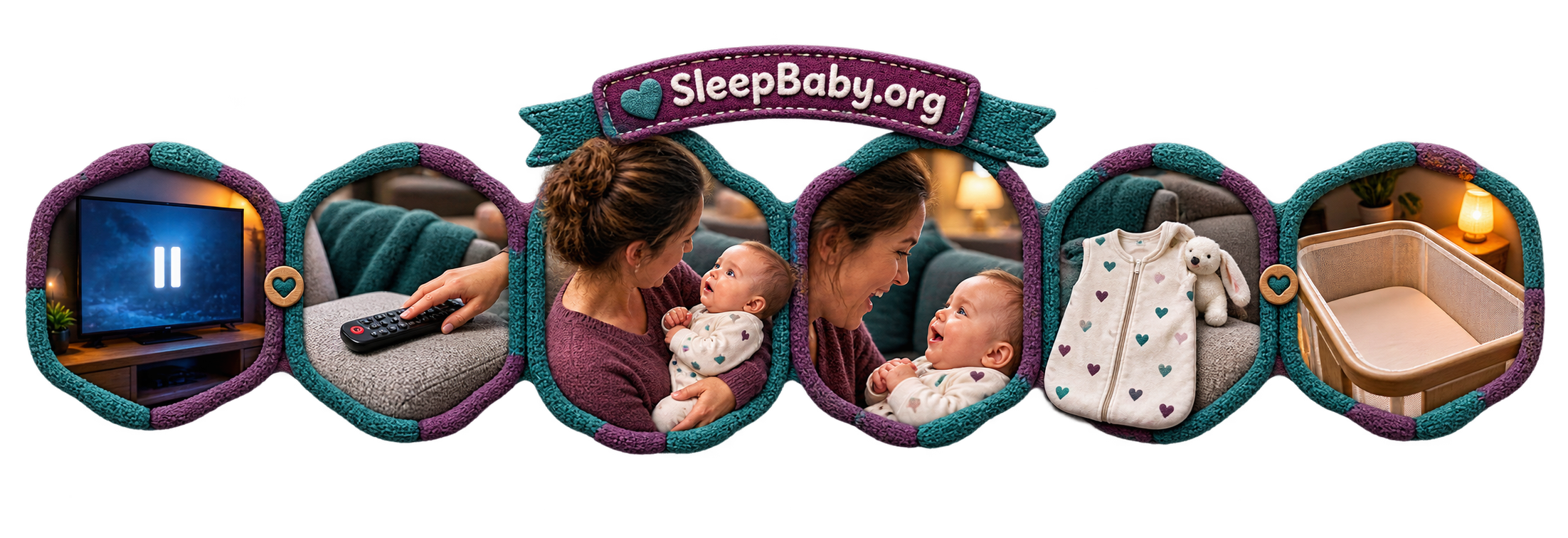
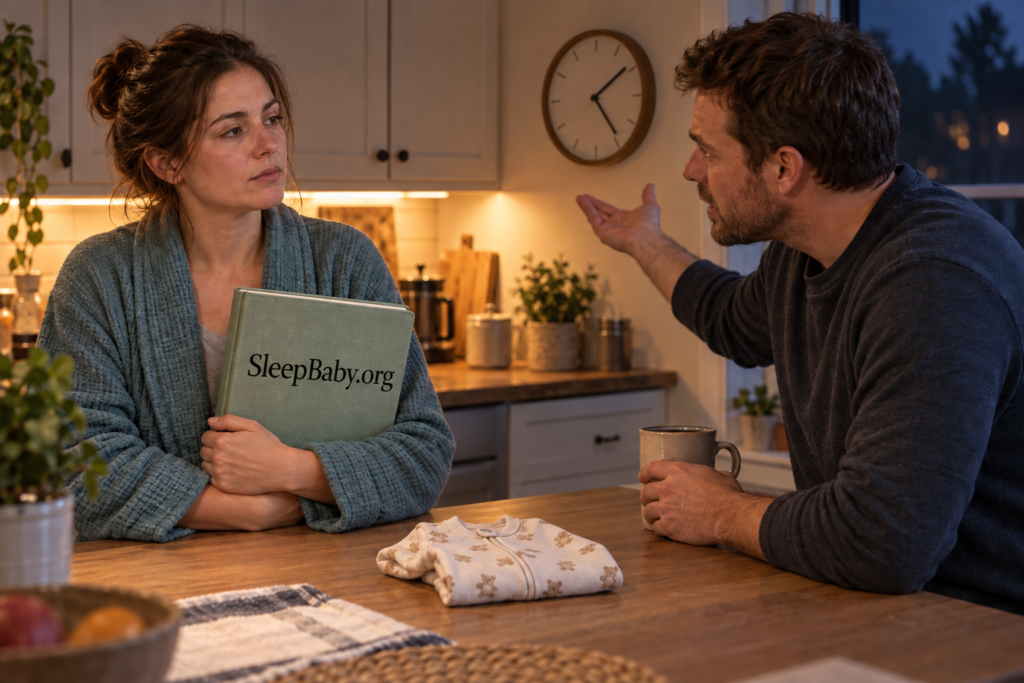
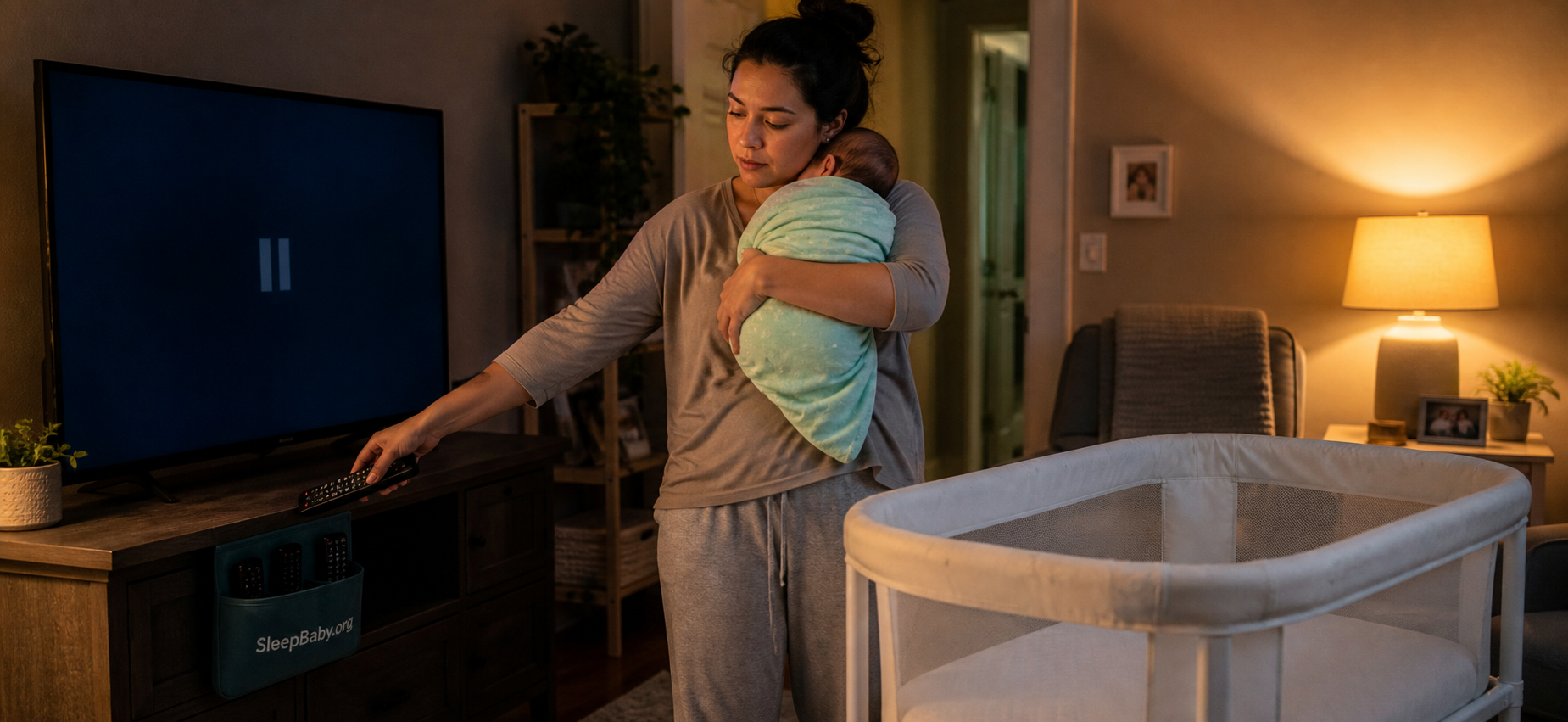
The remote under the burp cloth
That is the private question underneath this search: “Am I doing something harmful because I want one normal adult thing?” Wanting a show is not the problem. Parents need laughter, stories, sports, news, and a little territory that is not measured in ounces or wake windows. I am not interested in turning your home into a silent museum. I am interested in placing adult entertainment where it asks the least of the baby’s sleep.
Low volume can still have loud moments
There is no universal television number that makes a room safe for sleep. A volume setting depends on the device, room, distance, content, and the baby’s response. I would not borrow a decibel threshold from another noise question and present it as a medical rule.
Instead, listen for contrast. Dialogue may sit low enough that you lean forward, then an advertisement or theme song jumps. A startle is not automatically dangerous, and one wake-up does not convict the television. A repeatable pattern matters: the same kind of peak, followed by stirring, a head turn, crying, or a shortened sleep, across comparable naps or bedtimes.
Do not turn a separate sound machine up to overpower the television. That can leave the baby with two competing sound sources and leave you less able to hear a wake. If an infant sleep machine is already part of the routine, follow the AAP’s noise safeguard: place it as far from baby as possible, set the volume as low as possible, and limit how long it runs. Then reduce or move the optional source—the TV.
Television sound versus steady audio
| Feature | Television soundtrack | Steady audio cue |
|---|---|---|
| Pattern | Dialogue, music, silence, and sudden peaks | Deliberately consistent |
| Visual load | Moving light and scene changes | None when audio-only |
| Best adjustment | Lower it, move it, use captions, or turn it off | Far from baby, with the volume as low as possible, for limited duration |
| When baby wakes | Pause and respond | May remain part of the established sleep cue if it is already working |
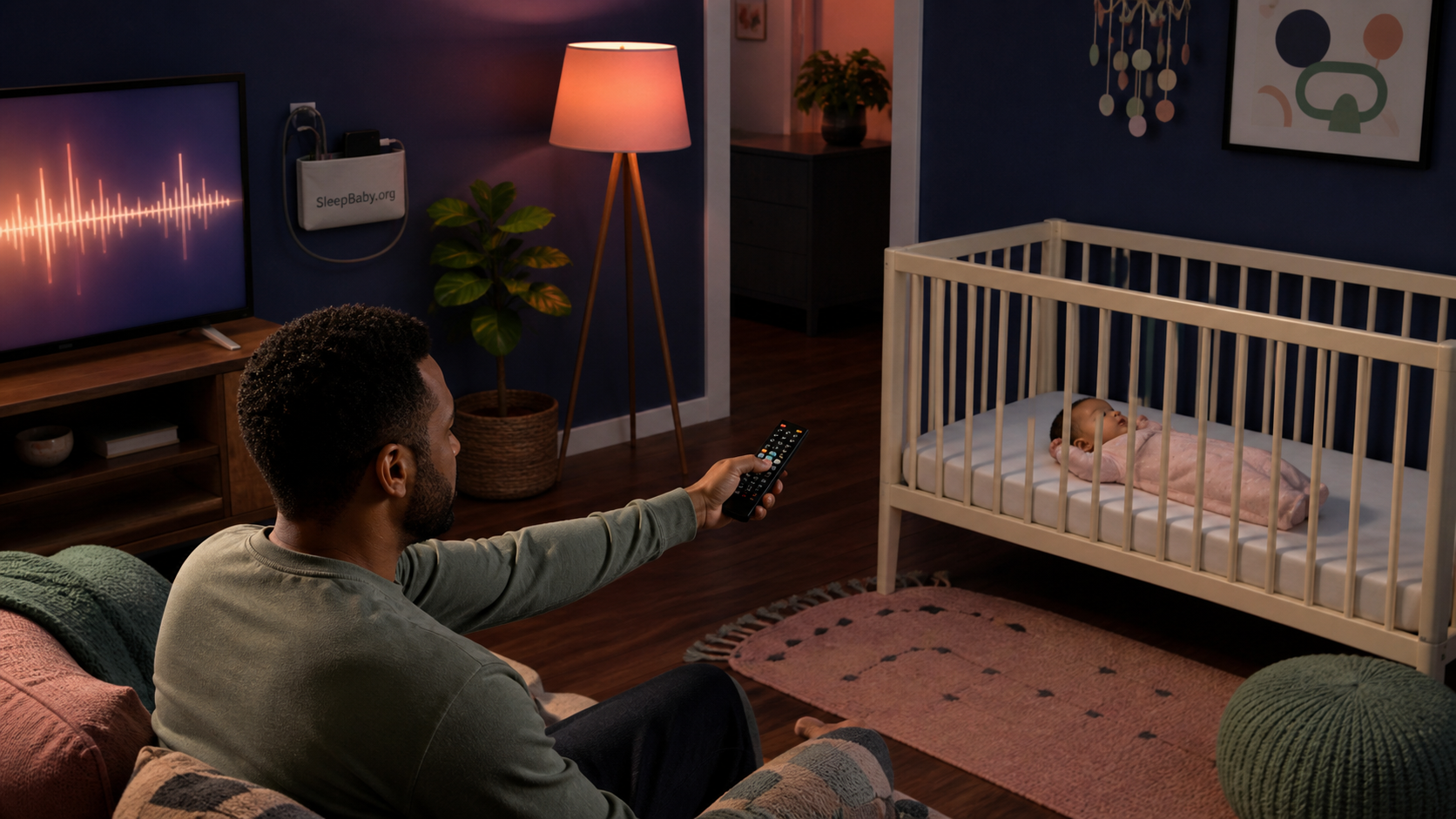
The safety pivot is often from couch to crib
If baby falls asleep on you during a show, the next decision is not brightness. It is the transfer. Couches, recliners, armchairs, and adult beds are not infant sleep spaces. If you feel yourself fading, stop the program, stand while you are still alert enough to move safely, and place baby on the back in the clear crib or bassinet.
A parent may say, “The TV keeps me awake.” It may keep your attention for a while; it cannot reliably cancel sleep deprivation. If you have been awake through feeds, pumping, illness, travel, or a long day, your body can cross from watching to sleeping without a respectful warning. The safest plan is not a more gripping series. It is arranging the handoff before you sit in the soft corner.
If every transfer fails and contact sleep has become the only way anyone rests, that deserves practical help, not blame. Start with the separate guide for a baby who will not sleep in the bassinet, and ask your pediatric clinician for individualized guidance when feeding, growth, breathing, pain, reflux-like symptoms, or unusual sleepiness complicate the pattern.
Watch the safety hierarchy
The television can change; the safe sleep surface cannot
This American Academy of Pediatrics video reinforces the fixed part of the answer: every nap and night begins on the back on a firm, flat, clear infant sleep surface. Use it before experimenting with screen angle, captions, or another room.
SleepBaby takeaway: a quiet television cannot make a couch, recliner, adult bed, or covered bassinet safe. Fix the sleep location before optimizing the room.
If baby expects the TV, use a three-night exit ramp
A baby who wakes when the TV goes off has not proven they need television for sleep. They may be reacting to any abrupt change: sound stops, the room goes darker, the parent moves, or a feed ends at the same moment. Change one layer at a time so you can see what the actual cue is.
Night one: simplify the screen
Lower brightness, turn the picture away, use captions, and keep the same familiar final phrase or song. Turn the TV off before the final transfer rather than after baby is fully asleep.
Night two: move the program
Complete the same feed or cuddle without the screen in baby’s sightline. If another adult wants the show, move the viewing to another room or use private audio only when a separate awake caregiver retains monitoring responsibility.
Night three: keep the cue baby can meet again
Repeat the short phrase, gentle song, darkened room, and safe bed. Do not add three replacement gadgets. The goal is not sensory emptiness; it is a small, repeatable finish.
This is not a promise that three nights fixes sleep. Teething, illness, hunger, travel, schedule changes, and development can all move through the same week. I use the exit ramp to prevent an optional, changing soundtrack from becoming the only explanation you test.
What I would do in six real rooms
Baby is in a bassinet beside the TV
Turn the screen away, lower sound, and move the viewing when you can. Do not cover the bassinet to block light. Keep baby on the back in the clear sleep space.
Baby sleeps in another room
For a young infant, start with the AAP recommendation to room-share without bed-sharing, ideally for at least the first six months. If your older baby or your clinician-supported setup uses another room, keep the television below the level that masks the monitor or household, check the connection, and maintain a clear path to respond. A separate room solves direct screen light; it does not remove caregiver responsibility.
An older sibling or partner is watching
Move the family program away from the sleep space or ask the viewer to use captions. If private audio is used, designate which awake adult remains able to hear and respond to baby.
Baby wakes and stares at the screen
Pause it. Feed, change, soothe, or interact as needed. AAP and WHO guidance protect real interaction for infants; the easiest boundary is to stop background television while baby is awake.
You are in a hotel or one-room space
Turn the television away from the travel crib, reduce brightness, use captions, and stop the program before the room’s adult falls asleep. If you need a small night cue after the screen is off, read the separate guidance on a red light for baby sleep rather than leaving moving pictures on all night.
The TV seems unrelated to the waking
It may be. Keep the screen off for one or two comparable sleeps while leaving the safe routine unchanged. If waking is identical, look at feeding, timing, illness, comfort, and development rather than escalating the screen theory.
How to tell whether the TV is actually waking your baby
Newborn active sleep can include twitching or jerking, eye movement beneath closed lids, and short changes in breathing rhythm without a skin-color change. Those signs can pass without help. If you turn the television off every time an eyelid moves, you may end up changing the room for behavior that would have passed on its own. I would look for a repeated sequence rather than a single movement.
The sequence I would watch is specific: a bright scene or sound peak happens; baby startles or turns; breathing and movement become more active; then baby fully wakes or needs help returning to sleep. One sequence can be coincidence. If it happens at similar moments over several comparable sleeps, it becomes a practical reason to change the setup. You do not need to prove a biological mechanism before making the room calmer.
A two-sleep, one-change test
- Keep the nonnegotiables stable: same safe sleep surface, usual feeding response, and usual room temperature.
- Name the suspected signal: moving light, sudden sound, screen proximity, or the moment the program stops.
- Change only that signal: turn the screen away, use captions, move the viewing, or turn it off before the final cue.
- Compare a similar sleep: a bedtime and a twenty-minute car nap are not useful twins. Compare two ordinary bedtimes or two naps begun at roughly the usual time.
- Keep the result modest: “The first stretch was calmer with the TV off” is evidence for your household, not a universal rule for every baby.
Do not run a home experiment through illness, breathing trouble, poor feeding, unusual lethargy, or an unsafe sleep arrangement. Those are care and safety questions, not optional variables. Also stop if the comparison makes the evening harder without teaching you anything. A parent does not owe the internet a controlled trial.
The result may be that the television was not the problem. Hunger, a late nap, travel, a new skill, or ordinary active sleep may explain the timing better. That is still a useful answer. It lets you move the remote out of the defendant’s chair and return to the baby’s actual pattern.
A narrow two-adult solution for television sound
Avantree Ensemble wireless TV headphones
If one adult wants to keep watching while another awake adult is the designated caregiver, the Avantree Ensemble moves the program audio into adult headphones instead of sending scene changes across the baby’s sleep area. The included transmitter and charging base make it a more direct fit than buying unrelated adapters one by one. Check the TV first: Avantree says this model needs Optical (TOSLINK) or 3.5 mm AUX output; an HDMI-only TV or a soundbar passthrough setup is not a match.
This is not my pick for a sole caregiver who needs both ears available. It does not monitor baby, block screen light, improve infant sleep, or make any sleep surface safe. Its value is narrower and honest: in a two-adult setup, the off-duty viewer can hear the show privately while the designated caregiver keeps the monitoring channel open.
Check the Avantree Ensemble on Amazon
As an Amazon Associate, SleepBaby may earn from qualifying purchases.
When the television is not the real question
Turn the screen off and call emergency services for severe breathing trouble, blue or gray color around the lips, tongue, or face, unresponsiveness, or a pause in breathing longer than 20 seconds—especially if color or muscle tone changes. A TV adjustment, camera, audio monitor, or sleep log is not an emergency response.
Contact your pediatric clinician for frequent snoring, recurring nighttime breathing difficulty, gasping, unusual daytime sleepiness, feeding difficulty, poor growth, pain, or another sleep change that concerns you. Those questions need the baby’s full health context. “Maybe it is the television” should not delay medical attention.
If baby is healthy but sleep remains fragmented, use a tiny comparison rather than changing everything. Choose two similar naps or bedtimes. Keep feeding, safe sleep, and routine stable. On one, remove the TV from the room. Note whether settling, repeated startles, and sleep length meaningfully change. I trust one calm comparison more than a week of adjusting brightness, volume, white noise, and bedtime all at once.
The plan I would use tonight
- Place baby on the back in a firm, flat, clear crib, bassinet, portable crib, or play yard that meets CPSC standards.
- Keep every remote, speaker, and device outside the sleep space, and every monitor part and cord at least three feet away.
- Turn the TV away and down while you finish the transition.
- Pause when baby wakes; return your face and voice to the foreground.
- Turn the TV off before the final sleep cue, or move adult viewing to another room.
- If your own eyelids feel heavy, choose the safe transfer and your own sleep.
The opening room can change now. The television stops repainting the wall. Baby’s last cue is smaller: the same phrase, the same safe bed, the same darkness they can meet after the next feed. You still get to be a person who watches things. You simply stop asking the baby’s sleep space to carry the show.
Sources
- American Academy of Pediatrics: 2022 safe-sleep recommendations
- HealthyChildren.org: How to Keep Your Sleeping Baby Safe
- American Academy of Pediatrics: Digital Ecosystems technical report
- HealthyChildren.org: Helping Kids Thrive in a Digital World
- World Health Organization: movement, sedentary behavior, and sleep for children under 5
- Kirkorian et al.: Background television and parent-child interaction
- Uzundağ et al.: Background TV and infant-family interactions
- NHS: Helping your baby to sleep
- American Academy of Pediatrics: How Noise Affects Children
- HealthyChildren.org: Stages of Newborn Sleep
- HealthyChildren.org: Urgent Care, ER or Pediatrician? A Parent Guide
- HealthyChildren.org: Sleep Apnea in Children—Detection and Treatment
- U.S. Consumer Product Safety Commission: Baby-monitor cord safety alert
- Avantree: Ensemble compatibility and connection requirements
Let the last cue become smaller
Move the show—not the safe-sleep rules
A baby can sleep through a television without needing it. Keep the sleep surface safe, remove the moving screen from the final wind-down, and preserve one cue you can repeat when the night starts again.
Find the next SleepBaby answer for tonight
SleepBaby offers education, not individualized medical care. Contact your child’s clinician when sleep, feeding, breathing, growth, or responsiveness concerns persist.