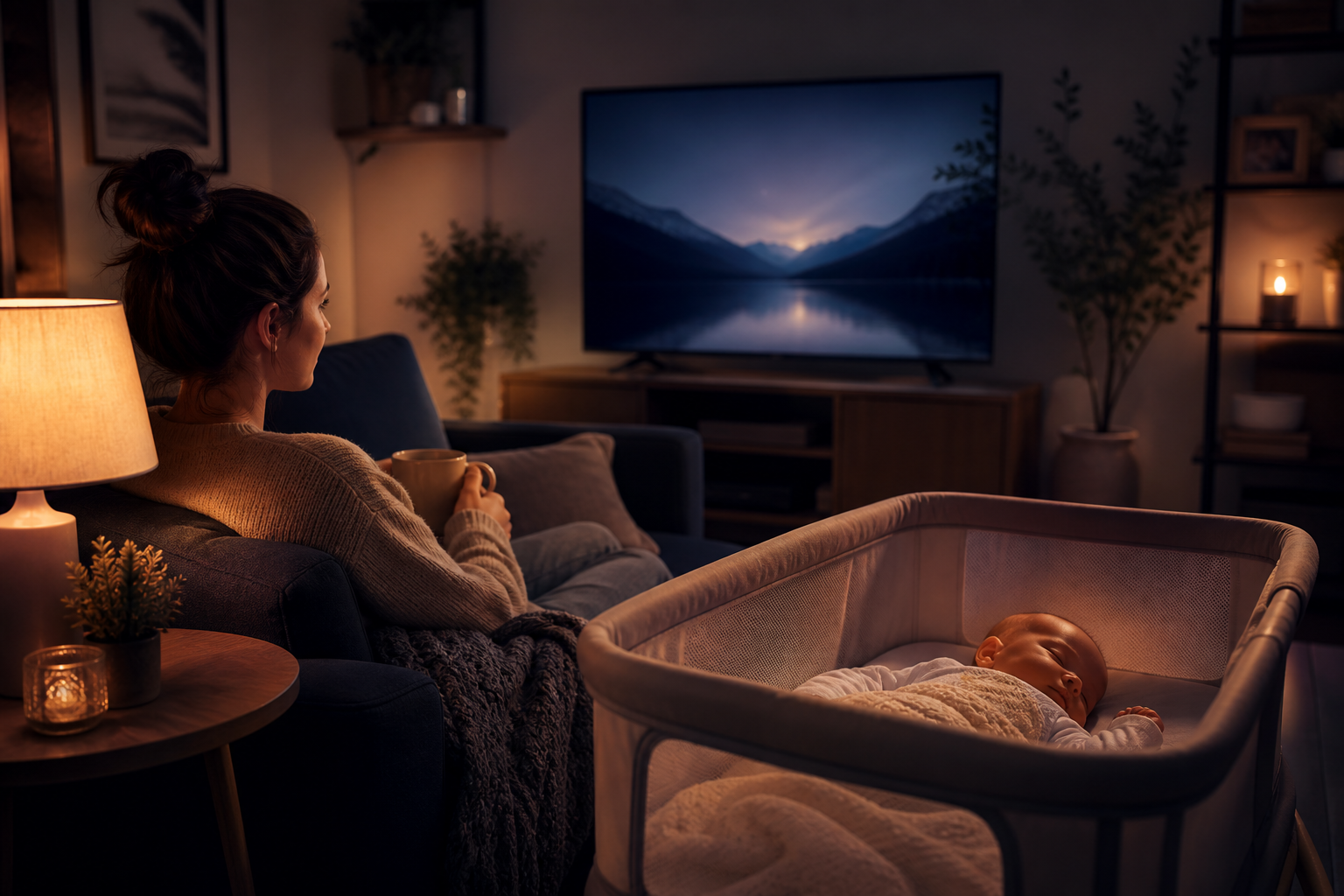
The remote is in your hand, the baby is finally asleep, and suddenly pressing play feels like a parenting ethics exam. Yes, you can watch TV while your baby sleeps. The television is not automatically dangerous. What matters is where your baby is sleeping, whether you might fall asleep while holding or feeding them, and whether the screen’s light or sound is repeatedly disturbing their sleep.
I would make the safe-sleep setup the first decision and the show the second. Put baby on their back in a firm, flat, noninclined crib, bassinet, portable crib, or play yard with an empty sleep space. If you are exhausted on a couch or armchair with the baby in your arms, turn the television off and move the baby to that safe space. Once those pieces are right, ordinary adult television in another room—or a dim, quiet screen turned away from the sleep space—is usually a practical household choice, not a parenting failure.
The three checks I would make before pressing play
- Surface: Is baby on their back in a firm, flat, empty sleep space made for infant sleep?
- Separation: Are you watching from a position where you cannot accidentally fall asleep with baby on a couch, chair, or adult bed?
- Stimulation: Is the screen turned away and the volume low enough that flashes and sound peaks are not repeatedly reaching the baby?
If all three answers are yes, I would stop treating the television as the main problem. If one answer is no, fix that specific piece. This distinction matters because parents often spend ten minutes worrying about blue light while a much more important risk is sitting right underneath them: a deeply tired adult holding a sleeping infant on soft furniture.
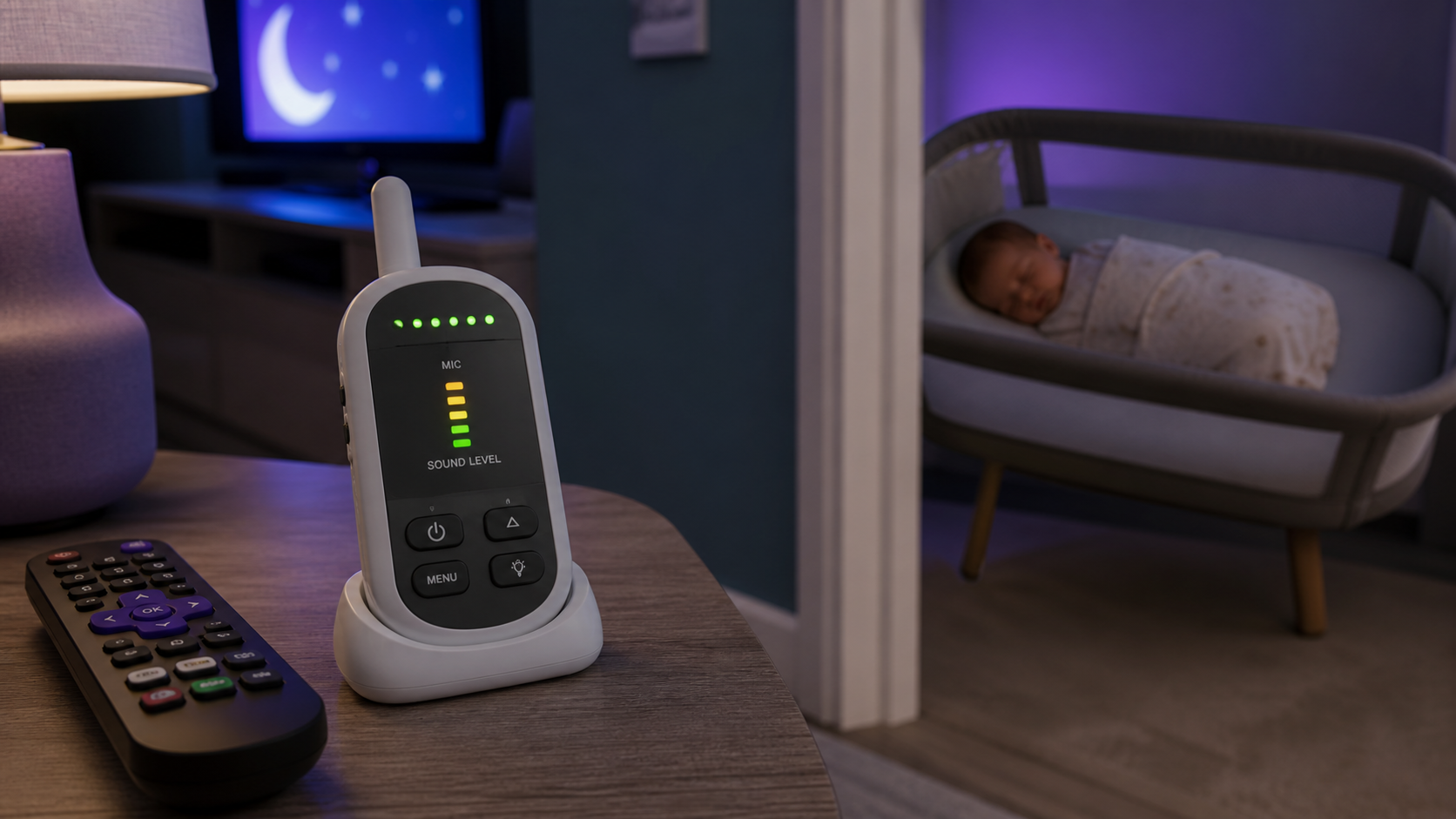
Can the TV be in the same room as a sleeping baby?
It can, but same-room viewing needs more restraint than watching from down the hall. A television changes both the light pattern and the sound pattern in the room. Even at a low average volume, commercials, action scenes, theme music, and laugh tracks can create abrupt peaks. The picture can wash the ceiling and the side of a bassinet with quick changes from dark blue to bright white.
Some babies sleep through a normal household soundtrack. Others twitch at every title card as though the streaming service has personally summoned them. I would watch the baby rather than chase a universal decibel number. If eyelids flutter with every bright cut, the head turns toward the screen, startles cluster around louder scenes, or the nap repeatedly ends earlier when the television is on, that is useful evidence. Move the viewing farther away, turn the screen away, reduce brightness, enable subtitles, or save the program for another room.
Choose the setup that asks the least of your baby’s sleep
| Setup | What works | What I would change |
|---|---|---|
| Baby in another room | Normal low television volume, reliable monitoring, easy access to baby | Avoid headphones that block awareness of the home |
| Baby in the same room | Screen turned away, low brightness, subtitles, steady low sound | Move the screen if its changing light lands on the sleep space |
| Baby asleep in your arms | Transfer to the safe sleep space before you settle in | Do not use a couch, recliner, or adult bed as the baby’s sleep location |
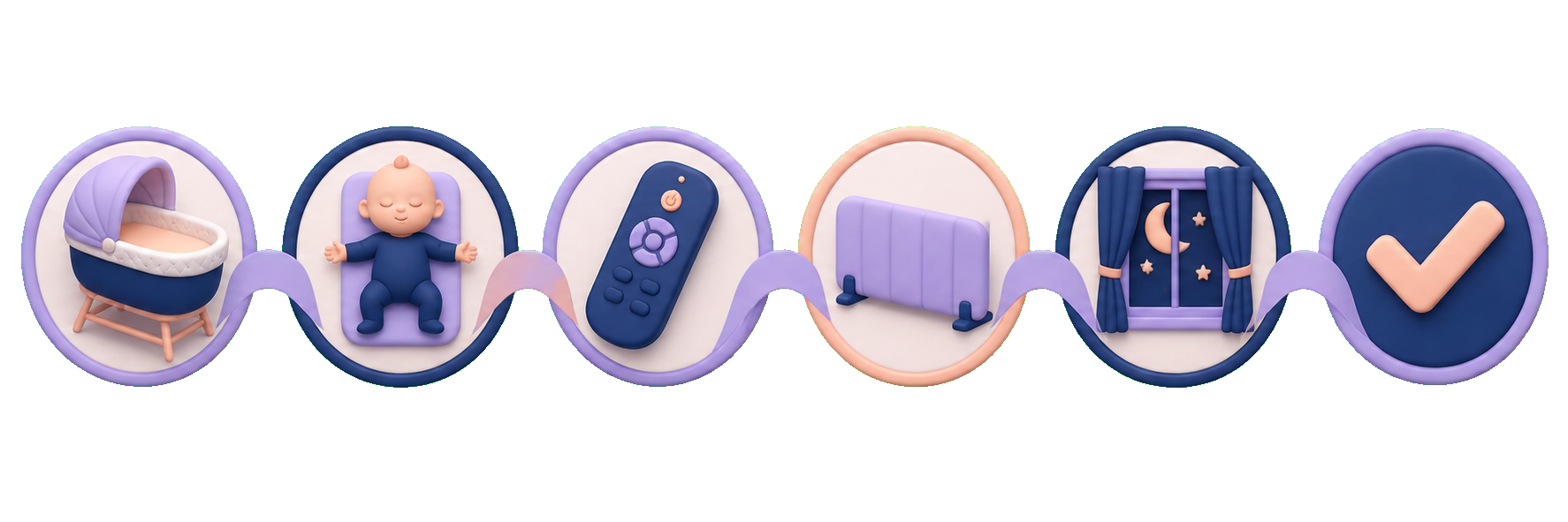
Safe surface first: the crib or bassinet decision outranks the screen decision.
The television question can hide a couch question
This is the part I would underline twice. The American Academy of Pediatrics warns that couches and soft armchairs are especially dangerous places for an infant to sleep with an adult. A television may make a tired parent feel temporarily occupied, but it does not remove sleep pressure. If you are feeding, rocking, or contact-napping on a sofa at night, “I will stay awake because the show is interesting” is not a safety plan.
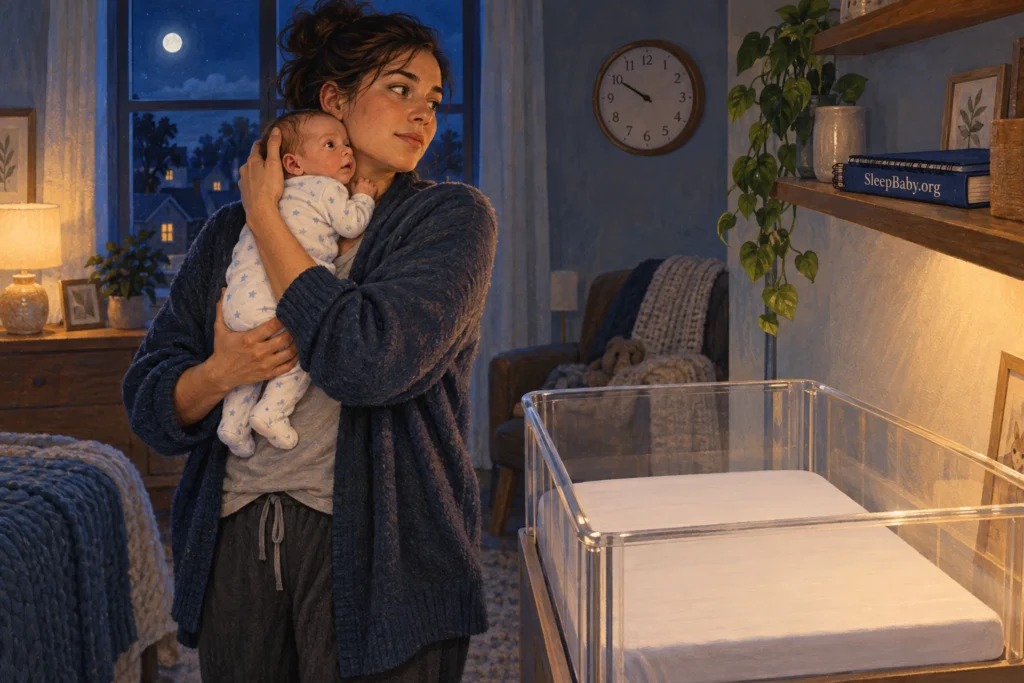
A clearly labeled hypothetical Kacey-and-Benjamin moment: Imagine it is 9:42 p.m. Benjamin has gone heavy and warm against my chest, the credits are rolling, and I am negotiating with myself about one more episode. The dangerous detail is not the fictional detective on the screen. It is that my blinking has slowed and I am sitting in the soft corner of the couch. In that moment, I would put Benjamin on his back in his clear bassinet before choosing whether I am awake enough to watch anything at all. The scene is hypothetical, not family history and not evidence; it shows the decision I want a tired parent to recognize.
I have a very low tolerance for plans that require an exhausted person to prove they can defeat biology. If your head is dipping, you reread the same subtitle three times, or you cannot remember the last scene, move baby to the safe sleep space and go to sleep. If that transfer is the hard part, use this safe bassinet-transfer guide as the next step. The episode will remain available. The safe choice needs to be available now.
Will television light ruin a baby’s sleep?
“Ruin” is much too strong. Light is one signal the developing body uses to distinguish day from night, but a single evening program is not a switch that permanently resets a baby’s sleep. The practical concern is repeated stimulation: a bright screen close to the sleep space, moving light across closed eyelids, or a program that keeps rousing a baby who had been settling.
I would make the room boring from the baby’s point of view. Turn the television away from the crib or bassinet. Lower brightness instead of trying to solve everything with volume. Do not put the screen where an awake or half-awake baby can stare directly at it. If you need to see the screen in a shared room, captions let you reduce sound without turning the television into a silent strobe light at maximum brightness.
Follow the light path
- Screen → wall: reflected light is usually gentler than a screen facing the sleep space.
- Wall → bassinet: if sharp color changes still reach baby’s face, change the angle or room.
- Baby wakes: switch the screen off and respond; do not use the program as infant entertainment.
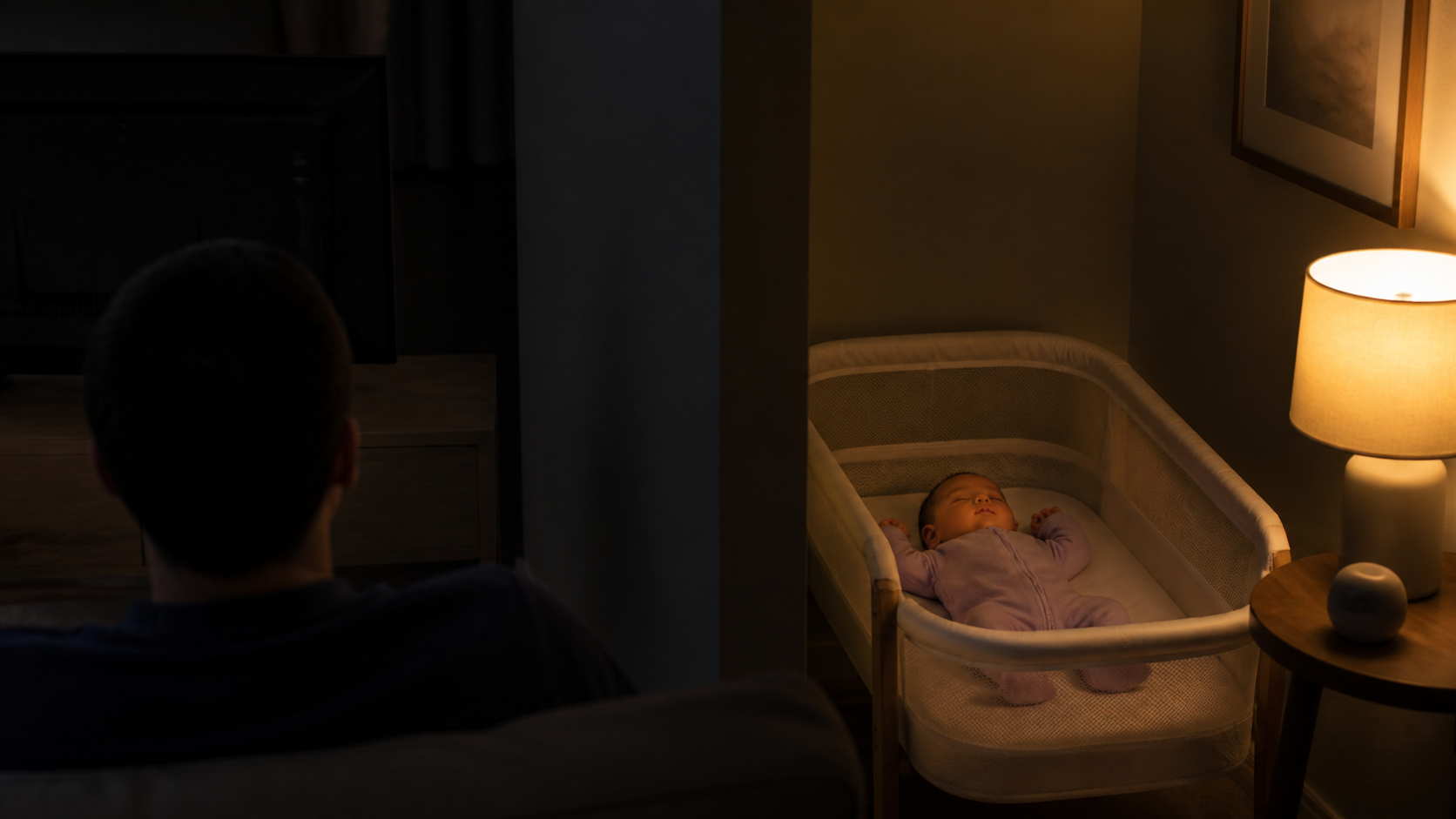

Redirect before you forbid: angle, distance, and brightness may solve the problem.
How loud is too loud?
There is no useful household number that guarantees every baby will sleep well through every program. Distance, room shape, the baby’s age, and sudden peaks all matter. A low conversation-level soundtrack in another room is different from a speaker beside the bassinet. A calm documentary is different from a movie that alternates whispered dialogue with explosions apparently mixed for a minor earthquake.
Use the lowest volume that lets you follow the program, and let the baby’s response refine it. If every loud scene produces a startle, grimace, head turn, or full wake, the answer is already in front of you. Reduce the volume, use captions, move rooms, or watch later. I would not keep “testing” the baby’s ability to adapt through a nap that is clearly being fragmented.
If your baby already sleeps with a separate steady sound source, keep that device at its usual safe setting and location. Do not turn it up to compete with the television. Steady sound and a television soundtrack do different jobs: one is intentionally consistent, while the other changes with dialogue, music, advertisements, and scene cuts. Adding more sound to cover loud sound can leave the baby with a noisier room and leave you less able to notice waking. Lower or move the television instead.
My sound ladder
- Turn it down when peaks reach the sleep space.
- Turn on captions when dialogue becomes hard to follow.
- Move yourself when the same-room setup still wakes baby.
- Turn it off when baby is awake, needs you, or the room cannot be made calm.
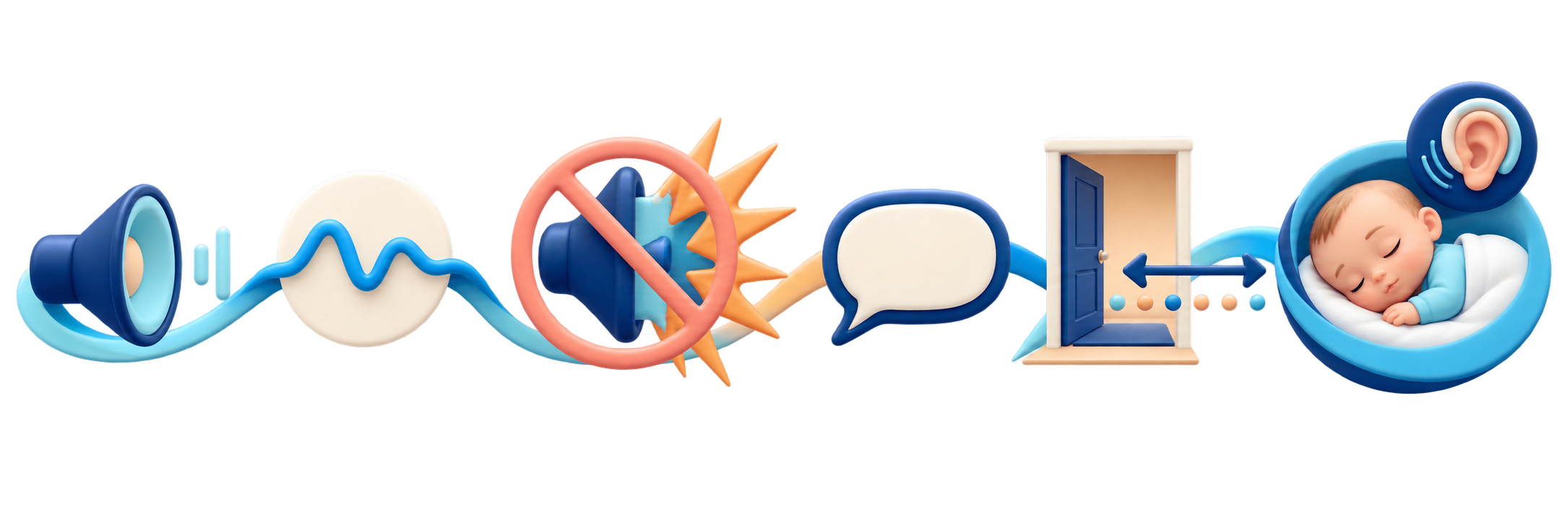
Watch the peaks: average volume can sound low while sudden scenes still wake a baby.
Sleeping near a TV is not the same as growing up with background TV
Parents deserve this distinction because the internet often compresses several different questions into “screen time.” An adult watching a program after the baby has fallen asleep in a separate safe space is not the same exposure as positioning an awake infant to watch television. It is also not the same as leaving television on through feeding, floor play, conversation, and the ordinary back-and-forth from which infants learn.
AAP media guidance prioritizes real-world interaction for babies. Research on background television has also found that it can reduce the quantity or quality of parent-child interaction. That does not mean one episode after bedtime causes developmental harm. It means the easiest healthy boundary is a useful one: when baby wakes and rejoins the room, pause the show. Let your voice, face, and response become the foreground again.
I would be more concerned about hours of automatic background television during awake time than about a parent deliberately watching one show while the baby sleeps elsewhere. The question beneath the search is often, “Am I selfish for wanting an hour that feels like mine?” No. Rest and recreation are real needs. The goal is not to make the house joyless; it is to keep adult media in the adult lane and infant sleep in a safe, low-stimulation lane.
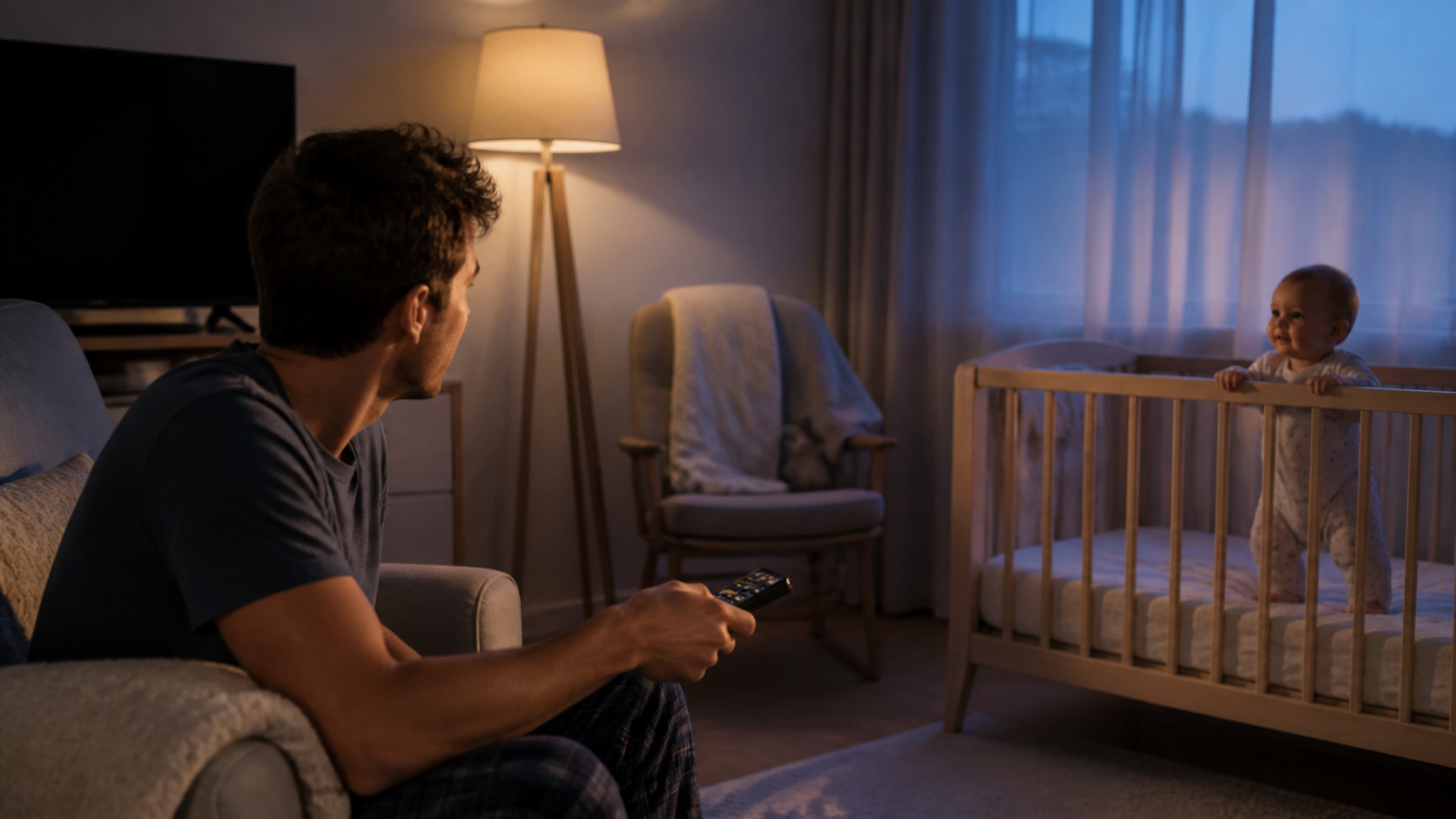
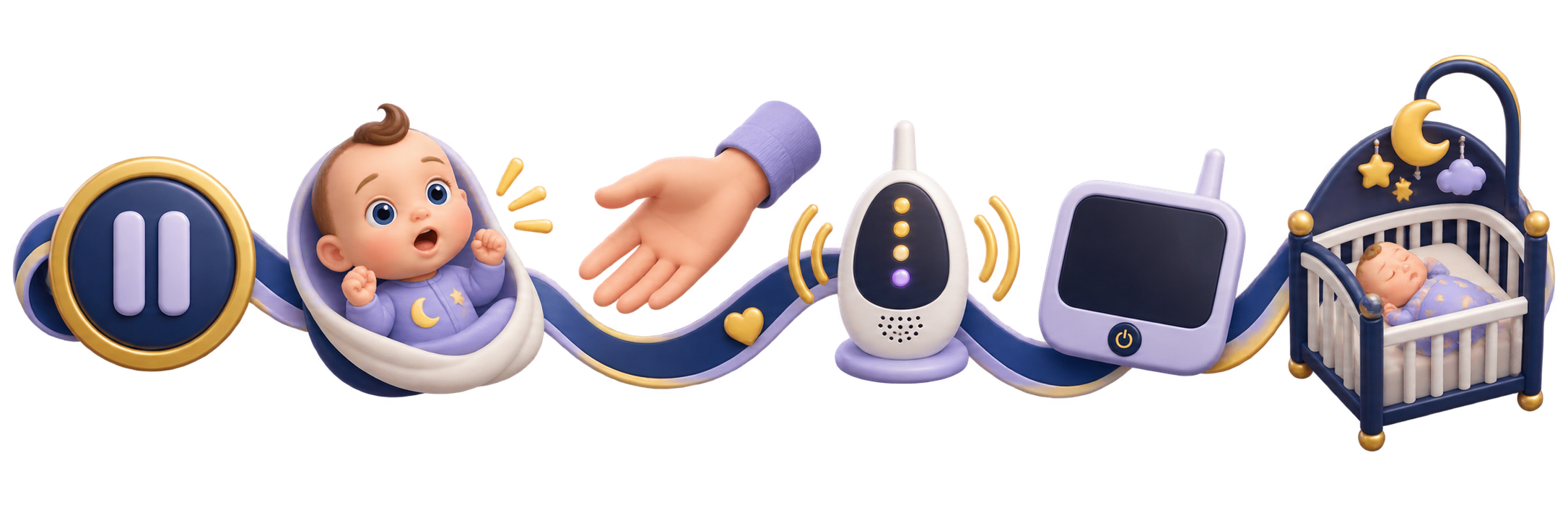
Awake again: pause, respond, and keep the television from becoming constant background media.
How do I hear my baby over the television?
First, do not solve this by sealing both ears with noise-canceling headphones. That may make the program easier to hear while making the home harder to hear. Keep the volume modest, keep the path to baby clear, and use a monitor appropriate for your setup if the baby is in another room.
A monitor is a convenience tool, not a safety guarantee. It does not prevent sleep-related death, make an inclined product safe, or replace checking on a baby who sounds or looks unwell. Place and use it according to the manufacturer instructions, with cords kept well away from the crib or bassinet. If connection drops, batteries are low, or television sound masks the parent unit, fix that before settling into the episode.
A 20-second monitoring check
- Parent unit is on, connected, and within sight or hearing.
- Sound indicators respond when the baby unit detects noise.
- Television volume does not overpower the parent unit.
- No monitor cord is within the baby’s sleep space or reach.
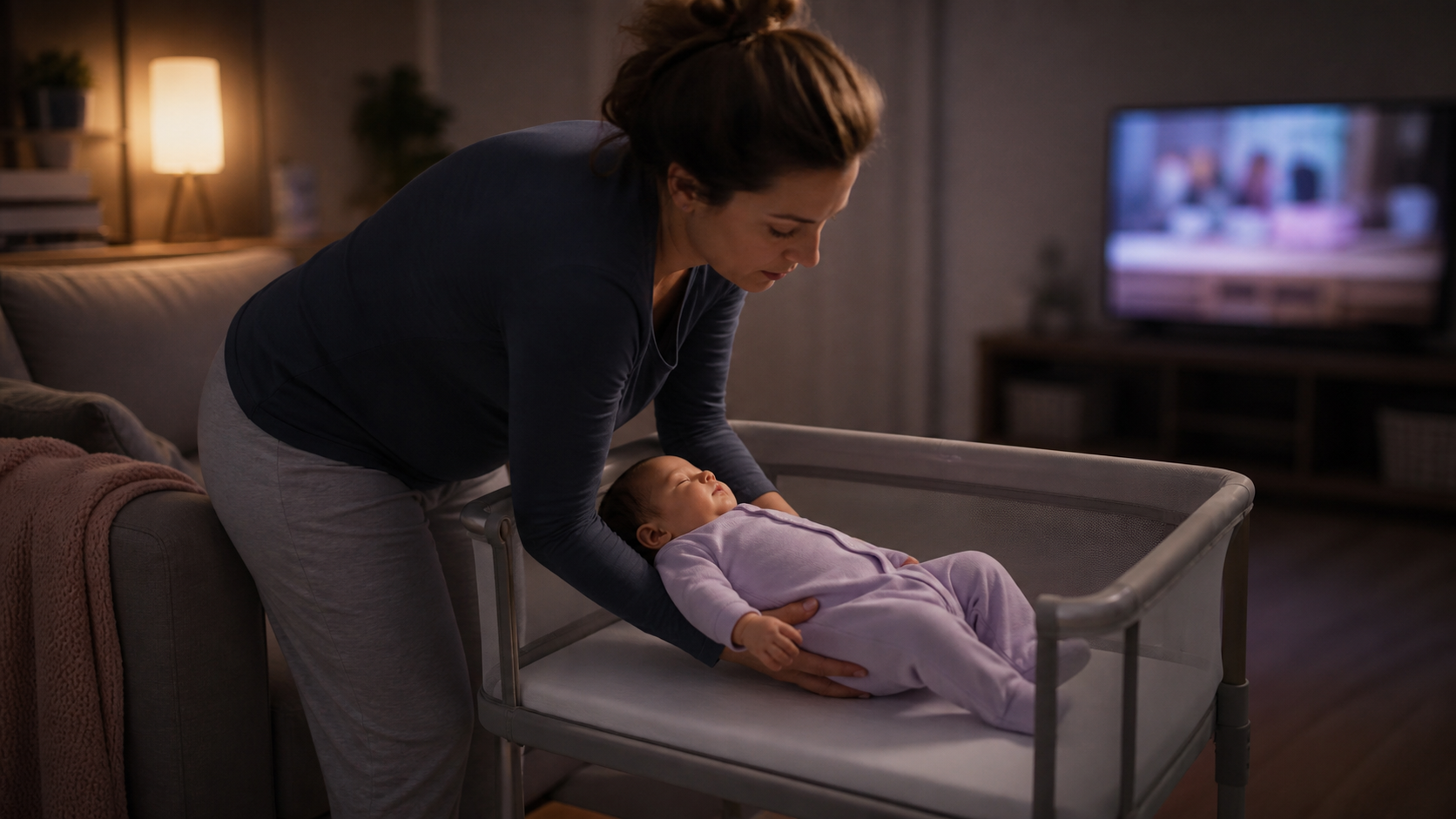
A practical pick for watching from another room
VTech DM221 Digital Audio Baby Monitor
If television audio makes you worry that you will miss a quiet wake-up, the VTech DM221 fits this exact situation because its parent unit includes visual sound indicators as well as audio. That is a better match than isolating headphones: the monitor adds another way to notice sound without asking you to cover both ears. I like the narrowness of the job—it helps you notice waking; it does not pretend to analyze sleep, prevent SIDS, or replace a safe crib or bassinet.
See the VTech DM221 audio monitor on Amazon
As an Amazon Associate, SleepBaby may earn from qualifying purchases.
The answer changes with age, room, and the kind of sleep
A newborn sleeping in a bassinet beside you, a six-month-old napping upstairs, and a toddler dozing on the far end of the living room are not the same setup. The television question becomes clearer when you name the actual arrangement instead of treating every sleeping child as one category.
Newborns and young infants in the same room
Newborn sleep is scattered across day and night, and feeding remains central. If your newborn is in a bassinet in the room with you, protect the sleep space first and expect to pause often. Keep the screen out of the baby’s direct sightline, use low sound, and do not let a long episode delay feeding or a response to waking cues. A newborn who is unusually sleepy, difficult to wake for feeds, feeding poorly, or showing a concerning change needs clinical attention—not a darker television setting.
Room sharing without bed sharing is compatible with an adult having normal quiet time. It does not require every person in the room to sit motionless in darkness. But “normal household sound” should not become a challenge issued to the baby. If the room is bright and loud enough that sleep repeatedly breaks apart, the setup is giving you its answer.
Older babies sleeping in a separate room
Distance reduces direct screen light and often reduces sound, but it increases your reliance on a clear monitoring path. Test the parent unit before the movie begins. Put it where you can see or hear it. Keep television volume below it. If your home has closed doors, multiple floors, or loud heating and cooling equipment, do not assume a cry will carry because it did yesterday.
Naps versus nighttime sleep
Daytime television may be less visually dramatic because the room is already lit, but it can still interrupt a short nap through sudden sound. At night, a bright screen can become the dominant light source. I would use the same three checks for both, then change the details: sound peaks are often the nap problem; screen glow and adult fatigue are often the nighttime problem.
When an older baby or toddler can see the screen
Once a child can sit, stand, call out, or negotiate bedtime, a visible television may become an invitation rather than mere background. If they are watching the show instead of settling, move the screen out of sight or watch elsewhere. That is not because one glimpse is catastrophic. It is because your stated goal is sleep, and the room is currently offering something more interesting.
Four reassuring statements that need one extra sentence
- “Babies should learn to sleep through noise.”
- Normal household sound is not a problem for many babies. Repeated startles and shortened sleep are still valid reasons to lower this particular noise.
- “Blue light will destroy melatonin.”
- Light can influence circadian signaling, but this phrase turns a dose-and-context question into a catastrophe. Keep bright moving light away from the baby and judge the actual sleep response.
- “The baby is asleep, so screen-time guidance does not matter.”
- An adult program after bedtime is different from infant screen viewing, but background television can still crowd out interaction if it stays on after the baby wakes.
- “A monitor means I can turn the volume up.”
- A monitor adds a channel of awareness. It does not guarantee you will notice every cue, and it does not cancel the effect of loud sound reaching the sleep space.
How to tell whether the television is actually disturbing sleep
Parents can become so alert to the possibility of a problem that every grunt starts to look like evidence. Babies move, sigh, squeak, briefly open their eyes, and pass through lighter sleep without needing the room redesigned. I would look for a repeatable relationship rather than one dramatic wiggle.
For two or three comparable sleeps, note only four things: where the television was, whether its light reached the baby, whether a loud scene happened near the wake-up, and how long sleep lasted. You do not need a color-coded spreadsheet. A note such as “screen faced away; captions; woke after 48 minutes” is enough. Then change one feature. If turning the screen away changes nothing but moving to another room produces a longer, calmer sleep several times, you have a practical answer.
Do not run this experiment when the baby is sick, feeding unusually, overtired, or sleeping in an unsafe place. Safety and care needs are not variables. The experiment is only about the optional features of the adult setup.
A tiny one-change test
- Observe: what exactly happened before the wake?
- Choose: light angle, distance, volume, or program type—one only.
- Repeat: compare a similar nap or bedtime, not a completely different day.
- Keep: the change only if it makes the household easier without weakening safe sleep.
The useful outcome may be “television was not the issue.” Perhaps the baby woke hungry, the nap began late, or the room became hot. That is still progress. The point is not to convict the screen. It is to stop guessing.
Wanting television after bedtime is not the problem
There is a quiet emotional trap in this question. A parent finally gets the baby down, considers doing something pleasant, and then wonders whether responsible parenting requires turning the entire home into a monastery. It does not.
I would rather help you build a setup that respects both people in the house. The baby gets a safe sleep space and a calm sensory environment. The adult gets a program, a snack, a conversation, or forty minutes in which nobody needs their body. Those needs can coexist. The boundary is that adult leisure cannot depend on unsafe contact sleep, ignoring waking cues, or keeping an awake infant beside a constantly running screen.
The other honest boundary is fatigue. Sometimes the most restorative choice is not finishing the episode. If television is the only thing keeping you upright while you hold the baby, the leisure plan has already turned into a safety problem. Put baby down safely and choose your own sleep. Kacey’s imaginary detective will solve the case without us.
What I would do in five common situations
Baby is asleep in a bassinet beside the television
Turn the screen away, lower brightness and volume, and watch for repeated stirring. If the bassinet receives moving light or the baby keeps startling, move the viewing—not the safe sleep rules.
Baby fell asleep on me during a show
Transfer baby to the safe sleep space before fatigue wins. Do not treat the next episode as a strategy for staying awake on a couch or recliner.
Baby sleeps upstairs while I watch downstairs
Use reliable monitoring, keep the volume low enough to notice the parent unit, and check that you can reach baby promptly. The monitor supports awareness; it is not a medical device or permission to ignore safe sleep.
The TV wakes baby after twenty minutes
That is not a moral verdict. It is a setup result. Try captions, greater distance, a different room, or a later viewing time. Change one variable so you can tell what helped.
Baby wakes and looks toward the screen
Pause it. Respond to the baby, feed or settle as needed, and return them to the safe sleep space. Adult viewing time can resume after the awake interaction is finished.
Watch the safety boundary
Safe sleep for every nap and every night
The written answer comes first. This short American Academy of Pediatrics video reinforces the part television can never change: baby sleeps on the back on a firm, flat, clear infant sleep surface.
SleepBaby takeaway: decide the sleep surface before deciding whether to press play. A quiet show cannot make a couch, recliner, or adult bed safe for infant sleep.
When the question is no longer about television
Turn the screen off and respond immediately if your baby has trouble breathing, develops blue or gray color around the lips or face, is unusually difficult to wake, has a concerning change in responsiveness, or seems acutely unwell. Call emergency services for severe breathing difficulty, blue or gray color, unresponsiveness, or another emergency. Contact your pediatric clinician for persistent concerns about sleep, feeding, growth, breathing, or unusual wakefulness. A monitor and a television-volume adjustment are not substitutes for medical assessment.
The version I would use tonight
Put baby on their back in the clear crib or bassinet. Sit somewhere you are unlikely to fall asleep holding them. Turn the screen away, lower brightness, start with captions and modest volume, and keep your monitoring path open. If baby wakes, pause. If you become sleepy, stop.
That remote from the opening does not need to feel like an ethics exam. It is just a remote. The real parenting work happened in the choices around it: a safe surface, an alert adult, a calmer room, and a willingness to press pause when Benjamin—or your own heavy eyelids—changes the plan.
Sources
The remote can stay ordinary
Build the sleep setup first, then choose your quiet
A safe surface, a screen turned away, modest sound, and an alert adult are enough to turn this from a guilt question into a household setup. Keep the baby’s sleep protected without pretending parents stop being people after bedtime.
Find your next SleepBaby answer
SleepBaby offers education, not individualized medical care. Contact your child’s clinician when sleep, feeding, breathing, or responsiveness concerns persist.





What viewers said10 comments · 4 replies+
Archived comments from the original Baby Sleep Miracle presentation. Not independently verified by SleepBaby.org; individual experiences vary.
Thank you so much for this video! I had no idea about the dangers of baby swings :O
Hi Mary-Ann. I have a question: Is method in any way similar to the ones recommended by Dr Bucknam, Dr. Weissbluth or Dr. Karp? We tried those but none of them help.
Hi Regina, thank you for your question. The short answer is no. The techniques I share in my guide are based on newest scientific research and this is why I have never seen any approach similar to the one I recommend.
This method really works! I tried it on my son Jesus and after just one week he went from waking up more than 5 times a night to waking up just once or twice. You are a lifesaver, Mary-Ann!
I'm truly impressed with how much information you share in your video. And all for free! I can feel that you truly care about mothers like myself, and that's hard to find these days. I have recommended your site to several of my friends already.
Mary-Ann, our child suffers from autism. Is your approach still suited?
Chloe, I made sure my method can be used with any child, even babies who are special like yours. Please note that I'm not a doctor and that I always advice to consult with your physician because nothing is more important than the safety and well-being of your love.
Hallo Mary-Ann, I'm from Germany. Do you have your guide in German?
Hello Heide, we do! Normally you should already see our video in German. If not, please contact our support so they can guide you
Thenk you for your answer, Mary-Ann!
I just completed your approach and I have to say, it worked almost too well. Yes, it took a bit of getting used to with your bedtime routine but the difference is huge. My son George used to take 1 hours to go down and now he's firmly asleep in no more than 10 minutes! You're the best!
It seems I'm the only man watching this video, lol! What you shared about the 'emotional backpack' made immediate sense to me and I can't wait to help my little girl Mila to unpack it!
Hey there, just discovered your site and this really sounds different. Just wanted to say thanks for sharing :)
For everyone who's still thinking about getting Mary-Ann's guide I want to advise you to go ahead. I wasn't sure myself but now I'm so thankful I invested in this program. It made a huge difference in our life as a family and yes, my baby girl does sleep through the night now.