
A summons and a baby: start here
Do not bring your baby to jury duty without checking with the court on your summons. Childcare or breastfeeding may support a request to postpone service, be excused, or receive an accommodation, but the rules depend on that court. A submitted request is not an approved request. Find the jury office’s contact details, follow its request procedure, and confirm what you must do while waiting for a decision.
A jury summons can turn an ordinary feeding into a complicated bit of calendar math. Who could take the baby? Would there be somewhere to pump? What happens if you send the form and nobody answers?
I would start with the court’s name and the response deadline, before shopping for supplies or trying to assemble a whole day of care. You need to know which problem you are solving: asking for relief from service, arranging to serve without your baby, or confirming whether a particular arrangement with your baby is actually allowed.
This guide covers U.S. jury service. It can help you prepare the questions and facts; the court handling your summons makes the decision. Another parent’s experience, even in your state, may involve a different court and different rules.

Can you bring a baby to jury duty?
There is no single national permission slip for bringing a baby to jury duty. A courthouse may restrict children in jury assembly areas or courtrooms. Being allowed through the building entrance would not necessarily mean your baby can stay with you during selection or a trial. Massachusetts, for example, tells trial jurors not to bring children.1
Ask the jury office about the particular stage named on your paperwork. A qualification questionnaire, a reporting summons, jury selection, and actual trial service are not interchangeable. Do not assume that a rule for public courtroom visitors also applies to a person reporting as a juror.
If a staff member says children are permitted somewhere in the building, get the useful details: the location, whether another adult must supervise, whether that adult and baby can enter, and whether you could leave a jury room to feed. A nearby lobby is not childcare. A lactation room is not necessarily a room where a baby can wait.
Permission to enter with a child and permission to miss jury service are separate questions. Ask both if both affect your situation. Bringing the baby without checking is not a reliable way to obtain an excuse, and leaving the baby unattended is never a care plan.
First, work out which court summoned you
Look at the full court name, location, juror number, response deadline, and reporting instructions. A federal district court and a state court in the same city may have different procedures. The U.S. Courts website explains that each of the 94 federal district courts has its own jury procedures and policies on excuses.2
Use the jury office and official website identified by your summons. If the paperwork seems suspicious, independently find that court’s official website and use its published contact details. Avoid sending your juror number, baby’s medical information, or identity documents to an address copied from a social post.
Next, read the actual request instructions. The court may use a portal, a written form, mail, an email address, or another process. A call can clarify what to submit, but a helpful conversation does not replace a required form unless the court says it does. Keep a copy of what you submit and the submission confirmation.
Know what you are asking for
Three answers that mean different things
01 / Postponement
A later date. Ask what dates are available and whether that date would give you a workable care plan.
02 / Excuse
Release from the service covered by the court’s decision. Ask about eligibility, evidence, and how approval is confirmed.
03 / Accommodation
An arrangement that helps you serve, such as discussing pumping access and breaks. It does not automatically cancel reporting.
Use the terms on your court’s form. The office can tell you which request route fits the facts.
What if you have no childcare?
Tell the court promptly and describe the actual care gap. “I have a baby” leaves important questions unanswered. More useful facts include the baby’s age, whether you provide necessary care during the reporting hours, what other caregivers are realistically available, and why substitute care cannot be arranged.
Be accurate about cost and availability. If there is a waitlist, say so. If a possible caregiver is available only for part of the day, state the hours. If your partner cannot leave work or your usual childcare is closed, describe that constraint without assuming it automatically qualifies you. Ask which supporting information the court requires before gathering documents it may not need.
Some courts recognize caregiving hardship, but the wording matters. California’s state court rule includes necessary care for a child or another dependent when no comparable substitute is available or practical without undue economic hardship.3 The federal Central District of California has its own caregiving excuse criteria and requests information about employment, the care provided, and dependents’ ages.4 Neither example creates an automatic rule for every U.S. parent.
If a later date would solve the problem, explain how. A postponement until an existing childcare place begins is a concrete request. If the same care barrier would remain, say that rather than proposing a date you cannot reasonably manage. Do not exaggerate or invent a hardship to match a form.
It can help to write down the hours that need covering before calling. Include the journey in both directions, not just the time printed beside “report.” Then note what each realistic caregiver can cover. That turns a vague worry into a specific explanation: care is available until noon, for example, but there is no safe arrangement for the afternoon. Use your own facts rather than copying someone else’s successful request.
If paying for care is the barrier, ask whether the court wants an estimate, proof of cost, or a written explanation. Also ask whether any juror expense support applies and how it works. Do not assume a juror payment will cover childcare or arrive before you need to pay a provider. The useful budget is based on confirmed arrangements, including when any reimbursement would actually be available.

Breastfeeding or pumping: ask about the local rule
Breastfeeding may have a specific request route, or the court may handle it through its broader postponement, excuse, or accommodation process. Ask what applies to your court and whether the rule distinguishes direct nursing from expressing milk. Your baby’s age and feeding needs are relevant facts, but do not assume that one feeding method guarantees a particular decision.
One clear example is California state court Rule 2.1006. It allows a breastfeeding prospective juror to request a deferral of up to one year and to renew the request while breastfeeding. Under the rule, a written request under penalty of perjury must be granted without requiring an appearance.5 That is a California state court rule; do not apply it automatically to a federal summons or another state.
If you will serve, ask separately about private pumping space, breaks, cleaning arrangements, power, and milk storage. A promise that “there is a room” does not tell you whether it is accessible during jury selection or whether you need a key. Ask who will coordinate access on the day.
If your baby currently feeds only at the breast, describe that plainly. A plan that says “leave a bottle” is not complete if the baby has not been able to feed that way. Do not abruptly change feeding, skip needed feeds, or start a new feeding approach simply to make the summons easier to explain. Ask your baby’s clinician or a qualified feeding professional for help with the feeding problem, while asking the court about the service problem.
Workplace pumping protections are not, by themselves, proof of a jury-service exemption. Keep the request tied to the jury office’s procedure. If you have a feeding or health concern requiring a particular schedule, discuss it with your clinician or lactation professional and ask the court what documentation, if any, it needs.
A message you can adapt for the jury office
Use the court’s required form if it has one. This wording is a starting point for describing your situation, not a substitute for that process. Keep the explanation factual and short enough that the person reading it can identify what you need.
Keep these facts together
“I am scheduled for jury service on [date], juror number [number]. I care for a baby aged [age]. My difficulty attending is [specific childcare or feeding situation]. I am requesting [postponement, excuse, or information about accommodations]. [If relevant: a later date that would help is … because …]. Please tell me which form or evidence is required and what reporting instructions I must follow until a decision is made.”
Then ask: How will I receive the decision, and how do I check the status if I have not heard back?
Use your juror number only through the court’s official channel. Avoid putting sensitive details into a public comment or social media message. Include enough information to explain the request; ask before sending a large collection of medical or financial records.
Save the message, attachments, confirmation number, and date. For a phone call, note the number called, the staff member’s name if offered, and the instructions. If something important is unclear, repeat it back: “To confirm, should I still check the reporting line tonight?” That is a useful clarification, not an argument.

For the bedtime part of your day
One less thing to invent from scratch
Court arrangements come first. If you also want a separate resource to consider for ordinary bedtime planning, you can explore Baby Sleep Miracle from SleepBaby.org. It does not determine jury eligibility, replace childcare, or change your baby’s feeding and safety needs.
A separate bedtime resource to consider after your practical care arrangements are clear.
If your request is pending, denied, or suddenly urgent
If it is pending: check the portal or decision channel specified by the court. A submission receipt means the request was received; it may not mean it was granted. If the reporting date is close and you have no decision, contact the jury office again using the official urgent or reporting instructions. Ask exactly what to do next.
If it is denied: read the decision and follow its instructions. Ask whether there is a review process, an alternative date, an accommodation, or an opportunity to explain hardship to a judge. Do not assume there is an appeal route, or that asking again suspends your reporting obligation. A clear new fact is more helpful than repeatedly sending the same message.
If care falls through overnight: document the change and use the court’s designated contact method as soon as you can. Explain the reporting time and why your earlier plan no longer works. Leaving a voicemail is not evidence that you have been excused. Continue checking the court’s instructions and keep a record of your attempts.
If you cannot safely arrange care and cannot reach the court, there is no universal internet answer that can authorize an absence. Follow any emergency instructions supplied with the summons, keep trying the official channels, and seek advice from a qualified local legal professional if you need help understanding your obligations. Do not leave your baby alone or with someone who cannot provide safe care.
I would keep the court decision and the childcare decision on two separate lines of the same page. “Waiting for an answer” does not make a caregiver available. “Found a caregiver” does not mean a request was granted. Keeping those facts separate makes the next call much easier.
When an answer arrives, read the whole decision
Check the juror number, dates, and scope. Does the message postpone this reporting date, excuse you from this service period, or ask for more information? Is a new date already assigned, or must you select one? If the wording does not match what you requested, ask the jury office to clarify before changing your plans.
Keep the actual decision, not only the message you sent. If it came through a portal, save the confirmation in a form you can find again. Put any replacement deadline or reporting date into your calendar. An approved request may solve the immediate problem without removing every future jury obligation; let the written decision tell you what has changed.
If you will attend, plan for the whole absence
Ask about the expected reporting hours and how updates or release times are communicated. An estimate is useful, but it is not a guaranteed pickup time. Build the care plan around travel, parking, security, waiting, and the possibility that selection takes longer than expected.
If another adult can help, agree who is responsible for the baby and what happens if you cannot answer your phone. Ask the court about phone storage and use rules. Give the caregiver a second reachable contact and the information they need for an urgent health problem. A plan that relies on you answering every text may not work during proceedings.
Make the backup concrete enough to use. “Call someone if I am late” gives the caregiver another problem to solve. Agree in advance which adult can take over, how that person will get access to the baby’s supplies, and who is allowed to collect the baby from childcare. Confirm those arrangements directly with the people involved instead of assuming their availability.
If you are selected for a trial, ask how the expected schedule will be communicated and how to raise a continuing care or pumping issue through the proper channel. Update the care arrangement once you have that information. Do not promise a caregiver that selection day is the only day you will need help unless the court has confirmed that your service is finished.
If you are considering a new childcare provider, do the ordinary safety checks even when the calendar feels tight. Our guide to what to notice and ask on a daycare tour can help you look beyond a friendly introduction. Do not treat a rushed, unfamiliar arrangement as safe simply because it fills the hours.
If the court specifically permits a feeding arrangement involving your baby nearby, confirm it in advance with the responsible office. Work out the supervising adult, access, meeting point, timing, and what happens if a break changes. Do not assume a caregiver can walk into a restricted area or that a crying baby will create an immediate break.
A short orientation before you go
Jury Service Overview comes from the United States Courts’ official channel and is linked by the U.S. District Court for Maryland. It introduces federal jury service. It does not answer your local childcare or breastfeeding request, so keep those questions with your jury office.
Prefer a separate player? Watch the official overview on YouTube. Published May 2, 2017; use your current summons for current reporting instructions.
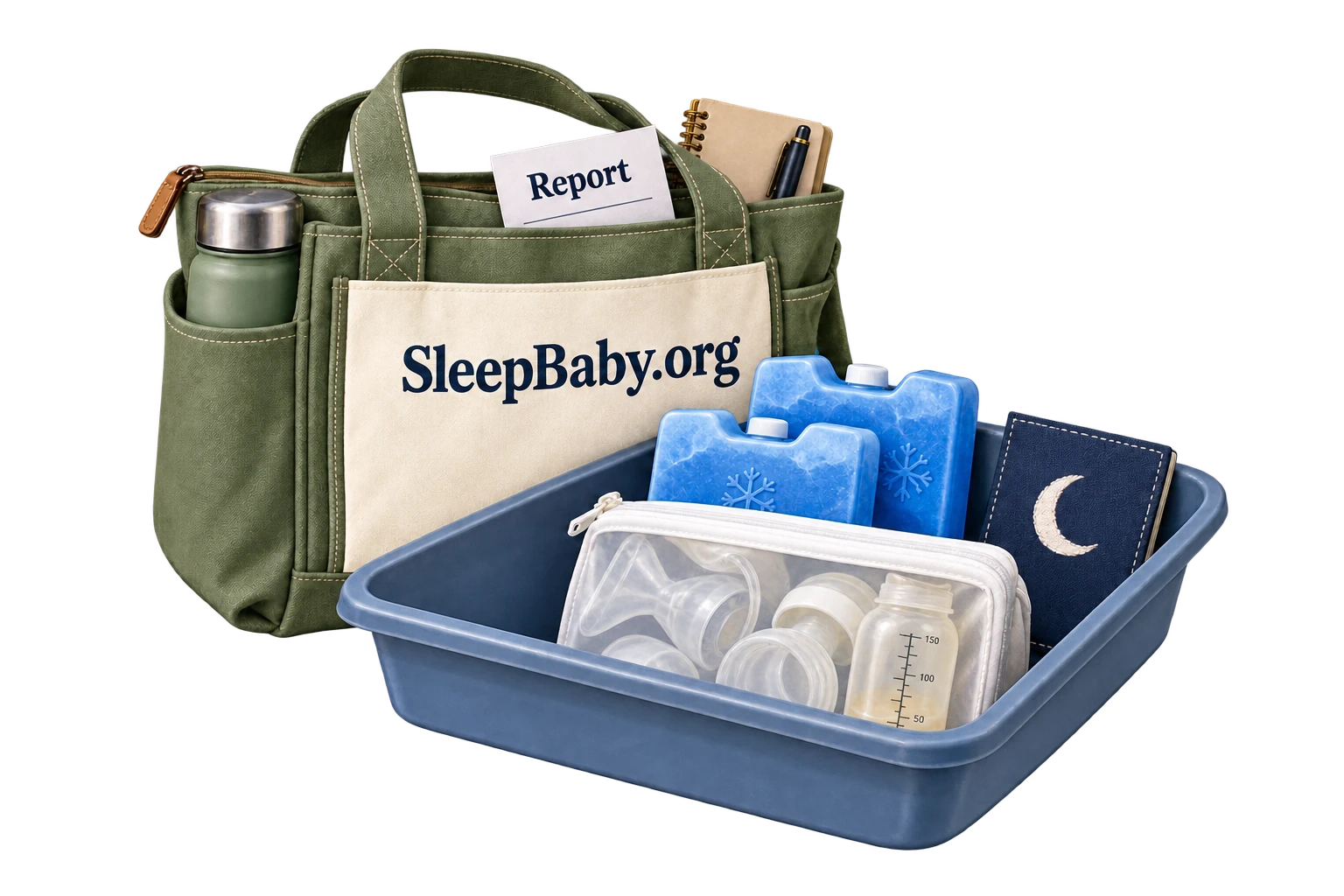
Make a pumping plan that works beyond the bag
The bag is only one part of being away from a nursing baby. Ask about the place, the timing, and how to reach the person who can help if the room is locked or a break is delayed. Explain your needs before you are uncomfortable and trying to solve everything from a hallway.
Follow the milk’s route
Confirm security rules for your pump, cooler, ice packs, liquids, and other necessary supplies. Pack the equipment you already know how to use, with the correct clean parts, containers, power supply, and any backup that fits your feeding plan. A new pump used for the first time on the reporting morning adds another unknown.
CDC guidance says pump parts should be cleaned after each use. If suitable washing access is unavailable, its planning guidance suggests bringing multiple clean sets and cleaning the used parts later at home.6 Keep clean and used parts separated and follow the pump manufacturer’s instructions. Ask about a clean preparation surface rather than assuming one will be available.
For travel, CDC says expressed milk can be kept in an insulated cooler with frozen ice packs for up to 24 hours; on arrival, use, refrigerate, or freeze it promptly.7 That is handling guidance, not a promise that any bag stays adequately cold in any conditions. Follow the storage guidance for the milk’s actual history, including whether it was previously frozen or already offered to the baby.

Only if you will transport expressed milk
A compact cooler option to compare
Already own a suitable insulated cooler and frozen packs? Start there. You do not need a special purchase to make a jury request, and a cooler adds no value if your plan does not involve transporting milk.
If you need a compact set, the Medela Breast Milk Cooler Set is one option: the manufacturer describes a cooler bag, a contoured ice pack, and four 150 mL (5 oz) bottles. Check the current listing’s contents, bottle fit, cleaning instructions, and the court’s entry rules before deciding. This recommendation does not promise compatibility with every pump or a specific safe holding time.
As an Amazon Associate, I earn from qualifying purchases. The free alternative is to use suitable equipment you already own. Follow CDC milk-storage guidance and the product’s directions.
Give the caregiver facts they can use
If your baby has an individual feeding or medical care plan, leave the current written instructions and needed supplies with a caregiver who can follow them. Explain where the original instructions are kept and whom to contact with questions. A reporting deadline is not a reason to improvise medication, change a prescribed feeding plan, or omit necessary care.
Before leaving, share what actually happened that morning: the last feed, the last sleep, the next likely need, and any care instructions specific to your baby. “The usual routine” can mean different things to two adults. A brief written handoff is easier to use than a hurried doorway explanation.
Leave this with the caregiver
Today so far: last feed, last nap and anything different from normal.
Care that stays fixed: feeding instructions, safe sleep setup and any clinician-provided plan.
If plans change: who can extend care, who can collect the baby and how to reach a backup adult.
Tell me at pickup: what the baby actually ate, when sleep happened and any concerns.
Show the caregiver the sleep space. For an infant, use the back position on a firm, flat, noninclined approved crib, bassinet, or play yard with a fitted sheet and no loose bedding or soft objects. A stroller, car seat, carrier, or sling is not the planned nap space; if the baby falls asleep there, move them to a suitable firm, noninclined sleep surface as soon as possible.8
Do not solve a short nap by having an exhausted adult sleep with the baby on a sofa or armchair. If your caregiver is unfamiliar with infant care, demonstrate the essentials and check that they can carry them out. An adult’s willingness to help and their ability to provide safe care are both worth checking.
You can share a familiar settling phrase or ordinary pre-nap sequence without demanding a perfect copy of home. If sleep is regularly difficult in group care, our daycare nap guide explains which observations help. For this day, useful information beats a promised nap total.
When you get home, respond to the day your baby had
Ask about actual feeds, naps, and mood before deciding what the evening needs. There may have been more sleep than expected, less sleep, or simply a different rhythm. Offer the usual responsive care and a familiar bedtime sequence. You do not need to compensate for an imperfect day with a new sleep method that night.
If you are worried that time with another safe caregiver will undo every bedtime habit, keep the goal smaller. Familiar cues and responsive help can continue across adults, even when the details vary. Our guide to sleep learning without formal sleep training separates gradual skills from an all-or-nothing deadline.
Keep the approved court response and any future reporting date somewhere easy to find. If service continues, update the caregiver plan with what you learned about actual hours, access, and communication. You are allowed to improve the arrangement after the first day.
The next useful step
Find the jury office on your summons and ask how to request the help your situation needs. Get clear on what happens while you wait, save the answer, and then build the feeding and care arrangements around it. You do not have to solve the entire courthouse day before making that first contact.
Sources and court guidance
Reviewed September 26, 2026. The examples below illustrate why the actual court matters; they are not a national list of exemptions. Follow the current instructions issued for your summons.
- Massachusetts: Trial Juror’s Handbook, including what not to bring.
- U.S. Courts: qualifications, exemptions and excuses; summoned for federal jury service.
- California Rule of Court 2.1008, including necessary care and hardship.
- U.S. District Court, Central District of California: requesting an excuse.
- California Rule of Court 2.1006: deferral for a breastfeeding prospective juror.
- CDC: returning to your workplace, used here for practical pumping preparation, not jury eligibility.
- CDC: breast milk storage and preparation.
- American Academy of Pediatrics: reducing sleep-related infant deaths.
- U.S. District Court for Maryland: juror videos, official source listing for the orientation.
- Medela: cooler bag and breast milk storage set, product contents and intended use.
When the paperwork is put away
Come back to the bedtime questions
For more guidance on ordinary baby sleep and the routines around it, visit SleepBaby.org. Start with the question that is actually making tonight difficult.






What viewers said10 comments · 4 replies+
Archived comments from the original Baby Sleep Miracle presentation. Not independently verified by SleepBaby.org; individual experiences vary.
Thank you so much for this video! I had no idea about the dangers of baby swings :O
Hi Mary-Ann. I have a question: Is method in any way similar to the ones recommended by Dr Bucknam, Dr. Weissbluth or Dr. Karp? We tried those but none of them help.
Hi Regina, thank you for your question. The short answer is no. The techniques I share in my guide are based on newest scientific research and this is why I have never seen any approach similar to the one I recommend.
This method really works! I tried it on my son Jesus and after just one week he went from waking up more than 5 times a night to waking up just once or twice. You are a lifesaver, Mary-Ann!
I'm truly impressed with how much information you share in your video. And all for free! I can feel that you truly care about mothers like myself, and that's hard to find these days. I have recommended your site to several of my friends already.
Mary-Ann, our child suffers from autism. Is your approach still suited?
Chloe, I made sure my method can be used with any child, even babies who are special like yours. Please note that I'm not a doctor and that I always advice to consult with your physician because nothing is more important than the safety and well-being of your love.
Hallo Mary-Ann, I'm from Germany. Do you have your guide in German?
Hello Heide, we do! Normally you should already see our video in German. If not, please contact our support so they can guide you
Thenk you for your answer, Mary-Ann!
I just completed your approach and I have to say, it worked almost too well. Yes, it took a bit of getting used to with your bedtime routine but the difference is huge. My son George used to take 1 hours to go down and now he's firmly asleep in no more than 10 minutes! You're the best!
It seems I'm the only man watching this video, lol! What you shared about the 'emotional backpack' made immediate sense to me and I can't wait to help my little girl Mila to unpack it!
Hey there, just discovered your site and this really sounds different. Just wanted to say thanks for sharing :)
For everyone who's still thinking about getting Mary-Ann's guide I want to advise you to go ahead. I wasn't sure myself but now I'm so thankful I invested in this program. It made a huge difference in our life as a family and yes, my baby girl does sleep through the night now.