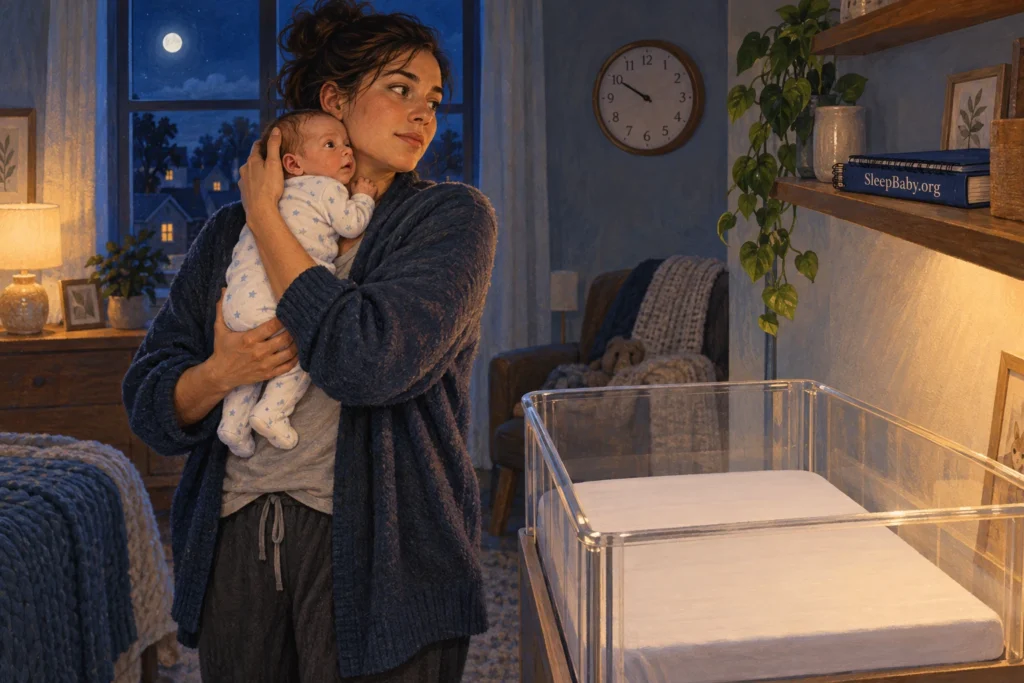
The movement is one clue, not the whole answer
When your baby stretches a lot while sleeping, start with the moment around it
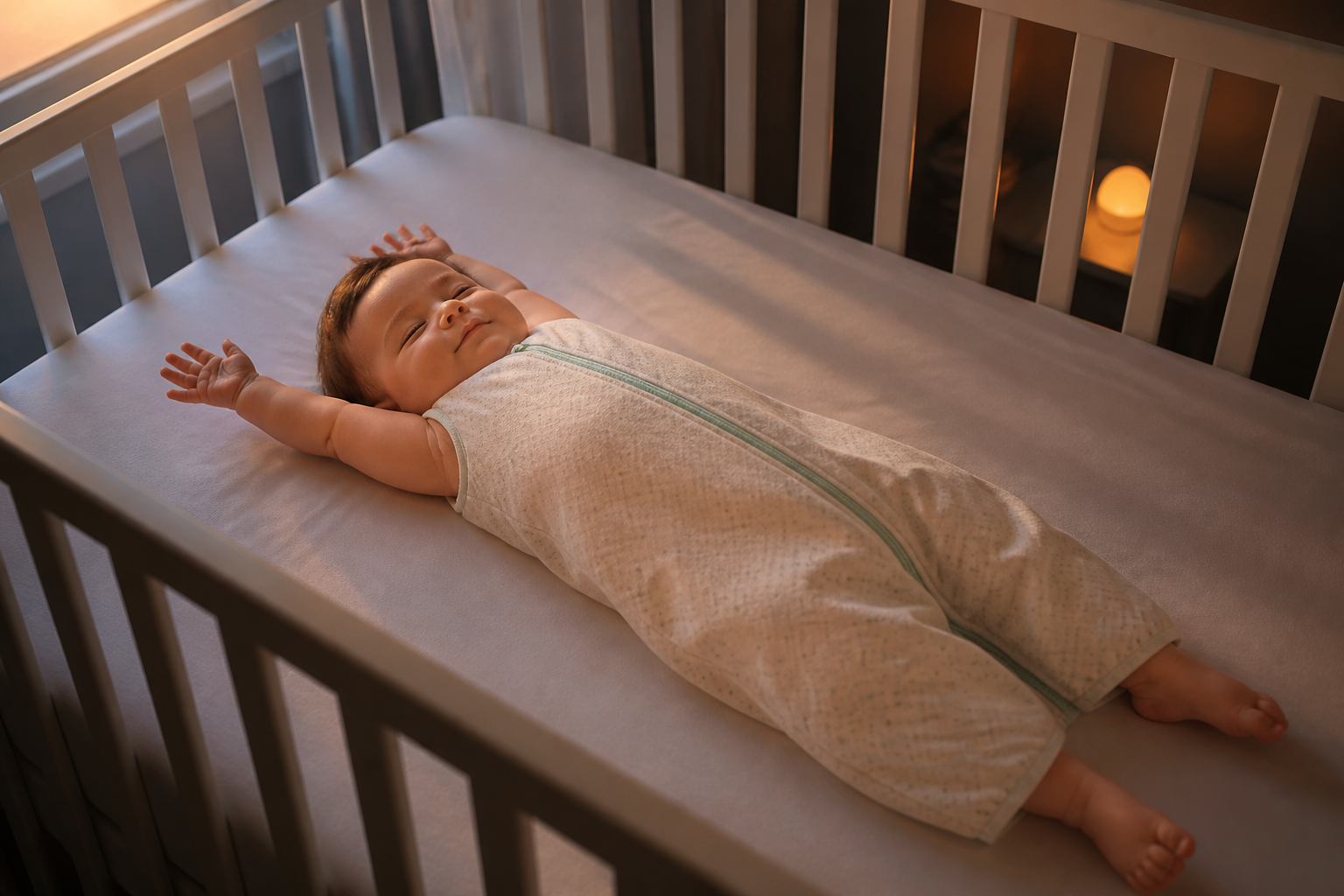
The monitor catches both arms reaching overhead, the legs lengthening, and a tiny face folding into a yawn. Then your baby goes still again. A brief, roughly even stretch while falling asleep, sleeping lightly, or waking is often ordinary. Babies are not motionless in sleep, especially in the newborn months. But a stretch alone cannot prove that sleep is deep, comfortable, restorative, or “working well.”
The useful question is not simply, “Why does my baby stretch a lot while sleeping?” It is: What state was my baby in, what shape did the movement take, was it symmetric, was the sleep scene safe, and did anything else change? Those five details help separate a familiar sleep transition from a pattern that deserves a pediatrician’s attention.
I know the private question underneath the search: Can I let my baby keep sleeping, or am I missing the first sign of something important? I would not answer that from the stretch alone. I would answer it from the pattern around the stretch.
SleepBaby.org · The original video
A little help
for the night ahead.
Take a moment to watch the original Baby Sleep Miracle presentation. Your article will be right here when you’re ready to keep reading.
Ready to get started?Take the next step with SleepBaby.
Help my baby sleepComposite Kacey-and-Benjamin scene — not a family memory and not medical evidence
The second between seeing movement and deciding what it means
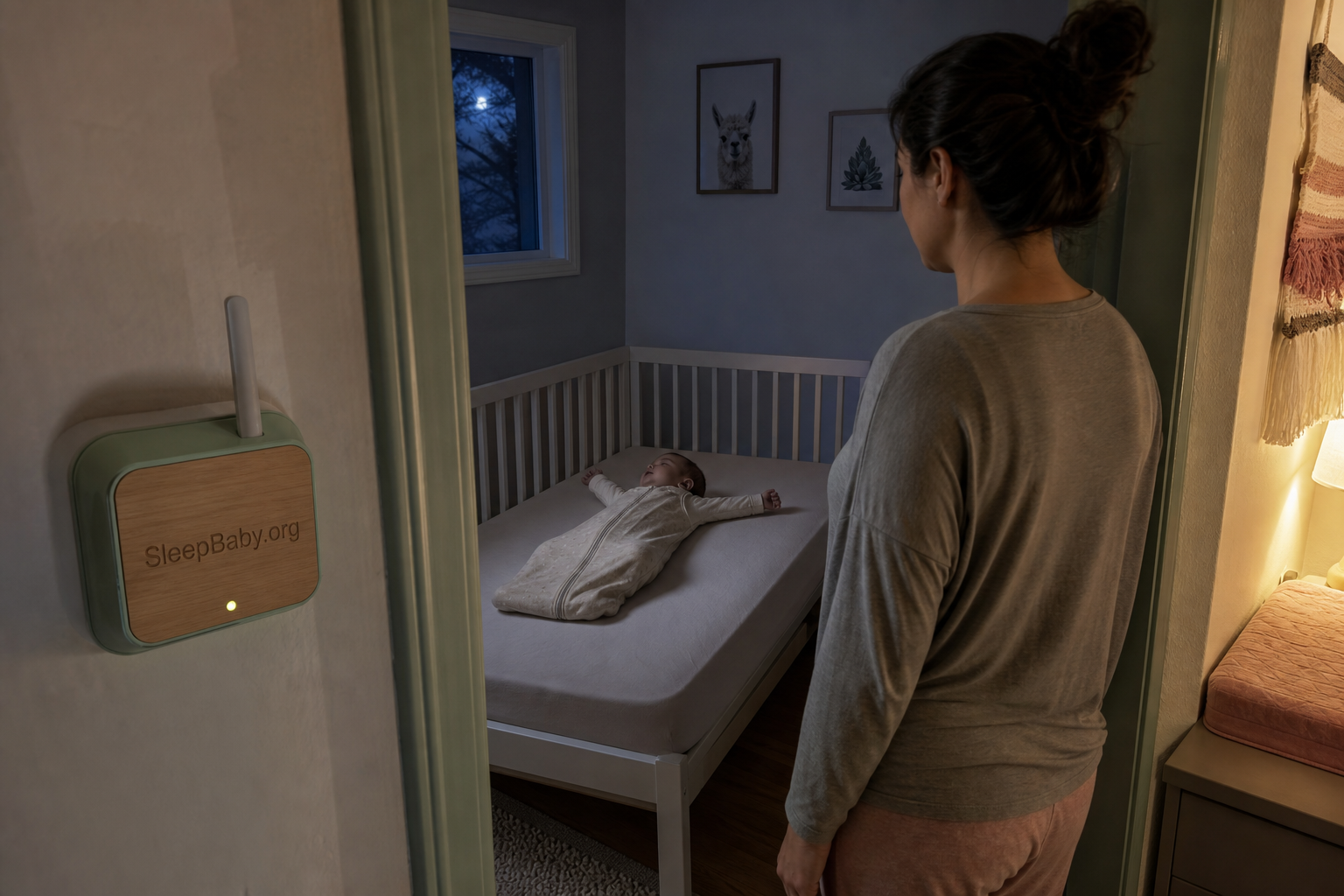
In this composite scene, I glance at the monitor and see Benjamin stretch from his fingertips to his toes. His arms drift out, his back lengthens, and for one dramatic second he looks as if he has been personally inconvenienced by the existence of pajamas. My first impulse is to go in and fix something.
Instead, I pause. Was he asleep or waking? Was it one slow extension or a series of identical movements? Did both sides move together? Is he still on a firm, flat, level, bare sleep surface? Is his breathing easy, his color usual, and his body relaxed afterward? The monitor is very good at showing me a movement. It is much less qualified to write the conclusion.
Nothing in that scene proves a diagnosis or even proves that Benjamin is comfortable. It shows the reasoning I would use: observe enough to describe the event accurately, respond to danger immediately, and resist turning one ordinary-looking stretch into a story the evidence cannot support.
What a sleeping stretch can—and cannot—tell you
Newborn sleep has lighter, more active periods. During active or REM sleep, a baby may twitch or jerk an arm or leg. While falling asleep or waking, a newborn may stretch, yawn, startle, or move between drowsy and alert states.3, 4 That is why a brief stretch that belongs to a sleep transition can be completely unsurprising.
What I would not do is promote that observation into a bigger claim. Stretching is not a home test for good sleep. It does not show that a baby moved through sleep cycles “effectively,” grew overnight, soothed themselves, had reflux, felt pain, or has a neurological problem. Those conclusions require information a monitor clip does not contain.
Age matters too. In early infancy, a sudden change in head position or sensation of falling can trigger the Moro, or startle, reflex. The arms may move outward and then return toward the body, and the reflex usually fades during early infancy.5, 6 But I would not label every wide-armed stretch “Moro” from appearance alone. I would want the baby’s age, state, possible trigger, symmetry, repetition, and behavior afterward.
The distinction is not semantic fussiness. “A stretch” can describe a slow whole-body extension, a sudden startle, a one-second sleep jerk, or repeated stiffening. Those shapes do not all belong in the same decision lane.
Three movement shapes that parents often describe with the same word
One slow stretch
The arms, legs, back, or face lengthen over a moment, often with a yawn or a shift toward waking. It ends, the body softens, and breathing and color remain usual.
What I would note: the sleep-to-wake transition, symmetry, and normal behavior afterward.
One quick irregular jerk
A hand, foot, shoulder, or limb jumps for a split second during sleep. Brief sleep-only twitches can occur, particularly soon after falling asleep.7
What I would note: whether it remains brief and sleep-linked or begins happening while fully awake.
A repeated stereotyped cluster
The same stiffening, flexion, head drop, eye movement, or body crunch repeats in a series, especially just after waking. That is not a pattern to dismiss as “just stretching.”
What I would do: seek urgent medical assessment rather than waiting for another nap to compare.
If what you are seeing is more like a sudden jump, kick, or twitch than a long extension, our guide to quick jumps and twitches during sleep answers that next, narrower question. The anchor matters because “stretch” and “jerk” can sound interchangeable in a worried search bar, but they describe different shapes.
Age changes the context, but it does not create a magic cutoff
In a newborn, active sleep occupies a large share of the night, and the edges between sleeping and waking can include yawns, stretches, starts, facial movements, and brief limb activity. The Moro reflex is also an early-infant reflex and generally fades around three to four months.5 Those facts make some early movement unsurprising; they do not create a calendar date after which every stretch becomes concerning.
An older baby may still lengthen the whole body while surfacing from sleep, just as an adult might stretch on waking. What changes my level of concern is not a birthday by itself. I care more about whether the movement is new, repeated, clearly one-sided, occurring while fully awake, paired with distress or altered responsiveness, or accompanied by a developmental change.
Frequency needs the same restraint. “A lot” can mean three visible stretches during one long waking transition, or it can mean the same stiff movement appearing in clusters after every wake. Those are not equivalent. I would note how many distinct episodes occurred, whether each one looked the same, and whether the baby returned fully to baseline between them. There is no useful universal number of normal stretches per night.
Duration is descriptive rather than diagnostic too. A slow extension lasting a few seconds and a split-second jerk have different shapes, but a stopwatch cannot tell you the cause. The pediatrician needs the movement plus the state, symmetry, repetition, recovery, and whole-baby context. If you are calling, a strong question is: “Does this pattern fit what you would expect for my baby’s age and state, and what specific change should make me seek care sooner?”

Use five frames before you touch the crib
When the baby is breathing comfortably and there is no urgent change, I use five frames to decide whether I am watching an ordinary transition or collecting information for the pediatrician. This is not an acronym to memorize at 2 a.m. It is simply the order in which the details become useful.

-
1. State: asleep, falling asleep, waking, or fully awake?
State is the first fork. A stretch as the eyes flutter open belongs to a different context than repeated stiffening during calm, fully awake play. Active sleep and the edges of waking can be visibly busy. A pattern that repeatedly appears while the baby is awake deserves a lower threshold for calling the pediatrician.
I would name the state without overclaiming it: “eyes closed and breathing regularly about ten minutes after falling asleep,” or “eyes open just after waking.” “Definitely in deep sleep” is usually more confidence than a monitor can support.
-
2. Shape: slow extension, quick jerk, or repeated copy?
Describe the movement as if the clinician cannot see the word stretch. Did the arms rise slowly? Did the knees straighten? Was there a yawn? Did one hand jump once? Did the trunk fold forward in the same way five times? A useful description has verbs, a rough duration, and a beginning and end.
I would not deliberately startle the baby, move the head, hold a limb, or recreate the event to see whether it happens again. Observation should not become a home neurological exam.
-
3. Symmetry: did both sides participate similarly?
Normal newborn reflex patterns are expected to be reasonably similar on both sides. A camera angle, a tucked sleeve, or the mattress edge can make one arm hard to see, so one imperfect clip is not a verdict. A clear, persistent pattern in which one side moves less or behaves differently is worth discussing promptly with the pediatrician.5, 6
The practical question is not “Was the stretch mathematically identical?” Babies are not synchronized swimmers. I am looking for a meaningful, repeatable difference—not demanding mirror-image choreography from a person who recently discovered fingers.
-
4. Scene: did the safe-sleep setup stay boring?
Start every infant sleep on the back on a firm, flat, level surface covered only by a fitted sheet. Keep pillows, bumpers, blankets, toys, positioners, wedges, and other loose objects out.1, 2 The baby’s movement does not create a reason to add something soft, incline the surface, pin the arms, or hold the body in one position.
I want this frame to be almost boring to report: “Back start, empty crib, fitted sheet, firm flat mattress.” Boring is excellent here. The crib does not need to solve the movement; it needs to remain a safe place for sleep.
-
5. Signals: what did the whole baby do?
Look beyond the moving limb. Did breathing remain easy? Was color usual? Did the baby settle, wake normally, feed as expected, and behave like themselves? Is there apparent pain, unusual sleepiness, a change in responsiveness, new stiffness or floppiness, or loss of a skill?
This frame often decides the lane. One stretch followed by a soft body and a normal feed is not the same event as repeated stiffening followed by poor responsiveness. The movement may be visually louder, but the whole-baby signals carry more weight.
What I would not change because of one ordinary-looking stretch
I would not rebuild the schedule, shorten a wake window, add a feed, remove a feed, change bedtime, or wake the baby repeatedly because one sleep-linked stretch looked dramatic. A movement can be noticeable without being a message about every other part of the day. If feeding, growth, comfort, or sleep duration is also a concern, assess that concern on its own evidence with the pediatrician rather than asking the stretch to explain it.
I also would not try to make the baby still. Do not tuck a loose blanket around the body, wedge a rolled towel beside the hips, tighten a swaddle past the rolling boundary, add a weighted layer, or use a positioner. Stillness is not the goal of safe infant sleep. A safe setup allows ordinary movement on a firm, flat, level, bare surface.
And I would not keep entering the room to check muscle tone or pull on an arm. Repeated handling can wake the baby, change the very state you were trying to observe, and turn a clear event into an experiment with no reliable result. If breathing, color, and responsiveness are normal and the movement ended, write down what you saw. If the pattern concerns you, call. If urgent signs are present, act.
One calm check for tonight
- Confirm easy breathing, usual color, and normal responsiveness.
- Name the movement once: slow stretch, quick jerk, or repeated cluster.
- Check whether both sides looked reasonably similar.
- Confirm the back start and the firm, flat, level, bare sleep space.
- Let an ended, ordinary-looking event end. Record a repeatable concern; do not manufacture another test.
This is the part I find most protective for a worried parent: you do not need to choose between ignoring the baby and analyzing every pixel. You can make one accurate observation, keep the safety floor steady, and use a clear threshold for the next action.

Three lanes: watch, call, or act now
I would rather give you a usable boundary than repeat “babies move in their sleep” until it sounds comforting. The following lanes do not diagnose the event. They tell you what level of response fits the information you have.
Usually reasonable to watch
- One brief, yawn-like extension while falling asleep or waking.
- A brief irregular sleep-only twitch that stops on its own.
- Roughly symmetric movement followed by a relaxed body and normal waking behavior.
- Usual breathing, color, responsiveness, comfort, feeding, and development.
Watching does not mean staring at the monitor until dawn and assigning emotional significance to every sock movement. It means noticing whether the pattern ends, belongs to sleep, and leaves the whole baby unchanged.
Call the pediatrician promptly
- The movement repeatedly happens while the baby is fully awake.
- One side consistently moves less or the pattern is clearly asymmetric.
- The baby seems unusually stiff or floppy outside the isolated sleep event.
- Episodes are becoming longer, more frequent, or identical each time.
- There is apparent pain, poor feeding, unusual sleepiness, a developmental change, or a meaningful change from baseline.
If the office asks what happened, the five frames give you a cleaner report than “a lot of weird stretching.” State the state, shape, side-to-side pattern, sleep scene, and whole-baby signals.
Seek urgent or emergency help
- Breathing is difficult, color turns blue or gray, or the baby cannot be awakened normally.
- Sudden stiffening, flexion, head drops, eye deviation, or body crunches repeat in a cluster, especially just after waking.
- A suspected seizure continues, repeats without recovery, or the baby does not return to baseline.
Infantile spasms are uncommon, but they can be subtle and often occur in clusters after waking rather than during ordinary sleep.8 This is the point to seek medical assessment now, not to wait for a clearer video or compare another nap.
Keep the sleep scene steady while the baby moves
A stretching baby can look as if they need more support, softer bedding, or help staying in place. That visual instinct is understandable and often points in the wrong direction. Normal movement does not make a pillow, rolled blanket, bumper, wedge, incline, positioner, weighted product, or restraint safer.
Begin every sleep on the back. Use a firm, flat, level infant sleep surface with only a fitted sheet, and keep the space bare. If a baby can roll independently both ways, continue placing them down on the back; after that back start, they may be left in the position they reach on their own while the sleep space stays empty.2
If your baby is swaddled, stretching itself is not the only decision point. Stop swaddling when the baby shows signs of trying to roll. Do not use weighted swaddles or weighted sleep clothing.1 An arms-free, correctly sized, unweighted wearable blanket can be one warmth option, but it does not treat movement or repair an unsafe surface.
If the pattern repeats, bring a clean description—not a diagnosis
A short factual note can help the pediatrician more than a page of guesses. I would record the date and approximate time, whether the baby was asleep or had just awakened, what moved, how long it lasted, whether both sides looked similar, and what breathing, color, responsiveness, feeding, and behavior were like afterward.
A useful one-event note
- State: “Eyes opened about 30 seconds before the movement.”
- Shape: “Both arms rose slowly once; legs straightened; about three seconds.”
- Symmetry: “Both sides appeared similar,” or “left arm stayed still in three separate events.”
- Scene: “Back start in an empty crib on a firm, flat mattress.”
- Signals: “Breathing and color stayed usual; fed normally afterward,” plus any change that did occur.
If it is safe and does not delay care, a short video of a concerning event can help a clinician see what words flatten.8 Do not hold the baby in place, provoke the movement, or prioritize the camera over responding. If urgent signs appear, put the phone down and get help.
I also would not count every overnight wiggle. The goal is to notice a repeatable pattern, not create a second job whose manager is the baby monitor. One clean description can be useful. Forty timestamps with no meaningful difference usually add volume rather than clarity.
As an Amazon Associate, SleepBaby may earn from qualifying purchases.
Optional warmth support for this exact situation
An arms-free way to keep warmth in the sleep plan
For a baby who naturally reaches, lengthens, and changes position during sleep, I would choose an unweighted, sleeveless wearable blanket over a swaddle, weighted product, positioner, or loose blanket. The Burt’s Bees Baby Solid Organic Lightweight Beekeeper™ Wearable Baby Blanket is a specific fit for that job: the manufacturer describes a 0.5 TOG cotton design with the arms free, room for movement when the correct size is chosen, and a two-way zipper for diaper access.
That combination is the reason to consider it. It provides wearable warmth without pinning the arms or adding loose bedding, while the lightweight construction is more situation-specific than a generic basket of “sleep essentials.” Choose the size from your baby’s current measurements and the manufacturer’s chart. This product does not treat stretching, prevent SIDS, guarantee longer sleep, or make an unsafe sleep surface safe.
Helpful Amazon finds for this topic
These optional shopping links are separate from the guidance above and are not medical advice or a substitute for professional care.
As an Amazon Associate, SleepBaby.org may earn from qualifying purchases.
What changes when the monitor lights up again
Return to that opening picture: arms overhead, legs long, face briefly scrunched, then stillness. The movement itself has not become a guarantee. What has changed is the question you bring to it.
I would look for the state, the shape, the symmetry, the scene, and the signals. One slow, roughly even stretch at the edge of waking, followed by easy breathing and ordinary behavior, can remain exactly what it appears to be: a baby moving through a moment. A repeated cluster after waking, a consistent one-sided pattern, or a change in breathing, color, responsiveness, feeding, comfort, or development moves the decision elsewhere.
In the composite scene, I do not need to rush into Benjamin’s room and stop his body from being a body. I need to know what I saw, keep his sleep space safe, and respond to the whole pattern. That is the quieter kind of confidence I want for you—not certainty from one stretch, but a clear way to decide what comes next.
Sources
- American Academy of Pediatrics: Evidence Base for 2022 Updated Recommendations for a Safe Infant Sleeping Environment
- NICHD Safe to Sleep: Ways to Reduce Baby’s Risk
- HealthyChildren.org: States of Consciousness in Newborns
- HealthyChildren.org: Stages of Newborn Sleep
- MedlinePlus: Moro reflex
- HealthyChildren.org: Newborn Reflexes
- Seattle Children’s: Newborn Reflexes and Behavior
- HealthyChildren.org: Infantile Spasms—What Parents Need to Know
- NICHD Safe to Sleep: Clear the Crib video resources
- Burt’s Bees Baby: Solid Organic Lightweight Beekeeper Wearable Baby Blanket
SleepBaby.org · The original video
A next step for
the next bedtime.
Still thinking about sleep? Watch the presentation here, then explore the SleepBaby program whenever you’re ready.
Ready to get started?Take the next step with SleepBaby.
Help my baby sleep