Yes—if your baby is already sleeping in a separate room, a fully closed (never locked) bedroom door is generally the better fire-safety choice. A closed door can slow the movement of heat, smoke, and toxic gases. But the door is only one layer: the nursery still needs working smoke-alarm coverage, a bare safe-sleep space, quick adult access, sensible airflow, and a way for you to hear what you need to hear. If your baby is younger than about six months, the American Academy of Pediatrics’ room-sharing recommendation comes first: keep baby on a separate sleep surface in your room rather than moving them early simply to solve the door question.
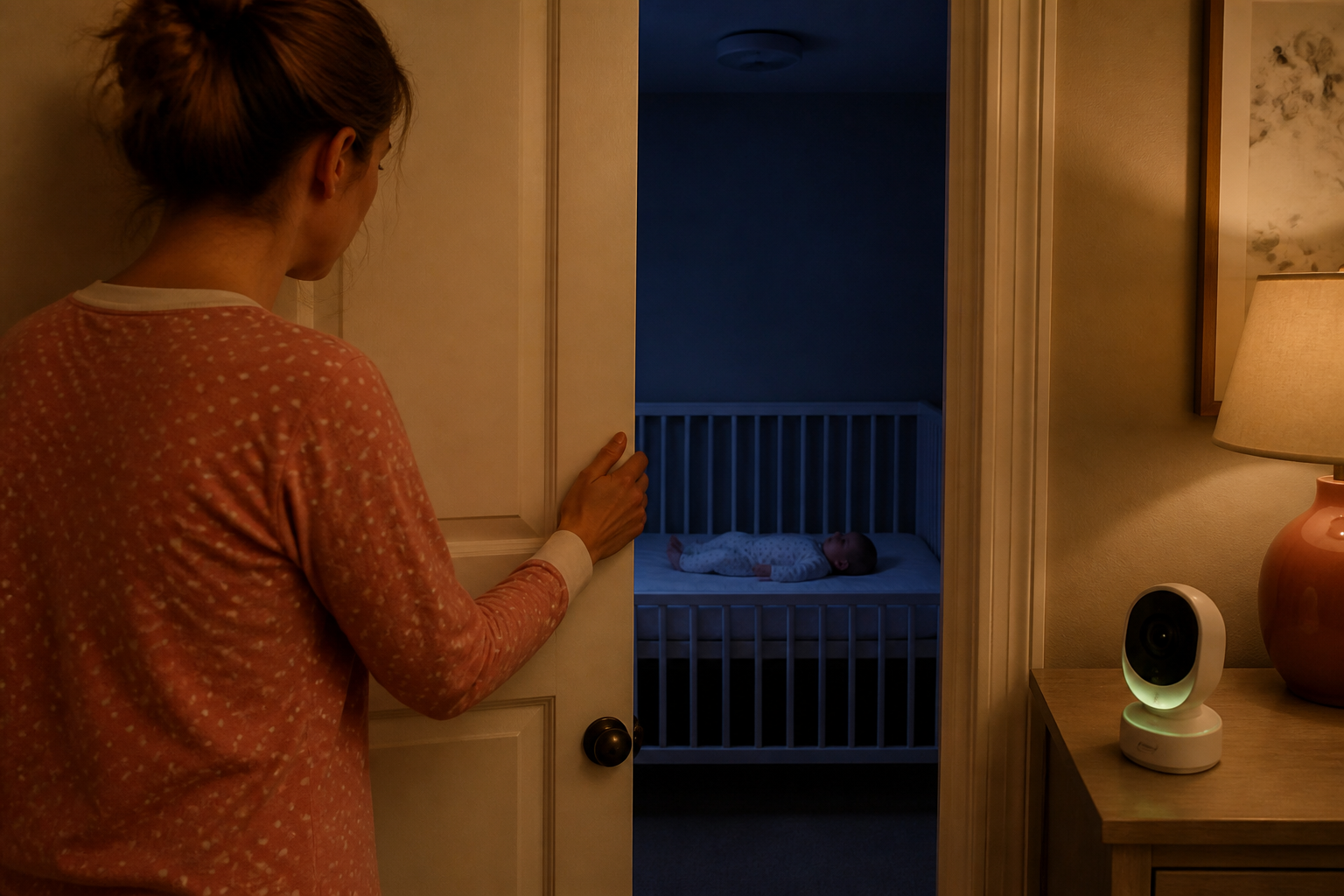
The tiny witness is the latch. It clicks, the hallway gets quieter, and suddenly a piece of hardware feels like a referendum on whether you are close enough to your baby. I want to make that click mean something calmer: the door is a barrier, not a goodbye.
I know why this question refuses to stay practical. You are not only asking whether the nursery should be open or closed. You are asking, Will I still hear her? What if he needs me? What if the room gets hot? What if the alarm sounds and I am one door farther away? I hear the private question underneath all of them: Does closing the door make me less available?
It does not have to. A thoughtfully closed door can add fire protection while your alarms, monitor, room setup, and bedtime checks keep you connected. The goal is not to choose between protection and presence. The goal is to give each tool one honest job.

First decide where your baby should sleep
Before we decide what to do with a nursery door, we have to decide whether the nursery is the right sleep location tonight. The AAP recommends room sharing without bed sharing for at least the first six months. That means baby sleeps near you, but on a separate, firm, flat sleep surface designed for infants—not in the adult bed.
If that is your current setup, close your bedroom door at night and keep baby’s bassinet or crib in the room with you. There is no need to move a young baby into a separate room just so you can follow closed-door guidance. If you are deciding when the separate nursery becomes appropriate, this guide to when to move a baby out of your bedroom will help you make that transition without turning one date on the calendar into a deadline.
If your baby is already sleeping in a separate nursery—whether because they are older, your pediatrician has helped you make an individualized plan, or your household circumstances require it—then the closed-door question is real. My answer is to close it fully, leave it unlocked, and complete the rest of the setup below.
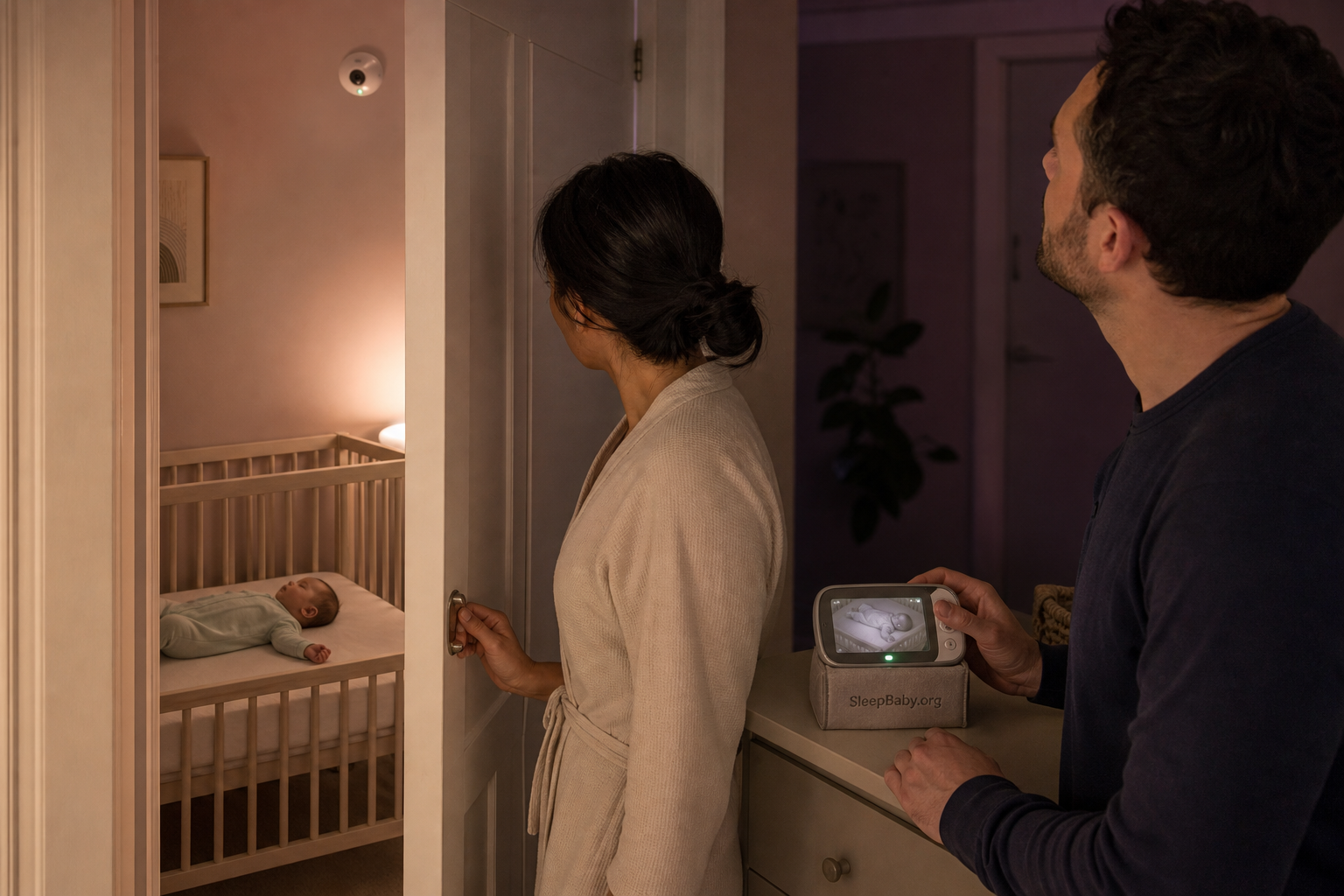
Why a closed bedroom door matters in a fire
A bedroom door is not decorative during a fire. Fire Safety Research Institute testing shows that a closed door can make a dramatic difference by limiting how quickly heat, smoke, and toxic gases enter a sleeping room. That buys a layer of separation while alarms alert the household and adults follow the escape plan.
This corrects one of the most misleading instincts in the old version of this advice: that an open door is automatically safer because you can reach the baby faster. In an ordinary bedtime check, an open doorway may save a second. In a fire, however, the open doorway also removes a barrier. The useful comparison is not “open means close to baby; closed means far away.” It is “closed and immediately openable by an adult” versus “open to the hallway air and smoke.”
I also do not want to oversell the door. It cannot detect smoke, wake you, call for help, or plan an exit. It does one physical job: it separates spaces. That job becomes meaningful only when the rest of your system works.
Never lock a baby’s bedroom door. Do not use any latch, knob cover, gate, or childproofing setup that can delay an adult opening the door from the hallway. If an older toddler wanders, choose a strategy that preserves immediate adult access and review it with your pediatrician or local fire-safety professional.
Kacey’s Five Quiet Checks
What to check before the latch clicks
I use five nouns because bedtime is not the hour for a twelve-step inspection. You can walk these in under a minute once the setup is established.
Door: closed, unlocked, and boring
The best nursery door is gloriously uninteresting. It closes all the way. It is not propped with a wedge, blanket, stuffed animal, or cord. It does not have an interior lock that can trap a child or slow an adult. The path to it is clear at night, and every regular caregiver knows how its childproofing hardware works.
If the latch is loud enough to wake your baby, repair the hardware rather than leaving the door open by default. Tighten a loose strike plate, ask a qualified person to align the latch, or use a quiet door-closing routine while baby is awake. Do not tape over fire-rated hardware or modify a door in a way that prevents it from closing properly. The practical goal is a door that shuts completely without a nightly percussion solo.
If your family uses a humidifier, white-noise machine, fan, or monitor in the room, route every cord so it remains well beyond the child’s reach as the crib and child change. “He cannot reach it yet” is a temporary fact. The door decision does not cancel ordinary strangulation and electrical-safety checks.

Alarm: the closed door needs a voice
A closed door can slow smoke, but it can also muffle sound. That is why your smoke-alarm plan has to be concrete, not implied. Fire-safety guidance calls for working smoke alarms protecting sleeping areas and on every level of the home. Interconnected alarms add an important advantage: when one detects smoke, all of them sound.
For a nursery behind a closed door, ask a simple question from your actual sleeping position: What will wake the adults if smoke begins in or near that room? Some local fire departments recommend an alarm in the baby’s room as well as outside sleeping areas, paired with a monitor that lets adults hear the room alarm. Building codes and alarm placement requirements vary, so use your local fire department or fire marshal—not a parenting comment thread—as the authority for your home.
I would rather you discover a weak alarm, dead battery, quiet monitor setting, or confusing escape route during a planned check than at 2:00 a.m. with adrenaline making every hallway look unfamiliar. Test the system according to the alarm manufacturer’s instructions. Include the baby in the household escape plan. Decide which adult is responsible for the baby when it is safe to act, where everyone meets outside, and how emergency services are contacted. A closed door buys a layer; a practiced plan turns that layer into action.
| What you notice | What it means | What to do before bedtime |
|---|---|---|
| You cannot hear the nursery alarm from your bed | The door barrier is working acoustically too well for your current alert plan | Ask your fire department or qualified alarm professional about correct placement and interconnected alarms; test any monitor’s audio alert from bed |
| The door will not latch fully | You do not have a reliable closed barrier | Repair or adjust the door so it closes normally; do not improvise with tape, wedges, or furniture |
| A childproof cover slows you down | The hardware is solving the wrong problem | Remove or replace it with a setup that preserves immediate adult access |
| Your escape plan is “we’ll figure it out” | The most important handoff is undefined | Assign roles, choose an outside meeting place, and practice with the whole household |
Watch the barrier do its job
This short Fire Safety Research Institute demonstration is useful because the door question is spatial. The point becomes clearer when you can see how an open and closed bedroom separate from the same fire conditions.
Takeaway for this nursery: close the door, then back the barrier with working alarms, a practiced escape plan, and immediate adult access. The video proves the door’s job; it does not make the rest of the system optional.
Room: safe sleep does not change behind a closed door
The door can be perfectly managed while the sleep space is not. I want the hierarchy to stay clear: every sleep still starts with baby on their back, on a firm, flat, non-inclined surface designed for infant sleep. The crib, bassinet, or play yard stays empty—no pillow, loose blanket, bumper, positioner, stuffed animal, or weighted sleep product.
A camera angle can create false reassurance here. A monitor may show that your baby is still, but it cannot certify that the mattress is appropriate, that a product is safe, or that the room-sharing recommendation has been met. Consumer monitors are not proven to reduce the risk of SIDS. If you use one, use it because it helps you hear or see the nursery—not because an app, dashboard, oxygen number, or alert promises to make an unsafe sleep space safe.
Keep the crib away from reachable cords, blind strings, curtains, unstable furniture, and anything the child could pull into the sleep space. Recheck the radius as your baby learns to roll, sit, stand, and reach. The safest closed-door nursery is not a sealed gadget room. It is a simple sleep space with fewer things to go wrong.
Air: check the room you actually have
The old version of this article made a closed door sound as though it automatically maintains an ideal temperature. Some rooms do stay more stable with the door closed. Others become warmer or cooler because of HVAC design, sun exposure, vent placement, weather, or a return-air path. Your nursery does not owe the internet a universal number.
Check the room under normal overnight conditions with the door closed. Make sure supply and return vents are unobstructed. Dress baby in sleep clothing appropriate for the room, generally no more than one layer more than an adult would wear comfortably, and watch for signs of overheating such as sweating, a hot chest, or flushed skin. Do not judge comfort by cold hands and feet alone.
If the room repeatedly becomes hot, stuffy, unusually cold, or noticeably different from the rest of the home, do not solve a building problem by permanently defeating the door barrier. Ask a qualified HVAC professional to assess airflow and balance. If your baby seems ill, is breathing unusually, or is difficult to wake, that is not an airflow troubleshooting project—seek medical care.
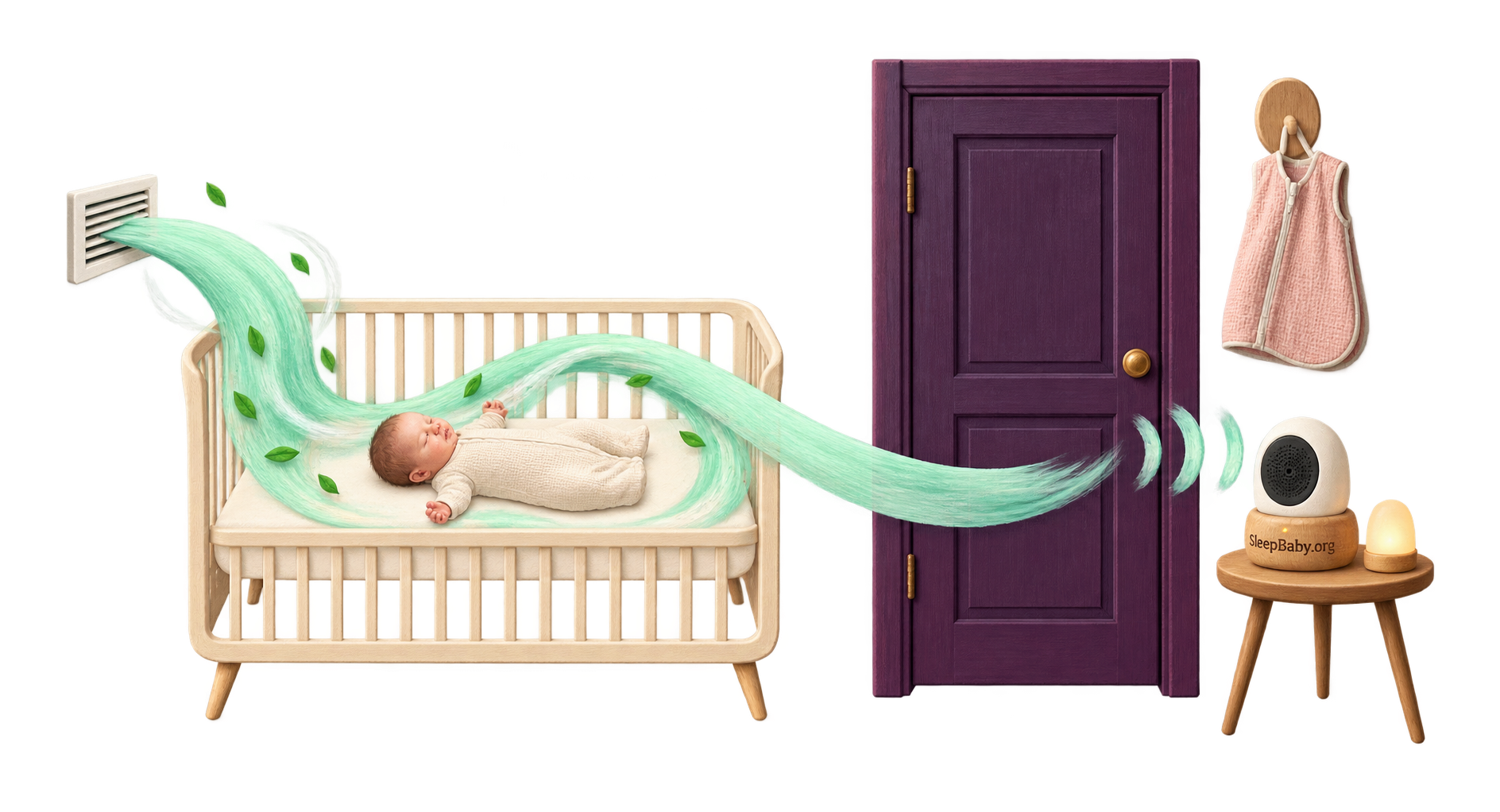
Monitor: connection without pretending it is protection
A baby monitor can answer the practical fear that arrives with a closed door: “Will I hear my baby?” It can carry cries, ordinary wake-ups, and—when configured and positioned appropriately—the sound of a room alarm. A video monitor can also let you check whether your child is standing, awake, or quietly resettling without opening the door and adding light or hallway noise.
But I want a bright line around what the monitor cannot do. It is not a smoke alarm. It does not guarantee a signal. It does not replace an adult checking an unusual sound, a child who seems sick, or an alarm. It does not prevent SIDS. Wi-Fi, dedicated-parent-unit, audio-only, and wearable systems each have failure points: dead batteries, volume settings, network interruption, range, camera obstruction, or a device accidentally left in another room.
Test yours from the place you actually sleep. Confirm that the volume and visual indicators are noticeable in your normal nighttime environment. Keep the camera, base, and every cord far beyond the child’s reach. Then let the monitor be what it is: a useful line of awareness through a closed door, not a medical promise or fire-safety system.
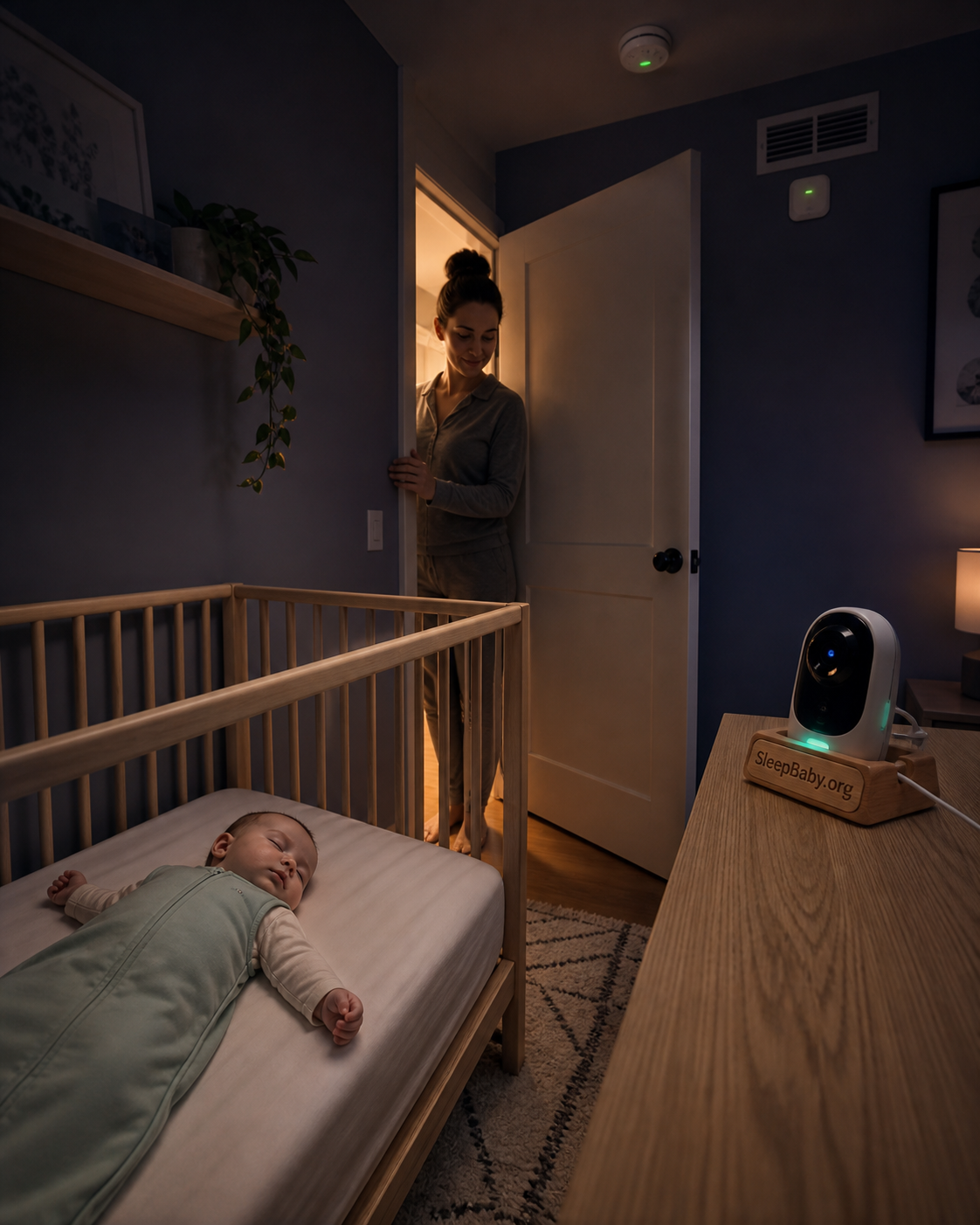
If your baby cries when the door closes
Sometimes the problem is not safety equipment at all. The latch itself has become a cue: parent leaves, hallway disappears, protest begins. I would not turn this into a showdown or leave the door open forever after one hard night. I would make the cue smaller and more predictable.
- Practice while everyone is calm. During the day, close and open the door briefly while you remain visible and cheerful. The goal is familiarity, not training through distress.
- Build the close into the same sequence. Diaper, pajamas, feeding as appropriate, book or song, crib, short goodnight phrase, door. Predictability matters more than a perfect minute.
- Close it fully once you leave. A door resting open by two inches is neither a reliable fire barrier nor a clear bedtime cue.
- Respond according to your family’s sleep approach. Closing the door does not require ignoring your baby. You can go back in, soothe, feed, or check as needed, then close it again when you leave.
- Fix the noise if the hardware is the trigger. A startling latch or squeaky hinge is a maintenance problem, not evidence that the door should remain open.
If an older child can open the door and wander, the plan becomes more individualized. Avoid locking the child in. Consider the room layout, stairs, exits, developmental needs, and how quickly an adult can reach the child. A pediatrician, occupational therapist, or local fire-safety professional may be helpful when elopement, disability, or severe sleep disruption changes the ordinary advice.
What about pets, siblings, and household noise?
A closed door can help keep pets out of the nursery and reduce light or household noise. Those are useful side benefits, not the main safety argument. Do not rely on the door alone if a pet can push it open; make sure it latches normally. Never place a pet gate, heavy furniture, or storage item where it blocks adult access to the nursery.
If a baby and older child share a room, both children need an escape plan appropriate to their ages, and the adult retrieval plan has to be explicit. The crib still stays out of reach of toys, bedding, cords, and furniture the older child can move. These safe baby-and-toddler room-sharing ideas can help you think through zones and routines before the door closes.
Noise is the gentlest part of this decision. A closed door may soften television, dishes, siblings, or hallway conversation. If you use white noise, keep the machine outside the crib and follow its instructions. More sound is not automatically better. The aim is a repeatable sleep cue, not an acoustic wall that hides alarms or the baby from you.
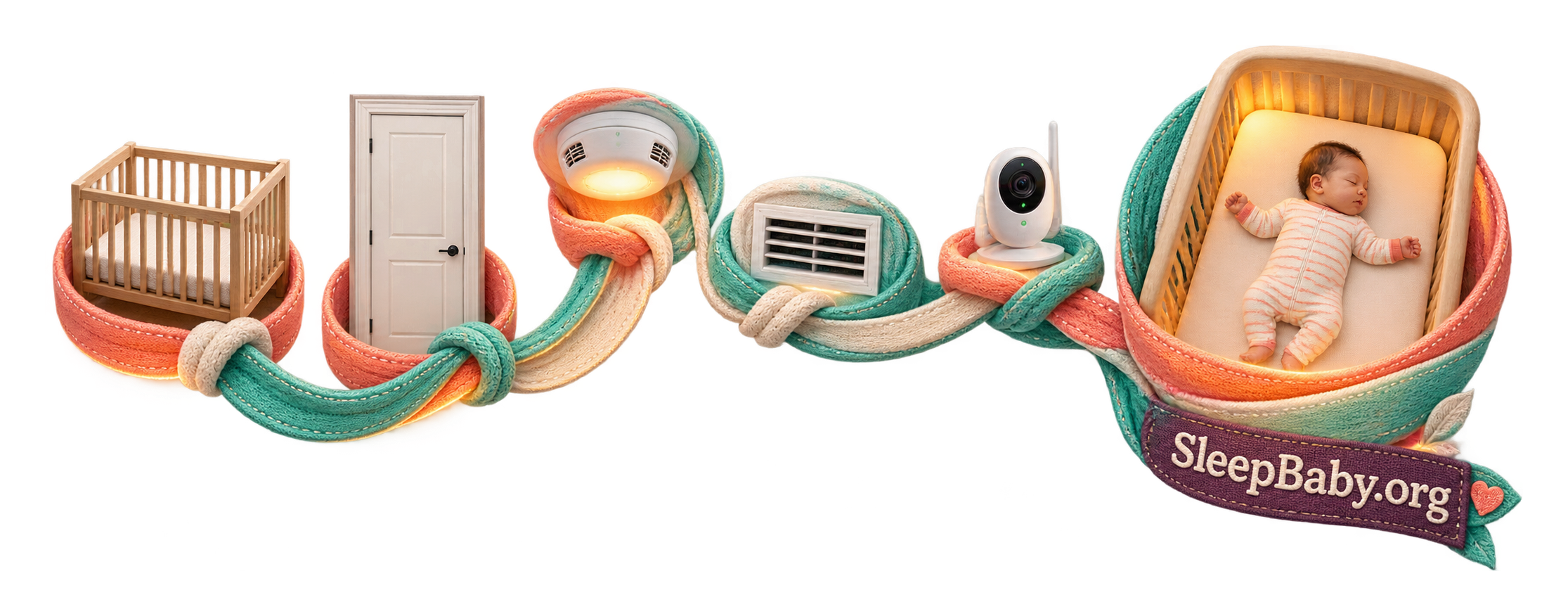
A worked bedtime: from open-door worry to a complete setup
Let me make this ordinary, because ordinary is where good safety habits survive. It is 7:35 p.m. Your eight-month-old has finished feeding. You place them on their back in the crib wearing appropriate sleep clothing. The mattress is firm and flat; the crib is empty. The monitor camera and cord are outside reach.
You check that the nursery feels comfortable with the door in its normal closed position and that the vent is clear. The smoke alarms are in their established, tested locations. The adult who is responsible for the baby in the escape plan is home and knows the route. The monitor parent unit is charged, audible, and beside your bed—not under a pillow or muted in another room.
You say the familiar goodnight phrase and pull the door until the latch engages. Your baby protests for thirty seconds. You listen, look at the monitor if that is part of your routine, and decide whether a check is needed. If you go back in, you open the door normally, care for your baby, leave, and close it again. The door does not dictate your response. It simply returns to its one job each time you leave.
At your own bedtime, you do not start the whole inspection over. You notice the alarm indicator, confirm the monitor is where it belongs, and walk the clear hallway once. That is the Five Quiet Checks doing what a good tool should do: reducing mental noise without pretending to control every possibility.
When the answer changes
Your baby is under six months
Prioritize the AAP room-sharing recommendation unless your pediatrician has helped you make a different plan. Close the bedroom door of the room you and baby share.
The nursery has no reliable alarm coverage
Do not treat an open door as the repair. Ask your local fire department or qualified alarm professional how to establish appropriate detection and notification.
The room overheats with the door closed
Adjust clothing appropriately and get the airflow or HVAC problem assessed. A persistent room-comfort defect deserves a building solution.
You cannot open the door instantly
Remove the lock or obstructive childproofing. The correct closed-door setup always preserves fast adult access.
Questions parents ask after they close the door
Should I leave the door cracked?
No, not as the normal nighttime setup. A fully closed door provides the intended barrier. A crack also creates an ambiguous bedtime cue and can allow more hallway light and noise into the room. Repair the reason you feel you need the crack—alarm audibility, monitor setup, airflow, or your own reassurance—rather than asking two inches of open doorway to solve it.
Can I lock the nursery door?
No. The door should be closed but immediately openable by an adult. A lock can delay access during a fire, medical emergency, or ordinary nighttime need. If wandering is the concern, get individualized childproofing guidance that accounts for your home and child.
Will I hear my baby?
Often yes, but houses, doors, distances, sleep depth, fans, and hearing differ. Do not guess. Test from your bed using the monitor and settings you will actually use. Remember that hearing ordinary cries and hearing a room smoke alarm are related but different checks.
Does a monitor make a separate room safe earlier?
No. A camera does not replace the AAP recommendation to room-share for at least the first six months, and it does not reduce SIDS risk. Use age, development, household realities, and pediatric guidance to decide where baby sleeps.
Should the nursery window be open?
A window decision depends on fall prevention, security, outdoor temperature, air quality, screens, and the room’s ventilation. It is not a substitute for appropriate HVAC or smoke alarms. If the window creates any access or fall hazard, secure it according to child-safety guidance.
What if I feel more anxious after closing it?
Walk the Five Quiet Checks once, test the monitor and alarms on a planned schedule, and resist repeated checking that does not change the setup. If anxiety is making sleep impossible, driving compulsive checks, or feeling larger than this one decision, tell your healthcare professional. You deserve support too.
When to call someone instead of adjusting the door
- Call emergency services for a sounding alarm, visible smoke or fire, or an immediate breathing or responsiveness emergency. Follow your escape plan; do not troubleshoot a monitor first.
- Call your pediatrician for persistent noisy or difficult breathing, blue or gray color, unusual difficulty waking, feeding problems, illness concerns, or questions about when your baby should move to a separate room.
- Call your local fire department or alarm professional when you are unsure about alarm placement, interconnection, audibility, or escape planning in your specific home.
- Call a qualified HVAC professional when the nursery repeatedly becomes unusually hot, cold, or stuffy with the door closed.
The most reassuring answer is not “nothing bad can happen.” No door, monitor, alarm, or parenting routine can make that promise. The reassuring answer is that the decision can be specific. You can know what the door does, what it does not do, and which other layers complete the plan.
So when the latch clicks tonight, I hope you hear it differently. Not as distance. Not as neglect. Not as a test of whether you are attentive enough. Hear one quiet layer moving into place: baby in the right room for their age and plan, safe sleep space ready, door closed and unlocked, alarms able to wake the adults, air checked, monitor honestly assigned its small useful job.
Sources
- Fire Safety Research Institute: Close Before You Doze
- American Academy of Pediatrics / HealthyChildren.org: How to Keep Your Sleeping Baby Safe
- Montgomery County Fire and Rescue Service: Fire Safety for Babies and Toddlers
- U.S. Consumer Product Safety Commission: Childproofing Your Home
- Fire Safety Research Institute: Close Before You Doze – Dramatic Difference Video
- Infant Optics: documented DXR-8 PRO features
Your next sleep starts at the threshold
Build the room behind the closed door
You have the five checks. Now use SleepBaby’s practical guides to make the crib, routine, room transition, and next wake-up feel like parts of one plan—not five separate worries.