A scheduled sleep study is not emergency monitoring. If your baby is struggling for each breath, has stopped breathing, has blue or gray lips or a blue or gray face, is unusually unresponsive, or you believe the situation is life-threatening, call 911 in the United States. Elsewhere, use your local emergency number. Do not wait for the appointment, try to capture a better video, or keep reading to see whether the symptoms fit a list. 7
An infant younger than 1 year with trouble breathing, ribs pulling in with each breath, stridor, or loud wheezing needs urgent emergency evaluation under your local plan. Faster-than-usual breathing, milder wheezing, a very sick appearance, or a change that worries you still deserves prompt medical contact. These examples help you choose a door; they do not diagnose the cause. 7
The American Academy of Pediatrics also advises emergency help when a child’s breathing stops for more than 20 seconds, color turns pale, blue, or gray, or an event comes with a change in muscle tone or illness. But a blue, gray, limp, unresponsive, or struggling baby is not a stopwatch exercise. Call. 6
If your baby is stable and the study is scheduled, the rest of this guide will walk you through the ordinary process: what the test records, what to confirm with the laboratory, what the setup may feel like, what happens if the night is messy, and why the answer usually comes later rather than at breakfast.
FIRST, CHOOSE THE RIGHT DOOR
Match the situation to the right action
- Emergency now
- severe breathing struggle, stopped breathing, blue or gray color, unusual unresponsiveness, or any life-threatening concern. Call emergency services. 7
- Call promptly
- faster or noisier breathing, a baby who looks very sick, a sharp change from baseline, or a concern you believe needs same-day guidance. Contact the baby’s clinician or seek urgent care under the baby’s local plan. 7
- Keep preparing for the study
- your baby is currently stable, the sleep team has arranged testing, and you are trying to understand the night ahead. Confirm the laboratory’s instructions rather than changing the baby’s care on your own.
That order matters. A sleep study is designed to collect diagnostic information during a planned recording. It is not a safety net for an acute event happening at home tonight.
What “sleep study” usually means in this guide
For most families arriving at this page, the useful starting picture is an attended overnight pediatric polysomnogram, often shortened to PSG. Unless the order says something different, the baby spends the night in a sleep laboratory while a trained technologist applies sensors, watches the signal quality, documents events, and helps keep the recording usable. A sleep-trained clinician interprets the collected information later. 1
Polysomnography brings several streams of information together. Depending on the order and laboratory, those streams may include sleep-stage patterns, eye and muscle movement, heart rhythm, airflow, breathing effort, oxygen, carbon dioxide, body position, sound, and video. The exact arrangement is tailored to the baby’s age, medical needs, referral question, and the center’s protocol. 1 9
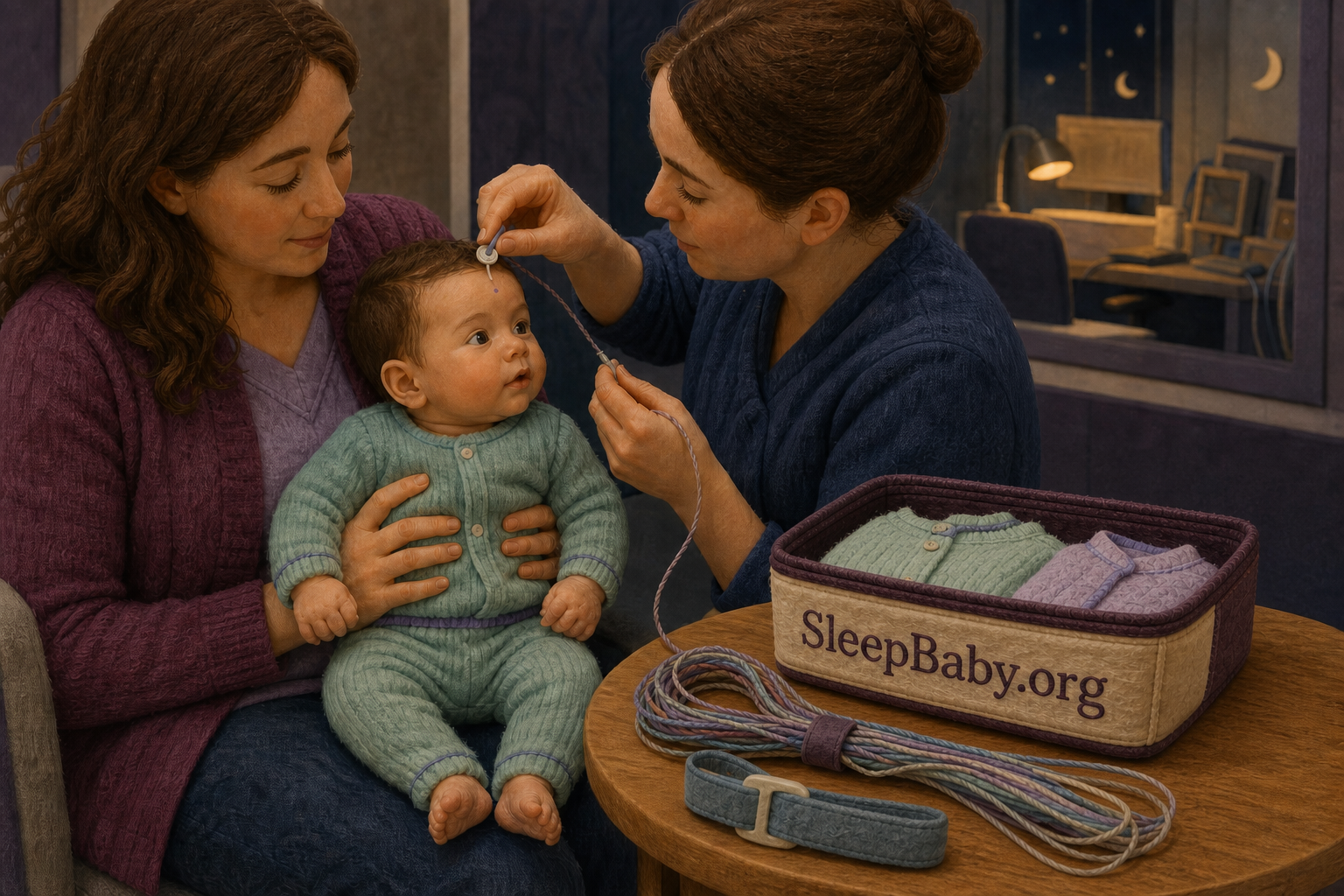
The sensors are passive recorders. They do not send electricity into the baby, draw blood, or make the baby sleep. That is different from promising that every part of setup feels painless. A technologist may measure the head, prepare small areas of skin, use paste or adhesive, place tape and belts, position a sensor near the nose, and secure a pulse-ox sensor to a finger or toe. That can be a lot of unfamiliar touching before bedtime, especially for a baby who would prefer that everyone stop rearranging the evening. Temporary skin irritation is possible. 1 16
What I want you to know early is that the baby is not being asked to perform. The baby’s job is to be a baby in an unfamiliar room. The technologist’s job is to keep the signals understandable. A later clinician’s job is to decide what those signals mean in the context of the baby’s age, history, examination, and the question that prompted the referral. 2
That division of labor is the most honest reassurance I can give you. You do not have to make the baby sleep beautifully. You do not have to read the monitor. You do not have to know whether one wake-up “counted.” You do need to bring accurate information, follow the center’s instructions, and tell the technologist what your baby needs.
Why a clinician may order testing without the symptoms becoming a diagnosis
A clinician may order a pediatric PSG when the history or examination raises a question that cannot be answered reliably from observation alone. One common question is whether a child has obstructive sleep apnea or another sleep-related breathing disorder. Testing may also be used for suspected hypoventilation, selected central breathing-control concerns, breathing needs related to another medical condition, or evaluation of prescribed positive-airway-pressure or noninvasive-ventilation support. 2
Some orders address a different kind of question. Pediatric PSG can be part of evaluating selected unusual movements, atypical or injurious parasomnias, possible sleep-linked neurologic events, or periodic limb movements. A separate next-day test may be added for an older child’s hypersomnia or narcolepsy evaluation. Those are specific pathways, not routine pieces added to every infant study. 3
Snoring, gasping, pauses, restless sleep, unusual movements, daytime sleepiness, or behavior changes can help explain why a pediatric clinician wants objective information. They cannot tell this Article which condition your baby has—or whether the referral was made for that reason at all. 6
There is an uncomfortable space between “the clinician found a reason to measure” and “we know the answer.” It is tempting to fill that space with a diagnosis from a phone video, a family story, or one alarming night. I would not. The study exists because several signals, gathered together and interpreted in clinical context, can answer questions that a single symptom cannot. 2 3
If the referral made you reconsider every hard night your baby has had, keep the medical question with the medical team. A separate guide can help you sort out when a sleep change needs medical attention after the immediate emergency boundary is clear; it cannot diagnose the reason for this study.
Read the exact test name before you picture the night
“Sleep study” is a family of tests, not one universal room with one universal set of wires. Look at the order, appointment letter, or patient portal. If the name is unclear, ask the laboratory what is scheduled and whether anything follows the overnight recording.
READ THE NAME ON THE ORDER
What changes—and what to ask next
The practical question is not “Which test sounds less intimidating?” It is “Which test did the clinician order, what question is it meant to address, and what changes about preparation?”
Call the laboratory before copying anyone else’s checklist
Official pediatric centers disagree about naps, medicines, arrival times, food, room arrangements, caregiver rules, equipment, and how long results take. That does not mean one center is wrong. It means those instructions belong to a particular laboratory, test, and patient population. 8 10 12 14
One short call can buy back a surprising amount of certainty. Keep the order in front of you and ask:
- What exact study is scheduled? Is it overnight only, a titration, a combined protocol, or followed by another test?
- When should we arrive and when do families usually leave? Ask about check-in, parking, morning pickup, and anything that changes on weekends.
- What should happen with naps? Should your baby keep the usual nap, shorten it, avoid it, or follow another age-specific plan?
- What should happen with medicines and prescribed support? Ask about every medicine, oxygen, PAP or ventilation support, monitor, feeding pump, or other device. Request the answer in writing when possible.
- How will feeding work after hookup? Can the baby breastfeed or bottle-feed with sensors in place? What milk, formula, food, cleaning supplies, cooler, or refrigeration setup should you bring?
- How should you prepare hair, skin, nails, and clothing? Mention braids, extensions, sensitive skin, previous adhesive reactions, tubes, casts, or access needs.
- Who may stay and where will everyone sleep? Ask about caregiver count, siblings, the baby’s sleep surface, the caregiver’s arrangement, bathroom access, and what the center provides.
- What illness symptoms require a call or reschedule? Let the clinical team decide whether the study should proceed.
- Who receives the report? Ask who explains it, whether follow-up is already booked, and when to call if no appointment appears.
Make the answers usable after the call ends. Write the laboratory’s name, the exact test name, the date of the call, and the role of the person who gave the instruction. For the choices with the biggest consequences—medicine, prescribed breathing support, feeding, naps, illness, and arrival time—read your note back in your own words and ask whether you understood it correctly. You are not asking the staff member to approve an internet checklist. You are making sure the plan attached to this baby’s order survived the conversation intact.
If an answer is broad, turn it into one concrete question. “Bring the baby’s usual equipment” can become, “Does that include the monitor, power supply, tubing, backup battery, and the supplies used for the overnight feed?” “Keep the usual routine” can become, “Does that include today’s nap and the medicine normally given at bedtime?” The laboratory may still need to check the order or ask the clinical team. That pause is safer than filling in the blank yourself. Official centers explicitly tell families to call with questions, yet their posted preparation rules differ, which is exactly why the local answer matters. 8 10 12 14
Call again if the plan changes before arrival—a new fever, worsening breathing, a medicine change, a newly prescribed device, or a feeding change can make yesterday’s answer incomplete. The purpose is not to win a perfectly predictable night. It is to arrive with the current clinical plan, the right supplies, and fewer decisions left to improvise.
A LABORATORY POLICY LEDGER
Usually true, verify locally, never change alone
The American Thoracic Society tells families to keep a child’s routine normal, including a usual nap, while several children’s hospitals tell families to limit or avoid study-day naps. Medication instructions also vary: one center may say to continue usual medicines unless directed otherwise, while another asks the ordering physician to decide whether something is held. 1 8 10 12
That conflict is exactly why I do not want you borrowing a checklist from a cousin’s study or an older child’s appointment. If your baby’s own laboratory or clinical feeding plan specifically requires waking, use its timing and instructions; this separate guide can help you wake a sleeping baby gently when the care plan calls for it, but it cannot invent the need.
Created for SleepBaby.org
Protect the baby’s real routine, feeds, medicines, and equipment
Preparation should make the night safer and more workable. It should not turn the day into an experiment designed to produce a prettier graph.
Naps and timing
Follow the laboratory’s age-specific instruction. Some centers want a normal routine; others limit study-day sleep. Do not keep an infant awake on general internet advice. If the direction sounds unrealistic for your baby’s age, feeding needs, or medical condition, call back and ask what matters most. 1 10 13
At home, a flexible rhythm may still help you organize the day. On study day, though, the laboratory’s current instruction outranks a generic schedule. If you need help with the ordinary days around the appointment, use a flexible baby sleep rhythm instead of chasing a perfect clock.
Medicines and prescribed support
Bring a current medication list. Bring medicines in their original labeled containers if the center requests them. Ask explicitly whether each dose should happen at the usual time. Never start, stop, delay, or change a medicine, oxygen, PAP or ventilation setting, monitor, or feeding device because you think it may affect the recording. 8 12 14
If your baby uses oxygen, PAP, a ventilator, feeding pump, monitor, suction equipment, or another device, ask what must travel with you: machine, mask, tubing, interfaces, chargers, backup batteries, formula or feeding bags, distilled water if applicable, written settings, or the care plan. A center’s ability to provide or connect equipment is local; do not assume it will have the exact item your baby uses. 13 14
Feeding
Bring the baby’s usual milk or formula, bottles, pumping supplies, feeding equipment, special food, cooler, labels, and cleaning supplies the laboratory requests. Ask how feeding works once the wires are bundled and whether the room has the refrigeration, sink access, or equipment-cleaning setup you need. Several pediatric centers specifically tell families to bring formula, special food, or routine medical equipment. 8 12 13
A necessary feed is not expendable for the sake of the graph. If the baby needs to feed, tell the technologist and use the permitted routine. The point is to record the baby the clinical team needs to understand—not to manufacture a night that ignores the baby’s care plan.
Hair, skin, clothing, and illness
Clean, dry, product-free hair and easy-access two-piece pajamas are common requests because technologists need the scalp and torso. Your center may give different instructions. Ask about braids, extensions, eczema, fragile skin, prior adhesive reactions, tubes, casts, or medical dressings before arrival. 12 13
Call if the baby becomes ill. Do not decide alone that a cough, fever, congestion, vomiting, new rash, or other symptom is either harmless to the study or an automatic cancellation. The laboratory and ordering team need to weigh the baby’s condition, the referral question, infection-control rules, and the risk of delaying testing. 12 13 15
A qualified packing list
Bring the center’s written instructions and the referral or insurance information it requests. Add:
- current medicine list and requested labeled medicines;
- usual formula, milk, bottles, pumping or feeding supplies, and special food;
- diapers, wipes, pajamas, toiletries, and a change of clothes;
- requested oxygen, PAP mask and tubing, ventilator, feeding pump, monitor, chargers, and backup supplies;
- familiar comfort items the center permits;
- caregiver medicines, clothing, snacks, and overnight necessities;
- a short written list of the questions you want answered before you leave.
Do not assume the laboratory supplies meals, formula, diapers, refrigeration, a crib, linens, a private bathroom, or space for a second caregiver. Ask. The useful packing list is the one built around your baby’s actual routine and the center’s actual room—not the longest list on the internet.
From check-in to lights-out: the setup sequence
Pediatric centers differ, but the night commonly moves through the same broad stages. Knowing the order can make the touch-heavy portion feel less like a series of surprises.
CHECK-IN TO LIGHTS-OUT
Rehearse the sequence, not a stopwatch
-
Arrive and review
You check in and review the order, the baby’s history, current health, routine, medicines, feeding, and equipment. This is the time to repeat an adhesive concern, feeding need, or device dependency even if it is already in the chart.
-
Settle into the local testing space
The technologist shows you the room or testing area and explains the center’s routine. Some pediatric labs describe a private room, a crib for infants, and a place for one caregiver; those are examples, not guarantees for every site. 9 11
-
Measure and prepare small skin areas
The technologist may measure the baby’s head and mark placement points. Small areas may be cleaned or lightly prepared so the sensors make a usable connection. The process is noninvasive, but rubbing, measuring, and repeated touch can be uncomfortable or upsetting.
-
Place the leads and breathing sensors
Scalp and face leads may be secured with paste, adhesive, or tape. Chest and limb leads, breathing-effort belts, an airflow sensor near the nose and mouth, a pulse-ox sensor, and carbon-dioxide monitoring may be added according to the order. Several pediatric centers estimate about an hour for setup; your baby’s timing may be shorter or longer. 8 15 17
-
Gather wires and check signal quality
Wires are bundled so the baby can move, and the technologist checks whether each channel is recording. A sensor may need to be adjusted before or during the night. The visible bundle can look more dramatic than the action it performs: these leads measure; they do not diagnose or treat by themselves.
-
Use the permitted bedtime and feeding routine
Once setup is complete, you follow the center’s instructions for feeding, calming, and lights-out. A baby may cry during placement, settle in arms, feed with help managing the wires, or need pauses. None of those responses is a parenting grade.
The sensors themselves do not sedate the baby. Some centers state that routine sleep studies are performed without sedating medicine. If your baby’s order involves a combined procedure, an inpatient protocol, or another test, ask directly what is planned rather than extending that local routine to every situation. 11
There may be paste in the hair, tape at the chin, belts around the torso, and one final sensor that becomes deeply offensive at exactly the moment everyone hoped to dim the lights. The human truth is not that setup is effortless. It is that the technologist expects to work with babies and children, and the parent is allowed to say, “We need a pause,” or, “My baby needs to feed.”
What each sensor watches—and what it does not do
The wires make more sense when you group them by the signal they collect. The exact montage varies, so think in families rather than counting stickers.
BODY TO SIGNAL MAP
Four questions for every sensor family
The wires make more sense when each visible placement is translated into a measurement job—and then stopped before it becomes a diagnosis.
Swipe to compare all columns →
| Common placement or channel | What it watches | What you may notice | What not to infer |
|---|---|---|---|
| Scalp EEG leads | Brain-wave patterns used to distinguish wake and sleep stages | Paste or adhesive in the hair; several small leads | A routine sleep-staging EEG is not automatically a full neurologic EEG, and one lead does not diagnose a disorder. |
| Near the eyes | Eye movements, including patterns that help identify REM sleep | Small stickers or leads near the outer eye area | Eye movement alone does not explain the whole night. |
| Chin and legs | Muscle tone and limb movement | Small leads on the chin and legs | Movement on a screen is not a diagnosis by itself. |
| Chest ECG lead | Heart rate and rhythm | Stickers on the torso | It is one recorded stream, not a stand-alone cardiac evaluation. |
| Near the nose and mouth | Air movement | A lightweight sensor that may feel especially noticeable on the face | Recording airflow does not mean the sensor is supplying oxygen. |
| Around the chest and abdomen | Breathing effort and body-wall movement | Soft belts around the torso | The belts record effort; they are not supposed to squeeze breathing into a pattern. |
| Finger or toe | Blood-oxygen saturation by pulse oximetry | A wrapped or sticker-like sensor that may glow | A number glimpsed on a monitor is not the final interpretation. |
| Near the airway or on the skin, depending on protocol | Exhaled or transcutaneous carbon dioxide | Another small sensor or sampling line | Carbon-dioxide monitoring does not mean every baby needs treatment or has hypoventilation. |
| Room microphone, position channel, and video | Snoring, movement, body position, behavior, and the context of signal changes | A camera or monitoring equipment in the room | Video supports interpretation; it is not surveillance for judging the parent or proof of a diagnosis on its own. |
These signal families are described across pediatric and federal sleep-study guidance, but the exact placement, brand, count, and recording method depend on the referral question and laboratory. 1 9 11 16
The map is intentionally repetitive in one way: every row ends with what not to infer. That is the discipline the night requires. An oxygen number is not the report. A movement is not a diagnosis. A technologist reattaching a lead is not evidence that something dangerous happened. Many streams have to be aligned, checked for technical quality, and interpreted together.
Created for SleepBaby.org
Overnight, keep parenting while the technologist keeps the signals usable
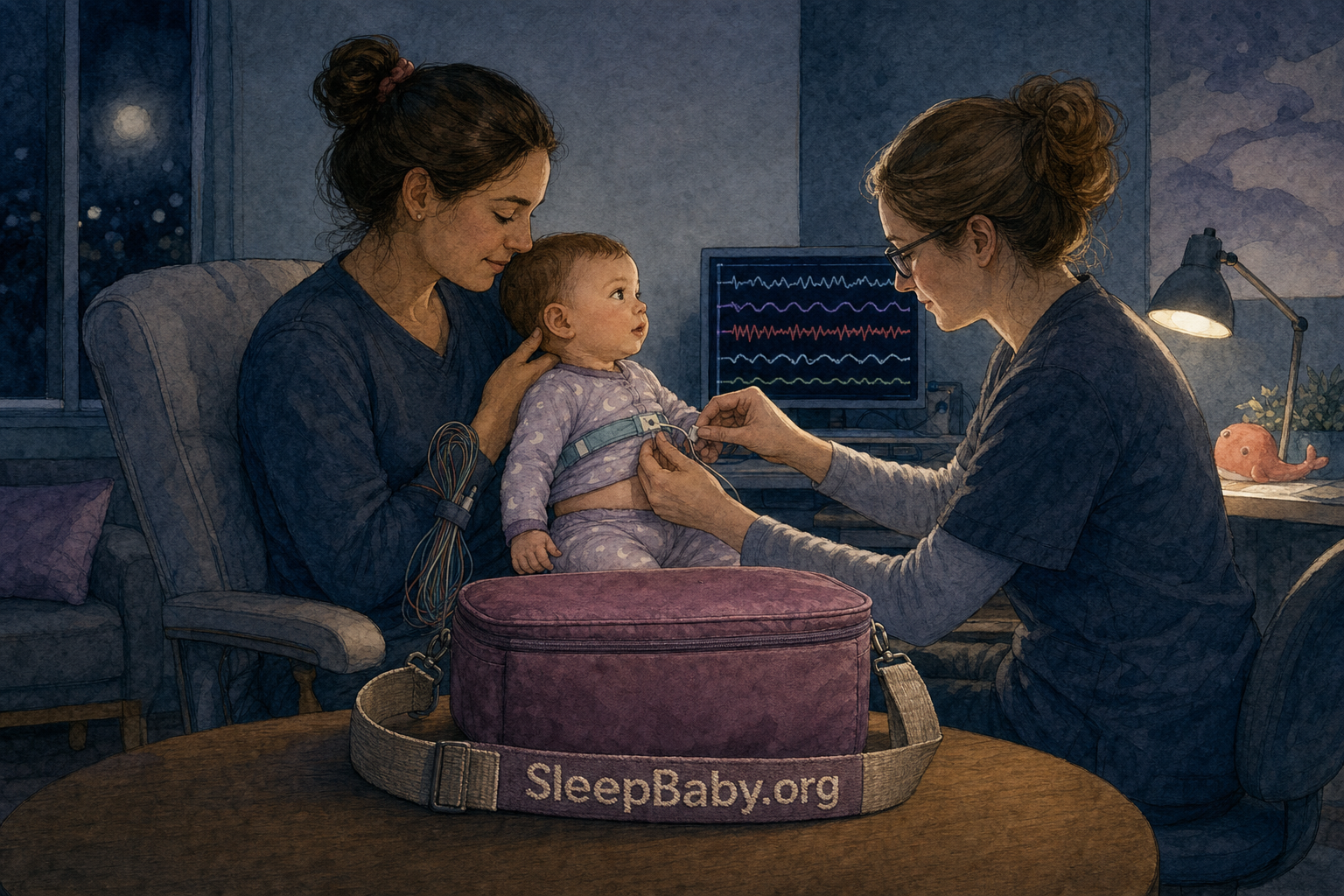
Once the lights go down, the two adults in the room have different jobs.
The technologist watches the recording and the signal quality from the center’s monitoring setup. If a lead becomes noisy, a belt shifts, or another channel stops reading clearly, the technologist may speak to you or come in to adjust it. Pediatric and federal guidance describes overnight staff monitoring, audio or video, and help with sensors or bathroom needs. 1 10 16
Your job is not to guard every wire. Your job is to keep being the baby’s caregiver within the laboratory’s rules: feed when the care plan and center allow, use the permitted calming routine, tell staff when the baby needs something, and ask for help before moving or disconnecting equipment.
Many pediatric laboratories expect one parent or guardian to stay. The exact number of caregivers, sleeping arrangement, sibling policy, bathroom access, room type, crib or bed, and morning departure time are local. Confirm them rather than assuming the setup shown on a hospital page is waiting for you. 9 10 12 14
Feeding may require a little choreography once the wires are bundled. Ask the technologist how to pick up or position the baby without pulling a lead, where feeding supplies can go, and when staff need to note an event. Do not delay a necessary feed to protect an imaginary perfect record.
A baby may sleep in shorter stretches, wake to feed, cry when a sensor is adjusted, or seem interested in every new sound. The laboratory is not a recreation of home, and it does not need you to pretend otherwise. MedlinePlus notes that people may sleep less well in the laboratory and that a literal full night is not always required to obtain useful information. Pediatric adequacy, however, still belongs to the sleep team and the question it is trying to answer. 16
Here is the only-SleepBaby truth I want in the middle of all that equipment: the room may be organized around measurement, but the baby is not a performance. The technologist keeps the signals usable so you can keep doing the ordinary work of noticing hunger, discomfort, warmth, and the need to be held. Neither of you is grading the baby on bedtime.
Do not try to interpret the monitor. Do not change oxygen, PAP, ventilation, or another prescribed device unless the protocol and clinical team direct it. And do not rebuild a loose sensor yourself. Call the technologist; the equipment belongs to the recording team.
When the night is messy, choose the next action—not a verdict
Most parent worries about the study arrive as some version of: “What if the baby does not do this correctly?” The better question is: “What should I do next, and who decides what the event means?”
MESSY NIGHT, SAFE NEXT ACTION
Choose the next action—not a verdict
The baby cries or will not settle
What you do
use the laboratory’s permitted calming and feeding routine. Tell the technologist what normally helps and ask what can happen with the sensors in place. If the baby needs a pause during setup, say so.
Who decides what it means
the sleep team. Crying may affect how quickly setup or sleep begins, but it does not let a caregiver declare the whole night failed.
The baby wakes or feeds often
What you do
care for the baby according to the clinical feeding plan and the laboratory’s instructions. Ask staff to help protect the wires. Do not skip a medically necessary feed.
Who decides what it means
the interpreting team. Waking and feeding are observable events and ordinary infant care, not misconduct. A short feed is not a ruined graph.
A sensor loosens or comes off
What you do
call the technologist. Do not reattach it, move other leads to compensate, or read the screen for clues.
The baby sleeps less than usual
What you do
continue the permitted routine and let the staff know what is happening. Do not try to create sleep by changing medicine, feeds, oxygen, or support on your own.
Who decides what it means
the clinical team. Less sleep does not automatically erase the night. It also does not automatically mean the recording was adequate. The answer can depend on signal quality, the clinical question, the sleep stages and events captured, and the technical limitations. 16
If short sleep is an ongoing home issue, you can later understand short naps at home without grading the study yourself. Home nap troubleshooting cannot tell you whether the PSG answered its question.
The laboratory cannot collect enough useful information
What you do
ask what the team will review, who will contact you, and whether follow-up is already scheduled. Write down the answer.
Who decides what it means
the interpreting clinician and ordering team. Depending on the question and what was captured, they may recommend a repeat, a modified setup, another protocol, or a different evaluation. The Article cannot promise which path—or promise that another test will be needed at all.
You hear a concerning comment or glimpse a number
What you do
ask the technologist whether there is anything you need to do right now. If your baby appears acutely unwell, use the urgent or emergency plan rather than waiting for the report.
Who decides what it means
the final interpretation belongs to the appropriate clinician. A monitor value, a single event, or an offhand overnight phrase is not the complete report.
The word messy describes the lived night, not the quality of the medical work. A useful recording may contain crying, waking, feeding, movement, and repaired signals. Or the team may decide it needs more. Your part is to respond to the baby and communicate; their part is to judge the data.
Morning means collection ended, not that the answer arrived
In the morning, staff remove the leads, tape, belts, and sensors according to the laboratory’s process. Some paste or adhesive residue may remain for a bath or hair wash at home. Temporary redness can happen where skin was prepared or tape was removed. Follow the center’s removal and skin-care directions, and contact the baby’s clinician if irritation persists, worsens, blisters, or otherwise concerns you. 18 16
Do not add a product-specific adhesive remover or scrub the skin aggressively unless the laboratory or clinician tells you to. A baby’s skin and the materials used in one center may be different from those in another.
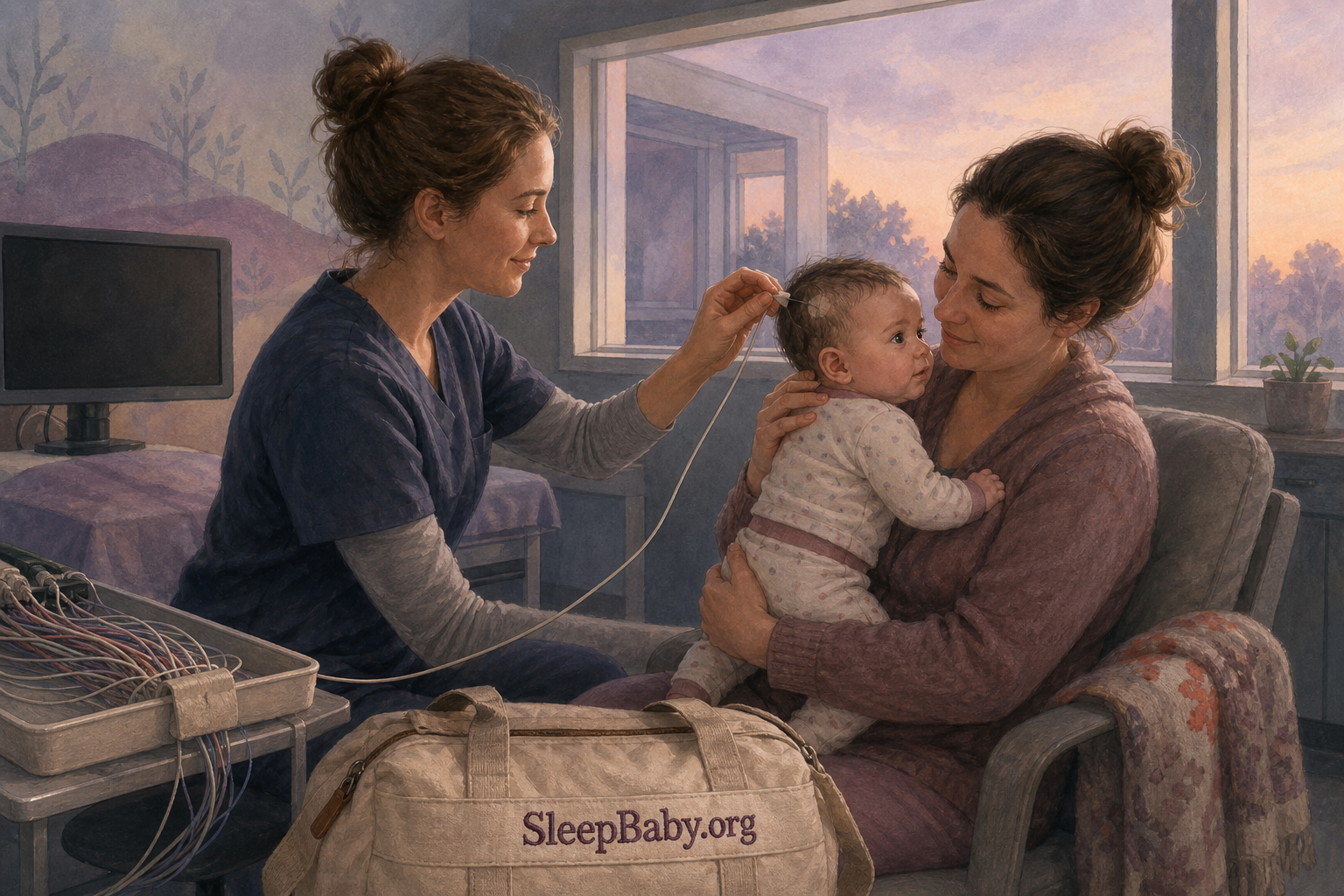
The overnight technologist may be able to tell you that data collection is finished or that the report will go to a particular clinician. In most workflows, the technologist does not deliver the final diagnosis. A sleep-trained clinician still needs to review the synchronized signals, events, and technical quality. 1
This is a quiet but important emotional boundary: you can be finished with the wires before you are finished with the waiting. Relief in the morning does not have to come from an invented answer. It can come from getting the baby back into familiar clothes, collecting the feeding supplies, and knowing the recording is now in the right hands.
Before you leave, ask three questions:
- Were there any aftercare instructions for skin, hair, medicines, equipment, or routine?
- Who will receive and explain the report?
- When should you call if follow-up is not already scheduled?
How a night of signals becomes a report
A PSG is not one number waiting to print. It is a synchronized record that has to be checked, reviewed, scored, and interpreted in clinical context.
FROM TRACES TO A FAMILY CONVERSATION
Who owns each step after the last sensor comes off
-
The technologist collects the recording
The technologist applies sensors, monitors signal quality, documents relevant events, and makes adjustments when channels become unusable. Audio, video, notes, and the timing of feeds or awakenings can help place signal changes in context. 1 10
-
The record is checked and scored
The laboratory reviews the recorded channels and technical quality according to its process. Sleep stages, breathing events, movements, arousals, oxygen and carbon-dioxide patterns, and other ordered measures are aligned across the night. This is one reason an answer does not appear the moment the last piece of tape comes off.
-
A sleep-trained clinician interprets the study
The clinician considers the patterns together with the baby’s age, symptoms, medical history, examination, referral question, and the limitations of the recording. Pediatric guidelines emphasize that PSG findings belong inside the clinical evaluation rather than outside it. 2 3
-
The report reaches the responsible clinical team
Depending on the center, the report may go to the referring clinician, sleep clinic, pediatrician, or another responsible provider. Ask which route applies. Stanford says its results go to the referring physician; other centers describe follow-up through the sleep clinic or ordering provider. 9 15
-
The family gets interpretation and a next-step discussion
Official centers quote very different timelines: Johns Hopkins All Children’s gives an example of seven to ten business days, Boston Children’s and UCSF describe about two weeks, and Children’s Minnesota says results generally take three to four weeks. Those numbers prove variability; they do not create a promise for your baby’s report. 10 12 13 15
Before the study, ask who will contact you and when. After the study, call the responsible office if the promised window passes or if follow-up never appears. If the baby’s condition changes while you wait, use the clinician or emergency path that matches the current symptoms rather than waiting for the report.
The report may answer the referral question, raise another question, or show that more information is needed. It is not automatically a complete treatment plan. Any next step depends on what the study found, why testing was ordered, the baby’s clinical context, and the team’s judgment.
When the results conversation arrives, separate what was recorded from what it means for this baby. Ask which referral question the study addressed, whether the recording was technically adequate for that question, which findings the clinician considers important, and which findings may be incidental or uncertain. Then ask what changes now, what stays the same for now, who owns the next step, and what would justify an earlier call. Pediatric sleep-testing guidance places the tracing inside a broader clinical evaluation; a family should not have to turn one highlighted number into a diagnosis or treatment plan alone. 2 3 6 7
“Technically adequate” and “clinically complete” are not interchangeable. A recording can contain usable signals and still leave a question that needs history, examination, another specialist, or occasionally different testing. The reverse is also possible: a night that felt fragmented to the caregiver may still contain information the interpreting clinician can use. Let the team tell you what the record can support instead of grading the study by clock time, number of awakenings, or how calm the bedtime looked.
If the explanation becomes a stream of abbreviations, ask for the plain-language sentence underneath them: What did the study show, what did it not show, and what is the next decision? Request a copy of the report if the clinical system allows it, but keep the follow-up conversation. The document can preserve measurements and interpretation; it cannot know which part is frightening you or which home-care instruction still feels ambiguous.
I would not treat the waiting period as empty bureaucracy. Someone has to turn many synchronized traces into a careful clinical interpretation. But I also would not leave the family without a plan. You should know who owns the result, who explains it, and when to call.
Bring the baby home before trying to “fix” the night
Follow the laboratory’s aftercare instructions and return to the baby’s usual routine unless the clinical team tells you otherwise. Do not change medicine, oxygen, PAP, feeding, monitoring, or sleep arrangements because of a monitor glimpse or an overnight comment.
Write down what remains unanswered:
- Did the team collect enough useful information for the referral question?
- When is the report expected?
- Who will explain the findings?
- What symptoms should prompt an earlier call?
- What is the next appointment for?
- Are there any temporary aftercare instructions?
A strange night in a laboratory is one medical data-collection event. It is not a sleep-training verdict and it does not prove that home sleep has been permanently changed.
If the baby is unsettled after coming home, first protect the medical plan and the safe sleep surface. Then you can help your baby settle back into the crib without treating the lab night as a behavior failure. If you want a gentler long view, you can also support sleep without turning the study into a sleep-training verdict.
The night may leave you with paste in the hair, a bag full of feeding supplies, and a brain trying to replay every beep. You do not have to solve the study before breakfast. Bring the baby home. Keep the care plan steady. Put the remaining questions in one place. Let the sleep team do the interpreting, and let ordinary sleep support stay ordinary until the medical plan is clear.
Sources
- American Thoracic Society: Sleep Studies in Children. Pediatric PSG signals, technologist role, routines, sensors, monitoring, and later specialist interpretation.
- American Academy of Sleep Medicine: Respiratory Indications for Polysomnography in Children. Respiratory indications and the requirement to integrate PSG with clinical evaluation.
- American Academy of Sleep Medicine: Non-Respiratory Indications for Pediatric PSG and MSLT. Selected non-respiratory pathways and distinct MSLT use.
- American Academy of Sleep Medicine: Pediatric Home Sleep Apnea Testing Position. Current pediatric HSAT boundary; guideline update remains in development and requires recheck before publication.
- American Academy of Sleep Medicine: Pediatric MSLT and MWT Protocol Update. Older-child protocol scope and separate daytime-test boundary.
- American Academy of Pediatrics: Sleep Apnea in Children—Detection and Treatment. Symptom context, polysomnography, and emergency thresholds.
- American Academy of Pediatrics: Trouble Breathing. Emergency, urgent, and prompt-care breathing boundaries.
- Children’s Hospital of Philadelphia: Prepare for Your Child’s Sleep Study. Local setup, medicine, food, equipment, caregiver, and nap examples.
- Stanford Medicine Children’s Health: What to Expect During Your Child’s Sleep Study. Attended PSG signals, tailored orders, room-sharing example, and result routing.
- Children’s Minnesota: Sleep Study (Polysomnogram). Technologist monitoring, local preparation policies, and one result-time example.
- Nationwide Children’s Hospital: Sleep Study. Signal families, distinct study types, local infant sleep-surface and routine-sedation examples.
- Johns Hopkins All Children’s Hospital: Preparing for Your Child’s Sleep Study. Local feeding, equipment, medicine, hair, caregiver, illness, and timing instructions.
- UCSF Benioff Children’s Hospitals: Pediatric Sleep Lab. Common PSG channels, local preparation, equipment, overnight monitoring, and result timing.
- Cincinnati Children’s: Sleep Study Instructions for Caregivers. Local schedule, caregiver, hair, medicine, and equipment instructions.
- Boston Children’s Hospital: Preparing for a Sleep Study. Setup sequence, technologist sensor checks, local nap/illness rules, and result timing.
- MedlinePlus: Sleep Study. General laboratory experience, possible skin irritation, signal monitoring, and limited full-night guidance.
- Yale Medicine: Pediatric Sleep Study. Pediatric age range, common channels, setup-time example, overnight monitoring, and follow-up example.
- Johns Hopkins All Children’s Hospital: What to Expect After a Sleep Study. Paste and tape removal, temporary redness, and local follow-up timing.
AFTER THE WIRES, BACK TO THE NIGHTS YOU LIVE IN
Let the sleep team interpret the study. Let home sleep become familiar again.
An overnight study can answer a clinical question, but it does not automatically rebuild bedtime, naps, settling, or repeated waking. Once your baby’s medical plan is clear, SleepBaby can help you organize the ordinary pieces—timing, cues, crib settling, and responsive routines—without pretending to diagnose a graph or replace the clinical team.