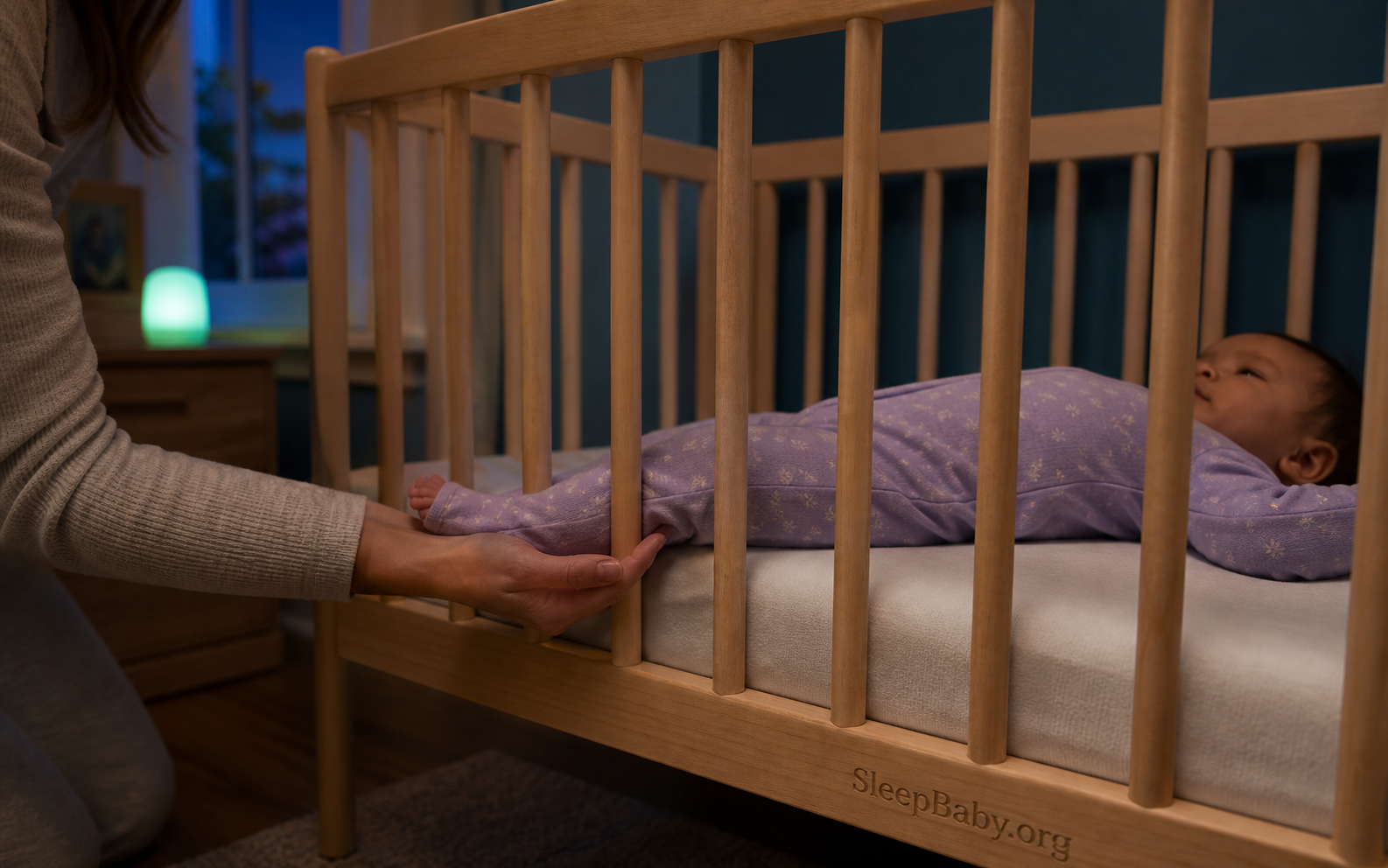
If your baby’s foot is between the crib slats, do not add a bumper, mesh liner, vertical rail cover, pillow, rolled blanket, or positioner. Support the leg and slide the foot back only if it moves through the same opening gently, without twisting, pulling, or resistance. Stop if the limb is firmly wedged. A deformed, pale, blue, cold, very swollen, badly cut, or unusable foot or leg needs urgent medical help; a trapped child, severe injury, or uncontrolled bleeding needs local emergency help.
After the foot is free, check your baby first, then the crib. Compare both legs for normal color, warmth, movement, swelling, skin injury, and distress. Inspect every slat and fastener, the mattress fit, the label, and the recall status. An occasional foot through intact, correctly spaced slats is startling, but it is not the same as a leg trapped by a broken rail or dangerous gap.
A reader-labeled composite Kacey-and-Benjamin moment: In this imagined scene, I—Kacey—see one small pajama foot beyond the crib bars on the monitor and reach Benjamin expecting disaster. He is awake and offended, not pinned, and the foot slides back with gentle support. My first impulse is still the one many parents have: make the frightening picture impossible by adding something soft. This composite is not a factual memory or medical evidence. Its useful truth is the order I want beside me in that moment: child first, structure second, bare crib last.
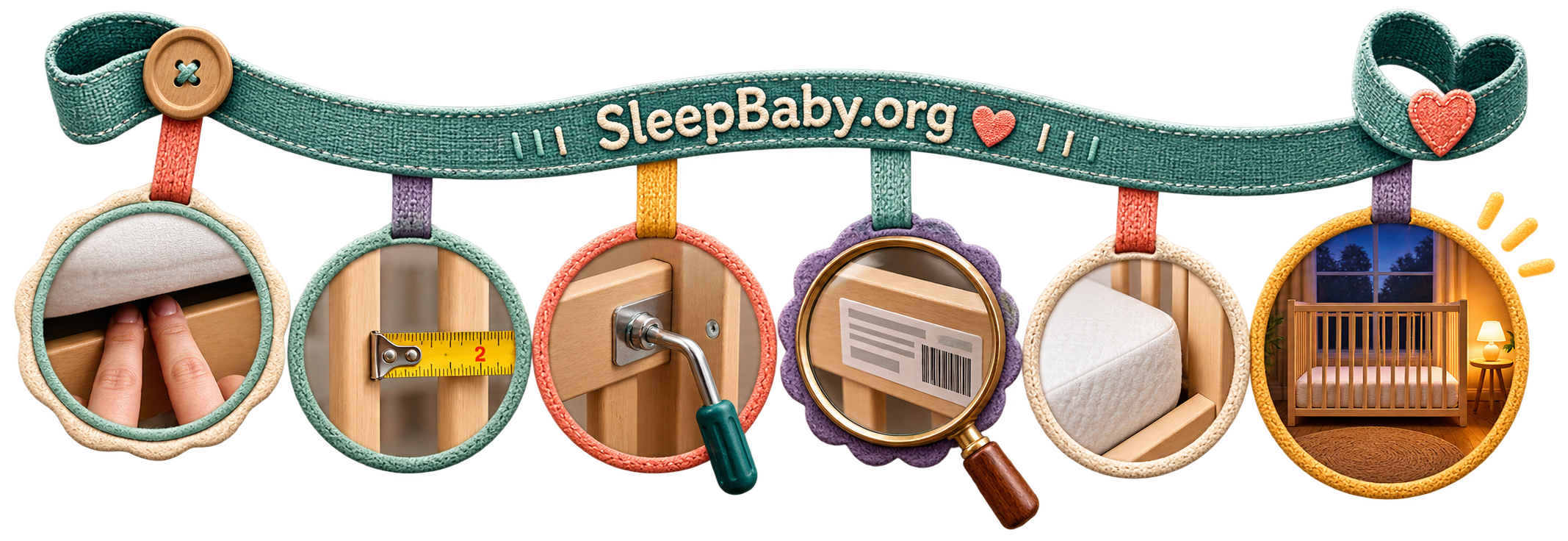
Free → Check → Inspect → Reset
Use this four-part path when a hand, foot, or lower leg reaches through the crib rails. It is a decision tool, not a diagnosis.
- Free gently. Support the leg and guide the foot back through the same opening only if it moves without force or twisting.
- Check the child. Compare color, warmth, movement, swelling, skin, pain, and normal use with the other side.
- Inspect the structure. Check slats, mattress fit, supports, fasteners, assembly, model label, and recalls.
- Reset the sleep space. Return only the snug fitted sheet to a firm, flat, level mattress and start the next sleep on the back.
How do I free a foot from crib slats without making it worse?
Move slowly enough to notice resistance. Support the calf and ankle so the knee is not carrying the pull. Bring the foot back through the opening it entered, following the angle it already has rather than rotating the ankle or prying the slats apart. If the baby is kicking, pause long enough to calm the movement instead of turning the release into a tug-of-war.
I would stop the instant the foot does not glide. Do not yank the ankle, torque the knee, bend a slat, or ask another adult to pull from the other side. Do not cut, unscrew, or spread crib parts while the baby is still in the crib unless emergency responders direct you to do so. A firmly trapped limb, changing color or temperature, obvious deformity, severe pain, or a damaged crib is no longer an ordinary “foot through the bars” moment.
If the child cannot be freed without force, call local emergency services or rescue help and follow their instructions. If the crib is unstable, keep your hands on the baby without putting yourself underneath a collapsing part. This article cannot tell from a description whether a bone, joint, nerve, or blood vessel is injured, and a home experiment cannot safely answer that question.
Once the foot is free, move the baby to a safe place where you can see and compare both legs. I care about the baby before I care about measuring the furniture. A ruler can wait thirty seconds; circulation and movement should not.
The after-release limb scan
- Color and warmth
- Does the foot look like its normal color for this baby, and is it warm rather than unusually pale, blue, gray, or cold?
- Movement and use
- Can your baby wiggle toes and move the ankle and leg as usual? Does an older mobile baby resume normal use?
- Shape, swelling, and skin
- Look for deformity, rapidly increasing swelling, a deep cut, uncontrolled bleeding, or a pressure mark that is worsening instead of fading.
- Pain and settling
- Persistent severe crying, marked tenderness, or refusal to move the limb matters more than whether the monitor image looked dramatic.
Get prompt professional assessment for deformity, a deep wound, marked or worsening swelling, severe or persistent pain, inability or refusal to use the limb, or abnormal color, temperature, sensation, or movement that does not quickly normalize.[10][11]

Does a foot between the slats mean the crib is unsafe?
Not by itself. Current crib standards are designed to prevent a baby’s head and body from passing through dangerous openings. The familiar maximum slat spacing is 2 3/8 inches—about 6 centimeters.[1][5] A small hand or foot can still reach through an opening that is narrow enough to protect the head and torso. The standard does not promise that every limb stays visually tucked inside.
That distinction is reassuring only after two other questions are answered: Is the baby unhurt, and is the exact crib intact and correctly assembled? A foot extending between parallel, solid slats is different from a leg dropping into a mattress-edge gap, entering a space beside a missing slat, or becoming caught where loose hardware has changed the geometry.
I would not use the age of the crib, its appearance, or a seller’s “meets standards” sentence as the whole inspection. Find the manufacturer, model, and date label. Read the instructions for that exact unit. Check recalls with the exact identity. Crib requirements address slats and openings, mattress supports, hardware, strength, labeling, and registration—not just the distance between two rails.[3]
If the label is missing, the assembly is uncertain, a part was substituted, or the crib has been modified, do not improvise your way to confidence. Keep the baby out of that crib until the manufacturer or an appropriate product-safety authority can confirm the setup. Tape, zip ties, homemade spacers, extra boards, and “close enough” replacement hardware can create a new failure that is harder to see.
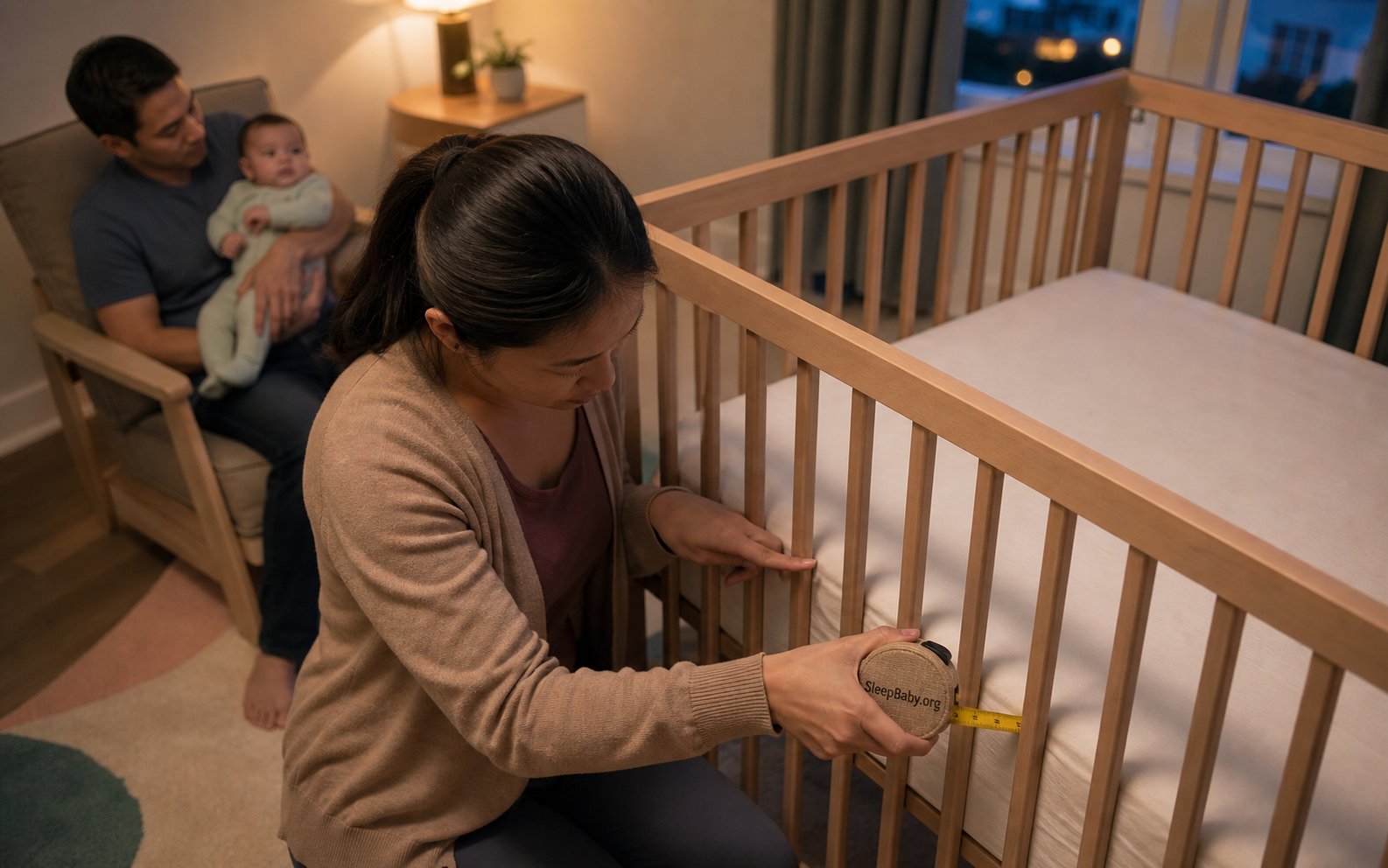
The 30-second crib structure check
- Slat gauge: openings are no more than 2 3/8 inches, and no slat is missing, cracked, loose, bowed, or improvised.
- Two-finger mattress check: the firm mattress fits tightly; more than two fingers between the mattress and crib side or end is too much.[6]
- Hardware and support scan: every fastener, bracket, support, and part is original or manufacturer-authorized, present, tight, and installed as directed.
- Label and recall check: identify the exact model and manufacture date, then check current recall information rather than a similar-looking crib.
- Mobility-height check: use the mattress position required for the baby’s current abilities and the manufacturer’s instructions.
A “no” or “I can’t tell” means pause crib use. It does not mean add padding.
Why not add a bumper or breathable mesh liner?
Because the safer answer to an opening problem is an intact, compliant crib—not another object tied inside it. Federal law bans padded crib bumpers and includes vertical crib slat covers intended to block access to openings.[2] Non-padded mesh liners are outside that particular statutory definition, but “not included in this definition” is not the same as “recommended for infant sleep.”
The American Academy of Pediatrics advises against mesh liners. They are unnecessary in a compliant crib and may loosen, trap or suffocate a child, or become a climbing aid.[7] “Breathable” describes one material claim; it does not erase attachment, entrapment, strangulation, loosening, or climbing risks. It also does not repair an opening created by damage or the wrong mattress.
This is where I want Kacey’s judgment to stay visible: I understand why a soft barrier feels like the caring response. You saw skin against wood and want to cushion the whole perimeter before the next nap. But a frightening picture can pull us toward a product that creates a more serious hazard than the picture itself. The crib should become structurally trustworthy and visually boring again.
The same boundary applies to a pillow wedged beside the rails, a rolled towel under the sheet, a blanket threaded through slats, a positioner, a pool noodle, or any homemade cover. None belongs in the infant sleep space. CPSC’s plain summary is useful here: a firm mattress, a fitted sheet, and a bare crib.[4]
What not to add—and the exact reason
Padded bumper
Banned, unnecessary, and associated with suffocation, strangulation, and entrapment hazards.
Vertical slat cover
Falls within the federal bumper definition when designed to block the crib openings.
Mesh liner
Not recommended by the AAP; it may loosen, trap, suffocate, or help a mobile child climb.
Blanket or towel
Loose bedding and improvised padding add material to the crib without correcting its geometry.
Positioner
It restricts the sleep space and cannot safely substitute for an intact crib or ordinary mobility.
What changes this from an ordinary foot-through-the-bars moment?
The event itself is only one clue. Frequency, location, crib condition, and the baby’s body decide what it means. A baby who occasionally pushes one relaxed foot through intact slats and pulls it back without distress presents a different problem from a baby whose leg repeatedly drops into the same widening opening or mattress-edge gap.
When it happens repeatedly, note the exact location after your baby is safely out of the crib. Photograph the empty crib, not a trapped child. Compare that spot with the rest of the rail. Recheck the mattress edge and support. Look for a fastener that works loose under movement, a bowed slat, a cracked joint, or a mattress that shifts farther than it should. Then use the manufacturer’s instructions and product identity rather than a general internet fix.
I would also separate “repeats because my baby likes this position” from “repeats because the structure funnels the leg into one faulty gap.” If the crib passes every exact check and the baby remains comfortable and uninjured, ordinary movement may continue to look odd without creating an emergency. If the same abnormal gap keeps catching the leg, the structure—not the baby’s sleep style—needs to be resolved.
What changes the answer?
| What you see | What it suggests | Next action |
|---|---|---|
| One foot through intact, even slats | May be ordinary mobility if the baby is comfortable and the structure passes. | Check the limb, inspect once, and keep the crib bare. |
| Repeated catch at the same rail opening | Could reflect movement—or a local slat, joint, or hardware defect. | Inspect the empty crib and contact the manufacturer if anything is abnormal. |
| Leg in the mattress-edge gap | The mattress may be mismatched, shifted, or unsupported. | Stop crib use until exact fit and support are confirmed. |
| Missing, bowed, loose, or cracked part | The crib has a structural problem. | Keep the baby out; use only manufacturer-authorized repair or replacement. |
| Swelling, deformity, abnormal color, or no movement | Possible injury or circulation problem. | Seek prompt professional or emergency assessment as severity requires. |
Do I need to keep moving my rolling baby away from the rails?
Start every sleep by placing your baby on the back on a firm, flat, level surface with only a fitted sheet.[8][9] Once a baby can roll independently in both directions, you do not need to spend the night repeatedly turning them back. If your baby rolls only one way, Safe to Sleep says you can reposition them to the back after a stomach roll.
The crib should remain empty either way. Do not wedge the baby in the middle, use a sleep positioner, or tuck material around the hips to keep the legs away from the rails. Mobility is not a reason to add restraint. It is a reason to make the whole legal sleep surface safe for the movement your baby can now do.
Stop swaddling when your baby shows signs of trying to roll. A swaddle that compresses the arms is not a solution to rail-reaching. If back placement itself has become the next struggle, this is the natural place to read what to do if your baby cries when placed on the back. That guidance belongs beside the ordinary sleep-position question—not inside the urgent injury steps.
I know the monitor can turn one pajama foot into a full architectural crisis. I would use the monitor to confirm breathing, distress, and whether the baby is actually caught; I would not use it to demand a perfectly centered pose all night. A baby who has found the rail and is calm may need less intervention than a parent whose nervous system is still standing at attention.

Can a sleep sack keep a baby’s leg out of the crib slats?
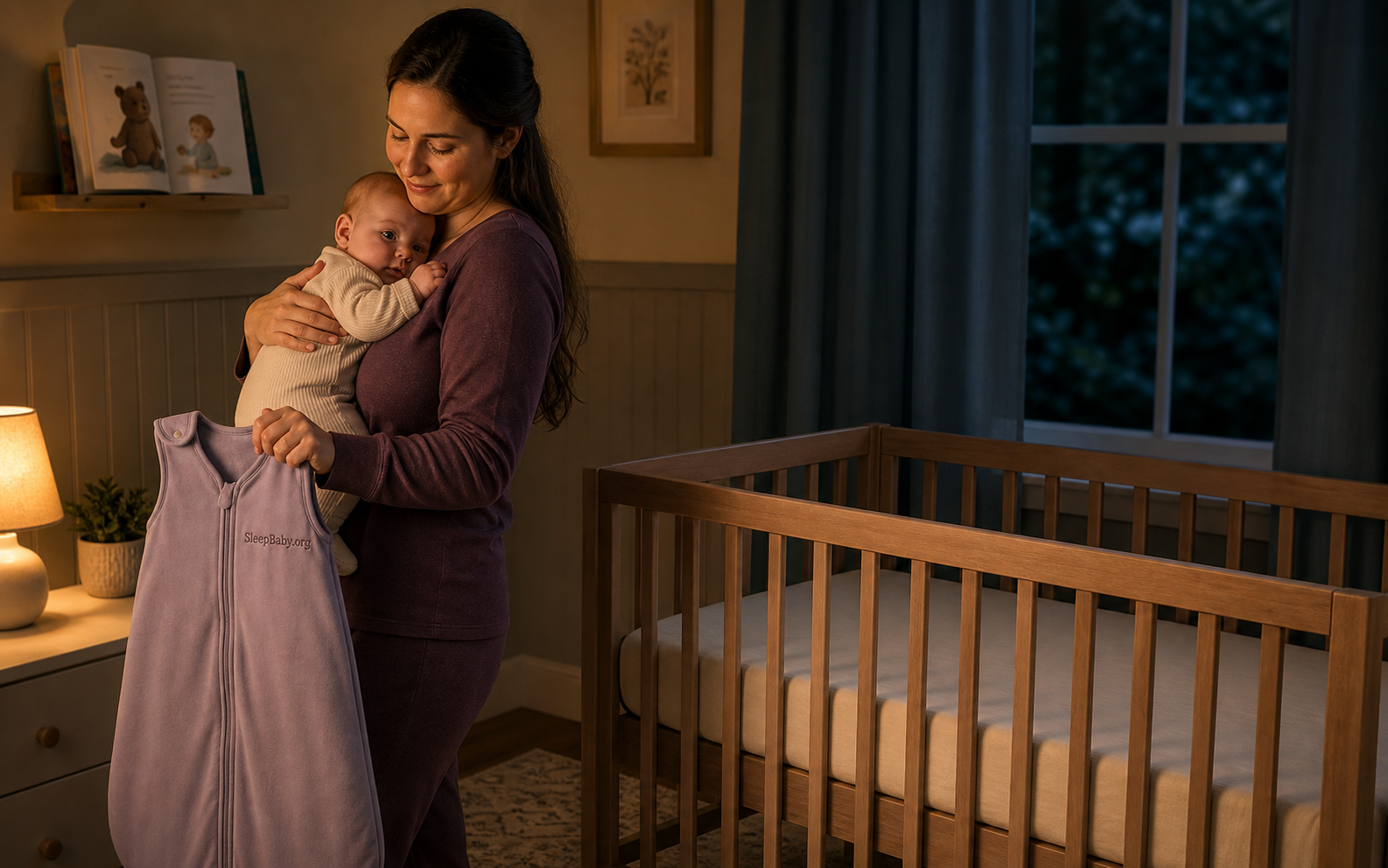
No sleep sack should be sold or used as a restraint. A correctly fitted, arms-free, unweighted wearable blanket can solve a different problem: keeping a baby warm without putting a loose blanket or liner in the crib.[6][8] It does not change the slat spacing, repair hardware, immobilize the legs, prevent injury, or guarantee sleep.
The fit matters at the upper body. The neck and arm openings should not allow the baby to slip inside, and the lower portion should allow free hip and leg movement. Follow the manufacturer’s exact age, weight, height, and fit guidance; use room-appropriate clothing underneath. Avoid weighted products and any garment that compresses the arms once rolling attempts begin.
That is the product distinction I would protect after a scare: warmth is a clothing job; crib geometry is a structure job. When those jobs are blended, parents are more likely to buy a liner because it looks warm, or expect a sleep sack to hold the knees together. Neither expectation is safe or honest.
Warmth without a barrier
Ordinary sleepwear
Choose room-appropriate pajamas that fit properly and do not add loose material to the crib.
Wearable blanket
Use one correctly fitted, arms-free, unweighted option when extra warmth is needed.
Not the job
Neither option prevents a foot reaching slats or makes a damaged crib safe.
Article-specific Amazon recommendation
Woolino 4 Season Ultimate Baby Sleep Bag
I would shortlist this for the parent who is about to buy a crib liner because the room feels cold. Woolino describes a 2-month-to-2-year size, adjustable underarm snaps, shoulder snaps, a two-way side zipper, and a room-temperature dressing guide.[12] Those fit and dressing features make it more useful here than a loose blanket, a barrier tied to the rails, or a short-lived accessory that solves no structural problem.
Why buy it: it offers a repeatable wearable-warmth option across growth and seasons while leaving the crib bare. It does not prevent a foot from reaching the slats, repair a crib, treat an injury, guarantee temperature control, or promise better sleep. Use only the correct fit and room-appropriate layers under the manufacturer’s instructions; keep it arms-free and unweighted.
See the Woolino sleep bag on Amazon
As an Amazon Associate, SleepBaby may earn from qualifying purchases.
Existing optional shopping paths preserved from this article
- Browse baby sleep essentials on Amazon
- Browse smart bassinets on Amazon
- Browse newborn care essentials on Amazon
As an Amazon Associate, SleepBaby.org may earn from qualifying purchases.
Should I lower the mattress or move my baby to a toddler bed?
Lower the crib mattress according to mobility and the manufacturer’s instructions. The AAP’s room-safety checklist says to lower it before a baby can sit and use the lowest position before the baby can stand.[6] That change reduces fall and climbing risk. It does not change the distance between slats, so it cannot guarantee that a foot will stay inside.
A foot outside the rails is not, by itself, a reason to move a 12- or 15-month-old to a toddler bed. Use the crib’s stated limits, the child’s height, the ability to climb out, and the manufacturer’s conversion instructions. A premature transition can trade one startling crib image for a room the child can roam before the whole space is ready.
If your baby is pulling to stand, the lowest mattress setting and an empty crib matter more than a rail cover. Remove anything that can become a step. Keep monitor cords, curtain cords, furniture, lamps, and reachable objects away from the crib. A liner marketed as soft can become exactly the extra foothold a mobile baby did not have before.
I would make the room transition when the crib limits or climbing behavior require it, not because one leg has discovered the outside world. That keeps the decision tied to the risk that actually changed.

What if my baby keeps doing it?
Repetition deserves a better inspection, not a more padded sleep space. If the foot goes through in several different places while your baby rolls and scoots, that pattern may reflect ordinary exploration of the full crib surface. If the leg repeatedly catches at one location, inspect that exact slat, joint, mattress edge, and support while the crib is empty.
Write down what actually happened: time, location, whether the baby was asleep or awake, whether the limb came back easily, and whether there was any mark or change in movement. That record can help the manufacturer or clinician understand the event. Do not keep a baby wedged in place for a photograph. Evidence should never extend the trapping.
If the crib passes, the baby is uninjured, and each event is simply a foot poking through and returning, you can respond calmly. Some families find that appropriately fitted pajamas or an arms-free wearable blanket reduce minor skin friction, but neither should be expected to control movement. The goal is not to make rail contact impossible. It is to remove hidden structural hazards and know what would make the next event different.
At night, I would rather have one short checklist than a promise that the foot can never appear again. Check the child. Check the exact opening. Restore the empty sleep surface. Then let ordinary baby movement be ordinary.
Watch: reset the whole sleep space
Safe Sleep for Your Baby: Every Nap & Every Night
The American Academy of Pediatrics demonstrates the unchanged foundation after the foot is free and the crib passes inspection. The video is here for the room reset; it does not replace the injury or structural guidance above.
Takeaway: A startling foot does not earn a softer crib. The reset remains firm, flat, fitted, and bare.
When should I call the pediatrician, manufacturer, or emergency services?
Call local emergency services when the child is trapped and cannot be released without force, the crib is collapsing, there is severe injury or uncontrolled bleeding, or the foot or toes are becoming blue, pale, cold, numb, or immobile. Follow the responder’s instructions rather than dismantling the crib around a moving child.
Seek prompt medical assessment for obvious deformity, a deep wound, marked or worsening swelling, severe or persistent pain, inability or refusal to move or use the limb, or ongoing concern after an injury—especially for a baby under one year.[10][11] The clinician can decide whether an exam or imaging is needed. This article cannot diagnose a sprain, fracture, nerve injury, or circulation problem.
Contact the crib manufacturer or product-safety authority when slat spacing seems abnormal, the mattress does not fit, a part is missing or damaged, hardware repeatedly loosens, the model identity or instructions are unclear, or the crib appears in a recall. Use only an exact authorized part or replacement. A generic mattress, rail, or fastener can create a fit problem even when its retail description says “standard.”
Talk with your child’s clinician when repeated events accompany unusual stiffness, weakness, asymmetrical movement, pain, or another developmental or medical concern. Do not use the crib event alone to diagnose a mobility problem. Bring the plain record of what you saw and what changed.
What I would do tonight
- Free the foot only if it slides back gently; stop at resistance.
- Compare both legs for color, warmth, movement, swelling, skin injury, and distress.
- Move your baby to a safe place while you inspect the empty crib.
- Check slat spacing, mattress fit, hardware, supports, label, recall status, and mattress height.
- Keep the baby out of the crib if any part is damaged, missing, mismatched, loose, or uncertain.
- Reset with a firm, flat, level mattress and one snug fitted sheet—nothing tied, tucked, or padded around the rails.
- Start sleep on the back; follow rolling and swaddle-stop guidance as mobility changes.
- Use sleepwear or one correctly fitted arms-free, unweighted wearable blanket only for warmth.
Back in the composite scene, Benjamin’s foot may visit the other side of the slats again. What changes is not the crib becoming padded or the monitor becoming silent. I know what deserves speed, what deserves measurement, and what deserves no extra product at all. The four-step order is the part I want to remember at 2 a.m.: child first, structure second, bare crib last.
That is how the room becomes boring again—not because we promise that a mobile baby will never touch the rails, but because the dangerous possibilities have clear boundaries and the safe setup has nothing left to improvise.
Sources
- U.S. Consumer Product Safety Commission: Crib Safety Tips.
- U.S. Consumer Product Safety Commission: Crib Bumper FAQs.
- U.S. Consumer Product Safety Commission: Full-Size Baby Cribs Business Guidance.
- U.S. Consumer Product Safety Commission: Safe Sleep—Cribs and Infant Products.
- HealthyChildren.org / American Academy of Pediatrics: Choosing a Crib.
- HealthyChildren.org / American Academy of Pediatrics: Make Baby’s Room Safe—Parent Checklist.
- HealthyChildren.org / American Academy of Pediatrics: Baby Products to Avoid.
- HealthyChildren.org / American Academy of Pediatrics: Safe Sleep—9 Ways to Reduce Risk.
- NICHD Safe to Sleep: Ways to Reduce Baby’s Risk.
- NHS: What to Do If Your Child Has an Accident.
- HealthyChildren.org / American Academy of Pediatrics: Leg Injury.
- Woolino: 4 Season Ultimate Baby Sleep Bag, used only for the product’s stated sizing and design features.
After the monitor scare
Make the crib boring again—and give your nervous system a bedtime too
When you have checked the child, checked the structure, and removed the urge to pad every rail, the next night can feel quieter even if one tiny foot remains adventurous. SleepBaby can help you turn that clear safety floor into a calmer, repeatable sleep plan for the rest of the night.
SleepBaby guidance does not replace emergency care, a clinician’s assessment, a recall check, or the crib manufacturer’s instructions.






What viewers said10 comments · 4 replies+
Archived comments from the original Baby Sleep Miracle presentation. Not independently verified by SleepBaby.org; individual experiences vary.
Thank you so much for this video! I had no idea about the dangers of baby swings :O
Hi Mary-Ann. I have a question: Is method in any way similar to the ones recommended by Dr Bucknam, Dr. Weissbluth or Dr. Karp? We tried those but none of them help.
Hi Regina, thank you for your question. The short answer is no. The techniques I share in my guide are based on newest scientific research and this is why I have never seen any approach similar to the one I recommend.
This method really works! I tried it on my son Jesus and after just one week he went from waking up more than 5 times a night to waking up just once or twice. You are a lifesaver, Mary-Ann!
I'm truly impressed with how much information you share in your video. And all for free! I can feel that you truly care about mothers like myself, and that's hard to find these days. I have recommended your site to several of my friends already.
Mary-Ann, our child suffers from autism. Is your approach still suited?
Chloe, I made sure my method can be used with any child, even babies who are special like yours. Please note that I'm not a doctor and that I always advice to consult with your physician because nothing is more important than the safety and well-being of your love.
Hallo Mary-Ann, I'm from Germany. Do you have your guide in German?
Hello Heide, we do! Normally you should already see our video in German. If not, please contact our support so they can guide you
Thenk you for your answer, Mary-Ann!
I just completed your approach and I have to say, it worked almost too well. Yes, it took a bit of getting used to with your bedtime routine but the difference is huge. My son George used to take 1 hours to go down and now he's firmly asleep in no more than 10 minutes! You're the best!
It seems I'm the only man watching this video, lol! What you shared about the 'emotional backpack' made immediate sense to me and I can't wait to help my little girl Mila to unpack it!
Hey there, just discovered your site and this really sounds different. Just wanted to say thanks for sharing :)
For everyone who's still thinking about getting Mary-Ann's guide I want to advise you to go ahead. I wasn't sure myself but now I'm so thankful I invested in this program. It made a huge difference in our life as a family and yes, my baby girl does sleep through the night now.