
Check your baby first
Call 911 now in the U.S. if your baby is struggling to breathe, cannot cough or cry effectively, turns blue or gray, collapses, has a seizure, or cannot be awakened. Put the phone on speaker and follow the dispatcher. Outside the U.S., use your local emergency number.
If your baby is breathing comfortably and responsive, take the napkin away and call Poison Control at 1-800-222-1222 for advice about the material and amount. Do not make your baby vomit or give food or water to push it down.
A damp napkin with a corner missing can leave you wondering how much actually went into your baby’s mouth. Start with the baby in front of you: their breathing, their response to you and any trouble swallowing. Sorting out the paper comes next.
A small amount of ordinary paper is generally low in toxicity. The Missouri Poison Center includes napkins in its paper guidance, while also warning that paper can cause choking. A clean paper scrap, a wad of paper and a napkin used to wipe up a household chemical need different consideration. The word “napkin” alone cannot settle what to do.
I would keep the remaining napkin and its packet nearby for the call, out of your baby’s reach. You do not need an exact measurement or a perfectly reconstructed story before asking for help.
SleepBaby.org · The original video
A little help
for the night ahead.
Take a moment to watch the original Baby Sleep Miracle presentation. Your article will be right here when you’re ready to keep reading.
What viewers said10 comments · 4 replies
Archived comments from the original Baby Sleep Miracle presentation. Not independently verified by SleepBaby.org; individual experiences vary.
Hi Mary-Ann. I have a question: Is method in any way similar to the ones recommended by Dr Bucknam, Dr. Weissbluth or Dr. Karp? We tried those but none of them help.
Hi Regina, thank you for your question. The short answer is no. The techniques I share in my guide are based on newest scientific research and this is why I have never seen any approach similar to the one I recommend.
This method really works! I tried it on my son Jesus and after just one week he went from waking up more than 5 times a night to waking up just once or twice. You are a lifesaver, Mary-Ann!
I'm truly impressed with how much information you share in your video. And all for free! I can feel that you truly care about mothers like myself, and that's hard to find these days. I have recommended your site to several of my friends already.
Mary-Ann, our child suffers from autism. Is your approach still suited?
Chloe, I made sure my method can be used with any child, even babies who are special like yours. Please note that I'm not a doctor and that I always advice to consult with your physician because nothing is more important than the safety and well-being of your love.
Hallo Mary-Ann, I'm from Germany. Do you have your guide in German?
Hello Heide, we do! Normally you should already see our video in German. If not, please contact our support so they can guide you
Thenk you for your answer, Mary-Ann!
I just completed your approach and I have to say, it worked almost too well. Yes, it took a bit of getting used to with your bedtime routine but the difference is huge. My son George used to take 1 hours to go down and now he's firmly asleep in no more than 10 minutes! You're the best!
It seems I'm the only man watching this video, lol! What you shared about the 'emotional backpack' made immediate sense to me and I can't wait to help my little girl Mila to unpack it!
Hey there, just discovered your site and this really sounds different. Just wanted to say thanks for sharing :)
For everyone who's still thinking about getting Mary-Ann's guide I want to advise you to go ahead. I wasn't sure myself but now I'm so thankful I invested in this program. It made a huge difference in our life as a family and yes, my baby girl does sleep through the night now.
Ready to get started?Take the next step with SleepBaby.
Pick your priceIf your baby is coughing or choking
An effective cough and an ability to make sounds are different from a weak or absent cough, inability to cry, changing color or becoming less responsive. The AHA/AAP infant choking algorithm uses these signs to guide the response. Stay with a baby who is coughing effectively and watch closely for deterioration; do not start thrusts simply because you found paper.
For a responsive infant under about 1 year with severe choking, the 2025 joint AHA/AAP guidance recommends repeated cycles of five back blows followed by five chest thrusts, using the heel of one hand for the chest thrusts. Do not use abdominal thrusts on an infant. Activate emergency help promptly and use the dispatcher’s guidance and your infant first-aid training.
If the infant becomes unresponsive, start CPR beginning with chest compressions, following emergency guidance; infant CPR includes breaths. Look for a visible object when opening the airway for breaths. Never sweep a finger blindly around the mouth. If the object comes out, keep monitoring until emergency care arrives.
First-aid instruction should be current and appropriate to your child’s age. The AHA updated the infant chest-thrust technique in 2025, so an older picture or remembered class may look different. This short section cannot replace hands-on practice. During an emergency, stay with the dispatcher instead of searching for another tutorial.
Remove access without probing the mouth
Move the napkin and any loose pieces away. If a loose piece is clearly visible at the front of the mouth and easy to take out, remove it gently. Do not chase a piece toward the back of the mouth or repeatedly put your fingers inside to check. Wipe paper from the lips with a soft damp cloth.
Keep attention on your baby while another adult retrieves the packet, if someone is available. A missing corner does not tell you whether all of it was swallowed; some may be on clothing, the tray or the floor. Report what you actually saw and what you are unsure about.
Poison Control’s first-aid guidance says not to induce vomiting. Do not give salt water, oil, laxatives or a home “flush.” Food and drinks are not a way to test or clear a suspected blockage. Trouble breathing or swallowing needs help, not another mouthful.
Identify the napkin, including anything on it
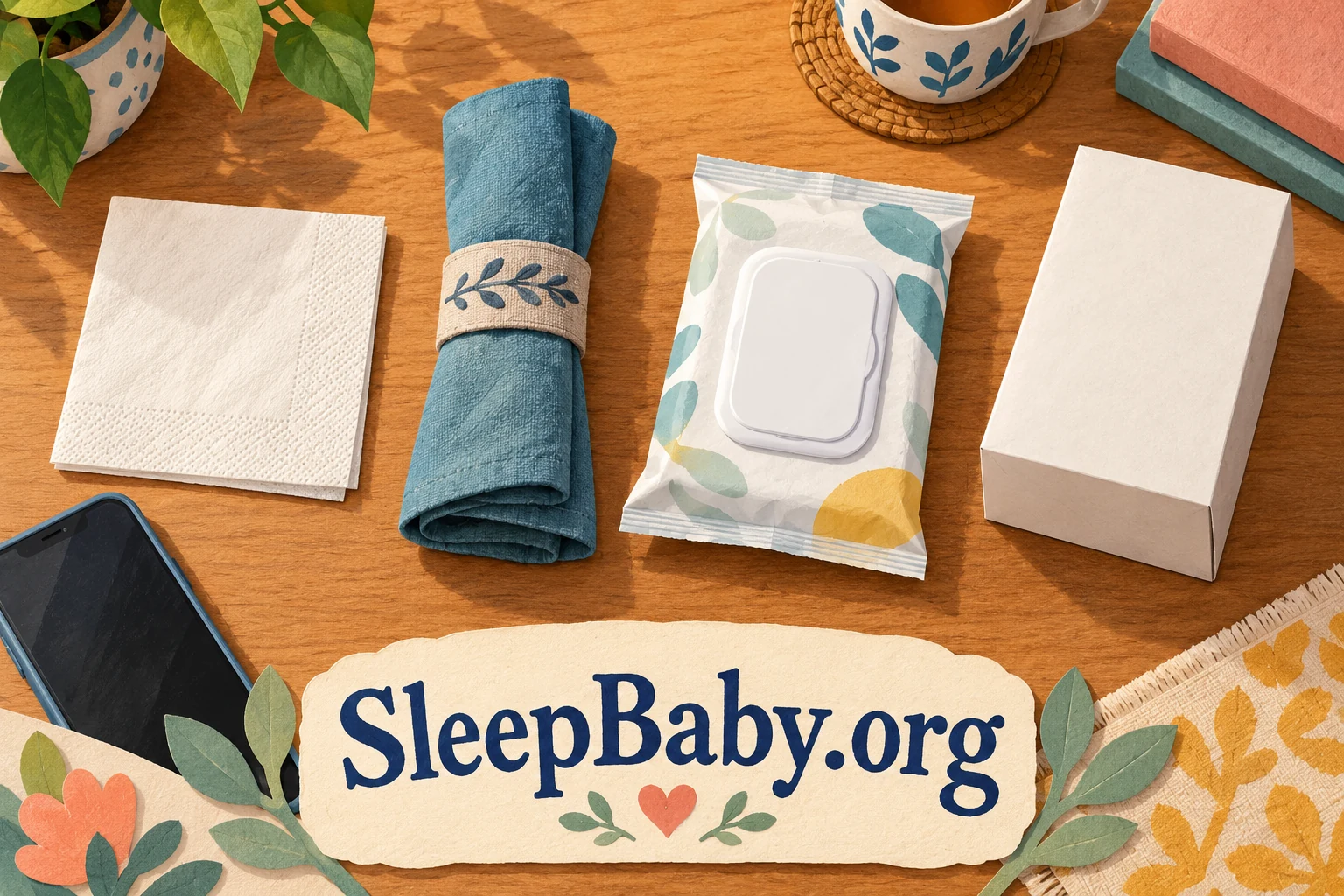
Put the remaining material somewhere an adult can inspect it without giving your baby another chance to grab it. Check the original packet if you have it. At a restaurant, ask staff what the item was and whether it had been used with a cleaning product. You can make the call while someone finds that information.
The material check
Plain paper: tell the specialist whether it was a small corner, several pieces or a wad, and whether it was clean and unused.
Used or treated paper: name any cleaner, medicine, alcohol, cosmetic or other substance it could have touched. Keep that product’s container too.
Cloth, wipe or wrapper: describe it as that material. A fabric napkin, moist towelette, plastic wrapper or sticky tab is not covered by reassurance about plain paper.
Unknown: say “I don’t know.” Give the specialist the best description you have instead of choosing the most reassuring category.
Small amounts of ordinary printing ink are also described as low risk in Missouri’s paper guidance. That does not establish the safety of every decorative finish, fragrance, coating or substance spilled onto a napkin. There is no need to guess at ingredients from its color. The packaging and what the napkin was used for are more useful details.
Cleaning wipes can contain disinfectants, detergents, perfumes and preservatives. Keep them distinct from wipes intended for skin, and tell Poison Control which product was involved. Even a wipe that looks like a soft napkin needs its own assessment. Keep cleaning wipes and baby-care wipes stored separately so they are harder to mix up.
AFTER THE CARE PLAN IS CLEAR
Leave bedtime planning for a quieter moment

For ordinary bedtime planning later, the SleepBaby.org Method is introduced on our homepage, with information about bedtime routines and baby sleep schedules.
Once you have the advice you need about the napkin, you can return to the familiar parts of your evening. If routine planning is something you want to explore, read the current Method information when you have a quieter moment.
A sleep routine does not assess swallowing, treat an exposure or replace the observation plan from Poison Control or your clinician. Keep those care instructions first, including any advice about feeding and sleep.
What to have ready for Poison Control
The U.S. number is 1-800-222-1222. Calls are free and confidential, and specialists are available around the clock. You can call even if you are unsure that anything was swallowed. The National Capital Poison Center explains how the service works; outside the U.S., contact your local poison information service.
For a baby, using the phone is a practical way to discuss uncertainty and age-specific advice. The webPOISONCONTROL tool is not intended for babies younger than 6 months or for some other situations, including multiple-product exposures. Do not let an online form delay a call. Emergency breathing or responsiveness problems belong with emergency services first.
A short note for the call
Baby: age, approximate weight and how they are acting now.
Item: paper, cloth, wipe or packaging; brand or product name if known; anything it had touched.
Event: when it happened, what you saw, the amount that may be missing and any coughing, vomiting or swallowing difficulty.
Before ending: write down what to do about feeding, what to watch for, how long to observe and exactly when to call back or seek care.
You might start with: “My baby is 8 months old. I found a torn paper napkin in their mouth about ten minutes ago. They are breathing normally now. I don’t know how much is missing.” Change those details to your own situation. If there was coughing, say so even if it stopped. That short account gives the specialist something concrete to work with.
Keep the advice where another caregiver can find it. A message such as “Poison Control said to observe, with these instructions…” is more useful than “It was fine.” Include the time of the call and the return precautions. If circumstances change, call again rather than assuming the earlier advice covers new symptoms.

Symptoms that need medical attention
Breathing comfortably does not rule out a swallowing problem. Seattle Children’s lists drooling, difficulty swallowing, gagging, vomiting and refusing food or drink among symptoms of an object stuck in the swallowing tube. Seek urgent medical advice if these appear or persist after the episode. New breathing difficulty, a weak or absent cough, blue or gray color, or inability to wake requires emergency help.
Seattle Children’s also advises prompt medical assessment for suspected swallowed foreign objects in children under 2. This matters particularly if the item may have been fabric, plastic or something else mixed in with the napkin. Explain the actual material; do not apply general home advice for a smooth swallowed object to a young baby on your own.
Do not wait to find something in a diaper before acting on symptoms. A photo of the remaining material can help explain the event, but it cannot show where a swallowed piece went. If the specialist recommends an examination, take the packet or a sample safely contained and away from your baby.
Should you give water, milk or food?
Ask the specialist what is appropriate for your baby’s age and this exposure. Some general poison-information pages suggest water in particular situations. That is not a blanket instruction to give a young infant a drink after every paper incident.
The American Academy of Pediatrics says babies under 6 months ordinarily need breast milk or formula rather than additional water, unless their pediatrician advises otherwise. Do not dilute formula or force an extra bottle as a remedy. For an older baby, food or a cup of water still should not be used to push suspected material down.
If your baby is drooling unusually, struggling to swallow, coughing with attempts to feed or refusing a feed after the event, stop trying to make feeding work and seek medical advice. When the care team says usual feeding can continue, follow that plan. A normal feed can be part of the information you report; it is not a substitute for an assessment when one is needed.
Can your baby take their usual nap?
Ask about sleep when you call, particularly if nap time is close. Get a clear observation plan before treating the episode as finished. A baby who cannot be awakened is having an emergency; do not assume unusual drowsiness is simply tiredness after a stressful moment.
Once the clinician or poison specialist has addressed the exposure and given you a plan, use your baby’s ordinary safe sleep space. The NIH safe-sleep guidance calls for placing babies on their backs on a firm, flat, level sleep surface with a fitted sheet and no loose bedding or soft objects. Do not prop your baby up, use a pillow, or leave them sleeping on a sofa because you want to watch more closely.
Write any observation instructions down before you feel tired yourself. If two adults are sharing care, agree who is following the plan and pass on changes directly. Ordinary bedtime choices can wait while you clarify a health concern; there is no routine to protect at the expense of getting advice.
Make the next reach harder
After your baby’s immediate care is handled, look at the spot where it happened. A napkin placed beside a plate may sit within easy reach of a baby leaning forward. A tissue packet tucked into a stroller pocket may be accessible once little hands start exploring. Move supplies to a place you can use without leaving them beside the baby.
Choose one simple change for the next meal: napkins behind the adult, a cleared tray, or loose wrappers put away before seating your baby. Ask other caregivers to use the same arrangement. At a restaurant, move the paper bundle, straw wrappers and wipe packets before you settle in rather than rearranging them around a reaching child.
Packaging deserves attention too. Germany’s Federal Institute for Risk Assessment warns that adhesive tabs on tissue packets can stick in a young child’s throat. Keep those packets from becoming toys. This is a packaging hazard, separate from the toxicity of paper itself.
Store cleaning products in their original containers, locked and out of reach, as the AAP’s poison-prevention guidance recommends. A used cleaning napkin should not be left on the high-chair tray or tossed into an open bin a child can reach. Put it away as part of finishing the cleaning job.

Questions that often come up afterward
How long will a piece of napkin take to pass?
There is no reliable one-size timetable to give from the word “napkin.” The material, amount, baby’s age and symptoms affect the advice. Ask whether you need to look for anything in the stool and how long to observe. Do not use a promised 24- or 48-hour deadline to decide that symptoms can wait.
Does paper dissolve in the stomach?
Paper becoming wet and soft does not establish that a swallowed wad will safely disappear. Low toxicity is only one part of the assessment. Describe how much may be missing and get advice about the actual event instead of relying on how the leftover napkin feels.
What if the napkin had food or something dirty on it?
Tell the specialist what it touched and whether you know the ingredient or product. A napkin from an unused stack and one taken from a waste bin have different histories. If you cannot identify the residue, say that. Do not taste or sniff an unknown substance closely to work it out.
Does chewing paper mean my baby has pica?
One episode does not establish a diagnosis or a nutritional deficiency. NHS community paediatrics guidance distinguishes young children’s mouthing from pica and notes that pica is not diagnosed under age 2. Tell your pediatrician about repeated non-food eating, what is being eaten and how often. Do not start an iron supplement on that basis alone.
Should I buy something to prevent this?
Start with placement, supervision and safe storage. No special paper-ingestion product is needed to make the call or explain what happened. For first-aid preparation, choose current infant training; a purchase cannot replace knowing when to call emergency services.

You can deal with this one step at a time: check your baby, identify the material as well as you can, get individual advice and write down the plan. Then make the small household change that keeps the next napkin out of reach.
Keep the Poison Help number handy
This AAPCC public-service clip, linked by the Illinois Poison Center, is a general reminder about the Poison Help service. It does not teach napkin treatment or infant choking first aid.
Written alternative: save the U.S. Poison Help number, 1-800-222-1222, and call for advice about a possible exposure. Call 911 first for a breathing or responsiveness emergency. Read how to get help or find the clip in the official video library.
Start with the supplies you already have
As an Amazon Associate I earn from qualifying purchases. No specific product or affiliate link is recommended here.
A phone, the product packet and a place to write the advice are useful right now. A purchase cannot assess a swallowed item.
A free next step: move napkins and wrappers out of reach, store cleaning products safely, and share the care instructions with the next caregiver.
Sources
- AHA/AAP: 2025 pediatric basic life support
- Poison Control: when to call instead of using the online tool
- AAP: water and healthy hydration
- BfR: choking hazards from tissue packaging tabs
- AHA: publication of the 2025 CPR guidelines
- AHA/AAP: 2025 infant choking algorithm
- Missouri Poison Center: paper, including napkins
- Seattle Children’s: swallowed foreign objects
- NHS community paediatrics: pica
- Illinois Poison Center: official video library
- AAP: poison prevention
- Poison Control: first aid for poisonings
- Poison Control: how to get help
- NIH: a safe infant sleep environment
- Poison Control: cleaning wipes
WHEN ORDINARY PLANNING CAN RESUME
Return to the familiar steps
Follow the care plan you were given. For a separate look at everyday bedtime routines and baby sleep schedules, our homepage has the current SleepBaby.org Method information.
SleepBaby.org · The original video
A next step for
the next bedtime.
Still thinking about sleep? Watch the presentation here, then explore the SleepBaby program whenever you’re ready.
What viewers said10 comments · 4 replies
Archived comments from the original Baby Sleep Miracle presentation. Not independently verified by SleepBaby.org; individual experiences vary.
Thank you so much for this video! I had no idea about the dangers of baby swings :O
Hi Mary-Ann. I have a question: Is method in any way similar to the ones recommended by Dr Bucknam, Dr. Weissbluth or Dr. Karp? We tried those but none of them help.
Hi Regina, thank you for your question. The short answer is no. The techniques I share in my guide are based on newest scientific research and this is why I have never seen any approach similar to the one I recommend.
This method really works! I tried it on my son Jesus and after just one week he went from waking up more than 5 times a night to waking up just once or twice. You are a lifesaver, Mary-Ann!
I'm truly impressed with how much information you share in your video. And all for free! I can feel that you truly care about mothers like myself, and that's hard to find these days. I have recommended your site to several of my friends already.
Mary-Ann, our child suffers from autism. Is your approach still suited?
Chloe, I made sure my method can be used with any child, even babies who are special like yours. Please note that I'm not a doctor and that I always advice to consult with your physician because nothing is more important than the safety and well-being of your love.
Hallo Mary-Ann, I'm from Germany. Do you have your guide in German?
Hello Heide, we do! Normally you should already see our video in German. If not, please contact our support so they can guide you
Thenk you for your answer, Mary-Ann!
I just completed your approach and I have to say, it worked almost too well. Yes, it took a bit of getting used to with your bedtime routine but the difference is huge. My son George used to take 1 hours to go down and now he's firmly asleep in no more than 10 minutes! You're the best!
It seems I'm the only man watching this video, lol! What you shared about the 'emotional backpack' made immediate sense to me and I can't wait to help my little girl Mila to unpack it!
Hey there, just discovered your site and this really sounds different. Just wanted to say thanks for sharing :)
For everyone who's still thinking about getting Mary-Ann's guide I want to advise you to go ahead. I wasn't sure myself but now I'm so thankful I invested in this program. It made a huge difference in our life as a family and yes, my baby girl does sleep through the night now.
Ready to get started?Take the next step with SleepBaby.
Pick your price



Thank you so much for this video! I had no idea about the dangers of baby swings :O