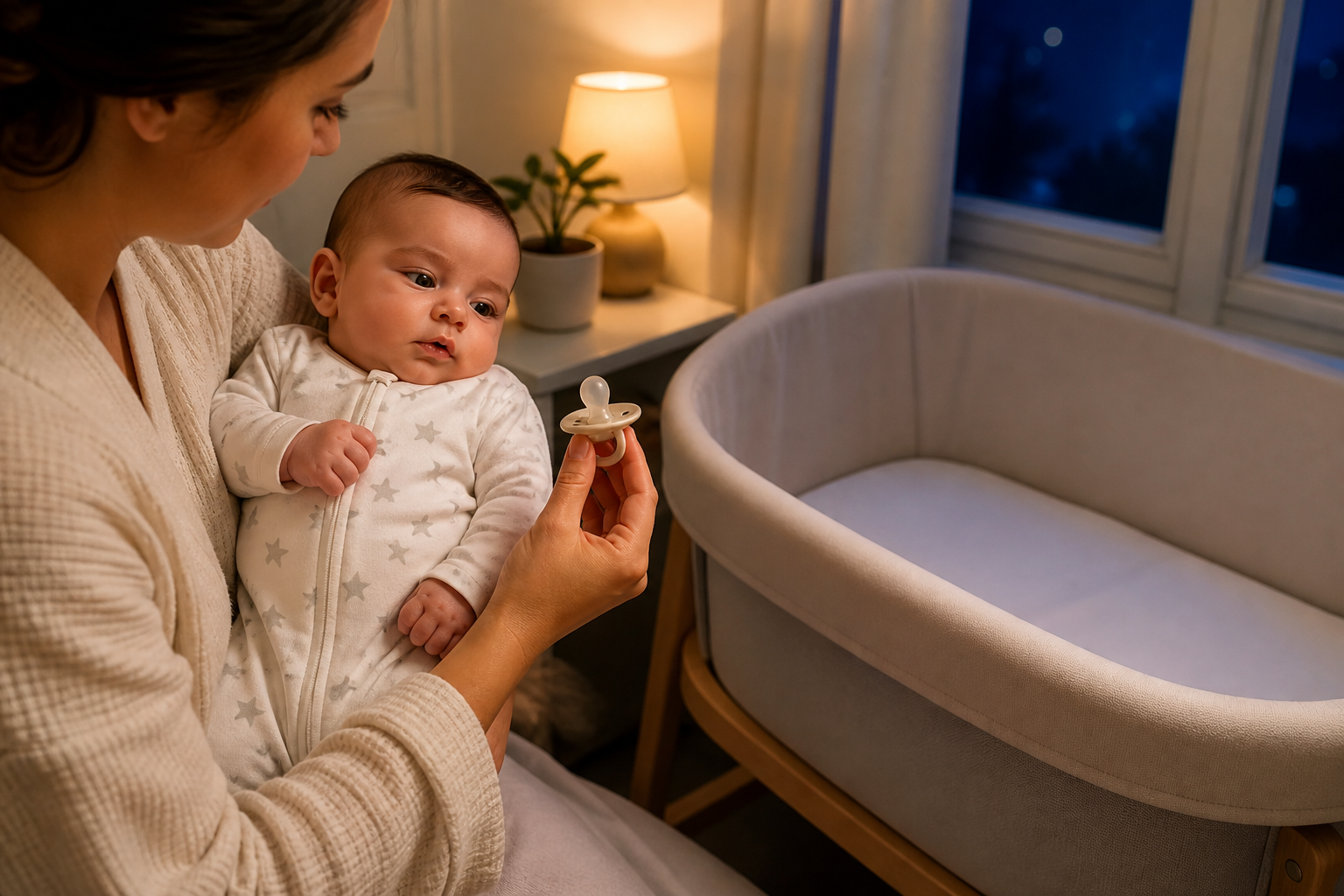
The dummy is on the cot sheet, your baby is finally asleep, and you are standing in the doorway wondering whether leaving it there is sensible or somehow the one detail every safe-sleep page expected you to know already.
Yes—a baby can sleep with a dummy or pacifier. I want my answer to stay attached to the condition that makes it useful: a clean, intact, standalone pacifier may be offered when you put your baby down for a nap or the night. It is associated with a lower risk of sudden infant death syndrome (SIDS), but it is optional, not a guarantee, and not a substitute for the bigger safe-sleep rules: place your baby on their back on a firm, flat, noninclined surface with the sleep space otherwise empty. If the dummy falls out after your baby is asleep, you do not need to put it back.
The private question beneath “can my baby sleep with a dummy?” is often not really about silicone. It is: Am I helping my baby settle, or have I accidentally made sleep less safe? I would answer that with a hierarchy. The sleep surface comes first. Feeding comes before soothing. The dummy is an optional extra that sits underneath both—not a device you have to keep in place all night.
Why a pacifier at sleep time may help
The American Academy of Pediatrics and the NIH Safe to Sleep campaign recommend offering a pacifier at naps and bedtime because pacifier use is associated with reduced SIDS risk. Researchers do not claim that a pacifier prevents every sleep-related death, and the exact protective mechanism is not fully settled. That uncertainty matters: the correct sentence is “may reduce risk,” not “makes sleep safe.”
The foundation remains boring in the best possible way: back for every sleep, firm and flat mattress, fitted sheet, no pillows, bumpers, loose blankets, positioners, stuffed toys, or inclined products. A dummy does not cancel out stomach sleeping, bed-sharing risk, overheating, smoke exposure, or an unsafe surface. I think of it as one small protective layer placed on top of a sleep setup that already passes inspection.
The sleep-safety stack
Build from the mattress up—not from the dummy down
- Surface: firm, flat, noninclined, and approved for infant sleep.
- Position: place baby on their back for every nap and night.
- Space: fitted sheet only; keep everything else out.
- Baby: comfortably dressed, smoke-free surroundings, feeding needs met.
- Optional dummy: offer it loose and standalone; do not force it.
If the first four layers are wrong, the fifth cannot repair them.
Can a newborn sleep with a dummy?
A newborn can sleep with a dummy, but feeding status changes the timing. If your baby is not directly breastfeeding, official guidance says you may offer one as soon as you like. If your baby is breastfeeding, wait until breastfeeding is well established. That does not need to mean circling an arbitrary date on the calendar. It means milk supply is adequate, feeding feels consistent and comfortable enough, your baby latches effectively, and weight gain is on track.
Some families reach that point around three or four weeks; others need longer. If feeds hurt, your baby is difficult to wake for feeds, nappies are unexpectedly dry, weight gain is uncertain, or you are using the dummy to stretch the time between feeds, pause the sleep experiment and speak with your pediatrician, midwife, health visitor, or lactation professional. A pacifier satisfies nonnutritive sucking. It does not provide milk.
I would ask one plain question before offering it to a newborn: Have I confidently ruled out hunger? Newborns do not read our bedtime plans, and they are unimpressed by the distinction between “comfort sucking” and “I would actually like dinner.” If feeding is due or cues are unclear, feed first. The dummy can wait five minutes without taking it personally.
Should I remove the dummy once my baby is asleep?
No. You do not need to remove it, and you do not need to replace it when it falls out. Offer it as you put your baby down; after sleep begins, let gravity make its own administrative decisions.
This is the detail I wish every short answer made enormous. Parents sometimes turn a recommendation to “offer a pacifier” into a new overnight job: watch monitor, notice empty mouth, creep in, replace dummy, repeat. Official guidance does not ask you to do that. The association with lower SIDS risk remains even if the pacifier falls out after your baby falls asleep.
If your baby wakes and clearly wants it, you may offer it again. But first check the ordinary possibilities: hunger, a wet or soiled nappy, temperature, illness, discomfort, or simply the end of a sleep cycle. A dummy is useful because it can soothe; it becomes exhausting when every wake is automatically treated as a missing-dummy emergency.
Clearly labeled composite scene
The 1:18 a.m. replacement service
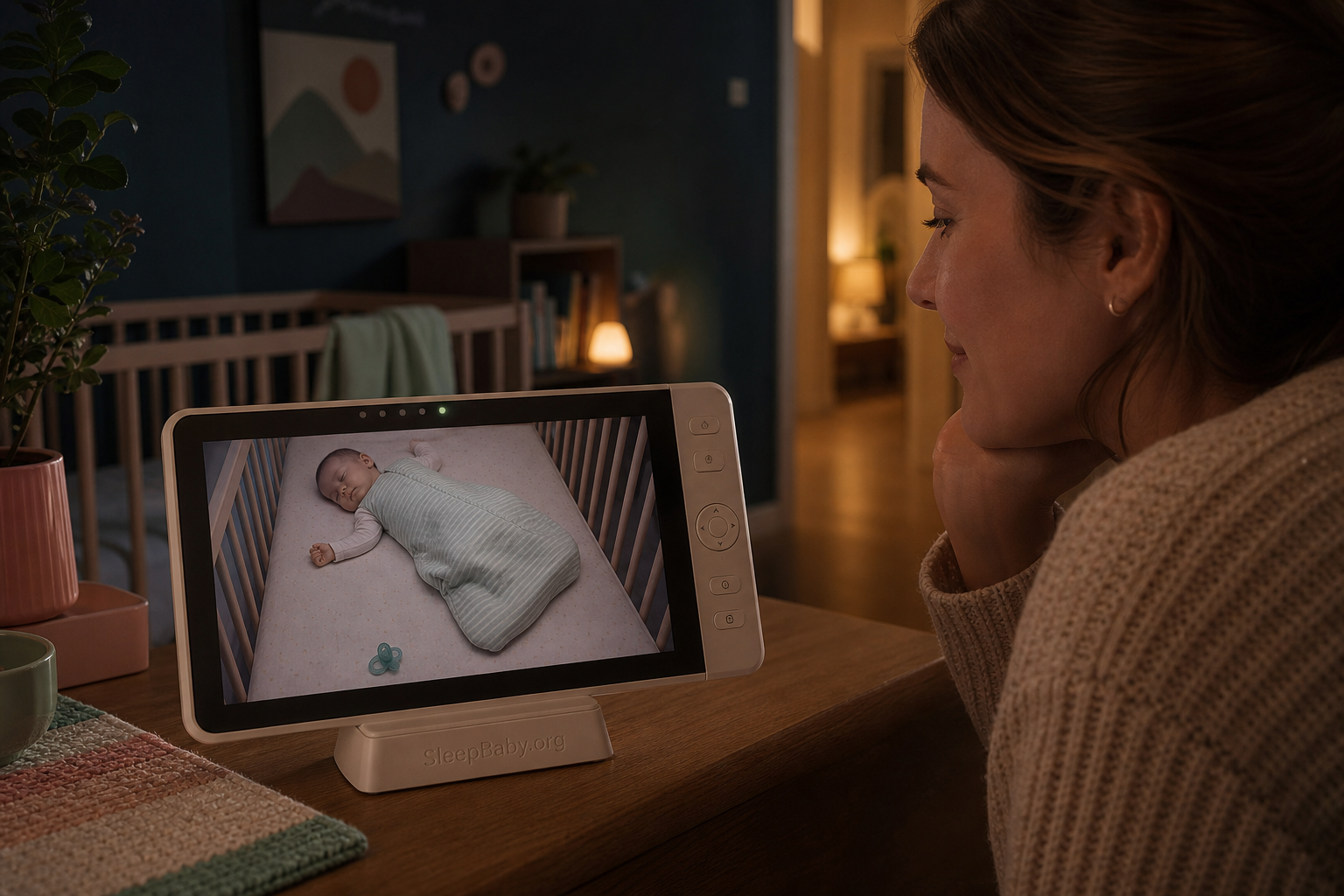
Imagine Benjamin asleep in his cot while I stare at the monitor and notice the dummy three inches from his cheek. He is peaceful. I am the only person in the house treating this as unfinished business. In that composite Kacey-and-Benjamin moment, the useful move is not to open the door and create a problem on behalf of a sleeping baby. It is to leave the dummy where it fell and let sleep continue.
The scene is illustrative, not evidence. The evidence comes from the AAP and NIH guidance: once the dummy falls out during sleep, it does not need to go back in.
What must never be attached to a sleep-time dummy?
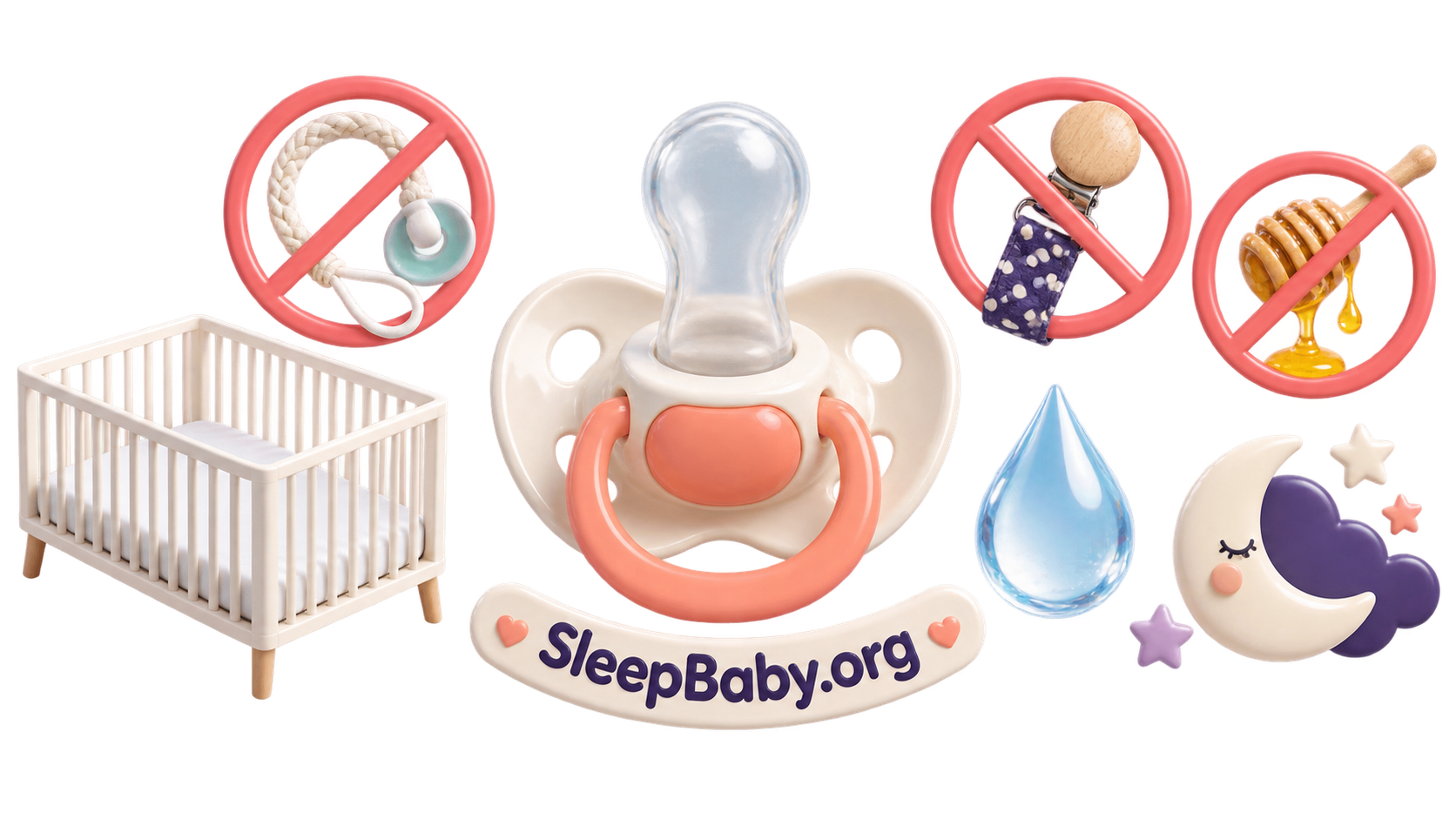
For sleep, use the pacifier by itself. Do not attach it to your baby’s clothing, sleep sack, hand, neck, blanket, stuffed animal, lovey, cot, or bassinet. No ribbons, strings, cords, chains, beaded clips, plush holders, or weighted pacifiers belong in an infant sleep space. Attachments can introduce strangulation, choking, entrapment, or suffocation hazards, and the CPSC specifically regulates pacifier attachments and small parts.
A clip can be convenient while your baby is awake and directly supervised, provided it meets applicable safety standards and is used exactly as directed. Bedtime changes the calculation. Unclip it before sleep. “But it is short” and “but it came with the pacifier” are not safety categories.
Do not coat the teat with sugar, syrup, juice, medicine, or honey. Honey is unsafe before 12 months because it can cause infant botulism, and the CDC explicitly says not to put it on a pacifier. Sweet coatings also add unnecessary sugar exposure and can damage teeth once they appear.
The ten-second bedtime inspection
- Clean?
Wash or sterilize according to age and manufacturer directions. - Intact?
Discard cracks, tears, stickiness, swelling, weak spots, or loose parts. - Correct size?
Use the age range and one-piece or safety-tested design intended for your baby. - Completely bare?
Remove every clip, cord, toy, cover, and coating before sleep.
Never use a bottle nipple as a pacifier; it can separate and become a choking hazard.
How do I choose, clean, and replace a sleep-time dummy?
I would choose the least complicated pacifier that fits your baby’s age and meets current safety standards. A one-piece design removes joints where parts might separate. The shield should be wider than your baby’s mouth and have ventilation holes. The teat should be resilient, without cracks, swelling, stickiness, bite marks, or a texture that has changed with heat and washing. “Orthodontic” describes a shape; it does not make prolonged use consequence-free or turn one model into a SIDS-prevention product.
Follow the manufacturer’s age range rather than assuming every teat and shield size works from newbornhood through toddlerhood. Replace pacifiers at the interval the manufacturer gives, and sooner if anything looks damaged. I would also check the CPSC recall database if a product cracks, separates, or behaves differently from the others in the pack. A pacifier is inexpensive enough that visible deterioration is not a repair project.
Cleaning depends on your baby’s age, health, and the product instructions. For a young infant, sterilize before first use and as directed by your pediatric clinician or manufacturer. Boiling, steam, or dishwasher cleaning is appropriate only when the specific pacifier is designed for it. Let it cool fully, squeeze out any trapped water with clean hands, and inspect the teat again. For an older healthy baby, routine washing with hot soapy water may be sufficient if the manufacturer allows it.
Do not “clean” a dropped dummy in your own mouth. That exchanges saliva and oral bacteria, which is not the reset it appears to be at 2 a.m. Keep a small rotation of clean pacifiers in a dry container so you are not making hygiene policy while half awake. I like systems that remove decisions from nighttime: one clean dummy by the cot, the used one into a separate dish, wash in daylight.
If the pacifier lands outside the cot, use a clean replacement rather than fumbling on the floor. If it remains on the bare fitted sheet, it can stay there. Never wedge it into your baby’s mouth, prop it with rolled fabric, or use a product designed to keep it positioned. The ability to fall away freely is part of why the setup stays simple.
A simple newborn pacifier worth considering
For a newborn in the 0–3 month range, the Philips Avent Soothie SCF190/01 two-pack is a more useful fit for this exact job than a pacifier-and-plush combination, clip, cord, or glow-in-the-dark attachment. Its one-piece silicone construction keeps the sleep-time setup deliberately plain, and the two-pack gives you a clean spare for the middle-of-the-night floor drop without encouraging you to reinsert a fallen dummy.
Buy it for the practical rotation, not as a sleep cure: check the marked age range, inspect it before every use, follow the cleaning and replacement instructions, and place only the unattached pacifier in the cot. Your baby may still refuse it, and that is completely fine.
See the Philips Avent Soothie 0–3m two-pack on Amazon
As an Amazon Associate, SleepBaby may earn from qualifying purchases.
What if my baby refuses the dummy?
Let them refuse it. The AAP and NIH guidance says to offer a pacifier, not to win a negotiation with one. Touch it gently to the lips and give your baby a moment. If they turn away, gag, become upset, or repeatedly push it out, stop. You can try again on another sleep, try an age-appropriate shape, or decide your baby is simply not interested.
I would not hold it in place until sucking starts. In my view, refusal is information rather than a problem I need to solve. That can make settling more stressful, and there is no requirement that every baby use a pacifier. Safe sleep is still safe sleep without one when the core environment is correct. Breastfeeding, smoke-free surroundings, immunization, room-sharing without bed-sharing, temperature control, and the firm-flat-empty setup remain meaningful risk-reduction layers.
Refusal can also be information. A baby who suddenly rejects a familiar dummy may be hungry, congested, teething, nauseated, uncomfortable, or simply finished with it. Look at the whole baby rather than treating the pacifier as a test they have failed. If the change comes with poor feeding, breathing difficulty, fever, unusual sleepiness, fewer wet nappies, or obvious pain, speak with a clinician.
Can a swaddled baby sleep with a dummy?
Yes, a swaddled baby may use a standalone pacifier, provided every swaddling and safe-sleep rule is also met. Place baby on their back. Keep the swaddle secure and away from the face. Do not add a clip or tether because the baby cannot use their hands to move it. Stop swaddling as soon as your baby shows signs of trying to roll; do not wait for a successful roll.
The dummy does not make side or stomach positioning safer, and it does not make a loose swaddle acceptable. If your baby rolls independently after swaddling has ended, continue placing them on their back at the start of every sleep. You do not need to repeatedly turn a baby who can roll both ways on their own, but the cot must remain empty.
What if my baby wakes every time the dummy falls out?
This is where a helpful tool can become a very demanding coworker. Younger babies often cannot find and replace a pacifier, so a strong sleep association may mean you are called in whenever it disappears. That is frustrating, but it is not proof that the dummy is harmful or that you must remove it tonight.
I would look at frequency and timing. My first question is whether I am seeing an occasional request or running a replacement service through every cycle. One or two replacements around normal transitions may be manageable. Replacing it every 20 to 45 minutes all night suggests the pacifier is doing nearly all the work of reconnecting sleep cycles. Before changing it, make sure hunger, illness, discomfort, schedule mismatch, and the sleep environment are not the real drivers.
For an older baby who can grasp and deliberately bring objects to their mouth, you can place several clean, appropriately sized pacifiers on the bare cot mattress at bedtime—without clips, cords, plush attachments, or glow accessories that create unsafe parts. Practice finding one during awake floor play. Do not place a pacifier into the cot with a newborn as an object to hunt for, and do not scatter products whose manufacturer instructions do not support sleep use.
If frequent waking is the larger problem, my next stop would be the guide to babies waking every hour. It helps separate normal sleep-cycle transitions from hunger, schedule pressure, discomfort, and a settling cue that has become too much work for everyone.
Is a dummy better than thumb sucking for sleep?
They are not equivalent in the safe-sleep evidence. NICHD notes that finger or thumb sucking has not been shown to reduce SIDS risk in the way pacifier use is associated with reduced risk. A pacifier also has one practical advantage: eventually, the adult can remove it from the routine. A thumb remains impressively attached to its owner.
That does not mean you should stop a baby from sucking their fingers. Hand-to-mouth behavior is normal, and once babies discover their hands they may use them for comfort. Keep hands free unless swaddling is still developmentally appropriate; never cover or restrain hands simply to prevent sucking. I would not replace every finger-sucking moment with a dummy or frame either behavior as misbehavior.
The later dental question is about intensity, frequency, and duration. Both persistent thumb sucking and prolonged pacifier use can affect the developing bite. Pacifiers may be easier to phase out, but a child who uses one briefly at sleep may have a different risk pattern from a child who keeps it in for much of the day. That is why I prefer “sleep-only, then gradually less” over a dramatic early ban.
If you are deciding which soothing method to encourage, choose the one your baby accepts without interfering with feeding, sleep safety, or family functioning. You do not need to interrupt natural finger discovery. You also do not need to keep offering a pacifier to a baby who consistently declines it. The aim is not to manufacture independence through a sucking tool; it is to offer comfort within safe boundaries.
How long should a baby use a dummy?
There is no need to remove a pacifier in early infancy merely because your baby likes it. The risk-and-benefit balance changes later. The American Academy of Pediatric Dentistry notes that pacifier use after 12 months can increase the risk of acute ear infections, while use beyond 18 months can influence the developing mouth and bite. It encourages stopping nonnutritive sucking habits by 36 months.
That does not mean a birthday creates an emergency. It means the second year is a sensible time to move from “available whenever” toward “sleep times only,” then gradually reduce. Daytime removal is often the easiest first step because it protects opportunities for babbling, talking, eating, and exploring without taking away the strongest sleep association all at once.
I would avoid a sudden pacifier eviction during illness, travel, a new sibling’s arrival, or another major sleep disruption unless a clinician has identified an urgent reason. Pick a calmer week. Keep the bedtime sequence stable, choose another comfort cue—song, phrase, brief cuddle, hand on chest—and expect feelings without treating them as evidence the plan is wrong.
When the dummy question deserves professional advice
A pacifier question is rarely urgent by itself. The surrounding signs can change that. Contact your pediatric clinician or feeding professional if your baby is not feeding effectively, has fewer wet nappies than expected, is not gaining weight, repeatedly coughs or chokes with feeds, has persistent mouth sores or thrush, or seems to need the dummy to postpone every feed.
Ask a pediatrician or pediatric dentist about repeated ear infections, changes in the bite or palate, damaged teeth, or a pacifier habit that remains intense as your child approaches age three. Stop using a pacifier immediately if it is cracked, torn, sticky, swollen, separating, recalled, or has a loose component.
Seek urgent medical help for breathing difficulty, blue or gray color, unusual limpness, inability to wake normally, or choking that does not quickly clear. Remove the pacifier only if it is visibly obstructing the airway and follow emergency guidance. Do not let a sleep-soothing explanation delay assessment of a baby who looks unwell.
Official safe-sleep video
See where the dummy fits—and where it does not
I use this official NIH Safe to Sleep video to put the dummy back in its proper place: after the back position and the clear sleep space, never before them. The written safety guidance above remains complete if you do not play the video.
Pacifier takeaway: notice the order—back, firm and flat, empty space, then an optional clean standalone dummy. If you prefer text, read the official NIH transcript.
What I would do tonight
- Confirm your baby is fed and the sleep surface is firm, flat, and empty.
- Inspect a clean, intact, age-appropriate pacifier and remove every attachment.
- Place your baby on their back and offer the pacifier without forcing it.
- If it falls out after sleep begins, leave it out unless your baby wakes and you choose to offer it again.
- If replacements dominate the night, observe when wakes happen before deciding whether to reduce the association.
That dummy on the cot sheet is not an unfinished task. If your baby is asleep on their back in a safe, empty sleep space, it can stay exactly where it landed. The change is small, but the meaning is useful: you offered comfort; you did not sign up to hold sleep together one pacifier replacement at a time.
When the dummy is not the whole night
Build a bedtime plan that still works after it falls out
If pacifier replacements have turned your hallway into a night shift, SleepBaby can help you look beyond the missing dummy—at timing, settling cues, and the parts of the routine that can carry more of the load without promising a perfect night.
Sources
- American Academy of Pediatrics: Safe Sleep—9 Ways to Reduce SIDS and Suffocation Risk
- American Academy of Pediatrics: How to Keep Your Sleeping Baby Safe
- American Academy of Pediatrics: Baby Pacifiers and Thumb Sucking
- NIH Safe to Sleep: Ways to Reduce Baby’s Risk
- American Academy of Pediatric Dentistry: Policy on Pacifiers
- U.S. Consumer Product Safety Commission: Pacifier and Teether Clips
- CDC: Foods and Drinks to Avoid or Limit