

This guide is about infant sleep during the first year. Older toddlers have different sleep-space needs.
Your baby may seem to sleep better in your bed because your closeness keeps familiar cues—touch, voice, warmth, movement, and a quick response—from disappearing all at once. The adult mattress is not the safe part: keep baby close on a separate, firm, flat, level, bare infant sleep surface, then notice whether the waking starts during lowering, when your hands leave, or a few minutes later.2 4 6
That is the answer I want you to have before the internet hands you twelve definitions of “co-sleeping” and a transfer countdown timed like a televised rocket launch.
At 2:13 a.m., though, even a good safety sentence can feel very far away from the baby in your arms.
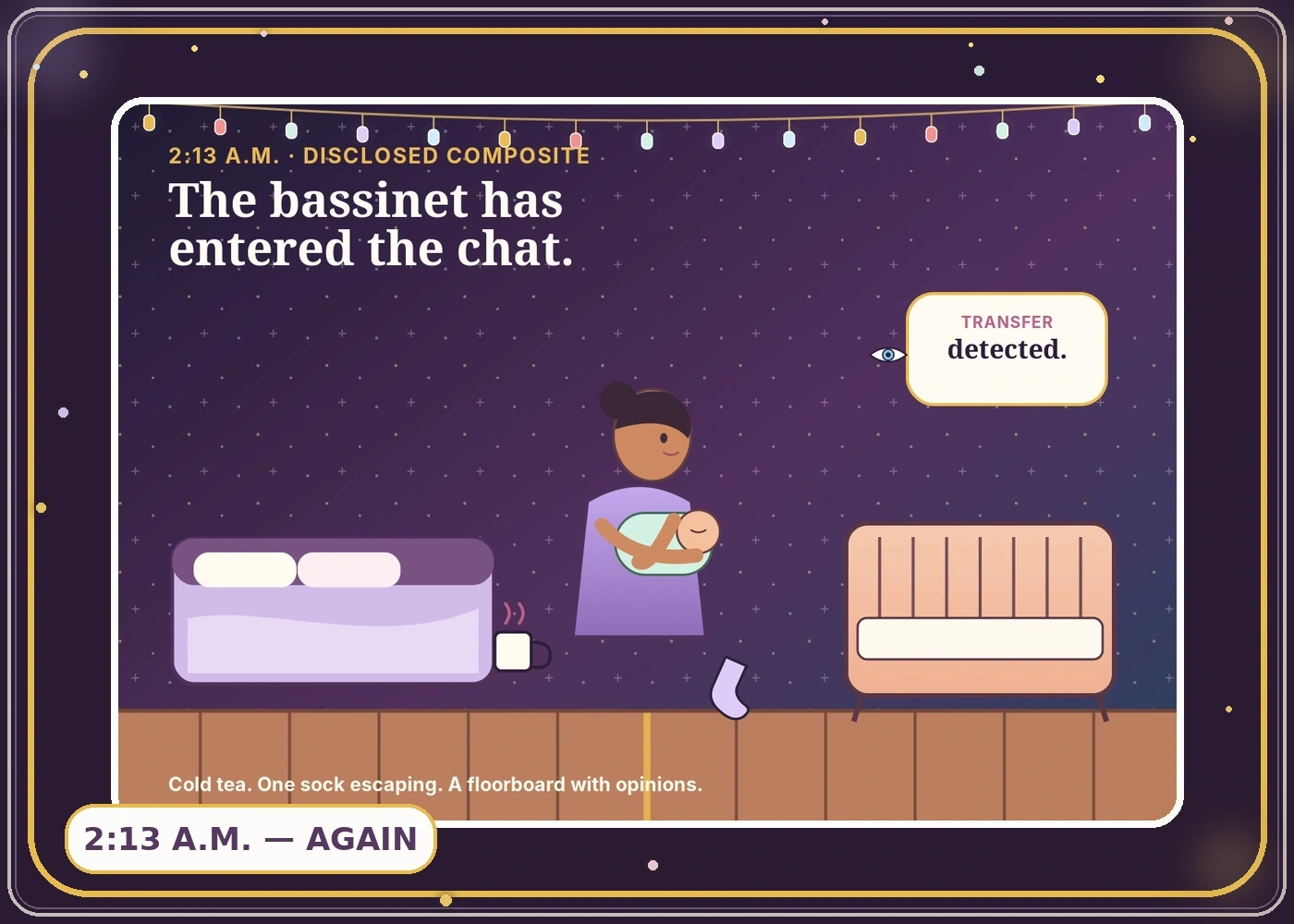
In the disclosed composite scene I kept returning to while building this guide, a mother has one cold cup of tea, one sock slowly surrendering, a damp patch on the shoulder of her pajama top, and a bathroom trip she has postponed because the baby finally went loose and peaceful against her chest. She takes three careful steps toward the bassinet. The floorboard announces the transfer like a stage manager. Two eyes open. Back in her awake arms, the tiny shoulders soften again.
That scene is a clearly disclosed composite drawn from a common pattern exhausted families describe. It is not a quotation, a customer story, an author biography, or one mother’s literal testimony.
I understand why the adult bed starts to feel like the only thing that “works.” Your baby is not grading mattresses. They are reacting to a bundle of familiar cues—and to the sudden loss of those cues when you put them down.
The distinction that steadies the rest of this article is simple:
The bed did not win. The bundle did.
You can keep much of the bundle while changing the surface.

Why your baby may settle better in your bed
There is rarely one secret ingredient in an adult bed. Several differences happen at once.
There may be no transfer at all
If your baby fed, cuddled, or fell asleep beside you, the adult bed removes the “landing.” There is no lowering through cooler air, no shift from curved arms to a flat surface, no hands sliding away, and no bassinet frame choosing midnight to audition for the percussion section.
That does not prove your baby needs an adult mattress. It means the transfer itself may be the hardest part.
Your response arrives earlier
When your baby is inches away, you may notice a wiggle, rooting movement, or soft complaint before it becomes a full cry. You can respond with a quiet phrase, touch, or feed almost immediately.
In another room—or during a longer walk from chair to crib—the same small stir may become a complete waking before you arrive. The night can therefore feel smoother in the adult bed even when part of the difference is how quickly the waking was noticed.
That smoother feeling is real. It just does not tell us that the adult sleep surface is safe for an infant.
Familiar sensory cues stay together
Your baby may have fallen asleep with your voice nearby, your hands supporting them, your movement, and the smell of a familiar caregiver. Small newborn studies have found that babies can respond to maternal or familiar odors, including reduced crying in some experimental situations. Those studies do not show that a worn shirt belongs in a crib, that scent makes sleep longer, or that an adult bed is safer.1
The safest way to keep your scent in the bedtime experience is to keep the shirt on the grown-up: hold, feed, speak, and settle while you are awake, then place baby in the separate sleep space with nothing loose added.
The new surface may feel like a large scene change
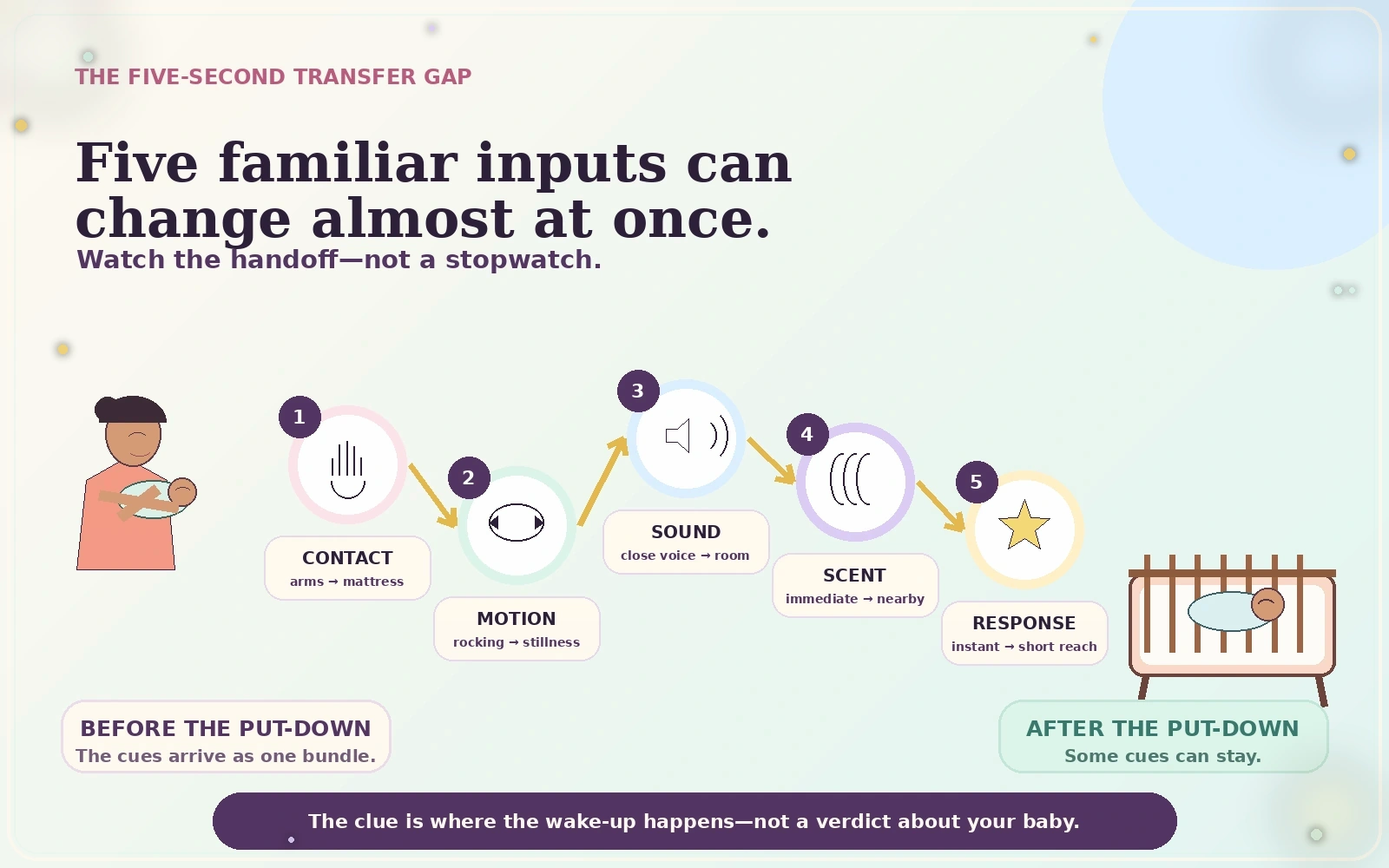
A sleepy infant can experience several changes within seconds: contact disappears, motion stops, sound shifts, the temperature around the skin changes, and the response is no longer immediate. A startle, squirm, or wake-up does not mean the crib is emotionally wrong. It means the handoff was noticeable.
I would not translate that wake-up into “my baby feels abandoned” or “I created a bad habit.” A baby can prefer closeness without making a moral argument about your bassinet.
| What changes | Why it may feel easier | What it does not prove |
|---|---|---|
| No put-down | Baby never crosses from arms to a new surface. | That an adult mattress is needed or safe. |
| Faster response | A small stir may be answered before it becomes a full wake-up. | That the sleep is deeper or more restorative. |
| Cues stay bundled | Touch, motion, voice, scent, and response do not change all at once. | That loose fabric, extra padding, or shared sleep should be copied. |
| Shorter distance | Feeding, comforting, and monitoring are easier. | That baby must share the adult sleep surface to stay close. |
The adult bed is not the safe part
Here is the no-joke boundary.
The American Academy of Pediatrics recommends that infants sleep on their backs for every sleep, on a firm, flat, noninclined surface designed for infant sleep, with only a fitted sheet. It recommends room-sharing without bed-sharing, ideally for at least the first six months; room-sharing remains protective through the first year.2 5 HealthyChildren’s current parent guidance says to room-share for at least six months and preferably up to one year.6
The CDC and Safe to Sleep® give the same core direction: back for every sleep; a firm, flat, level surface; a fitted sheet only; no pillows, blankets, toys, bumpers, positioners, cloths, or other soft or loose items.3 4
Adult mattresses are built for adult bodies and adult bedding. They can be softer, have gaps or edges, and be surrounded by pillows, comforters, sheets, people, pets, or walls. Sofas and armchairs are especially dangerous if an adult dozes while feeding or comforting a baby. Sitting devices are not routine infant sleep spaces either; a sleeping baby should be moved to a firm, flat sleep surface as soon as practical.2 4
This is not a judgment on how loving, responsive, desperate, or exhausted a parent is. It is a boundary around the sleep surface.
Room-sharing and bed-sharing are not the same thing
These terms get blurred online, so I prefer plain language:
- Room-sharing means baby sleeps in the same room as the caregiver, near the adult bed, on a separate infant sleep surface.
- Bed-sharing or surface-sharing means baby shares the adult mattress or another sleep surface with an adult, child, or pet.
The word “co-sleeping” can mean either arrangement, which is why it often creates confusion. In this article, I will name the actual arrangement.
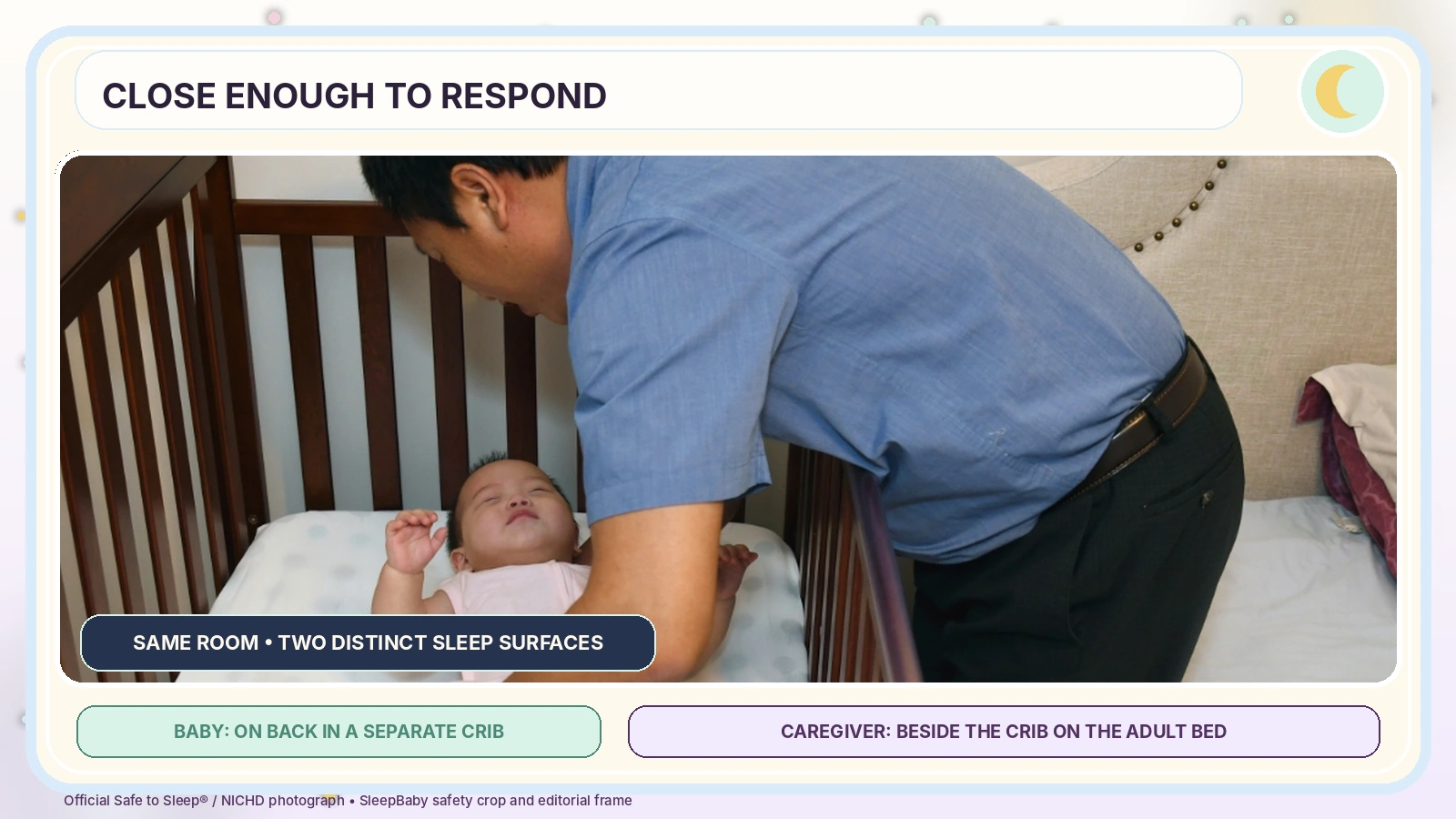
Room-sharing preserves much of what parents are seeking: closeness, easier feeding, quicker comforting, and a shorter path to a stir—without placing the baby on the adult mattress. The AAP evidence review notes that room-sharing facilitates feeding, comforting, and monitoring while avoiding risks created by the adult sleep surface.5
A product name is not a safety shortcut. A bedside sleeper is a defined CPSC-regulated product category that attaches to the side of an adult bed and must meet the applicable federal standard.14 That is not the same as an unregulated “sidecar,” nest, lounger, or in-bed sleeper. The AAP says evidence is still insufficient to recommend for or against devices promoted to make bed-sharing safe, and any infant sleep product must at minimum meet the federal standard that applies to its category.2 5 6
The infant space should look deliberately simple:
- The product’s own properly fitted mattress or pad.
- A fitted sheet made for that product.
- Baby placed on their back.
- No pillow, blanket, quilt, bumper, stuffed animal, lovey, positioner, wedge, towel roll, nest, loose cloth, non-fitted sheet, or mattress topper.
- No weighted blanket, weighted swaddle, or weighted sleep sack.
The bareness can feel emotionally wrong because adults use softness to say “welcome.” Infant sleep safety uses emptiness to say “protected.”

Keep the closeness and change the surface
I do not want the safer plan to sound like this: remove every comforting cue, place the baby far away, and hope independence appears by sunrise.
Room-sharing gives you a third option. Your baby can still hear you. You can answer quickly. You can feed and settle close by. The change is not “parent disappears.” The change is “baby’s sleeping body lands on a surface made for infant sleep.”
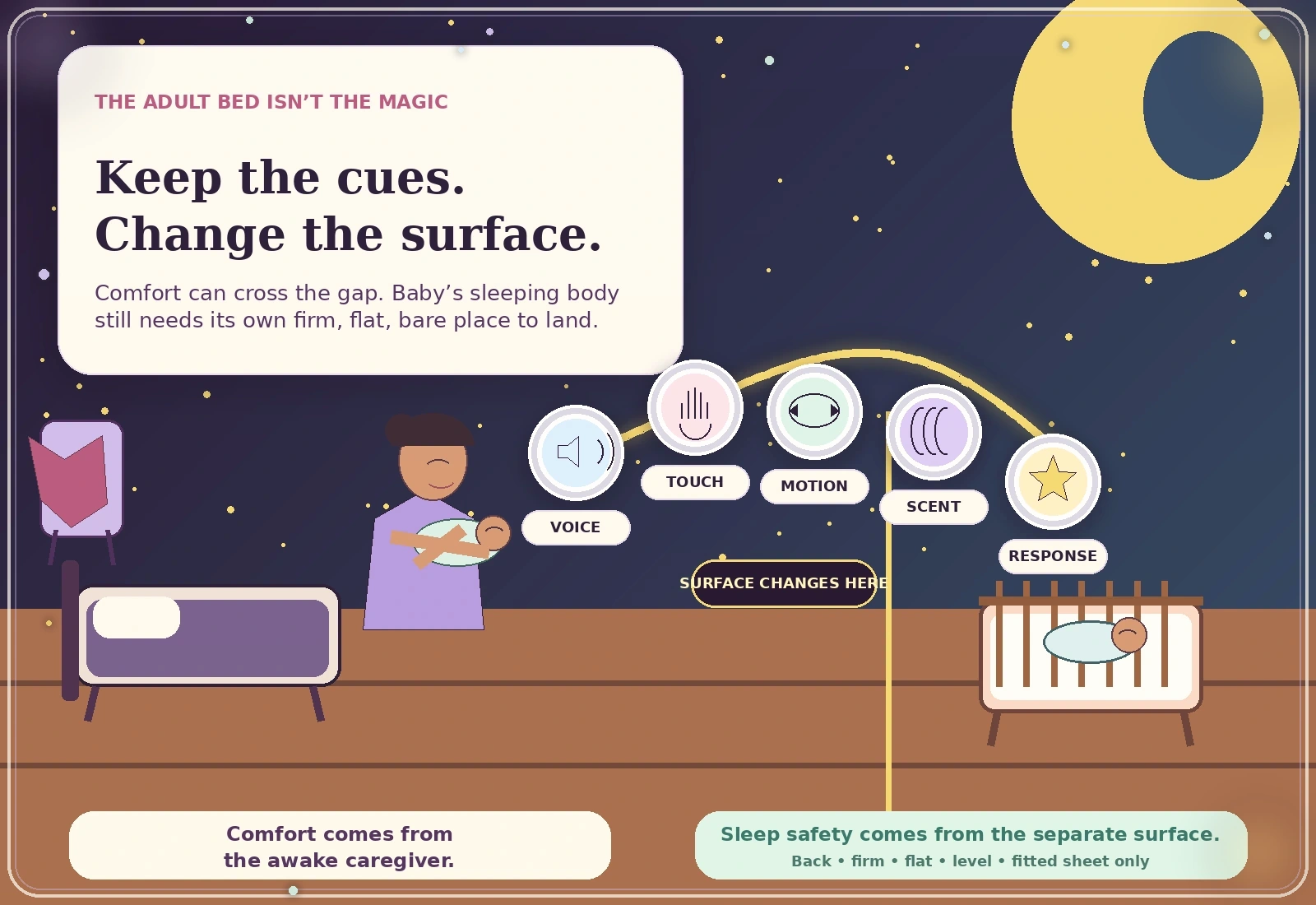
Think of the distance between your mattress and the bassinet as a small bridge. Some comfort cues can cross it safely because they come from an awake caregiver or the room. Other things must stop at the edge because they would become loose objects or unsafe sleep surfaces.
Can cross the gap
- Your voice or the same quiet phrase.
- Your nearby presence while you remain awake.
- A brief, light hand on baby’s torso or shoulder while you remain awake, then removed before you sleep or walk away.
- Appropriate sleep clothing for the room and developmental stage.
- A calm, repeatable sequence and quick response to early stirring.
Stops at the edge
- Your shirt, bra pad, blanket, pillowcase, or scented cloth left in the crib.
- A heating pad, hot-water bottle, electric blanket, or preheated mattress.
- A pillow, wedge, nest, lounger, bumper, toy, towel roll, or positioner.
- A mattress topper or extra layer meant to imitate the adult bed.
- Your own sleeping body on the same surface.
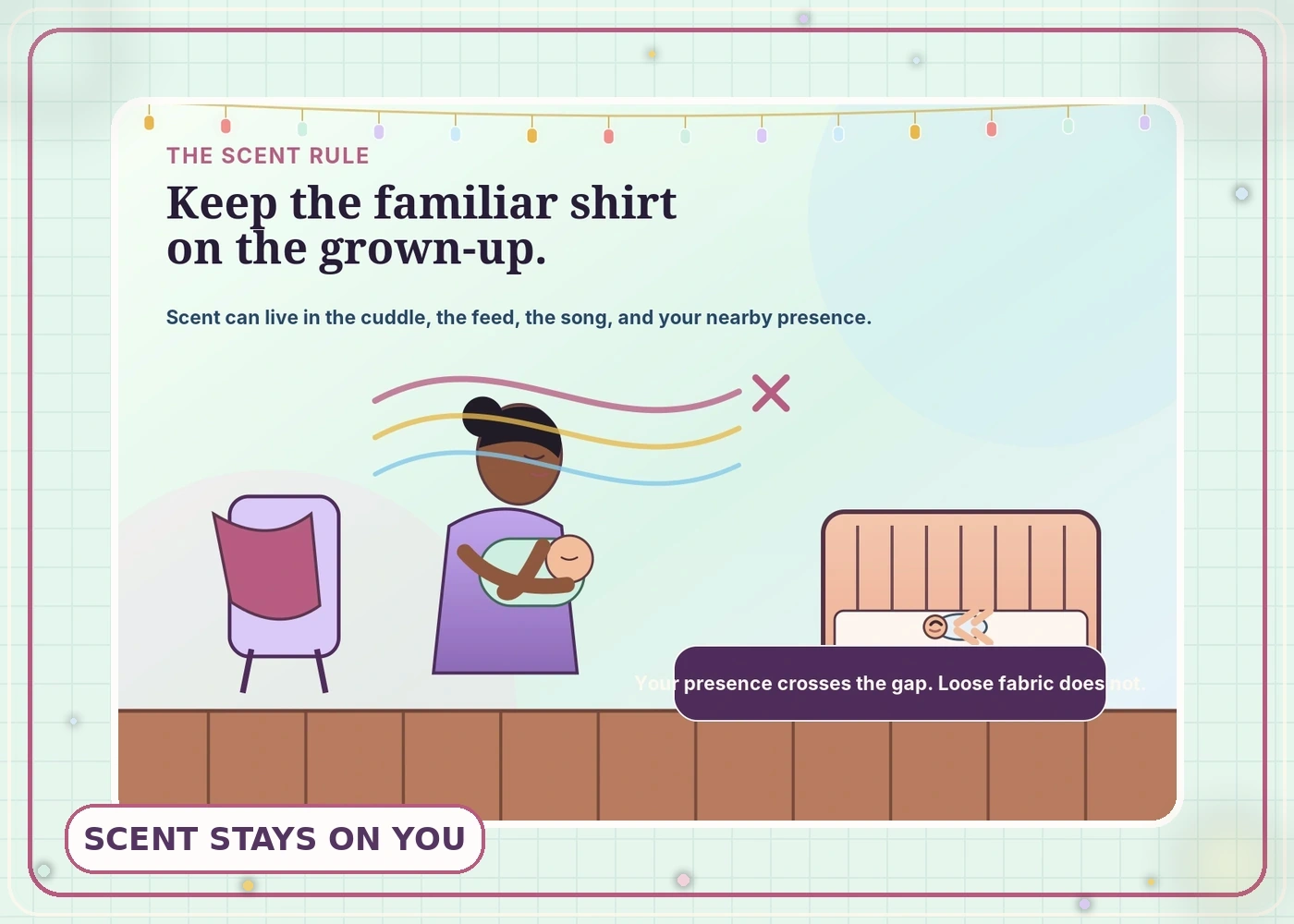
“Keep the closeness, change the surface” is not a slogan asking you to love your baby from farther away. It is a practical design rule: comfort comes from the caregiver; sleep safety comes from the separate surface.
The five-cue handoff
When a baby wakes during every put-down, parents often change ten things at once: new sound, new swaddle, later bedtime, warmer room, longer rocking, different feed, another gadget. By the third night, nobody knows what helped.
If you are reading this with milk drying on one shoulder, your phone at 4%, and the bathroom still waiting, you do not need a twelve-step protocol. You need one clue you can notice while tired.
Name the five parts of the handoff:
- Contact: arms, chest, or hands are supporting the baby.
- Motion: rocking, walking, bouncing, or feeding rhythm is present.
- Sound: your voice and breathing are close.
- Scent: the familiar caregiver is immediate.
- Response: a small stir gets an answer quickly.
Your goal is not to erase all five. It is to keep one or two safe cues steady while changing the surface.
You might stop walking before the transfer but keep the same phrase. You might bring the bassinet close enough that you can respond before the stir grows. You might practice one put-down while fully awake, then stop rather than repeating until everyone is frantic.
That is a gentler experiment than trying to make the crib imitate an adult bed.
Here is the part I wish tired parents were told more often: a wake-up has timing. You are not trying to turn your baby into a lab project or decode every sigh. You are catching the moment the bundle changes.
Before you choose a cue, run the 30-Second Handoff Filter. It prevents a transfer experiment from swallowing a feeding need, a health change, or the moment your own alertness is gone.
Only after the need and alertness checks are clear should you change one caregiver cue. The sleep surface does not enter the experiment.
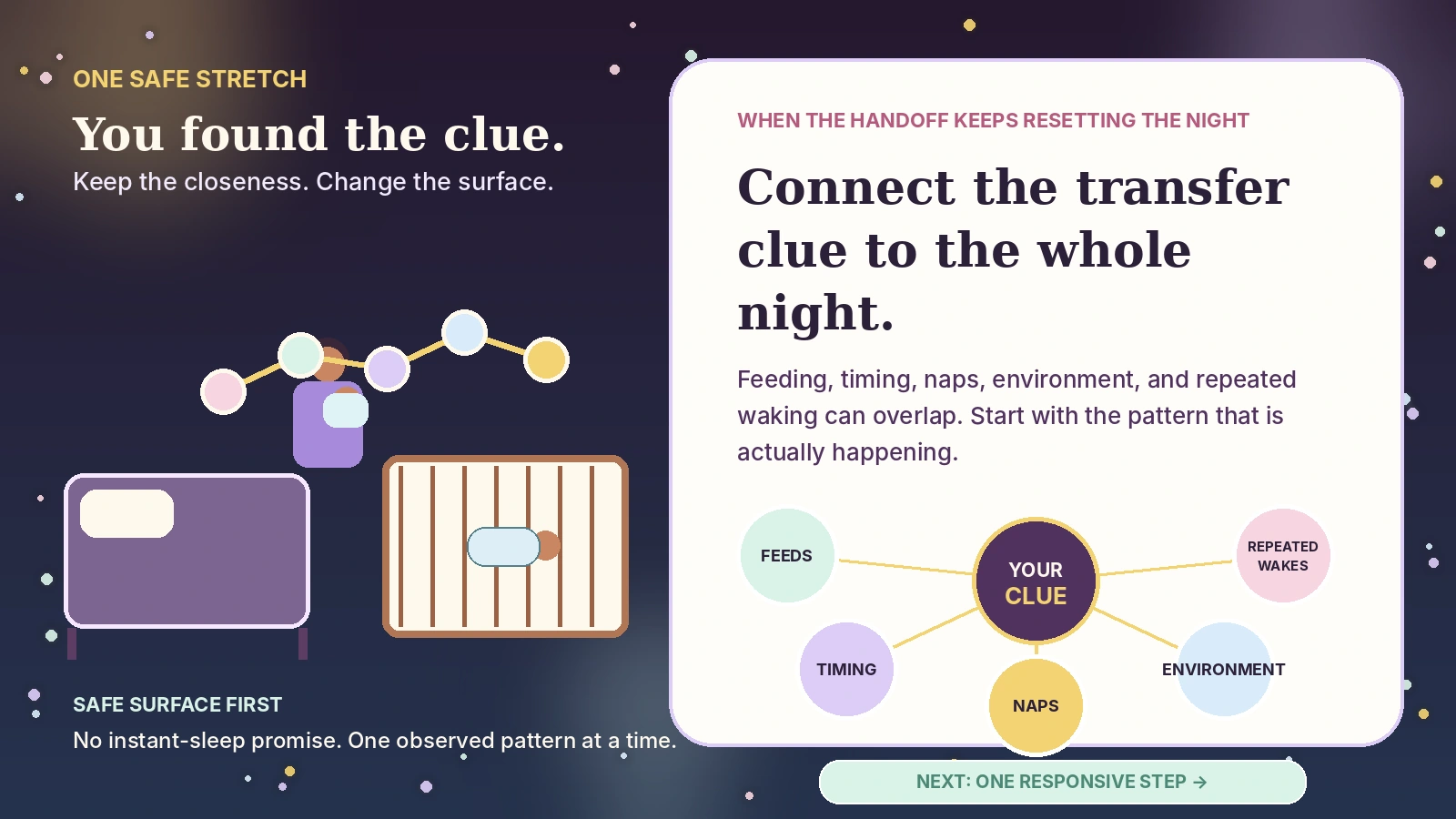
The Transfer Clue Compass starts at the same three checks, then turns the timing of the wake-up into one quick choice. The accessible table immediately below gives the same guidance in words.
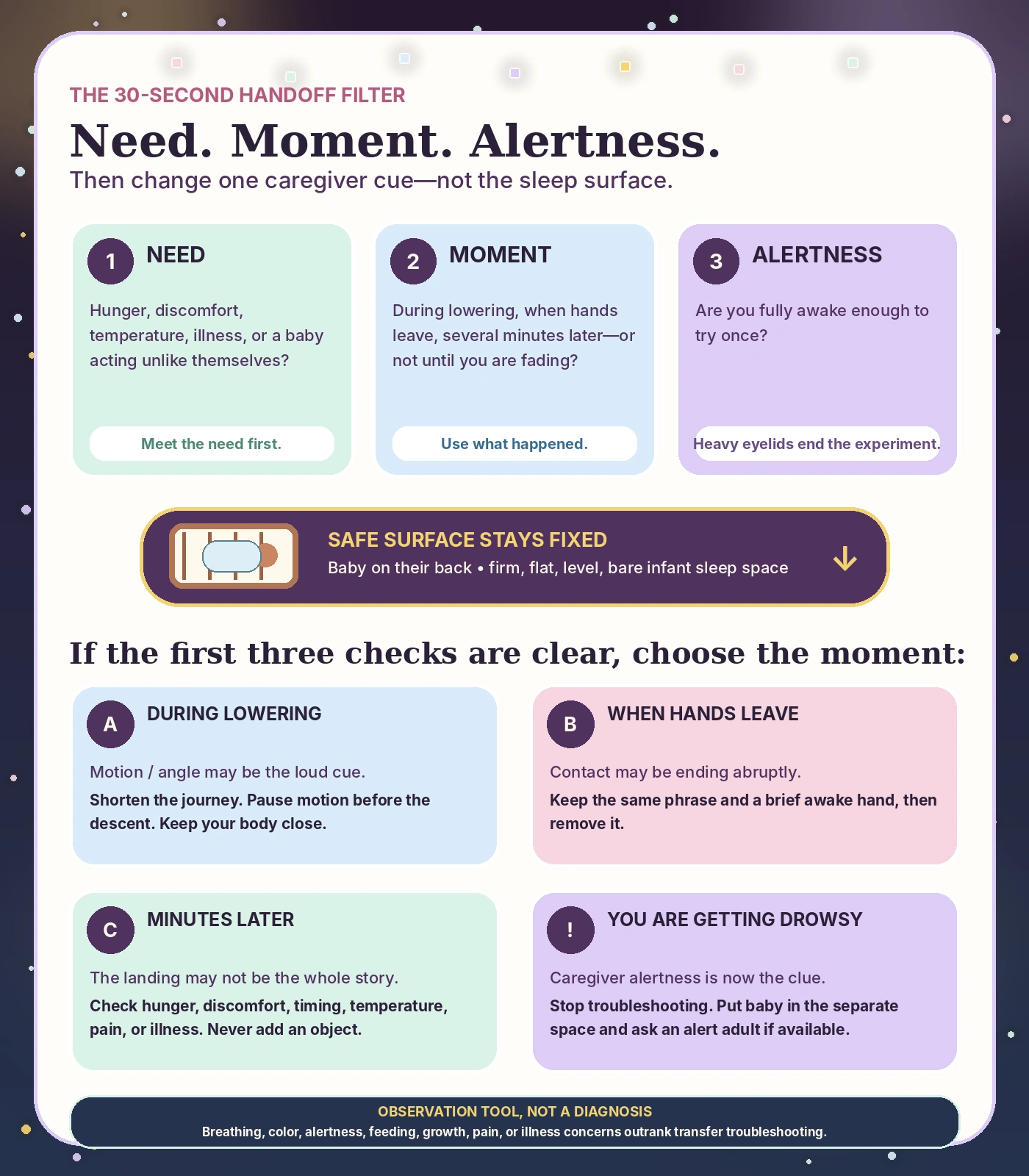
| What you notice | Check first | Cue that may be changing | One safer next move |
|---|---|---|---|
| Baby wakes during lowering | Baby’s basic needs are met and you are fully alert. | Motion, angle, or the speed of the transition. | Shorten the journey; pause the rocking before the put-down; keep your body close during the descent. |
| Baby wakes when your hands leave | Baby’s basic needs are met and you are fully alert. | Contact ends abruptly. | Use the same quiet phrase and a brief light hand while you remain awake, then remove it. |
| Baby wakes several minutes later | Hunger, discomfort, temperature, illness, pain, and feeding adequacy before assuming the landing caused it. | Timing or an ordinary sleep transition may matter more than the put-down. | Meet the need or seek guidance; do not change the mattress or add an object. |
| You are losing alertness | No further troubleshooting. | Caregiver alertness—not baby behavior—is now the decisive signal. | Place baby on their back in the separate sleep space and get another alert adult involved if available. |
This is an observation tool, not a diagnostic test. Breathing, illness, pain, feeding, or growth concerns belong with a healthcare professional; urgent signs belong with emergency care.
What the adult-bed preference does not prove
It does not prove your baby needs a softer mattress. It does not prove the crib is too “empty.” It does not prove you ruined independent sleep. It does not prove attachment requires sharing a mattress. And it does not prove that waiting for a mythical minute of “deep sleep” will make every transfer work.
Attachment is not a mattress endorsement.
Babies can need feeding, holding, reassurance, and responsive care while still needing a separate safe sleep surface whenever the caregiver may sleep.
What to keep—and what not to copy
A useful plan separates the cue from the object.
The 2 a.m. advice translator
At 2 a.m., internet advice often arrives disguised as an object: a shirt, a warmer mattress, an extra layer, a timer. Before you copy it, ask one question: Is this preserving a caregiver cue—or adding something to the sleep surface?
Keep the cue. Reject the object.
Four common tips, translated for a safer sleep surface
“Make the bassinet smell like you.”
“Warm or soften the mattress so it feels like your bed.”
“Wait exactly 20 minutes before putting baby down.”
The clue: timing can change which part of the handoff baby notices.
Safer translation: use the Transfer Clue Compass instead of a universal countdown. Try once only while fully awake; heavy eyelids end the experiment and point back to the separate safe surface.
“Stop responding or you’ll create a bad habit.”
The clue: a predictable sleep start can make the handoff easier to read.
Safer translation: keep one responsive cue steady—your phrase, nearby presence, or brief awake touch—and change only one cue gradually. Responsiveness and a separate infant sleep surface can coexist.
The filter: Keep the cue. Reject any object, padding, heat source, or sleeping adult body added to the sleep surface.
Keep your scent attached to you
You may see advice to sleep with a crib sheet first, place a worn shirt near the baby, or tuck a cloth into the bassinet. Do not place those items in an infant sleep space. Safe to Sleep® specifically includes non-fitted sheets, loveys, and lightweight cloths among items that should stay out.4
If familiar scent seems soothing, use it through your awake presence: hold your baby, sit close, speak softly, and transfer them without leaving fabric behind.
Keep warmth in clothing, not the mattress
A cooler surface may be one noticeable part of the handoff, but do not place a heating pad, hot-water bottle, electric blanket, or other heating object on an infant sleep surface. Use season-appropriate sleep clothing, keep baby’s head uncovered indoors, and follow product and pediatric guidance for your baby. Never add a loose blanket or weighted product to solve a temperature worry.2 6
Keep movement in the settling, not in an inclined sleep product
You can rock or sway while awake, then place baby on the flat sleep surface. Do not use an inclined sleeper, lounger, swing, car seat, or other sitting device as the routine destination for sleep. If baby falls asleep in a sitting device, move them to their regular firm, flat sleep space as soon as practical.4
Keep the response, not a promise of silence
A nearby bassinet does not guarantee no crying. It shortens the route between a stir and your response. That is valuable even when baby still needs help.
The practical question is not “Can I make my baby never notice the crib?” It is “Can I make the handoff safer, smaller, and more predictable?”

Try one safer transfer: Close, Lower, Linger
This is not a sleep-training system and it is not a guarantee that the first transfer will hold. It is a three-move practice for one sleep when the caregiver is fully awake. A plan that only works for a well-rested adult in matching pajamas is not a plan for 2:13 a.m.
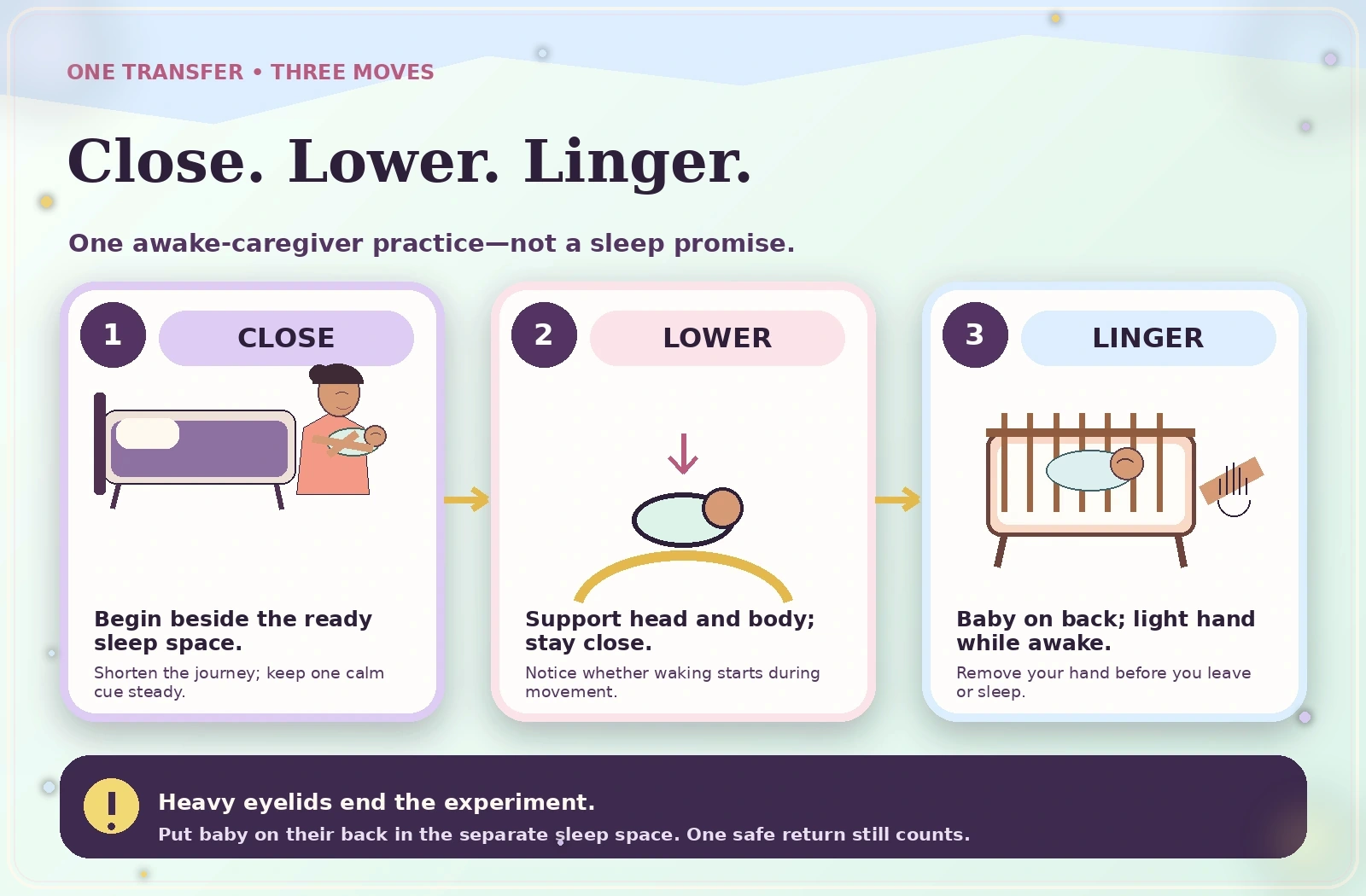
1. Close
Settle your baby close to the separate sleep space so the final journey is short. Feed if baby is hungry. Burp, change, or address discomfort as needed. Keep lights low and the sequence simple.
Choose the easiest sleep of the day or night for the experiment—not necessarily the most chaotic waking. One workable transfer teaches you more than six desperate repetitions.
Before you begin, make sure the sleep space is ready: correct mattress, fitted sheet, no loose items, and appropriate sleep clothing. If you use a swaddle, always place baby on their back and stop swaddling as soon as they show signs of trying to roll; weighted swaddles are not safe.6
2. Lower
Support your baby’s head and body and move slowly enough that the handoff is not a sudden drop. Keep your body close for most of the descent instead of reaching with locked arms from far above the mattress.
There is no universal magic angle, body-part order, or countdown. Watch your baby. If the wake-up happens during the descent, the motion change may be the loudest cue. If the wake-up happens only when your hands leave, the loss of contact may be the loudest cue.
3. Linger
After baby is on their back, keep a light, steady hand briefly on the torso or shoulder while you remain awake. Use the same low phrase or hum. Then remove your hand before you leave or sleep.
The linger is not a restraint, and no object takes your hand’s place. It is simply a softer ending to the transfer.
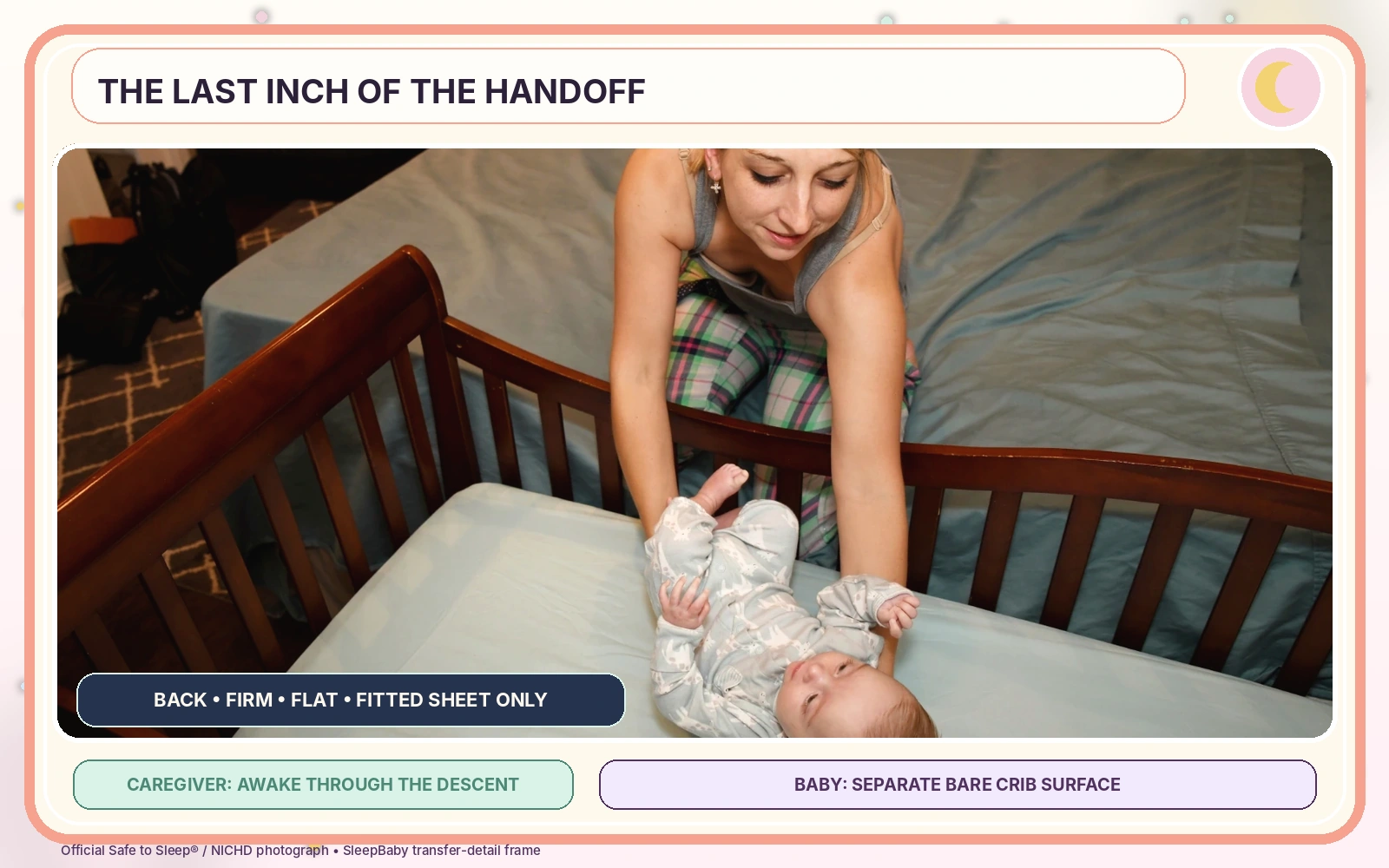
If baby wakes, you have information—not a failed exam. Soothe, feed, or reset as needed. Try again another time. If you are becoming frustrated or sleepy, stop the experiment and put safety first.

Keep a three-line note, not a surveillance novel
After one attempt, write only:
- Where did the wake-up happen? During lowering, when hands left, or later?
- Which safe cue stayed steady? Voice, nearby presence, light touch, or quick response?
- What will I repeat once? One small change, not a whole new bedtime personality.
That is enough information to make the transfer less mysterious without turning your nightstand into mission control.
Adjust the plan for your baby’s age
Age changes what is realistic. It does not change the safe-surface rule.
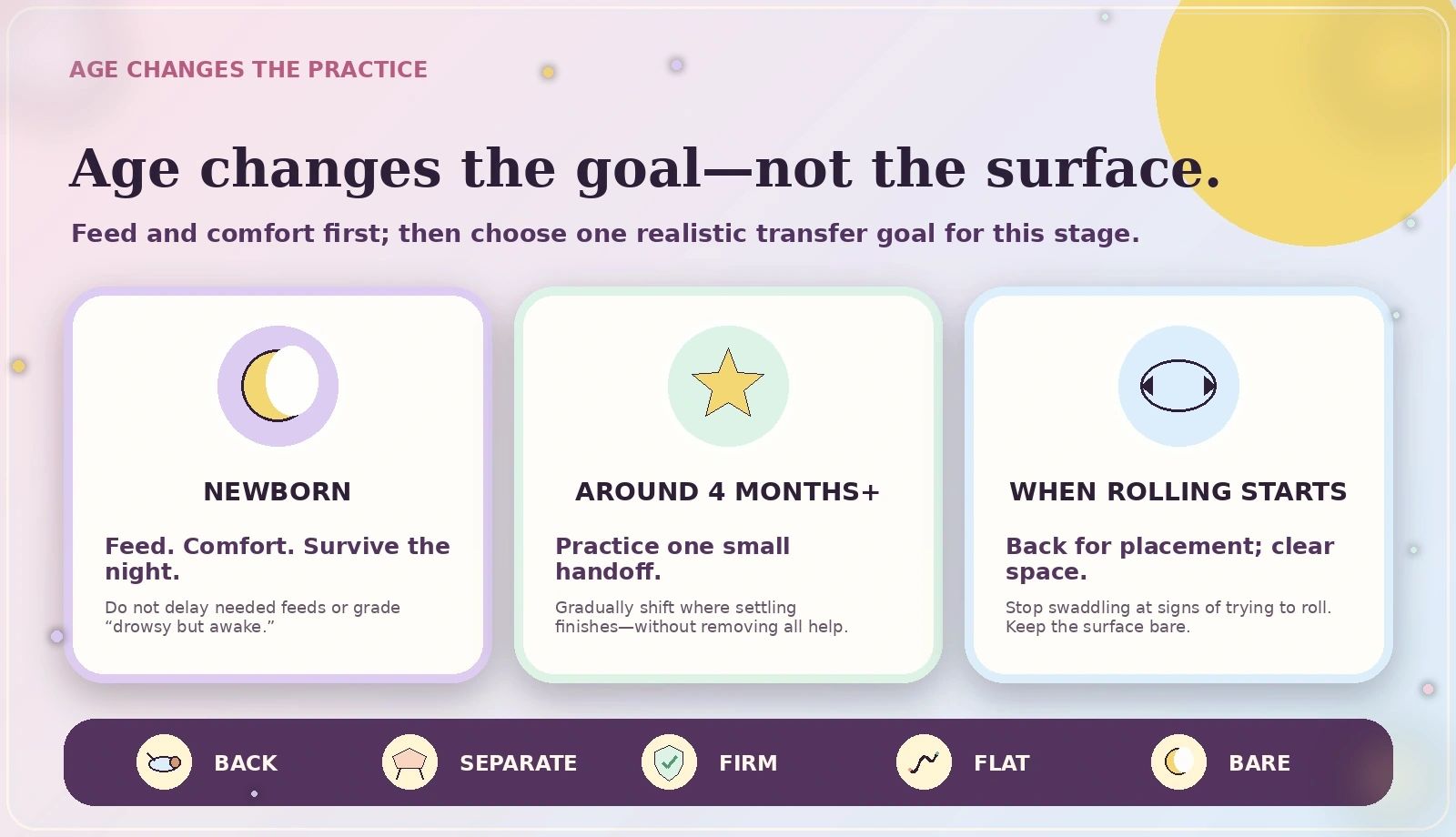
Newborns
Newborn sleep is irregular, and frequent waking and feeding are expected. Do not use a transfer plan to delay or remove feeds your baby still needs. The CDC notes that breastfed newborns may feed every one to three hours in the first days and often eight to twelve times in 24 hours; formula-fed newborns commonly feed every two to three hours in the first days, with individual needs varying.7 8
A newborn who settles only with substantial help is not behind. “Drowsy but awake” is not a test every newborn must pass. Your immediate goals are feeding, comfort, safe sleep, and caregiver survival—not a performance review at three weeks old.
Around four months and beyond
Sleep organization changes over the early months. HealthyChildren.org places “put baby down drowsy” guidance in its section for babies four months and older, not as a universal newborn rule.9
For an older infant, you may gradually practice more of the settling in the crib if that suits your family. You can begin with asleep-to-mattress transfers, then experiment with slightly more awake put-downs. There is no requirement to jump from full contact to zero help in one night.
When rolling begins
Always place baby on their back. Once baby can roll from back to tummy and tummy to back on their own, you do not need to turn them back each time they roll during sleep. Keep the sleep space clear, and stop swaddling as soon as baby shows signs of trying to roll.6
If feeding or growth is a concern
Do not reduce night feeding because an article told you the waking “must be habit.” Talk with your baby’s pediatrician or feeding professional if you are unsure whether intake, growth, latch, reflux, illness, or another issue is affecting sleep.
Make a plan for the moment you might fall asleep
This section is not permission to plan bed-sharing. It is harm-reduction guidance for a predictable emergency: an exhausted adult may unintentionally doze while feeding or comforting a baby.
The safest destination remains baby on their back in their own nearby, firm, flat, bare infant sleep space.
Before bringing baby into an adult bed for feeding or comforting, Safe to Sleep® advises clearing pillows, blankets, comforters, and other soft items from the area if there is any chance you may fall asleep. If you do fall asleep, return baby to the separate sleep space as soon as you wake. Never choose a sofa or armchair for a tired feed; those surfaces are especially dangerous.2 10
If you have no safe infant sleep space, ask your pediatrician, birth hospital, public-health department, social worker, or a local crib program about help obtaining one. Do not improvise with an adult bed, couch cushion, lounger, or padded product.
When the sleep change deserves a medical check
A long-standing preference for contact is different from a sudden change in a baby who previously settled comfortably.
This is another no-joke zone. I would not turn every failed transfer into a diagnosis. I also would not keep running a sleep experiment through a clear health change.
Contact the clinician promptly
Call when a sudden refusal of the sleep space comes with feeding difficulty, substantially fewer wet diapers, repeated vomiting, fever, pain, persistent congestion, unusual sleepiness, or a baby who seems markedly different from their normal self.12 13
In the United States, a baby younger than 3 months with a rectal temperature of 100.4°F (38°C) or higher needs prompt medical evaluation.12
Call 911 now
Call for difficulty breathing, skin or lips that look blue, purple, or gray, decreased alertness, or a baby who is unresponsive or increasingly hard to wake.13
Questions parents ask about babies sleeping better in an adult bed
Is my baby sleeping “deeper” in my bed?
It may look that way because there is no transfer, your response is faster, and small stirrings never become full cries. That does not prove the sleep is physiologically deeper or safer. The practical observation is enough: closeness changes the handoff, and the adult mattress adds risk.
Does wanting my bed mean my baby has separation anxiety?
Not necessarily. Newborns and young infants often settle with contact and familiar sensory cues. Older babies may become more aware of separation, but a crib wake-up can also be hunger, discomfort, timing, a transfer change, or ordinary sleep variability. Do not diagnose attachment from one put-down.
Will responsive settling create a bad habit?
Responding to your baby is not a bad habit. You can be responsive and still use a separate sleep surface. If you want to change how sleep begins, make one gradual change at a time rather than withdrawing all help at once.
Can I put my worn shirt under the fitted sheet?
No. Do not add a shirt, cloth, blanket, non-fitted sheet, or other loose or extra layer to an infant sleep space—even tucked under or near baby. Keep your scent on you.
What about a bedside sleeper or in-bed sleeper?
A bedside sleeper is a regulated product category that attaches to the adult bed; an in-bed sleeper sits on the adult surface, and products marketed with similar names are not automatically equivalent. The AAP says evidence remains insufficient to recommend for or against these products. Check the exact product’s current CPSC standard, recalls, age and weight limits, assembly, attachment, and instructions—never the marketing label alone.2 6 14
Can I warm the crib mattress before the transfer?
Do not use a heating pad, hot-water bottle, electric blanket, or other heating object on an infant sleep surface. Dress baby appropriately and keep the surface clear. A transfer can be gentler without turning the mattress into a temperature experiment.
Should I wait until my baby is in deep sleep?
You can observe whether a later transfer works better, but there is no universal minute count. Waiting longer also keeps an exhausted adult holding baby longer. If you are drowsy, safety outranks timing: place baby on their back in the separate sleep space.
What if every transfer fails?
Shrink the goal. Practice one safe transfer at the easiest sleep. Use Close, Lower, Linger. Note where the wake-up happens. Then stop for the night if you are depleted. A parent who recognizes their limit and chooses the safe surface has not failed.

Watch: Safe Sleep for Your Baby in 60 seconds
This one-minute video comes from the Safe to Sleep® campaign led by the Eunice Kennedy Shriver National Institute of Child Health and Human Development. It shows the destination behind the written advice: baby close by but on a separate surface, on their back, with the sleep area clear.
Written takeaway: Keep baby’s sleep area close to yours, but separate. Use a crib, bassinet, portable crib, play yard, or other infant sleep product that meets the applicable standard; keep the surface firm, flat, level, and clear; avoid overheating; and place baby on their back for every sleep. The article remains complete without the video; this is the official one-minute visual recap.11
One safe return still counts
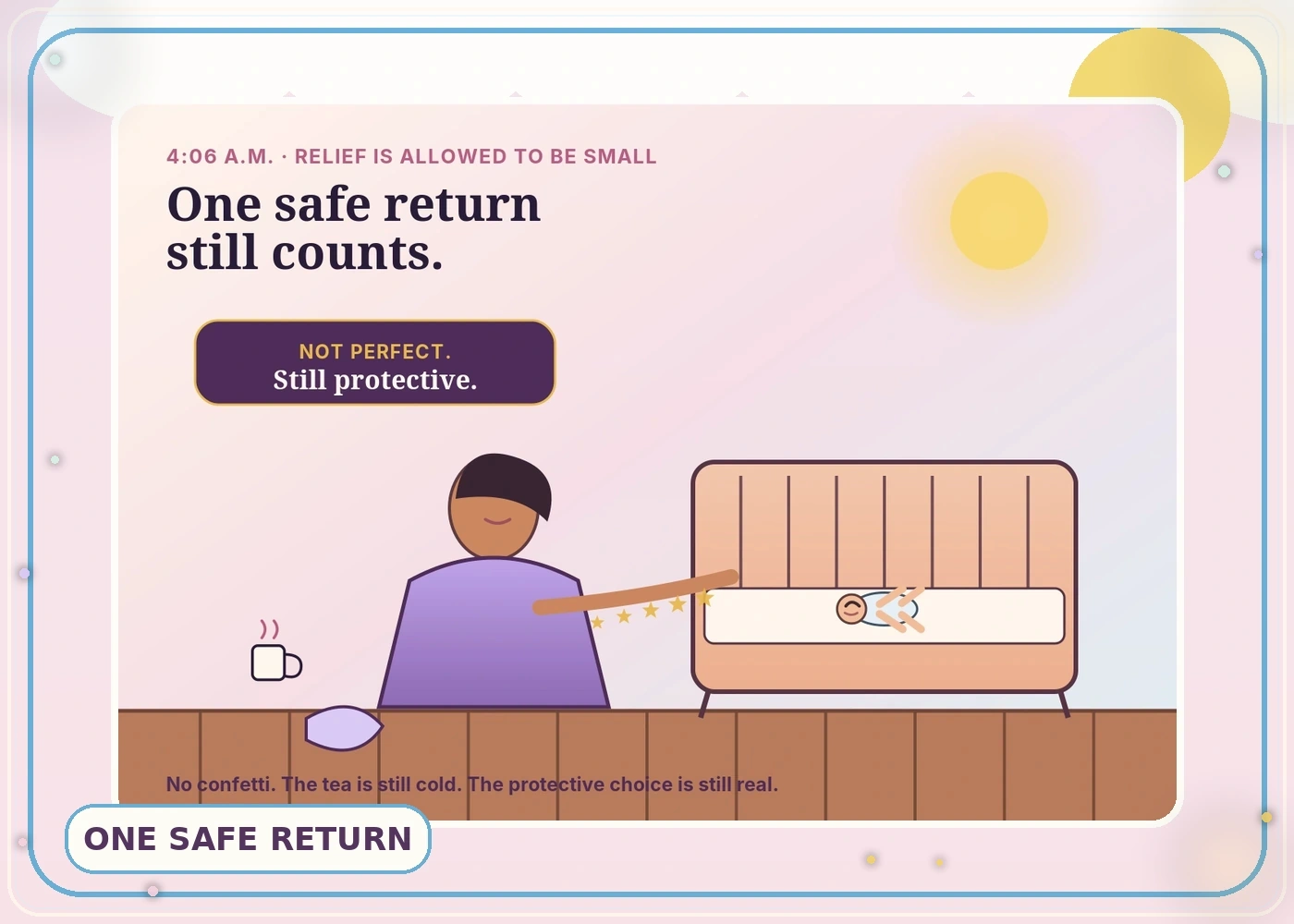
Back at 2:13 a.m., the composite mother tries the bassinet again. The baby wakes. Nothing about the moment looks triumphant. There is no confetti. The tea is still cold. The sock has completed its escape.
But she noticed her own heavy eyelids, chose the separate surface, and kept the next decision possible.
If the only clue you catch tonight is “I am too tired to keep experimenting,” that is still a useful clue. It points to the safe surface, not to a harder push.
That counts.
You are not the bad habit. Your arms may be where your baby currently releases the day, unclenches a fist, and stops arguing with gravity. I do not want to shame that closeness out of your family. I want to give it a safe edge.
The line I hope stays with you is this:
Closeness can cross a small stretch of air.
Your voice can cross it. Your hand can cross it while you are awake. Your quick response can cross it. Your love crosses it without effort.
The sleeping body still needs its own firm, flat, bare place to land.
Sources
- Sullivan RM, Toubas P. Clinical usefulness of maternal odor in newborns: soothing and feeding preparatory responses. Biology of the Neonate. 1998. Small experimental study; used only to support cautious language about newborn odor response, not sleep duration or sleep-surface safety.
- American Academy of Pediatrics. Sleep-Related Infant Deaths: Updated 2022 Recommendations for Reducing Infant Deaths in the Sleep Environment. Pediatrics. 2022.
- Centers for Disease Control and Prevention. Providing Care for Babies to Sleep Safely. Reviewed 2026-07-28.
- Safe to Sleep®, Eunice Kennedy Shriver National Institute of Child Health and Human Development. Safe Sleep Environment for Baby. Reviewed 2026-07-28.
- American Academy of Pediatrics. Evidence Base for 2022 Updated Recommendations for a Safe Infant Sleeping Environment. Pediatrics. 2022.
- American Academy of Pediatrics, HealthyChildren.org. Safe Sleep: 9 Ways to Reduce a Baby’s Risk of SIDS & Suffocation. Reviewed 2026-07-28.
- Centers for Disease Control and Prevention. How Much and How Often to Breastfeed. Updated April 2026.
- Centers for Disease Control and Prevention. How Much and How Often to Feed Infant Formula. Updated April 2026.
- American Academy of Pediatrics, HealthyChildren.org. Getting Your Baby to Sleep. Reviewed 2026-07-28.
- Safe to Sleep®, Eunice Kennedy Shriver National Institute of Child Health and Human Development. Ways to Reduce Baby’s Risk. Reviewed 2026-07-28.
- Safe to Sleep®, Eunice Kennedy Shriver National Institute of Child Health and Human Development. Safe Sleep for Your Baby video resources and text alternative. Reviewed 2026-07-28.
- American Academy of Pediatrics, HealthyChildren.org. Urgent Care, ER or Pediatrician? A Parent Guide. Updated May 14, 2026.
- American Academy of Pediatrics, HealthyChildren.org. When to Call Emergency Medical Services (EMS) for Your Child. Updated May 11, 2026.
- U.S. Consumer Product Safety Commission. Bedside Sleepers Business Guidance. Current federal standard and certification guidance for the bedside-sleeper product category; reviewed 2026-07-28.






Your turn
Join the night-shift chat