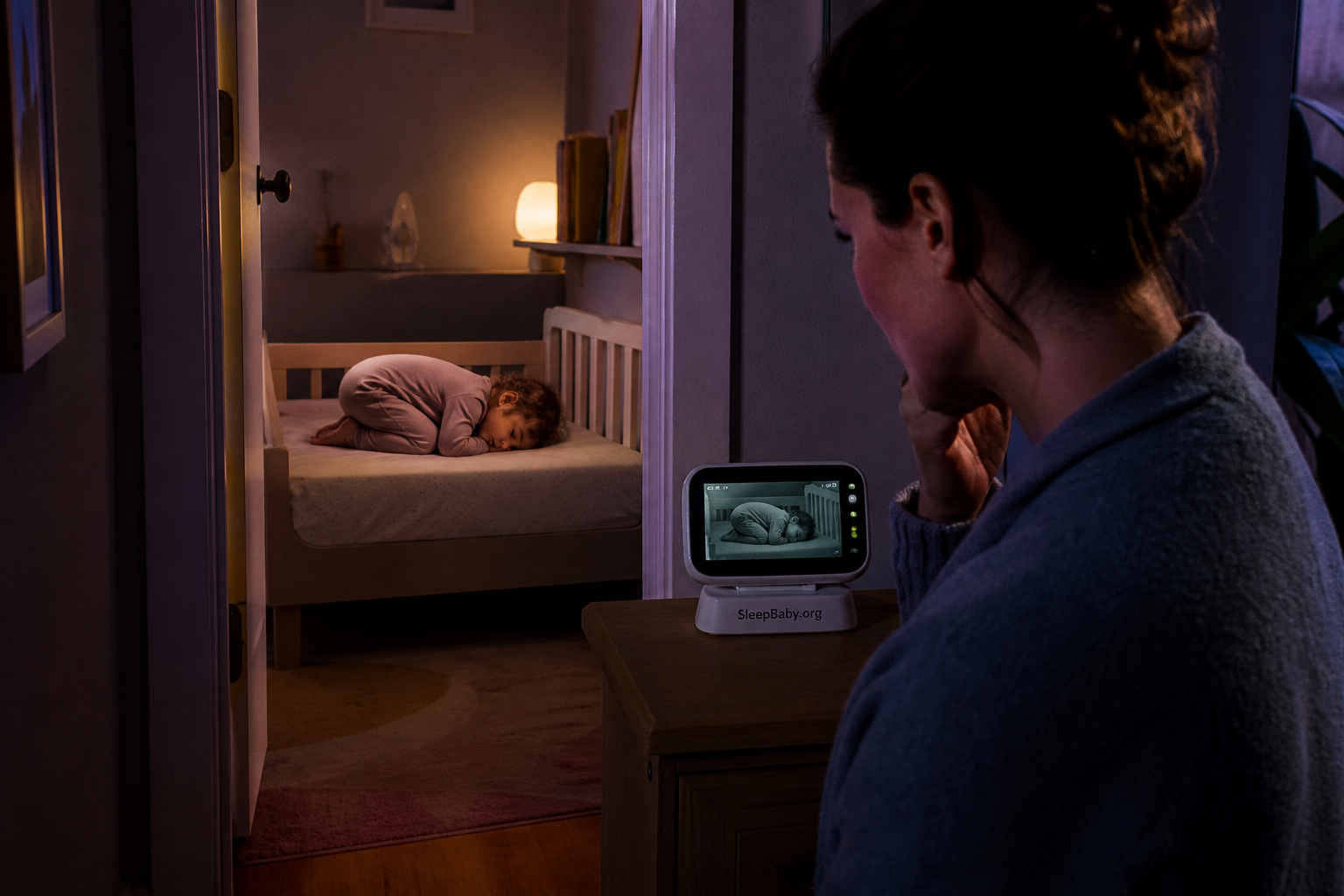
The monitor picture can look like a piece of toddler origami: bottom on the mattress, legs forward, chest folded over the thighs, head somewhere near the knees. It is the kind of posture that makes an adult’s lower back file a formal complaint just from looking at it.
Do you need to unfold a toddler who sleeps folded in half?
Usually, no—not solely because the position looks uncomfortable. If your toddler got into the position independently, has a clear face, breathes quietly and easily, is not trapped, and moves normally without pain when awake, you generally do not need to keep waking or repositioning them. What changes the answer is not the shape alone. It is labored breathing, loud habitual snoring, gasping or pauses, abnormal color, obvious pain, persistent stiffness, weakness, or a child who cannot comfortably straighten and move during the day.
I would not try to diagnose a sleeping position from a single frozen monitor frame. I would watch what the body is doing around the pose: breathing, color, freedom to move, and how that same child looks after waking. That turns a frightening picture into a short, useful observation.

The twenty-second check I would make tonight
- Look at the face and color. The nose and mouth should not be pressed into bedding or blocked by an object. Skin and lips should have their usual color.
- Watch several breaths. Quiet, easy breathing matters more than whether the spine looks dramatically curved.
- Check for trapping. Make sure clothing, cords, bed rails, or objects are not pinning the child in place.
- Notice whether they reposition. A child who got there independently and shifts during sleep gives you different information from a child who seems stuck or distressed.
If those four things look ordinary, I would let the toddler sleep and do the more informative check in daylight. Repeatedly unfolding a comfortable child may accomplish only one thing: waking a toddler who had somehow negotiated peace with sleep. That is a treaty I do not break casually.

Why the pose can look worse than the evidence around it
Adults tend to judge a child’s sleeping posture with an adult body in mind. We imagine our own hips, knees, neck, and morning stiffness. But the useful evidence is individualized and observable: did the child choose the position, can they leave it, are they breathing normally, and do they move comfortably after waking?
There is not good evidence that the folded posture has one universal cause. It should not be explained as a proven return to the womb, a psychological need for safety, a digestive trick, or a developmental exercise. Those are tidy stories, but tidy is not the same as supported.
A toddler may simply settle into a compact position and remain there for part of a sleep cycle. Some children rotate through several positions in one night with the focus of a person testing every mattress in a showroom. The position earns attention when it arrives with another signal—not because it fails an adult comfort test.
The monitor moment underneath this search
Composite scene: imagine Kacey pausing outside Benjamin’s room, one hand still on the doorframe, because the monitor shows him folded so completely that his pajama top and pants seem to have entered separate time zones. The first thought is not “how flexible.” It is “can he breathe like that?”
I would not use that fear as evidence, but I would respect the question inside it. A parent is not really asking whether the pose is photogenic. They are asking whether they are allowed to leave the room. My answer would be: check the airway, color, breathing effort, and freedom to move. If those are normal, let the picture be strange. If one is not normal, respond to that specific problem.
That distinction is the whole article in miniature: appearance starts the check; function decides what happens next.
Do the daylight mobility check before inventing a nighttime theory
The next morning gives you better information than the monitor did. Watch ordinary movement rather than staging a flexibility exam.
Usually reassuring
Your toddler straightens naturally, walks and climbs as usual, reaches both ways, plays without guarding a body part, and does not seem bothered when getting dressed or picked up.
Worth a pediatric question
The posture is new and persistent alongside pain, stiffness after waking, limping, weakness, loss of a skill, a marked one-sided pattern, swelling, or reluctance to move.
Bring useful evidence
Note when the posture appears, how long it lasts, whether the child changes position, and what movement looks like after waking. A brief video may help a clinician see the pattern.
I would not repeatedly ask a happy toddler to “show me if it hurts.” Toddlers can turn a simple question into experimental theater. Ordinary play often gives cleaner information.
When an unusual sleep position belongs in a breathing conversation
A folded position by itself does not diagnose obstructive sleep apnea. The American Academy of Pediatrics points parents toward a pattern: frequent snoring, difficulty breathing at night, breathing pauses, daytime sleepiness, attention trouble, or behavior changes. Loud or heavy breathing during sleep also deserves discussion with the pediatrician.
In other words, do not turn every odd pose into apnea. Also do not let the pose distract you from repeated gasping, pauses, heavy breathing, or loud habitual snoring. The body position may be the thing you first notice; the breathing pattern is the thing to report.
Call emergency services now if
Your child is blue, gray, or unusually pale; is struggling for each breath; cannot be awakened normally; has a prolonged breathing pause; or suddenly becomes abnormally limp or stiff. Do not wait to see whether repositioning fixes severe breathing distress.
For non-emergency concerns, take a short video from far enough away to show the chest and body position without disturbing the child. Write down whether snoring happens most nights, whether you hear gasps or pauses, and what daytime energy looks like. “They sleep weird” is hard for a clinician to interpret. “They snore loudly five nights a week and I recorded two pauses” is usable information.
Infant safe-sleep rules and toddler questions are not interchangeable
The AAP’s strongest safe-sleep recommendations—placing a baby on the back, using a firm flat noninclined surface, and keeping soft objects out—are written to reduce sleep-related infant deaths and explicitly apply through the first year. That boundary matters.
If the child in question is not yet 12 months old, follow infant safe-sleep guidance rather than treating this as a generic toddler-position article. Put an infant down on the back for every sleep on a firm, flat, noninclined approved surface, with the sleep space free of loose bedding and soft objects. Once an infant can roll both ways independently, AAP guidance says the child may be left in the position they reach on their own, but should still be placed down on the back.
For a child over 12 months, age, bed type, mobility, and developmental needs change the practical environment question. Avoid making the bed crowded merely because the first birthday has passed. Cords, entrapment gaps, oversized soft items, broken rails, and objects that can cover the face remain poor roommates at any age.
Should you move them onto their back?
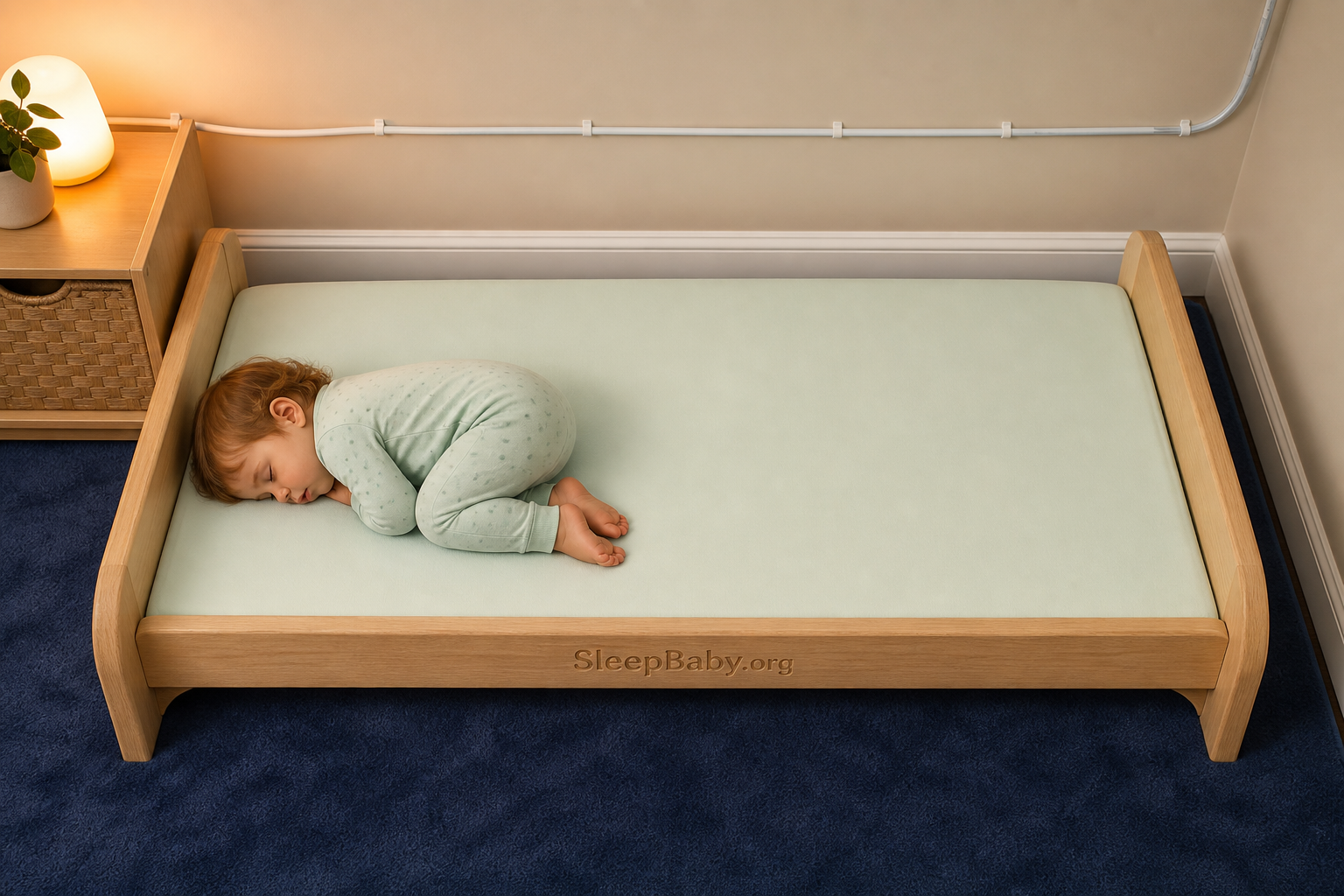
Not automatically. If a mobile toddler independently assumes the folded pose, breathes easily, and is not trapped, a nightly campaign to maintain one body position is unlikely to be useful. You may gently reposition a child who looks stuck, has the face obstructed, or is wedged against something unsafe. But the goal is to remove the obstruction or entrapment—not to win a wrestling match against sleep.
If repositioning wakes the child every time, step back and ask what you are treating. If the only answer is “the pose looks impossible to me,” the better action may be observation. If the answer is “their breathing becomes noisy and labored in this position,” that belongs with the pediatrician.
Does folded sleeping mean pain, autism, or a sensory problem?
No diagnosis can be made from this sleep posture alone. A single body position is not a reliable test for pain, autism, sensory processing differences, digestive trouble, or a neurological condition.
Context can still matter. Pain that wakes the child, persistent stiffness, loss of movement, weakness, or a major change in daytime behavior deserves medical attention. Developmental concerns should be discussed using the whole pattern of communication, play, movement, learning, and behavior—not a photograph of one sleeping pose.
I would be suspicious of any internet answer that converts one unusual but non-specific behavior into a diagnosis. Parents deserve a better threshold than “this looks odd.”
What sleep totals and bedtime routines can—and cannot—tell you
CDC guidance lists 11–14 hours of sleep per 24 hours, including naps, for children ages 1–2, and 10–13 hours for ages 3–5. Those ranges help you evaluate the whole sleep picture. They do not prove that a folded posture is harmless or harmful.
A calm routine can make bedtime more predictable: pajamas, teeth, one or two books, a short goodnight, and a room set up before the child is overtired. The NHS suggests beginning a wind-down routine around 30 minutes before the usual sleep time. If the posture is only one part of a larger settling struggle, our toddler sleep training guide can help you match a bedtime response to the actual friction. But routine advice should not become a magic explanation for posture. A child can have a beautiful routine and still sleep like a dropped pocketknife.
Look at whether sleep is restorative. Is your toddler reasonably alert for their age? Are nights repeatedly disrupted? Do they wake in pain? Are they snoring or struggling to breathe? Those questions carry more information than symmetry.
A simple note for the pediatrician
You do not need a spreadsheet worthy of a sleep laboratory. For three to five nights, jot down:
- when the folded position appears and roughly how long it lasts;
- whether your toddler changes position independently;
- whether breathing is quiet, loud, labored, or interrupted;
- whether snoring happens occasionally or most nights;
- how the child moves and behaves after waking;
- any pain, stiffness, weakness, morning headache, or unusual daytime sleepiness.
The question I would take in is: “Does the posture itself concern you, or is there something in the breathing and daytime pattern you want evaluated?” That invites a more precise answer than asking whether the pose is normal in the abstract.
What a monitor can show—and what it cannot
A video monitor is useful for seeing whether your toddler changes position, whether the face is visibly clear, and whether the chest seems to rise without obvious struggle. It can also help you notice a repeatable sequence: sitting up between sleep cycles, folding forward, then gradually rolling to the side. That sequence is more informative than one screenshot.
A consumer monitor cannot tell you whether oxygen levels are normal, whether a child has sleep apnea, whether a joint hurts, or whether a posture is medically safe. Even products that display movement or “vitals” are not a substitute for pediatric assessment. I would use the camera as a notebook with a lens, not as a tiny intensive-care unit mounted over the bed.
Place cameras and every cord well outside the child’s reach and follow the manufacturer’s mounting guidance. Toddlers are talented at turning objects previously described as “well out of reach” into active engineering projects. If you need a closer view, change the camera angle or approved mount; do not run a cord closer to the sleep space.
If the folded position appears at every partial waking
Sometimes the useful pattern is not the final pose but how the child gets there. A toddler may sit up during a partial waking, remain drowsy, and tip forward without fully lying back down. If breathing remains easy and the child later changes position, the observation may simply belong in your sleep notes.
If this happens alongside frequent full wakings, crying, pain signals, sweating, loud snoring, or obvious breathing effort, do not focus narrowly on “fixing” the fold. Write down the entire sequence. The pediatrician or sleep clinician needs to know what comes before and after it.
Pose without interference
Child folds, breathes quietly, stays asleep, changes position later, wakes comfortable, and moves normally.
Pose with sleep disruption
Child repeatedly sits, folds, startles, cries, snores, gasps, sweats heavily, or seems exhausted after a long night in bed.
Pose with daytime symptoms
Child wakes stiff or sore, avoids movement, limps, loses balance or a skill, or protects one side of the body.
The second and third patterns do not prove a particular diagnosis. They do give you a better reason to call than the geometry of the pose alone.
What not to buy or improvise to stop the folding
Do not add a wedge, body positioner, restraint, rolled blanket, oversized pillow, weighted product, or makeshift barrier to force a toddler into a different posture. Those products do not answer why the position occurs, and they can introduce new entrapment or breathing hazards.
I understand the temptation. When a monitor image creates anxiety, buying a physical solution feels more decisive than watching. But the right response is matched to the signal: clear an obstruction, correct a real bed hazard, document a breathing pattern, or discuss pain and mobility with the pediatrician. A product cannot turn an unknown into a diagnosis.
The one purchase that can have a legitimate role is an observation tool when you do not already have one: a basic video monitor that lets you see the child without entering repeatedly. Even then, the value is documentation and fewer unnecessary disruptions—not prevention, treatment, or medical reassurance.
Try one calm observation night before changing the whole routine
Unless there is a red flag, keep bedtime ordinary. Use the usual pajamas, routine, room temperature, and sleep timing. Make sure the sleep space has no obvious entanglement or cord hazard. Then observe the position without adding three new products and moving bedtime by an hour.
Changing several variables at once makes the next night harder to interpret. If the child sleeps well but folds, you have learned that the pose may not be interfering. If the child repeatedly wakes or breathes noisily, you have captured a pattern worth discussing. Either result is more useful than a night spent unfolding them every seven minutes while both of you become increasingly opposed to sleep as a concept.
I would make the note, save one short video if needed, and return the room to darkness. The purpose of observation is to produce a clearer next decision—not to turn a parent into overnight surveillance staff.
Watch: what clinicians mean by a breathing pattern
Johns Hopkins Medicine explains the breathing pattern clinicians look for when a child snores or has pauses during sleep. Watch for the distinction this article keeps making: an odd position is a picture; repeated noisy or interrupted breathing is a pattern to report.
Takeaway: record the breathing pattern you actually see; do not use a monitor or video to diagnose the child yourself.
Amazon recommendation: Infant Optics DXR-8 PRO video baby monitor
If your practical job is documenting the folded posture and checking visible breathing without walking in every ten minutes, a dedicated non-Wi-Fi parent-unit monitor is a stronger fit than a wearable “vital” tracker, sleep positioner, or phone-only camera. The separate screen keeps the view available overnight, while night vision and zoom can help you see whether the face is clear and capture a short clip or observation for the pediatrician. It does not diagnose apnea or make sleep safe; it simply gives you a clearer, less disruptive look at the pattern you need to describe.
See the Infant Optics DXR-8 PRO on Amazon
As an Amazon Associate, SleepBaby may earn from qualifying purchases.
Questions parents ask after seeing the pose
Can their legs go numb?
A monitor image cannot tell you that. If the child wakes, straightens, walks, and plays normally, that is reassuring functional information. Persistent weakness, limping, pain, swelling, or reluctance to bear weight warrants medical advice.
Should I add a pillow so they cannot fold so far?
Do not add sleep products to engineer a body position. Pillows, wedges, positioners, and restraints are not treatments for an unexplained posture. Make the sleep environment appropriate for the child’s age and address a real breathing or mobility concern with the pediatrician.
Is this a sign they need a toddler bed?
Not by itself. Bed transitions are usually driven by climbing, size limits, safety, and developmental readiness—not one compact sleep pose. Check the crib manufacturer’s limits and the child’s ability to climb out.
What if they only do it when congested?
That pattern is worth mentioning. Congestion can change noisy breathing, but gasping, struggling, pauses, blue or gray color, or severe breathing effort need prompt medical attention. Do not use wedges or inclined sleep products as a workaround.
What if they wake up happy?
A child who wakes comfortable, moves normally, and seems restored gives you reassuring context. It does not overrule breathing red flags, but it matters more than how uncomfortable the pose looks to an adult.
WHEN THE MONITOR PICTURE LOOKS IMPOSSIBLE
Trade the midnight pose debate for a calmer sleep plan
You may still glance at that folded little silhouette tonight. But now the question is smaller and kinder: clear face, easy breathing, free movement, comfortable child. If the posture is only one piece of a larger bedtime struggle, SleepBaby can help you sort the rest of the night without turning every odd position into an emergency.
Let the picture be strange; watch the child
The monitor may still show a toddler folded like the instruction sheet forgot one final step. I would not chase a perfect-looking posture. I would protect the breathing space, watch the breathing pattern, check daylight movement, and bring specific changes to the pediatrician.
That is the return I want for the parent standing in the hallway: not absolute certainty from one image, but a clear way to decide whether to leave the door closed, make a note, call the doctor, or act now.





What viewers said10 comments · 4 replies+
Archived comments from the original Baby Sleep Miracle presentation. Not independently verified by SleepBaby.org; individual experiences vary.
Thank you so much for this video! I had no idea about the dangers of baby swings :O
Hi Mary-Ann. I have a question: Is method in any way similar to the ones recommended by Dr Bucknam, Dr. Weissbluth or Dr. Karp? We tried those but none of them help.
Hi Regina, thank you for your question. The short answer is no. The techniques I share in my guide are based on newest scientific research and this is why I have never seen any approach similar to the one I recommend.
This method really works! I tried it on my son Jesus and after just one week he went from waking up more than 5 times a night to waking up just once or twice. You are a lifesaver, Mary-Ann!
I'm truly impressed with how much information you share in your video. And all for free! I can feel that you truly care about mothers like myself, and that's hard to find these days. I have recommended your site to several of my friends already.
Mary-Ann, our child suffers from autism. Is your approach still suited?
Chloe, I made sure my method can be used with any child, even babies who are special like yours. Please note that I'm not a doctor and that I always advice to consult with your physician because nothing is more important than the safety and well-being of your love.
Hallo Mary-Ann, I'm from Germany. Do you have your guide in German?
Hello Heide, we do! Normally you should already see our video in German. If not, please contact our support so they can guide you
Thenk you for your answer, Mary-Ann!
I just completed your approach and I have to say, it worked almost too well. Yes, it took a bit of getting used to with your bedtime routine but the difference is huge. My son George used to take 1 hours to go down and now he's firmly asleep in no more than 10 minutes! You're the best!
It seems I'm the only man watching this video, lol! What you shared about the 'emotional backpack' made immediate sense to me and I can't wait to help my little girl Mila to unpack it!
Hey there, just discovered your site and this really sounds different. Just wanted to say thanks for sharing :)
For everyone who's still thinking about getting Mary-Ann's guide I want to advise you to go ahead. I wasn't sure myself but now I'm so thankful I invested in this program. It made a huge difference in our life as a family and yes, my baby girl does sleep through the night now.