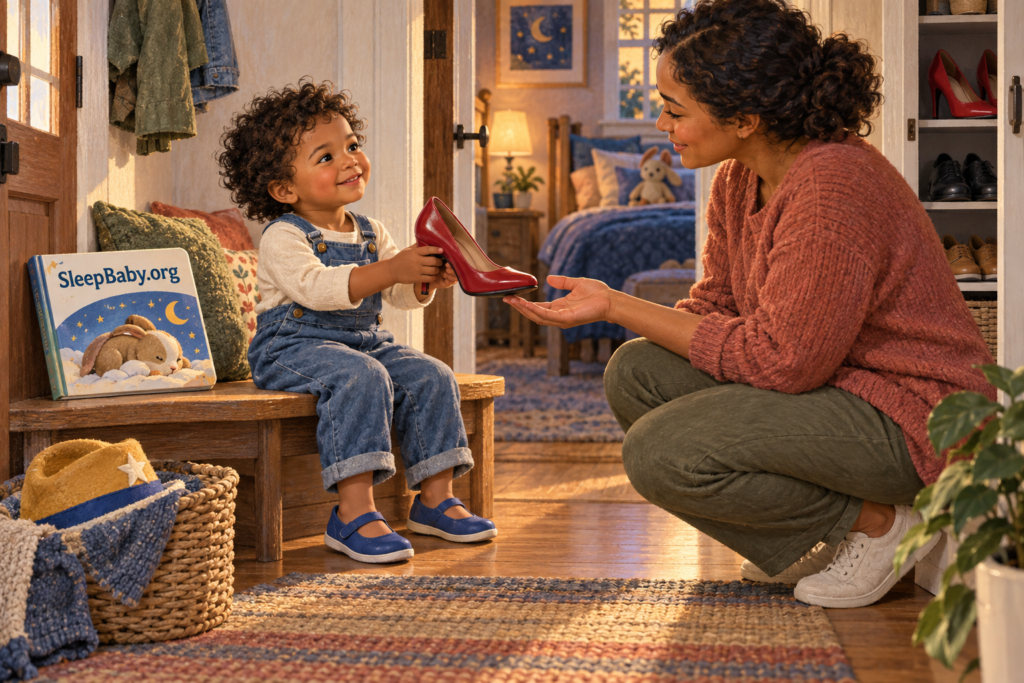
If your toddler likes high heels, I’d welcome the dress-up and put the heels away before walking begins. Copying a grown-up, loving a shiny shoe, and wanting a turn can all be part of the appeal. You do not need to turn that interest into a worry about who your child will become.
For today, offer a costume prop or a pair of their own well-fitting shoes. Use one clear line: “You can play dress-up. These shoes are for grown-up feet.” The same rule can apply to every child in the house.
The awkward part is usually what happens next. Your toddler wants the exact red pair. Someone bought plastic princess heels. A relative thinks a boy should not be interested. And you still have to get everyone through dinner and into pajamas. Here is how I’d handle those moments without making the shoes the biggest event of the day.
Why does my toddler want to wear my high heels?
A pair of heels has quite a lot going for it from toddler height: a different shape, a grown-up association, maybe a bright color or an interesting sound. Your child might be copying how you get ready, inventing a character, or simply investigating something you wear. Those are possibilities, not a diagnosis you need to settle before responding.
The American Academy of Pediatrics describes dress-up as one form of pretend play. Familiar objects and roles give children something to act out and talk about.[1] A toddler announcing “I’m going to work” in your shoes may be borrowing the whole getting-ready ritual, not requesting a lesson in fashion.
I’d start by noticing what they actually do. Do they admire the sparkle? Bring you the matching shoe? Announce that they are a particular person? Keep asking to put it on by themselves? You can respond to that part of the game while making a different choice about what goes on their feet.
You do not have to quiz them. “You like the shiny red” or “You’re getting ready like me” is enough. If you guessed wrong, they may show you. Staying curious is more useful than assigning a big meaning to one small preference.
Are adult heels or plastic dress-up heels okay for toddlers?
I would not choose either for toddler walking. Adult heels do not fit toddler feet, and a smaller toy heel is not automatically a good walking shoe. A box marked “dress-up” tells you the intended game; it does not tell you that the shoe holds your child’s foot securely.
NHS guidance recommends well-fitting children’s shoes with a fastening that holds the heel in place. Evelina London’s children’s footwear guidance also warns that high heels move the foot forward and increase pressure at the front of the foot.[2][3] For a toddler, I’d put fit and a steady, comfortable walk ahead of matching the costume.
That does not mean one brief try-on proves that you have damaged your child’s feet. I would not make that claim. It means you can change the plan now without waiting for a fall or a complaint. If your child is already standing in loose heels, help them sit and take the shoes off rather than asking them to walk across the room to you.
I would not use stairs, a smooth kitchen floor, a sofa, or a playground as a place to test whether they have “got the hang of it.” And I would not offer a supposedly safe number of minutes in heels. A timer cannot correct a poor fit.
What if the toy heels have a strap or a rubber sole?
Look at the actual shoe and your actual child. One appealing feature does not answer every question about fit, stability, age suitability, or where it will be used. I’d still choose their normal suitable footwear for moving around. You can keep the character, hat, or pretend destination while changing the shoes.
If a clinician has recommended particular footwear or orthotics for your child, keep following that individual advice. A costume does not need an exception to the care plan.
The part worth keeping
Keep the play. Change what they walk in.
You can say yes to the interesting part without saying yes to the heel.
They love the sparkle
Offer a bright color or an attached design on a suitable everyday shoe. You are choosing a shoe first; the sparkle gets to come along.
They want to be the grown-up
Offer a soft hat, a short costume vest, or a pretend job. “Your café is open. What are we making?” gives the role somewhere to go.
They love the sound
Make a little hand-clapping rhythm together. The sound can become a game without a child having to balance on a heel.
They want to choose
Offer two pairs you are happy for them to wear. “Blue shoes or yellow shoes?” gives them a real decision inside your limit.
Start with what you already own. A new purchase is optional.
What I’d offer instead, without buying a new dress-up box
Try one small change before adding a pile of alternatives. If your toddler is playing “leaving for work,” hand over a sturdy pretend phone suitable for their age, or let them carry an empty, handle-free fabric pouch you have checked. If they are playing a character, a soft hat and their ordinary shoes may be plenty. If they just want to copy you, get ready beside them.
Choose props that suit the child, not only the picture you have in mind. I’d leave out long cords, trailing scarves, loose jewelry, detachable decorations, and clothes that drag underfoot. Check the age label on purchased costumes and accessories. An adult’s accessory does not become a toddler toy because it looks charming in a photograph.
You can also take the story off their feet entirely. A doll can go to a pretend party. A stuffed animal can run the shoe shop with imaginary shoes. Your toddler can point to the pair you should wear while you get ready. None of those games needs a toddler-sized heel.
If every suggestion earns a firm “no,” stop adding more. Too many replacements can turn a clear boundary into a long sales pitch. I’d leave one suitable option available and let the child be disappointed for a bit, with me nearby.
Make the storage do some of the work
Move adult heels out of reach when you are finished with them. A low open basket of fascinating shoes is a very demanding test of toddler self-control. Use your normal childproof storage, and avoid creating a climbing invitation with visible shoes above a chair or stool.
Give the available dress-up things a different home. One small basket containing a few checked props is easier to understand than a shared pile where yesterday’s forbidden shoes are mixed with today’s allowed hat. You do not need a beautiful playroom. You need the answer to stay reasonably consistent.
If your boy likes high heels, keep the same shoe rule
I would not read a toddler’s future identity from the shoes they want today. The AAP explains that interests in clothing and play do not reliably predict a child’s later gender identity. It encourages room to explore without shame.[4] Your child does not need to defend a preference before you treat them warmly.
The useful limit is about the shoe: it is too big, it slips, or it is not what you choose for walking. “Those are for girls” adds a different message that does nothing to improve the fit. I’d use the same explanation for a son, daughter, sibling, or visiting cousin.
If another adult comments, keep your toddler out of the debate. You can say, “We’re fine with dress-up. We use the same footwear rules for everyone.” Have any longer conversation privately. Your child should not have to stand there while adults discuss whether their game is acceptable.
There is also no need to make the interest a family performance. Ask before taking pictures, keep teasing out of it, and let the game end when the child moves on. A warm, ordinary response leaves room for the next interest to be equally ordinary.
How to say no when your toddler wants the exact pair
I’d keep the words short enough to repeat without improving them every time. Name the want, state the limit, and offer the next available thing. The goal is not to produce a sentence so persuasive that a two-year-old immediately thanks you.
“You want my red shoes. I’m putting them away. You can wear your blue shoes or play in your hat.” Then actually put the red shoes away. If you keep holding them at toddler eye level while negotiating, they are still the most interesting item in the conversation.
You can comfort a disappointed child without returning the heels. Sit nearby, help them regulate in the ways that usually work for them, and keep the alternative simple. If they need a cuddle more than another game, offer the cuddle. The next round of pretend play can wait.
A few words ready to use
- The first reach for your shoes
- “You like these. These stay with me. Let’s find your shoes.”
- The relative who brought toy heels
- “Thank you for thinking of the dress-up game. We’re using ordinary shoes for walking. A hat would be lovely next time.”
- The child who says it is unfair
- “You wish you could wear them. I hear you. The shoes are still going away.”
- The adult who questions the game
- “Dress-up is welcome here. The footwear rule is the same for every child.”
At daycare, parties, or someone else’s home
Ask about the footwear expectation before the event if you can. For a costume day, send ordinary shoes your child can use for the actual activities. A pretend royal, chef, dancer, or office worker can all wear the shoes that fit your child.
Tell the next caregiver what you have been saying, especially if the toddler will arrive already disappointed. “We’re keeping adult heels out of reach; she can choose either of these shoes” is more useful than “Please make sure she behaves.” It shares the decision instead of assigning the child a character flaw.
For a special photograph, I’d photograph the child holding or looking at the shoes while seated, or wearing their own shoes with the outfit. There is no need to make standing in adult heels the price of getting the picture. Stop if the child is uncomfortable or does not want to participate.
A shoe check that starts with your child’s feet
If you do buy shoes, I’d shop for the walking your toddler actually does. Consider their usual surfaces, the fastening you can manage, and the fit with their normal socks. A shoe that photographs beautifully but keeps coming off is asking both of you to work too hard.
The NHS advises regular fit checks as young children’s feet grow. Shoes should give the toes room and hold the foot securely; a trained fitter can help.[2] Do not rely on an age printed in a size chart or assume last season’s pair still fits.
Before the shoes leave the house
- Fit: toes are not cramped, and the shoe is the right size for this child now.
- Hold: the fastening is secure and the heel is not slipping out.
- Comfort: your child is not reporting pain or repeatedly trying to escape the shoe.
- Movement: watch a few ordinary steps on a clear, level surface. Stop for pain or a new limp.
Indoors, a child may not need shoes at all on a clean, safe surface; the NHS notes that barefoot walking can help early walkers.[2] Consider your floor and household hazards rather than assuming socks, slippers, or bare feet are equally suitable everywhere.
If your toddler resists only one pair, I’d inspect that pair before treating it as a behavior problem. Check for a folded sock, a rubbing edge, debris, or a fit that has changed. If discomfort continues, ask a healthcare professional. You do not need to persuade a child to walk through pain.
When siblings share the dress-up basket
A three-year-old costume set may be appropriate for one child and still belong out of a younger sibling’s reach. I’d separate the props before the game starts rather than depend on the older child to police every small piece. Keep the shared basket limited to items suitable for the youngest child who can reach it, and supervise the play.
The same shoe rule does not require identical activities. One child might want to run a pretend shop while another only wants to carry a large soft hat around. You can welcome both without asking the younger child to keep up or making the older child surrender every idea.
If two children want the same special prop, move the turn-taking discussion away from the adult heels. Those shoes are not an available prize for waiting nicely. Offer turns with a suitable hat, give each child a different pretend job, or pause that prop if neither can use it comfortably right now.
For visiting children, tell their adult what is in the basket and ask about anything that affects the activity. Keep the explanation ordinary: “We’re using our own walking shoes, and these are the props available today.” That gives everyone the same starting point without making one child’s interest the subject of the visit.
Help the game change, without directing every minute
Once the shoes are put away, you do not need to supply a replacement performance. Sit down, watch what your toddler offers, and respond. If they hand you an imaginary cup, take an imaginary sip. If they put the hat on a bear instead of themselves, the bear can have the job.
A small exchange is enough. You can join for a moment and then return to making dinner while staying attentive to safety. For more possibilities, our toddler activities guide includes simple pretend, helping, and quieter play ideas. Pick one that fits the energy you both have.
When the shoes become a bedtime argument
Liking heels does not tell you why your toddler is having trouble sleeping. But a favorite game can be hard to leave, especially if “take those off” arrives at the exact moment you expect the whole bedtime routine to begin.
I’d give dress-up its ending before the bedroom part of the evening. Offer a short, concrete notice: “One more pretend delivery, then the costume goes in the basket.” Choose an ending you can actually carry out. “A little longer” is difficult to recognize when you are two.
Then move to a familiar next action. Put the props away together if the child wants to help; do it yourself if they cannot manage that part tonight. The AAP recommends a quiet, consistent bedtime routine.[5] You can keep that sequence without requiring your child to feel delighted about ending the game.
Give dress-up a place to stop
- Finish one small part. “Deliver the last pretend cup.”
- Put the props away. “The hat goes here for tomorrow.” Adult shoes stay in adult storage.
- Offer the next real choice. “Which pajamas?” or “Which of these two books?”
- Continue your normal routine. Keep costumes and shoes out of the sleep space.
If the argument starts again, I’d repeat the same short answer rather than restart dress-up for one more grand finale. “The shoes are away. I can help you choose a book.” There may still be tears. A clear ending can coexist with a comforting adult.
If bedtime is difficult well beyond the costume, look at the whole evening. Our routine guide for three-year-olds helps with a manageable sequence. If you are also caring for a younger baby, the separate guide to finding your baby’s bedtime helps you think about their different evening needs. You do not have to make both children ready for sleep in the same way.
If your toddler falls, hurts, or starts limping
Take the shoes off and stop the activity. Do not ask your child to walk again just to prove that everything is fine. A new limp deserves attention, and an unexplained limp should be assessed by a healthcare professional.
Seek urgent medical care if your child cannot put weight on the leg, the leg looks misshapen, or they are unwell with a high temperature. Sudden significant hip, thigh, or knee pain or worsening symptoms also need prompt assessment. NHS guidance sets out these warning signs.[6] Use your local emergency service for a serious injury or a child who is very unwell.
If the issue is ongoing discomfort, repeated rubbing, or a change in how they walk, contact their clinician rather than searching for a different costume shoe to solve it. Tell them when it started, whether there was a fall, and whether your child can bear weight. Shoe interest by itself is not a medical problem; pain and changed movement are different questions.
The questions I’d keep small
Should I buy a toddler their own high heels?
I would spend that money on something else, or keep it. A smaller heel does not solve the reasons I would avoid heels for toddler walking. If you want a gift, choose from the part of the game your child actually enjoys: a suitable costume, a pretend role, or everyday shoes in a favorite color.
Can I let them hold the shoes while sitting?
You can decide whether a particular shoe is suitable to handle under close supervision, checking cleanliness, sharp or damaged parts, and detachable decorations. I’d keep it brief and adult-controlled. If your toddler keeps trying to stand or put the shoe in their mouth, put it away and offer something else.
What if they already wore them yesterday?
You are allowed to change a household rule. “I let you try those yesterday. Today we’re using your walking shoes.” You do not need a long confession or an invented medical scare. If there is pain, a limp, or an injury, deal with that separately using medical advice.
How do I get relatives to stop making it a big deal?
Give them one practical request: welcome the game, use the same footwear limit, and keep jokes or predictions about the child out of it. If they want to join in, invite them to be the customer at the pretend café. There is a useful role available that does not involve commenting on your toddler.
Do I need to stop the whole dress-up phase?
No. You can stop a particular shoe choice and still make room for imagination. The next game may involve a hat, a laundry basket spaceship, or no props at all. Your toddler can have a wonderfully ordinary interest in something you wear, and you can have a wonderfully ordinary boundary about where those shoes belong.
Sources and further reading View sources
- American Academy of Pediatrics: Pretend play and imagination.
- NHS: Children’s feet, shoes, and leg or foot concerns.
- Evelina London Children’s Healthcare: Your child’s footwear.
- American Academy of Pediatrics: Gender identity development in children.
- American Academy of Pediatrics: Toddler bedtime trouble.
- NHS: Limping in children and when to get help.
- Melissa & Doug: Chef Role Play Costume Set, manufacturer specifications.
- Harvard Center on the Developing Child: Serve and return video.