
You may be able to take your baby to a pub, but check that particular venue’s rules before you go. I would choose a quiet, smoke-free daytime visit, with an alert sober adult responsible for the baby and an easy way home. A family-friendly sign does not tell you how loud the room will be, where you can feed, or whether there is a suitable place for a nap.
Start by calling the pub about babies, permitted areas and hours, and any event scheduled during your visit. Then decide whether the actual plan fits your baby today. You can enjoy an outing without committing to a whole afternoon.
Three things to settle before you say yes
The place: babies are admitted at your planned time, and there is a quiet, smoke-free space you can actually use.
The care: someone is clearly responsible for feeding, noticing changes and keeping the baby away from hot drinks and other hazards. That person stays sober and alert.
The way out: you can leave promptly, with safe transport and a suitable sleep space waiting at home. You are not depending on everyone else being ready to finish.
If one of these is missing, change the arrangement before leaving home. Meeting the same friends somewhere else may solve more than packing another bag of baby equipment.
Are babies allowed in pubs?
There is no useful worldwide yes-or-no answer. Admission depends on where you are, the premises’ licensing conditions and the venue’s own arrangements. A pub may welcome families in a dining room but restrict a bar area or evening entry.
For a UK starting point, GOV.UK says accompanied children may be able to enter a pub, depending on the premises’ specific conditions. That is not a promise that every pub must admit your baby. Check the local rules where you live or are visiting, particularly when travelling between jurisdictions.
Be specific when you call: give your baby’s age, your proposed arrival time and whether you need room for a pram. Ask when children must leave, whether your chosen room has different rules, and whether booking a table changes anything. A booking confirmation for two adults may not have accounted for the pram beside them.
I would also ask about live music, a televised match or a private party. An empty room at opening time can be a very different place an hour later. Keep any answer about access separate from your own judgment about whether the conditions suit your baby.
Does a newborn need to reach a particular age first?
This guide does not set a universal age at which a pub visit becomes safe. Your baby’s health, feeding needs, the setting and your ability to care for them matter. If your baby was premature, has a medical condition or has been given specific advice about visitors or outings, ask their care team how that applies. A pub’s admission policy cannot answer that health question.
You can postpone because recovery, feeding or the logistics feel like too much. You do not need to prove that you can manage the same outing you enjoyed before your baby arrived.
Your call-ahead checklist
- Are babies welcome in the room and at the time we want?
- Is there a child departure time or a restriction on prams?
- Is a match, band or other event scheduled?
- Can we book a table away from speakers, the kitchen route and the busiest bar area?
- Is there step-free access and enough space to keep the aisle clear?
- Where are the baby-changing facilities, and can the adult doing the changing use them?
- Can we leave and pay easily if our baby needs to go?
These questions tell you more than a star rating. If staff cannot promise a quiet table, treat that as useful information, not as a challenge to make the visit work anyway.
Choose a conversation, not a noise test
A pub does not have to be hosting a band to become loud. Several televisions, a crowded room and a sudden cheer can change the sound around your table. Stand in the proposed area before settling in. Check again when the room fills.
NIDCD identifies needing to raise your voice or shout to someone an arm’s length away as a warning sign of excessive noise. If conversation is becoming difficult, I would move to a quieter place or leave with the baby. I would not wait for crying to make that decision.
A baby who appears content or sleeps through noise is not providing a hearing-safety measurement. Nor does a single phone reading establish a safe exposure time for an infant. Noise risk depends on loudness and duration, and a room can change faster than your plan.
NIDCD puts avoiding loud sounds first. Properly fitting protective earmuffs may be useful when noise cannot be avoided, but no protector blocks all sound. Their fit matters. Ordinary headphones, a hat or a blanket over a pram are not substitutes for suitable hearing protection.
For an optional social visit, you usually have a simpler choice: another room, another hour or another venue. Hearing protection should not become a reason to stay beside speakers or through a noisy event. If your baby cannot wear it correctly or comfortably, leave the noise rather than trying to force a fit.
Check the garden as carefully as the dining room
Outside is not automatically the better option. Look for cigarette smoke, direct sun, heaters, unstable ground and access to the car park. CDC reports that there is no safe level of secondhand smoke exposure, and infants are particularly vulnerable to its effects. If smoke reaches the baby, move away or leave; a breezy table is not a reliable solution.
For shade, follow NHS advice on protecting babies from sun and overheating. Keep young babies out of direct sunlight and never drape a blanket over the pram to make it darker or quieter. Check your baby regularly and change the plan if the space becomes too hot.
Make the table work for care
Choose your position before drinks and plates arrive. Put the changing bag where you can reach it without blocking the aisle. If you use a pram, apply its brake when stopped and follow its instructions; leave access for staff and other customers. A table tucked into a corner is not useful if getting out requires moving four chairs.
Keep glassware, cutlery, hot plates and drinks beyond your baby’s reach. The NHS advises putting a hot drink well out of reach before holding a baby. Do not pass hot drinks over your baby. An adult can put a cup down and then take over holding; doing both at once is unnecessary.
If your baby uses a high chair, check that the seat suits their development, is stable and has its required restraint. Follow the chair’s instructions and stay beside them. Do not improvise a seat from cushions on a pub bench or put a car seat on a table or chair to bring the baby closer.
Decide who has the baby when someone orders, visits the toilet or goes to change a nappy. Make the handoff explicit. A group of attentive friends still needs one person to know they are currently responsible.
LEAVE ROOM FOR GETTING HOME
The table booking is only part of the evening.
The SleepBaby.org homepage introduces the SleepBaby.org Method and its information about bedtime routines and baby sleep schedules.
A pub visit asks for several small decisions: when to arrive, who handles the next feed and when to leave. Once you are home, ordinary bedtime planning may be the next thing you want to think through. You might want room for feeding, changing and settling without adding a long list of new steps to a busy day.
Visit the homepage to read what the Method covers and decide whether its discussion of routines and schedules fits that question. This is an invitation to explore ordinary sleep planning. It does not establish that a venue is safe, replace a suitable sleep surface or promise that an outing will have no effect on the night.
You can make the visit shorter and still keep the parts of your usual evening that are practical. Your baby’s immediate care comes first, including leaving when the setting stops working.

Plan for the feed that actually happens
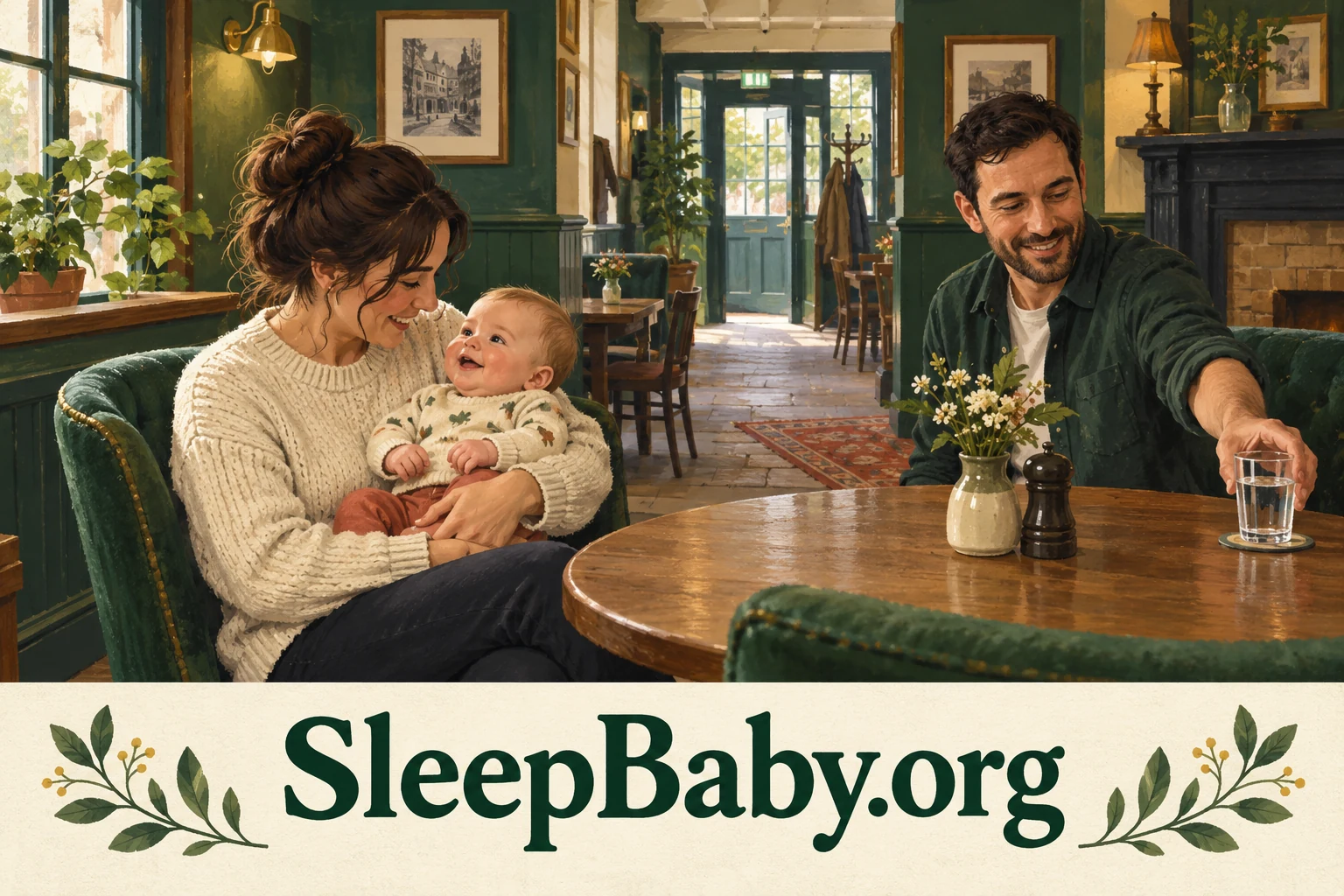
Pack for your baby’s usual feeding method, including a little flexibility if you are delayed. The outing should fit around feeding cues, not require your baby to wait until the food comes. You do not need to give an extra-large feed in the hope of buying more time.
Breastfeeding at the pub
Choose somewhere you can sit comfortably and bring your baby close without balancing against the edge of a table. In the UK, NHS guidance explains your right to breastfeed in public. You can ask for a quieter seat because you prefer it; feeding does not need to be hidden in a toilet.
Have another adult move hot items before you start. If the baby is distracted or distressed, try a quieter appropriate space. You can also leave and feed comfortably elsewhere. That choice belongs to your needs, not to pressure to make the table look undisturbed.
Bottles and formula away from home
Keep feeding equipment clean and follow the storage and preparation instructions for the milk you use. Do not rely on a member of staff being able to supply suitable water or keep a bottle at a safe temperature.
The NHS sets out what to take for making formula away from home, including suitable hot water and sterilised equipment. It advises ready-to-feed liquid formula when you cannot follow that preparation method. Ready-to-feed does not remove the need for clean, appropriately sterilised feeding equipment or following the product’s storage instructions.
If you bring expressed milk, use CDC’s breast milk storage guidance for transport and use. Put the milk plan in place before the trip, especially when a long journey and a meal are involved.
Hold your baby for the bottle and respond to their pauses. NHS bottle-feeding guidance says not to prop a bottle or leave a baby feeding alone. Discard unused milk after the feed as directed rather than saving a partly used bottle for later in the visit.
If your baby already eats solids
Bring food you know you can serve appropriately, or ask about the actual ingredients and preparation of a suitable menu item. A children’s menu is not automatically an infant menu. Follow your baby’s existing advice about texture, allergy and choking prevention, and supervise eating closely. Keep adult glasses and plates separate from the baby’s food.
Separate the drinking plan from the baby-care plan
You can visit a pub without drinking alcohol. For a first outing, I would make that the easy default for the adult caring for the baby and anyone driving. Name the sober caregiver before you leave, including who will handle the journey and the return home.
CDC warns that caring for an infant while intoxicated is unsafe. This concern applies whether the baby is breastfed, formula-fed or cared for by someone other than a parent. A second adult who is also impaired is not a backup care plan.
If you breastfeed, not drinking is the safest option. CDC advises waiting at least two hours after a single standard drink before nursing; more alcohol means a longer wait. A large or strong pub serving may contain more than one standard drink. Do not assume that finishing one glass starts a universal two-hour safety countdown.
If you plan to drink, arrange your baby’s feeds ahead of time with appropriate advice for your circumstances. Previously expressed milk may be part of that plan. Do not leave a hungry baby waiting because the adults have not organised an alternative.
The NHS explains that expressing milk does not clear alcohol from it faster. It also advises never sharing a bed or sofa with your baby after any alcohol. Keep the sober-care arrangement in place after you get home, when tired adults may be tempted to settle on the sofa.
Optional: hearing protection that actually fits
If you need infant hearing protection for unavoidable noise, Alpine Muffy Baby Comfort is one named option to investigate. Check the current exact model, head-size requirements and instructions before choosing it. A product marketed for babies does not necessarily fit every newborn. I have not tested it, and this is not a comparative performance recommendation.
Follow the manufacturer’s fitting and supervision instructions. Do not use a published noise-reduction figure to calculate that a loud pub is safe for your baby, or use hearing protectors as a sleep aid. Leaving the noisy area remains the first choice for this optional outing.
Free or already-owned alternative: meet at a quieter time or venue and leave if noise rises. If you already own suitable hearing protectors, check their condition and fit against their exact instructions before considering them. Buying something is not a requirement for seeing friends.
This section has no affiliate purchase link. As an Amazon Associate, SleepBaby.org earns from qualifying purchases through affiliate links elsewhere on the site.
A pub nap still needs a safe sleep space
Plan where your baby will sleep before the first yawn. NIH Safe to Sleep recommends placing babies on their backs on a firm, flat, level surface intended for infant sleep, with the space clear of soft objects and loose bedding. A booth, adult’s coat or pile of cushions does not meet that guidance.
The AAP advises that if your baby falls asleep in a stroller, car seat or carrier, you should move them to an appropriate flat sleep surface on their back as soon as possible. A reclined seat is not automatically a bassinet. If your pram has a separate bassinet, check the exact model’s intended sleep use and setup instructions rather than assuming every attachment is equivalent.
When the venue cannot accommodate a suitable sleep arrangement, make going home part of the nap plan. Do not keep the baby awake for the group or assume they will sleep safely wherever they happen to doze.
Never leave the baby outside the pub or in a car while you remain inside. Supervision does not turn an unsuitable sleeping surface into a suitable one. Keep the baby with the responsible adult and leave when meeting their needs requires it.
Watch: safe sleep still applies away from home
NIH’s Safe to Sleep campaign explains the essentials in this 60-second video. Use it when deciding whether your outing has a suitable sleep plan; it is not an endorsement of sleeping in a pub seat or stroller.
If the player does not work: open the official NICHD video or read its full official visual and audio transcript. The written takeaway is to place your baby on their back in a separate appropriate sleep space, use a firm flat surface, and keep soft objects and loose bedding out. Your baby’s sleep area belongs in the same room as you, separate from your own bed.
The table test: stay, change, or leave
Stay flexible: the space remains quiet and smoke-free, feeding is manageable, your baby is comfortable, and the responsible adult is alert.
Change something: a plate is within reach, the next table blocks the aisle, or your baby needs a feed or nappy change. Fix the immediate issue and reassess the whole setup.
Leave: smoke reaches you, noise rises, safe sleep is unavailable, your baby stays distressed, or the sober-care or transport plan breaks down. You do not have to finish an order to justify leaving.
These are planning cues, not a health assessment. If your baby has serious breathing trouble, turns blue or grey, or becomes unresponsive, seek emergency help rather than treating it as ordinary fussiness. MedlinePlus describes these kinds of changes as emergency warning signs.
Make the journey home part of the booking
Know who is driving and how your baby will travel before ordering. Bring and use an appropriate car seat according to its instructions and local requirements. If you are arranging a taxi or lift, confirm the practical seating arrangement in advance. Being able to book a ride on a phone is not the same as having the baby’s transport sorted.
If you are walking, keep enough energy and supplies for the return trip. Think about rain, hills and the route after dark. Choose an earlier departure if the alternative is a longer walk with a hungry baby and a tired caregiver.
At home, respond to the baby in front of you: feed if needed, change them and use their usual appropriate sleep space. You do not need to add a new bedtime technique because one outing went differently. Nor can a familiar routine undo unsafe exposure or replace medical advice if your baby seems unwell.
Afterward, save one useful observation for next time: the quieter room, the event that changed the noise, or the seat that let you feed comfortably. That is more helpful than deciding the whole outing was either a triumph or a disaster.
Questions that often come up at the last minute
How long should the first visit last?
There is no universal number of safe minutes. Keep your first plan modest and easy to shorten, then respond to the conditions and your baby’s needs. A short visit in a smoky or very loud space is still the wrong setting.
What if my baby cries?
Check for a feed, a nappy change, discomfort or a need for less stimulation. Move to a suitable quieter place with your baby. You can leave if settling is not working; you do not owe the room a demonstration of parenting technique. Seek medical advice if the crying or other symptoms concern you.
Do I need special equipment?
You need a workable care plan and your usual feeding, changing and transport essentials. Equipment can meet a particular need, but it cannot fix a venue that is unsuitable for your baby. Start with the place and the timing before shopping.
Can friends take turns holding the baby?
Only if you are comfortable with it and each person can hold the baby safely while sober and alert. Say who is taking over and keep hot drinks out of the handoff. There is no need for everyone at the table to have a turn.
Sources
- GOV.UK: Alcohol and young people
- NIDCD: How loud is too loud?
- NIDCD: Protect your child’s hearing
- CDC: Health problems caused by secondhand smoke
- NHS: Breastfeeding and drinking alcohol
- CDC: Alcohol and breastfeeding
- NHS: Formula milk common questions
- NHS: Bottle feeding advice
- NHS: Breastfeeding in public
- NHS: Baby and toddler safety
- Alpine: Muffy Baby Comfort hearing protection
- NHS: Keeping your baby safe in the sun
- AAP: How to keep your sleeping baby safe
- CDC: Breast milk storage and preparation
- NIH Safe to Sleep: Reduce baby's risk
- MedlinePlus: When to use the emergency room for a child
- NICHD: Safe Sleep for Your Baby, official 60-second video transcript
A SHORT VISIT COUNTS
Keep the good company. Keep the exit easy.
Choose the setting, name the caregiver and protect the way home. When you want to explore ordinary bedtime routines and schedules, the SleepBaby.org homepage introduces the Method.





What viewers said10 comments · 4 replies+
Archived comments from the original Baby Sleep Miracle presentation. Not independently verified by SleepBaby.org; individual experiences vary.
Thank you so much for this video! I had no idea about the dangers of baby swings :O
Hi Mary-Ann. I have a question: Is method in any way similar to the ones recommended by Dr Bucknam, Dr. Weissbluth or Dr. Karp? We tried those but none of them help.
Hi Regina, thank you for your question. The short answer is no. The techniques I share in my guide are based on newest scientific research and this is why I have never seen any approach similar to the one I recommend.
This method really works! I tried it on my son Jesus and after just one week he went from waking up more than 5 times a night to waking up just once or twice. You are a lifesaver, Mary-Ann!
I'm truly impressed with how much information you share in your video. And all for free! I can feel that you truly care about mothers like myself, and that's hard to find these days. I have recommended your site to several of my friends already.
Mary-Ann, our child suffers from autism. Is your approach still suited?
Chloe, I made sure my method can be used with any child, even babies who are special like yours. Please note that I'm not a doctor and that I always advice to consult with your physician because nothing is more important than the safety and well-being of your love.
Hallo Mary-Ann, I'm from Germany. Do you have your guide in German?
Hello Heide, we do! Normally you should already see our video in German. If not, please contact our support so they can guide you
Thenk you for your answer, Mary-Ann!
I just completed your approach and I have to say, it worked almost too well. Yes, it took a bit of getting used to with your bedtime routine but the difference is huge. My son George used to take 1 hours to go down and now he's firmly asleep in no more than 10 minutes! You're the best!
It seems I'm the only man watching this video, lol! What you shared about the 'emotional backpack' made immediate sense to me and I can't wait to help my little girl Mila to unpack it!
Hey there, just discovered your site and this really sounds different. Just wanted to say thanks for sharing :)
For everyone who's still thinking about getting Mary-Ann's guide I want to advise you to go ahead. I wasn't sure myself but now I'm so thankful I invested in this program. It made a huge difference in our life as a family and yes, my baby girl does sleep through the night now.