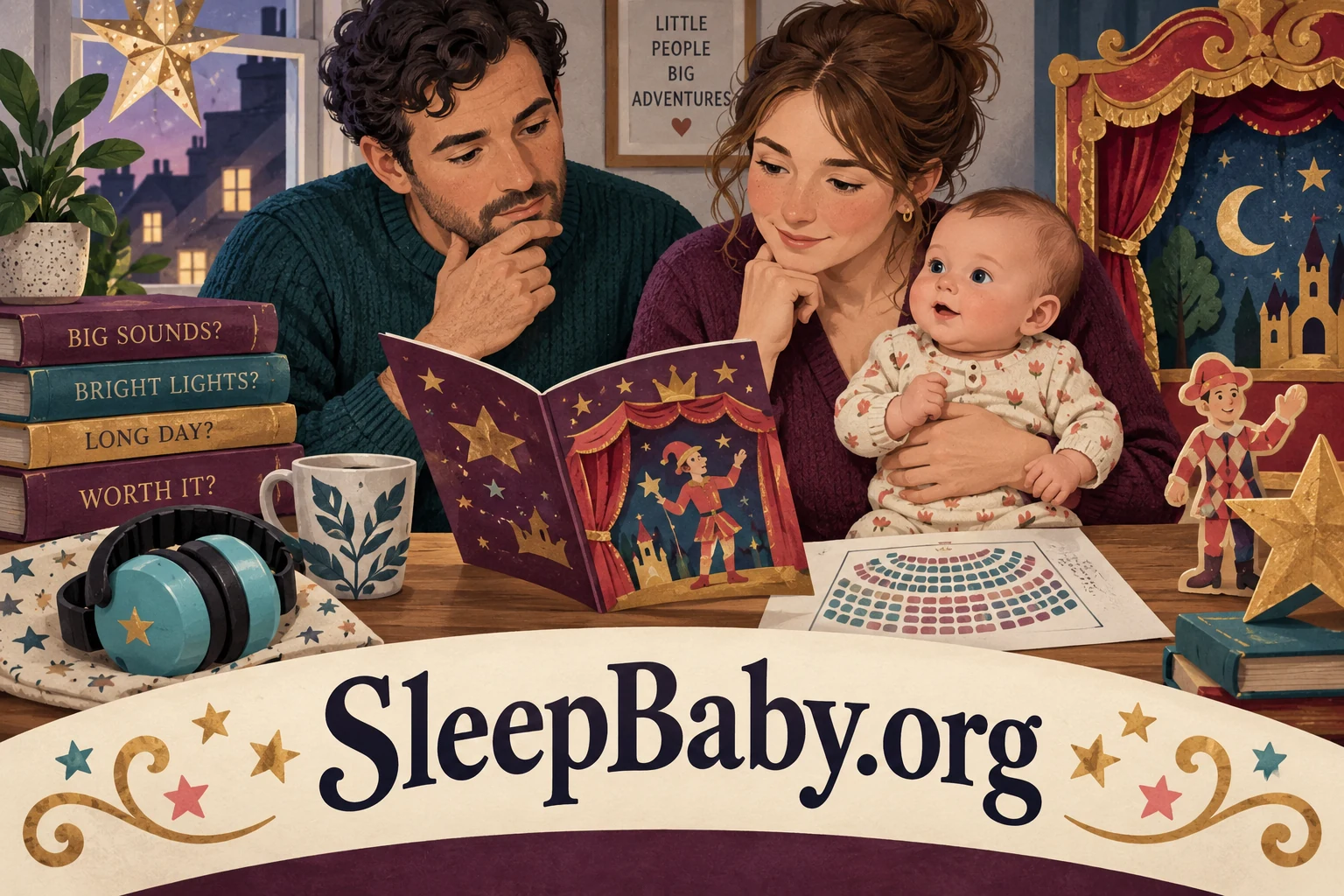
You may be able to take your baby to a pantomime, but check the exact performance’s infant admission rules and sound conditions before booking. A free lap ticket does not mean the show is suitable for a baby. I would look for a production with clear information about volume, sudden effects, feeding and leaving the auditorium. If those answers are uncertain, a baby-specific show or a different family outing is a more practical choice.
Start with the box office, not the seating chart. Tell them your baby’s age on the performance date and ask whether that particular show welcomes infants. Then work through what being there would actually involve.
Can you take a baby to panto? Admission is only the first question
Pantomime brings together songs, comedy, bright scenery and audience participation. That can include amplified music, cheering, sudden bangs and people calling back to the stage. The family label describes the audience the production hopes to attract; it does not tell you the sound level at your seat or how easy it will be to feed a baby halfway through.
There is no single age at which every baby becomes ready for every panto. A theatre’s minimum age is an admission rule. Your baby’s health, the actual performance conditions and your ability to meet their needs are separate considerations. A calm temperament does not protect hearing, and a baby who seems content still needs an appropriate environment.
I would not treat a long show as a test of whether your baby is good at going out. You are choosing an event for the family you have today. That might mean taking an older child with another adult while your baby stays with a trusted caregiver, choosing a smaller baby-focused performance, or leaving the theatre tradition until another year.
Four checks before the curtain rises
Ticket → Sound → Care → Door
- Ticket: your baby’s exact age is admitted to this performance, and any infant voucher or ticket is arranged.
- Sound: you have useful answers about music, sudden effects and a genuinely quieter place to go.
- Care: feeds, changes, carrying and sleep needs fit the whole trip, not just the running time.
- Door: you can leave promptly, retrieve your belongings and get home without waiting for the finale.
An unanswered check is something to resolve before paying. None of these checks certifies that an event is safe for an individual baby.
Check the show’s ticket policy, including the age cutoff
Ask about the date and time you intend to attend. A theatre may present a relaxed performance, a schools performance and an ordinary evening performance of the same production. An admission answer for one is not necessarily an answer for the others. Keep the written response with your booking details so you are not trying to reconstruct the conversation at the door.
Official policies checked on October 3, 2026 illustrate why it matters. ATG’s pantomime guidance welcomes babies unless the show says otherwise and describes a free babes-in-arms voucher for infants under 18 months sitting on an adult’s lap. The voucher still needs arranging so the venue can count everyone. Confirm the rule if your child is right at the stated cutoff.
Newcastle Theatre Royal’s 2026–27 Jack and the Beanstalk instead lists a paid babes-in-arms option for children under two. The production also warns of possible loud sounds, flashing lights, strobes, haze and smoke. Permission to bring a baby and warnings about the performance appear on the same page; both deserve attention.
Policies, charges and show details can change. Use these as examples of the distinctions to check, not as a promise about a future booking. Do not assume a child gets a separate seat, that a buggy can enter the auditorium, or that an infant ticket can always be added on arrival.
Before paying, read the exchange and refund terms too. Ask what happens if your baby is unwell on the day, the published effects information changes, or you decide the performance is unsuitable before attending. Do not assume an early departure will qualify for a refund. Knowing the financial commitment helps you decide whether this is an outing you can comfortably abandon.
What a relaxed performance does, and does not, tell you
A relaxed performance may change sound, lighting and audience expectations. It can be a useful option, but the name alone does not tell you which changes this production makes. Read the performance-specific description and ask what remains: amplified songs, audience shouting, dark moments, moving lights, smoke or surprise effects.
For example, Theatre Royal Plymouth’s relaxed Cinderella on December 17, 2026 describes house lights staying on, no loud bangs or loud music, open auditorium doors, freedom to come and go, and a chill-out area. Its listed running time is two hours. Those are concrete arrangements a parent can discuss with the venue; they are not a measurement of sound exposure for a particular infant.
Relaxed performances serve people with many different access needs. They are not necessarily baby performances, and you should still confirm infant admission. A welcoming atmosphere also does not mean you need to keep a distressed baby inside. Being able to step out is part of the benefit.
Ask where the quieter area actually is. A foyer with speakers relaying the show may not give the break you expect. Find out whether you can hear the performance there, whether there is somewhere to sit, and whether you may return to your seat whenever you are ready or only at a suitable moment.
Protect hearing without making earmuffs the whole plan
The American Academy of Pediatrics advises avoiding excessively noisy venues with young children. If children do attend, it recommends protective earmuffs, including for young infants. That is a reason to reduce exposure, not a reason to choose a loud show because you can buy equipment.
I would first ask whether a quieter performance is available and whether the venue can describe its loudest effects. Sitting farther from speakers may help reduce exposure, but a back-row seat is not automatically quiet. Sound reaches an auditorium in more than one way, and audience noise happens around you. Staff can discuss the production and room; an online seat review cannot certify a baby’s hearing safety.
If hearing protection is needed, use actual hearing-protection earmuffs designed to fit your infant and follow their instructions. Ordinary headphones, novelty ear coverings and warm winter earmuffs are not substitutes. The NIDCD explains that protective earmuffs need to cover both ears properly; hats and other gaps can reduce their effectiveness. No hearing protector blocks every sound.
Try the fit in a quiet place before the outing. Check that the cups sit as directed and that your baby tolerates them without your having to hold them down. Do not improvise extra straps or tighten equipment beyond its instructions. If the protection will not stay correctly fitted, leave the noisy area rather than repeatedly removing it while the show continues.
A quiet baby is not a sound meter
A baby who is sleeping or not crying has not shown you that the sound is harmless. Hearing damage may not be obvious at first. The AAP notes that needing to raise your voice to someone at arm’s length is a warning that an environment is too loud.
Use that warning to move away or leave. Do not use a phone reading, an adult workplace limit or an earmuff rating to calculate a guaranteed safe number of minutes for your baby.
Keep loose earplugs away from babies; the AAP warns that they can be a choking hazard for young children. Do not try to make an adult earplug fit a small ear. For an infant with known hearing or other medical concerns, ask their clinician about the specific proposed outing before making plans.
WHEN THE CURTAIN FALLS
Leave room for the evening after the show
A theatre trip still ends with the ordinary work of feeding, changing and getting home. The SleepBaby.org Method is introduced on our homepage, with information about bedtime routines and baby sleep schedules.
I would plan the trip home as carefully as the seats: who has the keys, where your baby can sleep safely, and which familiar bedtime steps still fit the evening. You can read the current Method information while considering that part of your day.
Sleep planning does not make a noisy performance suitable, replace infant hearing protection, or turn a carrier into a sleep space. Meet your baby’s immediate care and health needs first, even when the curtain has only just gone up.
Choose seats for care and a straightforward way out
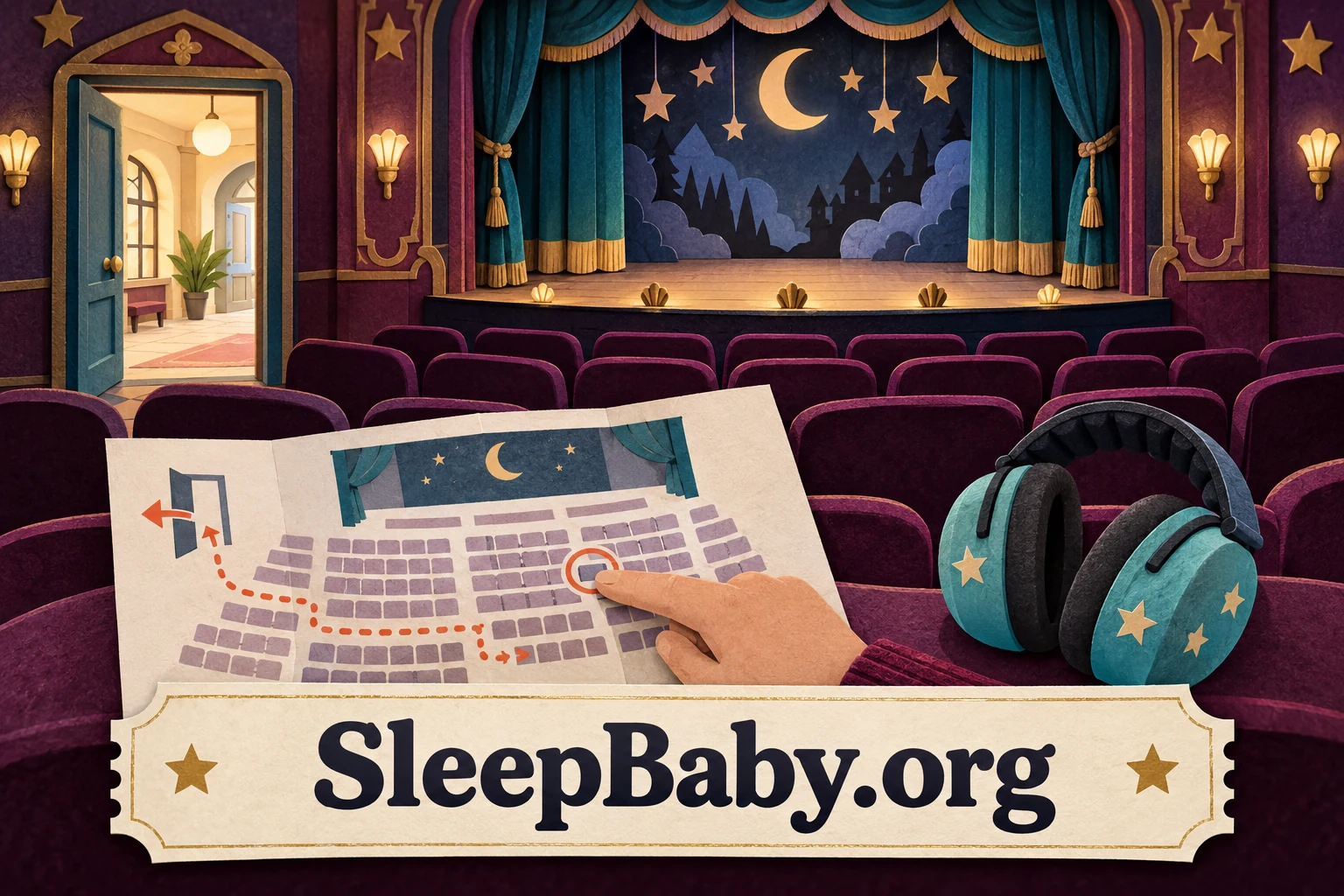
Once the performance itself looks workable, ask the box office about seats with an accessible route to the exit. An aisle position can reduce the number of people you need to pass, but aisles must stay clear. You cannot use one as a place to rock a baby, park a buggy or leave a changing bag.
Explain any mobility needs as well as the baby’s age. Ask about steps between the entrance, seats, toilets and changing area. A diagram that looks simple on a phone may conceal a steep staircase or a door that is not used during the performance. The useful seat is one you can reach and leave while safely carrying your child.
Newcastle Theatre Royal’s FAQ, for example, discourages babes in arms and young children from specified front rows of its upper levels and side boxes because of the auditorium layout. It also says buggy storage needs the duty manager’s agreement and is at the customer’s risk. Ask for guidance for your actual theatre rather than importing another venue’s arrangements.
Keep essentials with you if your buggy will be stored elsewhere. Establish how to retrieve it before the interval or final curtain. A plan to leave is much less useful if your coat, milk or car keys are inaccessible until everyone else comes out.
Plan the whole outing around feeds, changes and travel
A matinee may be more manageable than an evening performance, but look beyond its start time. Add the journey, arrival queue, collecting an infant voucher, finding the changing room and getting home. Ask whether the published running time includes the interval, and check again nearer the date if it is still to be confirmed.
Do not delay a needed feed to make the opening number. If your baby needs feeding before you leave, feed them and reassess the trip. If they need feeding at the venue, use the arrangement that lets you attend to them comfortably and safely. You do not need to time every feed to a theatre interval.
Ask where feeding is possible and whether that area stays available throughout the show. A private room may be helpful if you want one, but do not assume there will be a quiet seat, a plug socket, a bottle warmer or suitable preparation facilities. Pack and store milk using the guidance for the milk you use and your baby’s usual clinical advice; a theatre bar is not a guaranteed feeding station.
The NHS advises holding both your baby and their bottle during a bottle feed. Do not prop a bottle in a seat or buggy to keep watching. Take your baby out of a sling to feed, and put hot drinks well out of reach before holding them. Low light and a crowded interval make it especially useful to have these decisions settled beforehand.
Locate the changing facilities when you arrive, before you need them urgently. Ask whether reaching them means leaving a ticketed area and whether you will need your ticket to return. Keep nappies, wipes, a changing mat, spare clothes and any sealed milk supplies where you can reach them without emptying the bag across a row of seats.
The box-office note worth saving
Have the performance date, time and your baby’s age ready. Then ask:
- Is an infant admitted, and what ticket or voucher do they need?
- What sound and lighting effects remain in this exact performance?
- Which seats give us a practical route out without a difficult staircase?
- Where can we feed, change and take a genuinely quieter break?
- Can we leave and return during a scene, and what happens if we leave the building?
- Where will our buggy be stored, and can we retrieve it early?
Save the reply with your tickets. If staff cannot answer an essential question yet, wait for the information rather than filling the gap with an assumption.
Carriers and naps need their own plan
A carrier may make moving through the building easier if the venue allows it, but it does not replace safe positioning or an appropriate sleep surface. Follow the carrier’s age, weight and use instructions. The NHS’s TICKS guidance means keeping your baby close and supported upright, their face visible, their head close enough to kiss, and their chin away from their chest.
Check the position yourself, especially after sitting down or putting on a coat. Do not let a programme, scarf or your clothing cover the baby’s face. If you cannot see and monitor your baby in the seat you have chosen, change the arrangement rather than assuming they are comfortable because they are quiet.
I would not book on the assumption that a baby will nap through the show. The AAP’s safe-sleep guidance recommends moving a baby who falls asleep in a carrier, sling, stroller or car seat to a firm, flat sleep surface on their back as soon as possible. A theatre seat or a bundle of coats is not that surface.
Consider where an appropriate sleep space will actually be available during a long outing. If the plan depends on a prolonged carrier nap in the auditorium, I would shorten or change the outing. After travel, transfer your baby to their usual suitable sleep space; do not leave them sleeping in the car seat indoors to preserve the nap.
When to step out, and when to end the visit
You do not have to wait for crying to become loud enough for other people to notice. Repeatedly turning away, escalating fussing or difficulty settling is enough reason to take a quieter break and check what your baby needs. Those observations do not diagnose sensory overload or rule out illness. Start with the baby in front of you: their position, feed, nappy, comfort and responsiveness.
Move away promptly if the sound is excessive, the hearing protection slips, or an unexpected effect makes the environment unsuitable. Do not stay for one more song to see whether your baby adapts. If a quieter space is not available, leaving the venue may be the useful next step.
Once outside the auditorium, you can decide whether returning makes sense. A settled baby in a quieter foyer does not mean the auditorium has changed. If the same problem will be waiting at your seat, finish the outing. Repeated exits and returns are not a requirement for getting your money’s worth.
A health concern is a reason to get help
If your baby has difficulty breathing, blue or grey skin or lips, or is difficult to wake, seek emergency help immediately. In the UK, call 999. Ask theatre staff to help direct emergency responders; do not wait for the interval or assume your baby is simply tired from the show.
If your baby is not feeding, seems unwell, or you are worried and unsure what to do, seek medical advice promptly. In the UK, NHS 111 can advise. Outside the UK, use the appropriate local urgent or emergency service. These examples are not an exhaustive symptom checklist.
A baby who is already unwell does not need an experiment with a long outing. For a premature baby or one with a condition affecting breathing, hearing or feeding, discuss relevant concerns with their healthcare team before booking. A theatre’s admission policy cannot answer an individual medical question.
Make leaving possible for everyone in your group
Agree before you go whether everyone will leave together or one adult will take the baby home. If an older sibling is staying, decide which responsible adult stays with them and who has the tickets, coats and transport. Do not leave the plan at “we will work it out”; the person holding the baby may not be the person holding the car keys.
Check the journey home at the earlier time you might actually leave. A lift from someone who is watching the whole show is not an independent exit plan. If you need a bus, train or taxi, know where you can wait with the baby and what you will do if that option is delayed.
If you are attending alone with more than one child, choose a plan you can carry out without leaving anyone unsupervised. That may mean choosing a shorter event or going with another adult. The issue is practical care, not whether you are enthusiastic enough about the outing.
A brief explanation can help older children know what to expect: the baby may need to leave before the end, and the grown-ups have already decided what happens then. You do not need to make the baby’s distress a public negotiation in a dark row. A disappointed child can be supported without asking a baby to tolerate unsuitable conditions.
Would a baby-specific show fit better?
Look for a production that states a real infant age range, a short running time and concrete feeding and movement arrangements. “Family friendly” is less useful than those details. Check the age on the day of the show, whether siblings can attend, how seating works and how many adults may come with one baby.
As a current example, Theatre Royal Bath’s Scrunch is listed specifically for babies aged 6–18 months, with about 25 minutes of performance followed by about 15 minutes of play. Its information welcomes breast and bottle feeding, explains the seating, and allows families to step out and return. That describes a different kind of visit from a full-length panto; it is not an endorsement of every event described as sensory theatre.
You can also keep the theatre outing for an older child and make another plan for your baby. Or sing a familiar song together at home at a comfortable volume and save the stage experience for later. There is no need to introduce amplified theatre on a deadline.
An official explanation of moving away from noise
NIDCD’s Blow Dryer Classroom Demonstration: Move Away from the Noise introduces hearing risks and the role of distance. It is a classroom resource for older children and adults, not a test to perform with an infant or a way to approve a theatre seat.
Written takeaway: avoid excessive noise, reduce exposure, move away and use appropriate hearing protection when needed. At the theatre, you cannot control the production’s volume; leaving the auditorium may be the practical action. Never recreate a loud-sound demonstration with your baby.
Check the outing before buying accessories
As an Amazon Associate I earn from qualifying purchases. No specific product or affiliate link is recommended here.
If you already own infant hearing-protection earmuffs, check the instructions, condition and actual fit before considering another pair. Equipment does not settle whether this performance suits your baby, and an age label alone does not establish a proper fit.
A free alternative: enjoy familiar songs together at home at a comfortable volume, or postpone the theatre visit. Ask the box office about admission, sound and access before spending money on gear meant to solve a problem the venue may not allow you to solve that way.

After the show, notice your baby before adjusting bedtime
When you get home, attend to feeds, a nappy change and a suitable place to sleep. You do not need to add another activity because the outing ended early. Keep the next steps familiar and manageable rather than trying to turn an unusual day into a perfect schedule.
A missed nap or later journey does not give you enough information to predict the night. Avoid stretching a tired baby’s wake time just to reach the clock time you originally planned. Equally, do not explain every new symptom as overstimulation. If your baby seems unwell, feeding changes or unusual responsiveness deserve attention in their own right.
When there is time to think about the visit, save the useful details: whether the feeding space was available, whether the buggy was easy to retrieve, and what happened when the music started. Those observations can guide a future decision more honestly than simply deciding that the outing was a success or a failure.
The question I would ask before booking
Would this still feel like a workable family plan if we left after a few minutes? If the answer is no because of cost, transport, family expectations or an older child’s arrangements, change those parts before going. Being able to leave is part of planning a baby outing, even when you hope you will never need it.
You can enjoy pantomime and decide that this particular production is not right for your baby. A clear answer from the box office, a realistic care plan and permission within your family to leave early are more useful than another bag of accessories.
Sources
- ATG: pantomime infant admission and vouchers
- Newcastle Theatre Royal: Jack and the Beanstalk 2026–27
- Newcastle Theatre Royal: venue FAQ
- Theatre Royal Plymouth: Cinderella relaxed performance
- Theatre Royal Bath: Scrunch for babies
- American Academy of Pediatrics: excessive noise and children
- NIDCD: hearing protection for children
- NIDCD: how noise damages hearing
- NHS: infant carriers, feeding and everyday safety
- American Academy of Pediatrics: safe infant sleep
- NHS: urgent help for babies and children under five
- NIDCD: official video about moving away from noise
A FAMILY OUTING CAN HAVE A SHORTER ENDING
Bring the plan back to your own front door
Choose the performance around your baby’s needs, with a real way to leave. When you are thinking about ordinary bedtime routines and sleep schedules after the outing, visit our homepage to read about the current SleepBaby.org Method.






What viewers said10 comments · 4 replies+
Archived comments from the original Baby Sleep Miracle presentation. Not independently verified by SleepBaby.org; individual experiences vary.
Thank you so much for this video! I had no idea about the dangers of baby swings :O
Hi Mary-Ann. I have a question: Is method in any way similar to the ones recommended by Dr Bucknam, Dr. Weissbluth or Dr. Karp? We tried those but none of them help.
Hi Regina, thank you for your question. The short answer is no. The techniques I share in my guide are based on newest scientific research and this is why I have never seen any approach similar to the one I recommend.
This method really works! I tried it on my son Jesus and after just one week he went from waking up more than 5 times a night to waking up just once or twice. You are a lifesaver, Mary-Ann!
I'm truly impressed with how much information you share in your video. And all for free! I can feel that you truly care about mothers like myself, and that's hard to find these days. I have recommended your site to several of my friends already.
Mary-Ann, our child suffers from autism. Is your approach still suited?
Chloe, I made sure my method can be used with any child, even babies who are special like yours. Please note that I'm not a doctor and that I always advice to consult with your physician because nothing is more important than the safety and well-being of your love.
Hallo Mary-Ann, I'm from Germany. Do you have your guide in German?
Hello Heide, we do! Normally you should already see our video in German. If not, please contact our support so they can guide you
Thenk you for your answer, Mary-Ann!
I just completed your approach and I have to say, it worked almost too well. Yes, it took a bit of getting used to with your bedtime routine but the difference is huge. My son George used to take 1 hours to go down and now he's firmly asleep in no more than 10 minutes! You're the best!
It seems I'm the only man watching this video, lol! What you shared about the 'emotional backpack' made immediate sense to me and I can't wait to help my little girl Mila to unpack it!
Hey there, just discovered your site and this really sounds different. Just wanted to say thanks for sharing :)
For everyone who's still thinking about getting Mary-Ann's guide I want to advise you to go ahead. I wasn't sure myself but now I'm so thankful I invested in this program. It made a huge difference in our life as a family and yes, my baby girl does sleep through the night now.