

Yes, many museums welcome babies. For a first visit, choose one gallery you want to see, locate a place for feeding and changing, and keep an easy route out. Check the museum’s current ticket and buggy rules before leaving. Your baby does not need to understand the exhibits for you to enjoy looking together, and you do not need to stay until you have seen everything.
I would start with the floor plan rather than the list of highlights. A fascinating exhibition becomes a much harder outing if the lift is at the other end of the building and the next feed is already due. A small, workable plan leaves more room to enjoy the actual visit.

How old should a baby be before visiting a museum?
There is no single museum-ready age. Admission rules, the type of event, your baby’s care needs and your own recovery or energy all matter. A quiet look around a nearby gallery is a different commitment from a long journey followed by a timed exhibition and a crowded lunch queue.
For a newborn or a baby with particular health needs, follow your healthcare team’s advice about outings and care. Do not treat “babies welcome” on a museum website as medical clearance. Equally, you do not need to wait for a baby to recognise dinosaurs or name colours before considering a visit that interests you.
Think about the baby you have with you today. A young infant may spend the visit being carried and fed. An older baby who wants to move will need a suitable place for that, not an expectation that they remain happily contained while you read every label. A crawling area, if one exists, needs its own age and use rules checked.
Choose the museum around a workable visit
A famous collection is not automatically your best first outing. I would favour somewhere with a manageable journey, clear access information and a part of the collection I genuinely want to see. If leaving after one room would still feel worthwhile, you have given yourself a useful margin.
Read the family and accessibility pages together. Family information may explain changing facilities and buggy parking, while the access guide shows which entrance has a ramp, where the lifts are and whether a route includes stairs. If a detail matters to your ability to visit, ask the museum directly rather than filling the gap with a hopeful assumption.
Look for specific provision rather than a broad family-friendly label. Is the advertised activity for babies, preschool children or school-age visitors? Is it a drop-in gallery, a seated session or a performance with a fixed start? Does an adult need a separate ticket? Those differences can change your day more than the theme of the exhibition.
What current museum guidance tells you to check
These examples were checked on October 3, 2026. They show why checking your chosen venue matters; they are not a ranking or a promise that the same arrangements apply elsewhere.
- Natural History Museum, London: its visual guide explains entrances, lifts, baby-changing and feeding facilities. Most galleries are free, but arriving without a booked ticket may mean queuing. It says weekday afternoons are generally less busy than mornings or weekends, which is useful context rather than a guarantee.
- Science Museum, London: its under-sevens guide allows buggies in the museum and galleries but notes that some areas require buggy parking. The Garden is described for ages three to six. An early-years attraction is not necessarily an infant play space.
- MoMA, New York: its family guidance welcomes strollers but excludes them from escalators, lists changing stations and a feeding pod, and points visitors toward its Sensory Map. Ask staff about access to the feeding pod when you arrive if you want to use it.
Before travelling, check for changes affecting the part you want to visit. A lift, gallery or family room can be unavailable even when the museum itself is open. Save the relevant map or page so you are not trying to rediscover it while managing a hungry baby at the entrance.
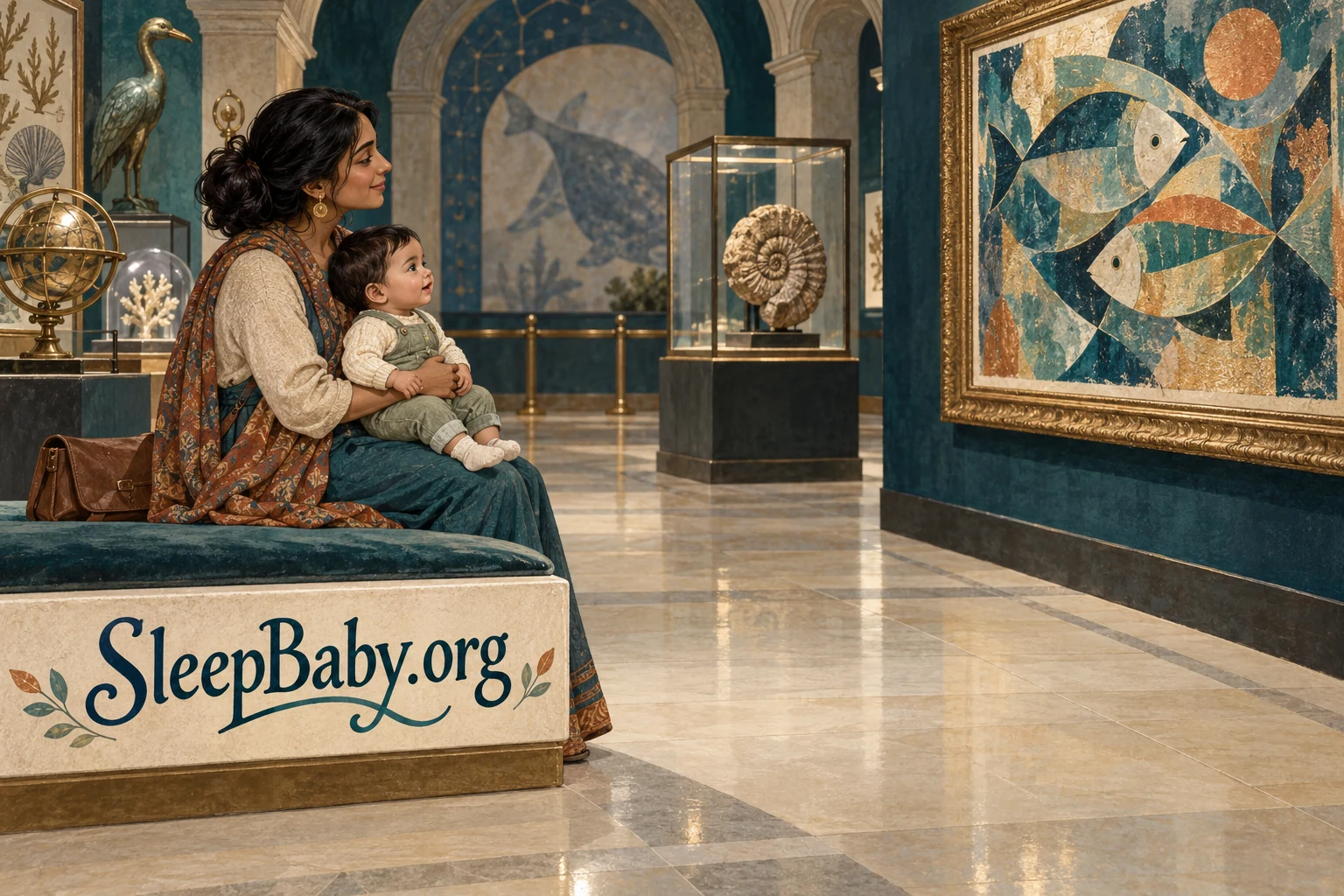
Look → Care → Leave
Give the visit three clear places:
- Look: one gallery, object or small exhibition you want to enjoy.
- Care: an agreed place for a feed, a change or a quiet pause.
- Leave: the practical route back to the exit and your transport.
You can repeat the first two steps if the day is going well. You can also go straight to the third. The plan should still work when you need to shorten it.
Check tickets, security and re-entry before booking
Confirm whether your baby needs a ticket or a place counted in the booking, even if admission is free. Ask about the exact exhibition or session rather than assuming general museum admission covers it. Some family activities need separate reservations, and a ticket for an older sibling may not include accompanying adults.
Find out what happens if you arrive late, leave a timed exhibition or step outside to settle your baby. Re-entry to the museum and re-entry to a particular exhibition can be different questions. Keep the answer with the booking details so another adult in your group knows the plan too.
Check bag rules and security arrangements. Pack milk and essential care supplies so you can explain and retrieve them without emptying everything onto the floor. If a medical or feeding item needs an exception, arrange it with the venue in advance. Keep necessary items with you when a larger bag goes into a cloakroom.
Choose a time you can change
There is no universal best hour to take a baby to a museum. Compare the venue’s own crowd advice with your baby’s usual feeds and your journey. An early opening may suit one family; it may also put another family into a rush at the very point they need time to get ready.
For a first visit, leave space around it. Avoid stacking a fixed lunch reservation or another paid attraction immediately afterwards if that would pressure you to keep moving. Include the journey home when considering how much of the day you are committing, not just the time inside the galleries.
A plan such as one room followed by a care stop is often more useful than a promise to stay for a particular number of minutes. Notice how both you and your baby are doing. You can add another room from a comfortable starting point; you do not have to rescue an overfull itinerary.
Trace the route with the buggy in mind
Find the accessible entrance, the lift serving your chosen gallery, the nearest changing area and the way back out. Check whether the shortest route on the map actually uses stairs.
If a lift is unavailable, ask staff for a suitable alternative before committing to that floor. A route that works for someone walking freely may not work while you are carrying a baby and managing a buggy.
Should you take a buggy or a baby carrier?
Choose around your baby’s needs, your comfort and the venue’s actual rules. A buggy can be useful for the journey and supplies, but permission to bring it into the building does not mean every gallery accepts it. A carrier can leave your hands freer, but it does not remove the need for care stops or a safe sleep plan.
If buggy parking is required, ask where it is and what you must remove. Do not leave your baby in a parked buggy while you enter an exhibit. Take your phone, valuables, milk and essentials with you. If carrying your baby and the remaining supplies would be difficult, choose a different room or shorten the visit.
Use lifts for a buggy rather than trying to manage it on an escalator. Keep handles and bags clear of displays and other visitors, and use the buggy according to its instructions. In a narrow room, pause and ask staff about the route instead of forcing a gap beside a fragile object.
WHEN THE GALLERY VISIT COMES HOME
Leave room for the evening beyond the museum
A museum plan still needs a homeward plan. The SleepBaby.org Method is introduced on our homepage, with information about bedtime routines and baby sleep schedules.
Before adding one more gallery, consider the feed, journey and ordinary care still ahead. You can read the current Method information while thinking about which familiar bedtime steps fit the day your baby has actually had.
An outing does not guarantee a longer night, and a sleep schedule cannot make a buggy or carrier into a suitable sleep space. Meet your baby’s feeding, comfort and safe-sleep needs first, even if that means leaving before your favourite exhibit.
Keep a carrier comfortable and your baby’s face visible
If you use a sling or carrier, follow its age, size and positioning instructions. The NHS TICKS guidance calls for a snug fit, a face you can see, a baby close enough to kiss, a chin clear of the chest and a supported upright back. Keep checking their position while you walk and stop.
Do not feed your baby in the sling. Take them out and find a comfortable place to feed. If a museum asks you to change how you carry your baby near the collection, discuss an arrangement that also follows the carrier’s instructions; a gallery rule does not replace appropriate positioning.
Leave more clearance than you think you need when turning near cases, sculptures and doorways. A bag on your back and a baby on your front both change the space you occupy. You do not need to get right up to an object for a shared look.
Plan feeding around care, not the exhibition timetable
Know where you can sit comfortably before the feed becomes urgent. Ask about feeding arrangements separately from the café rules. A designated feeding room can be helpful, but it may be occupied or need a code. Ask staff for another suitable option if waiting would prevent you from meeting your baby’s needs.
For expressed milk, plan the journey and storage conditions. The NHS explains how to store expressed milk and transport chilled milk in a cool bag with ice packs. Follow that guidance for the milk you are carrying. Do not assume a café can refrigerate it or that a warm bag will keep it safe.
If you use powdered formula, follow NHS preparation guidance, including sterilised equipment, correct proportions, sufficiently hot mixing water and cooling before feeding. Decide how you will do this before leaving. A museum café is not a guaranteed source of suitable preparation facilities, and a longer-than-expected visit does not justify improvising the proportions.
Hold your baby and their bottle during a feed; do not prop a bottle while you look around. For a baby already eating solids, use a suitable seated, supervised eating area and food prepared for their stage. Follow the venue’s eating rules, and keep food, wrappers and small loose parts away from the displays and your baby’s mouth.

Make the changing stop straightforward
Find the changing facilities early and ask whether another is available on your route. The symbol on a floor plan tells you where to start, but not whether that room is occupied or temporarily closed. If you need an accessible facility, check its actual access arrangements rather than assuming every changing room will meet your needs.
Keep a small changing kit together so you do not have to take the whole day bag into a narrow cubicle. Use the designated changing surface, keep the supplies within reach and stay with your baby. Keep plastic nappy sacks out of their reach and dispose of used items as the facility directs.
If something spills or a change becomes more involved than expected, let the gallery plan wait. The object you hoped to see can be a reason to return. It is not a reason to rush care or use an exhibition bench as an improvised changing station.
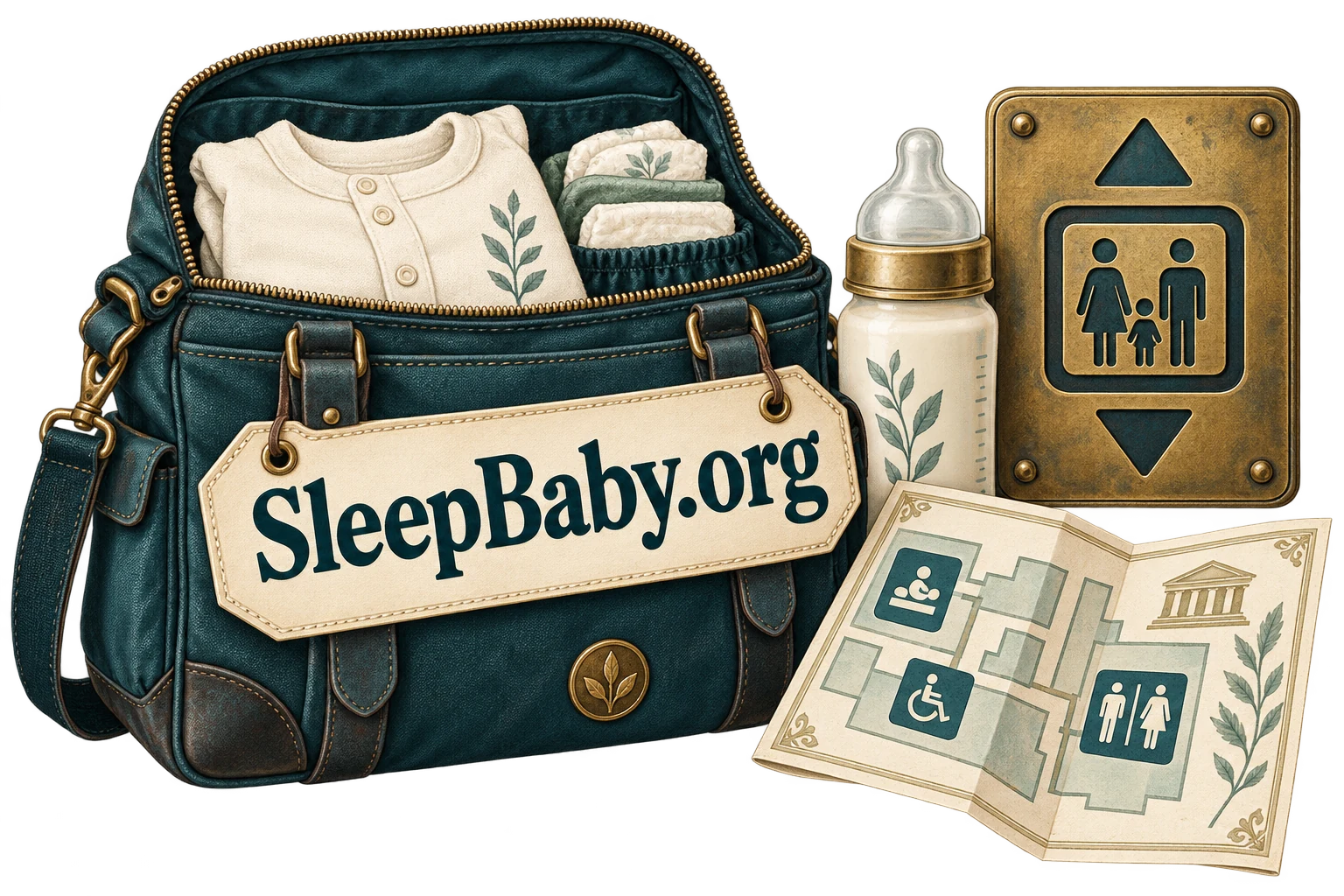
Pack what keeps the short visit workable
- Care: nappies, wipes, a changing mat and a complete spare outfit.
- Feeding: the milk, equipment and storage arrangement your baby actually needs.
- Comfort: an appropriate familiar item for supervised awake use, if useful.
- Navigation: tickets, saved map, charged phone and transport details.
- For you: what you need to manage the journey and a pause comfortably.
Check the bag’s size against the museum’s rules. Leave room to carry your baby safely if the buggy must be parked.
What can you actually do with a baby in a gallery?
Imagine arriving with one adult, a baby and a buggy. Before heading upstairs, you locate the lift and changing room, then choose a nearby gallery. After looking at one display, your baby needs a feed. You take the care stop and decide whether another room still fits. If the feeding space is unavailable and the practical alternative is outside, that can become the end of the visit. This is an example of a flexible route, not a timetable to copy. Its useful feature is that every step still works if the next gallery disappears from the plan. The visit has not failed just because care takes longer than looking at exhibits.
Start with something you enjoy looking at. A fish in a painting, a large curve in a sculpture or a bright patch of colour gives you something simple to talk about. You can describe what you notice in your own words. You do not need to turn the visit into a lesson or test whether your baby is following along.
The National Gallery of Ireland’s babies-and-toddlers tour encourages adults to chat about what they see, even before a child can answer, and to skip works or stay longer according to interest. That is a useful permission to make a small visit your own, rather than race through someone else’s route.
Try one observation, then pause. If your baby looks toward you or the object, you can continue. If they turn away, need a feed or want a change of position, respond to that. Their interest in the ceiling, your face or the light through a doorway does not make the visit unsuccessful.
Keep your baby clear of artworks, cases and barriers. A display being within reach does not make it touchable. Ask before using any hands-on exhibit, and check whether the materials are suitable for a baby who mouths objects. Do not offer a small museum-shop souvenir as something to chew while you finish the gallery.
If you want a photograph, follow the museum’s photography rules and keep the same care boundaries. Do not set your baby on a plinth, barrier or display to get the picture. Let another adult take a photograph while you hold your baby securely, or photograph the object separately if permitted. One ordinary picture is enough; getting a camera ready should not take your attention away from an unsecured baby or a crowded route.
If your baby cries, pause and check what they need
A baby making noise is not a verdict on your parenting or proof that museums are unsuitable for your family. Move to a practical place to check feeding, changing, comfort and tiredness. Ask staff where you can pause without blocking a doorway or the route of other visitors.
Do not keep pushing through a room because the next object is supposedly unmissable. If a space feels busy, bright or loud for your baby, leave that space. You do not need to establish exactly which feature caused the upset before trying somewhere calmer.
A museum may identify quieter areas without promising silence. The Natural History Museum’s facilities page lists places that usually have fewer people and lower noise levels, with seating. Its seating information also says staff can help you find somewhere to sit. Use that kind of practical information to choose a pause, then judge the room as you find it. A quieter gallery is still a gallery; it does not automatically allow food, become a private feeding room or provide a suitable infant sleep space.
A pause has three possible endings
Continue: your baby is comfortable and the next small part still fits.
Change rooms: you want a quieter or easier space, with a clear route there.
Go home: care, rest or the journey now matters more. You do not owe the museum another gallery because you bought a ticket.
If your baby seems ill rather than simply unsettled, respond to the health concern. Difficulty breathing, blue or grey skin or lips, or difficulty waking need emergency help; in the UK call 999, or use the local emergency number elsewhere. The NHS urgent-help guidance also explains when to seek advice. Tell museum staff if you need immediate assistance.
Have a sleep plan that does not depend on the buggy
Do not make an uninterrupted buggy nap the condition that keeps the whole visit together. Your baby may need sleep sooner than expected, and the museum may not have a suitable infant sleep space. Plan a way to end the visit and reach one, instead of extending the day around sleep in travel equipment.
The American Academy of Pediatrics advises moving a baby who falls asleep in a car seat, stroller, swing, carrier or sling to a firm, flat sleep surface on their back as soon as possible. A quiet gallery, attentive adult or reclined buggy seat does not turn that equipment into the recommended sleep space.
Keep an infant’s proper sleep space clear of pillows, loose blankets, toys and positioners. Do not use a museum bench, a coat-covered floor or a caregiver’s chair as an improvised place to leave a sleeping baby. If the practical sleep arrangement is no longer working, change the outing.
A museum preview for the grown-ups
The Smithsonian’s National Museum of Natural History offers Narrated Virtual Tour – Ocean Hall Introduction. This short official video shows an example of a gallery interior, including its whale model and coral-reef display. Use it as a way to think about choosing one area to explore, rather than as entertainment your baby needs to watch.
Written alternative: look at your chosen museum’s current photographs and floor plan. Pick one room, find care facilities and trace the exit route. This older virtual tour does not establish today’s access, crowds, feeding arrangements or buggy rules. The official Smithsonian video record identifies the film.
Check the route before buying museum gear
As an Amazon Associate I earn from qualifying purchases. No specific product or affiliate link is recommended here.
Your existing suitable buggy, carrier and changing supplies may already meet your needs. Check the museum’s access and storage rules before buying equipment for one visit. A new bag cannot create a lift route, and a carrier is useful only if it suits your baby and you can use it correctly.
A free alternative: save the museum map and plan one gallery close to the facilities you need. Shortening the route can be more useful than adding another item to carry.
When an older child wants to keep exploring
Agree the family plan before everyone is absorbed in different rooms. If two adults are visiting, decide who handles a care stop and where you will meet again. Keep tickets, keys and essential supplies with the person who needs them. A text saying “we’re outside” is less useful when the building has several exits.
If you are the only adult, choose an activity you can leave together. Explain to an older child that you will see one favourite thing, then check what the baby needs. Avoid promising a second attraction you cannot reliably reach. You can offer a choice between two nearby objects without handing over the whole timetable.

Leave enough energy for the journey home
Start leaving before the practical margin disappears. Collect the buggy or stored bag, find the correct exit and check the next transport step. A final detour through the shop is optional, particularly if it would use the time you need for a feed or the trip home.
At home, return to ordinary care and familiar bedtime steps where they fit. Use what actually happened with feeds and naps rather than insisting on the original clock time. A museum visit does not guarantee better sleep, and a difficult evening does not prove the outing was a mistake.

What would count as a good first museum visit?
For me, it would mean seeing something I wanted to see while still being able to meet my baby’s needs. That might include one painting, a feed and a short look at a display on the way out. There is no requirement to get through every floor or create a photograph that makes the day look more impressive.
Afterwards, notice one useful thing for next time: which entrance worked, where you found a comfortable pause, or which part you would skip. Keep the plan small enough that returning feels possible. The museum will still contain plenty to see on another day.
Sources
- Natural History Museum: visual guide and arrivals
- Natural History Museum: facilities and quieter spaces
- Science Museum: visiting with children under seven
- MoMA: practical tips for family visits
- National Gallery of Ireland: babies and toddlers tour
- Smithsonian: Ocean Hall video introduction
- American Academy of Pediatrics: safe infant sleep
- NHS: urgent help for babies and young children
- NHS: carriers, feeding and everyday safety
- NHS: expressing and storing breast milk
- NHS: making up infant formula
ONE SMALL VISIT CAN BE ENOUGH
Keep the way home in your museum plan
Enjoy the part that works for your family and leave time for care. When you are considering ordinary bedtime routines and sleep schedules at home, visit our homepage to read about the current SleepBaby.org Method.





What viewers said10 comments · 4 replies+
Archived comments from the original Baby Sleep Miracle presentation. Not independently verified by SleepBaby.org; individual experiences vary.
Thank you so much for this video! I had no idea about the dangers of baby swings :O
Hi Mary-Ann. I have a question: Is method in any way similar to the ones recommended by Dr Bucknam, Dr. Weissbluth or Dr. Karp? We tried those but none of them help.
Hi Regina, thank you for your question. The short answer is no. The techniques I share in my guide are based on newest scientific research and this is why I have never seen any approach similar to the one I recommend.
This method really works! I tried it on my son Jesus and after just one week he went from waking up more than 5 times a night to waking up just once or twice. You are a lifesaver, Mary-Ann!
I'm truly impressed with how much information you share in your video. And all for free! I can feel that you truly care about mothers like myself, and that's hard to find these days. I have recommended your site to several of my friends already.
Mary-Ann, our child suffers from autism. Is your approach still suited?
Chloe, I made sure my method can be used with any child, even babies who are special like yours. Please note that I'm not a doctor and that I always advice to consult with your physician because nothing is more important than the safety and well-being of your love.
Hallo Mary-Ann, I'm from Germany. Do you have your guide in German?
Hello Heide, we do! Normally you should already see our video in German. If not, please contact our support so they can guide you
Thenk you for your answer, Mary-Ann!
I just completed your approach and I have to say, it worked almost too well. Yes, it took a bit of getting used to with your bedtime routine but the difference is huge. My son George used to take 1 hours to go down and now he's firmly asleep in no more than 10 minutes! You're the best!
It seems I'm the only man watching this video, lol! What you shared about the 'emotional backpack' made immediate sense to me and I can't wait to help my little girl Mila to unpack it!
Hey there, just discovered your site and this really sounds different. Just wanted to say thanks for sharing :)
For everyone who's still thinking about getting Mary-Ann's guide I want to advise you to go ahead. I wasn't sure myself but now I'm so thankful I invested in this program. It made a huge difference in our life as a family and yes, my baby girl does sleep through the night now.